
AFF architekten Builds a Youth Club in Berlin That Takes the Gabled House Seriously
A recycled concrete and timber youth center in Alt-Rudow replaces a 1980s container with a two-story communal house for all ages.


Youth centers are among the most undervalued building types in public architecture. They rarely get the budget, the design attention, or the critical discussion that a library or museum would attract. Yet the program is arguably more consequential: a place where children, teenagers, and families learn to occupy shared space on their own terms. In the Alt-Rudow district of Berlin's Neukölln borough, AFF architekten has completed Youth Club NW80, a 1,012 square meter replacement for a worn-out single-story container building from the 1980s. The new structure sits on the same site, surrounded by modest gabled houses along a former village street, and it takes that domestic silhouette as its starting point.
What makes the project worth examining is the discipline of its means. Constructed from recycled concrete and prefabricated wood beams at a reported cost of approximately 440,000 euros, the building refuses spectacle. Instead, it deploys a carefully orchestrated section: a two-story atrium at its core, terraces that splice into the volume from east and west, and a 90-degree rotation of the upper floor plan that pulls the perimeter rooms back toward the center. The result is a building that reads as a simple house from the street but operates internally as something far more generous.
A Gable That Fits the Neighborhood
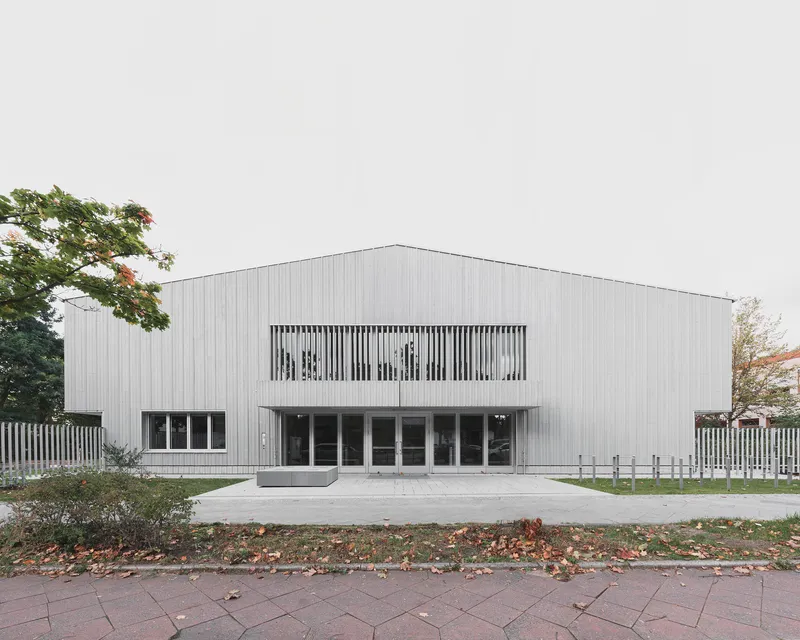


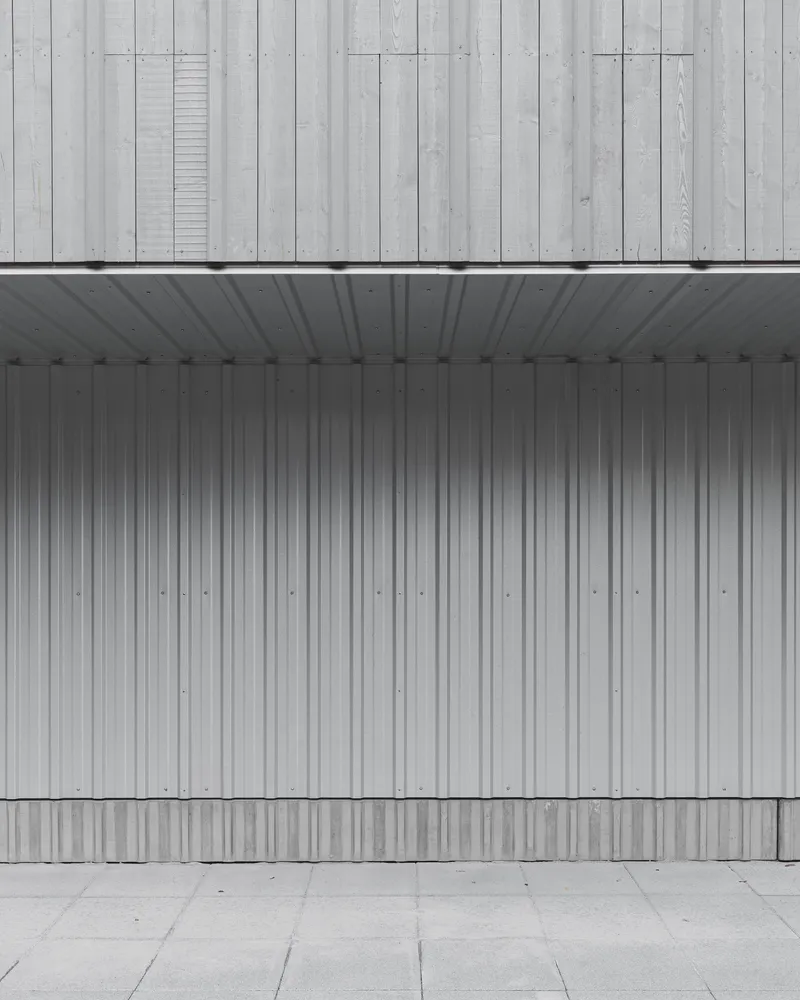
AFF architekten set the building slightly back from Neudecker Weg, giving it a small forecourt with an overhanging canopy and a low seating stage. The silhouette is deliberately archetypal: a slightly inclined gable roof atop corrugated metal cladding with vertical batten strips. From the street, the volume could almost pass for an oversized residential building. That contextual modesty is a conscious choice. Alt-Rudow is defined by single-family houses, and a flashier gesture would have read as an intrusion rather than an invitation.
The facade details reward closer attention. Strip windows punctuate the metal skin in rhythms that avoid symmetry, and the cantilevered upper volume creates subtle shadow lines against the flat landscape. The entry canopy, a sharp angular projection in concrete and metal, provides a threshold that signals public use without shouting it.
The Atrium as Organizational Engine

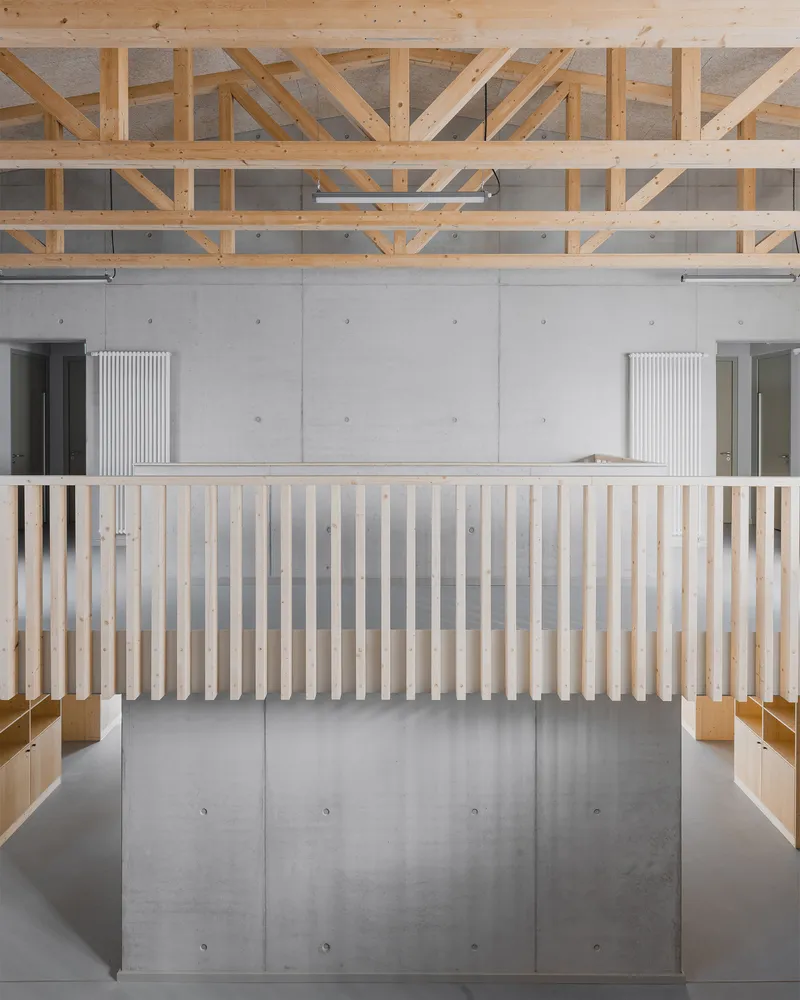
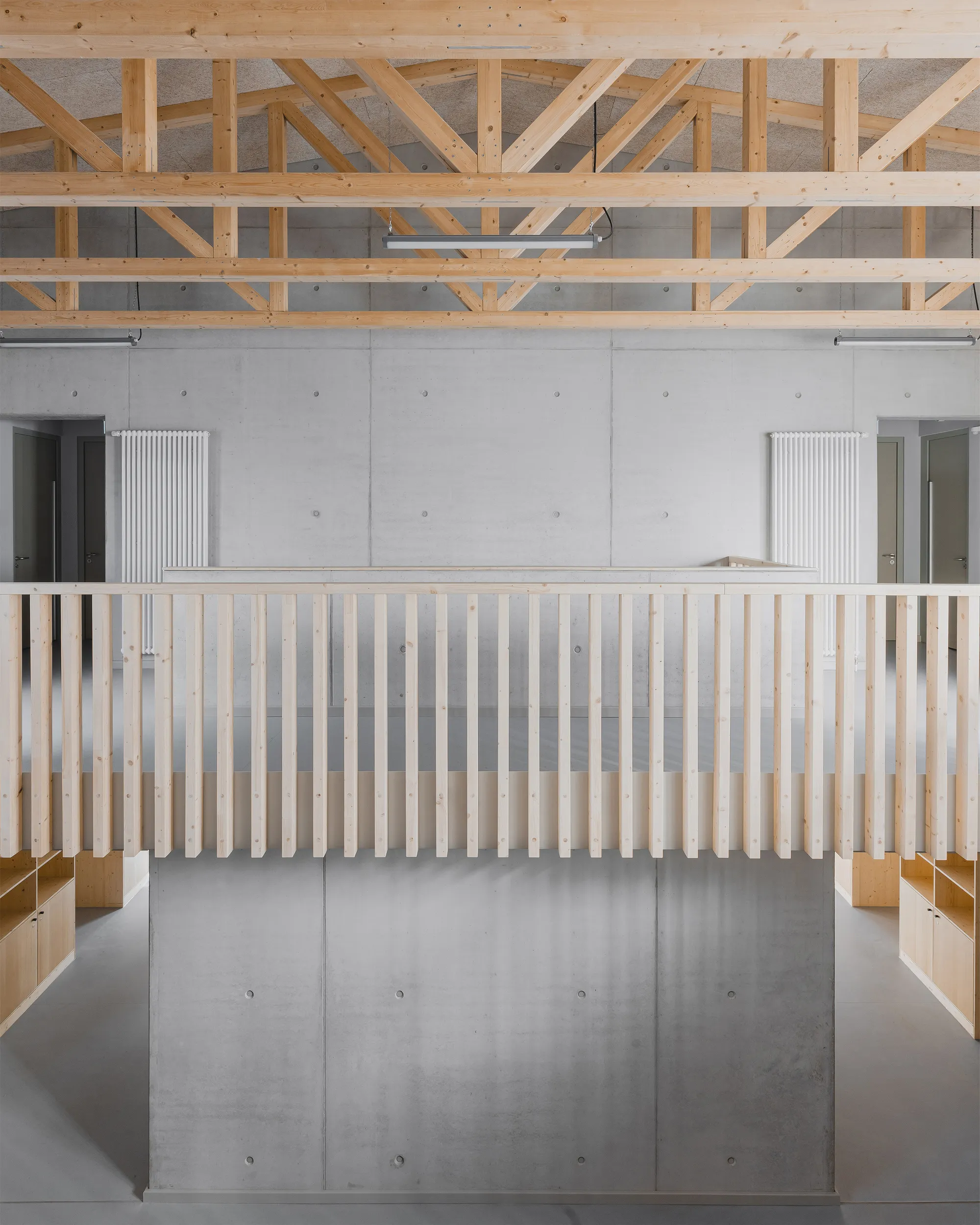
The double-height hall at the center of the building is the key spatial move. Exposed timber trusses span the full width of the gable, and the upper gallery wraps around with vertical slat balustrades that allow visual continuity between floors. This is not a decorative gesture. A youth club serving children, teenagers, and families needs simultaneous separation and oversight. The atrium provides both: you can see across it and through it while remaining in a distinct programmatic zone.
Concrete wall panels on the ground floor meet plywood shelving units and storage walls, giving the hall a raw but composed material palette. The timber truss ceiling reads as almost barn-like, reinforcing the domestic-agricultural register of the exterior gable. It is a building that wants to feel sturdy and unfinished, leaving room for the messiness of actual use.
Ground Floor: Workshop, Kitchen, and the Logic of the Terrace
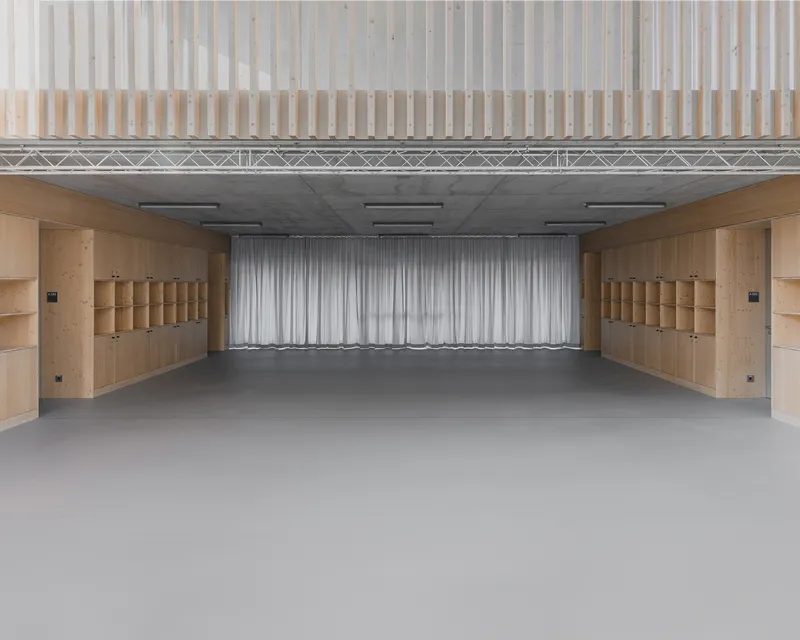

The ground floor arranges its program along two longitudinal axes. A workshop with an adjacent yard serves craftsmanship activities, while a kitchen connects to a herb garden for communal cooking. A parent-child café and family counseling rooms occupy the remaining area. The partially recessed ground floor along the east and west facades pulls the building slightly into the terrain, lowering the apparent height and creating a protected relationship with the surrounding garden.
Built-in mudroom alcoves with plywood panels, coat hooks, and cubby storage reflect a pragmatic understanding of what happens when thirty children arrive at once. These details, functional furniture pieces crafted from industrial solid wood panels, are designed to double as teaching tools for the youth woodworking workshop. The building is, in this sense, its own curriculum.
Upper Floor and the Rotated Plan
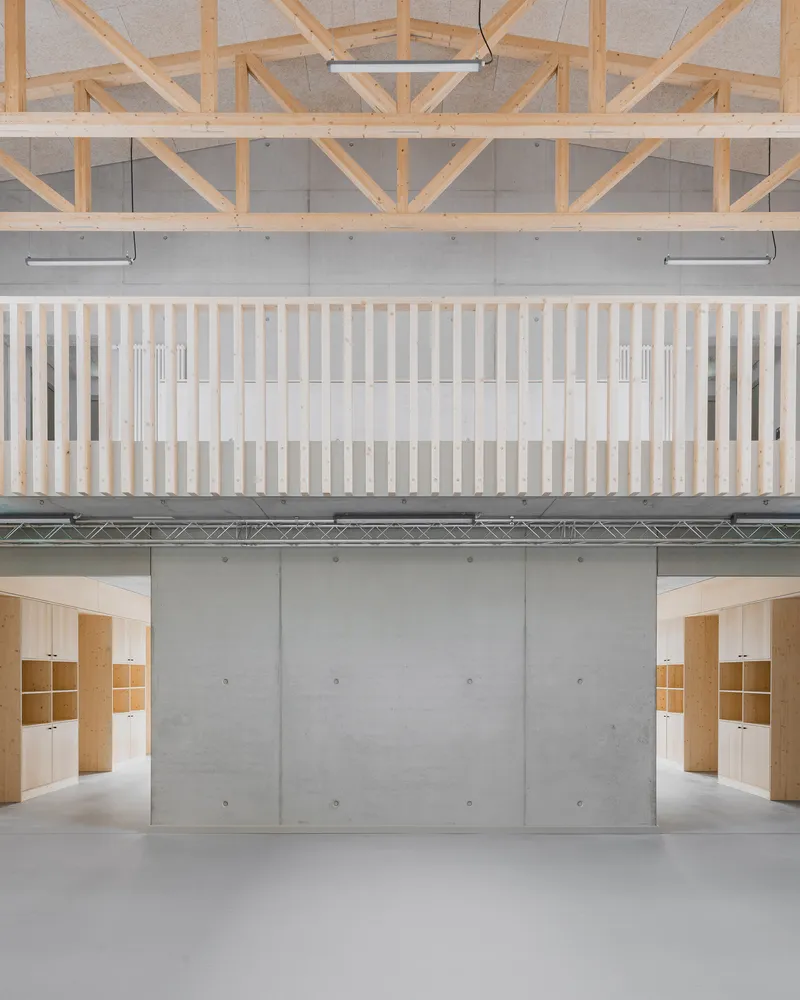

A central staircase leads to the upper floor, where the room layout is rotated 90 degrees relative to the ground plan. This is a small but consequential move. The rotation pulls workshop rooms, group rooms, and counseling spaces toward the building's central atrium, maintaining visual connection to the double-height hall while creating their own distinct orientation. Large terraces on east and west sides intersect into the building volume and connect back to the garden via external stairs, offering escape routes (literal and psychological) for teenagers who need a break from indoor activity.
The protected terraces also support the fire protection concept, a practical benefit of what might otherwise seem like a purely spatial luxury. The vertical batten balustrade along the gallery edge filters light from the upper windows and gives the mezzanine a sense of enclosure without isolation.
Garden and Landscape as Program

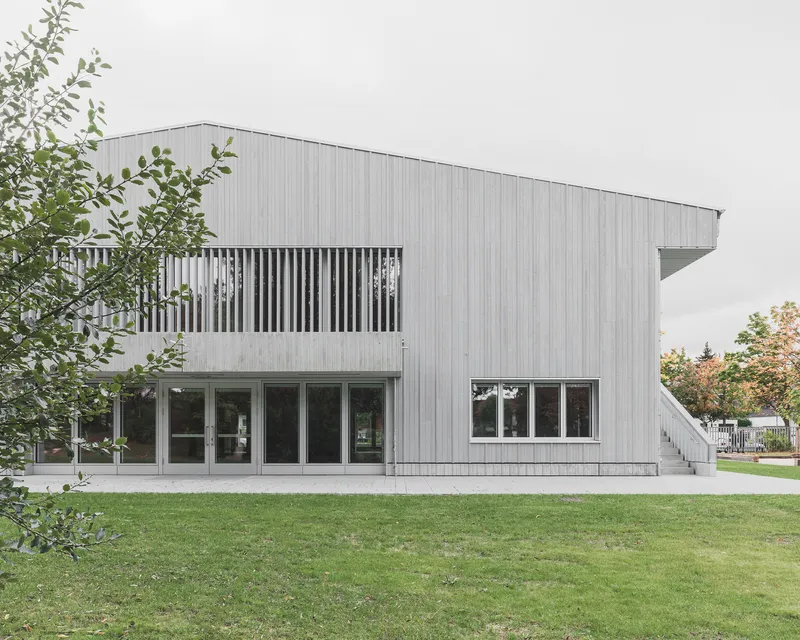
The surrounding terrace is not leftover space; it is an essential programmatic element. It extends the entrance area to the south, the workshop to the east, a garden terrace to the north, and the kitchen terrace to the west. The basic structure of the existing garden has been preserved, which means mature trees still frame the building and soften its corrugated metal envelope. A timber-edged sandbox sits below the garden elevation, and large outdoor areas provide space for unstructured play.
This seamless transition between interior and exterior is where the project becomes most legible as a youth space. Children do not respect the boundary between inside and outside, and a building that tries to enforce it will always lose. AFF architekten understood this and designed a perimeter that is porous in every direction.
Material Economy and Recycled Concrete
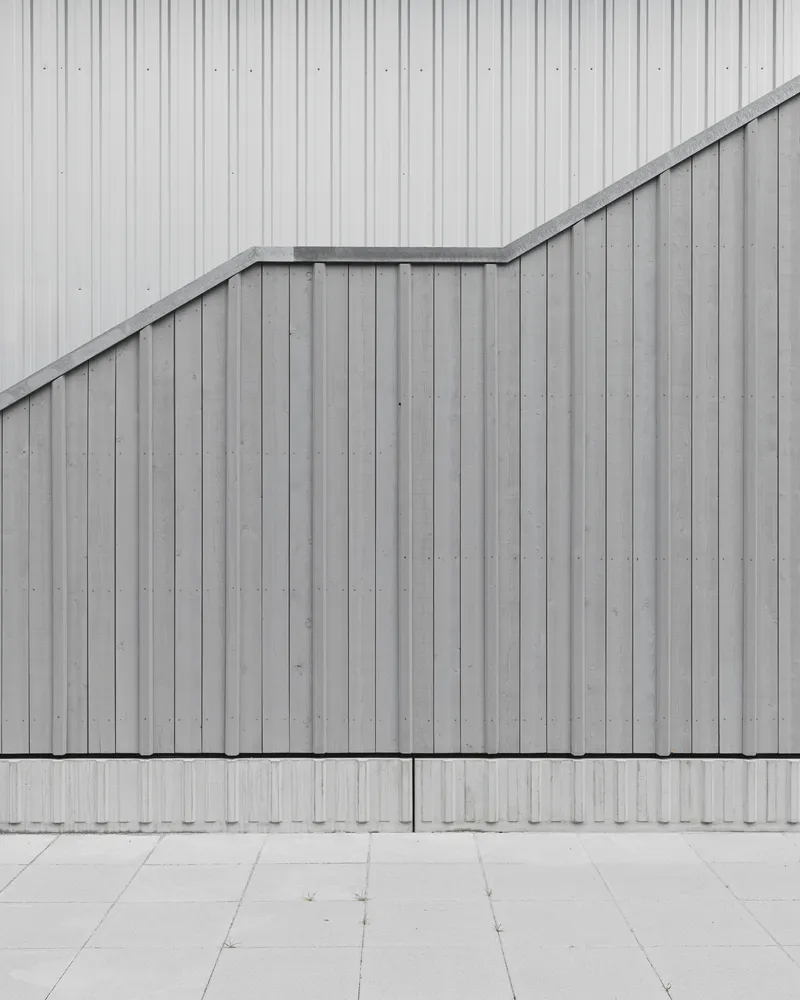
At approximately 440,000 euros for a 1,012 square meter public building, the budget here is remarkably tight. The use of recycled concrete and prefabricated wood beams is not just an environmental statement; it is a financial necessity. Corrugated metal cladding keeps the exterior costs low while providing a durable, graffiti-resistant surface. Inside, exposed concrete panels and plywood give the building an honest, workshop-like atmosphere that resists the institutional sterility common to publicly funded youth facilities.
The material choices reinforce the building's pedagogical ambition. Visible structure, exposed connections, legible construction logic: these are things young people can learn from simply by being in the space. The timber trusses overhead are not hidden behind a suspended ceiling. The plywood joinery is screwed, not glued behind a veneer. The building teaches by showing how it was made.
Plans and Drawings


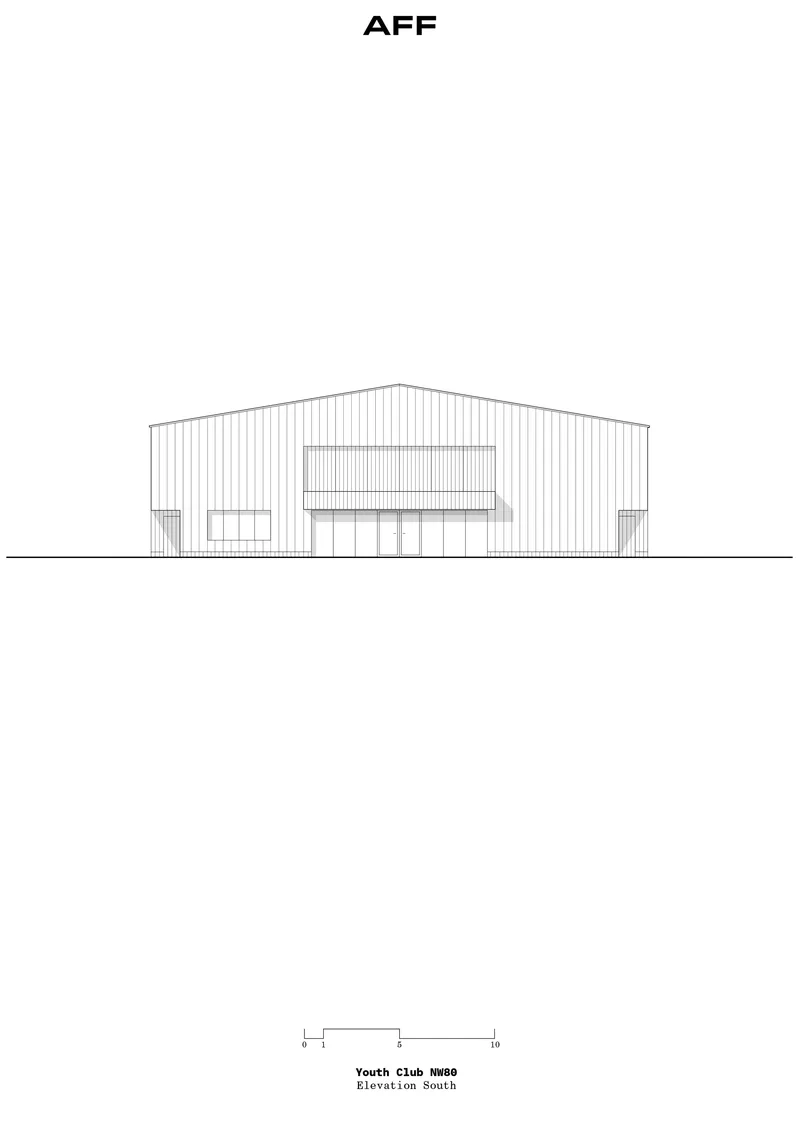
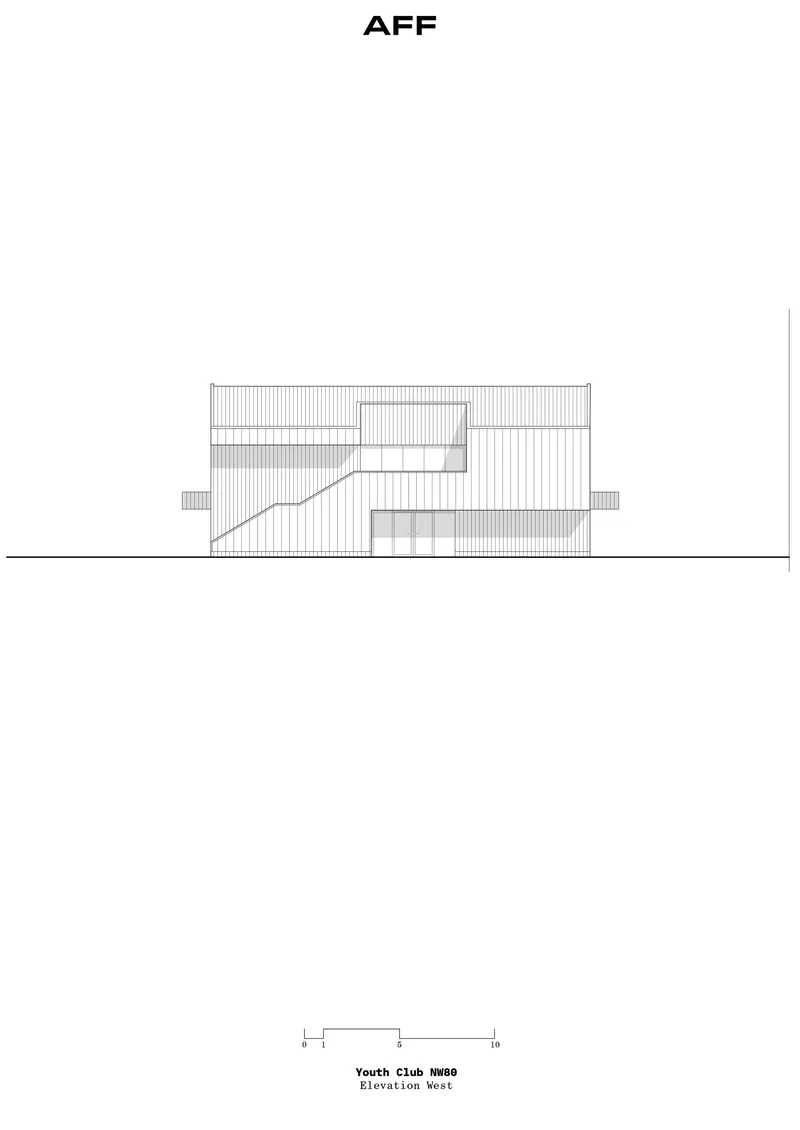
The axonometric drawing reveals the structural clarity of the scheme: timber trusses spanning the full gable width, with interior partitions floating beneath rather than bearing load. The site plan shows how the rectangular footprint sits within a loose canopy of existing trees, set back from the street edge. The section confirms the spatial ambition of the central atrium and the way the mezzanine terraces carve into the building volume. Two elevations, one showing the gable face with its central window, the other showing the stepped volumes and entry canopy, demonstrate the restrained composition that keeps the building grounded in its residential context.
Why This Project Matters
Youth Club NW80 matters because it proves that a meaningful public building does not require a significant budget or a signature form. AFF architekten took a program that is routinely dismissed (a neighborhood youth club in outer Berlin) and gave it architectural intelligence: a sectional strategy that produces spatial generosity, a material palette that educates by exposure, and a landscape approach that treats the garden as an extension of the program rather than a buffer. The building replaces a container. It now feels like it has always been part of the street.
In a moment when digital leisure threatens to render physical gathering spaces irrelevant, the strongest argument for a youth center is not a manifesto but a room worth being in. The double-height hall here, with its timber trusses and filtered light and balcony overlooking the action below, is exactly that kind of room. It does not compete with a screen. It offers something a screen cannot: the experience of shared, inhabited space under a common roof.
Youth Club NW80 by AFF architekten, Berlin, Germany. 1,012 m². Completed 2023. Photography by Tjark Spille.
About the Studio
Share Your Own Work on uni.xyz
If projects like this are the kind of work you want to make, uni.xyz is a place to publish your own, find collaborators, and enter design competitions.


Popular Articles
Popular articles from the community


Co-Life: Senior Housing Design That Reconnects Older Adults With the City
Co-Life reimagines senior housing design through healing gardens, shared streets, workshops, and a sustainable community across generations.

The Ocean Hive: Sustainable Architecture for a Self-Sufficient Civilization at Sea
The Ocean Hive imagines sustainable architecture at sea, where modular habitats, algae, wave power and ocean waste sustain a growing colony.

The Earth Pod: 3D Printed Homes for Resilient Refugee Communities
The Earth Pod reimagines refugee housing through 3D printed homes made from clay, combining resilience, self-sufficiency, and rapid shelter.

The Musturak Paradise: Senior Living Architecture for a Connected Future in Temara, Morocco
The Musturak Paradise reimagines senior living architecture in Temara via private homes, social spaces, culture, community, and shared care.


Similar Reads
You might also enjoy these articles

Bao Huynh Watercolor Atelier: A Serene Art Retreat in Hội An
Bao Huynh Watercolor Atelier in Hội An blends multifunctional art spaces, sustainable design, local materials, and family-friendly living in a serene environment.

Atelier Macri Concept Store Interior Design by CASE-REAL
Atelier Macri store features a "ko" counter, walnut wood details, cork displays, blending retail, gallery, and seamless customer experiences.

Manuel Vargas Izquierdo Stadium and High-Performance Sports Center: Architectural Excellence in Jalpa de Méndez
The Manuel Vargas Izquierdo Stadium blends sustainable design, inclusive sports facilities, and cultural-inspired architecture, revitalizing Jalpa de Méndez’s public spaces.

KAKR Buluh Awar Hall: Revitalizing Community and Ecology Through Bamboo Architecture
Community built bamboo hall revitalizes Buluh Awar village, empowering youth, restoring ecology, celebrating vernacular craftsmanship through sustainable architecture and culture.


Comments (0)
Please login or sign up to add comments
No comments yet. Be the first to comment!