

Mawi Design Builds a Chennai House of Rat-Trap Brick and Reclaimed Doors from Pondicherry's High Court
In dense Chennai, Agam House uses rat-trap bond, filler slabs, brick jalis and a stack-ventilated void to keep a 3,528 sq ft home cool.


Agam House sits on a tight plot in Chennai, where overhead wires cross the street and neighbours press in on every side. Mawi Design, the young Chennai practice led by principal architect Malli Saravanan, completed the 3,528 sq ft residence in 2022. Its answer to the site is a mostly solid brick-and-concrete exterior with a porous interior. The house is closed toward the city and open within itself.
Plenty of Indian architects now build in brick, so the material alone is not what interests us here. What interests us is how far Mawi Design pushes a short list of low-energy techniques, rat-trap bond masonry, filler slab roofs and perforated jali screens, into the core of the spatial idea. Then there is a set of 150-year-old timber doors salvaged from the High Court of Pondicherry. They work as climate controls and as the emotional centre of the house.
A Hard Shell for a Hot, Crowded Street
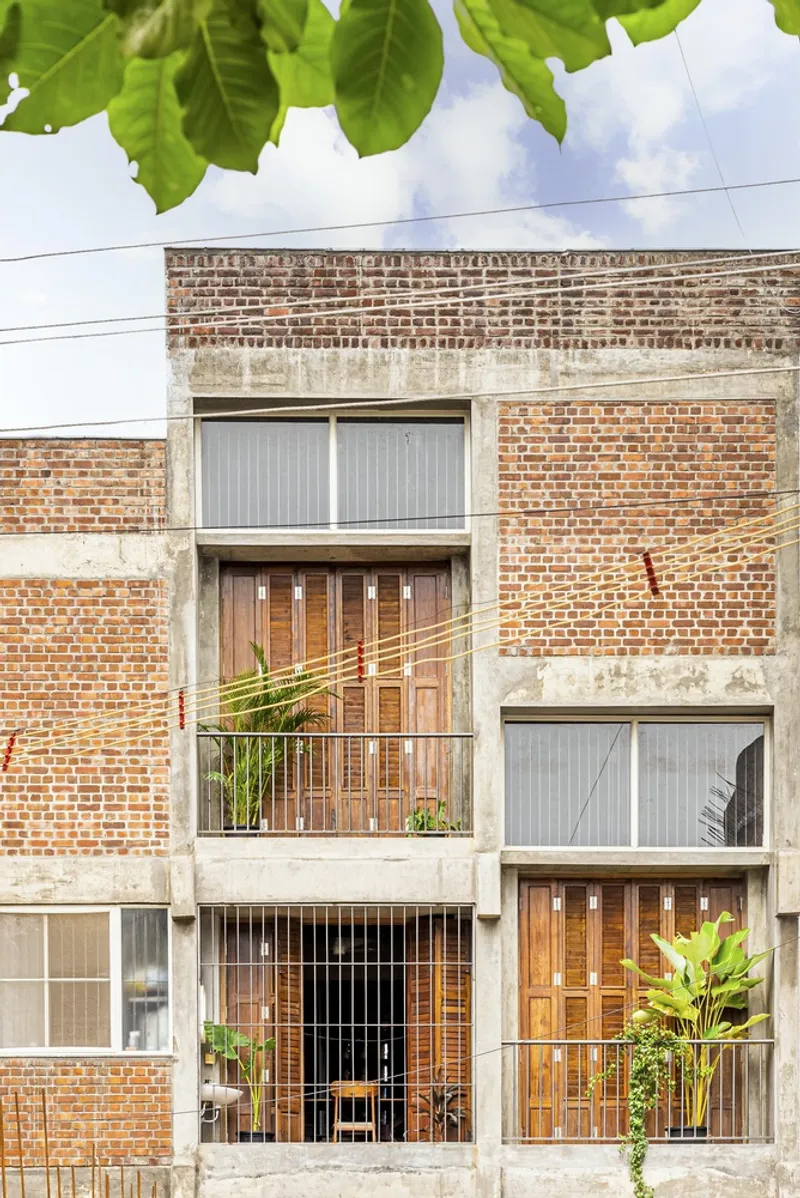
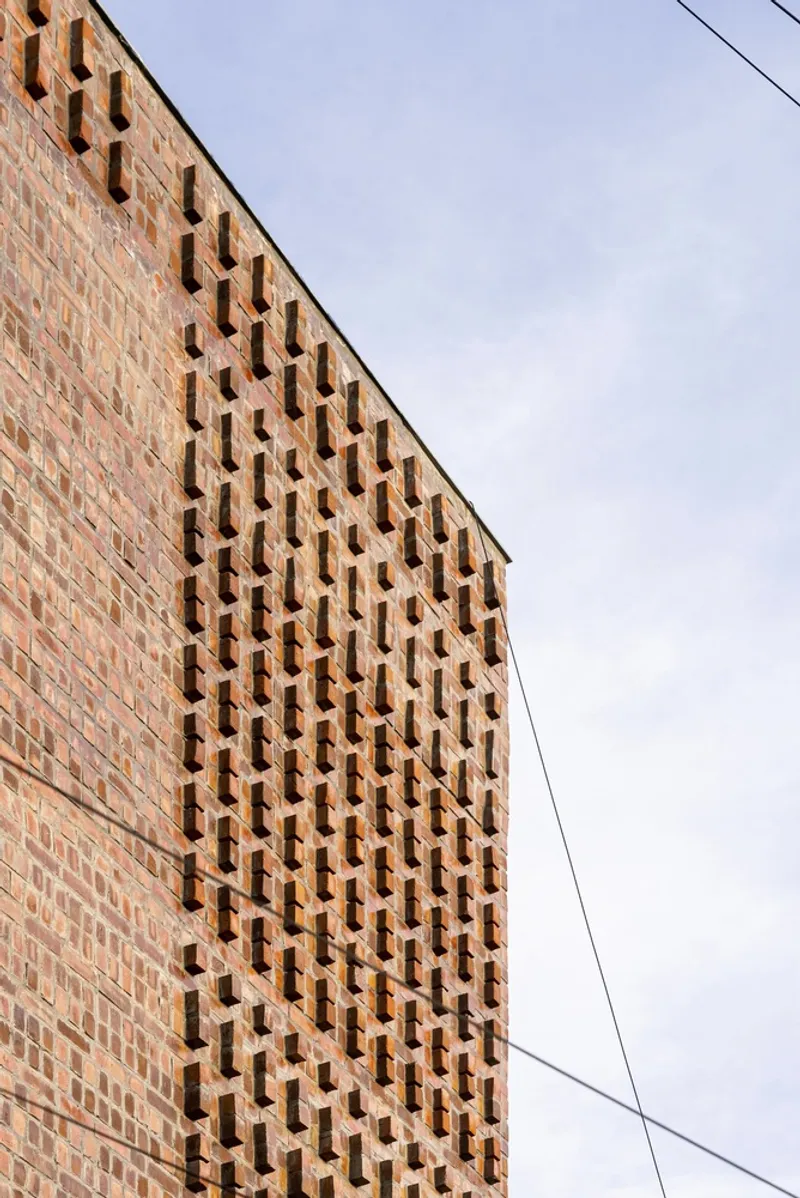
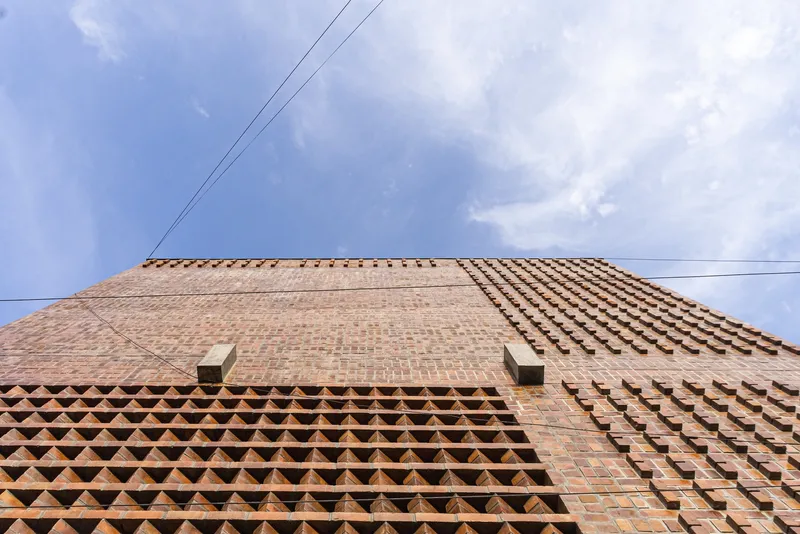
From the street, Agam House reads as a heavy object: exposed brick held in a concrete frame, a few deep balconies and very little glass. In Chennai's heat and humidity, this is the right instinct. The thick wall works as a thermal buffer, and it gives the family privacy on a street where the house next door is only a few metres away.
The wall is not mute, though. Projecting bricks and concrete blocks give the corner a rough texture that catches the light, and the perforated panels show that the mass is more breathable than it first appears. Rat-trap bond lays bricks on edge to form an internal cavity. It uses less material than a solid wall and insulates better, so even the plain parts of the facade are doing climate work.
The Jali as Filter, Lamp and Screen
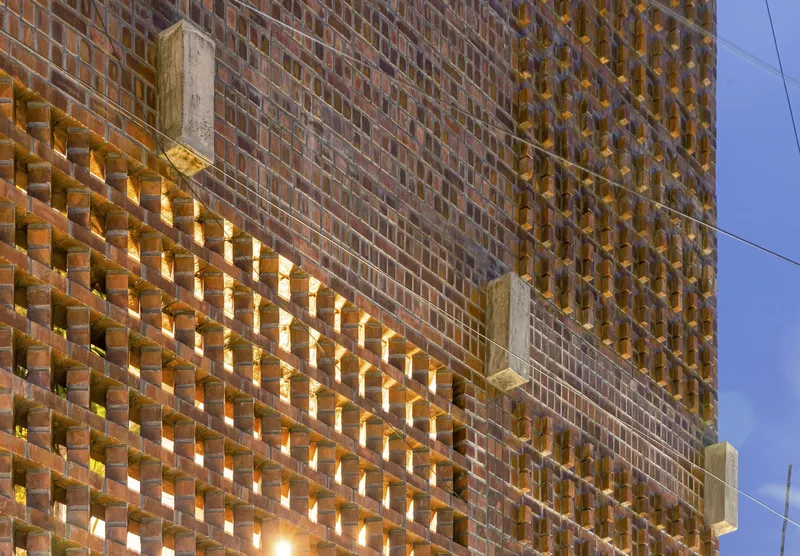
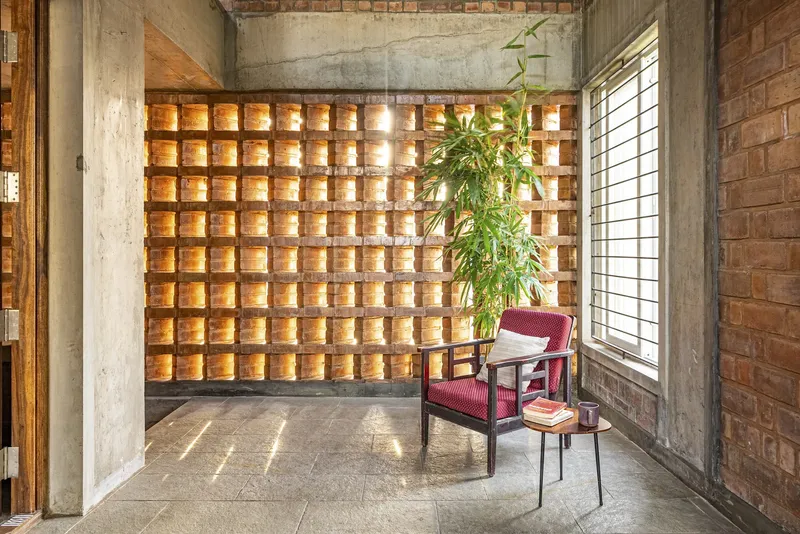
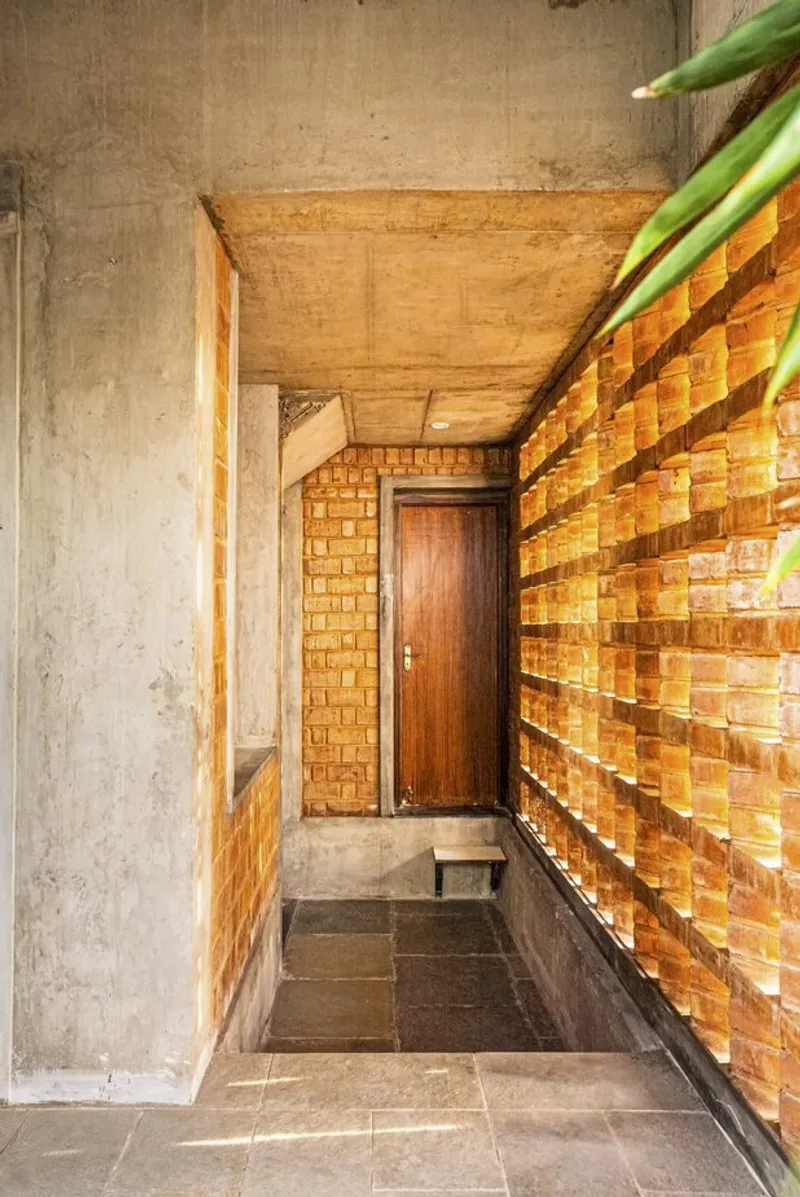
The perforated brick screens are the most photogenic element, and they earn the attention. By day, they turn harsh sun into scattered patches of light on the stone and slate floors. At dusk, the effect reverses, and the facade becomes a soft lantern for the street. The same wall performs differently depending on which side of it you stand.
Mawi Design keeps the jali at domestic scale. A red armchair and a potted bamboo sit right against it, so the screen reads as part of the room rather than a feature wall made for cameras. Air moves through the gaps along with light, which matters more in this climate than any visual effect.
Thresholds That Slow You Down
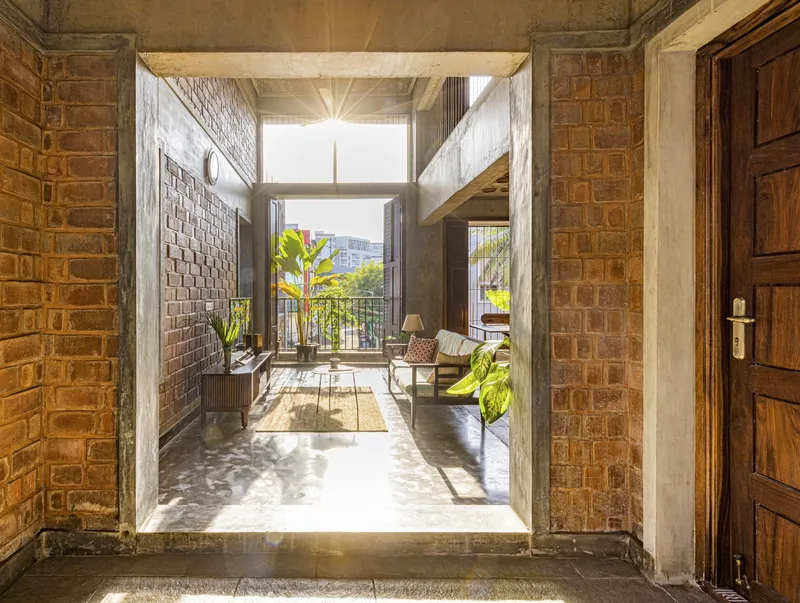
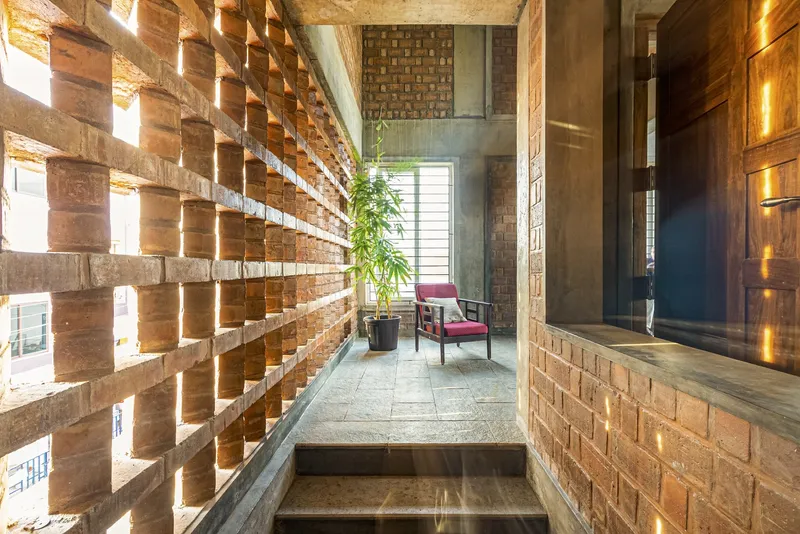
The plan is organised as a three-part grid, and the gaps between those bands become transitional spaces: corridors, landings and framed entries. You never step straight from street to living room. You pass through brick and concrete frames, along a lattice-lit corridor, and past plants. Each step lowers the temperature and the noise a little.
This layering is also where the firm's stated interest in "MA-WI", the space between and the space around, becomes concrete. The in-between zones are not leftover circulation. They are where the house does most of its environmental and social work.
The Double-Height Living Room
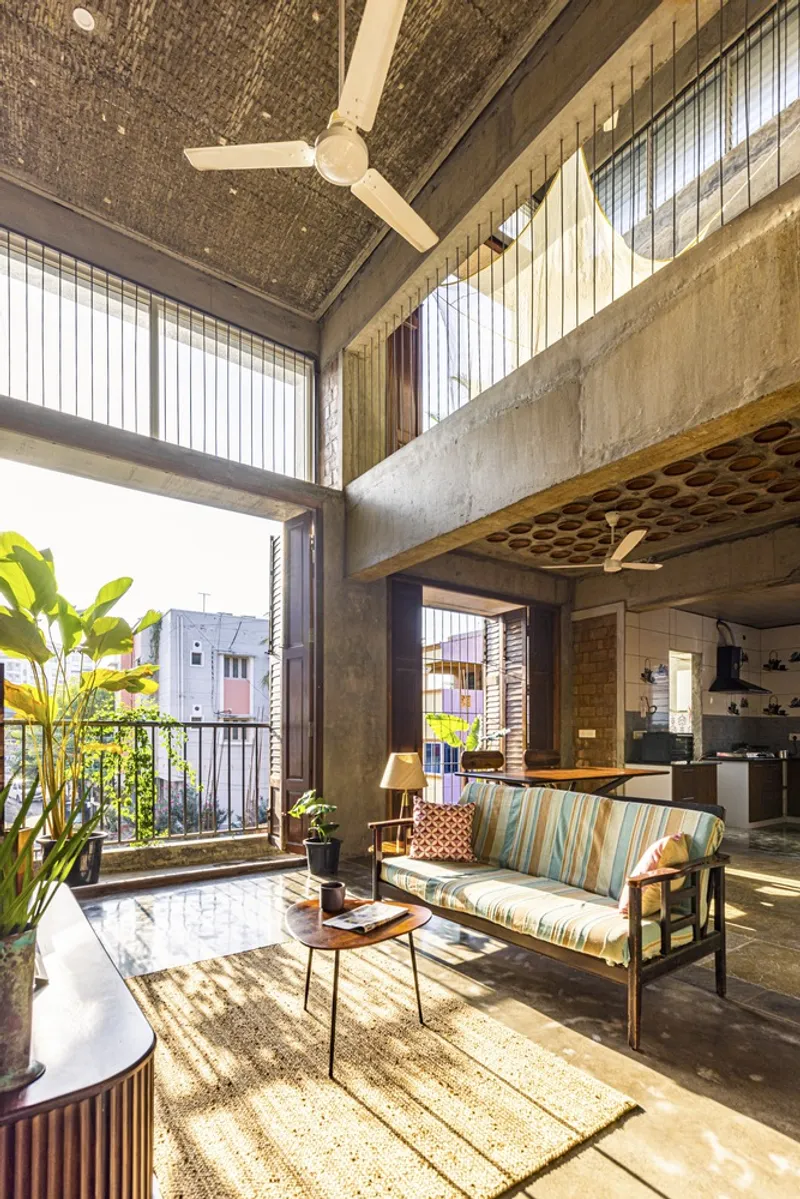
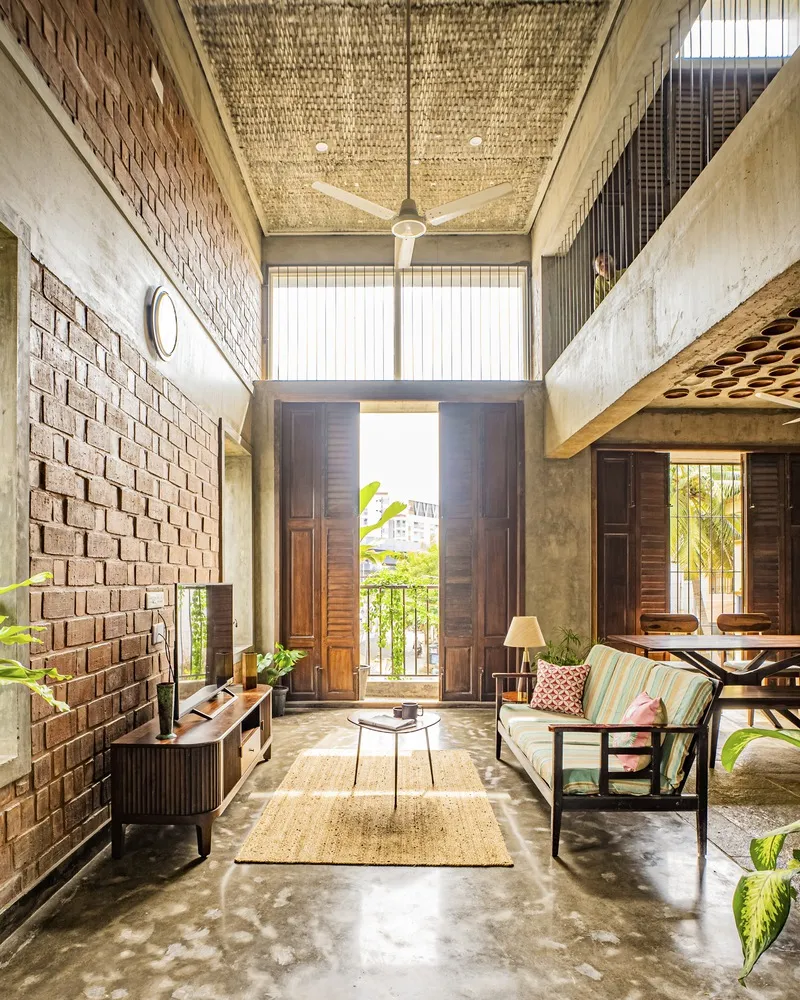
The living room rises through two storeys and is lined with exposed brick and tall timber shutters. A perforated ceiling band and a woven soffit filter the light from above, so dappled sun moves across the jute rug and polished concrete floor through the day. The furniture is modest: a striped sofa and a few plants. The architecture provides the atmosphere.
The volume's height is a practical decision as well as a dramatic one. It gives warm air somewhere to go, which sets up the house's main passive cooling strategy.
Stack Effect and Vertical Connection
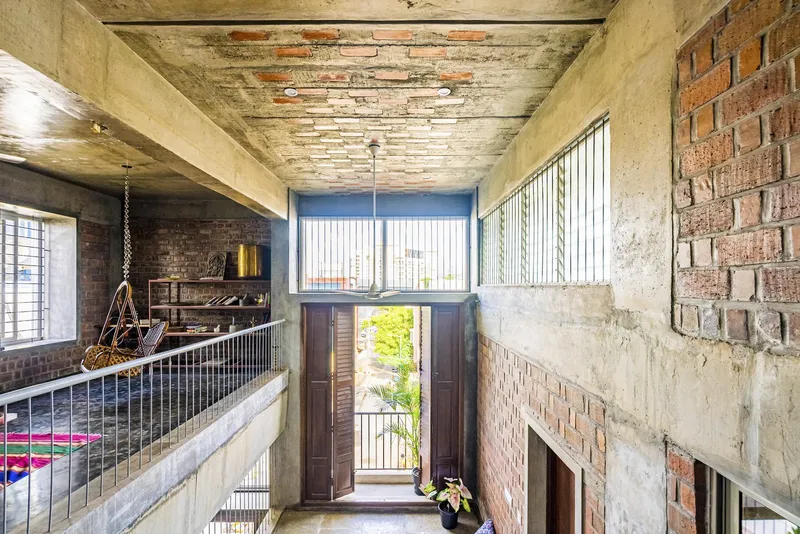
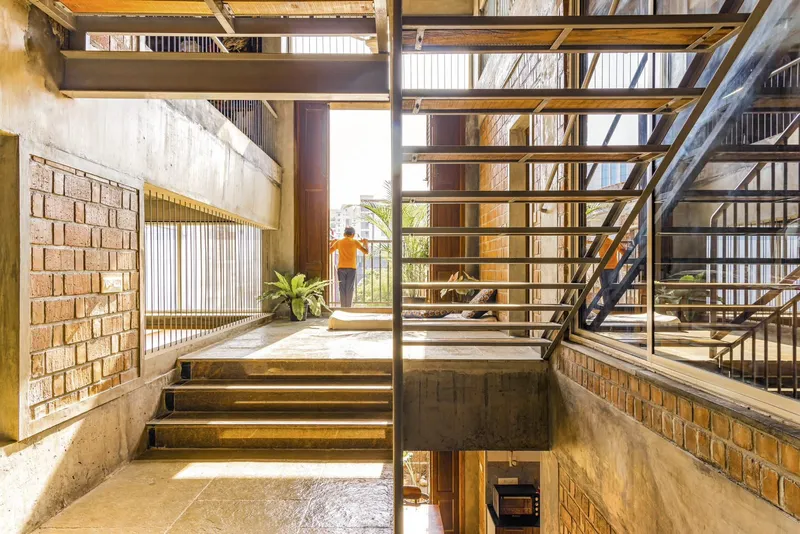
The void works as a chimney. Warm air rises and escapes high in the section, and cooler air is pulled in through lower openings. The brick-patterned soffit seen across the void suggests filler slab construction. In a filler slab, clay or brick units replace concrete that would carry no structural load, so the slab gets lighter, less carbon-intensive and slower to transmit heat.
The same vertical move connects family members across floors. A hanging swing chair, a mezzanine rail and an open steel-tread stair all face into the void, so someone on the upper landing can see and talk to someone below. We think this social benefit of a cooling strategy deserves more attention than it usually gets.
Courthouse Doors as Climate Controls
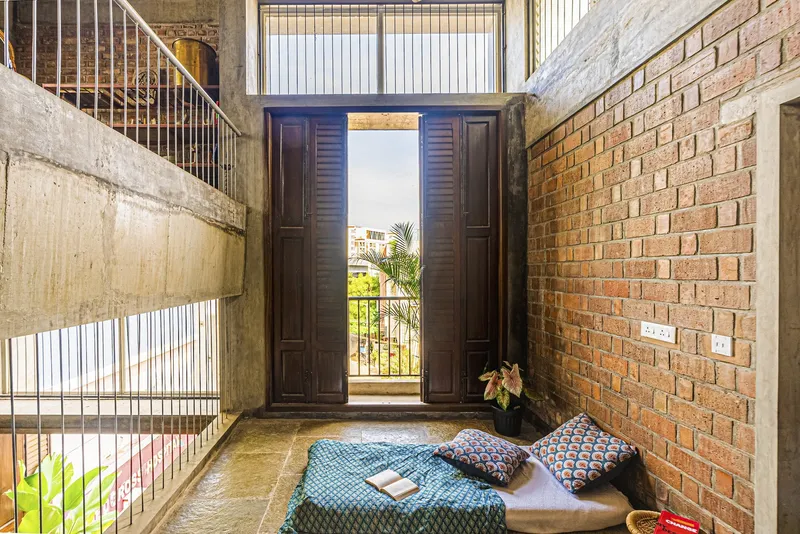
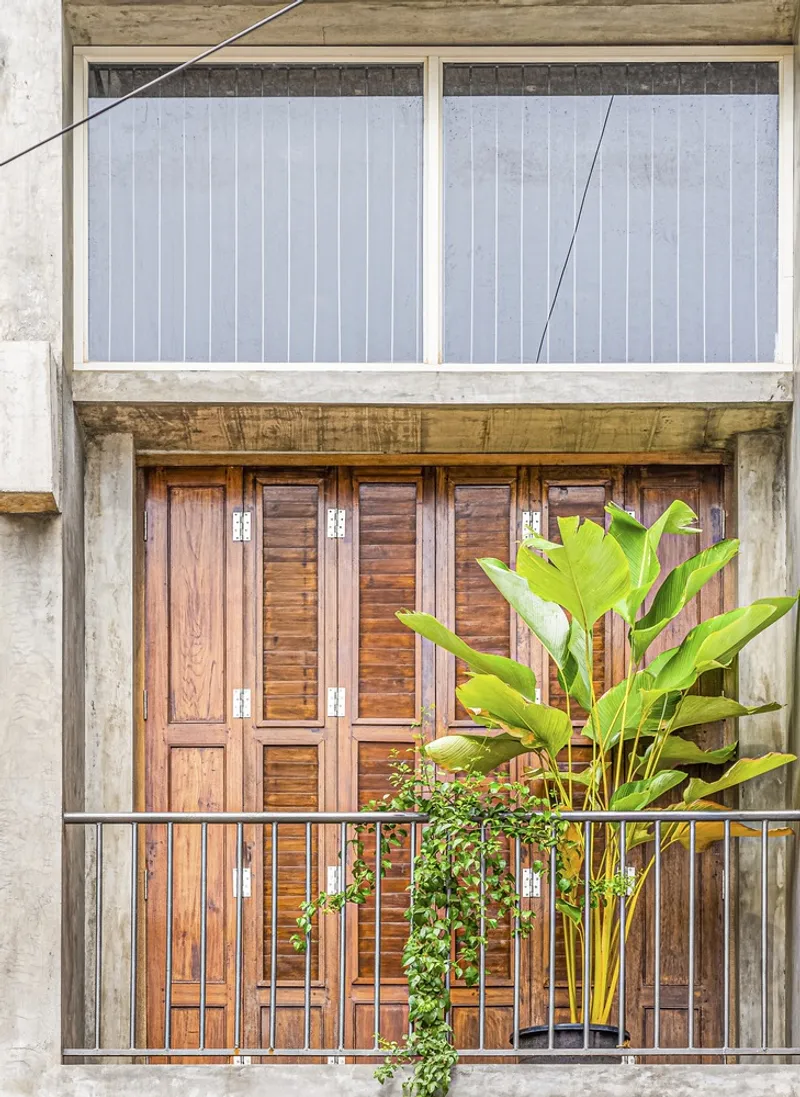

The 150-year-old doors from the High Court of Pondicherry are the project's boldest gesture. A doorway that once marked the line between public authority and the waiting crowd now marks the line between a family room and its balcony. Folded open, the shutters bring breeze and street views into the brick landing. Closed, they make the space feel enclosed and private.
This is reuse with a purpose. The doors make residents control the house by hand, opening and closing it as weather and mood change, rather than relying on a thermostat. Banana leaves and trailing vines on the concrete balconies add shade and soften the hard frame.
Why This Project Matters
Agam House shows that low-energy vernacular techniques do not belong only on rural sites with generous budgets. Rat-trap bond, filler slabs and jalis are cheap, well understood and easy to build. Mawi Design puts them on a dense Chennai street and builds a whole spatial idea around them, not a decorative layer. The result is a house that cools itself first and expects machines to help only after that.
The reclaimed courthouse doors give the house something technique alone cannot: a story, and a reason to be inhabited actively. For a practice founded in 2021, this is a confident, legible early work. It should push other urban Indian houses to treat passive design as the starting point rather than a feature added at the end.
Agam House by Mawi Design (principal architect Malli Saravanan), Chennai, Tamil Nadu, India. Area: 3,528 sq ft. Year: 2022.
About the Studio
Share Your Own Work on uni.xyz
If projects like this are the kind of work you want to make, uni.xyz is a place to publish your own, find collaborators, and enter design competitions.


Popular Articles
Popular articles from the community


Cube Design Draws an Ecological Corridor Between Two Shenzhen Hills with the Nankai Building
Beside Shenzhen's container docks, the Nankai Building pairs stacked balconies with a climbing green screen to connect two hillsides across its height.

LT2A and OPEN Architectes Thread a Brick and Glass High School Through a Wooded Belgian Campus
In Braine-l'Alleud, a 3,000 m² wing for Collège Cardinal Mercier pairs pale brick with a glazed colonnade, deferring to a small chapel and a dense wood.

GROUP A Strips a 1969 Rotterdam Harbor Headquarters to Its Frame and Wraps It in Timber Louvers
In Rotterdam's M4H harbor district, Ferro Offices reuses a 1969 frame, adds one timber storey and reaches BREEAM-NL Outstanding.

David Macias Steps a Doorless Stone and Plaster House Down a Tropical Colombian Hillside
In the humid hills of Colombia, Threshold House replaces the front door with an open void and terraces its 850 m² down the slope instead of fighting it.

Similar Reads
You might also enjoy these articles


Bamboo Housing Challenge 2026: Design Affordable, Sustainable Homes Using Bamboo
An international design competition by Bamboo U and IBUKU inviting architects and designers to reimagine affordable housing using bamboo — with the winning design built full-scale in Bali.

Computational Design & Education: Beegraphy Design Awards Introduces 7th Category (Featuring Jiyun's Innovative Approach)
Dive into Beegraphy’s 7th Design Awards category, where computational design meets education to create immersive, interactive learning tools, inspired by Jiyun’s work.

From Parametric Lighting to Urban Furniture: Join the 2nd Workshop in Beegraphy’s Computational Design Series
Dive into Cutting-Edge Design Techniques and Practical Applications with Industry Experts

Last Call: Unleash Your Architectural Genius in SHAK's Kindergarten Design Competition
Urgent call for architects to join SHAK's kindergarten design competition before the looming deadline

Explore Architecture Competitions
Discover active competitions in this discipline

Challenge to reimagine the Iron Throne

Photograph architecture without architects

Illustrate the lost glory of Angkor Wat - Render Challenge

Design challenge to reuse E-waste
Comments (0)
Please login or sign up to add comments
No comments yet. Be the first to comment!