
Agence Spatiale Clusters Timber Gables Around a Courtyard to Rethink the Saguenay School
In Chicoutimi, a Lab École prototype proves that child-scaled architecture can be warm, civic, and rooted in its suburban neighborhood.


Most schools in Canadian suburbs are single-volume boxes pushed to one side of a parking lot. Agence Spatiale's École de l'Étincelle in Chicoutimi, Saguenay, starts from a fundamentally different premise: rather than a monolith, the school is a cluster of gabled timber volumes arranged around a shared courtyard. The result reads less like an institution and more like a small village, scaled to the children who inhabit it and to the residential neighborhood that surrounds it.
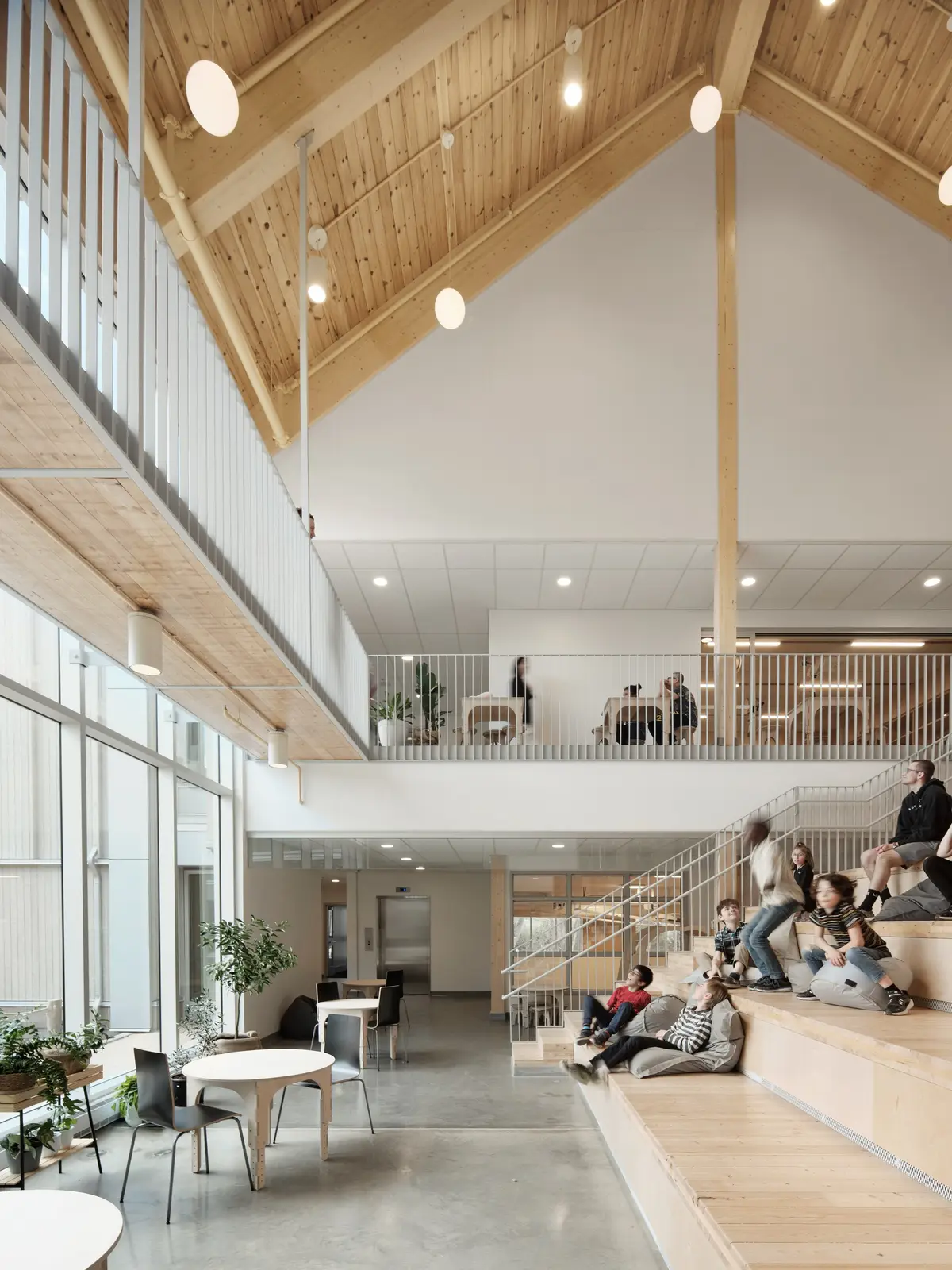
What makes this project genuinely interesting is its refusal to separate pedagogy from spatial form. The courtyard is not leftover space; it is the organizational heart, a sheltered outdoor room that every wing addresses. Inside, bleacher stairs double as gathering spaces, classrooms face directly into woodland, and kitchens sit at the center of social life. Every decision serves a thesis: that the physical environment of a school is itself a teaching tool. At 2,250 square meters, the building proves you do not need enormous area to generate spatial richness.
A Village of Gables
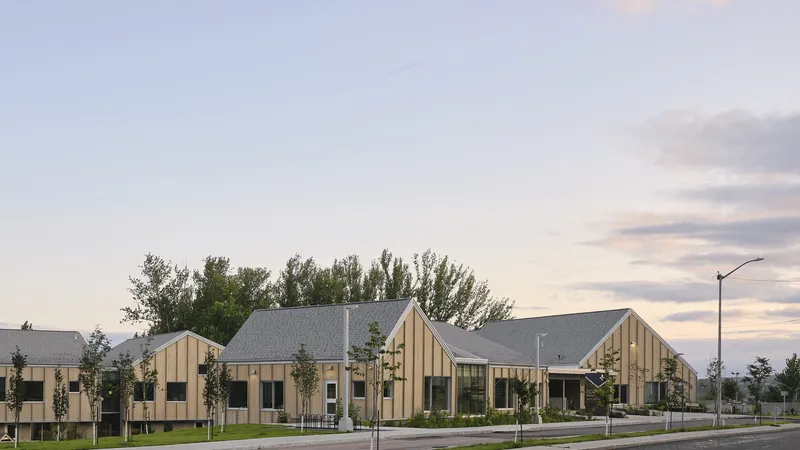
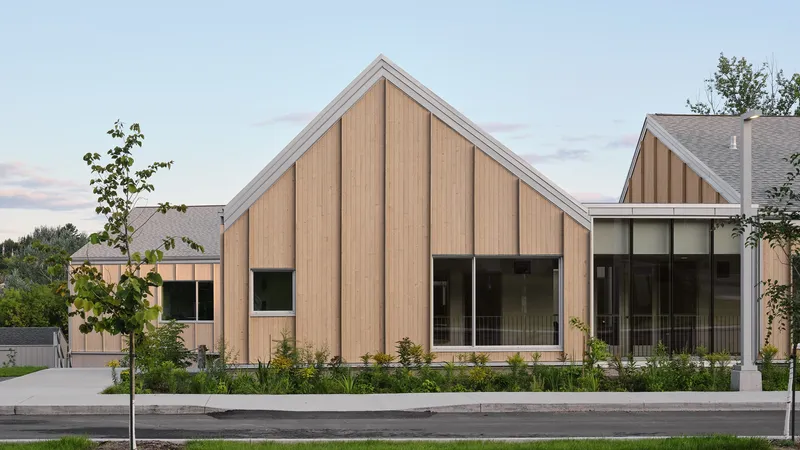
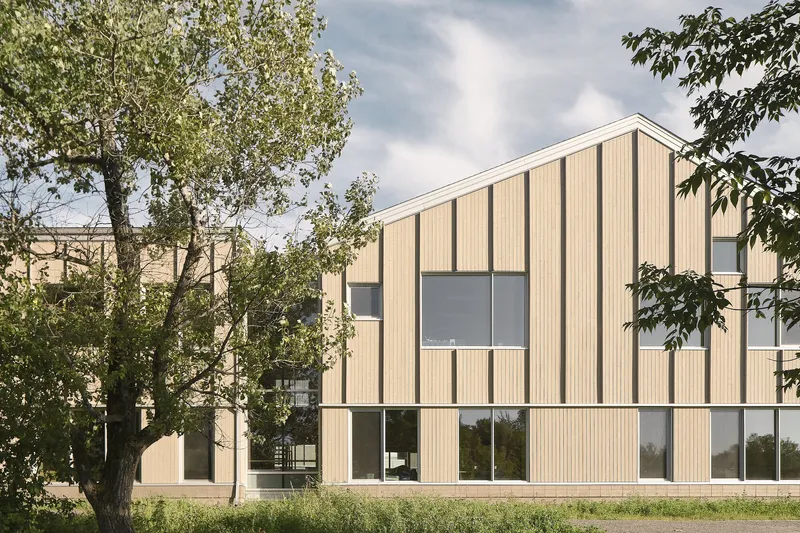
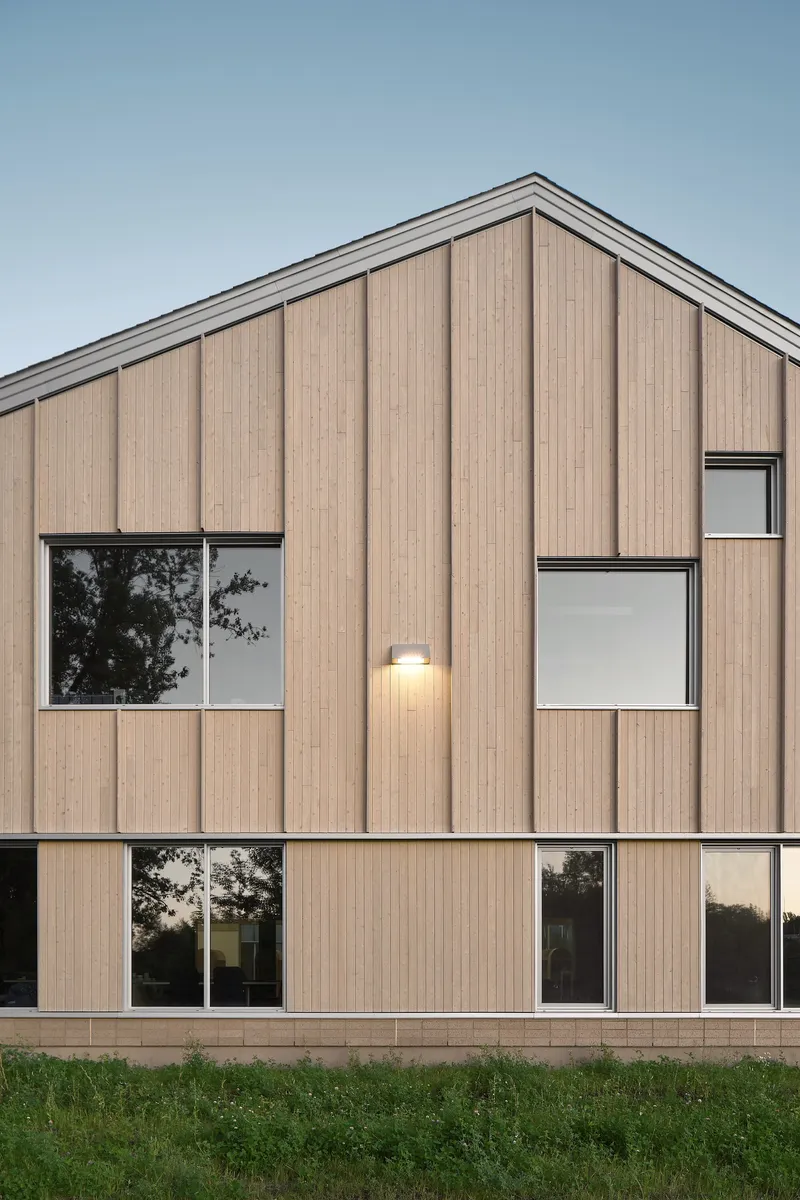
From the street, the school presents itself as a family of timber-clad gabled volumes, each pitched roof a distinct but related form. Vertical battens clad the facades, lending texture and grain that will age alongside the young trees planted in front. The scale is deliberately domestic. No wing towers above two stories, and the alternation of solid wall and ribbon window gives each volume a measured rhythm that belongs in its residential context.
The choice of gable is more than stylistic. It connects the school to the vernacular housing typology of the Saguenay region while providing interior ceiling volumes that feel generous without being cavernous. Scattered punched windows on the taller facades suggest that the building has its own personality, playful and slightly irregular, a welcome departure from the anonymous curtain walls that plague institutional architecture.
The Courtyard as Civic Heart
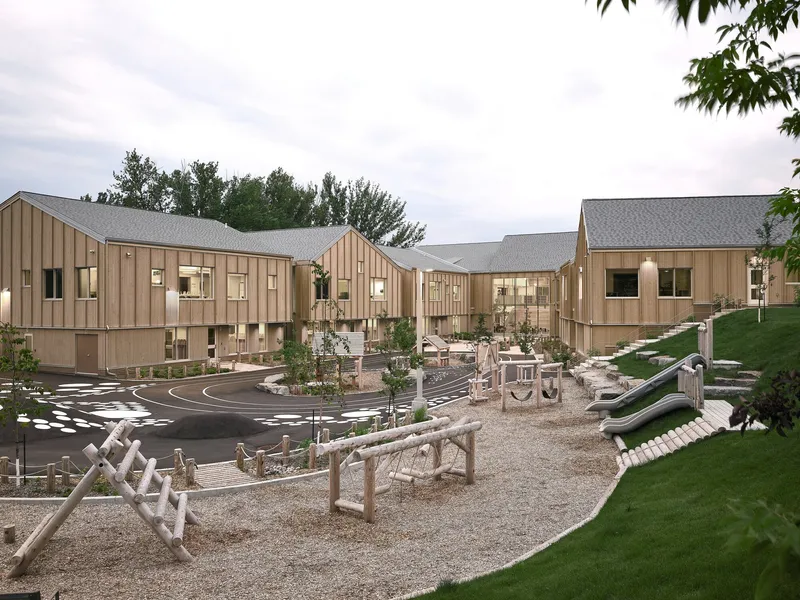
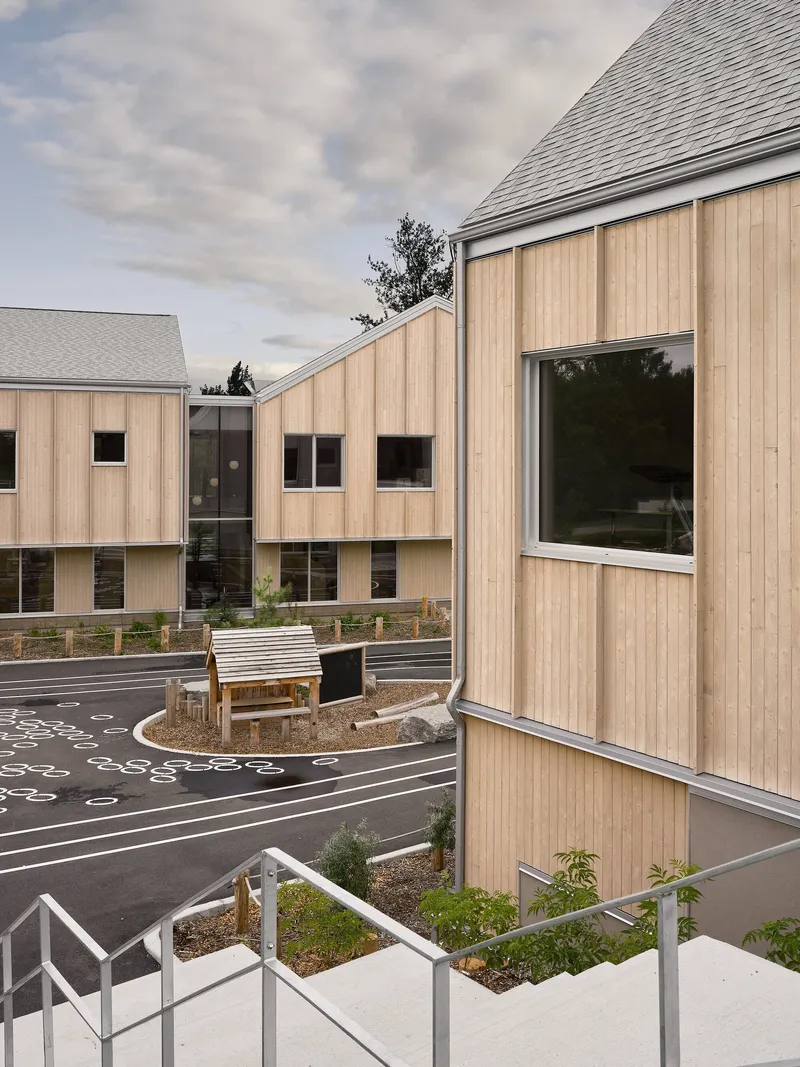
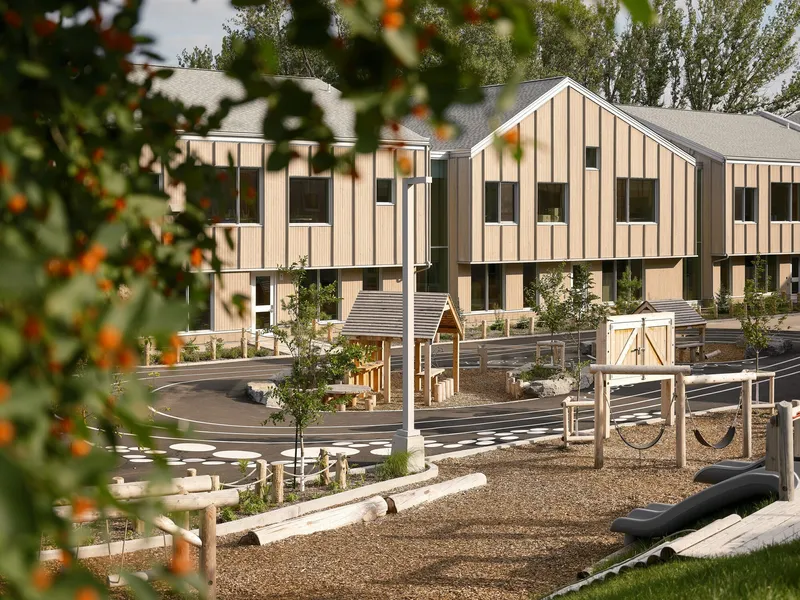
The central courtyard is where the project's ambition becomes clearest. Enclosed on all sides by the building's wings, it forms a protected outdoor room with gravel surfaces, planted beds, timber benches, and climbing equipment. Seen from above, the arrangement is unmistakable: an oval track and landscaped zones replace the standard asphalt yard, giving children a variety of textures and scales to explore.
Critically, the courtyard is visible from nearly every interior corridor and many classrooms. Glazed connectors between wings frame views back into this shared space, collapsing the boundary between inside and out. At dusk, the interplay of warm interior light and darkening sky turns the courtyard into a lantern, a signal to the neighborhood that school life extends beyond the bell.
Timber Inside and Out
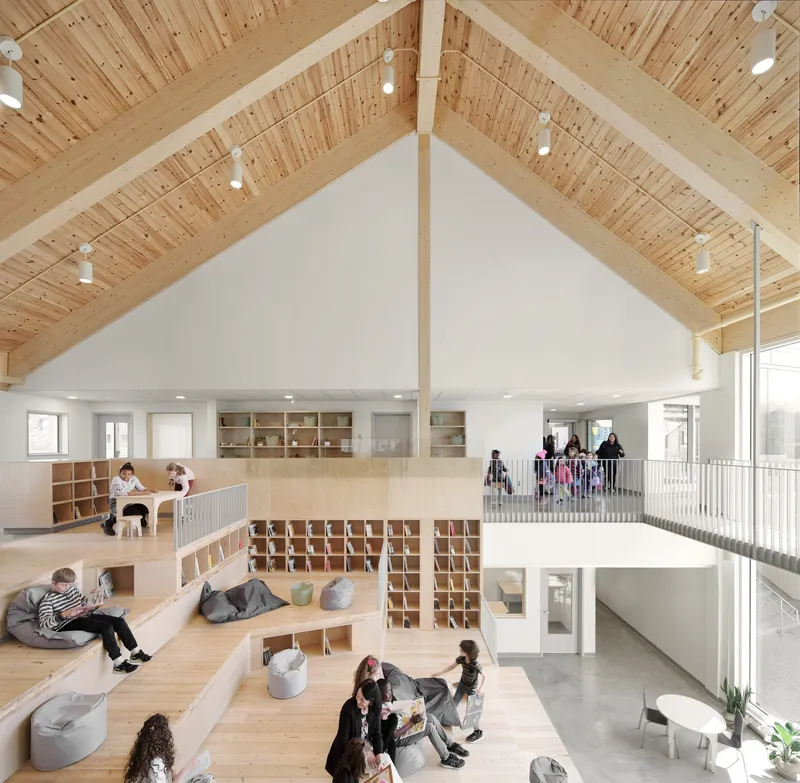
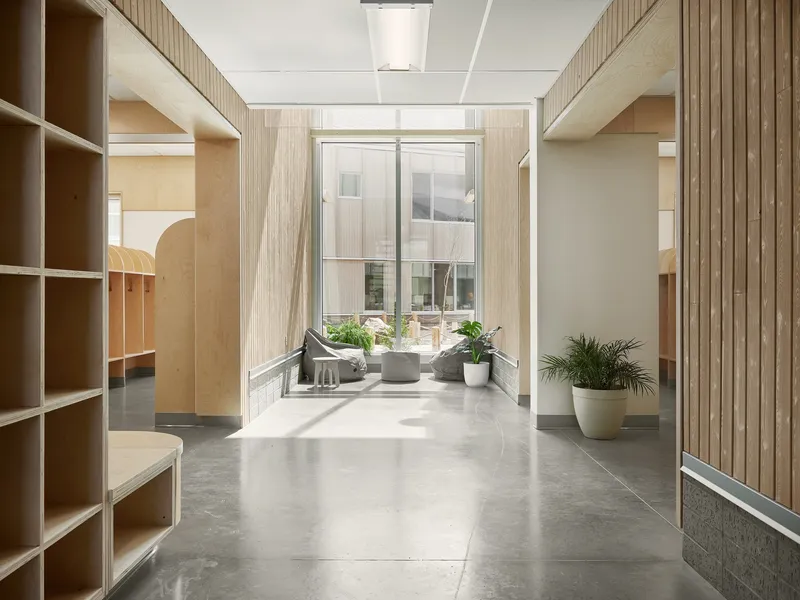
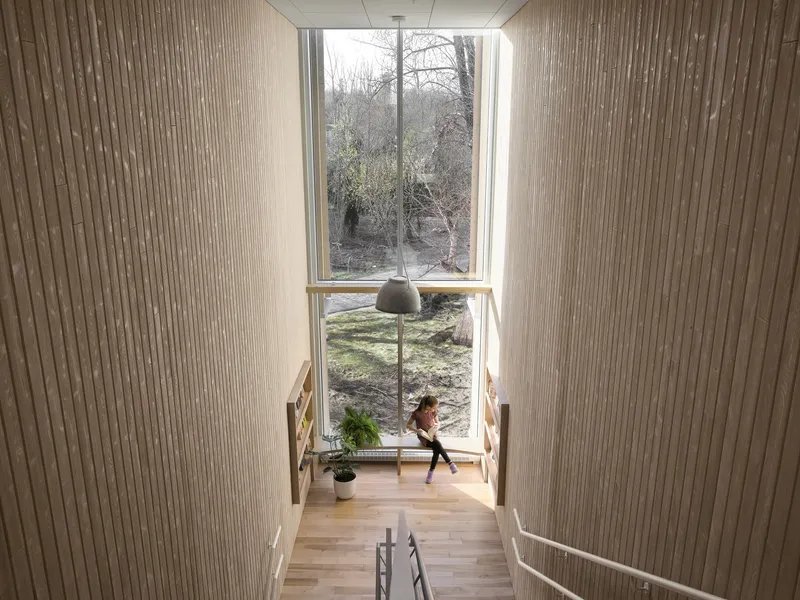
Step inside and the material palette tightens to a discipline of plywood, timber battens, and the occasional flash of sage green or olive. Ceilings vault in plywood panels, walls are lined with built-in shelving, and staircases are wrapped in the same warm wood that covers the exterior. The consistency is deliberate: it reduces visual noise and creates a calm backdrop for the chaos of elementary school life.
The timber staircase, framed by a tall window overlooking bare winter trees, is one of those moments where architecture does something simple extraordinarily well. A child descending the stairs is gently directed toward nature, a daily reminder that the building exists within a landscape. Corridors likewise terminate in courtyard views rather than dead ends, reinforcing orientation and connecting every journey through the building to the outdoors.
Learning Spaces That Double as Living Rooms
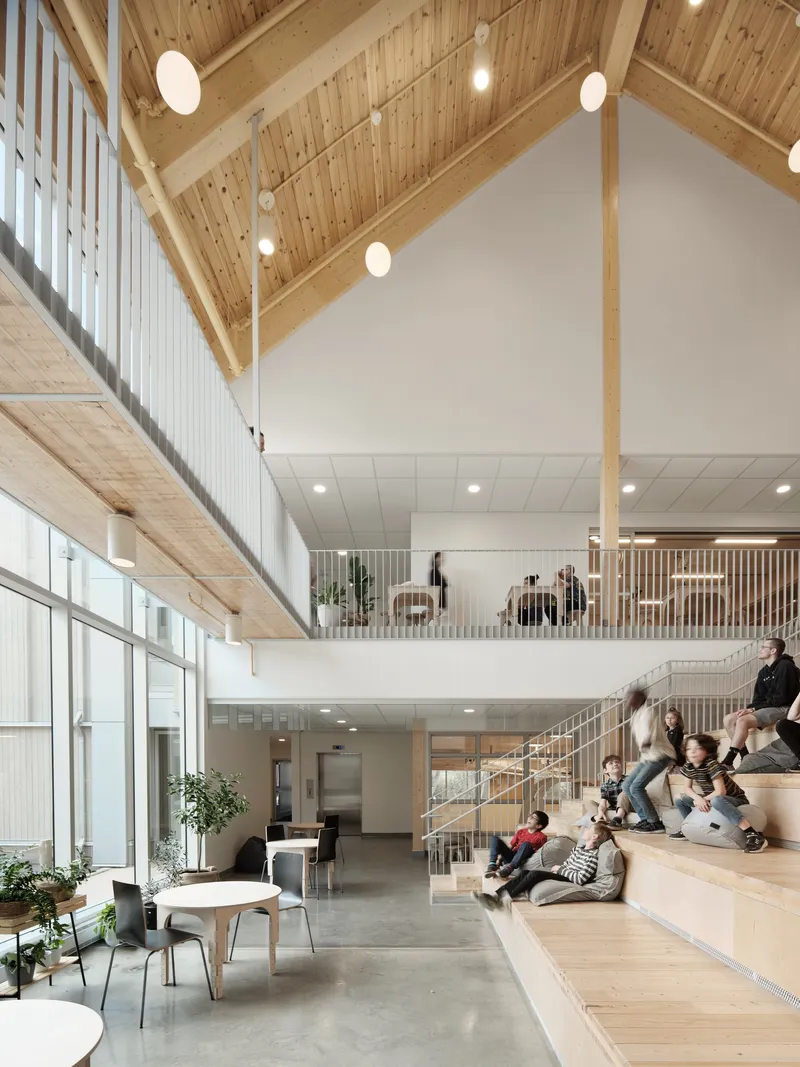
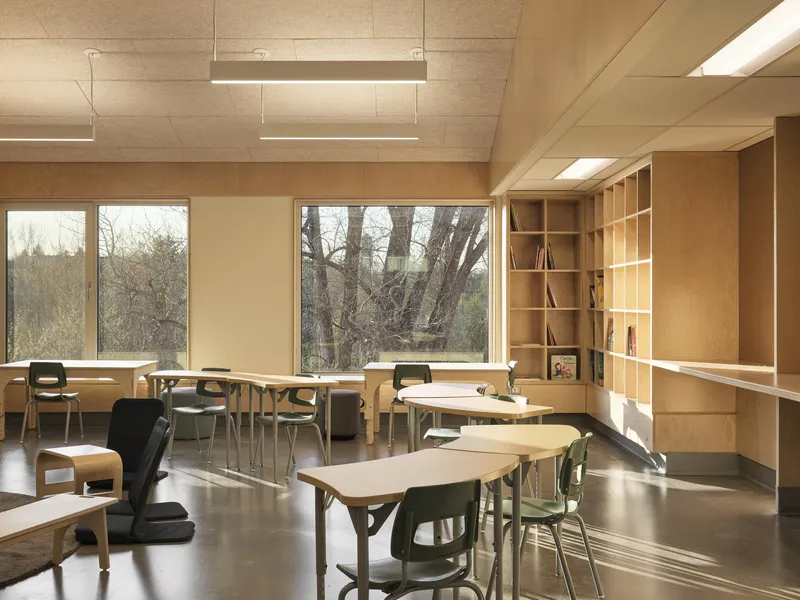
The double-height atrium with its wide timber bleacher steps is the school's most photographed space, and for good reason. It functions simultaneously as auditorium, informal classroom, and social landing. Students sit, sprawl, and gather on the stepped platforms beneath a vaulted timber ceiling that radiates warmth. The space avoids the typical school cafeteria problem of feeling like a holding pen; instead, it feels like the living room of a very large house.
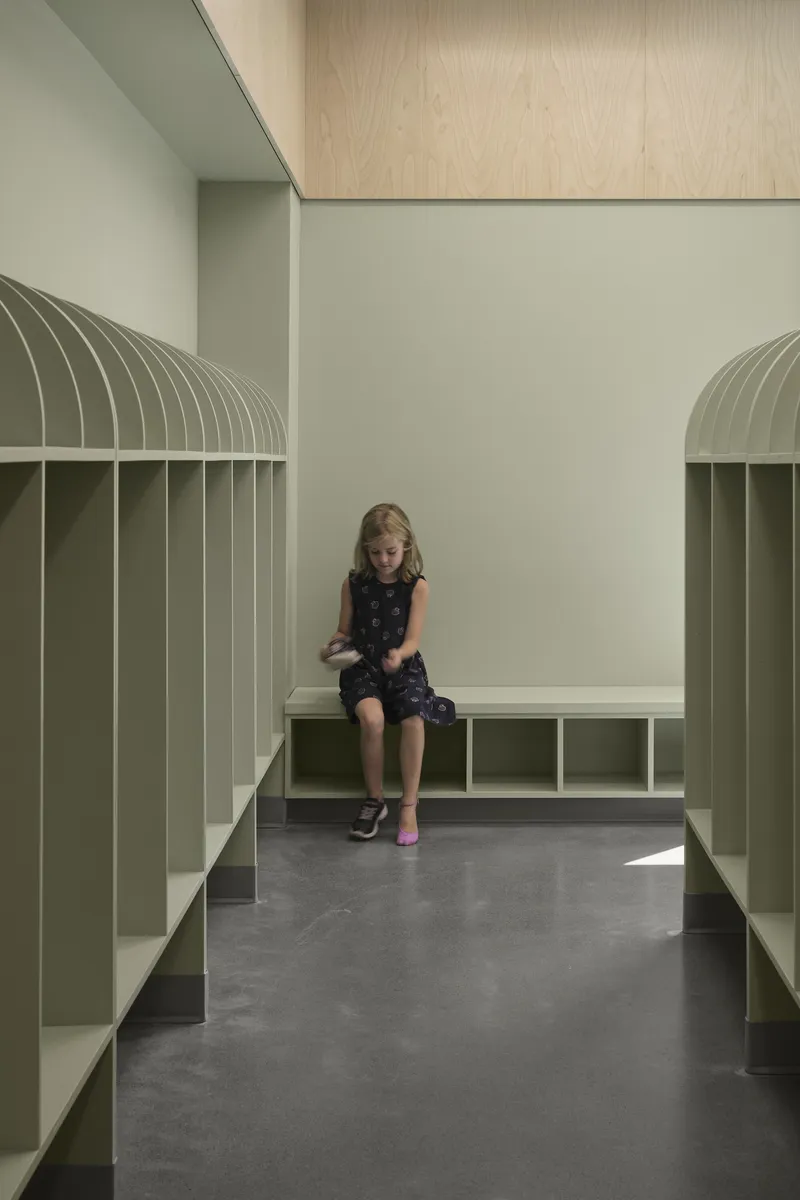
Classrooms continue this residential logic. Floor-to-ceiling windows face directly into woodland, plywood shelving is built into the walls, and sage green arched cubbies give children individual nooks that feel personal rather than institutional. It is a small gesture, an arched recess with a bench, but it communicates care. Architecture tells children something about their own worth, and these details say: you matter here.
Kitchens and Communal Rituals
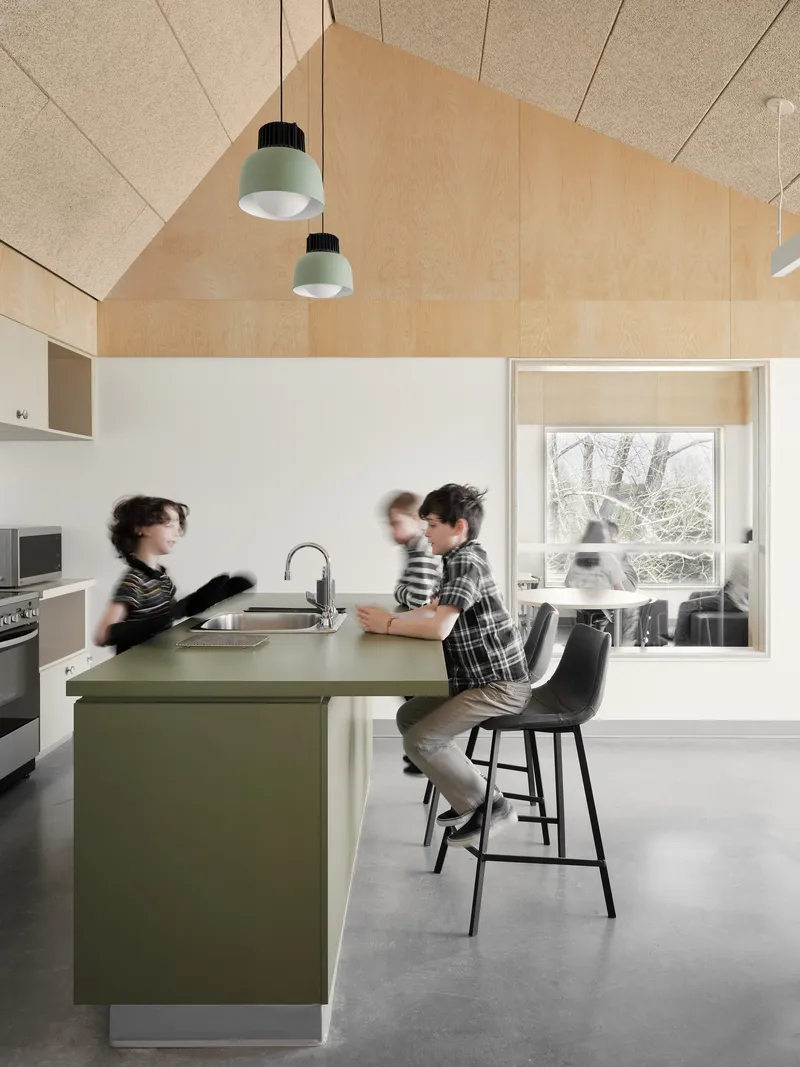
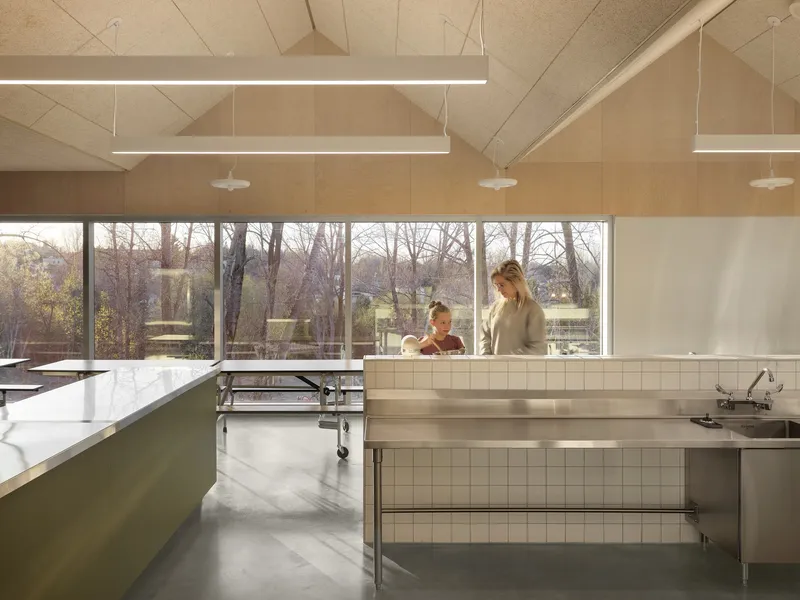
Two kitchens appear in the project, and both occupy positions of prominence rather than being hidden behind service corridors. One features an olive-green countertop island beneath a plywood vaulted ceiling, with pendant lights and children in constant motion around it. The other faces bare winter trees through horizontal windows, its white tile backsplash and plywood ceiling panels keeping the palette restrained. Placing food preparation at the center of school life is a pedagogical choice that the architecture amplifies.
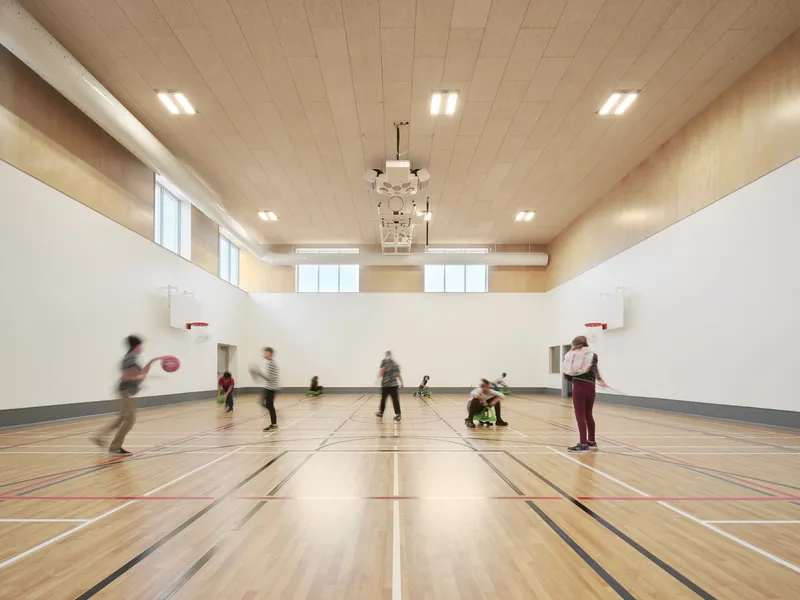
The gymnasium, by contrast, is more conventional in program but consistent in material expression. Timber floors and a plywood ceiling maintain the warmth that runs through every room. Even in a space dedicated to physical activity, with children in motion blur chasing a basketball, the architecture refuses to default to industrial finishes. The commitment to a single material language, held from facade to gym floor, is what gives the building its coherence.
Arrival and Threshold
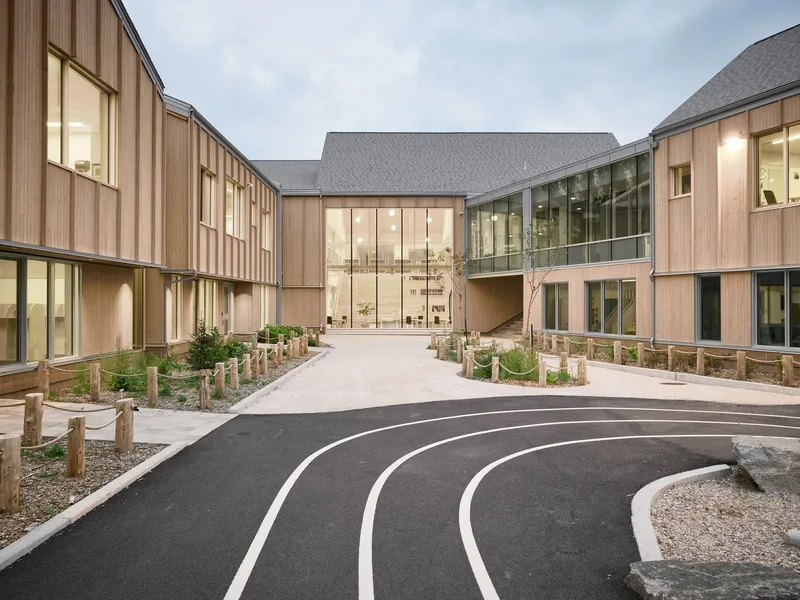
The entrance sequence deserves attention. A curved asphalt path leads between two timber wings toward a glazed central facade that glows at twilight. The approach is cinematic: you are funneled between solid walls, and then the building opens to reveal its transparent core. It is a compressed version of the courtyard idea applied to the moment of arrival, enclosure followed by release.
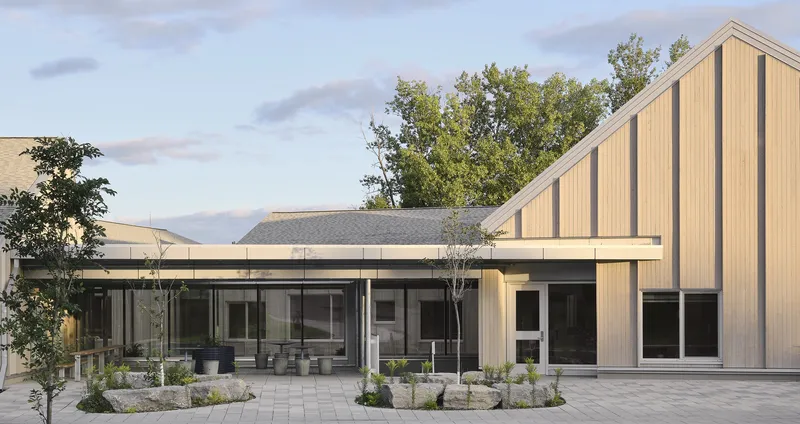
The gable end viewed from the courtyard, with its tall vertical timber cladding and single-storey glazed wing extending beside it, shows how the architects modulate scale across the project. Two-storey volumes anchor corners, while single-storey links keep the courtyard edges permeable and low. At dusk, the scattered punched windows on the taller facades glow unevenly, reinforcing the sense that this is not one building but many rooms gathered together.
Site and Neighborhood
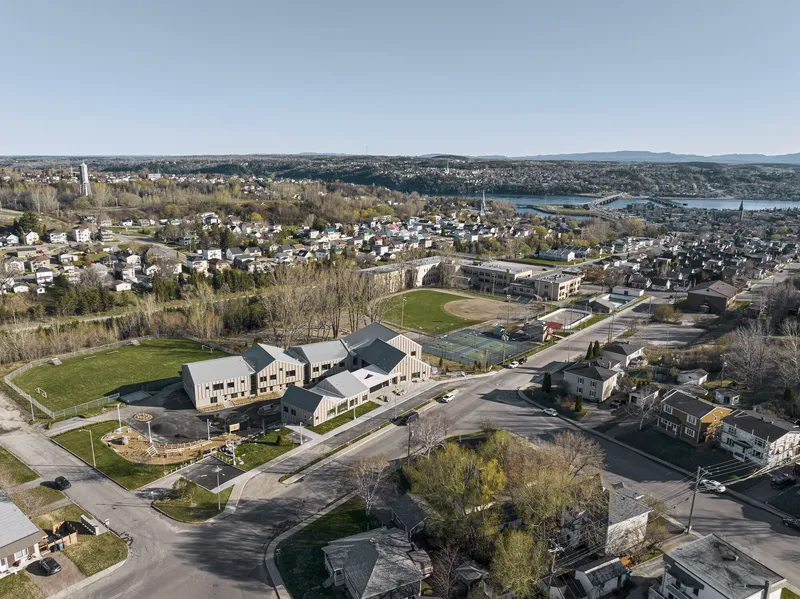
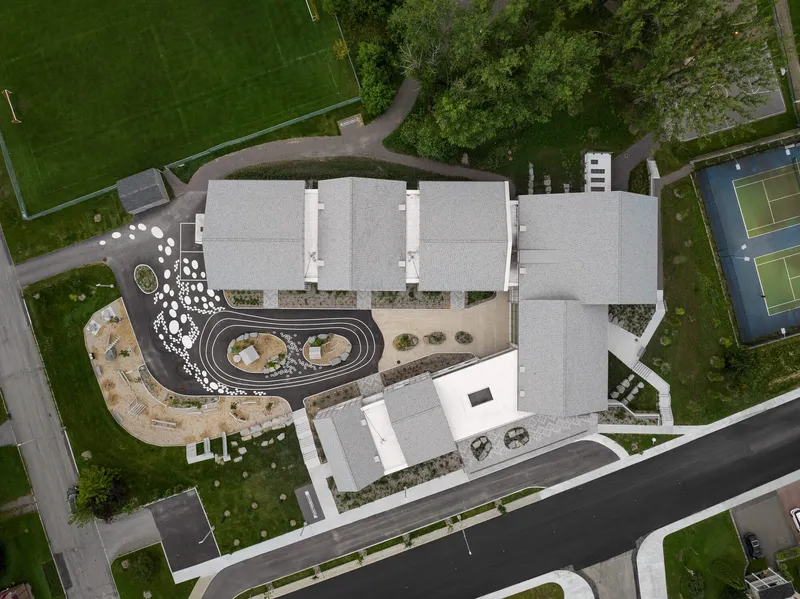
The aerial views confirm what the ground-level experience suggests: the school sits within a suburban fabric of detached houses and mature trees, and its footprint mirrors that context. The cluster of white-roofed gabled volumes reads from above as a continuation of the residential grain, not a rupture. The central courtyard, with its oval track and landscaped zones, is clearly the organizational diagram made physical.
Orienting the building around an interior courtyard rather than facing outward to parking lots means that the school's best spaces are shielded from traffic noise and wind. In a Saguenay winter, this matters enormously. The courtyard acts as a microclimate, collecting sun and blocking prevailing winds, extending the number of days children can use the outdoor space. Practical performance and spatial ambition align.
Why This Project Matters
The Lab École initiative has produced several notable school buildings across Quebec, but l'École de l'Étincelle stands out for its clarity of concept. One idea, the courtyard village, drives every decision from site plan to cabinet detail. Agence Spatiale demonstrates that working within a tight area and a suburban lot does not require compromising spatial ambition. By breaking the school into a family of gabled volumes, they create variety without disorder, intimacy without confinement.
More broadly, the project challenges the assumption that institutional buildings must look institutional. Timber cladding, domestic scale, and arched cubbies are not naïve gestures; they are strategic choices that lower the psychological threshold of a public building and invite a community to claim ownership. If we are serious about designing schools that shape how children understand space, light, and belonging, this is the standard against which new work should be measured.
École de l'Étincelle, Lab École Saguenay, designed by Agence Spatiale. Chicoutimi, Saguenay, Canada. Completed 1988. 2,250 m². Photography by Maxime Brouillet.
About the Studio
Share Your Own Work on uni.xyz
If projects like this are the kind of work you want to make, uni.xyz is a place to publish your own, find collaborators, and enter design competitions.


Popular Articles
Popular articles from the community


Manzana Morphosis: Stretching Barcelona's Grid into a Living Landscape for 2050
A radical reworking of the Eixample manzana turns density into a tool for generous public space, vertical ecology, and environmental performance.

Extended Shell: Retrofitting Kolkata's Balconies as Living Urban Thresholds
A modular retrofit system recovers the social and environmental intelligence of Kolkata's historic verandas for contemporary Park Street residents.

The Amber Palace Opera: A Geological Fiction Surfaces on Tallinn's Baltic Waterfront
Pierre Brillard reimagines a Baltic legend as a public landscape, opera house, and waterfront promenade rooted in Tallinn's coastal identity.

Cloaked Colonization: A Mobile Underwater Habitat That Moves Like a Fish
Micah Abaya's shortlisted EHC Pacific entry reimagines ocean settlement as a dispersed network of self-sustaining architectural organisms.

Similar Reads
You might also enjoy these articles

Pixel Gardens: One Repeated Module Stacked Into a Terraced Social Housing Tower for Famagusta
Salem Bader's shortlisted housing tower builds a vertical neighbourhood from one repeated module, offsetting units to carve terraces, light and air.

Bao Huynh Watercolor Atelier: A Serene Art Retreat in Hội An
Bao Huynh Watercolor Atelier in Hội An blends multifunctional art spaces, sustainable design, local materials, and family-friendly living in a serene environment.

Atelier Macri Concept Store Interior Design by CASE-REAL
Atelier Macri store features a "ko" counter, walnut wood details, cork displays, blending retail, gallery, and seamless customer experiences.

Manuel Vargas Izquierdo Stadium and High-Performance Sports Center: Architectural Excellence in Jalpa de Méndez
The Manuel Vargas Izquierdo Stadium blends sustainable design, inclusive sports facilities, and cultural-inspired architecture, revitalizing Jalpa de Méndez’s public spaces.


Comments (0)
Please login or sign up to add comments
No comments yet. Be the first to comment!