

Alhumaidhi Architects Wraps a Kuwaiti Courtyard Home in Soft Arches and Cascading Green
Shell House in Abdullah al-Salem reimagines the traditional Kuwaiti courtyard dwelling through layered terraces, planted edges, and sculpted light.


The courtyard house is one of the oldest residential types in the Gulf, born out of climate and culture in equal measure. In Kuwait, where summers punish anything that faces the sun unprotected, turning inward has always been a survival strategy as much as an aesthetic one. Alhumaidhi Architects understands this lineage, and with Shell House in the Abdullah al-Salem district, the firm has produced a 1,788 square meter residence that treats the courtyard not as a nostalgic gesture but as the organizing engine of the entire plan.
What makes this project worth studying is its refusal to choose between discipline and sensuality. The massing is rigorous: stacked volumes, clean white render, a legible plan wound around a central pool. But every edge has been rounded, every opening arched, every terrace planted until it spills. The house reads simultaneously as a piece of geometric order and as something organic, almost geological, as if the desert had softened a cube over centuries. That tension is rare, and it is sustained from the street facade all the way through to the rooftop.
A Street Face That Invites Without Revealing
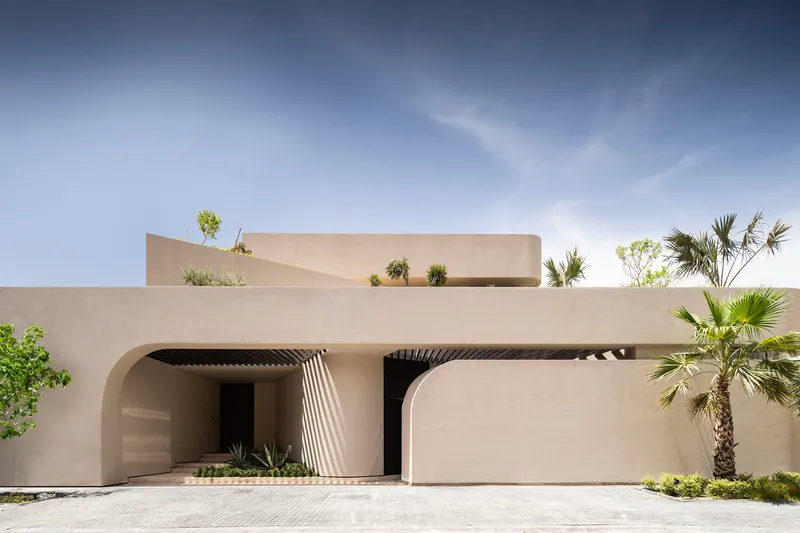
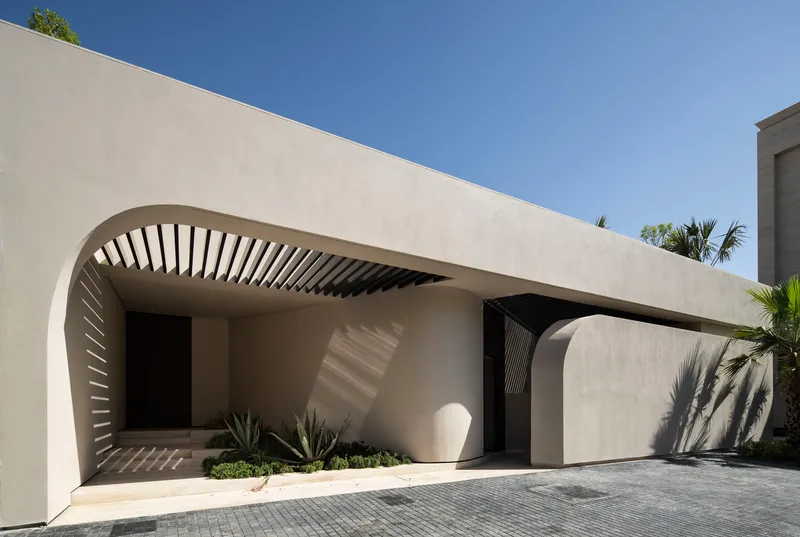
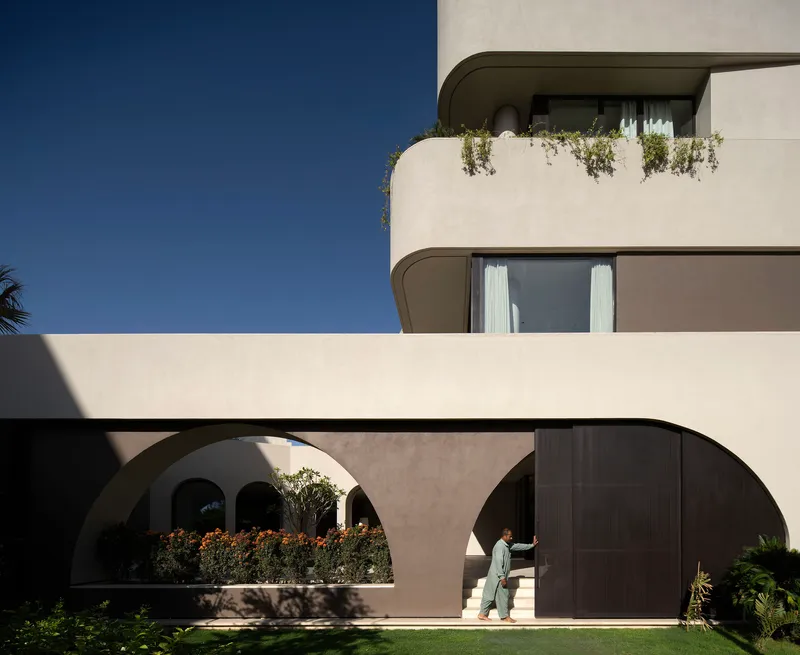
From the street, Shell House presents a pale, composed front. The entry portal is a single generous arch, framed by a radial timber slat canopy that casts long, rhythmic shadows across the stucco surface. It is an act of controlled hospitality: the arch says "enter," but the slatted screen filters the view and the light, revealing almost nothing of the interior beyond. Flanking palm trees and a planted bed complete a composition that feels civic in its care, unusual for a private dwelling.
Above the entry, stacked rounded balconies trail plants downward, giving the facade a vertical garden quality without the heavy infrastructure that term usually implies. A resident caught mid-stride beneath the arched passageway gives scale and life to what could otherwise read as austere. The proportions are confident; nothing is oversized for drama.
Terraced Volumes and the Logic of Layering
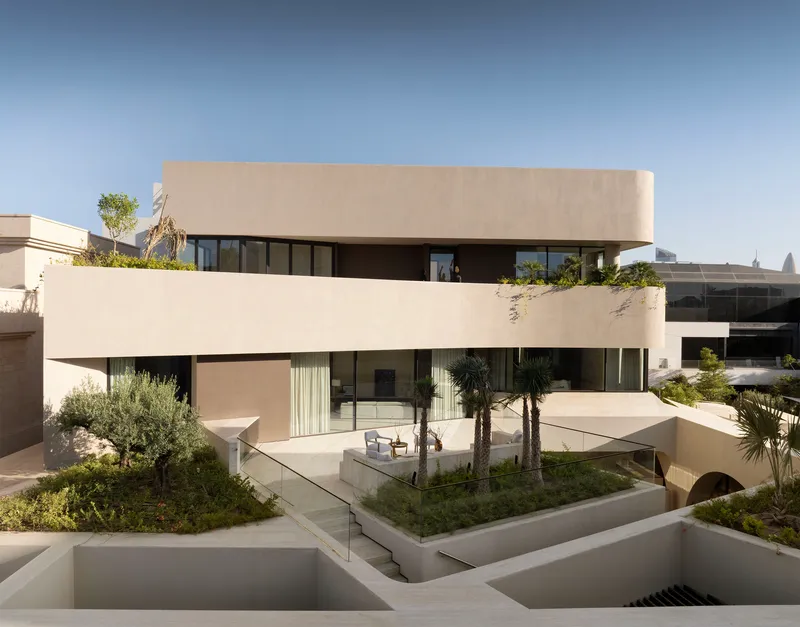
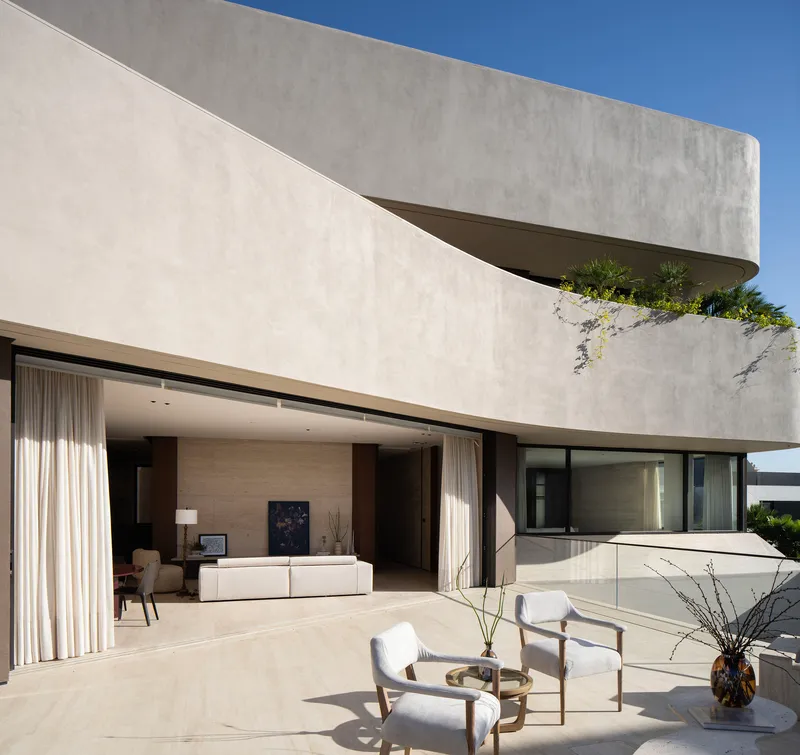
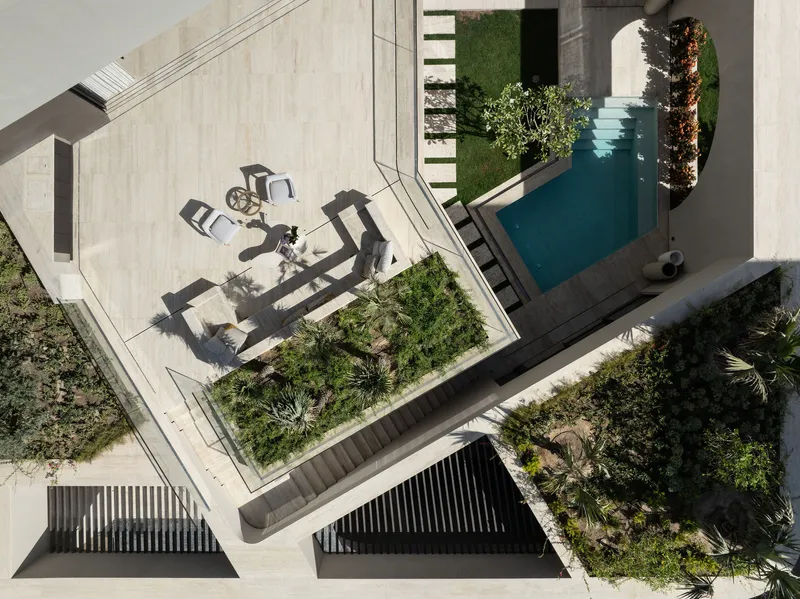
Seen from the garden side, the house reveals its true ambition. The massing steps back in tiers, each level pulling away to create a terrace, each terrace thick with planting. Olive trees, sunken beds, and cantilevered edges blur the distinction between architecture and landscape. The effect is closer to a hillside village than a single family home, a stack of inhabitable outdoor rooms climbing toward the sky.
The aerial view confirms the discipline behind the apparent informality. Courtyards, pool, and outdoor furniture are arranged with clear geometric intent, and long shadows reveal the depth of the overhangs that protect the spaces below. The cantilevered upper terrace shelters the open living room beneath, which opens through floor-to-ceiling glazing to the garden. In a Kuwaiti climate, this layering is not decorative. It is thermal strategy rendered as spatial sequence.
The Courtyard as Center of Gravity
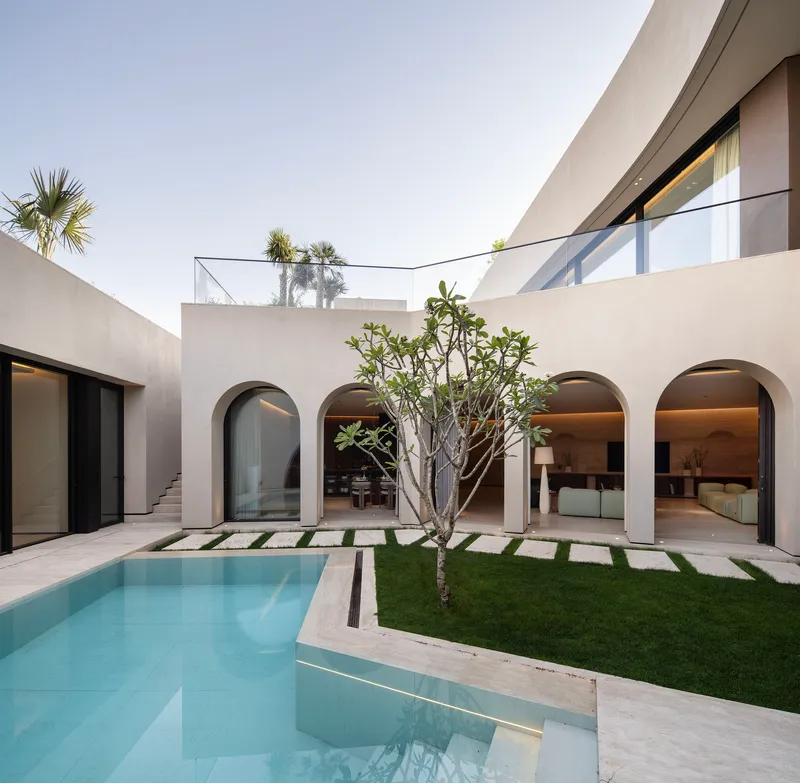
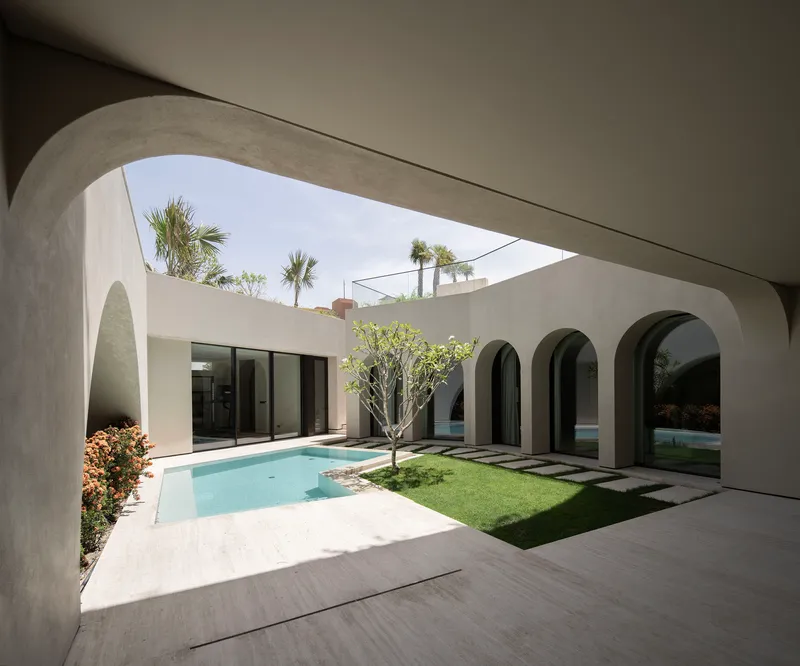
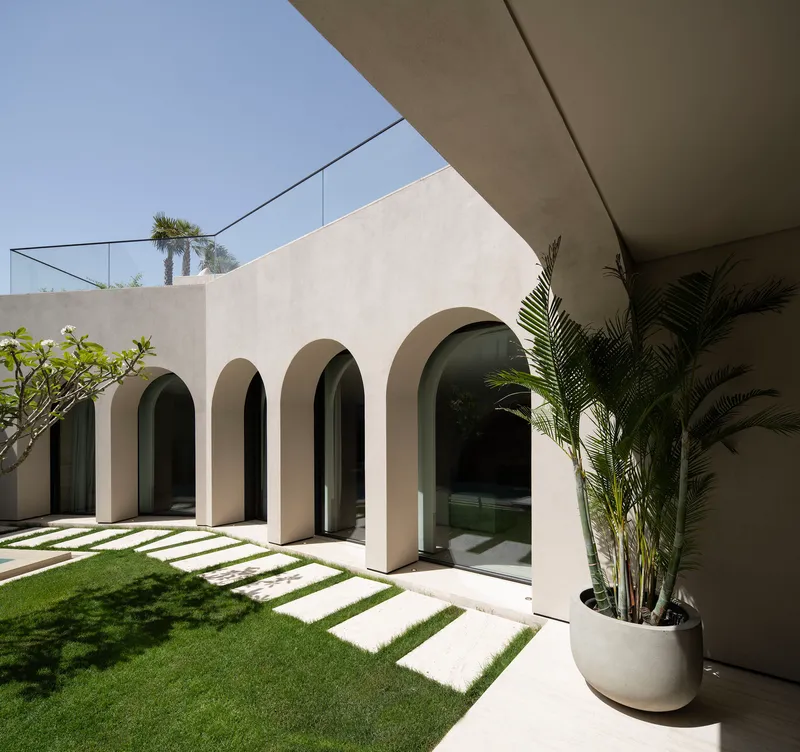
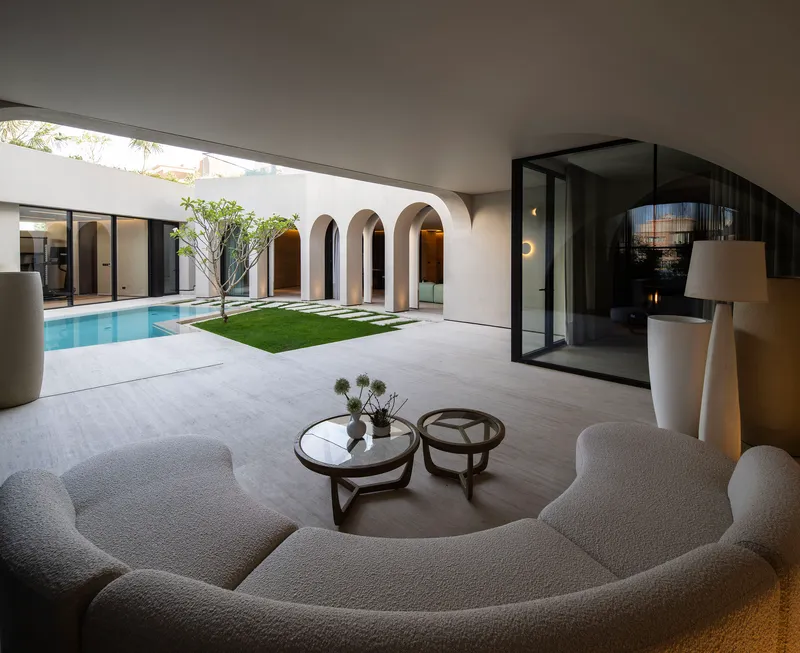
At the heart of the plan sits a rectangular pool flanked by lawn grid pavers and arched openings. Photographed at dusk, the courtyard glows with a quiet theatricality, the water reflecting the arches and the sky in equal measure. The proportions recall the riads of North Africa, but the material palette, smooth white plaster, pale stone, and restrained greenery, is distinctly contemporary Gulf.
The arcades surrounding the courtyard are deep enough to function as true outdoor rooms. Potted palms and stone pavers give them a sense of permanence rather than afterthought. Looking through the rounded arches toward the pool, one reads a layered sequence of frames within frames, a spatial technique as old as Islamic architecture itself, deployed here without pastiche. The courtyard does what the best courtyards have always done: it makes the sky a domestic surface.
Arches as Structural Poetry
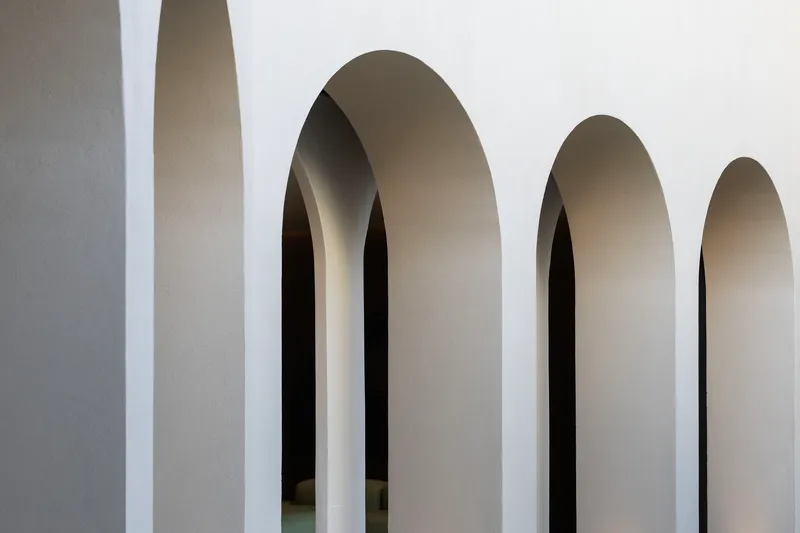
The arch is the project's primary motif, and Alhumaidhi Architects deploys it with discipline. A sequence of tall arched openings with smooth plaster reveals recedes into shadow, creating a colonnade that is at once muscular and delicate. The proportions are elongated, closer to parabolic than semicircular, which lends the spaces a verticality unusual in low-rise residential work.
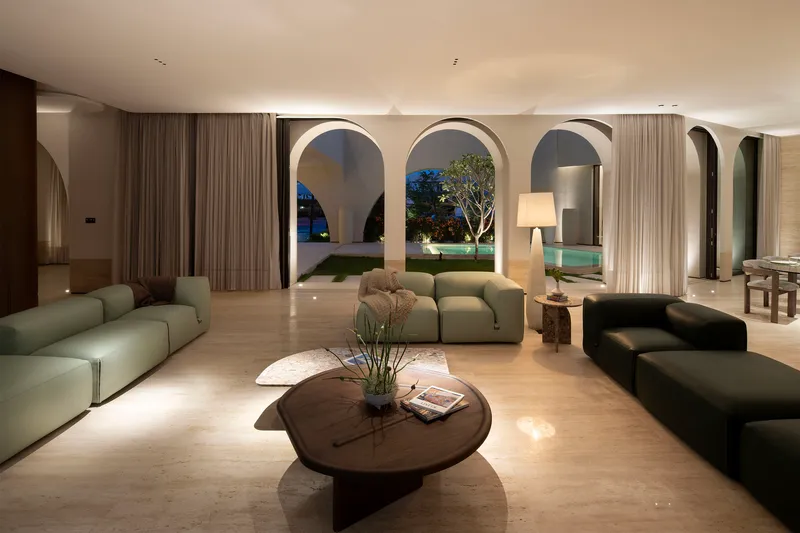
At twilight, the arched openings between interior and exterior become luminous frames, each one isolating a view of the illuminated garden and trees beyond. The effect transforms the living room into a kind of viewing gallery for the landscape. By repeating the arch at multiple scales, from the entry portal to the interior niches, the project achieves a formal coherence that many arch-heavy designs lose when they try to do too much.
Interior Atmospheres of Filtered Light
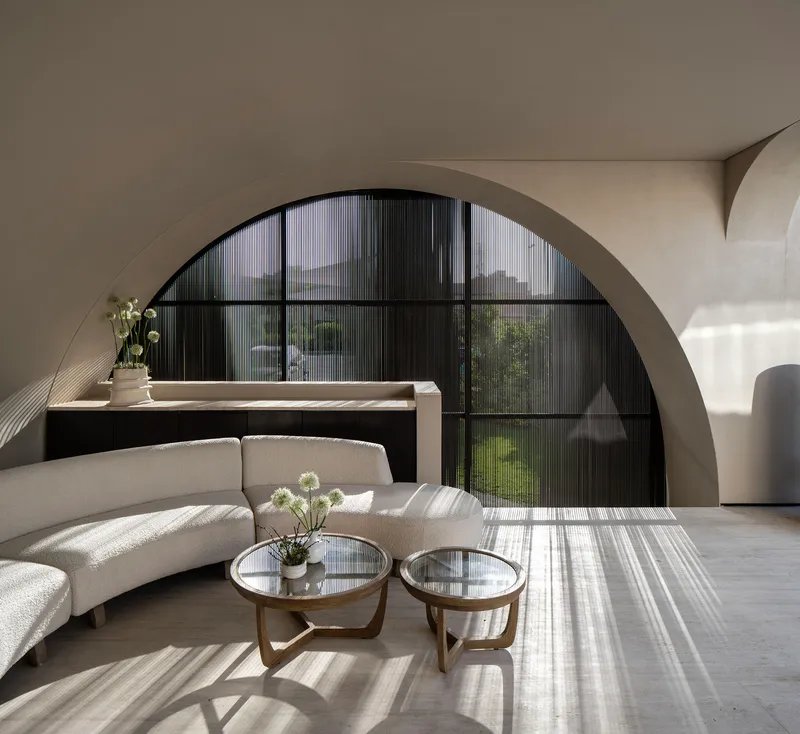
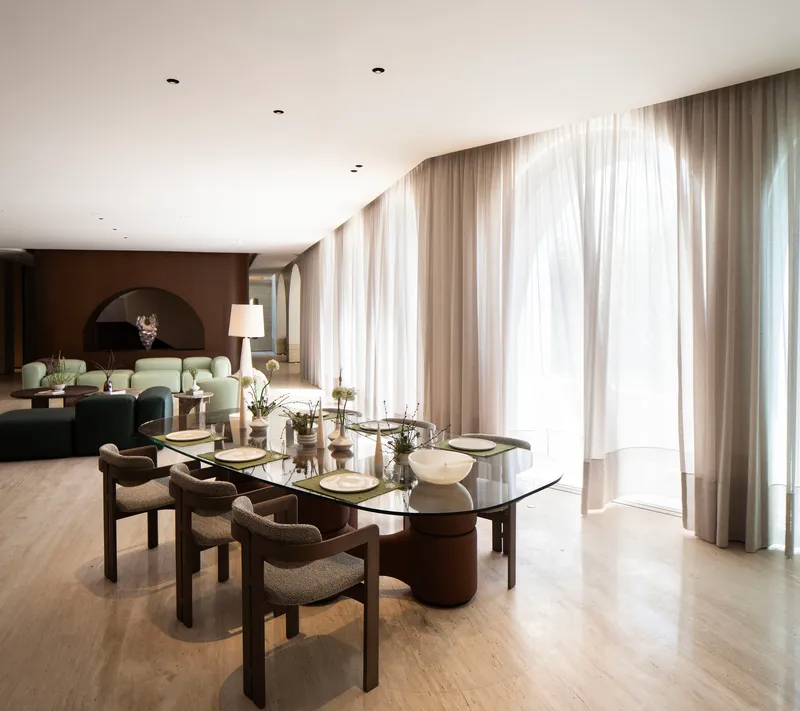
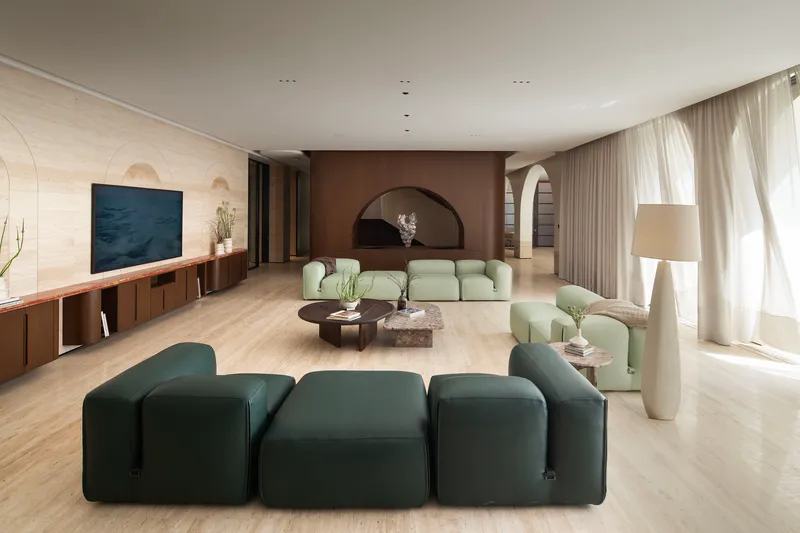
Inside, the material palette stays hushed: polished floors, pale timber, sheer curtains, and warm plaster tones. An arched black-framed window casts striped shadows across the living room floor, turning sunlight into pattern. The dining area is wrapped in floor-to-ceiling sheers that filter daylight into a soft, almost aqueous glow. These are rooms designed not to impress on first glance but to reward prolonged occupation, spaces where the quality of light changes by the hour.
A brown-toned arched wall niche in the living area introduces the only significant color contrast, and it reads as a sculptural recess rather than a decorative accent. The interiors resist the temptation of statement furniture or bold art; instead, the architecture itself provides the visual interest. It is a confident move that trusts the spatial quality to do the work.
The Rooftop as a Final Room
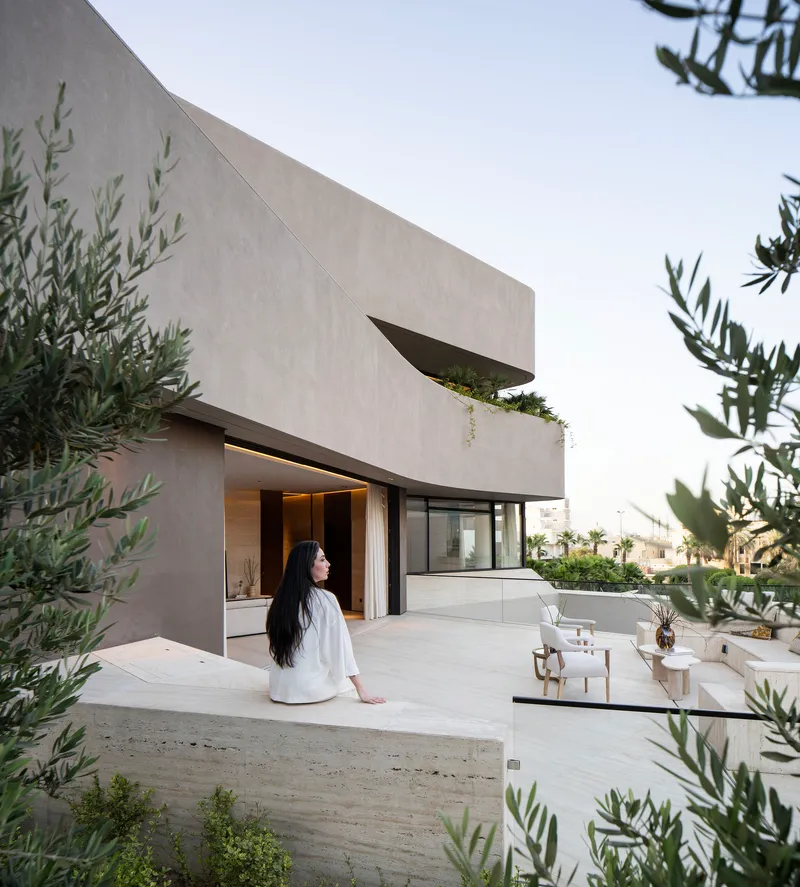
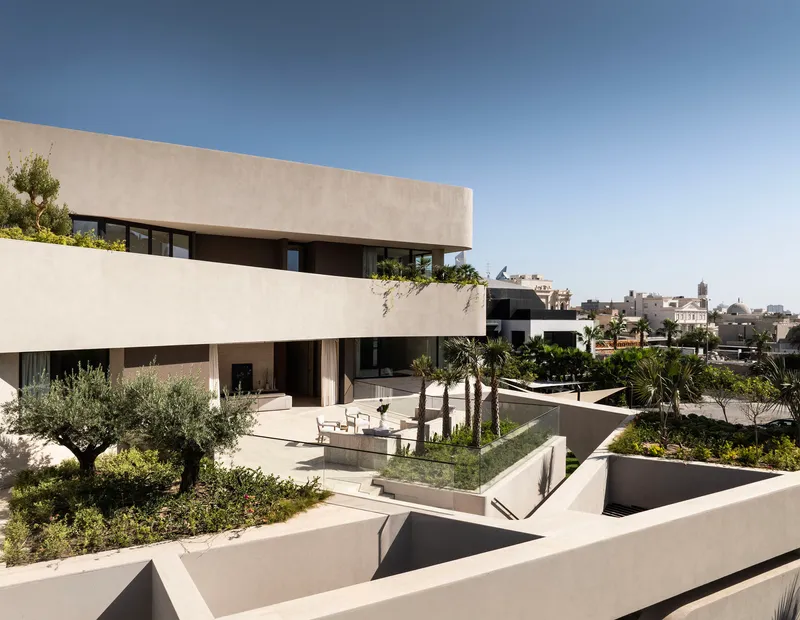
The roof terrace is treated as the culmination of the house's vertical journey. A cantilevered planter extends over the edge, olive trees cluster at the perimeter, and a seated figure in white surveys the distant cityscape at twilight. It is a private landscape elevated above the neighborhood, shielded from direct sightlines but open to the horizon.
The terraced garden courtyard below, with its olive trees and planted beds looking out over the city in afternoon light, reinforces the idea that every outdoor surface in this house is a room. There is no leftover space, no service yard hidden behind a wall. The landscape is as deliberately composed as the plan itself.
Plans and Drawings
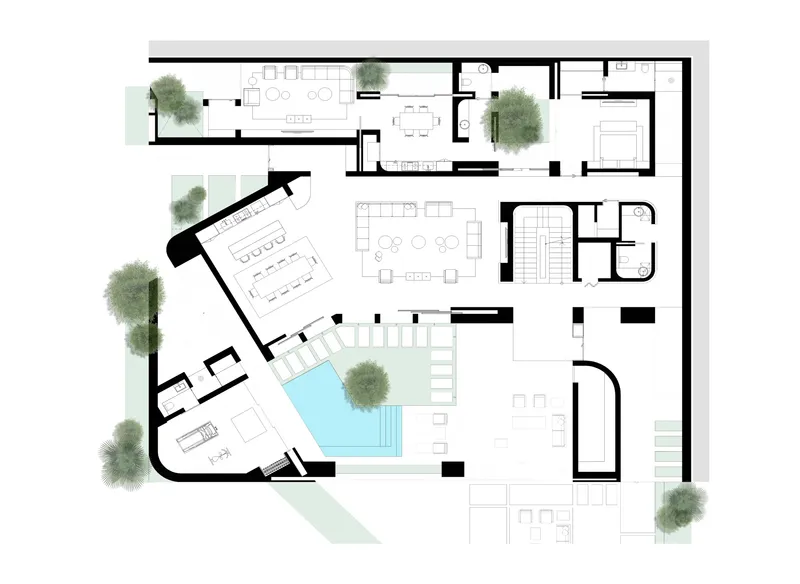
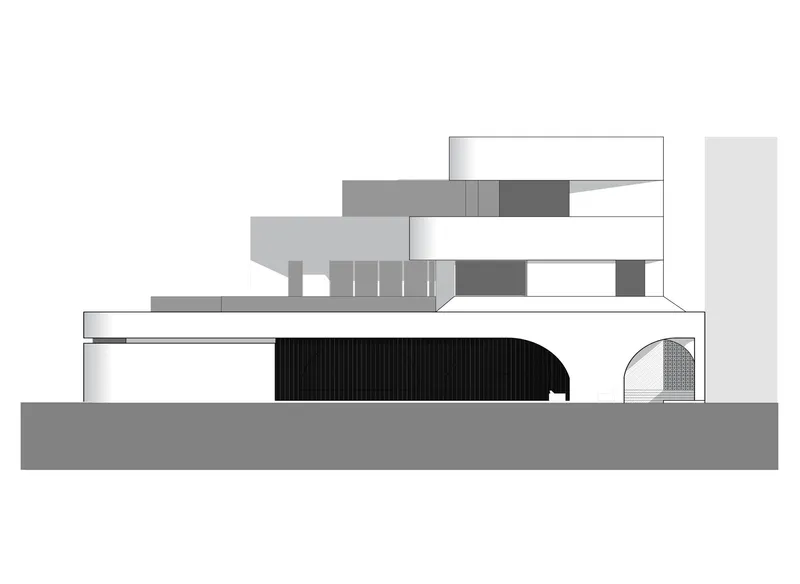
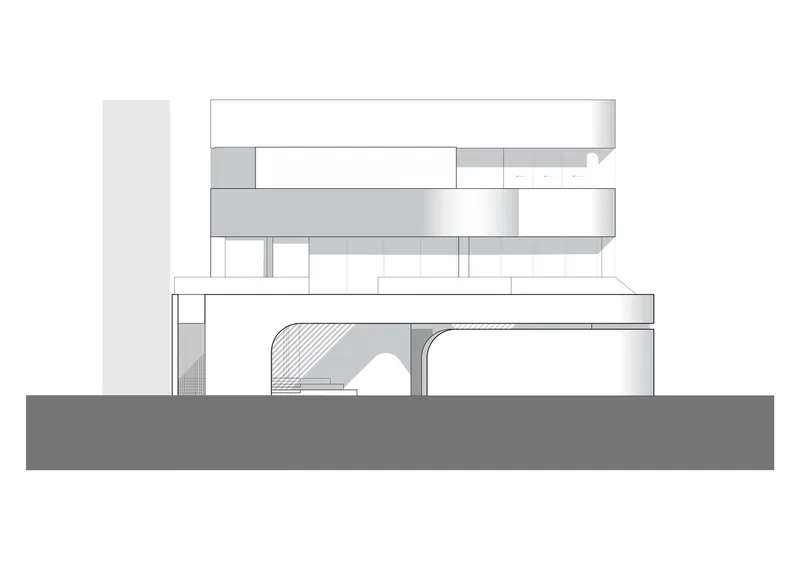
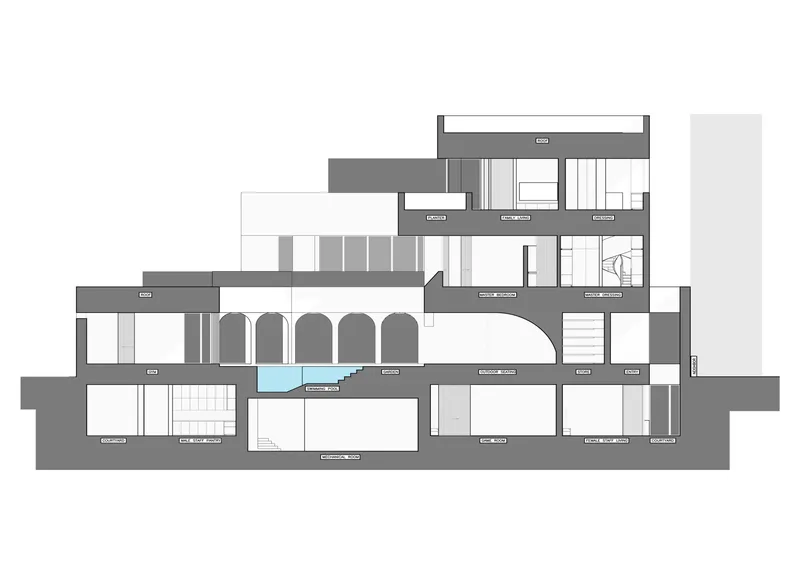
The floor plan confirms what the photographs suggest: rooms are angled around a central pool and courtyard, with planted trees anchoring the geometry. The organization is neither rigidly orthogonal nor freely curved; it occupies a middle ground where slight rotations create varied spatial relationships without sacrificing order. The sections reveal stacked floor plates connected by a curved interior staircase, with arched openings punctuating each level. A small pool appears on an upper level, a detail invisible from the street that speaks to the layered privacy of the design.
The elevation drawing shows the curved vertical louver screen that produces the radial shadows at the entrance. In section, one can read the full depth of the terraces and the generous floor-to-ceiling heights that allow the arched openings to achieve their proportions. These drawings are essential to understanding how the softness of the project is achieved through precise structural decisions, not merely through surface treatment.
Why This Project Matters
Shell House matters because it demonstrates that regional architectural identity in the Gulf does not require either historicist mimicry or imported minimalism. Alhumaidhi Architects has found a language that is legibly Kuwaiti in its courtyard logic, its climate responsiveness, and its spatial generosity, while remaining formally contemporary. The arches are not quotations; they are structural and atmospheric tools. The planting is not decoration; it is thermal regulation and spatial definition. Every element earns its place.
At a moment when luxury residential design across the region often defaults to glass boxes cooled by brute-force engineering, this house proposes an alternative rooted in passive strategy and spatial intelligence. The courtyard breathes. The terraces shade. The arches frame. It is a house that works with its climate rather than against it, and that alone sets it apart from the vast majority of its neighbors.
Shell House, designed by Alhumaidhi Architects, Abdullah al-Salem, Kuwait. Completed 2025. 1,788 m².
About the Studio
Share Your Own Work on uni.xyz
If projects like this are the kind of work you want to make, uni.xyz is a place to publish your own, find collaborators, and enter design competitions.


Popular Articles
Popular articles from the community


Singing Woman: An Opera House That Performs Before the Curtain Rises
Ovidiu Cristian Pavel's conceptual opera house translates Estonia's choral identity into a sculpted waterfront landmark facing the Baltic Sea.
Temporary Home for Dogs: A Reversed Zoo Rethinks Animal Shelter Architecture
In Bucharest, a sinuous corridor and freed landscape flip the logic of containment, designing a shelter that works to make itself unnecessary.

Manzana Morphosis: Stretching Barcelona's Grid into a Living Landscape for 2050
A radical reworking of the Eixample manzana turns density into a tool for generous public space, vertical ecology, and environmental performance.

The Amber Palace Opera: A Geological Fiction Surfaces on Tallinn's Baltic Waterfront
Pierre Brillard reimagines a Baltic legend as a public landscape, opera house, and waterfront promenade rooted in Tallinn's coastal identity.

Similar Reads
You might also enjoy these articles

Pixel Gardens: One Repeated Module Stacked Into a Terraced Social Housing Tower for Famagusta
Salem Bader's shortlisted housing tower builds a vertical neighbourhood from one repeated module, offsetting units to carve terraces, light and air.

Bao Huynh Watercolor Atelier: A Serene Art Retreat in Hội An
Bao Huynh Watercolor Atelier in Hội An blends multifunctional art spaces, sustainable design, local materials, and family-friendly living in a serene environment.

Atelier Macri Concept Store Interior Design by CASE-REAL
Atelier Macri store features a "ko" counter, walnut wood details, cork displays, blending retail, gallery, and seamless customer experiences.

Manuel Vargas Izquierdo Stadium and High-Performance Sports Center: Architectural Excellence in Jalpa de Méndez
The Manuel Vargas Izquierdo Stadium blends sustainable design, inclusive sports facilities, and cultural-inspired architecture, revitalizing Jalpa de Méndez’s public spaces.

Comments (0)
Please login or sign up to add comments
No comments yet. Be the first to comment!