
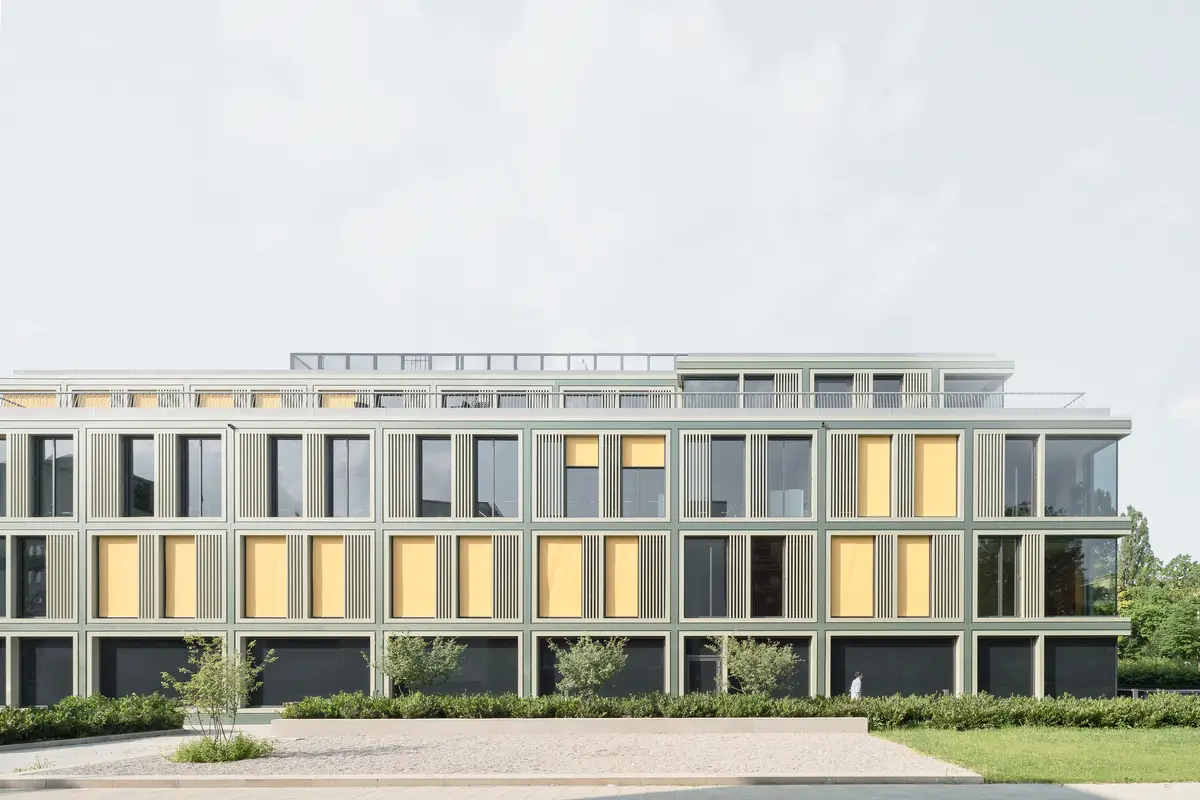
allmannwappner Strips a 1971 Munich Office Block Back to Its Bones and Gives It a Crisp Glass Skin
A Bogenhausen district renovation replaces closed parapets with storey-high glazing, turning a dated commercial building into a light-filled workplace.


Most postwar commercial buildings in Munich's residential districts share a common fate: they age poorly. Band windows with opaque parapets, minimal ground-floor presence, and generic massing make them invisible until they become actively ugly. The office building at Stuntzstraße in Bogenhausen, built in 1971, was a textbook example of that trajectory. Rather than demolish it, allmannwappner chose to revitalize the existing structure, peeling away the tired facade and rethinking how the 4,190 square meters of office and retail space could perform for another generation.
What makes the project worth studying is not the ambition of the intervention but its precision. The architects did not add floors or substantially alter the footprint. Instead, they replaced the old band-like facades with storey-high element facades, introduced corner glazing where solid walls once stood, and reorganized the floor plates around flexible open plans. The result is a building that looks entirely new yet sits within the same structural envelope, a quiet argument for the economic and environmental logic of renovation over replacement.
A New Face from Old Bones


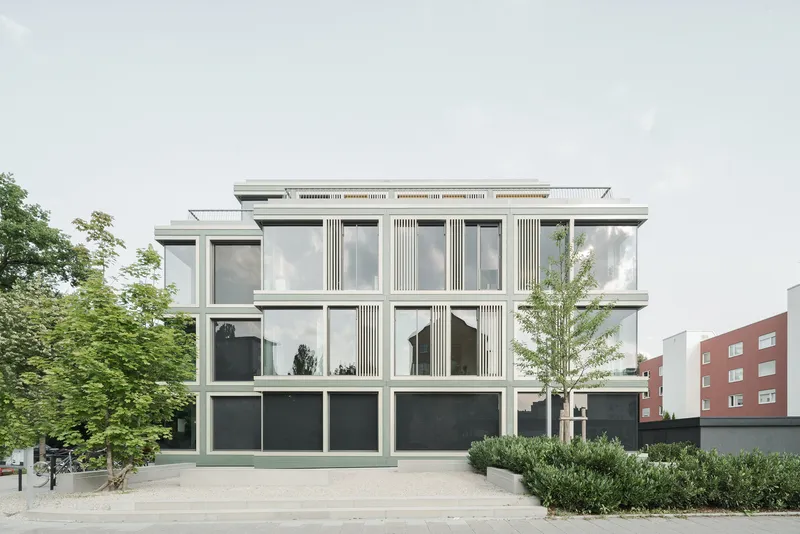
The original facade was a product of its era: horizontal bands of glazing interrupted by closed parapets that cut the building into thin slices. allmannwappner replaced this with floor-to-ceiling glass panes set within precisely framed light-colored mullions, creating a vertical rhythm that completely recharacterizes the proportions. A dark base at ground level anchors the composition and gives the upper floors a sense of floating, something the 1971 version never achieved.
At the corners, the glazing wraps without structural interruption, dissolving what were previously the building's most inert moments. The ground floor eliminates recesses and freestanding supports, producing a cleaner, more clearly contoured silhouette against the streetscape. It reads as a confident, contemporary volume rather than a timid renovation.
The Vertical Fin as Organizing Device


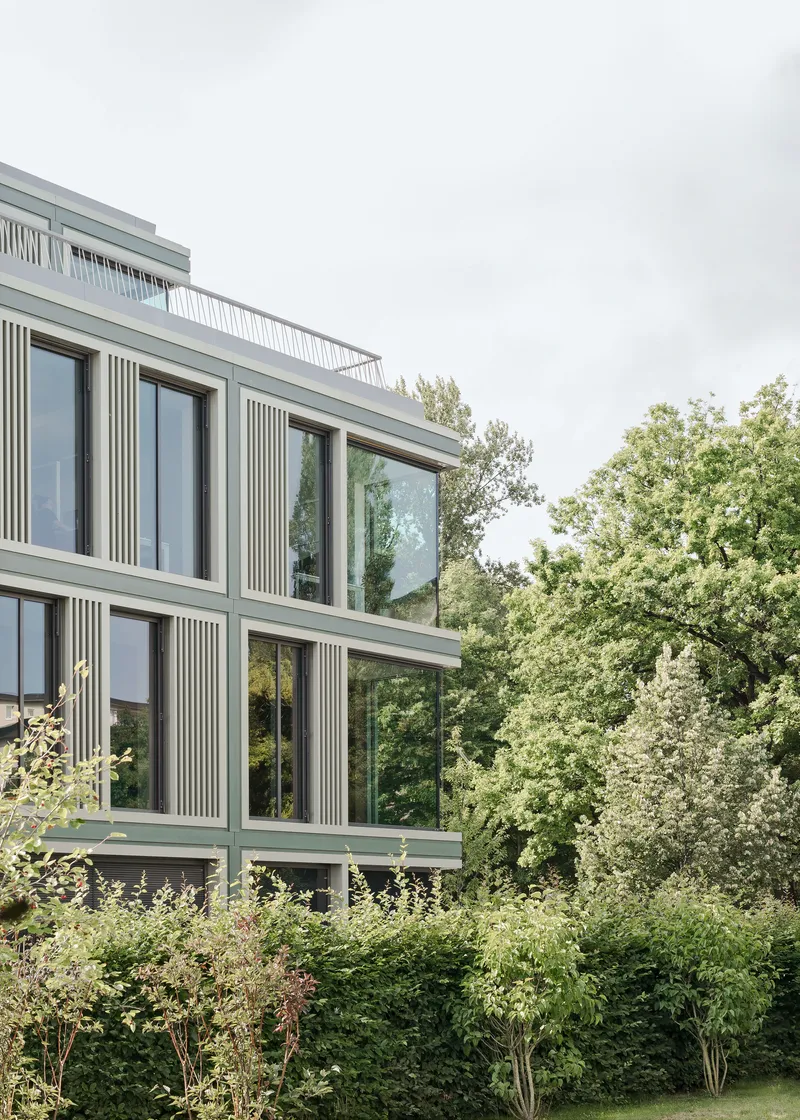
Look closely at the facade and you notice the vertical fin mullions are doing more than holding glass in place. They establish a cadence across the long elevations that prevents the building from reading as a flat curtain wall. In close-up, the fins project enough to create a layered depth, casting shadows that shift throughout the day and giving the surface a tactile quality that flat glazing never achieves.
On the upper floor, the fins transition into slat screens in front of a recessed terrace, signaling the setback without a jarring change in material language. The detail is worth noting because it solves a common problem in renovations: how to articulate the top of a building that was never designed to be read as an architectural roofline. Here, the screening simply thins out the same vertical vocabulary, letting light and air filter through while maintaining the facade's discipline.
Long Elevations and the Landscape Buffer


The building's longest face stretches along a planted strip that acts as a soft threshold between the street and the office floors. Mature trees and dense ground-level planting soften the repetitive grid and give the facade a context that a hard sidewalk edge would deny it. In summer, the canopy partially obscures the upper floors, producing a layered view where architecture and landscape intermingle.
This is not incidental. Bogenhausen is a leafy district, and a commercial building that ignored that character would feel alien. The planting strategy anchors the renovation in its neighborhood, allowing the crisp new facade to coexist with residential streets lined with old trees. It is a small move, but it makes the difference between a building that happens to be in a garden district and one that belongs there.
Dusk Reveals the Interior

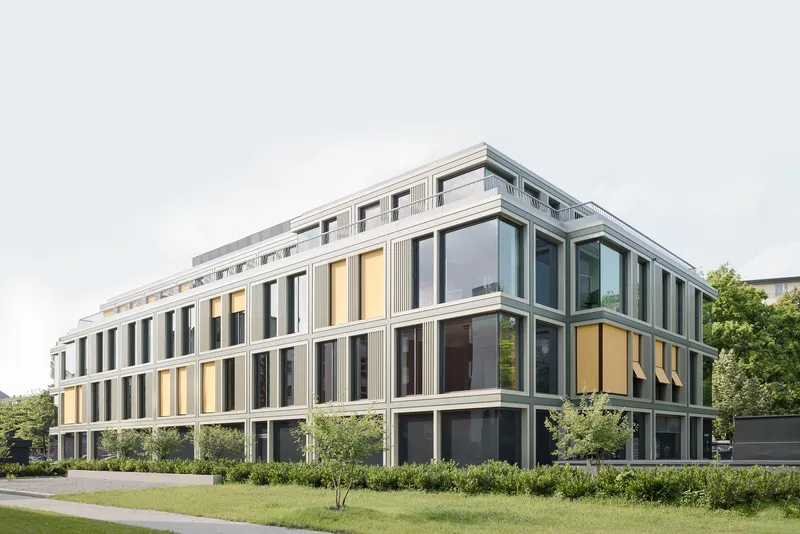
At dusk, the storey-high glazing does what it was designed to do: it dissolves the boundary between inside and out. The office floors glow behind the grid, and the building becomes a lantern that communicates activity without exposing it. The old band windows would have leaked light in thin horizontal strips. The new facade radiates it in full-height panels, each floor legible as a single luminous field.
From the garden side, the effect is even more pronounced. The lawn in the foreground reflects ambient light, the shrubs become silhouettes, and the building reads as a warm, inhabited volume rather than a dark commercial box. It is a transformation that costs nothing in terms of additional energy or technology; it is simply the consequence of replacing opaque spandrels with clear glass.
Plans and Drawings
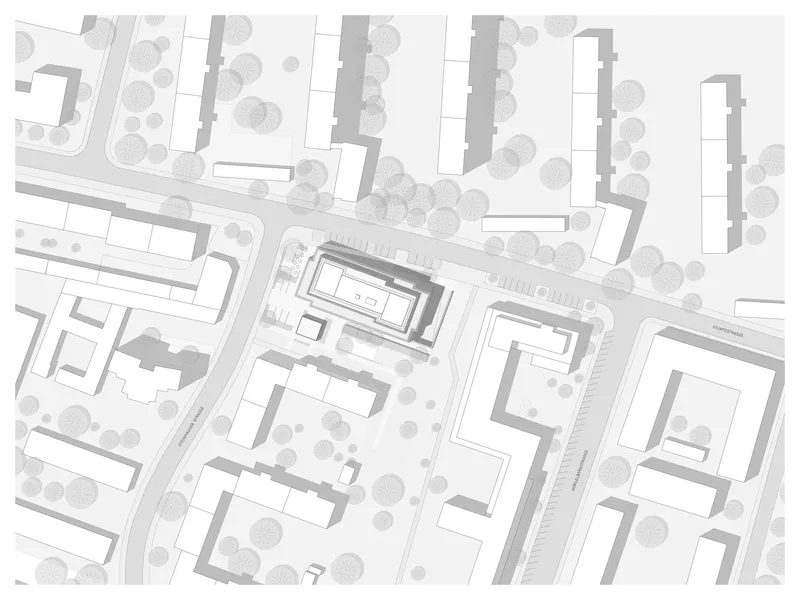
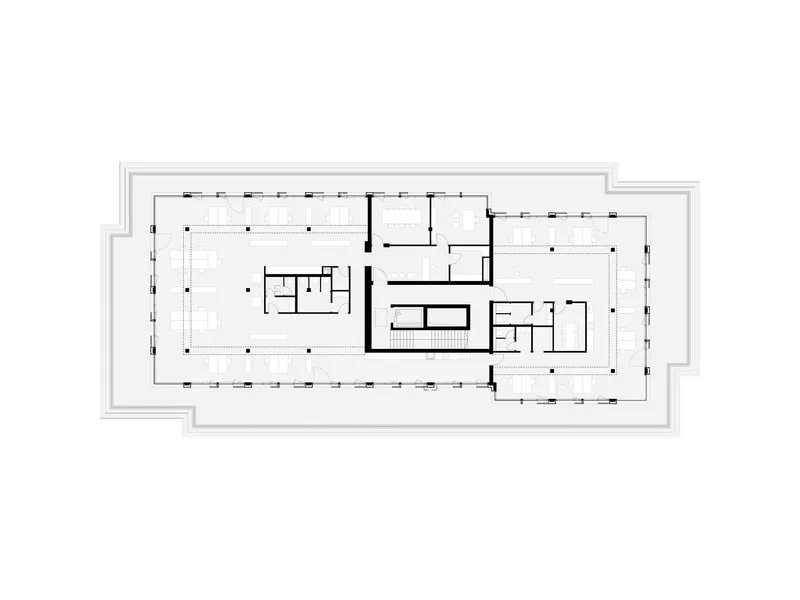

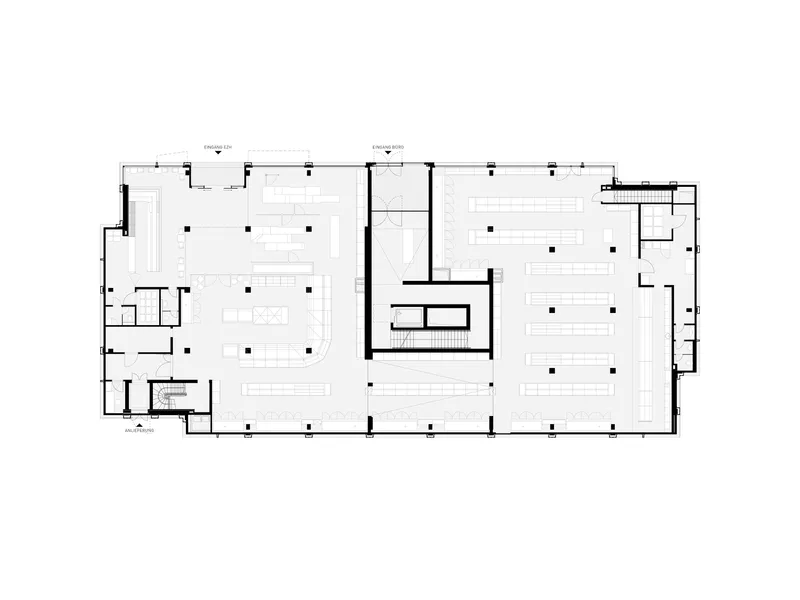


The site plan reveals the building's orientation along curved streets typical of Bogenhausen's postwar planning, with rows of trees framing the approach. In plan, the floor plates are organized around a central circulation core containing two stairwells and service spaces, freeing the perimeter for continuous open workspace. This layout is the key to the building's flexibility: tenants can configure the floor as a single open landscape or subdivide it into enclosed rooms along the edges without disrupting circulation.
The sections confirm what the exterior suggests: three standard floors plus a recessed top level beneath a sloped roof, connected by diagonal staircases that cut through the central core. A lower adjacent wing extends the usable area without competing with the main volume's height. The proportional logic is straightforward, and that is precisely the point. allmannwappner resisted the temptation to sculpt the section into something dramatic, opting instead for clarity and repeatability, qualities that make the building genuinely useful rather than merely photogenic.
Why This Project Matters
The case for renovation over demolition is often made in environmental terms, and rightly so. But Stuntzstraße makes an equally compelling argument on design grounds. By working within the constraints of the existing structure, allmannwappner was forced into a discipline that new construction rarely demands. Every decision, from the mullion depth to the corner glazing, had to negotiate with a building that already existed. The result is tighter, more considered, and ultimately more convincing than many ground-up office projects twice its size.
For the Bogenhausen district, the renovation turns a liability into an asset. A building that was aging into irrelevance now offers flexible, light-filled workspaces behind a facade that engages its tree-lined street with confidence. It is not a landmark project, and it does not need to be. It is a demonstration that mid-century commercial stock, far from being disposable, is a resource waiting to be unlocked by architects willing to look at what is already there.
Office Building Stuntzstraße by allmannwappner, Bogenhausen, Munich, Germany. 4,190 m². Completed 2021. Photography by Brigida González.
About the Studio
Share Your Own Work on uni.xyz
If projects like this are the kind of work you want to make, uni.xyz is a place to publish your own, find collaborators, and enter design competitions.


Popular Articles
Popular articles from the community


Manzana Morphosis: Stretching Barcelona's Grid into a Living Landscape for 2050
A radical reworking of the Eixample manzana turns density into a tool for generous public space, vertical ecology, and environmental performance.


graciastudio Turns a Viewless Tijuana Lot Inward Around a Courtyard of Concrete, Timber and Trees
In Tijuana, Jorge Gracia's GA2 House stacks a timber-clad private floor over exposed concrete and replaces a missing view with a planted interior patio.

Opera on the Sea: Driftwood Logic Shapes a Timber Opera House on Estonia's Coast
Trevor Orgill's opera house translates the entangled drift of floating timber into a civic building where wood, water, and music converge.

Cube Design Draws an Ecological Corridor Between Two Shenzhen Hills with the Nankai Building
Beside Shenzhen's container docks, the Nankai Building pairs stacked balconies with a climbing green screen to connect two hillsides across its height.

Similar Reads
You might also enjoy these articles

LAVA Architecten Gives Vocational Education a Sawtooth-Roofed Face on a Mechelen School Campus
In Mechelen, Belgium, a 2,053 m² STEM school on a 6×6 m grid turns workshops and classrooms into rooms that can be rearranged as teaching changes.

KEMA Studio Turns a Derelict Marvila Attic into a 60 m² Lighthouse Apartment Above Lisbon
In Lisbon's Marvila district, a rebuilt roof, four skylights and two plywood volumes turn an unlivable attic into a bright home facing the Tagus.

Pixel Gardens: One Repeated Module Stacked Into a Terraced Social Housing Tower for Famagusta
Salem Bader's shortlisted housing tower builds a vertical neighbourhood from one repeated module, offsetting units to carve terraces, light and air.

Bao Huynh Watercolor Atelier: A Serene Art Retreat in Hội An
Bao Huynh Watercolor Atelier in Hội An blends multifunctional art spaces, sustainable design, local materials, and family-friendly living in a serene environment.

Comments (0)
Please login or sign up to add comments
No comments yet. Be the first to comment!