
all(zone) Grows a Tropical Pavilion Market from a Vacant Bangkok Lot
A 550 m² steel-framed commercial center in Khlong Toei wraps walkways, cafés, and urban farming around preserved trees.


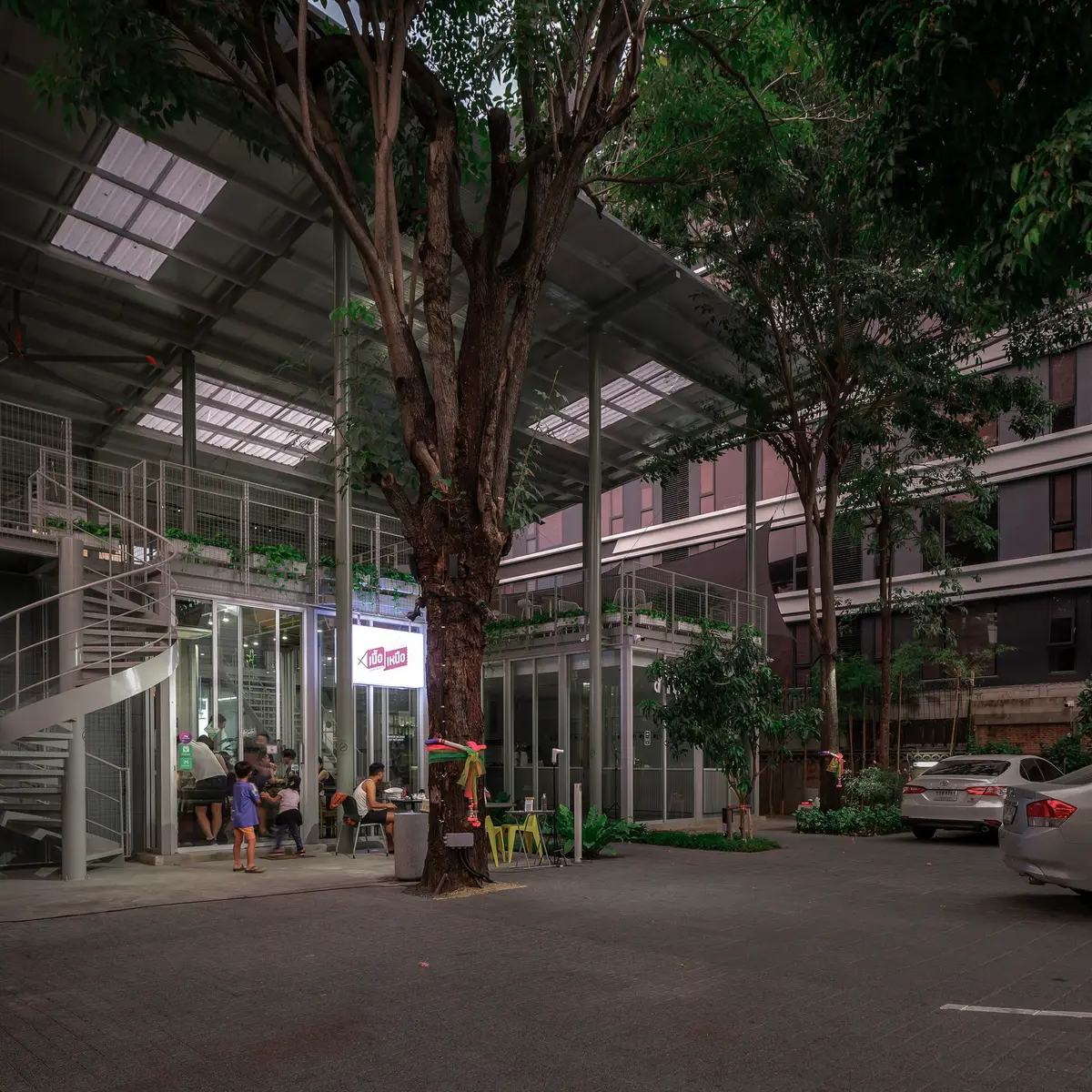
Bangkok offers its residents 6.9 square meters of green public space per capita, a figure that falls short of the WHO standard by more than two square meters. In a city where large parks exist but remain inaccessible to most daily routines, the question of what counts as green space becomes practical rather than philosophical. all(zone) answered that question in 2020 by turning a vacant lot in Khet Khlong Toei, wedged between high-rise residential towers, into POWWOWWOW: a four-story semi-outdoor commercial center that doubles as a garden, a food market, and a platform for urban farming.
What makes the project genuinely interesting is not the program itself, which is a familiar mix of cafés, food stalls, and weekend markets, but the logic that organizes it. The building is conceived as a big roof without walls: a tropical pavilion where steel structure, wire mesh, and crawling vines replace the sealed envelope of a typical commercial block. The site's existing mature trees were preserved, and new plantings are almost exclusively edible herbs, vegetables, and fruits. Visitors are encouraged to take them home. The architecture, in other words, is less a building than a scaffold for urban life to colonize.
A Roof First, Then Everything Else
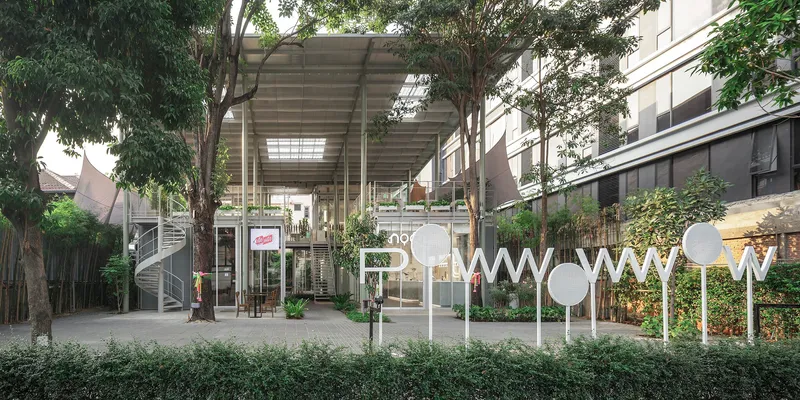


The corrugated metal canopy is the primary architectural gesture. It extends well beyond the building's footprint to shade walkways, terraces, and planted voids below. Translucent skylight panels punctuate the roof, casting geometric shadows that shift through the day. The effect is closer to a forest canopy than a commercial shelter: dappled, layered, constantly changing.
Structurally, the roof sits on a straightforward steel frame, which keeps columns slender and the ground level open. The construction system, steel structure, concrete block walls, and glass panels on aluminum frames, was designed from the outset to be dismantled and reassembled. The building treats permanence as optional, an honest acknowledgment that the 2020 Thai tax reform encouraging commercial use of vacant land could, in theory, reverse course.
Vertical Circulation as Public Space
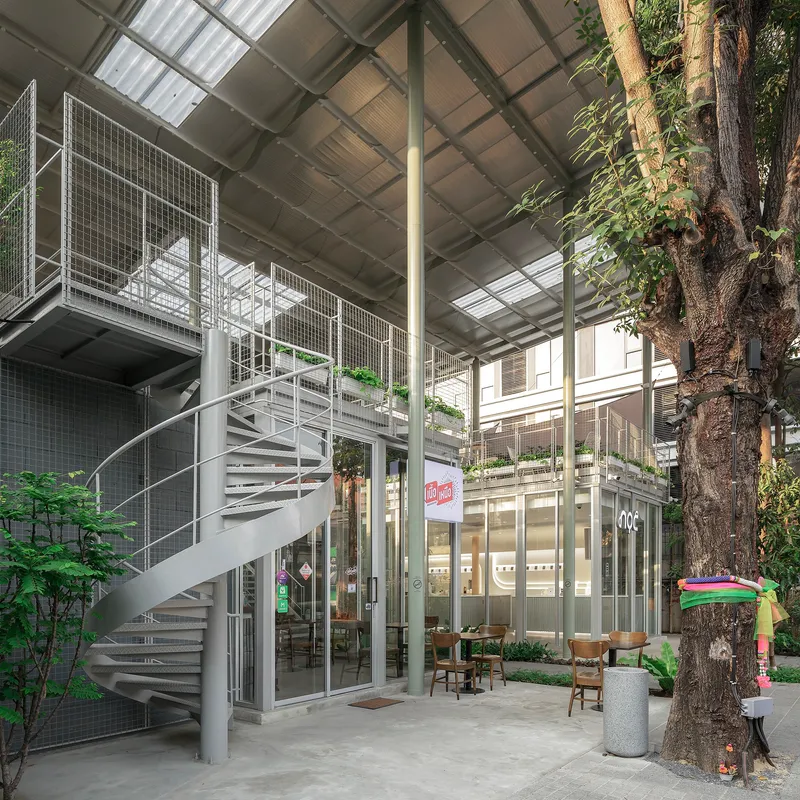
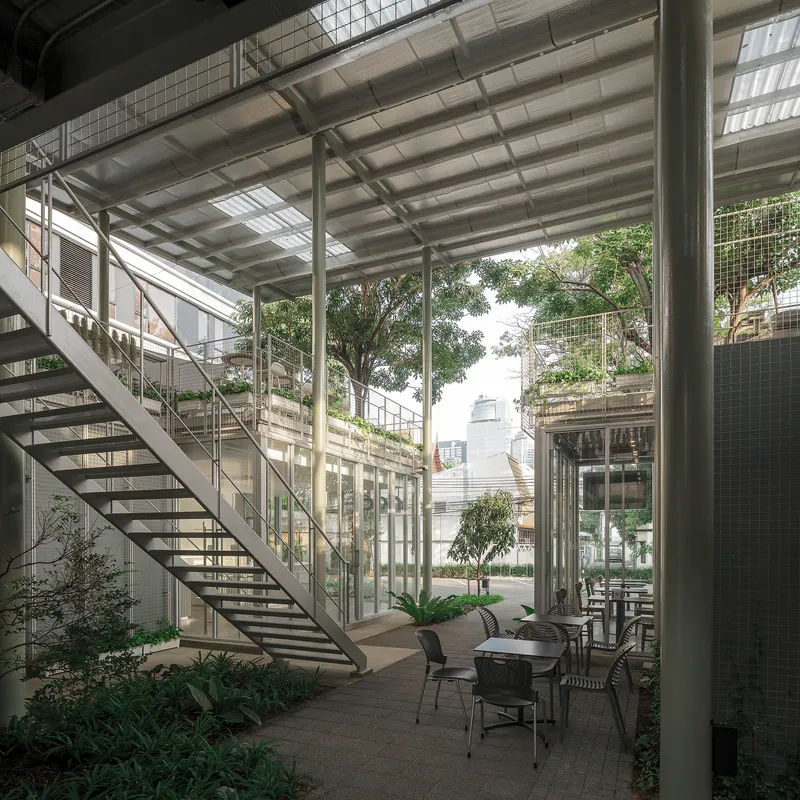

The helical steel staircase in the central courtyard is not just a circulation device; it is the social engine of the building. Rising through a void where a mature tree's roots remain exposed, the stair connects four levels of walkways that look down into planted courtyards and out toward the surrounding towers. People gather at the base. Diners observe from mesh-clad balconies above. The arrangement collapses the distinction between moving through the building and occupying it.
The walkways themselves are generous enough to pause on but narrow enough to feel like streets rather than corridors. Wire mesh balustrades keep sightlines open across the atrium, so you are always aware of the tree canopy below and the activity on other levels. It is a miniature vertical neighborhood rather than a stacked shopping mall.
Planting as Building Material


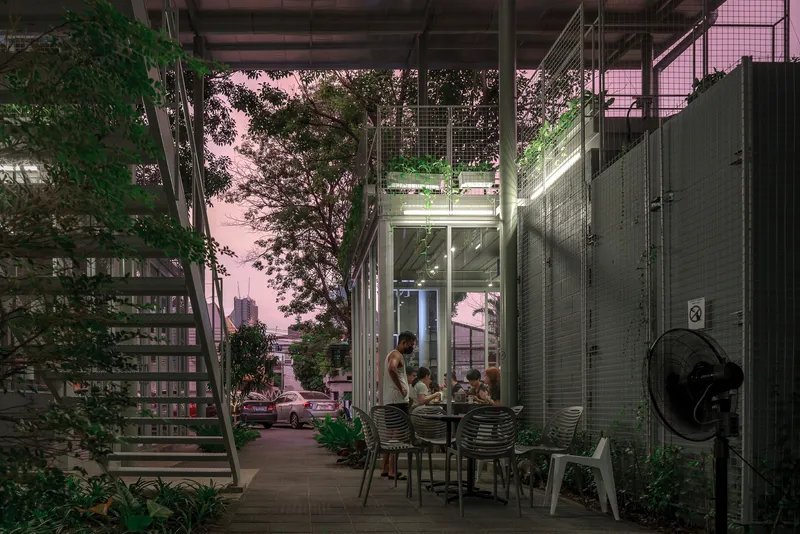
all(zone) committed to maintaining the volume of vegetation that existed on the vacant lot before construction. That is an unusually specific promise for a commercial project, and the design delivers it through a layered strategy. Opaque walls and fences serve as trellises for climbing vines. Wire mesh facade screens hold integrated planter boxes. Potted trees and crawlers colonize every terrace, gradually softening the steel and glass.
The plant selection is deliberate. Following local tradition, nearly all new species are edible: herbs, vegetables, and fruits that fuse contemporary urban farming with the practical knowledge of Thai home gardens. The result is a building whose green surfaces are productive, not decorative. At ground level, mature trees provide thermal comfort without mechanical cooling, while the density of planting across the facade and balconies creates a microclimate measurably cooler than the surrounding streets.
Glass, Mesh, and the Dissolving Envelope


The building envelope oscillates between transparency and permeability. Glazed storefronts face the ground-level passages, giving cafés and rental spaces a street-front presence. But above and beyond those panels, wire mesh takes over, allowing air to pass freely through the structure. The mesh is dense enough to define edges without creating enclosure, which is exactly the thermal strategy a tropical pavilion needs.
Walking through the corridors, you encounter an unusual layering: glass, then planting, then mesh, then trees, then sky. The sequence never resolves into a clear interior or exterior condition. Pedestrians on the lane connecting Sukhumvit 42 and Sukhumvit 40 can look straight through the building. The commercial center reads as a passage rather than a destination, which is precisely what makes people linger.
The Upper Levels
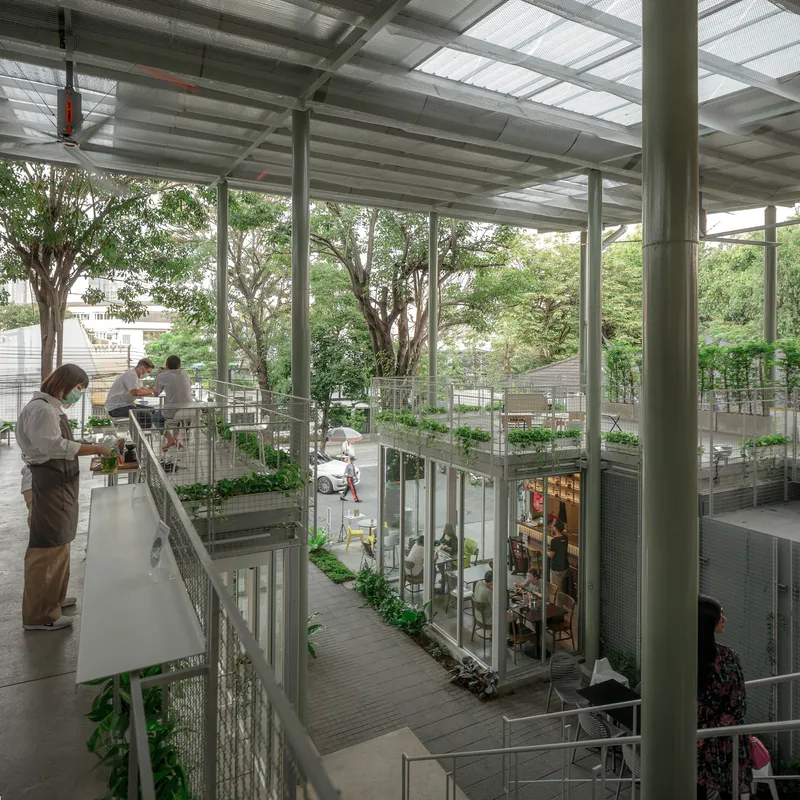


As you ascend, the character shifts. The upper walkways become quieter, more exposed to the sky through the translucent roof panels. White bar seating lines the mesh railings, oriented toward the courtyard void and the treetops rather than inward toward the retail units. These terraces function as informal co-working zones, reading spots, and observation decks depending on the hour.
The split-level organization means no two floors share the same section. Spaces step up and down relative to each other, creating pockets of intimacy within the otherwise open frame. It is a compact 550 square meters, but the vertical layering and visual connections to the trees give the building a spatial generosity well beyond its footprint.
Plans and Drawings
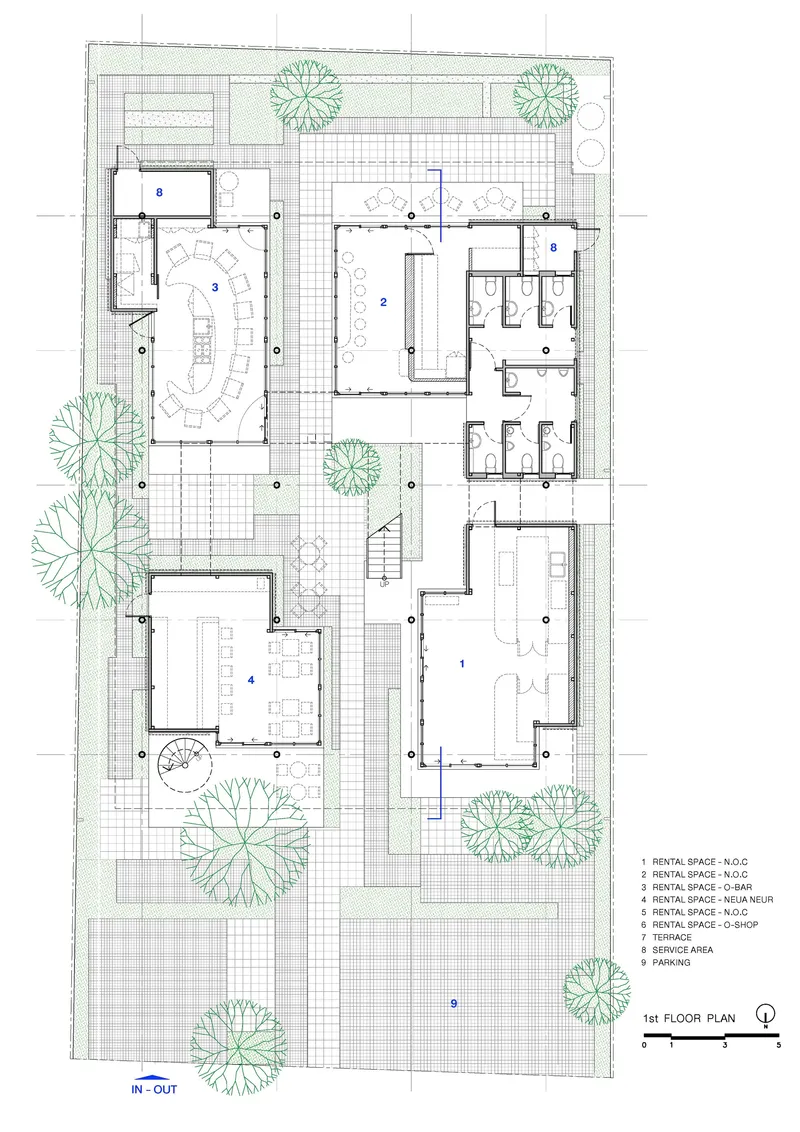
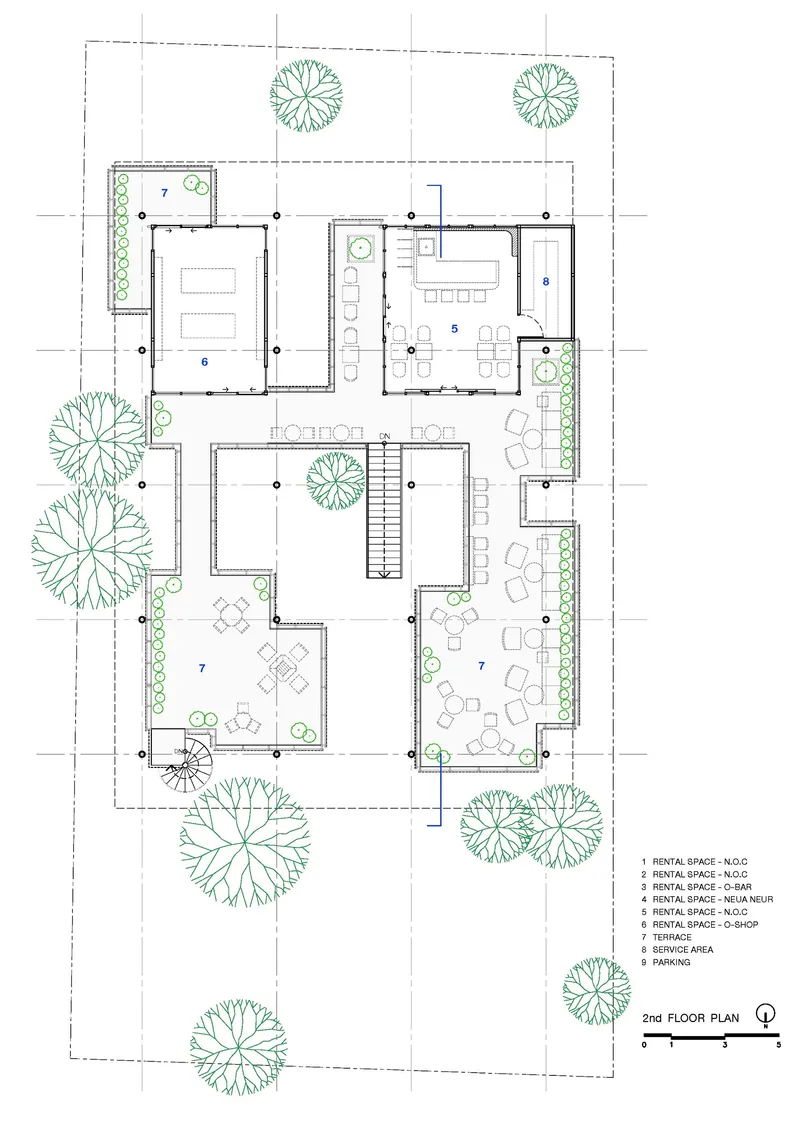
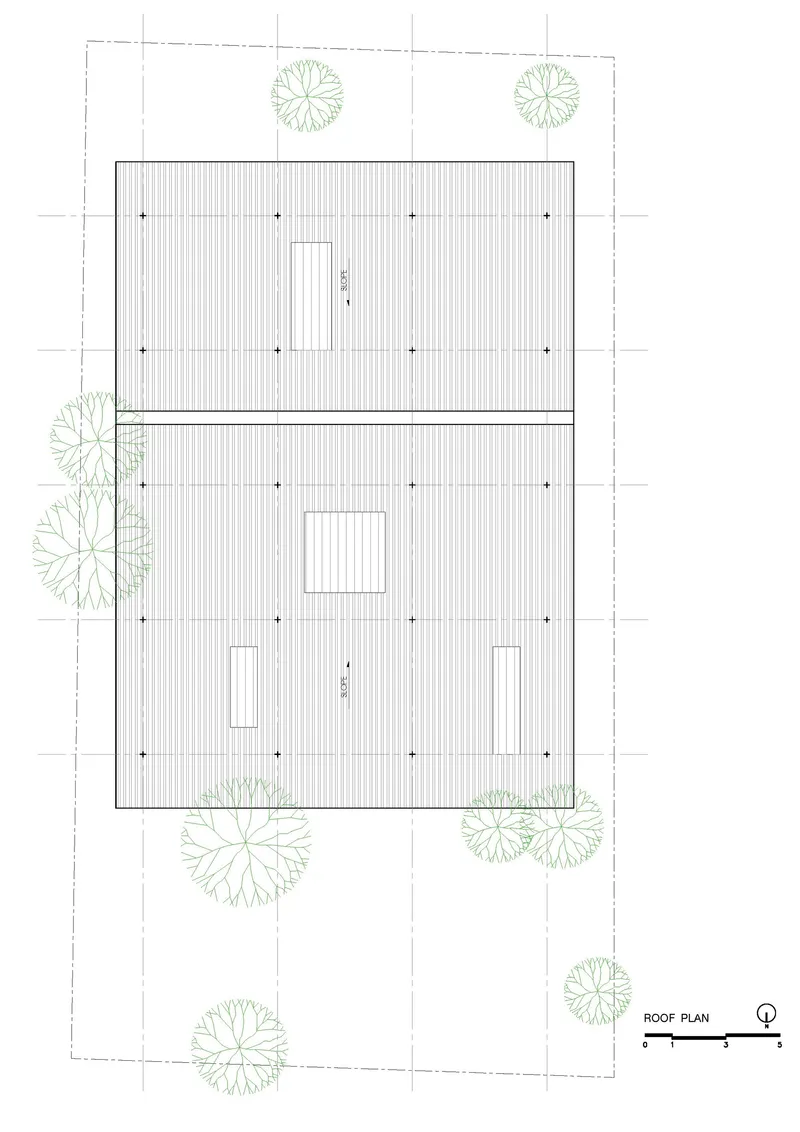
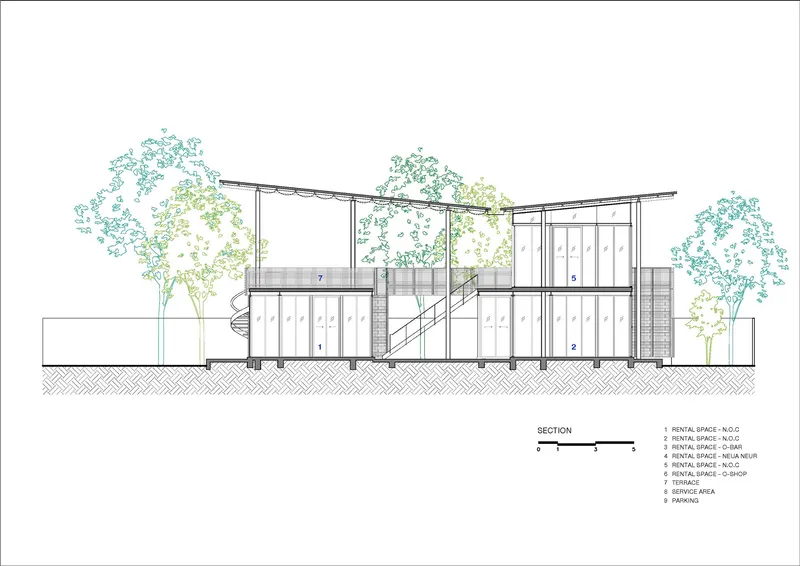
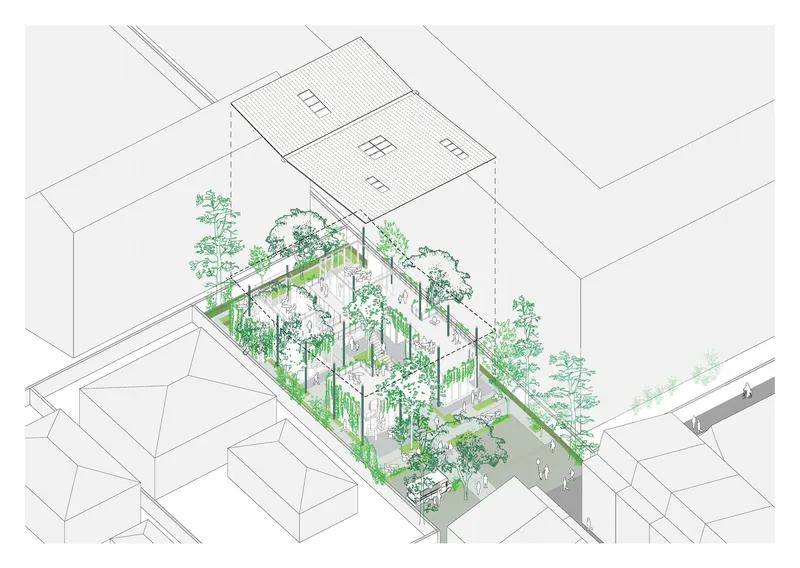

The floor plans reveal the courtyard as the organizational spine. Rental spaces line the edges, facing both inward toward the trees and outward toward the surrounding streets. The first floor plan shows how the central void is not merely leftover space but is the largest single area on each level, reinforcing the idea that the garden is the building and the built zones are its frame.
The section drawing clarifies the split-level logic and shows how the preserved trees extend through multiple stories, their canopies meeting the underside of the roof. The axonometric and isometric drawings are particularly revealing: they show the courtyard as a dense pocket of green embedded within a tight urban block, surrounded on all sides by the hard edges of the city. The contrast is the point. POWWOWWOW does not pretend to be a park. It inserts porosity and vegetation into the one typology Bangkok has in abundance: the commercial lot.
Why This Project Matters
The most common response to Bangkok's green space deficit is to call for more parks. all(zone) offers a sharper proposition: make everyday commercial infrastructure do the work of public green space. POWWOWWOW is a market, a garden, and a social condenser simultaneously, and it sits on a plot that would otherwise be either empty or sealed inside a conventional retail box. The fact that the entire structure can be disassembled and relocated makes it less a permanent monument than a replicable tactic, a template for how vacant sites across the city might host productive, vegetated, genuinely public commercial life.
The project also offers a material argument that resonates beyond Thailand. In tropical climates where the sealed, air-conditioned envelope remains the default commercial model, POWWOWWOW demonstrates that a steel frame, a generous roof, and strategic planting can create thermal comfort without mechanical systems. When the walls are mesh and the plants are edible, architecture stops being a container and starts being infrastructure for urban ecology. That is a quiet but radical shift, and it deserves more attention than the modesty of a 550 square meter market might initially suggest.
POWWOWWOW Commercial Center by all(zone). Khet Khlong Toei, Bangkok, Thailand. 550 m². Completed 2020. Engineering: Next Innovation Engineering. Construction Management: NEXT Steps Design & Consultants. Landscape Architect: Rachniporn Tiempayatorn. Lighting Designer: Kris Monopimok. Photography by Soopakorn Srisakul.
About the Studio
Share Your Own Work on uni.xyz
If projects like this are the kind of work you want to make, uni.xyz is a place to publish your own, find collaborators, and enter design competitions.


Popular Articles
Popular articles from the community


Opera on the Sea: Driftwood Logic Shapes a Timber Opera House on Estonia's Coast
Trevor Orgill's opera house translates the entangled drift of floating timber into a civic building where wood, water, and music converge.

Manzana Morphosis: Stretching Barcelona's Grid into a Living Landscape for 2050
A radical reworking of the Eixample manzana turns density into a tool for generous public space, vertical ecology, and environmental performance.

Faces of the Soviet Avant-Garde: Turning Moscow's Street Names into an Open-Air Museum
A network of sculptural installations across a Moscow residential district transforms forgotten architect names into spatial encounters with cultural memor

Singing Woman: Contemporary Architecture Inspired by Estonia’s Voice and the Sea
Singing Woman turns Estonia’s song culture into flowing opera house architecture, blending public life, landscape, sea, and national memory.

Similar Reads
You might also enjoy these articles

Bao Huynh Watercolor Atelier: A Serene Art Retreat in Hội An
Bao Huynh Watercolor Atelier in Hội An blends multifunctional art spaces, sustainable design, local materials, and family-friendly living in a serene environment.

Atelier Macri Concept Store Interior Design by CASE-REAL
Atelier Macri store features a "ko" counter, walnut wood details, cork displays, blending retail, gallery, and seamless customer experiences.

Manuel Vargas Izquierdo Stadium and High-Performance Sports Center: Architectural Excellence in Jalpa de Méndez
The Manuel Vargas Izquierdo Stadium blends sustainable design, inclusive sports facilities, and cultural-inspired architecture, revitalizing Jalpa de Méndez’s public spaces.
KAKR Buluh Awar Hall: Revitalizing Community and Ecology Through Bamboo Architecture
Community built bamboo hall revitalizes Buluh Awar village, empowering youth, restoring ecology, celebrating vernacular craftsmanship through sustainable architecture and culture.

Explore Shopping Center Competitions
Discover active competitions in this discipline

Challenge to design a portable theatre

Challenge to design a portable music platform

Challenge to design an open learning module for the elderly
Comments (0)
Please login or sign up to add comments
No comments yet. Be the first to comment!