
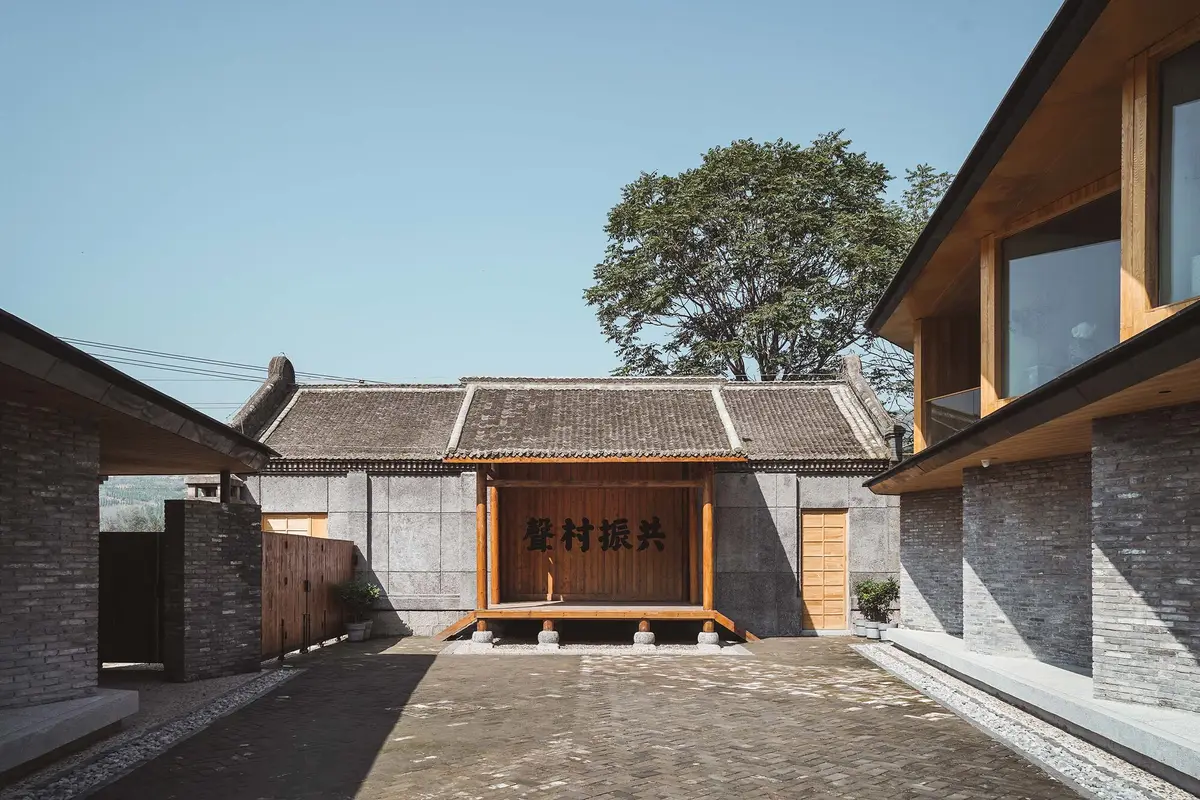
Approach Architecture Studio Revives a Coal-Era Village Committee into a Rural Cultural Center
In Henan Province's shallow mountain region, idle 1980s civic buildings become a bookstore, café, gallery, and tea house for Dananpo village.


China's rural coal towns carry a particular kind of architectural hangover. When the industry that justified a generation of civic construction recedes, buildings remain: brick committee halls, stone arched warehouses, paved squares that once organized community life but now sit empty. In Dananpo, a village in Henan Province roughly 50 kilometers from Jiaozuo City and within the scenic orbit of Yuntaishan, Approach Architecture Studio found exactly this condition. A cluster of 1980s brick and wood structures, formerly the village committee compound, had been idle for years while the community's economic support shifted to farming and migrant labor. The renovation, completed in 2021, converts these buildings into a 2,038-square-meter cultural center organized around the Fang Suo Rural Culture program, threading a bookstore, café, sales and exhibition center, restaurant, tea house, and art gallery through the existing fabric.
What makes the project worth studying is not the program itself but the discipline with which lead architects Jingyu Liang, Siyu Ye, and Yuan Zhou negotiated between preservation and insertion. Seven old stone arches on site are retained and reactivated. Courtyard walls that once sealed the compound from the street are removed, opening the square to village life. New timber-clad volumes and concrete canopies slot between existing brick buildings with a deliberate material contrast: warm timber against grey brick, poured concrete against weathered stone. The result is a cultural center that reads as both new and continuous, a place that acknowledges its coal-era origins without being nostalgic about them.
Before and During: Reading the Original Compound
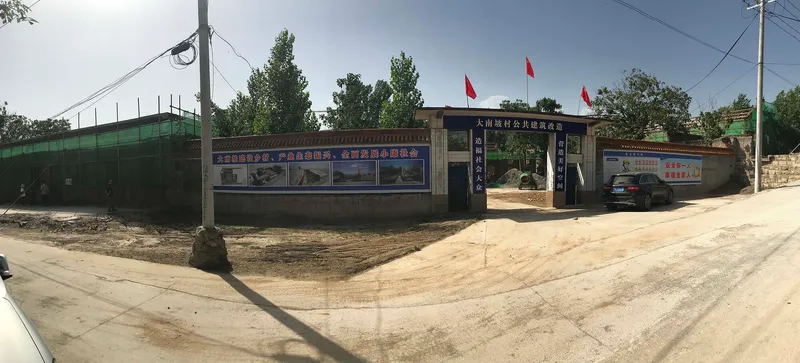
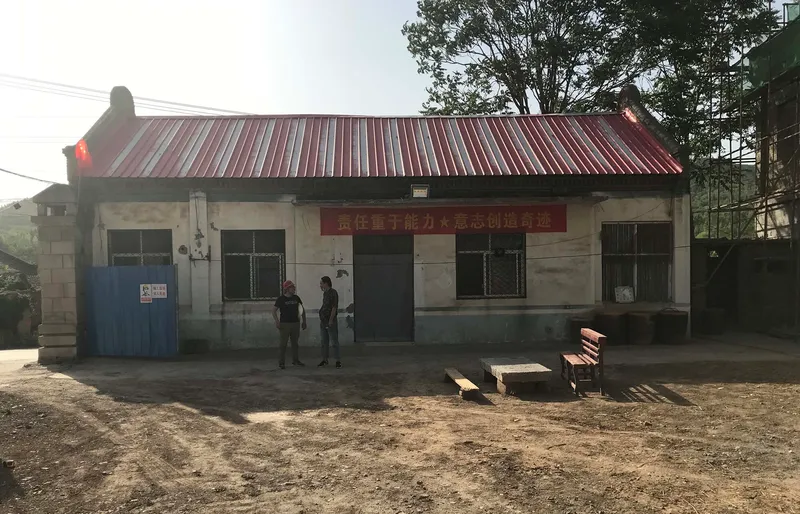
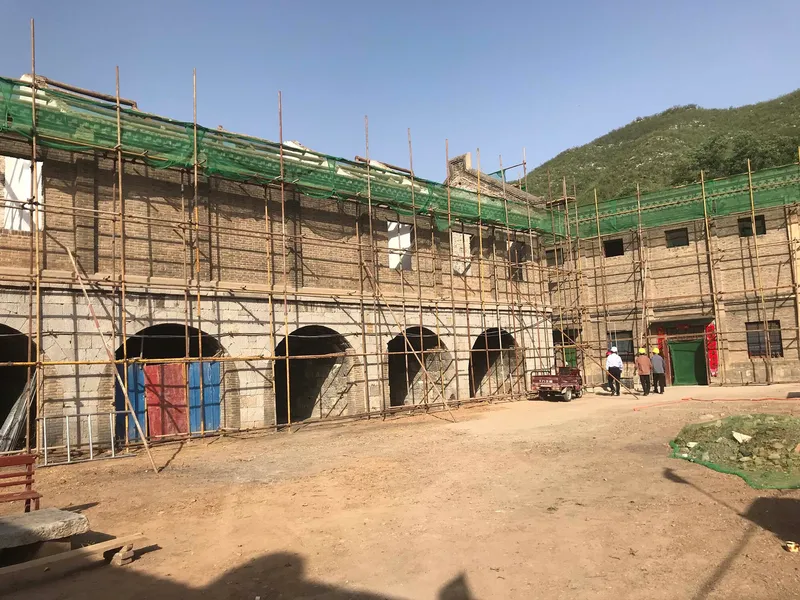
The pre-renovation photographs tell you everything about the stakes. A dirt courtyard, corrugated metal roofing, green chain-link fencing, overhead power lines, and the hazy flatness of a settlement that has been slowly losing its civic purpose. The compound's entrance was utilitarian, its facades weathered, its arched openings wrapped in bamboo scaffolding during the early phases of construction. These images are not just documentation; they are a baseline against which the renovation's restraint can be measured. Approach Architecture Studio did not arrive with a desire to erase. They arrived with a desire to understand what was already working spatially, even if the materials had degraded.
The arched openings visible through the scaffolding became central to the design strategy. Rather than infilling or replacing them, the studio treated these seven stone arches as connective tissue, linking a sunken courtyard restaurant to a newly built platform and corridor system. The decision to preserve structure while removing enclosure, keeping arches but opening walls, is a move that defines the entire project.
Opening the Compound: Courtyards as Public Infrastructure
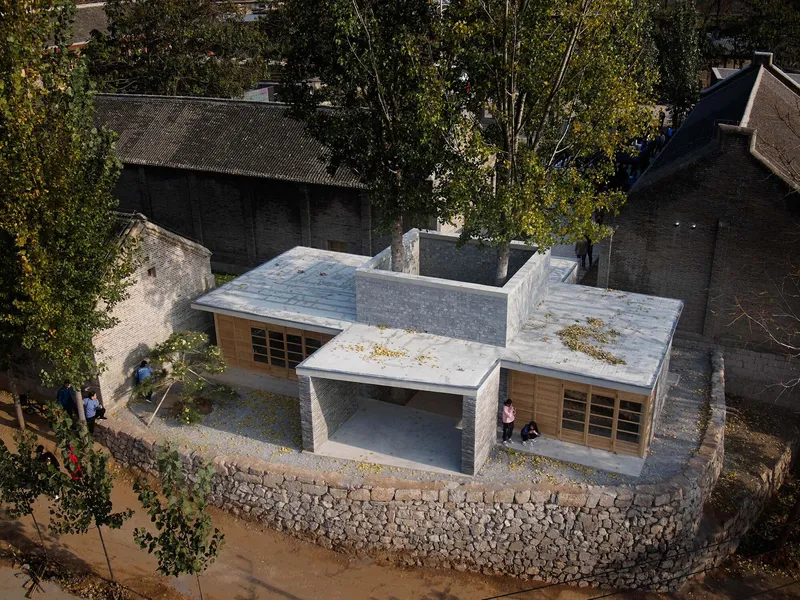
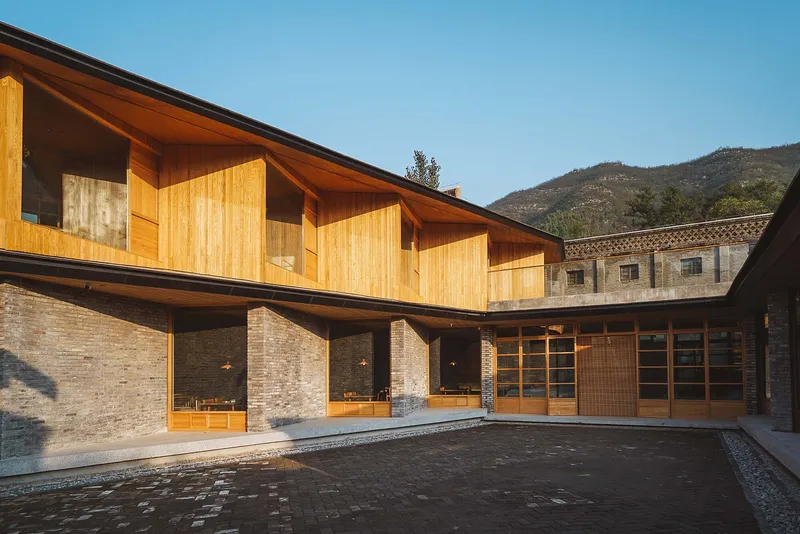
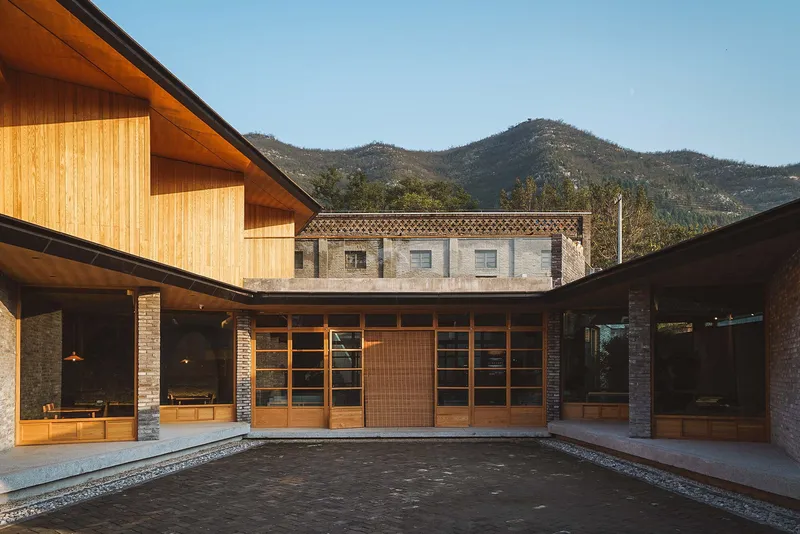
The aerial view reveals the strategy at a glance. The former compound wall is gone. Where the village committee once turned inward, the cultural center now faces the street, its courtyard becoming a shared ground between building and village. Gabion walls along the perimeter provide definition without opacity, and the paved courtyard between existing brick buildings functions as a kind of rural piazza, scaled to the village rather than the city.
Two courtyards emerge from the plan: one dedicated to vertical circulation and logistics, the other serving as a central public space for activities, gatherings, and informal use. The timber-clad volumes with sloped roofs and stone bases rise against the distant mountains, grounding the project in the terrain of Henan's shallow mountain region. The courtyard view in image 7, with its layered rooflines and autumn vegetation, demonstrates how the new volumes defer to the landscape rather than competing with it.
Material Conversations: Brick, Timber, Concrete
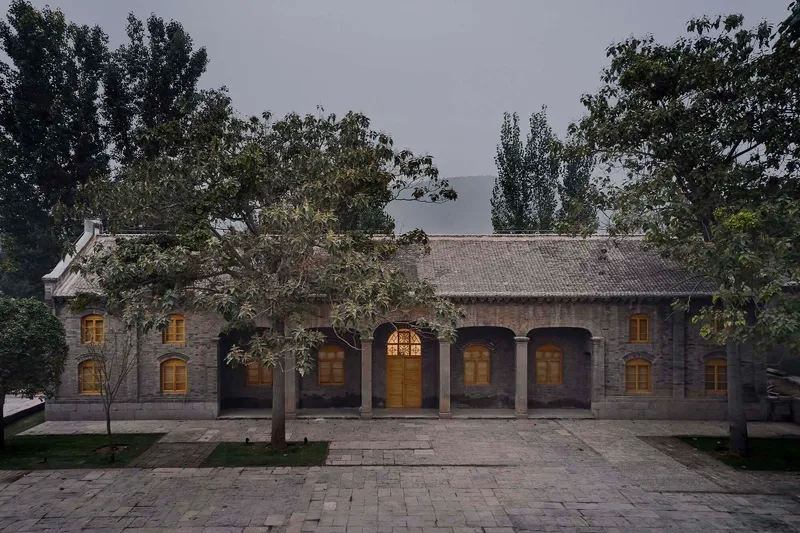
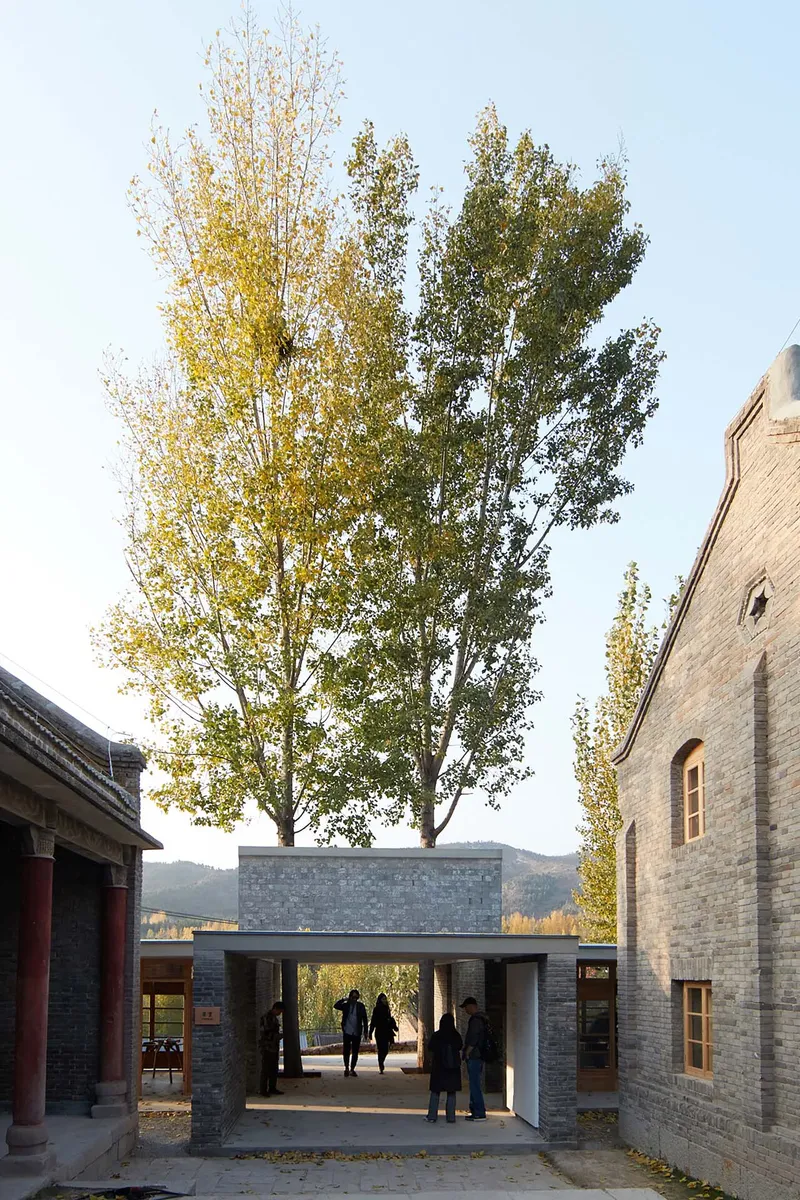
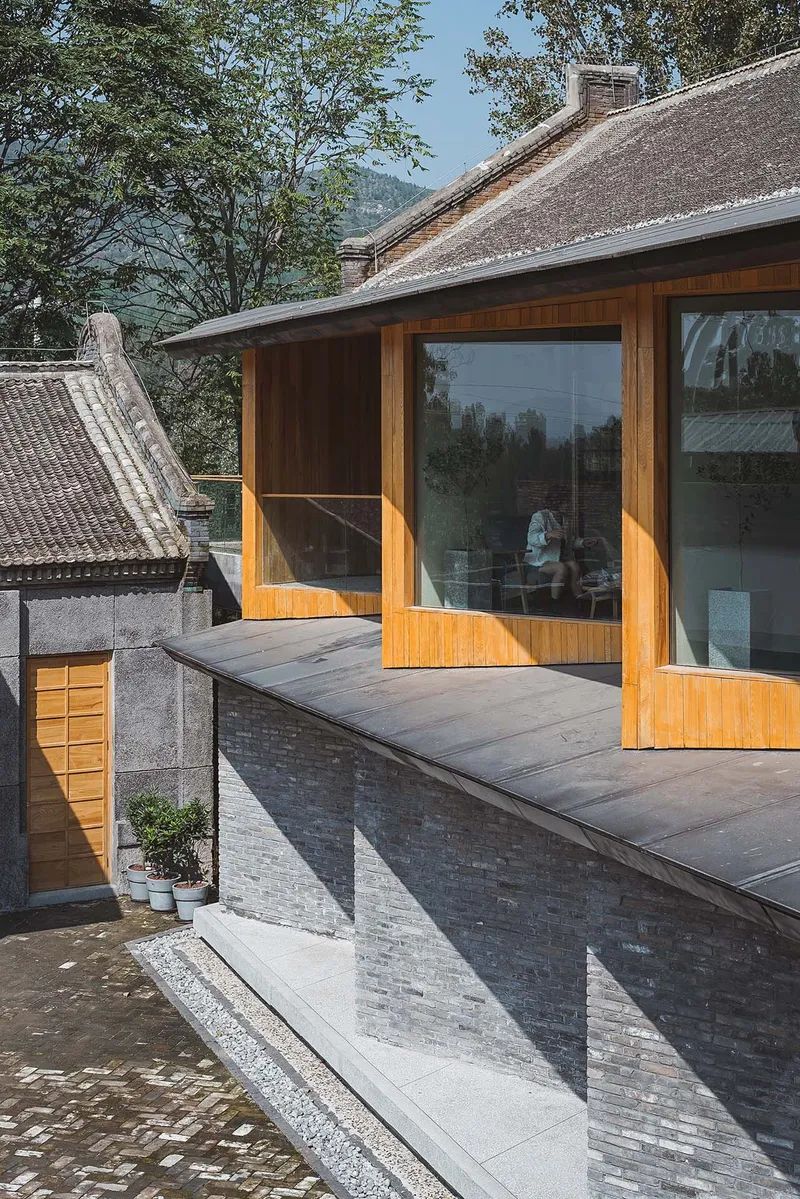
The material palette is deliberately tripartite. Existing grey brick walls anchor the compound in its history. New timber-framed glazed additions, cantilevered over brick walls and capped with roof decks, introduce warmth and transparency. Poured concrete appears as canopies, soffits, and structural beams, mediating between old and new without trying to mimic either. At dusk, the restored brick facade with its arched openings and tiled roof glows beneath overhanging trees, and the age of the building becomes legible rather than hidden.
The grey brick pavilion connecting two existing structures under tall autumn trees is one of the project's quietest moves. It is a link, not a statement. Its flat roof sits below the ridgelines of the older buildings, and its proportions suggest a covered outdoor room rather than a building in its own right. This kind of architectural humility is hard to maintain across a 2,000-square-meter renovation, but Approach Architecture Studio holds the line.
Thresholds and Passages
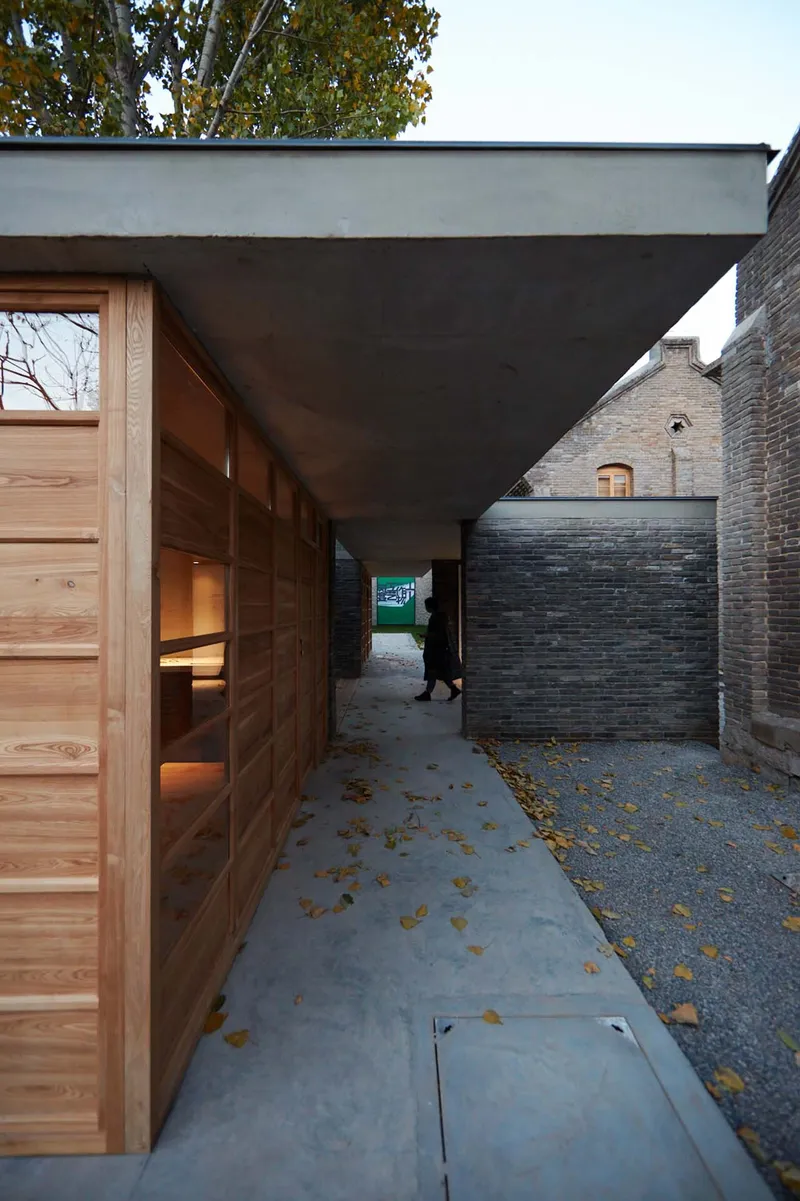
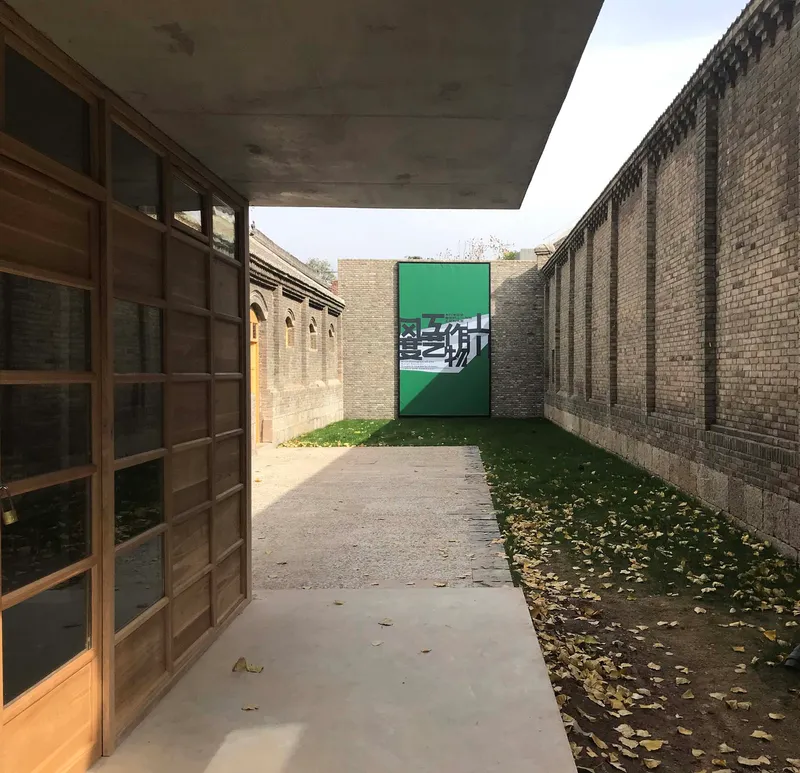
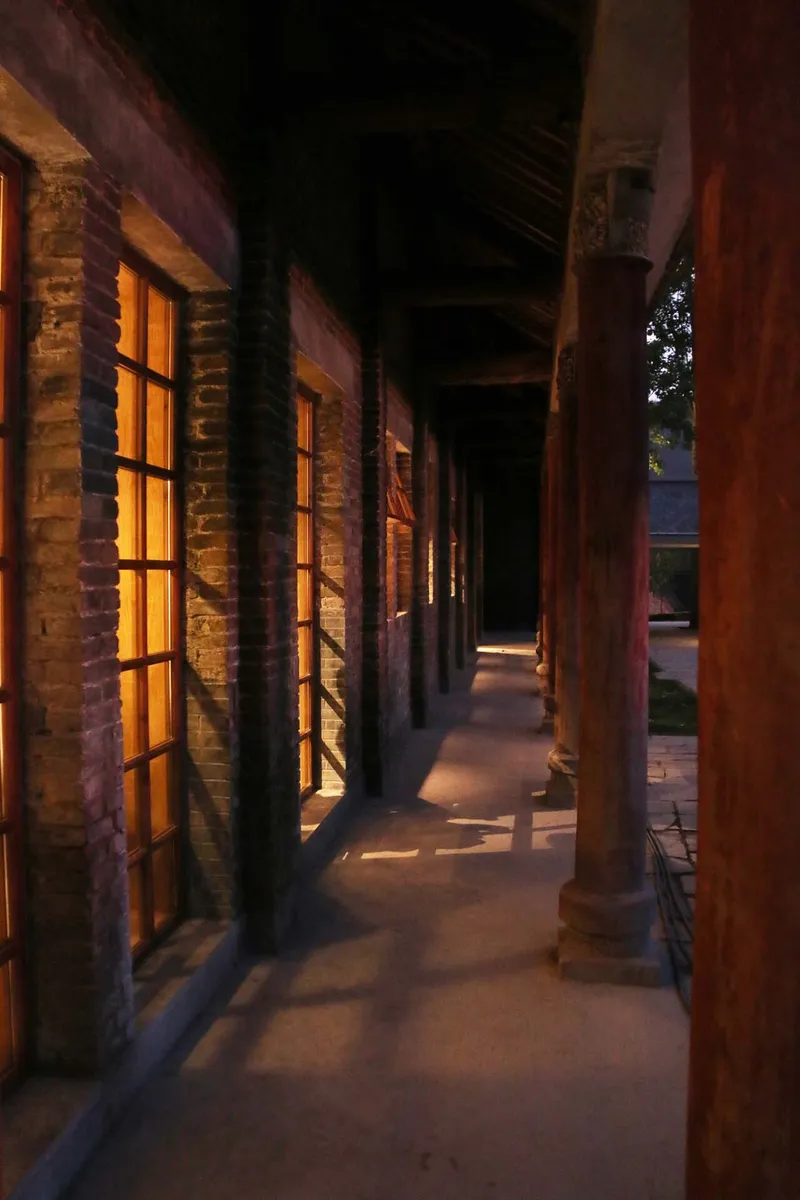
A cultural center with this many programs, bookstore, café, gallery, restaurant, tea house, needs to distribute visitors without creating corridors that feel institutional. The solution here is a series of covered passages, transition spaces between interior rooms and courtyard, that handle circulation while maintaining the feel of walking through a village compound. Timber sliding doors, concrete soffits, exposed brick columns, and planted beds line these passages, turning movement into experience.
The covered exterior corridor with its exposed brick columns and timber roof beams at dusk is particularly effective. It reads as both old and new: the columns are original, the beams are treated, the light is contemporary in its precision. Autumn leaves scattered on the ground suggest that the space is used casually, not curated for photographs. The green painted door with its graphic at the end of one passage adds a note of informality that keeps the project from feeling too precious.
Interior Program: From Arched Dining to Timber Trusses
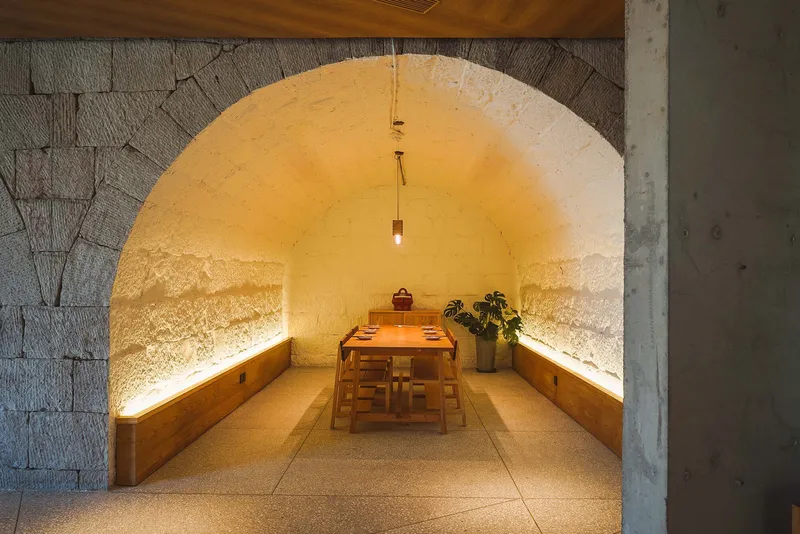
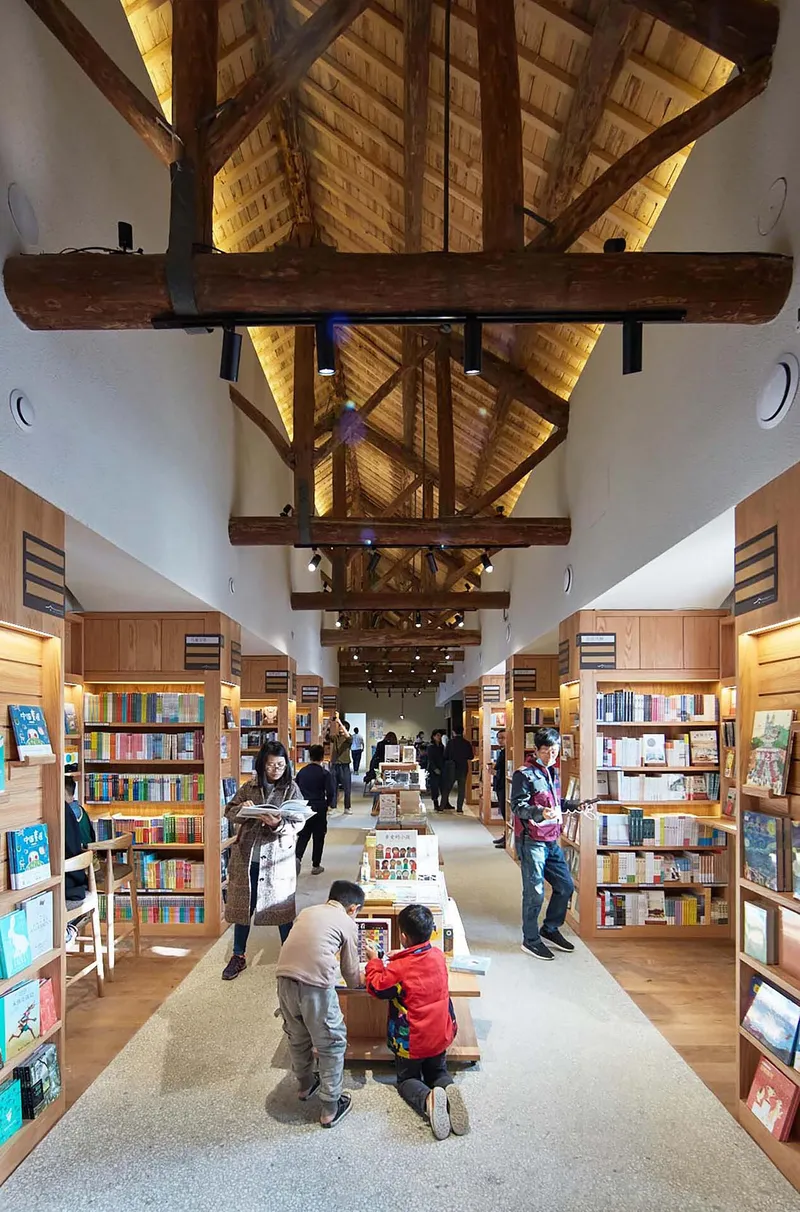
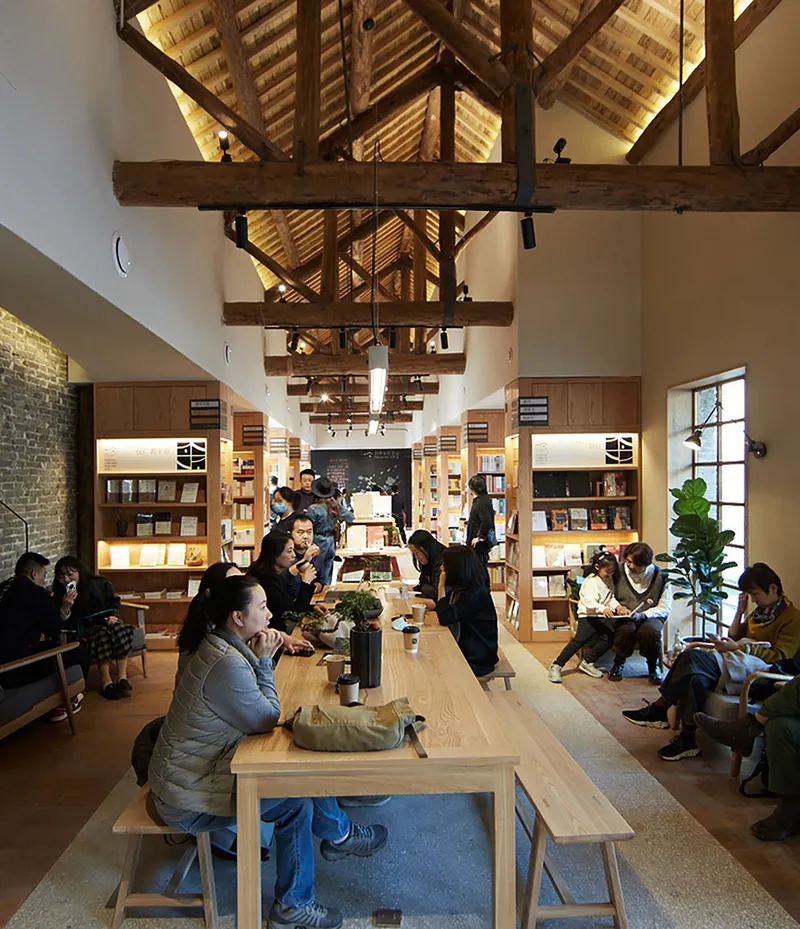
The vaulted stone dining room is the project's most dramatic interior. Uplighting washes the arched ceiling, and timber benches flank a central table in a space that feels genuinely ancient, though the lighting and furniture are clearly new. The seven stone arches are put to work here, not merely displayed. Nearby, the bookshop occupies a volume with exposed timber trusses, its visitors browsing between wooden display shelves under heavy beams and track lighting. The central seating area beneath the vaulted ceiling provides a reading and gathering space that is generous without being cavernous.
What ties these interiors together is the consistent use of timber as the primary warm material, whether in trusses, shelving, benches, or ceiling planes. Against the rough stone and poured concrete, the wood creates a domestic scale that makes public spaces feel approachable. You can imagine villagers using the bookshop for an afternoon, not just tourists passing through.
Framed Landscapes and Inhabitation
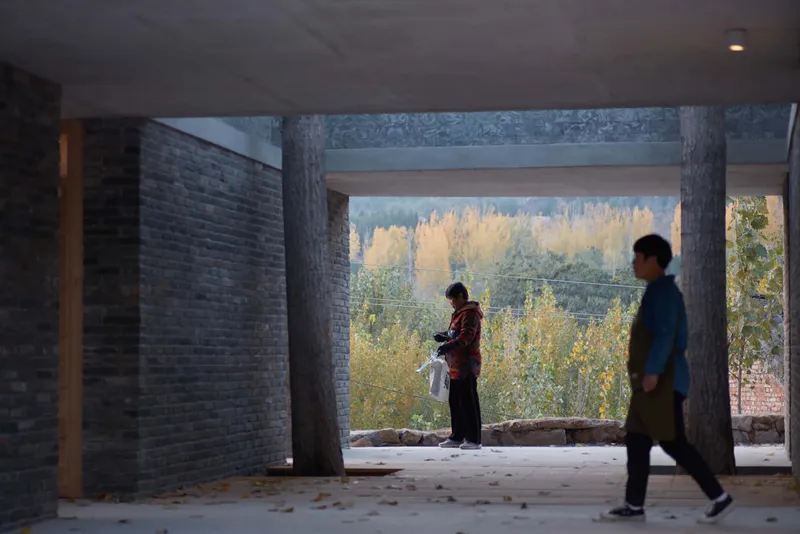
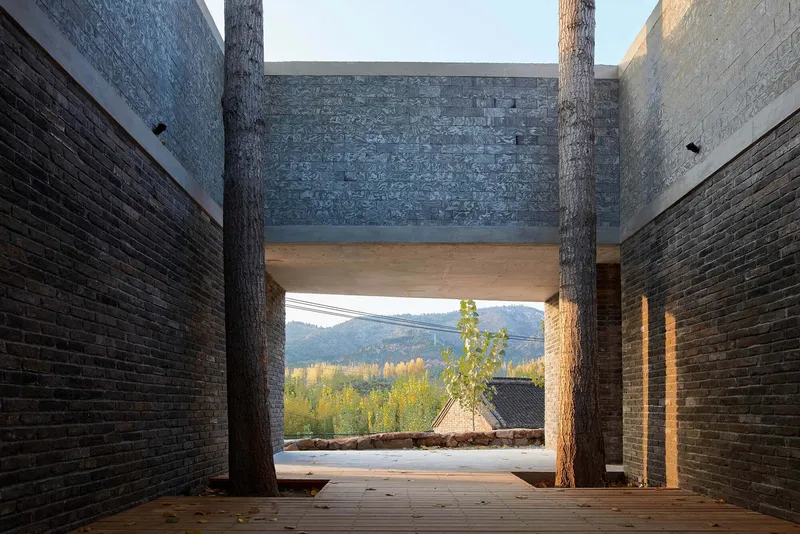
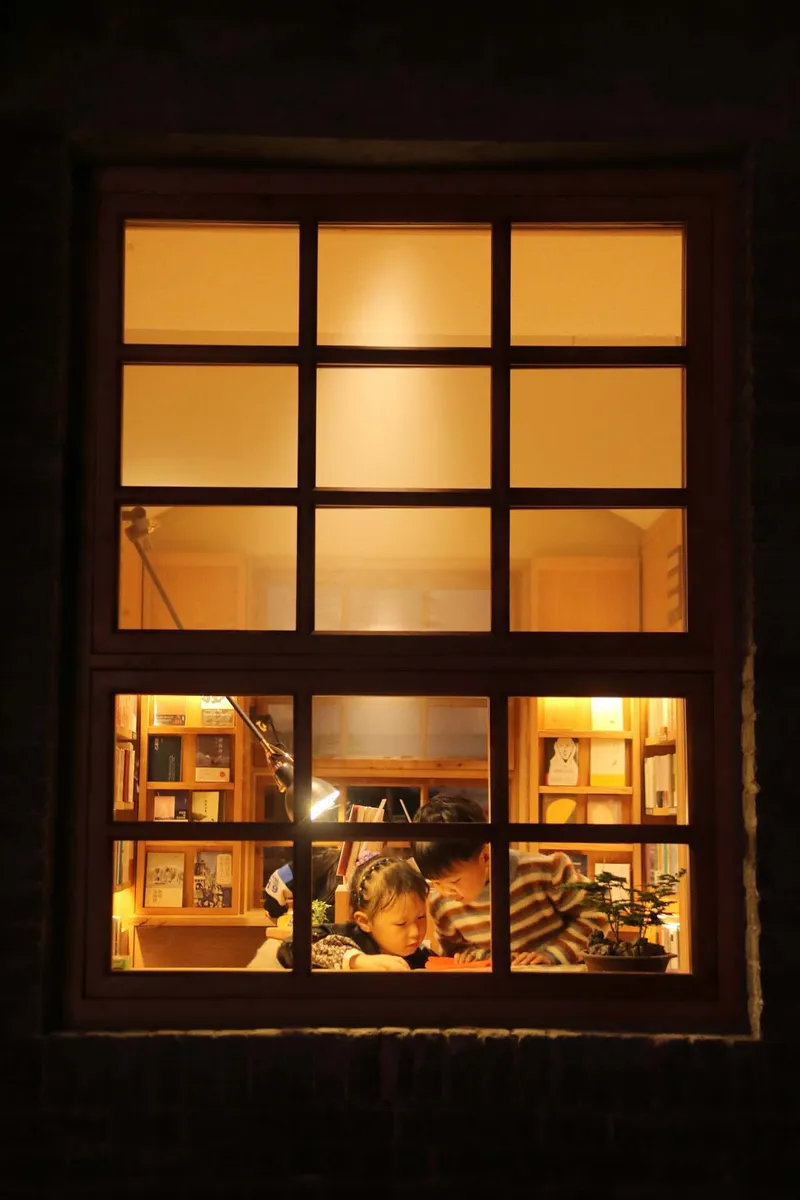
Some of the most compelling moments in the project are its framed views. Two figures silhouetted against golden autumn foliage, visible through an interior opening lined with preserved tree trunks. A brick passage capturing distant hills at sunset. A gridded window revealing two people reading inside a warmly lit room at night. These are not incidental compositions; they are evidence of a design that treats aperture, threshold, and orientation as primary tools.
The decision to preserve existing tree trunks within the interior and courtyard spaces is worth noting. These trees, mature enough to have been growing when the village committee was active, anchor the building in a timeline longer than its own. They also provide scale and a sense of inhabitation that even the best furniture arrangement cannot achieve. The landscape is not a backdrop here. It is a participant.
Everyday Details: Tea, Retail, and Domestic Scale
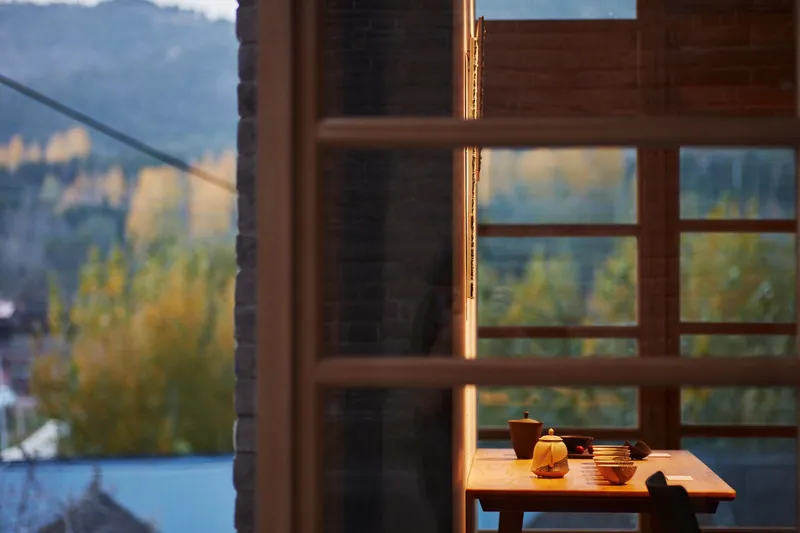
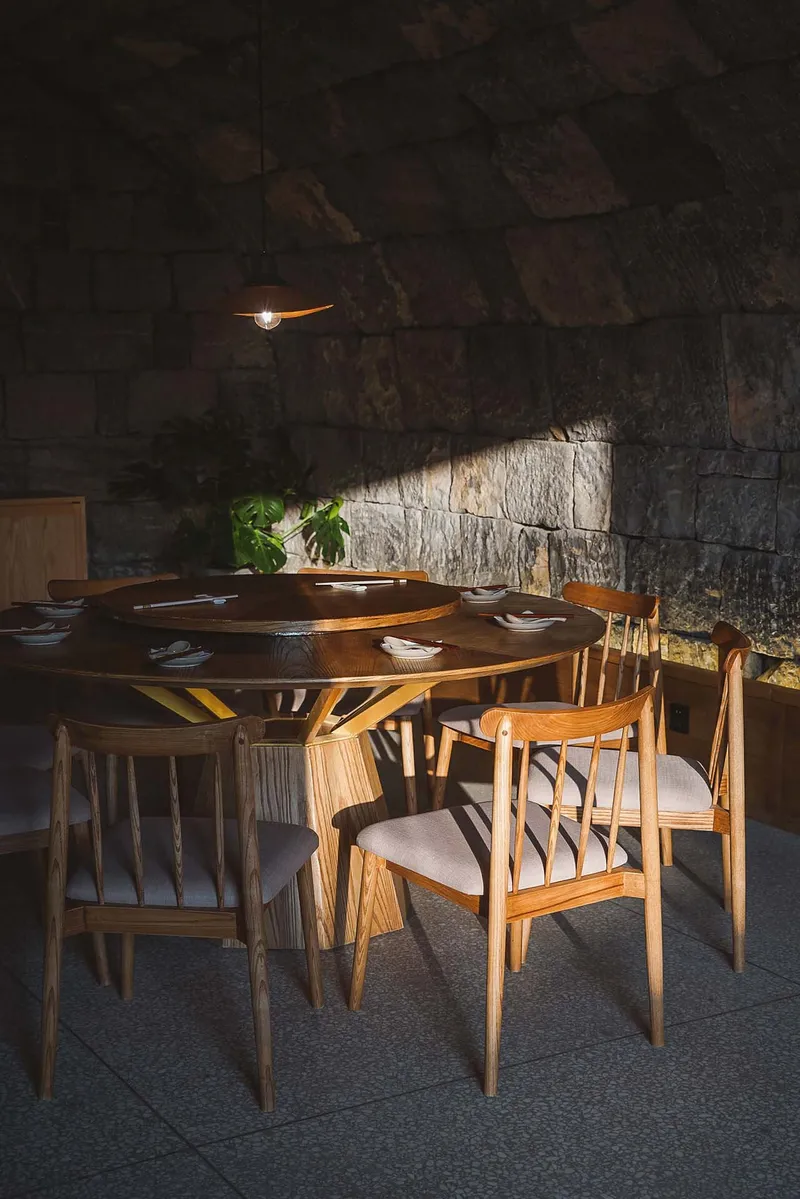

The tea house, with its low table and ceramic teaware beside a gridded timber window at golden hour, is an exercise in restraint. The window grid provides rhythm and privacy without curtains, filtering light into a warm interior. Elsewhere, a dining area with a circular timber table beneath a pendant light and rough stone wall suggests a space that could be in a private home rather than a cultural center. The angled timber display shelves holding bulk goods in wooden bins with chalkboard labels bring the project's retail component down to earth: this is a village economy, and the architecture does not pretend otherwise.
These small-scale moments are where the project's intelligence is most visible. The cultural center is not a single monumental gesture; it is an accumulation of considered decisions about how people might actually use a bookstore, a tea house, or a shop in a village of farmers. The domestic scale of the Yubei traditional vernacular house, with its three bays and front and back corridors, informs the proportions throughout.
Plans and Drawings
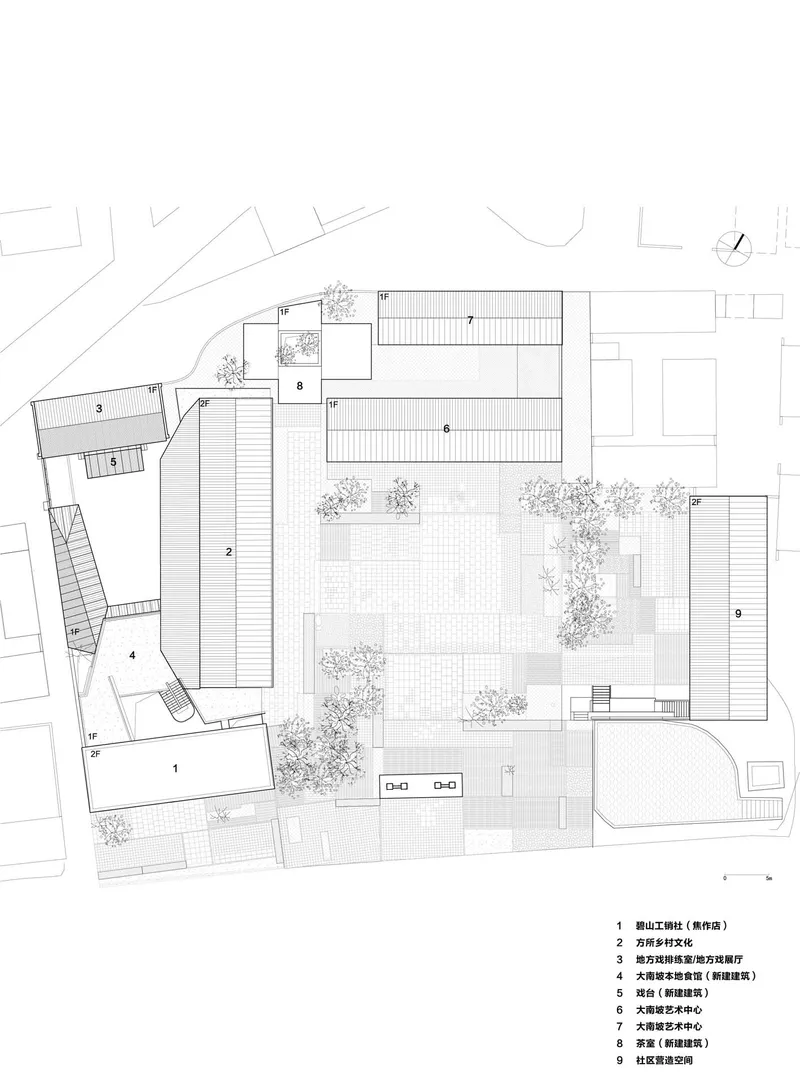
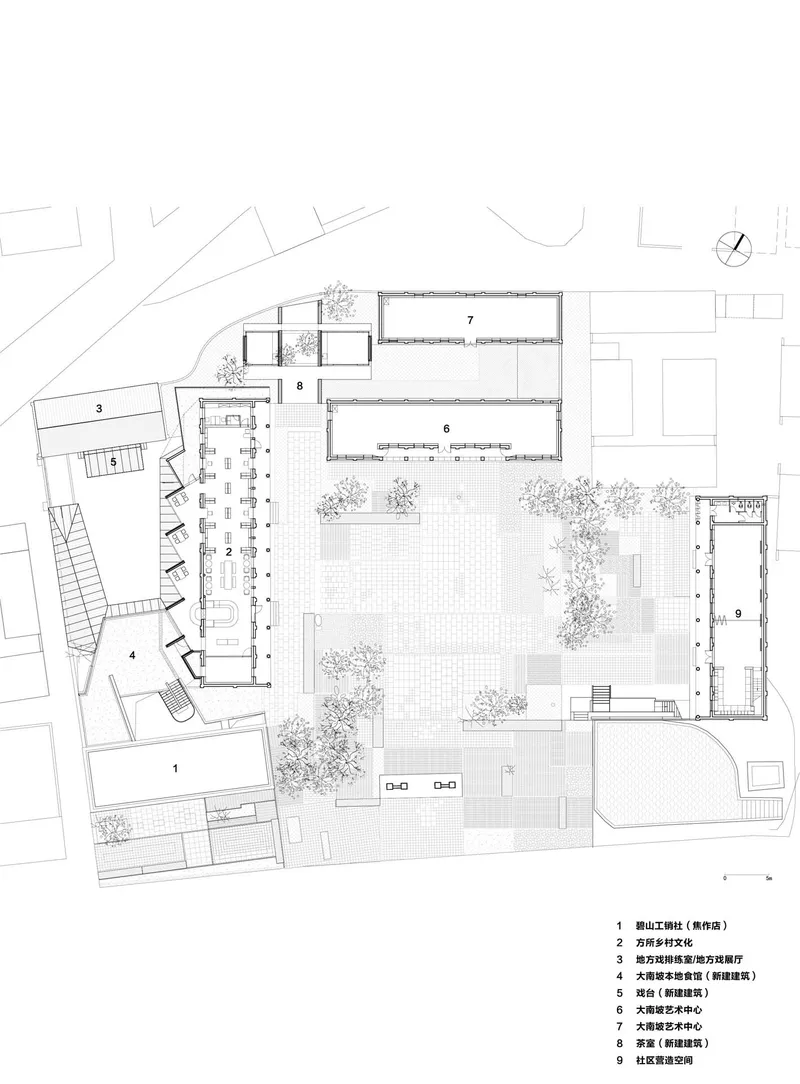
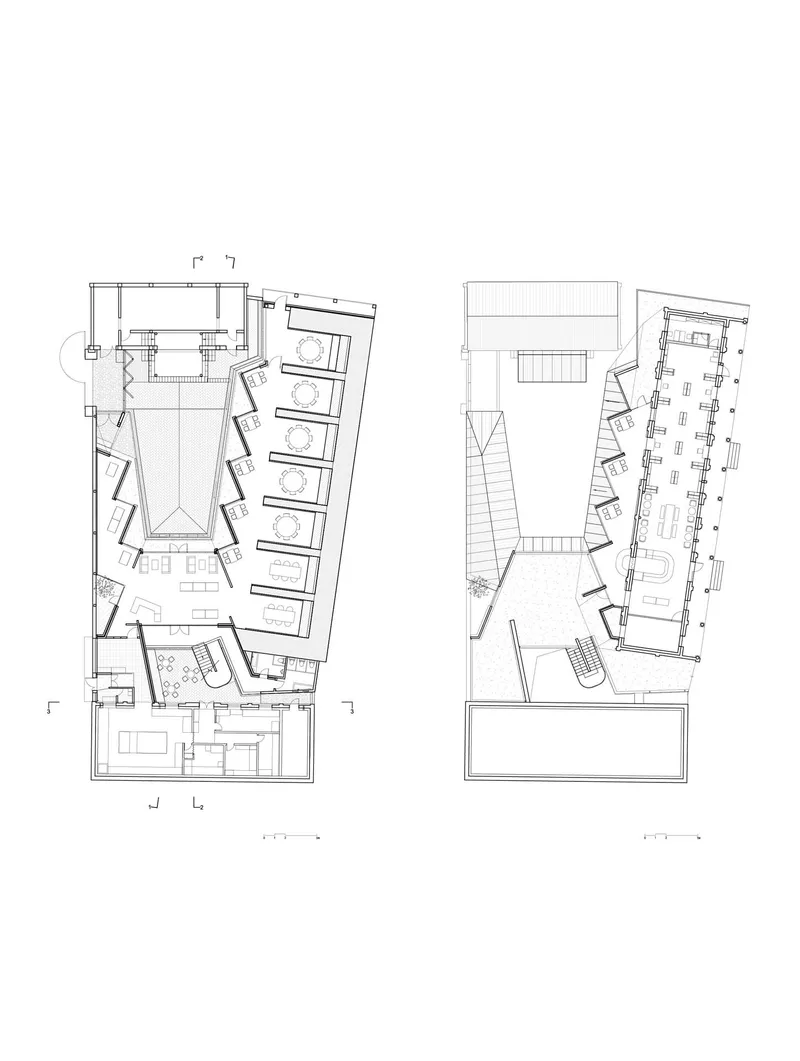
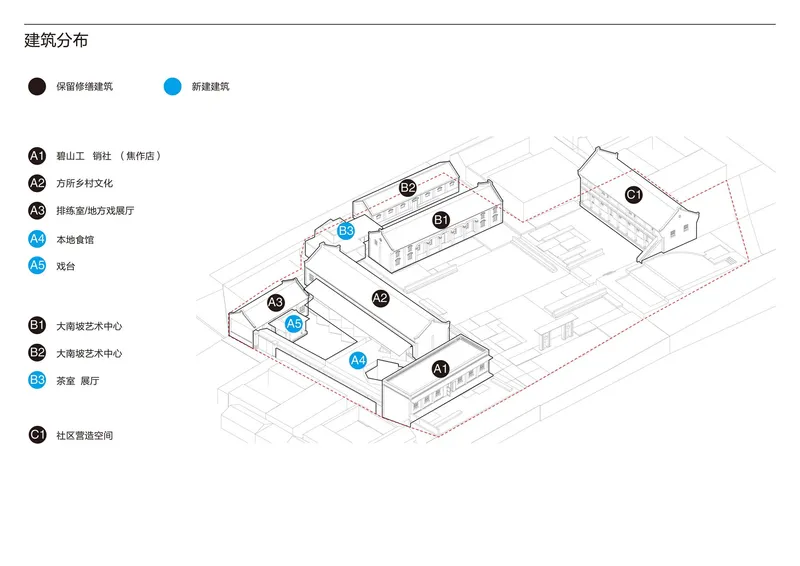
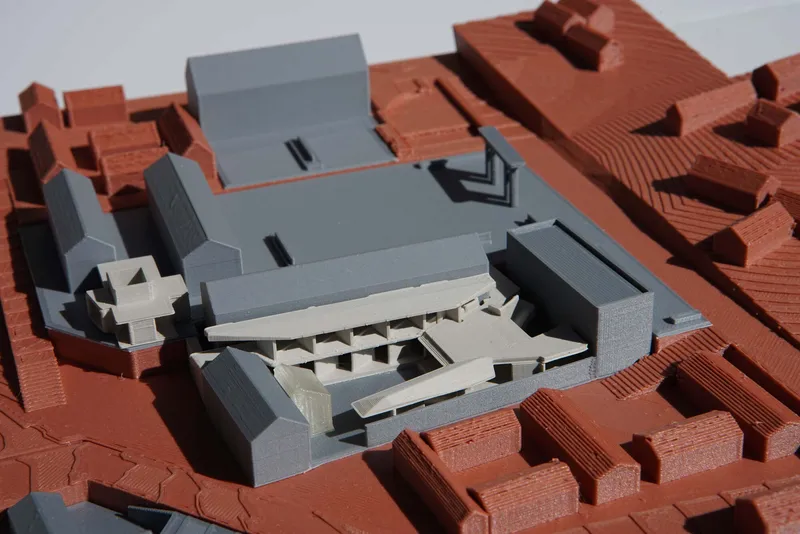
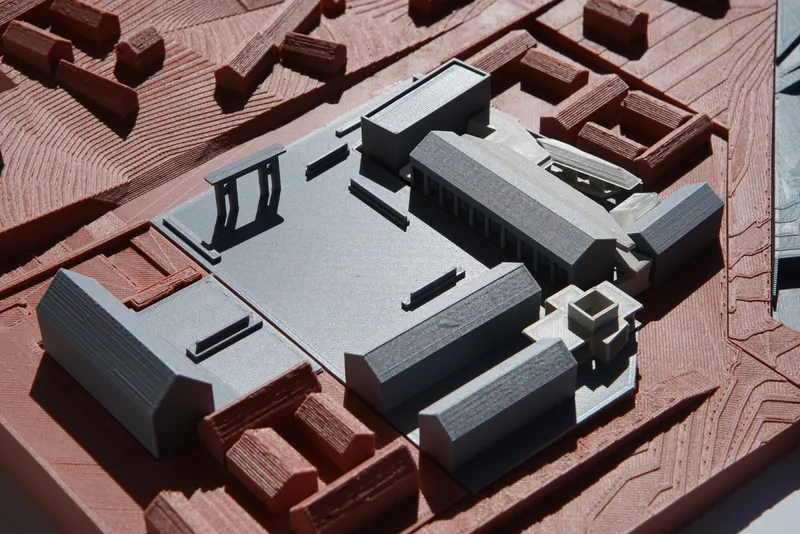
The site plan confirms the reading of the compound as a collection of volumes arranged around a paved courtyard, with scattered trees marking the primary public space. The floor plans show the interior layout with furniture arrangement and central courtyard vegetation, making clear how each program, from café to gallery to bookshop, occupies its own volume while sharing the courtyard. The axonometric drawing with its labels distinguishing existing and new structures is particularly useful: it reveals how little was actually demolished and how much was simply reconnected.
The physical model, shown in white and grey volumes set within a red tiled roof context, gives perhaps the clearest picture of the project's relationship to the village. The new flat roofs are legible as insertions among the terracotta ridgelines of Dananpo's existing buildings. The model's aerial view, with its grey roofs and central courtyard surrounded by red buildings, positions the cultural center as a civic heart rather than an isolated object.
Why This Project Matters
Rural cultural centers in China have become a genre, and a contested one. At their worst, they are trophy projects dropped into villages for the benefit of urban visitors and Instagram feeds, disconnected from the economic and social realities of the communities they claim to serve. The Dananpo Cultural Center avoids the worst of these pitfalls through a strategy that is more surgical than spectacular. By retaining the compound's existing structures, opening its walls to the street, and distributing its programs across multiple small volumes rather than one large building, Approach Architecture Studio produces a project that feels like an evolution of the village rather than an imposition upon it.
The project's deeper contribution is its demonstration that renovation, not just new construction, can be a viable model for rural cultural investment. The seven stone arches, the brick colonnades, and the mature trees are not obstacles to be engineered around; they are the project's strongest assets. In a period when China's rural building stock continues to empty out as populations migrate to cities, the question of what to do with idle civic buildings is not academic. Dananpo offers one answer: keep the bones, open the walls, add timber and light, and trust that a bookstore and a tea house can do what a village committee no longer can.
Dananpo Cultural Center Renovation by Approach Architecture Studio (lead architects: Jingyu Liang, Siyu Ye, Yuan Zhou). Located in Jiaozuo, Henan Province, China. 2,038 m². Completed 2021. Photography by Rui Zhu.
About the Studio
Share Your Own Work on uni.xyz
If projects like this are the kind of work you want to make, uni.xyz is a place to publish your own, find collaborators, and enter design competitions.


Popular Articles
Popular articles from the community


The Amber Palace Opera: A Geological Fiction Surfaces on Tallinn's Baltic Waterfront
Pierre Brillard reimagines a Baltic legend as a public landscape, opera house, and waterfront promenade rooted in Tallinn's coastal identity.

Manzana Morphosis: Stretching Barcelona's Grid into a Living Landscape for 2050
A radical reworking of the Eixample manzana turns density into a tool for generous public space, vertical ecology, and environmental performance.


FCC Arquitectura Expands a Portuguese Granite House with a Board-Marked Concrete Wing
In Portugal, JV House pairs a cleaned-up whitewashed and granite dwelling with a timber-shuttered concrete extension, courtyards and a garden pool.

Singing Woman: An Opera House That Performs Before the Curtain Rises
Ovidiu Cristian Pavel's conceptual opera house translates Estonia's choral identity into a sculpted waterfront landmark facing the Baltic Sea.

Similar Reads
You might also enjoy these articles

LAVA Architecten Gives Vocational Education a Sawtooth-Roofed Face on a Mechelen School Campus
In Mechelen, Belgium, a 2,053 m² STEM school on a 6×6 m grid turns workshops and classrooms into rooms that can be rearranged as teaching changes.

KEMA Studio Turns a Derelict Marvila Attic into a 60 m² Lighthouse Apartment Above Lisbon
In Lisbon's Marvila district, a rebuilt roof, four skylights and two plywood volumes turn an unlivable attic into a bright home facing the Tagus.

Pixel Gardens: One Repeated Module Stacked Into a Terraced Social Housing Tower for Famagusta
Salem Bader's shortlisted housing tower builds a vertical neighbourhood from one repeated module, offsetting units to carve terraces, light and air.

Bao Huynh Watercolor Atelier: A Serene Art Retreat in Hội An
Bao Huynh Watercolor Atelier in Hội An blends multifunctional art spaces, sustainable design, local materials, and family-friendly living in a serene environment.

Explore Cultural Center Competitions
Discover active competitions in this discipline

Challenge to design luxury tourism on rails

VR headsets Storefront design competition

Bring back Drive In's

Designing a staircase for a client
Comments (0)
Please login or sign up to add comments
No comments yet. Be the first to comment!