
Approach Design Studio Folds a Public Park into a Former Police Station in Beijing
A decommissioned police station in Daxing District becomes a hybrid office and community park wrapped in a steel exoskeleton.


China's shift from rapid urban expansion to careful stock renewal has opened a door that most architects only talk about walking through. Approach Design Studio, led by Di Ma, actually stepped in. Folding Park takes a decommissioned F-shaped police station in Beijing's Daxing District, a building that once turned its back entirely on the neighborhood, and wraps it in a steel framework that functions simultaneously as office space and public recreation ground. The result is a 1,844 square meter project completed in 2019 that is less renovation than provocation: what happens when you drape a park over a building instead of placing one next to it?
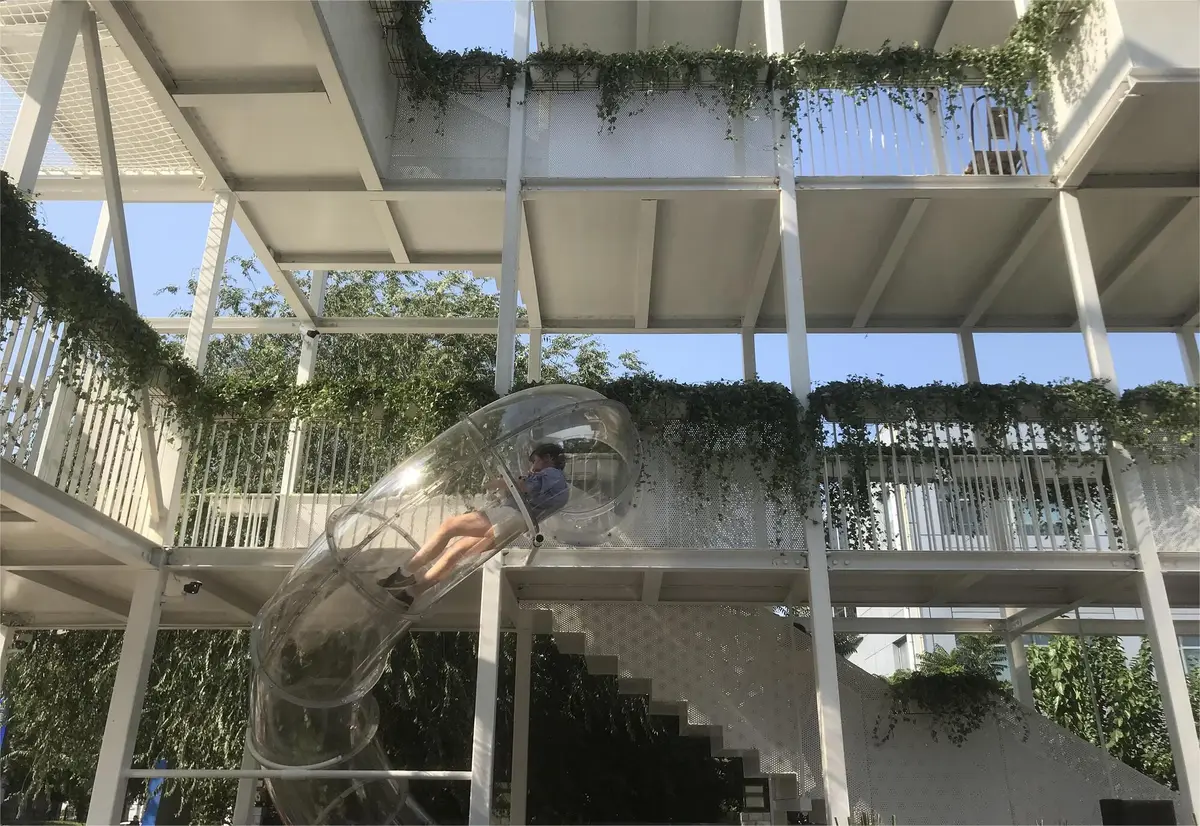
The genuinely interesting move here is the refusal to treat architecture and landscape as separate design problems. The park is not an amenity bolted onto the project; it is the project's circulatory and social system. Staircases, terraces, rooftop jogging paths, a mini-golf green, an amphitheater, and a transparent tube slide are all threaded through and around the original structure by way of a white steel exoskeleton. The approach was initially conceived using construction scaffolding, a cheap, universal, and rapidly assembled kit of parts. When engineers couldn't calculate scaffolding as a civil structural system, the team substituted steel square tubes and I-beams, preserving the scaffolding's logic of lightness and repetition while meeting code.
The Exoskeleton as Urban Interface
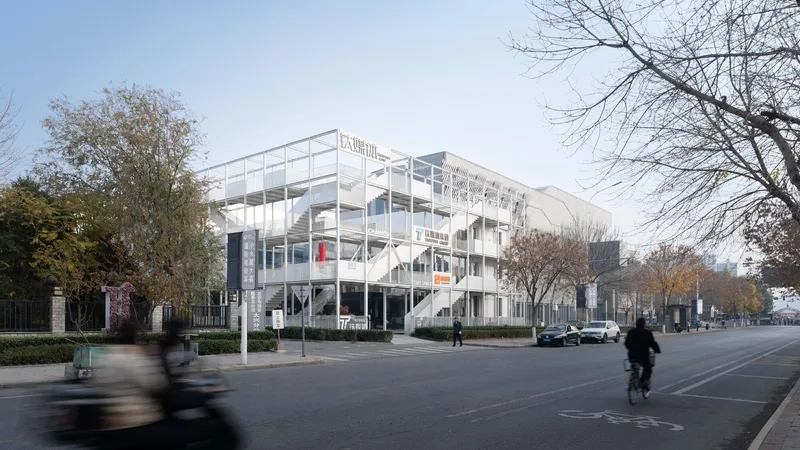
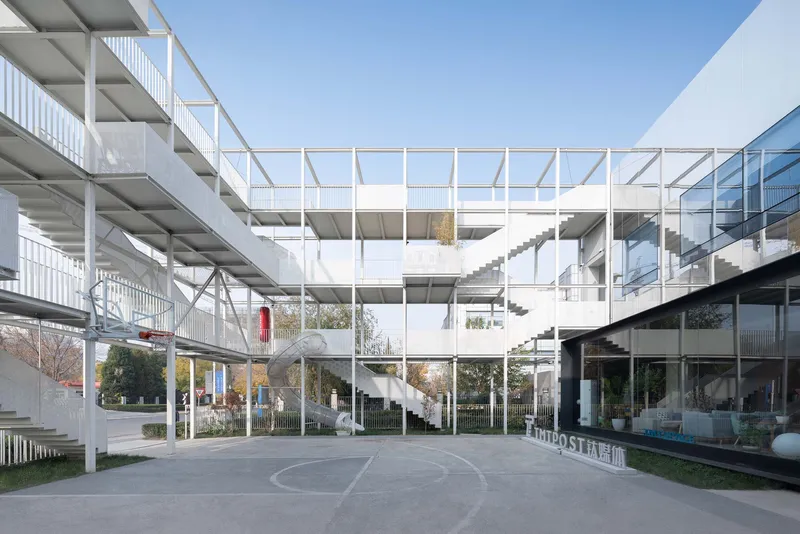
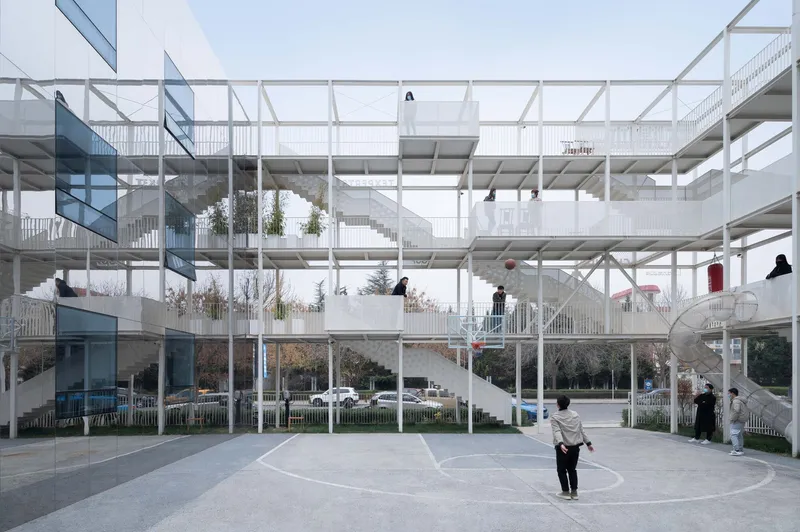
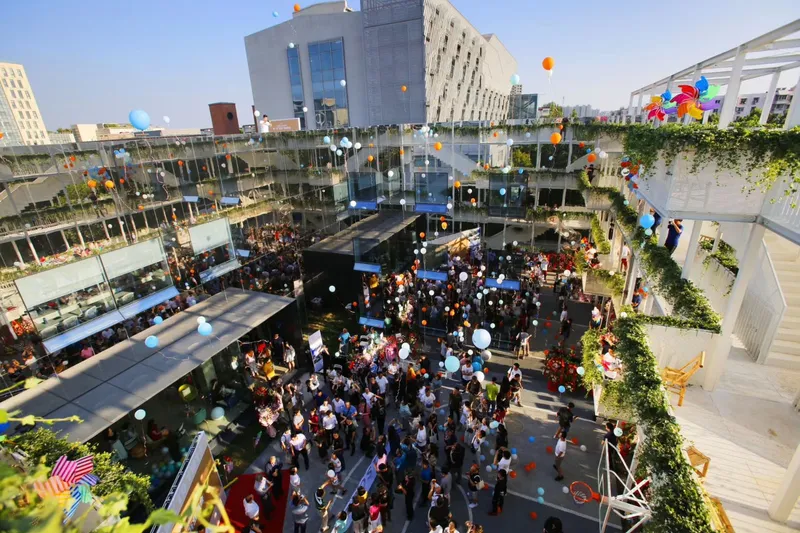
From the street, Folding Park reads as a cage of white steel hovering around a modest mid-rise. The grid of tubes wraps two facades and extends along two adjacent streets, turning what was once a closed institutional boundary into a permeable edge. Cyclists and pedestrians pass directly alongside the structure. Slatted balustrades and mesh panels maintain visual connections to the neighborhood rather than screening the interior from view, a deliberate inversion of the former police station's posture.
The structural frame also serves as a scaffold for inhabitation. Cantilevered balconies, walkways, and terraces plug into the grid at multiple levels, creating a multi-story public promenade that wraps the building's perimeter. The exoskeleton does not merely enclose; it extends the usable surface area of the building outward and upward, giving a compact footprint a far larger social territory.
Courtyard as Collective Stage
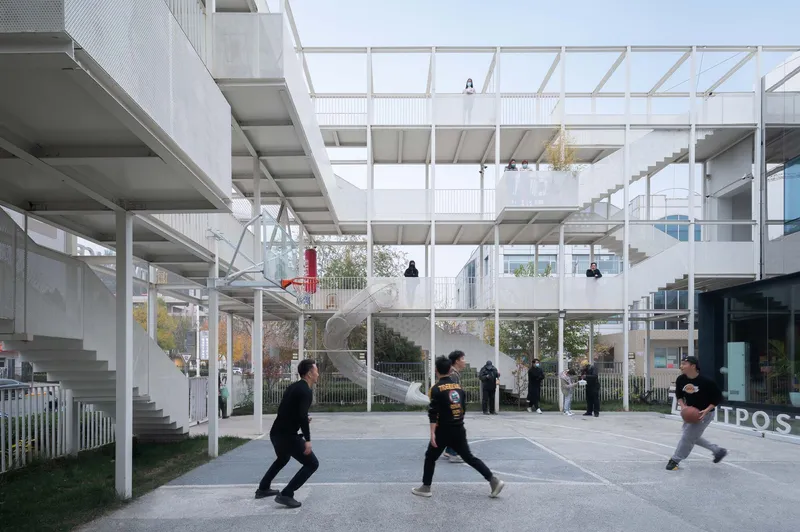
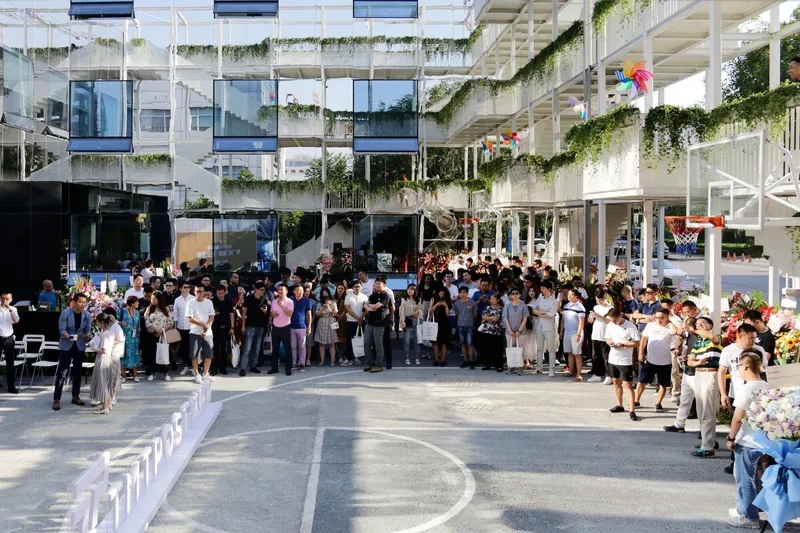
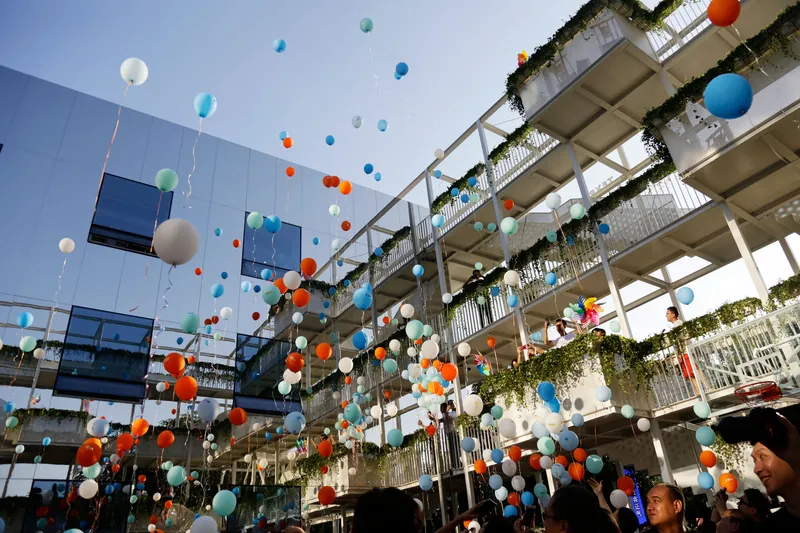
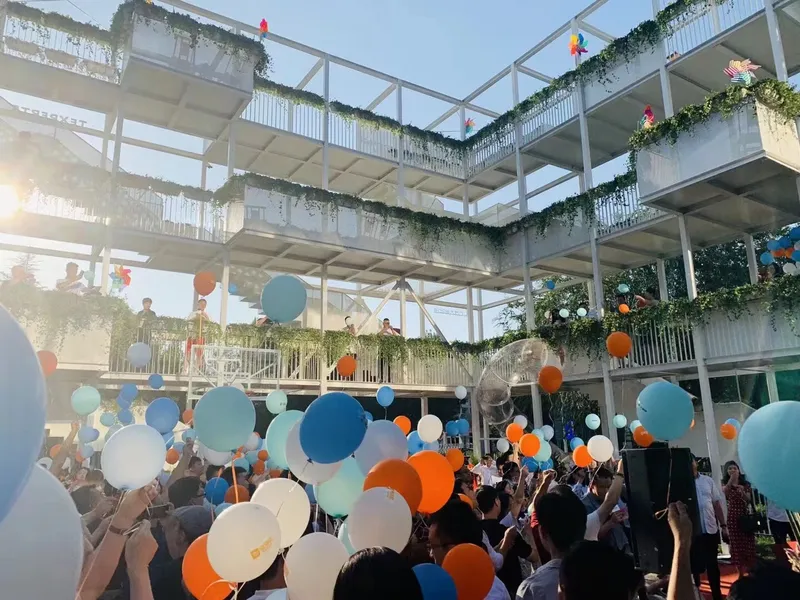
The F-shaped plan naturally generates a central courtyard, and the design exploits it as a flexible gathering space. Residents play basketball beneath pendant lights. Community events fill the ground with balloons and bodies. Varying floor levels at the courtyard's edges form a rough amphitheater, so the space can shift from pickup game to film screening to neighborhood assembly without any physical reconfiguration. The courtyard is never furniture; it is stage and bleachers at once.
What keeps the courtyard from feeling oppressive despite its tight dimensions is the porosity of the surrounding structure. The steel frame overhead filters light without blocking it, and the open staircases on every side mean that the eye always finds an escape route. Balloon releases and evening projections, captured in use, suggest that the community has taken ownership of the space rather than treating it as a managed amenity.
Color, Circulation, and Interior Identity
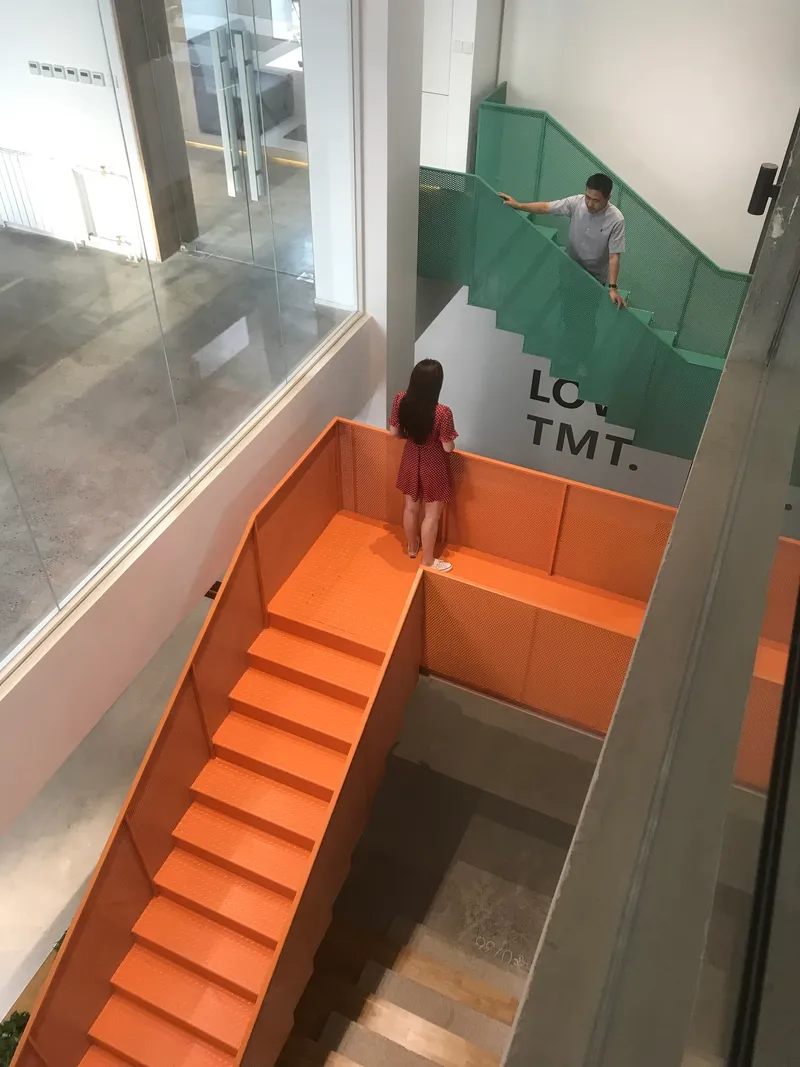
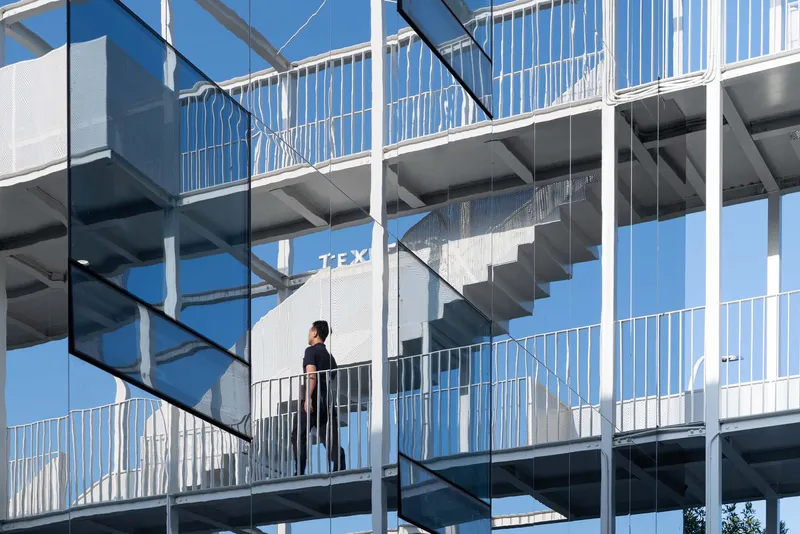
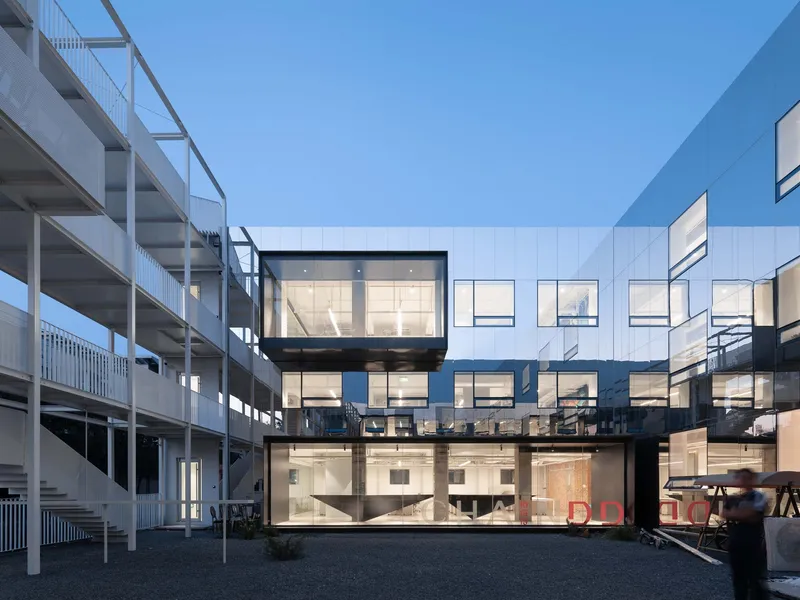
Inside, the original compartmentalized rooms have been opened up and reconnected by a set of see-through staircases powder-coated in orange and green. Against the predominantly white palette of the exterior steel, these hits of color function as wayfinding devices and spatial markers, making circulation legible from across the courtyard. The choice signals that movement through the building is not a private act but a visible, communal one.
At dusk, the glass courtyard facade glows to reveal the office interiors beyond. The building's daytime identity as a public park and its nighttime identity as a workspace for TMTpost Group, the financial technology media client, coexist without friction. The glass acts as a membrane between the two programs rather than a wall separating them.
The Mirror Trick and the Disappearing Mass
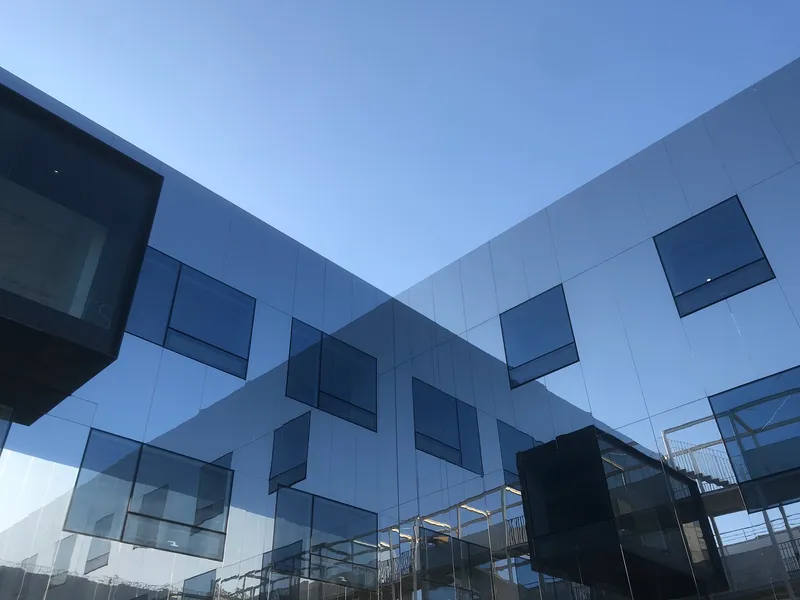
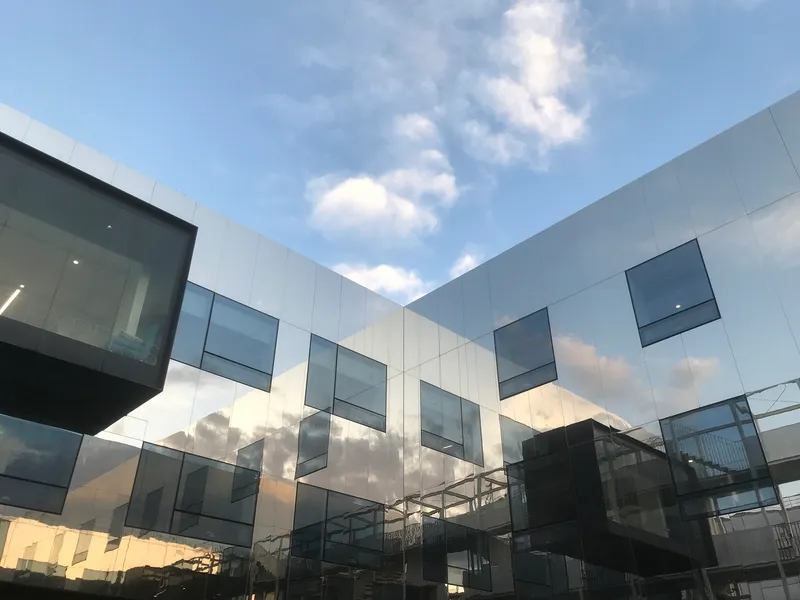
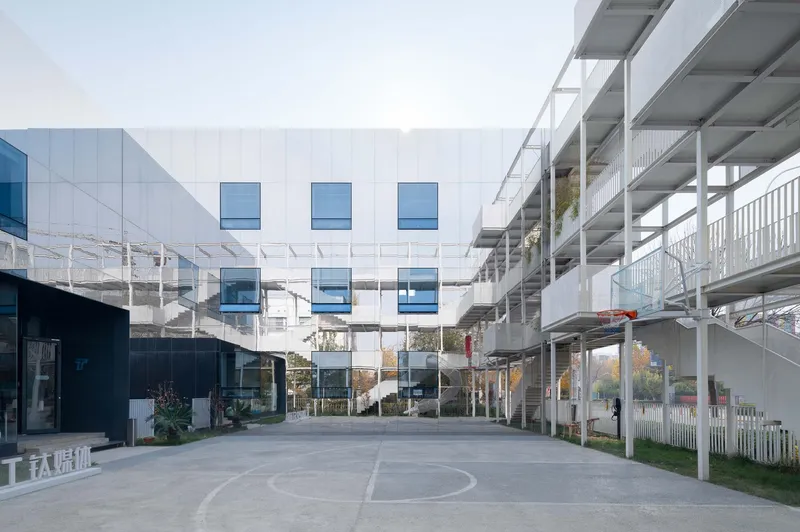
Mirrored panels clad portions of the courtyard facade, reflecting clouds and neighboring buildings back at the viewer. The intent is clear: reduce the perceived mass of a building that occupies nearly all of its 1,259 square meter site. Irregularly placed protruding box windows break the mirror surface into facets, each reflecting a slightly different slice of sky. The effect is disorienting and deliberate, making the solid walls recede behind their own reflections.
Whether you find this charming or gimmicky depends on your tolerance for optical tricks, but it does solve a real problem. In a dense neighborhood where the building footprint leaves little room for open ground, dematerializing the facade is a legitimate strategy for relieving visual congestion.
Rooftop as Recreational Surface
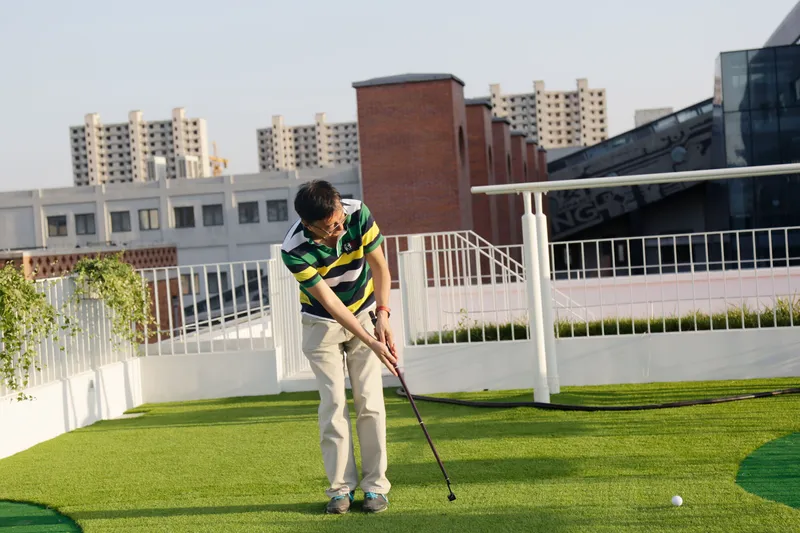
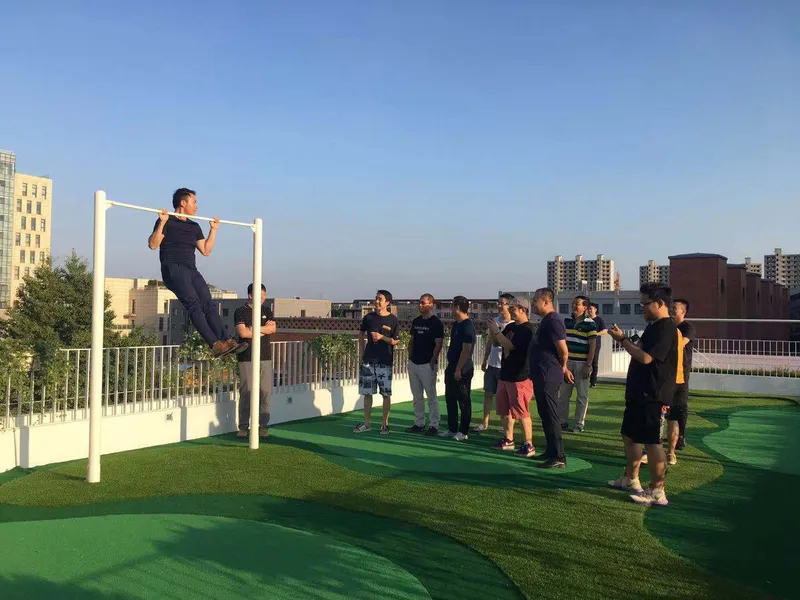
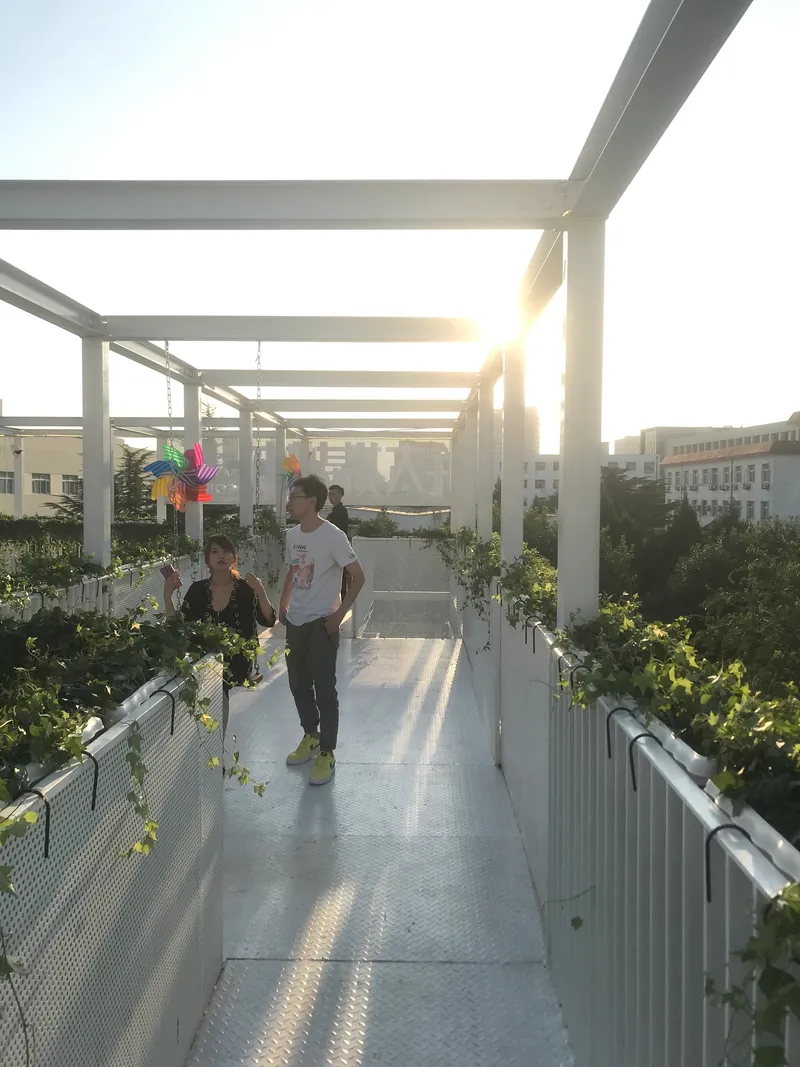
The roof is treated as a fully programmed recreational layer. A putting green sits within white railings, overlooking residential towers. A pull-up bar and exercise area draw users at dusk. A timber-decked pathway runs beneath a steel pergola, offering a sunset promenade. None of these elements are extravagant; each is built from the same vocabulary of steel tubes and simple finishes that defines the rest of the project.
The rooftop is where the "folding" concept becomes most literal. A park that would normally lie flat on the ground has been folded upward, tracing the building's perimeter from street level to roof. The jogging path doesn't end at a parapet; it connects back down through the staircases to the courtyard below, completing a continuous loop of public space.
Planting Without Prescription
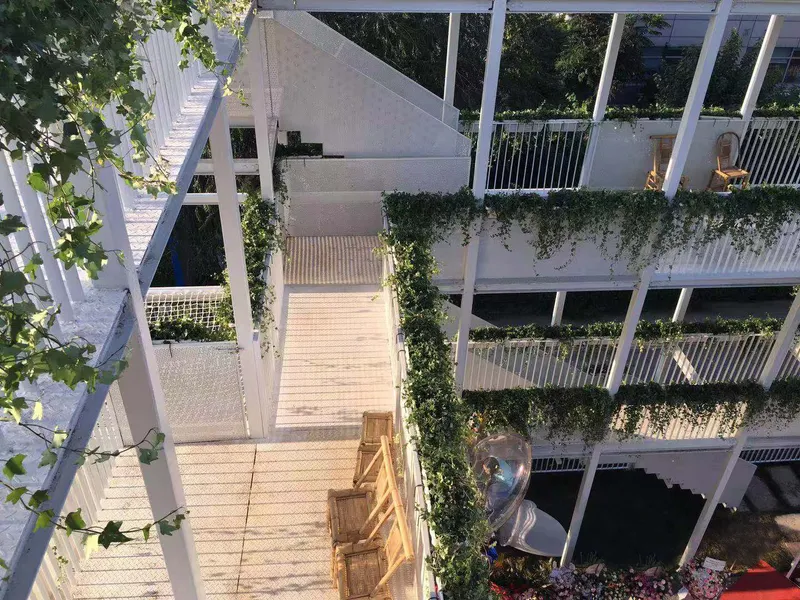
The landscape strategy is one of the project's most unusual and honest decisions. Natural greenery was originally planned for the terraces, but fake greenery was rejected on principle, and the project was completed without any fixed planting at all. Instead, residents and users are invited to choose plant species themselves and customize the building's appearance over time. Some balconies now cascade with trailing vines; others remain bare. The building's green identity is earned, not specified.
This open-ended approach aligns with the broader thesis of the project: that public space in renewed urban buildings should be programmed by its users, not its architects. The tube slide, the amphitheater steps, the basketball court, and the planter edges are all frameworks for activity, not prescriptions of it.
Evening Program and Projected Community
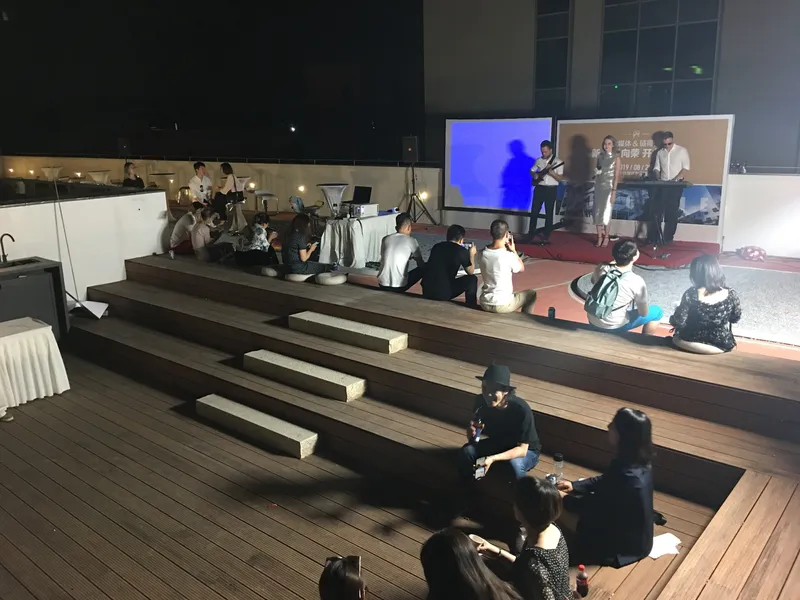
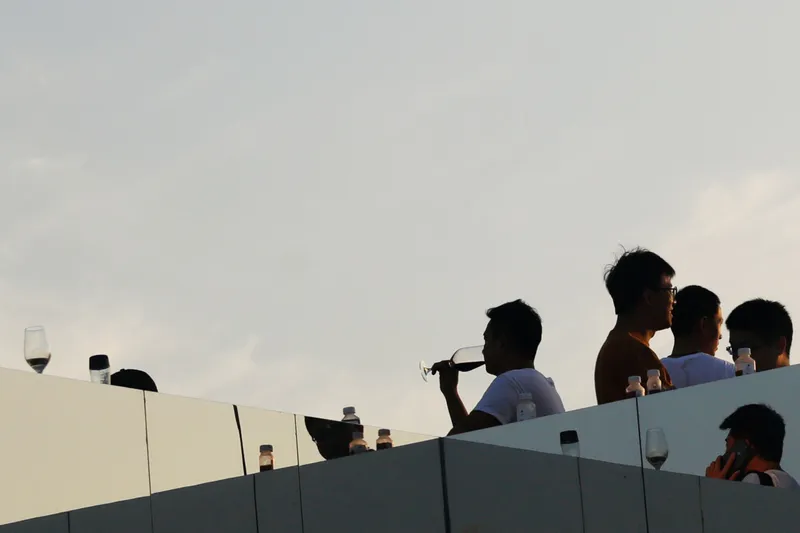
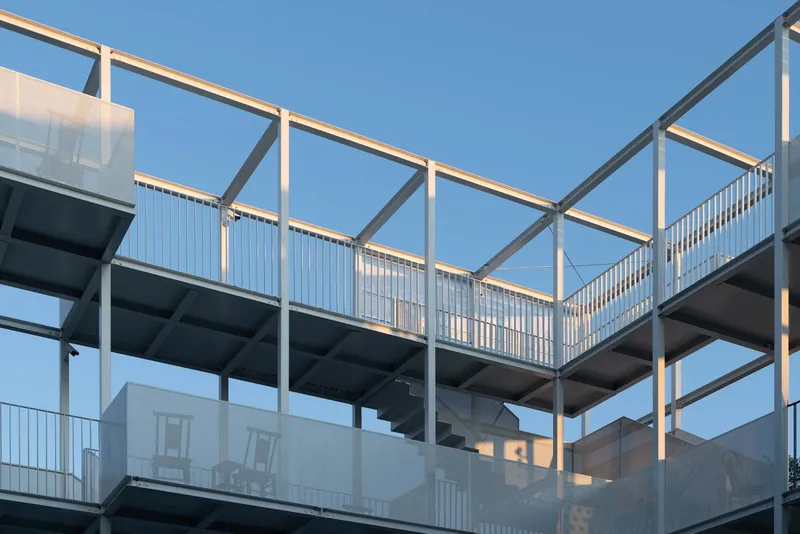
Timber bench seating faces an outdoor projection screen for evening presentations, lectures, and screenings. A frosted glass rooftop balustrade silhouettes figures against the sunset sky. These are the images of the building in use, not as architecture but as infrastructure for a neighborhood's social life. The stacked terrace levels with corrugated metal railings are rough and unprecious, designed to absorb wear rather than resist it.
Plans and Drawings
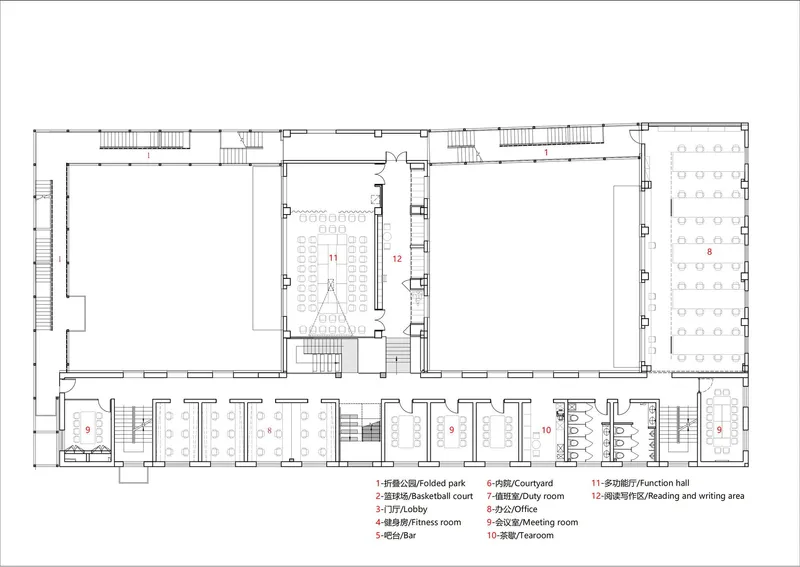
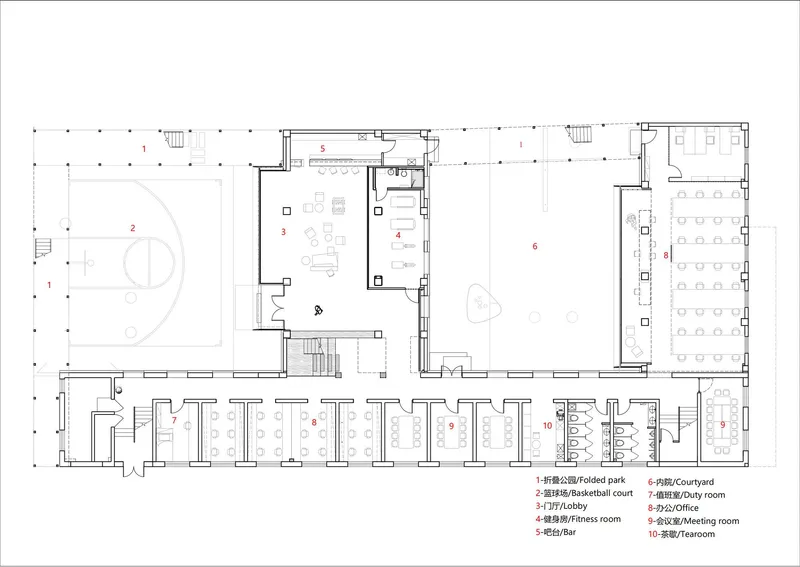
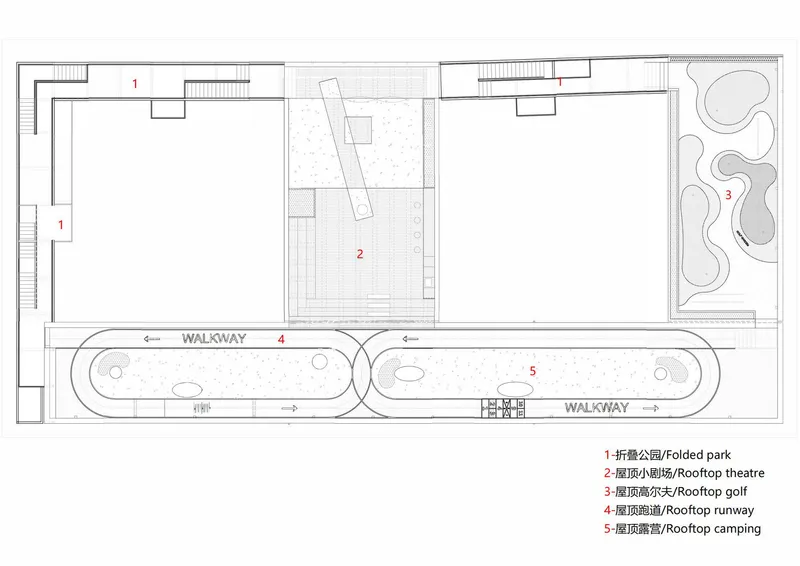
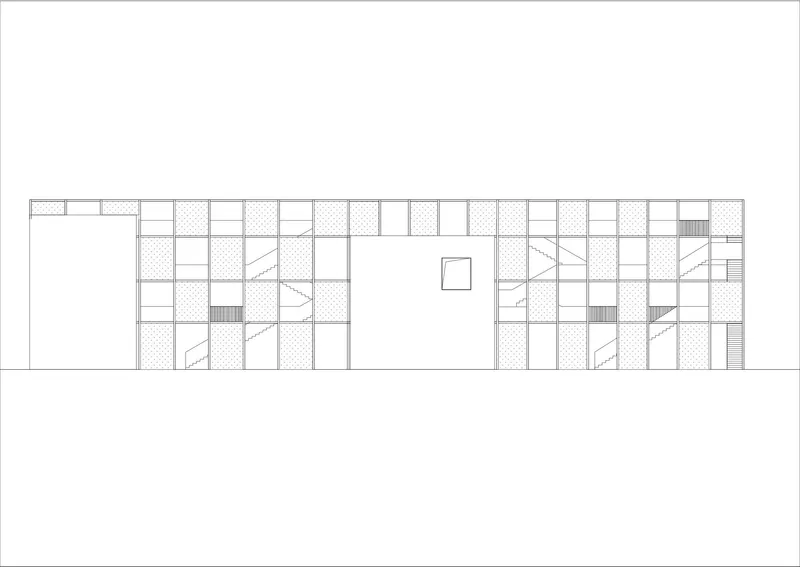
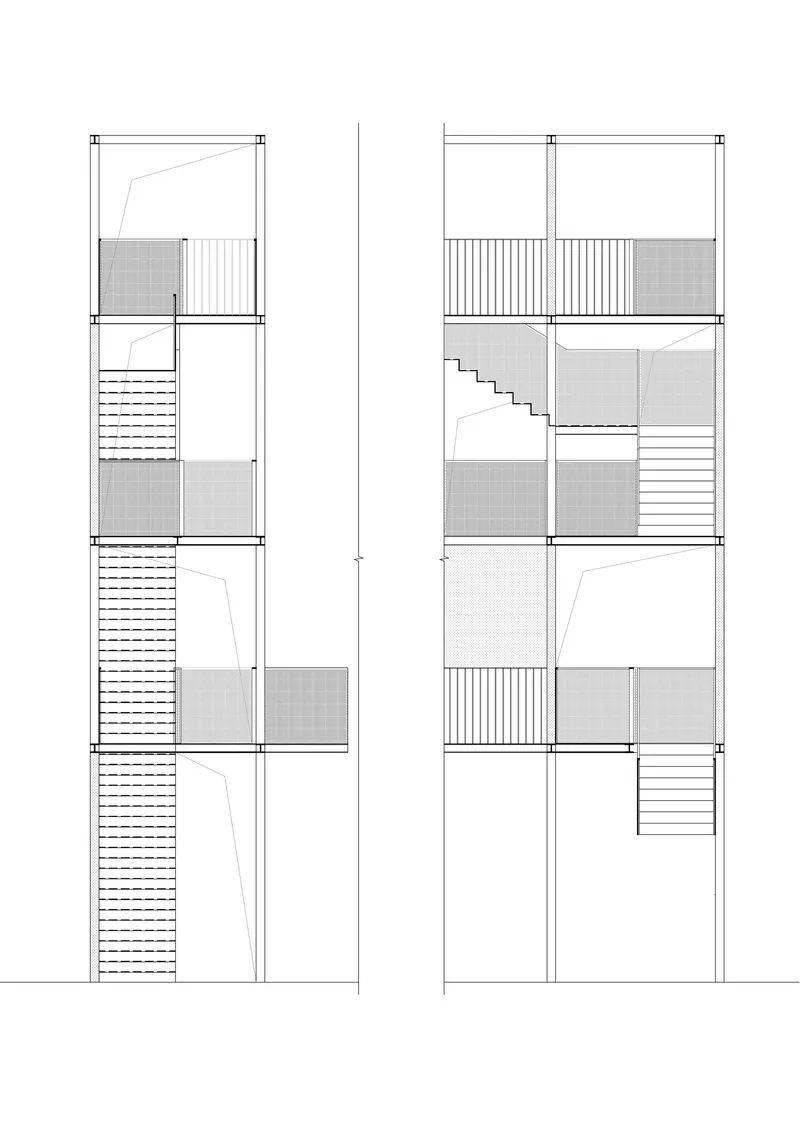
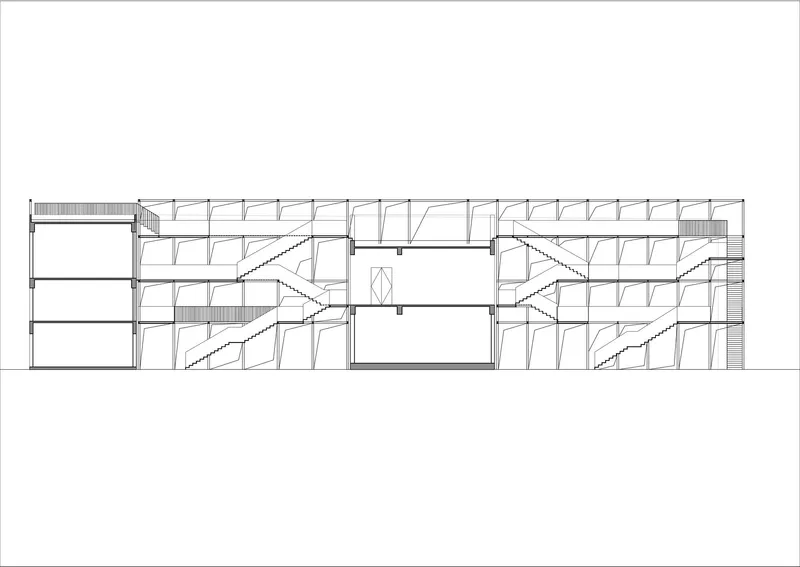
The floor plans reveal how tightly the program is packed around the central courtyard: offices, meeting spaces, a fitness room, and a basketball court are all slotted into the F-shaped plan. The roof plan shows curving walkways threaded through organic planted zones and a rooftop theater space. The sections are the most revealing drawings, exposing the paired staircases that frame a central atrium and the angled structural frame system that gives the exoskeleton its distinctive silhouette. The elevation drawing captures the gridded facade logic: alternating solid and patterned panels with recessed window openings that create depth without ornament.
Why This Project Matters
Folding Park matters because it treats urban renewal not as a design exercise but as a political act. A former police station, the literal embodiment of institutional closure, is pried open to the neighborhood it once surveilled. The steel exoskeleton is a device for making that transformation visible and irreversible: you cannot re-close a building that has been wrapped in a public park. The project's initial scaffolding concept, though abandoned for structural reasons, lives on in the spirit of the final design. Everything is provisional, adaptable, and inviting of appropriation.
More practically, the project offers a replicable strategy for Chinese cities navigating the transition from expansion to renewal. By layering public program onto the exterior of an existing building rather than carving it out of the interior, the design preserves rentable office area while generating community space that didn't exist before. The building's unfinished quality, its bare planters waiting for residents to fill them, its rough steel edges, is not a flaw. It is the argument: that the best urban renewal projects are the ones that leave room for people to finish the work.
Folding Park, designed by Approach Design Studio (lead architect: Di Ma), is located in Daxing District, Beijing, China. The project covers 1,844 square meters and was completed in 2019. Photography by nature image, Di Ma, and TMT POST Group.
About the Studio
Share Your Own Work on uni.xyz
If projects like this are the kind of work you want to make, uni.xyz is a place to publish your own, find collaborators, and enter design competitions.


Popular Articles
Popular articles from the community


longwave studio Reorganizes a 112 m² Tainan Apartment Around the Daily Routines of a Family and Two Cats
In Tainan, Taiwan, birch plywood, rust-red furniture and a freestanding plaster wall link arrival, storage, work and family life in one apartment.

Juan García Correa, John González and Claudia Rueda Sink a Circular Amphitheater into a Manizales Engineering Building
On the La Nubia campus in Manizales, Colombia, the S1 Building folds labs and offices into a hillside of ramped lawns that double as a campus route.

Jaramillo Van Sluys Arquitectura and Urbanismo Turn a Demolished Registry Lot in Quito into an Orchard Plaza
In Quito's Centro Histórico, a 2,800 m² plaza exposes the San Agustín convent wall and redraws its lost Augustinian orchard in volcanic stone.

David Macias Steps a Doorless Stone and Plaster House Down a Tropical Colombian Hillside
In the humid hills of Colombia, Threshold House replaces the front door with an open void and terraces its 850 m² down the slope instead of fighting it.

Similar Reads
You might also enjoy these articles


LAVA Architecten Gives Vocational Education a Sawtooth-Roofed Face on a Mechelen School Campus
In Mechelen, Belgium, a 2,053 m² STEM school on a 6×6 m grid turns workshops and classrooms into rooms that can be rearranged as teaching changes.

KEMA Studio Turns a Derelict Marvila Attic into a 60 m² Lighthouse Apartment Above Lisbon
In Lisbon's Marvila district, a rebuilt roof, four skylights and two plywood volumes turn an unlivable attic into a bright home facing the Tagus.

Pixel Gardens: One Repeated Module Stacked Into a Terraced Social Housing Tower for Famagusta
Salem Bader's shortlisted housing tower builds a vertical neighbourhood from one repeated module, offsetting units to carve terraces, light and air.

Bao Huynh Watercolor Atelier: A Serene Art Retreat in Hội An
Bao Huynh Watercolor Atelier in Hội An blends multifunctional art spaces, sustainable design, local materials, and family-friendly living in a serene environment.

Explore Public Park Competitions
Discover active competitions in this discipline

Challenge to reimagine the Iron Throne

Photograph architecture without architects

Illustrate the lost glory of Angkor Wat - Render Challenge

Design challenge to reuse E-waste
Comments (0)
Please login or sign up to add comments
No comments yet. Be the first to comment!