
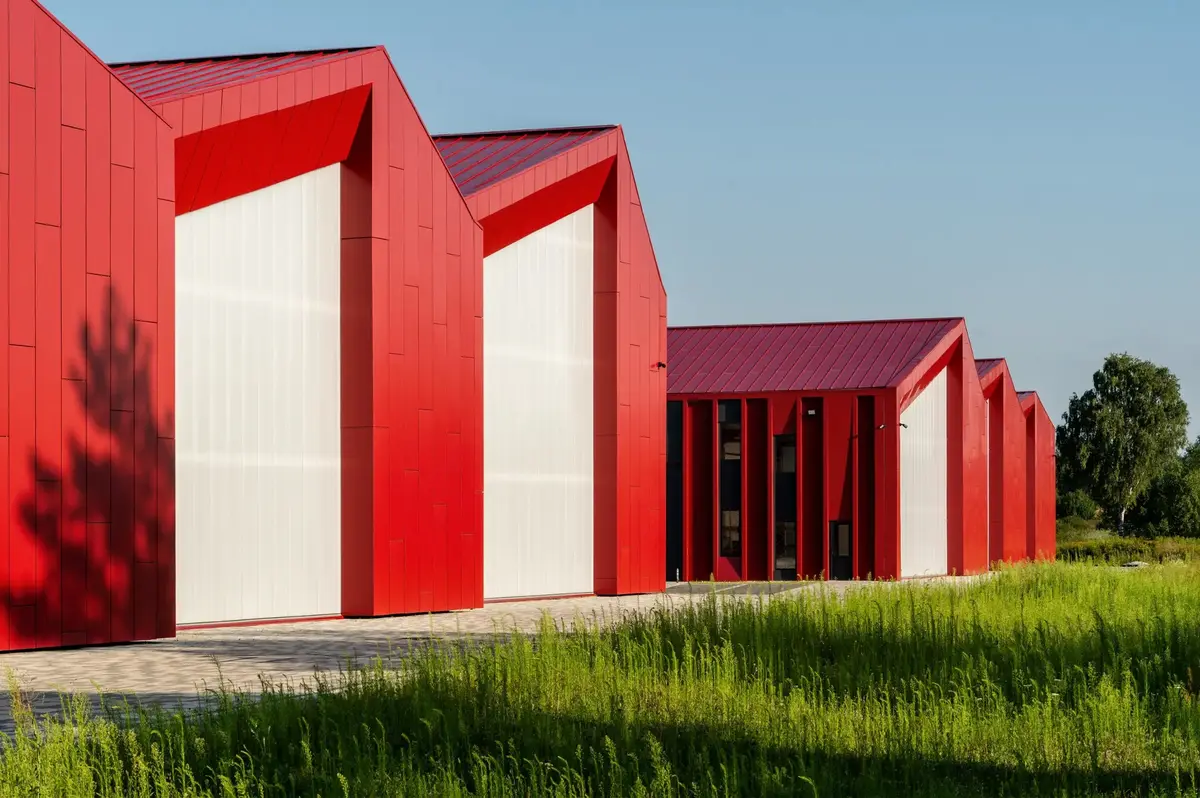
Aranchii Architects Disguise a Ukrainian Logistics Hub as a Village of Red Gabled Houses
Near Lviv's Circular Road, three warehouse volumes totaling 12,000 square meters channel domestic scale through Falun red cladding and terraced rooflines.


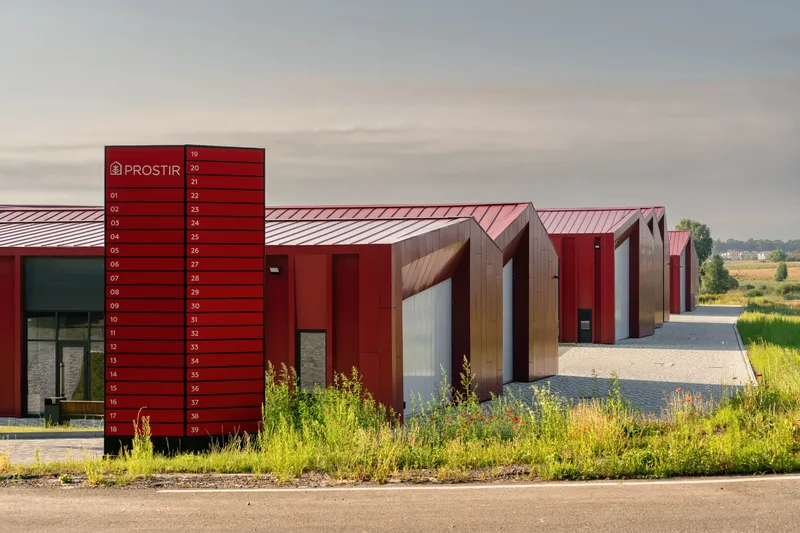
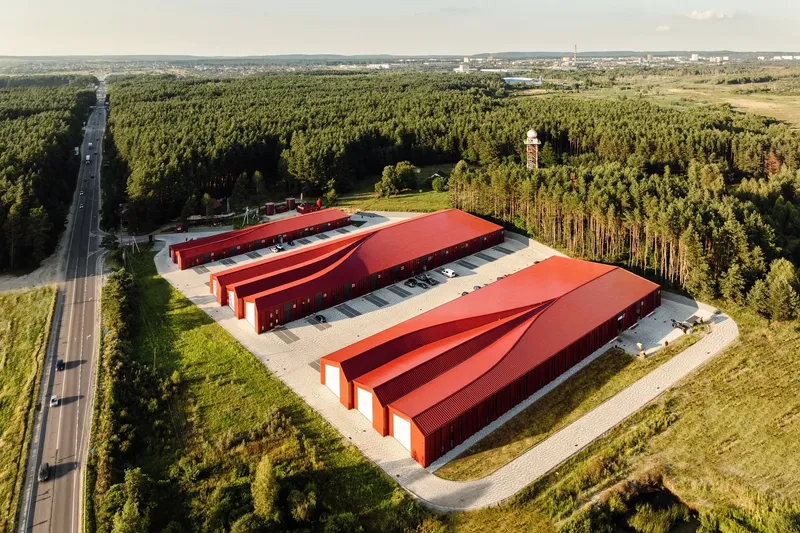
Logistics parks are not usually places that reward a second glance. They occupy ring roads, hug highway off-ramps, and present the world with featureless sandwich panel facades. Prostir Business Hub, completed in 2024 by Aranchii Architects, sits in exactly that context: Zymna Voda, on the outskirts of Lviv, where Ukraine's western logistics corridor has intensified since the start of the full-scale Russian invasion. The brief called for over 12,000 square meters of combined office, warehouse, and commercial space across three modular buildings. What arrived is something altogether more provocative: a row of steep gabled volumes wrapped in Falun red corrugated metal that reads, from the elevated Circular Road above, like a line of Scandinavian houses transplanted into an industrial clearing.
The real interest here is not the color trick alone but the argument the building makes about typology. Aranchii Architects treat the logistic hub as a problem of collective identity. Each gable corresponds to a modular bay that a tenant can claim in multiples of the structural grid (six meters in the smaller building, twelve in the larger ones). The domestic silhouette is not decoration. It signals that many independent operations share a single roof, exactly the way houses share a street. The terraced sawtooth roofline was computationally shaped so that every volume remains visible from the driver's vantage on the road above, turning the project into its own signage.
Red as Strategy

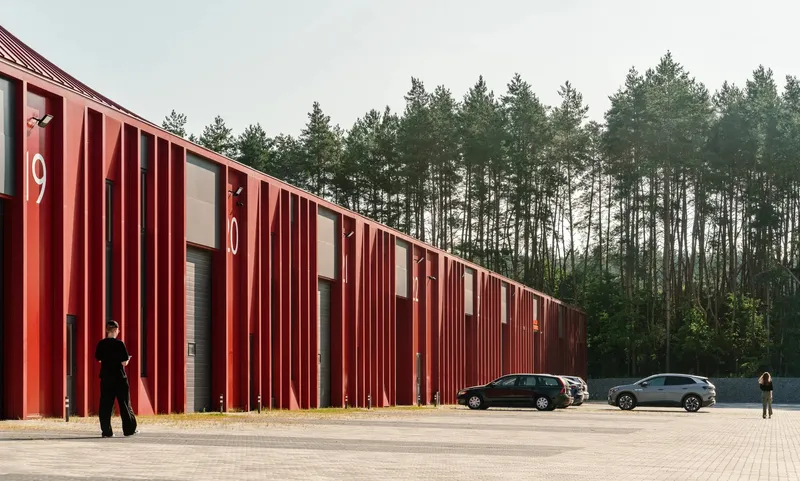
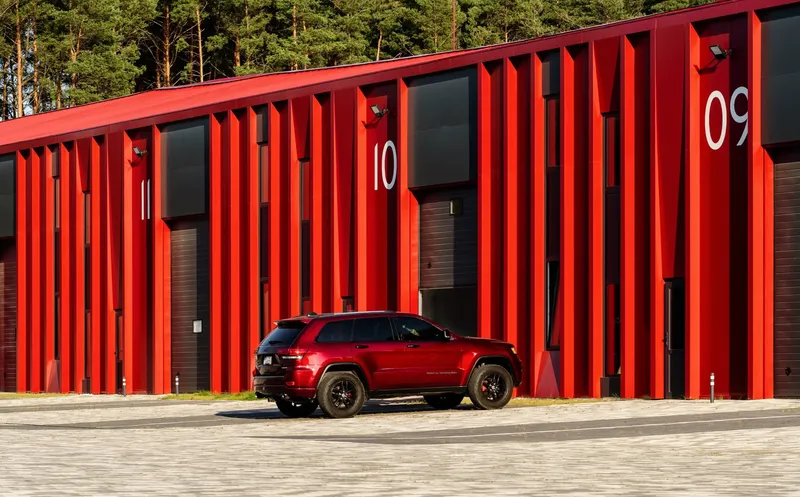
The Falun red chosen for the corrugated metal cladding is not arbitrary. It references the iron-oxide pigment historically used to protect timber structures in Scandinavia, a color that reads as both industrial and domestic depending on context. Against the pine forest that borders the site, the red registers as warm and grounded rather than aggressive. Along the long longitudinal facades, vertical window slots punctuate the ribbed surface at a rhythm that recalls residential fenestration more than commercial strip glazing. Dark vertical insets between bays modulate the proportions, preventing the facade from collapsing into one flat plane under low winter light.
The strategy works precisely because it does not try to hide the building's industrial bones. The corrugated profile is honest about what it is: a cost-effective envelope for a speculative logistics program. But the gable geometry and the color give that envelope cultural texture. It is an exercise in minimum means, maximum legibility.
Gables and the Domestic Silhouette

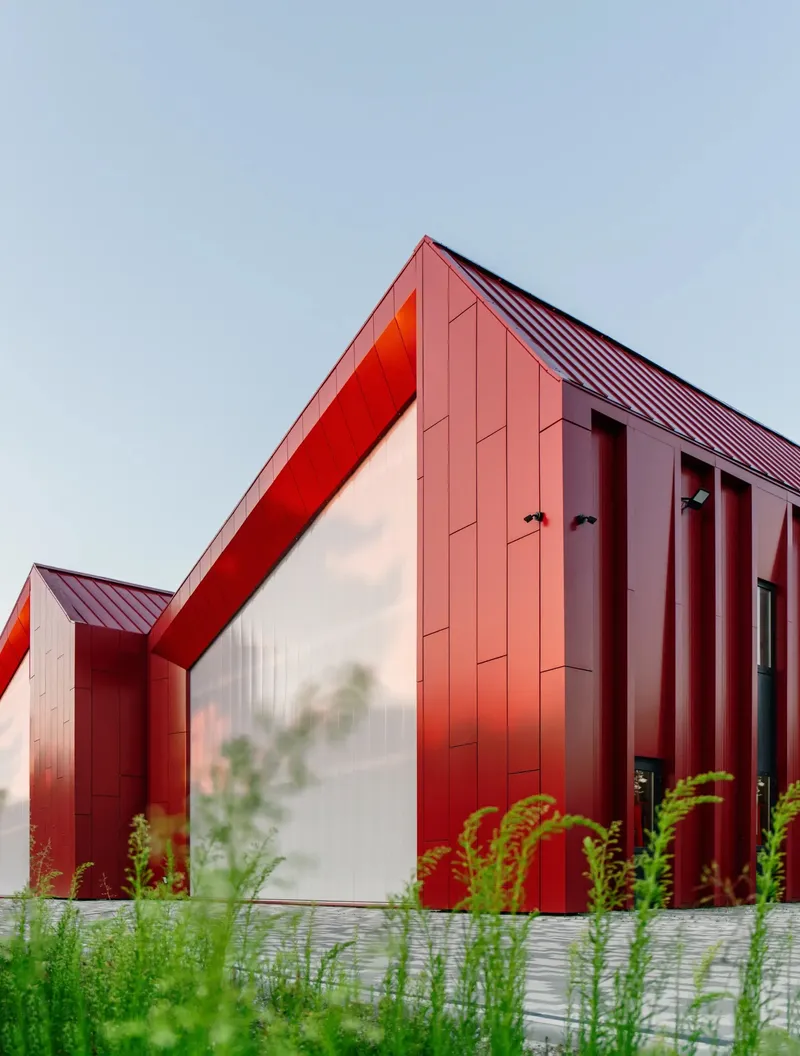

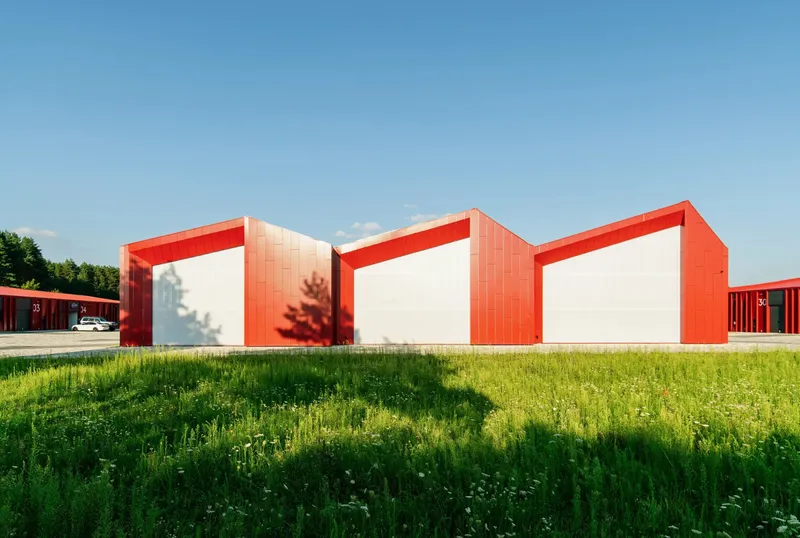
The two larger volumes each carry three gabled bays; the smaller building has two. Seen from the ground at dusk, with recessed white entries glowing beneath the red overhangs, the composition genuinely evokes a terrace of houses. Human figures walking between the volumes reinforce the residential scale in a way that a typical loading dock never could. Aranchii Architects eliminated elevated docks entirely, opting for barrier-free ground-level logistics access that further blurs the boundary between commercial use and pedestrian comfort.
The white end walls at each gable act as a visual release, breaking the red volumes into discrete episodes rather than letting them merge into a monolithic block. At the entry points, white recesses frame numbered bays, creating wayfinding cues that feel residential: house numbers rather than warehouse codes.
The Aerial Read


From above, the terraced red roofs resolve into a striking graphic composition. The sawtooth profiles, offset across the three buildings, catch light differently throughout the day, animating the roofscape. Parking bays sit between the volumes, organized so that cars occupy the interstitial space without dominating the ground plane. The curved site boundary pushes the buildings into a gentle fan arrangement that Aranchii Architects exploited for visibility: every gable peak is exposed to the elevated road, meaning a driver passing at 80 kilometers per hour registers the project as a sequence of distinct roofs rather than a single shed.
The computational approach to roof contouring deserves attention. Rather than defaulting to a uniform ridge height, the architects varied the terracing so that no volume hides behind another from the primary viewing angle. It is a calculated scenographic gesture, but one rooted in functional necessity: for a multi-tenant hub, being seen from the road is not vanity, it is commercial viability.
Entries and Thresholds
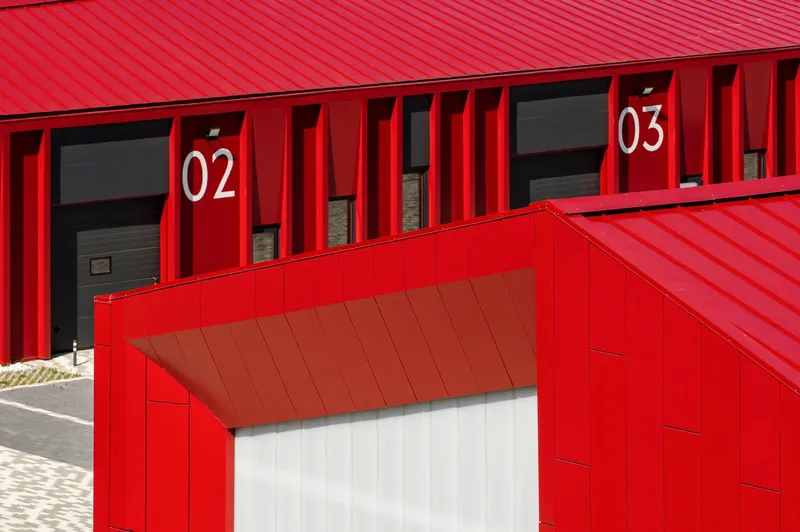
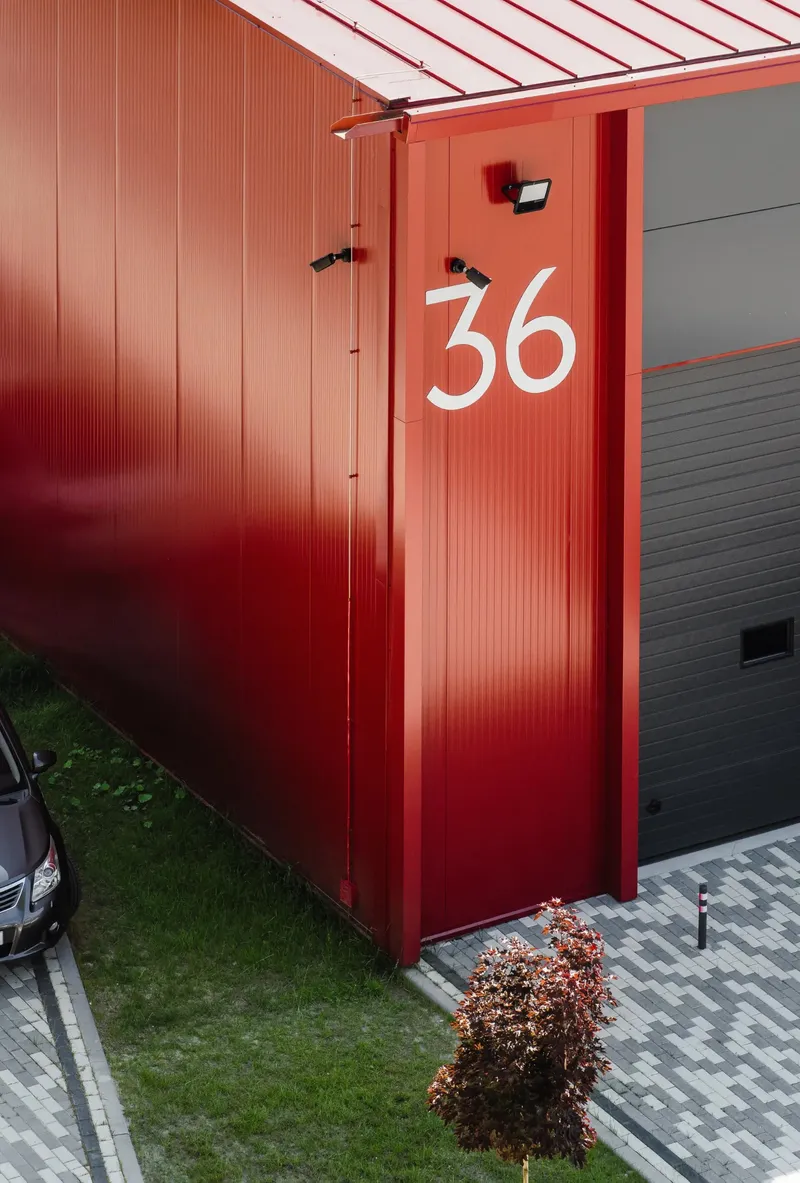
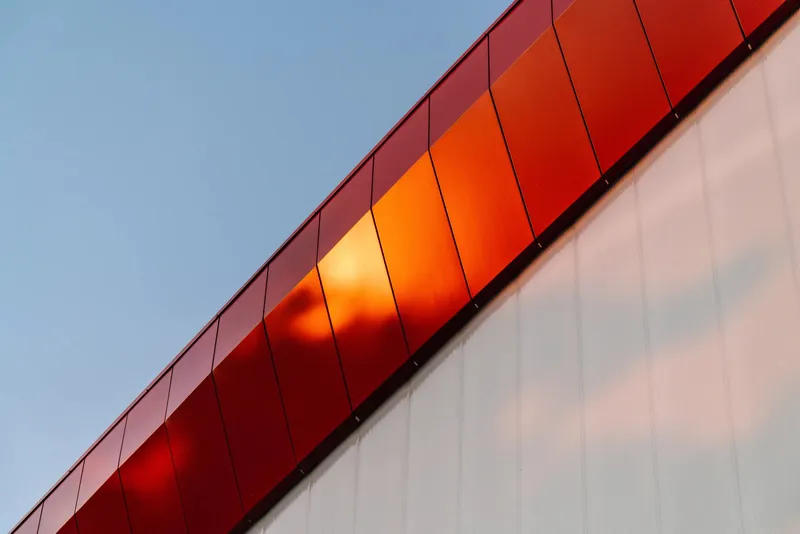
Detail shots reveal a careful negotiation between the red envelope and the white structural walls beneath. The canopy projections at each entry create deep shadow lines that give the facade depth. Numbered bays, painted directly onto the metal, reinforce the domestic analogy while keeping the graphic language blunt and industrial. A small shrub at the base of unit 36 reads almost like a doorstep planter, an unintentional bit of domesticity that proves the architects' thesis.
The junction between the angled metal soffit and the vertical white panel is resolved with a sharp crease, no capping trim, no visible sealant bead. It is a clean detail that rewards close inspection and suggests the architects cared as much about the joint as about the roofline.
Courtyards and Common Ground
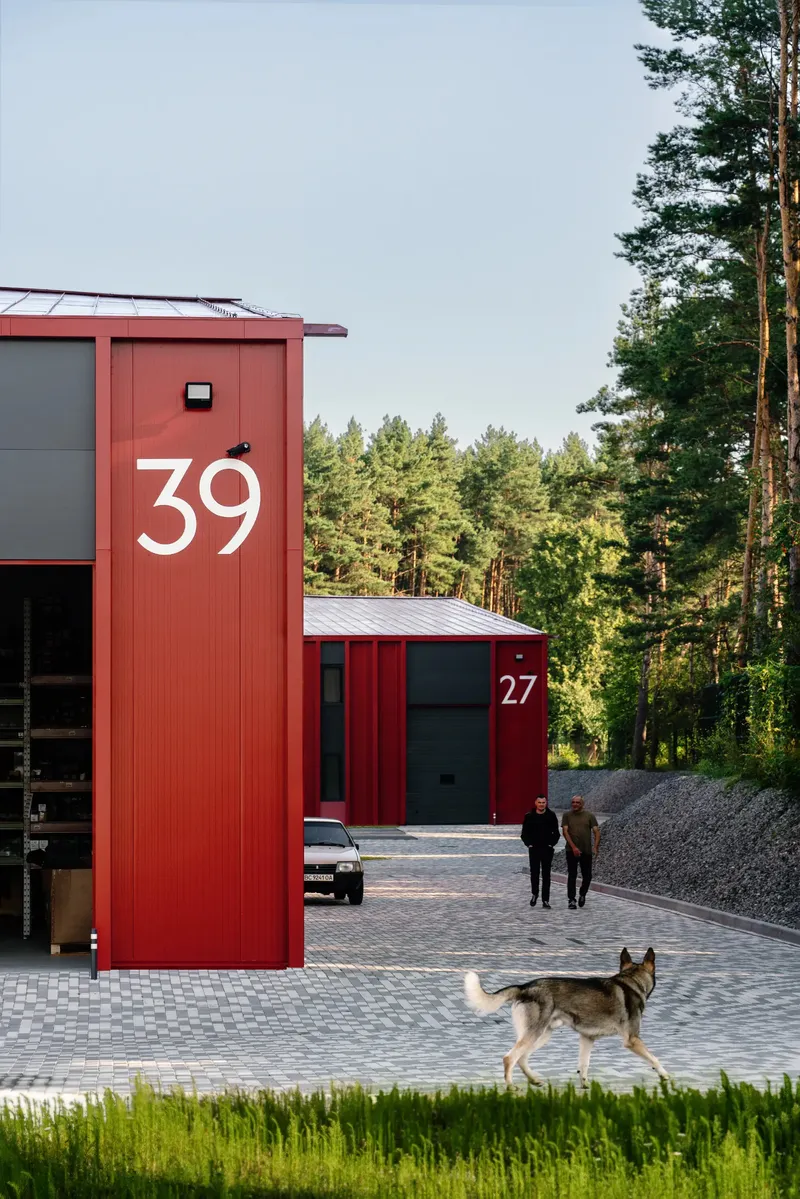
Between the buildings, the light-colored concrete paving creates courtyards that serve double duty: logistics access and social gathering. In one image, a dog trots across the forecourt while people linger near numbered entries. The scene would not look out of place in a housing cooperative. That is the point. By flattening the hierarchy between warehouse circulation and public space, the project invites an informality that most logistics parks actively discourage.
The pale paving also has a thermal logic. It reflects rather than absorbs solar radiation, reducing ground-level heat buildup during summer months. Combined with the compact volumetry that limits the heated envelope, these are modest but real passive strategies embedded in what is, at heart, a speculative commercial development.
Plans and Drawings


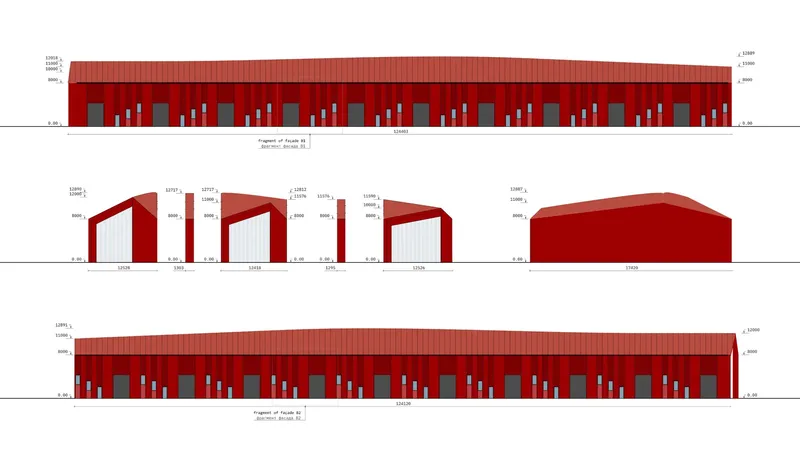
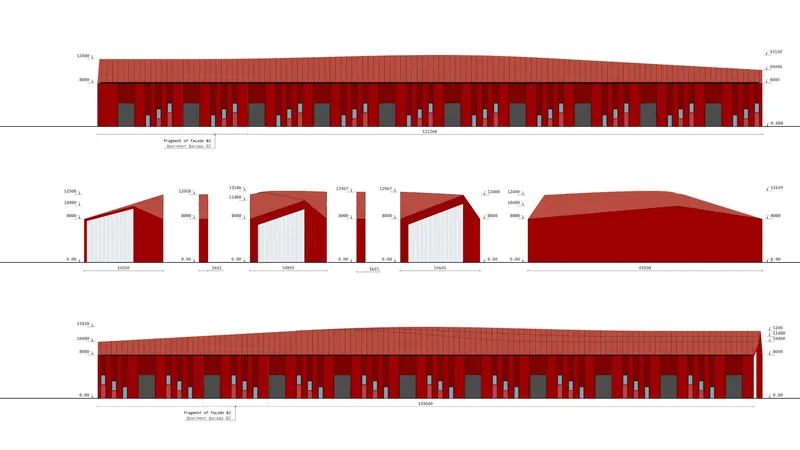



The site plan makes the striped logic legible: alternating bands of red (building) and white (circulation) organize the three volumes into a parallel arrangement with parking and landscaped buffers. The axonometric diagram illustrates the conceptual move that drives the project, a single linear volume bifurcating into distinct units that define shared courtyards between them. The facade color diagram and roof abstraction study show how the architects derived the sawtooth profile from a lowered Scandinavian row-house typology, compressing the domestic silhouette into a horizontal logistics language.
Elevation drawings across all three buildings demonstrate the rhythmic discipline. Window openings repeat at consistent intervals, their proportions adjusted between the shop-front variants shown in the facade study. The sawtooth section profiles confirm that the roof geometry is not ornamental: it produces north-facing clerestory zones that could admit diffused light deep into the warehouse floors. The repetition of a simple structural module, column, beam, gable, keeps the construction economical while lending the project its collective character.
Why This Project Matters
Since 2022, western Ukraine has become a critical logistics corridor, and the demand for functional storage and distribution space around Lviv is acute. Most of that demand is being met with generic sheds that treat architecture as a cost to minimize. Prostir Business Hub demonstrates that a clear formal idea, here the metamorphosis from domestic gable to industrial horizon, can deliver genuine spatial quality without inflating the budget. The modular grid, the sandwich-panel envelope, and the standard steel frame are all off-the-shelf solutions. The difference is authorship.
What Aranchii Architects have done is give a logistics park the legibility of a neighborhood. The red gables are not styling; they are an organizational diagram made visible. They communicate tenancy, scale, and identity in a single move. In a region where new construction must be fast, adaptable, and economically lean, that kind of clarity is not a luxury. It is infrastructure.
Prostir Business Hub by Aranchii Architects. Zymna Voda, Ukraine. 12,000+ square meters. Completed 2024. Photography by Alik Usik.
About the Studio
Share Your Own Work on uni.xyz
If projects like this are the kind of work you want to make, uni.xyz is a place to publish your own, find collaborators, and enter design competitions.


Popular Articles
Popular articles from the community


Opera on the Sea: Driftwood Logic Shapes a Timber Opera House on Estonia's Coast
Trevor Orgill's opera house translates the entangled drift of floating timber into a civic building where wood, water, and music converge.
Tsunami Convergenics: Turning Catastrophic Ocean Forces into Underwater Housing Infrastructure
A speculative underwater settlement off the coast of Onagawa, Japan, treats tsunamis and typhoons as energy sources rather than threats.
Temporary Home for Dogs: A Reversed Zoo Rethinks Animal Shelter Architecture
In Bucharest, a sinuous corridor and freed landscape flip the logic of containment, designing a shelter that works to make itself unnecessary.
Opera by the Sea Estonia: Three Shells Dissolving Architecture into Tallinn's Coastline
A winning opera house proposal replaces monumental form with interconnected shells that blur the boundary between building, park and Baltic Sea.

Similar Reads
You might also enjoy these articles

Pixel Gardens: One Repeated Module Stacked Into a Terraced Social Housing Tower for Famagusta
Salem Bader's shortlisted housing tower builds a vertical neighbourhood from one repeated module, offsetting units to carve terraces, light and air.

Bao Huynh Watercolor Atelier: A Serene Art Retreat in Hội An
Bao Huynh Watercolor Atelier in Hội An blends multifunctional art spaces, sustainable design, local materials, and family-friendly living in a serene environment.

Atelier Macri Concept Store Interior Design by CASE-REAL
Atelier Macri store features a "ko" counter, walnut wood details, cork displays, blending retail, gallery, and seamless customer experiences.

Manuel Vargas Izquierdo Stadium and High-Performance Sports Center: Architectural Excellence in Jalpa de Méndez
The Manuel Vargas Izquierdo Stadium blends sustainable design, inclusive sports facilities, and cultural-inspired architecture, revitalizing Jalpa de Méndez’s public spaces.

Comments (0)
Please login or sign up to add comments
No comments yet. Be the first to comment!