
Archimal
Becoming - Animal

Since Plato's time, humans have been creatures with a privilege. As rational and soulful beings, human beings are isolated from all things in the world and become outcasts in the world. Although this independence has brought great material development and prosperity of human society, it has also brought many problems such as environmental disasters. The most difficult of these questions is why, in the midst of our unprecedented development, our relationship with animals and nature is at such a high level of tension? What is our identity?
Philosopher Giorgio Agamben said that man always appears where he disappears. Man's definition of himself is always obtained by comparison with other beings, by the exclusion of other beings. In particular, animals, if people want to be human, they need to exclude the animality from themselves, cut off the connection, in order to gain their own status. But the problem is that defining oneself in terms of the other (or the exclusion of the other) is only a sign of weakness. As the poet Rimbaud put it, the self is always the other. Therefore, in human society, the excluded rudimentary animals will always come back to life in one form or another.
From the ancient Egyptian god of death, Anubis, to Marvel's Rocket Raccoon, half-human, half-animal characters have been featured throughout human culture. We believe that it is more than mere anthropomorphism or metaphorical rhetoric. There is a primal wisdom and a wish within these mixtures, make it possible to rediscover the relationship between humans and animals, and between humans and the world.
In The Thousand Plateaues, the philosopher Deleuze and Guatari refer to the liberation of this potential as becoming—animal, and provide a new perspective on the relationship between creatures of nature. The world is in constant change and transformation, unceasingly generating and dissolving. A person or an animal is not an totally independent, permanent, and fixed existence, but will always go out and form new relations and new and transient multiple combinations in the unceasingly contact with other existence in the world. The world is such flux, there is no innate stubborn existence. Life begins with differentiation, and this evolution is full of endless happenings and incalculable heterogeneity. In such a world, we must step out of our human conformism to become. We immerse ourselves in the flow of life's intuitions. Man becomes transcendent, not by affirming humanity, not by returning to an animal state, but by generating -- hybridity -- a state that is not himself. This becoming creates an "escape line”: we imagine all the becoming of life through life itself, and we use the human imagination to affirm human limitations.
By becoming, by becoming—animal, we no longer place ourselves in a position of organizational judgment, but become the Other with the forces that we encounter and constitute ourselves. This is freedom: not a freedom from our judgment of who we are, but a freedom from our limited self, our image, and an openness to life.
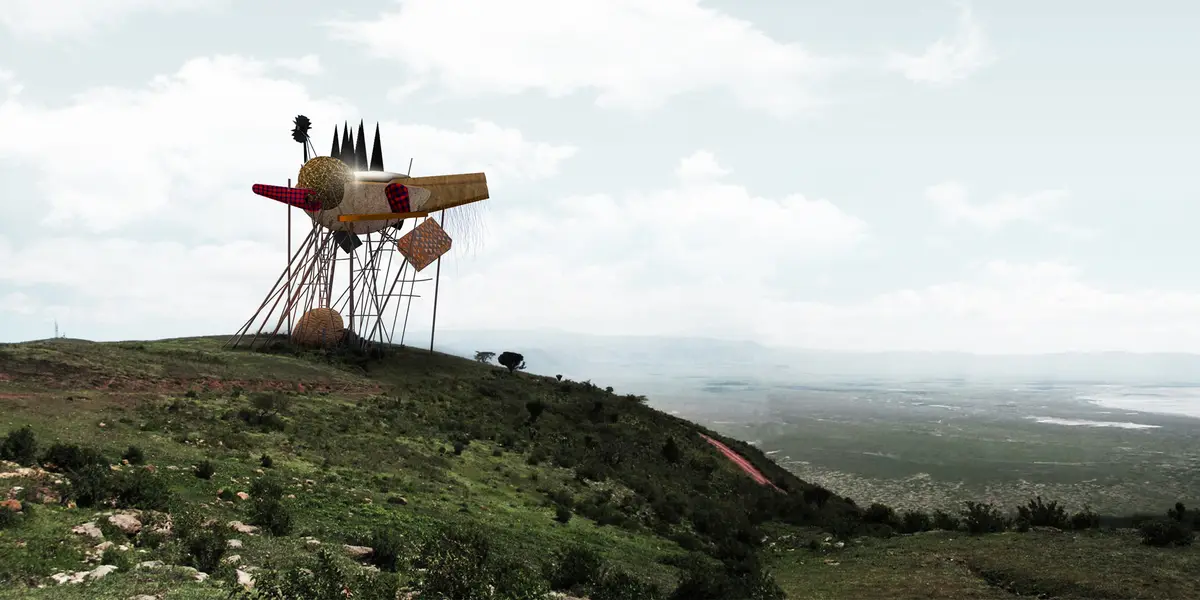
So our proposal seeks to pursue such a becoming—animal, which emerges in the context of a living prairie, a lake, and a crater, where life itself oscillates at its highest intensity. So what role can architecture play in this process? On the one hand, the construction is the environment of this becoming, provides a mixture of possible spatial heterogeneity, on the other hand, the building itself is in constant becoming, people and animals in this adventure will influence on the building. Events and material generated, turning it into a building beast, we call it the Archimal.
Our building is an unprecedented hybrid, where human and animal parts meet again, mix and assemble to form a giant beast. Nests, branches, fangs of wolves, spears and sticks of local Maasai people, feet of flamingos, bellies of hippopotamuses, manes of lions, fences, windmills, Platonic geometry... These things interweave together and play the role of architecture, showing the fate of the world.
This is truly an architecture, not just a sculpture that tries to transcend humanity. It is "empty". Functions are organized within it. The main space of functions floats in midair, forming Archimal's body, which hovers over the edge of the cliff and watches over the living world inside the crater. A number of feet and limbs support the body. The reception area is located directly below it. Through the reception area (like a local boar's lair), a long ladder allows visitors access to the Archimal's main interior space. There are many additions to the supporting limbs, which are intended for animals (monkeys, birds, insects, etc.) to perch in, so these additions may increase until they fill the entire space. The hippo's belly is the core of Archimal's interior space, which leads to an outdoor viewing deck, a horizontal viewing tower, a small dining room suspended below, toilets, storage areas and more. A number of holes protrude from the body in all directions. These are Archimal's eyes.
Archimal is also made of a variety of materials, including wood planks, branches, clay, metal, concrete, the colorful cloth of the Maasai people, and surfaces with intricate geometric patterns. Different materials vary here, and each encounter between materials is a collision of notes with notes.
The local Maasai people have a tradition of jumping. The one who jumps higher will get closer to heaven and god. They are jumping under the building, hoping to touch Archimal's stomach. We are also jumping here, hoping to go beyond the line between human and animal, to touch the deepest possibility of our existence.

Popular Articles
Popular articles from the community


Opera on the Sea: Driftwood Logic Shapes a Timber Opera House on Estonia's Coast
Trevor Orgill's opera house translates the entangled drift of floating timber into a civic building where wood, water, and music converge.

Singing Woman: An Opera House That Performs Before the Curtain Rises
Ovidiu Cristian Pavel's conceptual opera house translates Estonia's choral identity into a sculpted waterfront landmark facing the Baltic Sea.

The Amber Palace Opera: A Geological Fiction Surfaces on Tallinn's Baltic Waterfront
Pierre Brillard reimagines a Baltic legend as a public landscape, opera house, and waterfront promenade rooted in Tallinn's coastal identity.
Opera by the Sea Estonia: Three Shells Dissolving Architecture into Tallinn's Coastline
A winning opera house proposal replaces monumental form with interconnected shells that blur the boundary between building, park and Baltic Sea.

Similar Reads
You might also enjoy these articles

Shakur's House: Exposed Brick as an Interior Organiser in a 168 m² Mashhad Residence
Brick moves indoors in this Mashhad residence, where masonry walls, glass partitions and teal planes sequence a compact home without closing it off.

Day and Night Park: A Time-Based Urban Newsstand in Beijing
A temporary urban newsstand in Beijing blending travel, light, and reading through poetic colors, compact form, and community-focused design.

Modernist Patio Renovation in El Masnou, Barcelona by Oliver Segura Arquitectura + Cebrià Arquitectura
Modernist patio renovation blending tradition and innovation with a movable pool, leveled floors, and Catalan materials in El Masnou.
Alto Residencial Coop: Cooperative Housing Development in Santiago de Compostela by Carbajo Barrios Arquitectos
A linear cooperative housing complex blending white volumes and perforated metal façades, enhancing community living, natural light, privacy, and urban integration.


Comments (0)
Please login or sign up to add comments
No comments yet. Be the first to comment!