
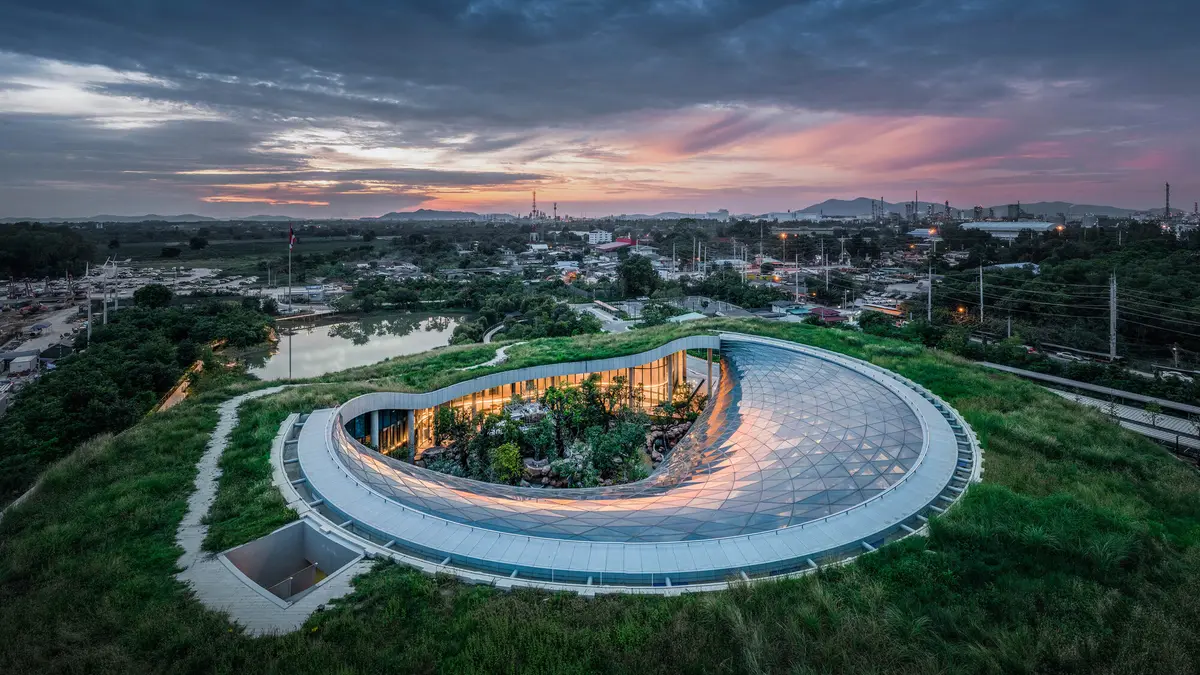
Architects 49 Wraps an LNG Terminal Office in a Living Forest Canopy in Map Ta Phut
A 13,500-square-meter circular office harnesses cold energy from liquified natural gas to grow a cloud forest in industrial Thailand.


Industrial energy infrastructure rarely generates architecture worth studying for its ecological ambition. The Center of Excellence for Forest Conservation, designed by Architects 49 at the Nong Fab LNG Receiving Terminal in Map Ta Phut, Thailand, is an exception worth examining closely. Completed in 2022, this 13,500-square-meter office building does something genuinely unusual: it harvests the by-product cold energy released during LNG regasification and channels it into a climatic atrium where cold-climate flora thrives year-round in tropical Thailand. The result is not a greenwashed corporate campus but a building that instrumentalizes an industrial process to reconstruct an ecosystem that had been erased from the site.
The name "Nong Fab" is a Thai ecological term for brackish swampland dominated by Hymenocardia punctata, a species that had entirely disappeared from the site by the time the project began. What Architects 49 and landscape collaborators TK Studio delivered is a ring-shaped building occupying just 14% of an 8.1-hectare office zone, with 43% given over to regenerated forest and wetland, 17% to a retention pond, and the remainder to circulation and parking. The building is, in effect, the smallest gesture on a site whose primary purpose is ecological restoration.
The Circle as Industrial Echo
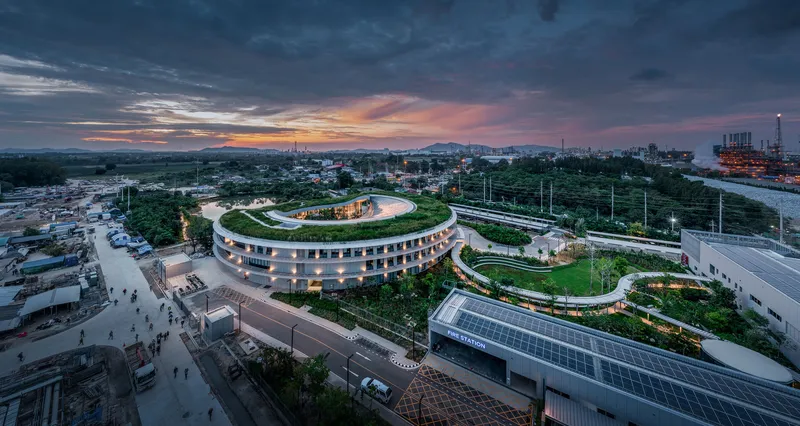
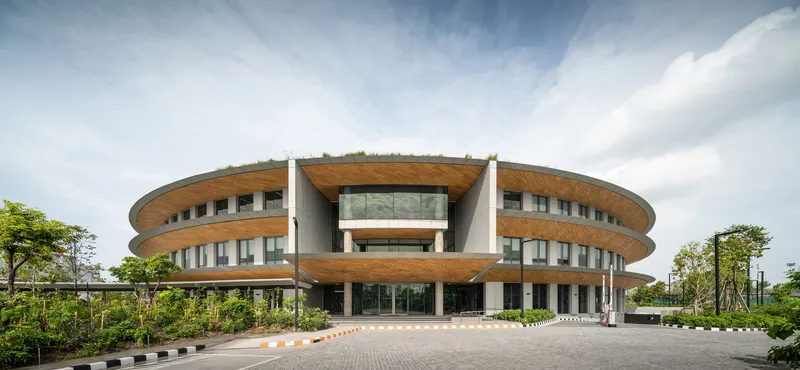
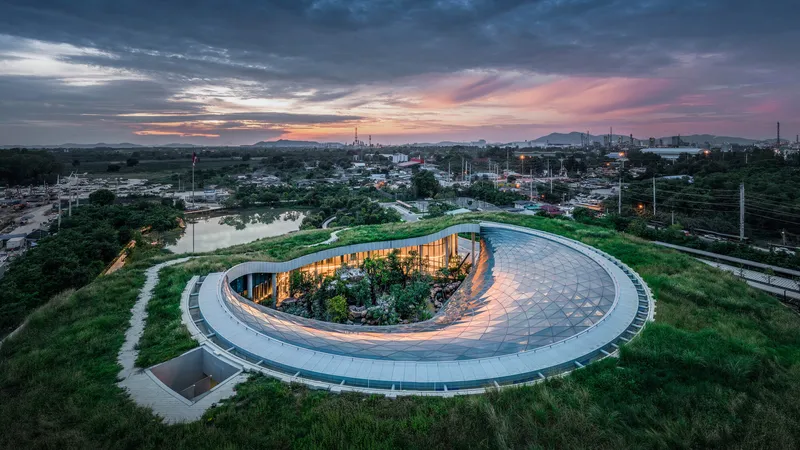
The building's circular plan is a deliberate formal reference to the cylindrical LNG storage tanks visible on the horizon. From above, the green roof dissolves the ring into the surrounding landscape, its planted surface winding down to ground level so that the building reads less as an object and more as a thickened topography. The timber-clad facade, visible at the main entrance, uses warm, organic materials to soften the industrial geometry. It is a smart calibration: the circle acknowledges the infrastructure that pays for the building without mimicking it literally.
The proportions of the ring also serve a pragmatic function. By keeping the footprint compact and circular, the architects maximized the ratio of landscape to built area. The green roof is not decorative. It prolongs rainwater runoff, provides animal habitat, and acts as an insulating layer that reduces cooling loads in a climate where air conditioning is the dominant energy expense.
Cold Energy and the Climatic Atrium
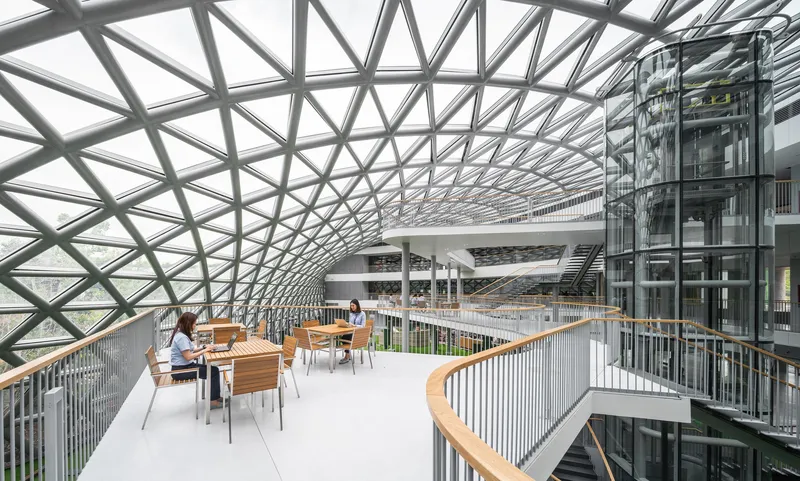
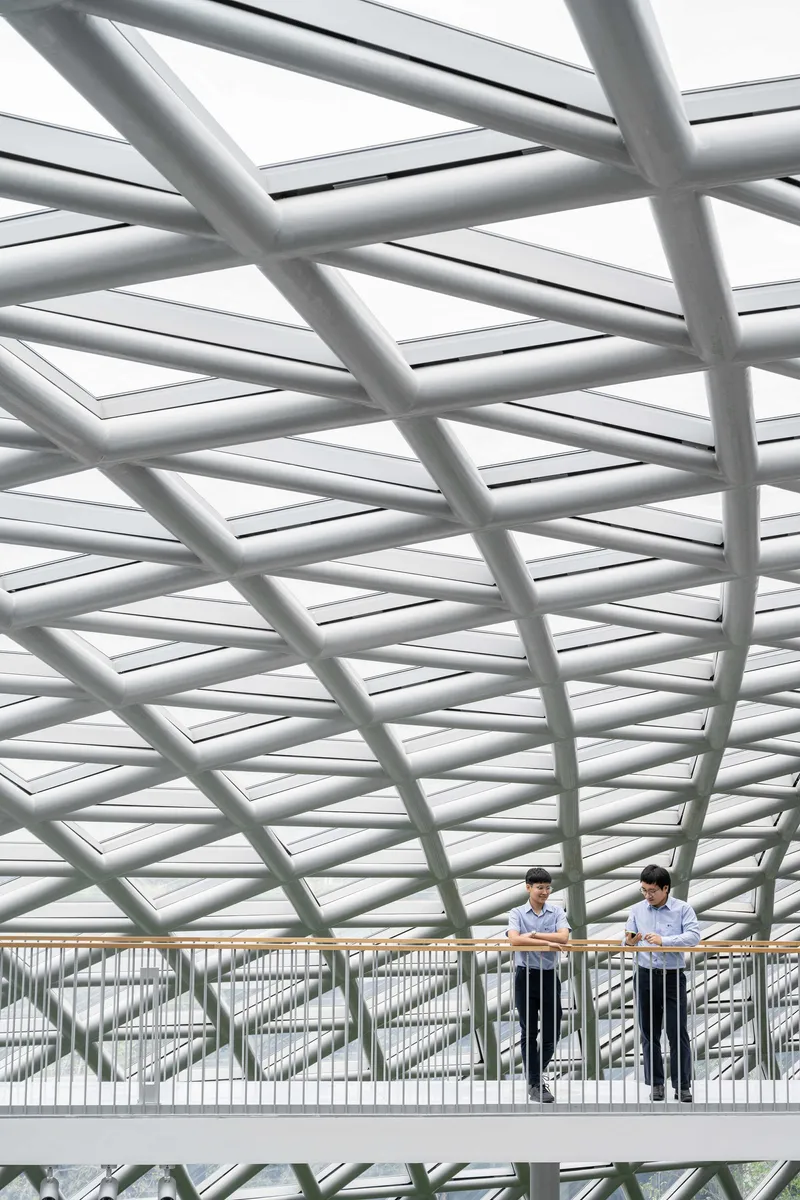
The most technically interesting move here is the central atrium, covered by a large glass dome with a curved diagrid steel lattice structure. Inside, a cloud forest environment is sustained using cold energy piped from the LNG regasification process. When LNG is converted back to gas, enormous quantities of cold energy are released as waste. Rather than venting it, the building repurposes it to regulate interior temperatures and support plant communities that would otherwise be impossible in Thailand's tropical heat.
A large waterfall circulates water through the atrium, providing the humidity levels that cloud forest vegetation demands. This is not a botanical curiosity; it is a working demonstration of how industrial by-products can be redirected into ecological benefit. The multi-level balconies and study spaces surrounding the atrium allow the building's occupants to work within this manufactured microclimate rather than simply looking at it through glass.
Diagrid Canopies and Interior Atmosphere
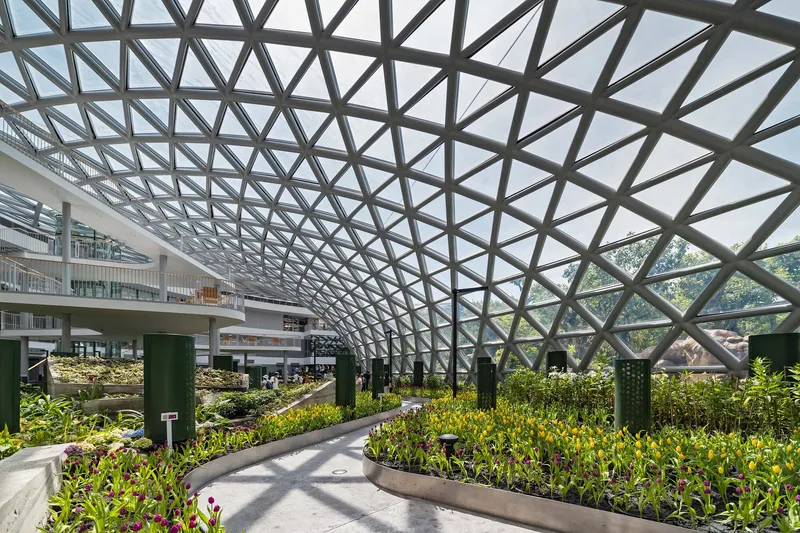
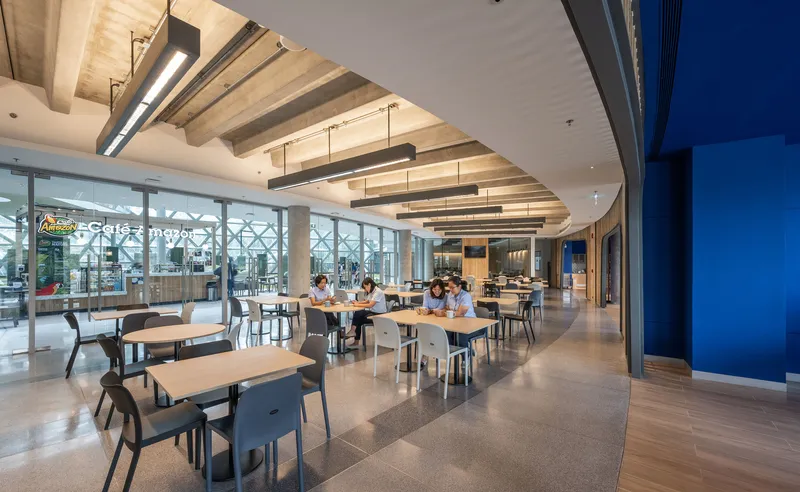
The building's secondary spaces reveal a consistent material intelligence. The covered garden terrace uses a diagonal steel roof structure that filters light over planted beds and walking paths, creating an intermediate zone between interior and exterior. The cafeteria opens directly into this space through full-height diagrid glazing, so the boundary between eating and garden is perceptual rather than spatial. Exposed timber ceiling beams in the cafeteria continue the warm material palette established on the exterior facade.
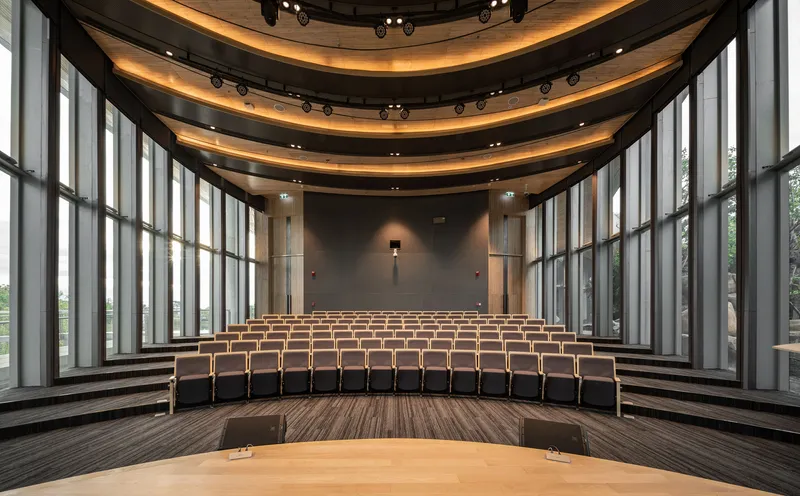
The auditorium, with its tiered wooden seating and vertical glass walls, follows the same logic of visual connection. Even in the most enclosed programmatic spaces, the architects ensured sightlines to vegetation. The control room, with its workstations facing a diagrid-glazed wall overlooking the landscape, treats the restored wetland as a working backdrop rather than an amenity to be accessed only during breaks.
Interior Workspaces and the Control Room
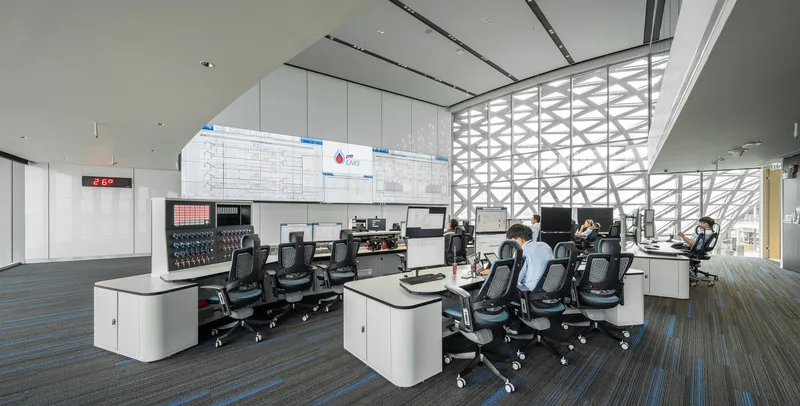
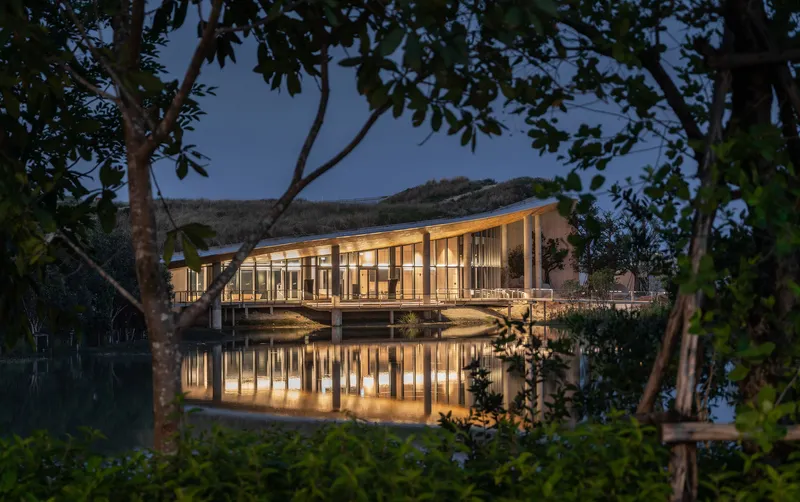
The control room is worth pausing on. In most energy infrastructure projects, the operational nerve center is a sealed, artificially lit box with monitors and fluorescent tubes. Here, staff face outward through floor-to-ceiling glazing toward the wetland and tree canopy. The glass pavilion on stilts above the lake, visible at dusk with its interior lights reflecting on the water surface, further extends this philosophy: even the satellite structures prioritize connection to the reconstituted landscape.
The site runs predominantly on renewable energy from wind and solar power, and the building was designed to meet TREES standards, Thailand's equivalent of LEED. These are not bolt-on certifications. The cold energy system, the green roof, the detention lawn that prolongs runoff during rainy season, and the natural buffer strip along the site boundary are all integral to the building's performance rather than afterthoughts.
Reconstructing Nong Fab
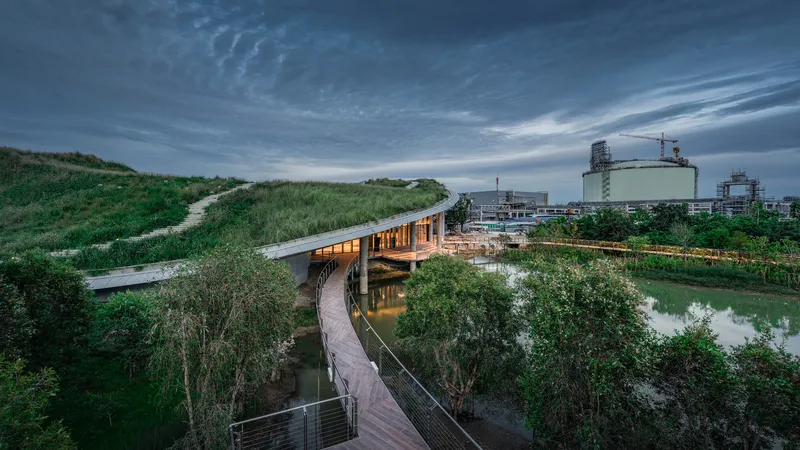
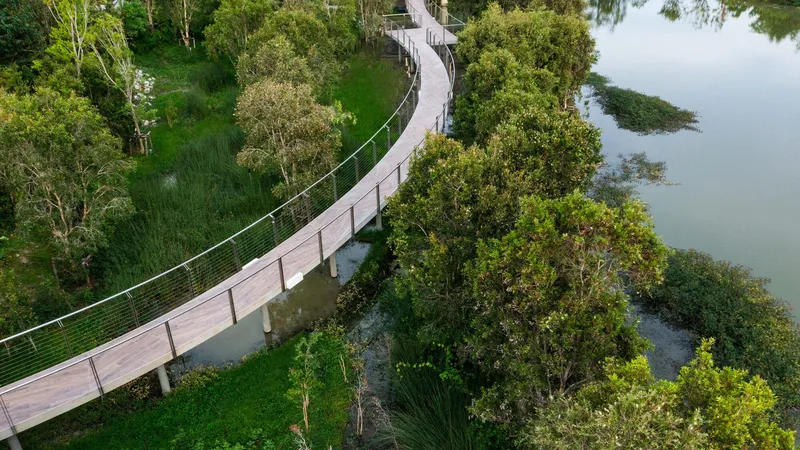
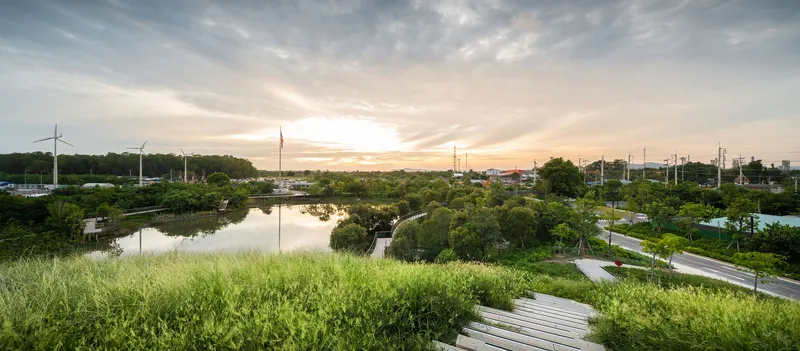
The landscape work is arguably the project's most significant achievement. Before construction, the site had been partially filled and leveled. The original swamp had been largely destroyed, all the Fab trees had vanished, and the ground was covered with native weeds and a few scattered survivors. TK Studio's landscape strategy recreated the natural water flow system to rejuvenate the wetland ecosystem, reintroducing over 200 native plant species including endangered indigenous vegetation.
The timber boardwalks curving through wetland grasses and shallow water are not merely recreational infrastructure. They organize access to multiple ecosystem zones: swamp, swamp peat forest, and beach forest, each calibrated to different water levels. A large retention pond serves as water catchment for the surrounding area, and a geosynthetic clay liner ensures the pond functions as intended. The elevated walkways bridge planted wetlands with the industrial tanks visible in the distance, making the juxtaposition between industry and ecology explicit rather than hiding it.
Plans and Drawings
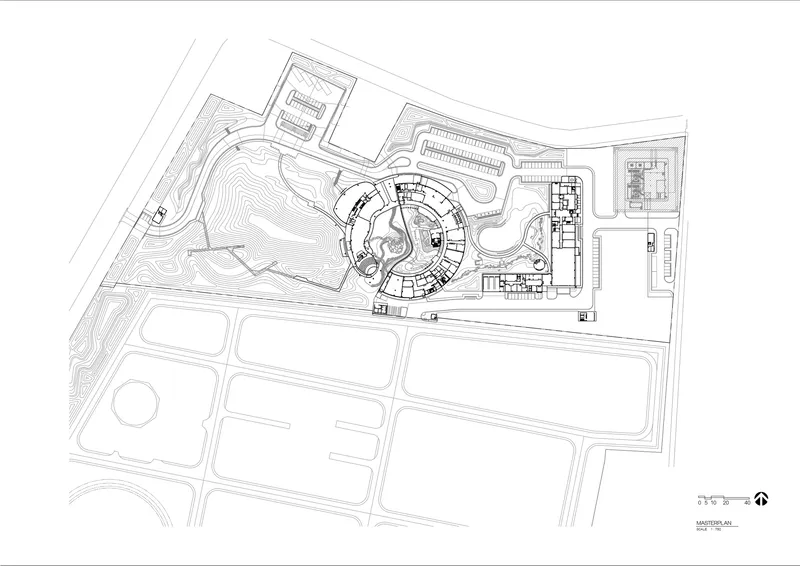
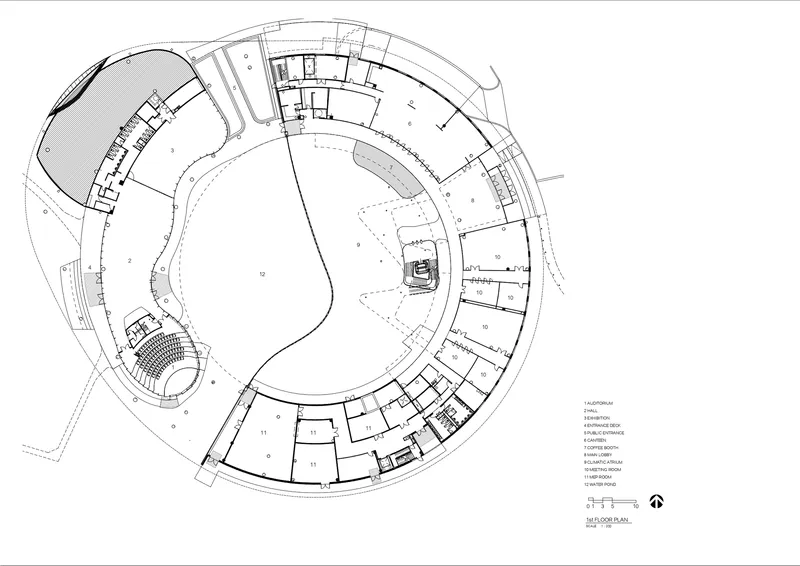
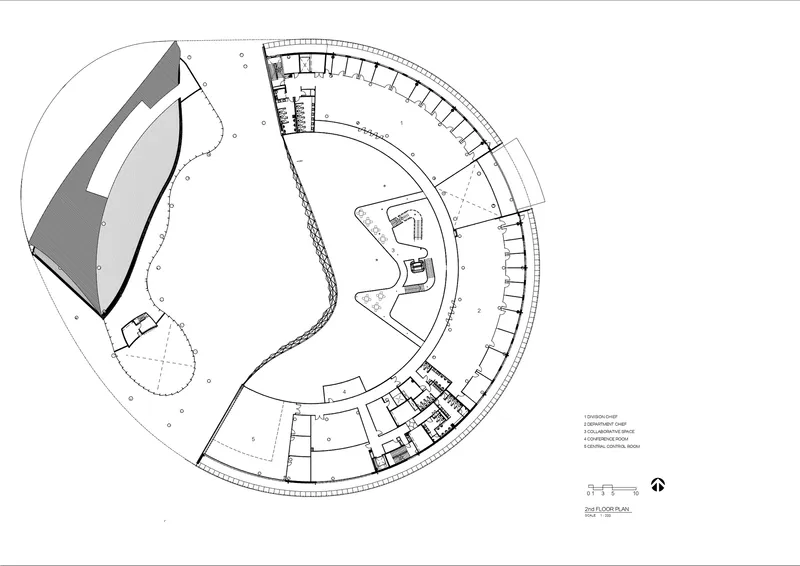
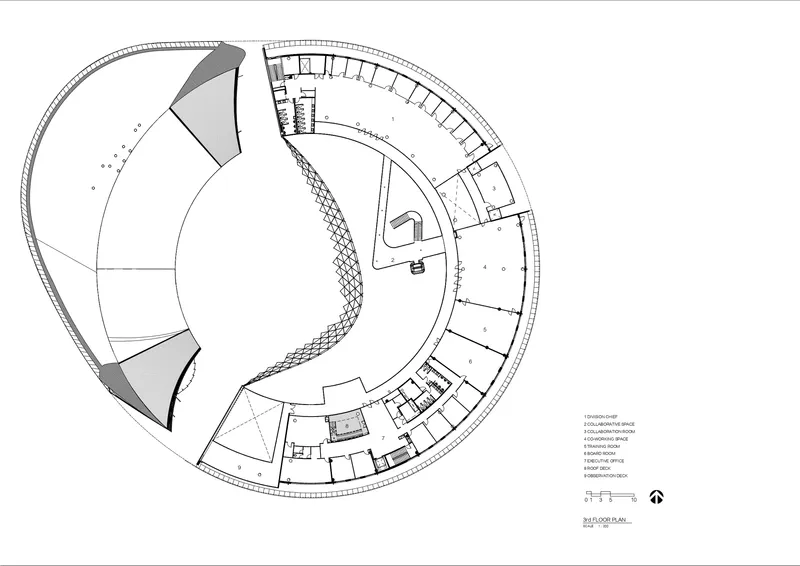
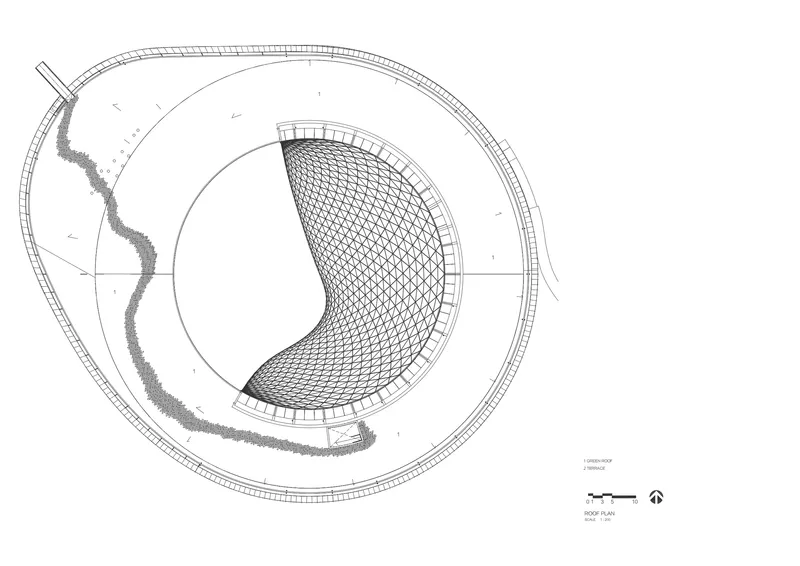
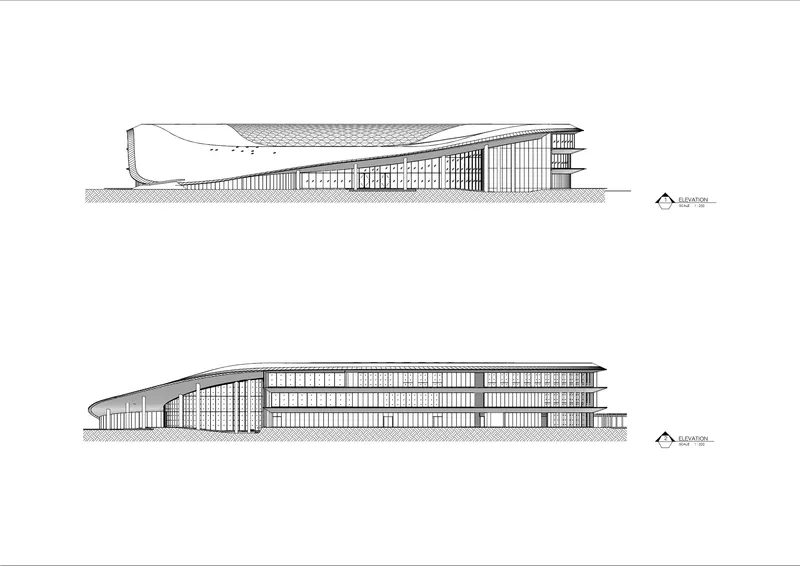
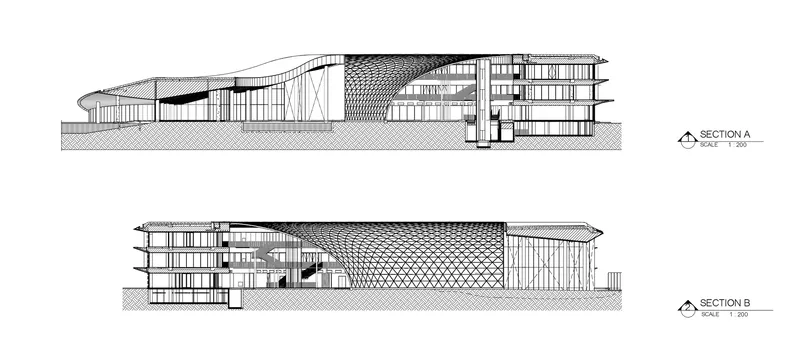
The site plan reveals the full extent of the landscape strategy: the circular building sits within a field of topographic contours, radiating wings connecting it to the surrounding terrain. The floor plans show how the curved programmatic zones wrap around the central courtyard, with triangular shaded volumes at the perimeter accommodating secondary functions. The roof plan makes visible the mesh canopy and perimeter tree plantings that blur the building's edge. Elevations and sections confirm the flowing roof profile and the patterned lattice ceiling structure of the atrium, illustrating how the cold energy system and waterfall are integrated into the section rather than appended to it.
Why This Project Matters
Corporate sustainability buildings tend to fall into two categories: either they pursue certification metrics with minimal spatial ambition, or they deploy spectacular green gestures with limited ecological substance. The Center of Excellence for Forest Conservation manages to avoid both traps. The cold energy system is not a gimmick; it is a genuine repurposing of industrial waste into a microclimate that supports otherwise impossible plant communities. The landscape restoration is not decorative planting; it is a systematic reconstruction of a destroyed wetland ecosystem using 200 native species.
What makes Architects 49's design persuasive is the proportion of ambition. Only 14% of the site is building. The rest is given over to water, forest, and ecosystem recovery. In a context where energy companies routinely commission architecture to launder their public image, this project offers something more credible: a building that makes the case for coexistence between heavy industry and ecological repair not through rhetoric, but through thermodynamics and hydrology.
Center of Excellence for Forest Conservation, designed by Architects 49 with landscape by TK Studio and lighting by 49 Lighting Design Consultants. Map Ta Phut, Thailand. 13,500 m². Completed 2022. Photography by DOF Sky|Ground and Nattakit Jeerapatmaitree.
About the Studio
Share Your Own Work on uni.xyz
If projects like this are the kind of work you want to make, uni.xyz is a place to publish your own, find collaborators, and enter design competitions.


Popular Articles
Popular articles from the community

Extended Shell: Retrofitting Kolkata's Balconies as Living Urban Thresholds
A modular retrofit system recovers the social and environmental intelligence of Kolkata's historic verandas for contemporary Park Street residents.

Singing Woman: An Opera House That Performs Before the Curtain Rises
Ovidiu Cristian Pavel's conceptual opera house translates Estonia's choral identity into a sculpted waterfront landmark facing the Baltic Sea.

Opera on the Sea: Driftwood Logic Shapes a Timber Opera House on Estonia's Coast
Trevor Orgill's opera house translates the entangled drift of floating timber into a civic building where wood, water, and music converge.

The Amber Palace Opera: A Geological Fiction Surfaces on Tallinn's Baltic Waterfront
Pierre Brillard reimagines a Baltic legend as a public landscape, opera house, and waterfront promenade rooted in Tallinn's coastal identity.

Similar Reads
You might also enjoy these articles

Pixel Gardens: One Repeated Module Stacked Into a Terraced Social Housing Tower for Famagusta
Salem Bader's shortlisted housing tower builds a vertical neighbourhood from one repeated module, offsetting units to carve terraces, light and air.

Bao Huynh Watercolor Atelier: A Serene Art Retreat in Hội An
Bao Huynh Watercolor Atelier in Hội An blends multifunctional art spaces, sustainable design, local materials, and family-friendly living in a serene environment.

Atelier Macri Concept Store Interior Design by CASE-REAL
Atelier Macri store features a "ko" counter, walnut wood details, cork displays, blending retail, gallery, and seamless customer experiences.

Manuel Vargas Izquierdo Stadium and High-Performance Sports Center: Architectural Excellence in Jalpa de Méndez
The Manuel Vargas Izquierdo Stadium blends sustainable design, inclusive sports facilities, and cultural-inspired architecture, revitalizing Jalpa de Méndez’s public spaces.

Explore Natural Forest Competitions
Discover active competitions in this discipline

Challenge to reimagine the Iron Throne

Photograph architecture without architects

Illustrate the lost glory of Angkor Wat - Render Challenge

Design challenge to reuse E-waste
Comments (0)
Please login or sign up to add comments
No comments yet. Be the first to comment!