

Architecture for Destigmatisation and Empowerment of Widows in Vrindavan
This thesis investigates how architecture can become a medium for social reform and healing, focused on the widows of Vrindavan, a community long subjected to marginalisation.

Vrindavan, known for its sacred associations with Krishna, also bears a difficult reality: it has become home to thousands of widows, often abandoned, destitute, and excluded from mainstream society. Their lives are marked by silence, isolation, and a lack of safe spaces for expression or livelihood. This thesis proposes that architecture can serve as a bridge reframing not just the built environment, but also the social and cultural attitudes surrounding widowhood.
The project envisions a skill development and empowerment center embedded within Vrindavan’s historic fabric. The spatial language emerges from metaphors of Krishna’s leela and the Parikrama Marg, reinterpreted as pathways of healing and shared journeys. Spaces are designed to create a “knot” a symbolic separation that allows widows to shape their own identity within a supportive community, while still remaining connected to the larger city.
Functional interventions include workshops for crafts and skills, communal courtyards for dialogue, therapeutic landscapes, and residential clusters that restore privacy and dignity. These spaces are not merely shelters; they are platforms for agency, resilience, and participation. Mythological references are subtly integrated - murals, symbolic gardens, and spatial rhythms creating a dialogue between tradition and progress.
Ultimately, this thesis challenges architecture to move beyond physical infrastructure. It asks: What can space give back to society? In Vrindavan, the answer lies in an architecture that transforms stigma into strength, silence into voice, and marginalisation into empowerment.

Popular Articles
Popular articles from the community


Extended Shell: Retrofitting Kolkata's Balconies as Living Urban Thresholds
A modular retrofit system recovers the social and environmental intelligence of Kolkata's historic verandas for contemporary Park Street residents.

Faces of the Soviet Avant-Garde: Turning Moscow's Street Names into an Open-Air Museum
A network of sculptural installations across a Moscow residential district transforms forgotten architect names into spatial encounters with cultural memor

Manzana Morphosis: Stretching Barcelona's Grid into a Living Landscape for 2050
A radical reworking of the Eixample manzana turns density into a tool for generous public space, vertical ecology, and environmental performance.
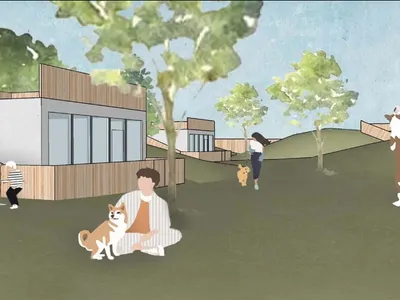
Temporary Home for Dogs: A Reversed Zoo Rethinks Animal Shelter Architecture
In Bucharest, a sinuous corridor and freed landscape flip the logic of containment, designing a shelter that works to make itself unnecessary.

Similar Reads
You might also enjoy these articles

Shakur's House: Exposed Brick as an Interior Organiser in a 168 m² Mashhad Residence
Brick moves indoors in this Mashhad residence, where masonry walls, glass partitions and teal planes sequence a compact home without closing it off.

Day and Night Park: A Time-Based Urban Newsstand in Beijing
A temporary urban newsstand in Beijing blending travel, light, and reading through poetic colors, compact form, and community-focused design.

Modernist Patio Renovation in El Masnou, Barcelona by Oliver Segura Arquitectura + Cebrià Arquitectura
Modernist patio renovation blending tradition and innovation with a movable pool, leveled floors, and Catalan materials in El Masnou.

Alto Residencial Coop: Cooperative Housing Development in Santiago de Compostela by Carbajo Barrios Arquitectos
A linear cooperative housing complex blending white volumes and perforated metal façades, enhancing community living, natural light, privacy, and urban integration.

Explore Vinyasa Architecture Competitions
Discover active competitions in this discipline


Challenge to reimagine the Iron Throne

Photograph architecture without architects

Illustrate the lost glory of Angkor Wat - Render Challenge

Design challenge to reuse E-waste
Comments (0)
Please login or sign up to add comments
No comments yet. Be the first to comment!