

Arenas Basabe Palacios and Soyka/Silber/Soyka Build 65 Homes Around Servant Cores in Vienna
Born from a EUROPAN 12 win, three larch-clad residential blocks in north Vienna prioritize flexibility, light, and shared ground.


Winning a competition is one thing. Turning that win into 65 occupied homes a decade later, in a foreign city, with a local co-architect and a masterplan that had to pass through years of collaborative planning, is something else entirely. Selma Am Park, completed in 2022 in the Siemensäcker neighborhood of north Vienna, is the built outcome of Arenas Basabe Palacios's "Urban Software" proposal, which won EUROPAN 12 and then evolved through a partnership with Soyka/Silber/Soyka Architekten into three residential blocks sitting on a shared underground garage in an eight-hectare neighborhood where cars are banished from ground level.
What makes the project worth studying is not its white stucco surfaces or its larch shutters, both of which are handsome but not novel. It is the organizational premise: every apartment wraps around a central "servant cabinet," a dense nucleus of storage, MEP services, and wet rooms that frees the perimeter for living space and guarantees that each home opens outward with at least two orientations. The result is a plan type that maximizes natural light hours per day while keeping corridor runs short. Three blocks, labeled S, M, and L (8, 15, and 42 units respectively), share a vocabulary of projecting bay windows, timber privacy screens, and staggered balconies, yet each block adapts its massing to the topography and the edges of the surrounding urban fabric.
Three Blocks, Three Scales
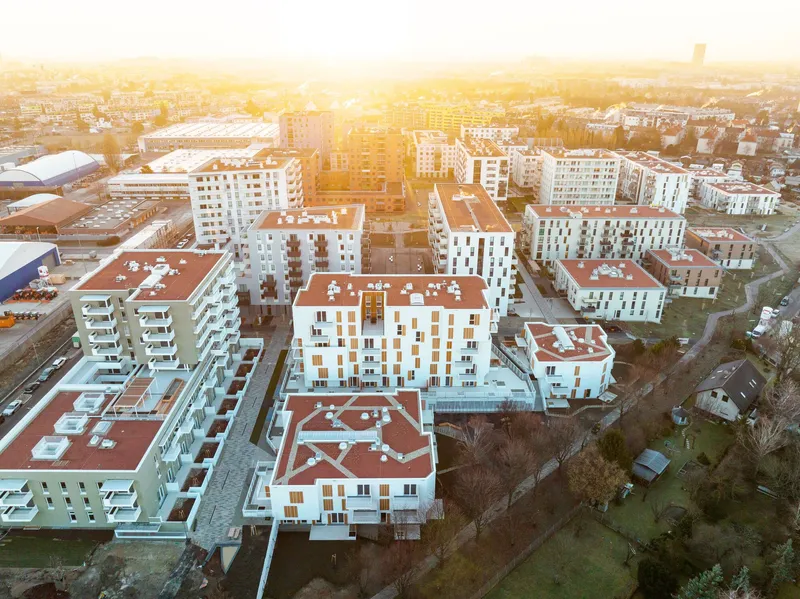
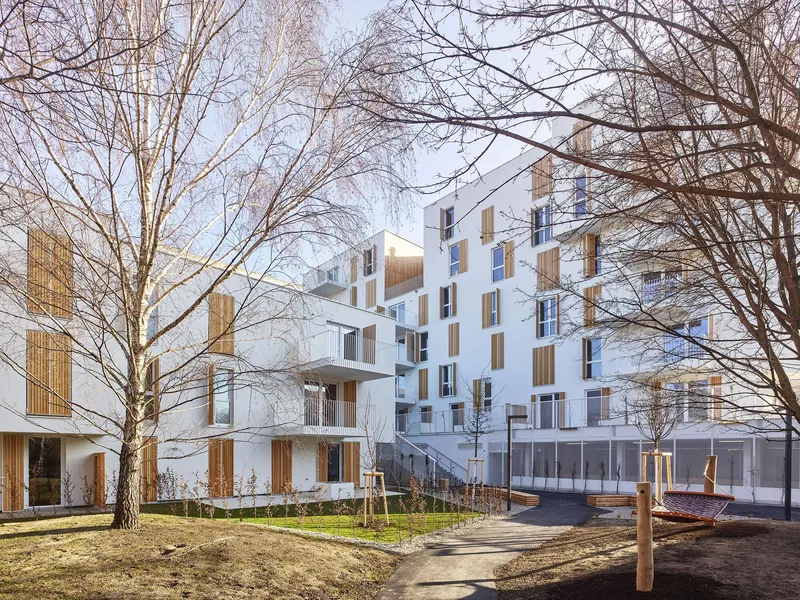
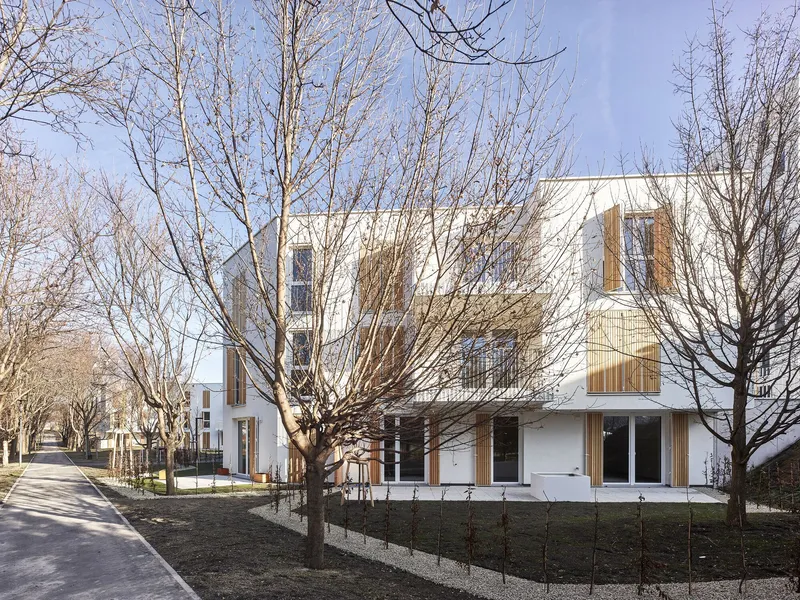
The aerial view reveals the logic immediately: three white volumes with terracotta roofs sit in staggered formation, their footprints loosely aligned but never symmetrical. The smallest block reads almost as a villa; the largest, at six stories, holds the density. Between them, pathways and planted grounds replace asphalt. The decision to split the program into three distinct masses rather than a single bar or courtyard block gives the project a grain closer to the existing low-rise neighborhoods nearby. It also creates gaps through which daylight, wind, and pedestrian routes can pass freely.
Seen from the street in winter, the buildings read as clean volumes punctuated by timber and shadow. Pollarded trees along the pathways reinforce the civic intention: this is not a gated compound but an extension of the public realm, designed with landscape architects Idealice Landschaftsplanung and planted with native species chosen for ecological resilience.
Larch as Climate Device


Local larch wood does heavy lifting across the project's skin. Vertical shutters fold over windows to block summer heat. Slatted screens provide privacy between adjacent balconies without eliminating airflow. Paneling wraps the base zones and entrance areas, giving tactile warmth at the scale where residents actually touch the building. The material is not decorative; it is a climate mediator and a social boundary, performing differently depending on whether it faces south, shields a terrace, or lines a stairwell.
Against the white stucco, the timber registers as a warm counterpoint, but its distribution is anything but uniform. On the street facade, shutters cluster where bedrooms face the road. On the courtyard side, they thin out to let the staggered balconies dominate. The rainbow captured in one photograph is accidental, but the layering of materials that it illuminates is not.
Staggered Balconies and the Courtyard Edge

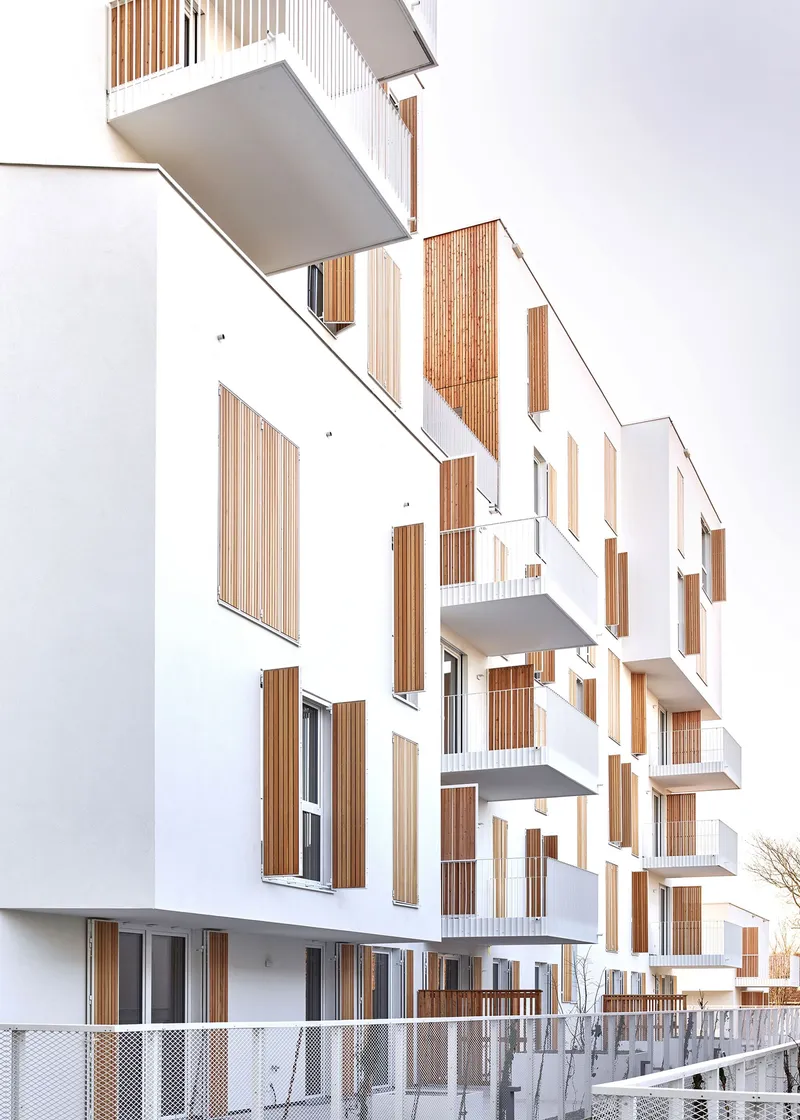

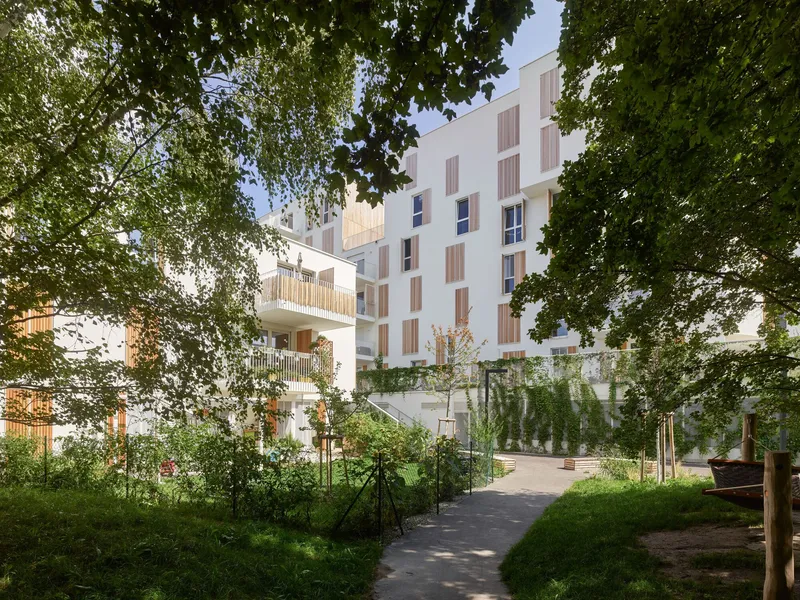
The courtyard elevations are the project's most expressive faces. Bay windows project and recede differently on each floor, creating a shifting topography of white planes that catches light in a way a flat facade never could. The projections are not arbitrary; they correspond to the dual-orientation living rooms behind them, pushing the day areas outward to capture more sky. Between the bays, timber screens slot in vertically, screening balconies and terraces with enough opacity to create private outdoor rooms but enough transparency to keep the courtyard feeling open.
Climbing plants on the courtyard walls are young in the photographs but clearly intended to thicken over time. The green wall visible in one image hints at how the facades will soften as the landscape matures, blurring the line between architecture and garden. It is a slow strategy, and it requires patience, but it signals that the architects thought about the building at year ten, not just at handover.
Interior Thresholds

The stairwells deserve more attention than they usually get in housing coverage. Here, larch cladding wraps the walls and translucent polycarbonate skylights pour diffused light from above, turning what could be a fire-code afterthought into a genuine communal space. The grey tile steps are robust and unpretentious, but the warmth of the wood and the glow of the roof light make the vertical circulation feel generous rather than grudging.
At ground level, the connection between garden and interior is handled on two levels stitched together, giving ground-floor units their own small territories of planting and paving. Mature trees frame the garden paths, and the decision to exclude cars from this layer means that what you hear from these homes is birdsong and footsteps, not engines.
Plans and Drawings
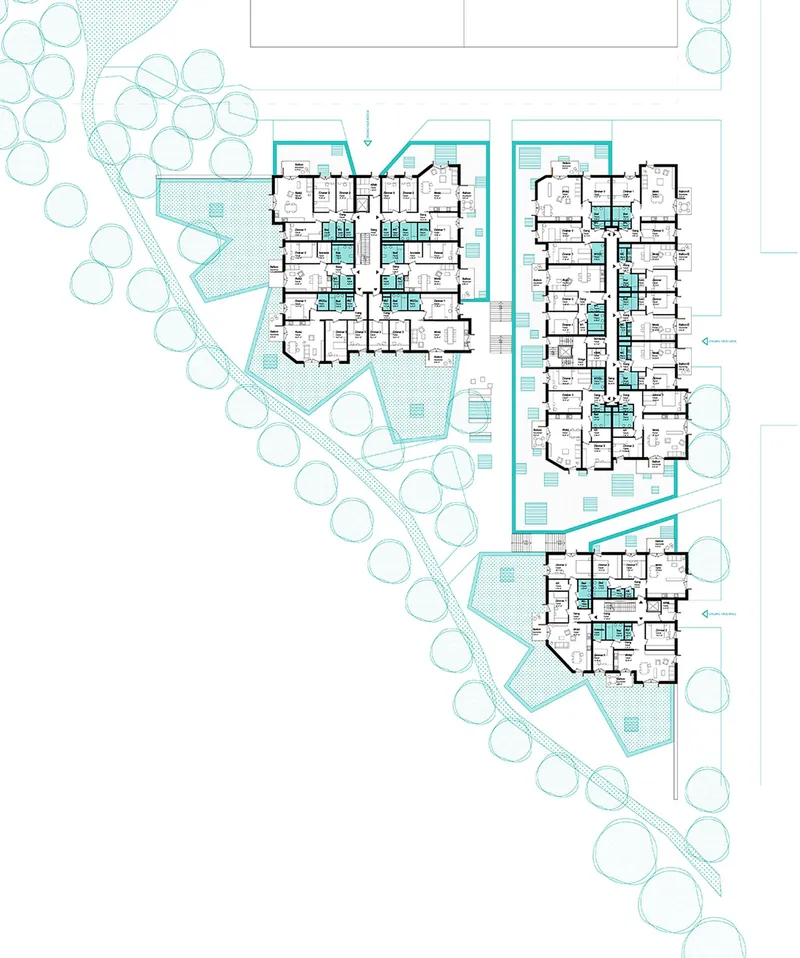

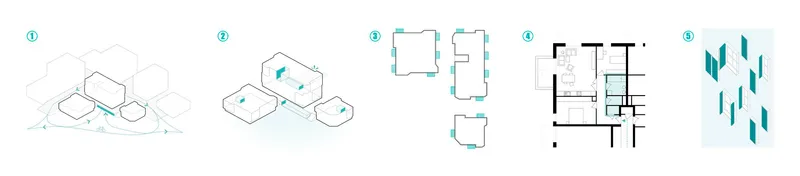
The site plan confirms the deliberate asymmetry of the three blocks: they share orientation roughly but vary in setback, length, and relationship to surrounding streets. The axonometric site drawing shows how the project plugs into the wider Siemensäcker masterplan, with green roofs and courtyards mediating between the new density and the existing low-rise context. The diagram sequence is particularly revealing, tracing the massing from loose axonometric sketches through isometric clusters to the final floor plan variations that accommodate the servant-cabinet typology.
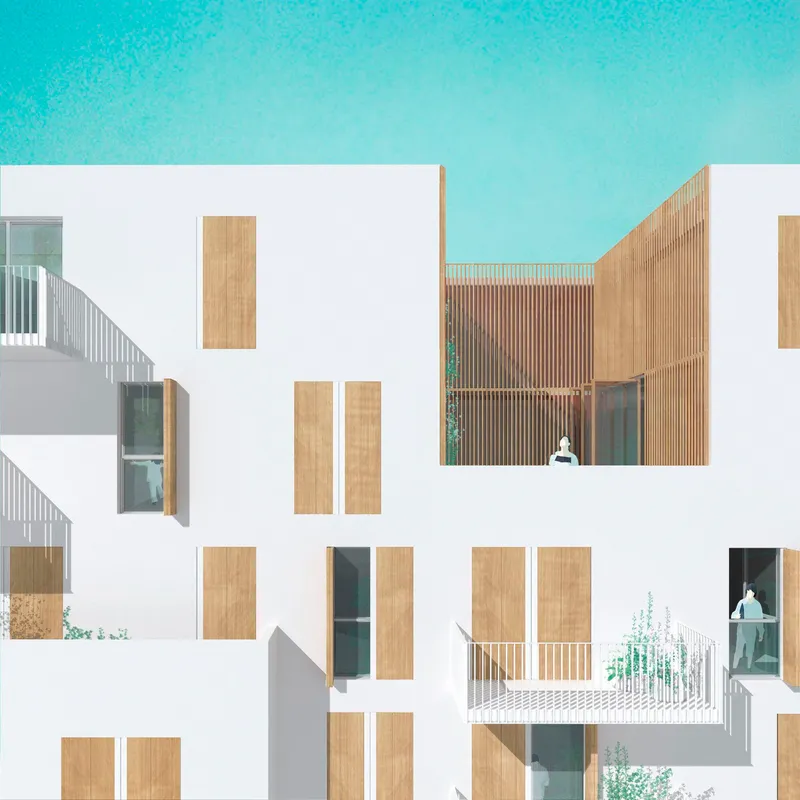
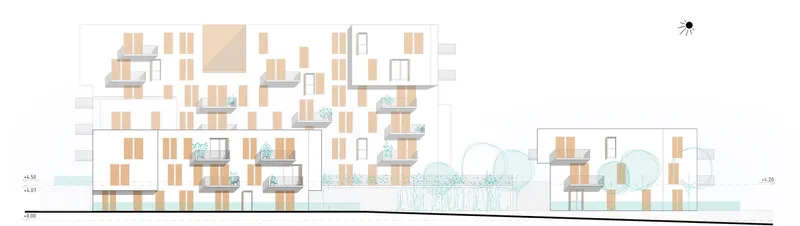

The sections cut through the courtyard reveal how the staggered balconies produce a cascade of outdoor space, each terrace stepping back to admit sun to the level below. Timber panels appear as precise notation marks in these drawings, their rhythm legible even in section. The elevation rendering, set against a turquoise sky, reads almost like a poster, but its value is analytical: it shows how the scattered timber elements break the facade into a field of textures rather than a monolithic wall. The six-story Selma L block, the densest of the three, demonstrates that the projecting bay strategy scales up without losing coherence.
Why This Project Matters
Selma Am Park is a case study in how a competition idea, in this case a strategy the architects called "Urban Software," can survive the long march from jury room to construction site without losing its organizing intelligence. The servant-cabinet plan type is a real contribution: it is compact enough to be economical, flexible enough to support a range of unit sizes across three blocks, and spatially clear enough that residents understand their homes as bright, outward-facing rooms rather than as corridors feeding off a central hallway. That Arenas Basabe Palacios, a Madrid practice, achieved this in partnership with Soyka/Silber/Soyka Architekten, a Vienna firm fluent in local codes and construction culture, speaks to the value of cross-border collaboration when both sides bring genuine expertise.
The project also makes a quiet argument about materiality and time. Larch weathers. Climbing plants grow. Native trees mature. The building in 2022 and the building in 2035 will not look the same, and the architects have designed for that difference. In a housing market that often treats facades as marketing images frozen at the moment of the press photo, Selma Am Park proposes that a residential block should age well, gaining texture and shade as its landscape catches up with its architecture. That is not a radical idea, but it is a disciplined one, and discipline is what carries a EUROPAN win through a decade of planning into a neighborhood that people actually live in.
Selma Am Park Housing, designed by Arenas Basabe Palacios (Enrique Arenas, Luis Basabe, Luis Palacios) and Soyka/Silber/Soyka Architekten. Vienna, Austria. 5,100 m² useful surface. Completed 2022. Landscape by Idealice Landschaftsplanung. Photography by Kurt Hoerbst.
About the Studio
Share Your Own Work on uni.xyz
If projects like this are the kind of work you want to make, uni.xyz is a place to publish your own, find collaborators, and enter design competitions.


Popular Articles
Popular articles from the community


The Amber Palace Opera: A Geological Fiction Surfaces on Tallinn's Baltic Waterfront
Pierre Brillard reimagines a Baltic legend as a public landscape, opera house, and waterfront promenade rooted in Tallinn's coastal identity.
Extended Shell: Retrofitting Kolkata's Balconies as Living Urban Thresholds
A modular retrofit system recovers the social and environmental intelligence of Kolkata's historic verandas for contemporary Park Street residents.

Temporary Home for Dogs: A Reversed Zoo Rethinks Animal Shelter Architecture
In Bucharest, a sinuous corridor and freed landscape flip the logic of containment, designing a shelter that works to make itself unnecessary.

Cloaked Colonization: A Mobile Underwater Habitat That Moves Like a Fish
Micah Abaya's shortlisted EHC Pacific entry reimagines ocean settlement as a dispersed network of self-sustaining architectural organisms.

Similar Reads
You might also enjoy these articles

Pixel Gardens: One Repeated Module Stacked Into a Terraced Social Housing Tower for Famagusta
Salem Bader's shortlisted housing tower builds a vertical neighbourhood from one repeated module, offsetting units to carve terraces, light and air.

Bao Huynh Watercolor Atelier: A Serene Art Retreat in Hội An
Bao Huynh Watercolor Atelier in Hội An blends multifunctional art spaces, sustainable design, local materials, and family-friendly living in a serene environment.

Atelier Macri Concept Store Interior Design by CASE-REAL
Atelier Macri store features a "ko" counter, walnut wood details, cork displays, blending retail, gallery, and seamless customer experiences.

Manuel Vargas Izquierdo Stadium and High-Performance Sports Center: Architectural Excellence in Jalpa de Méndez
The Manuel Vargas Izquierdo Stadium blends sustainable design, inclusive sports facilities, and cultural-inspired architecture, revitalizing Jalpa de Méndez’s public spaces.

Explore Social Housing Competitions
Discover active competitions in this discipline

Challenge to reimagine the Iron Throne

Photograph architecture without architects

Illustrate the lost glory of Angkor Wat - Render Challenge

Design challenge to reuse E-waste
Comments (0)
Please login or sign up to add comments
No comments yet. Be the first to comment!