

Arenas Basabe Palacios and Buschina + Partner Turn a Vienna Hillside into 82 Sun-Chasing Homes
A car-free neighborhood in Vienna's Meidling district orients every room and garden toward the south like a field of sunflowers.


Housing projects rarely earn their nicknames. The Sunflower Houses, a collaboration between Madrid's Arenas Basabe Palacios, Vienna's Buschina + Partner, actually does. Across 9,500 square meters of built area on the southern fringe of Vienna's Meidling district, 82 dwellings in 11 blocks twist and step to face the sun. Every daytime room, every terrace, every garden opens south. The metaphor is not decorative; it is the organizing logic of the entire plan.
What began as a winning entry in Europan 10 evolved, over more than a decade, into a 10.7-hectare masterplan called Wildgarten that the Vienna City Council approved in 2015. The built result is a car-free neighborhood that mediates between the large social housing blocks typical of outer Vienna and the intimate scale of neighboring allotment gardens. The architecture does not split the difference; it offers a third condition, one where density is achieved through careful arrangement rather than sheer volume, and where the public ground plane belongs entirely to pedestrians, wildflowers, and children on bikes.
A Chessboard of Buildings and Gardens

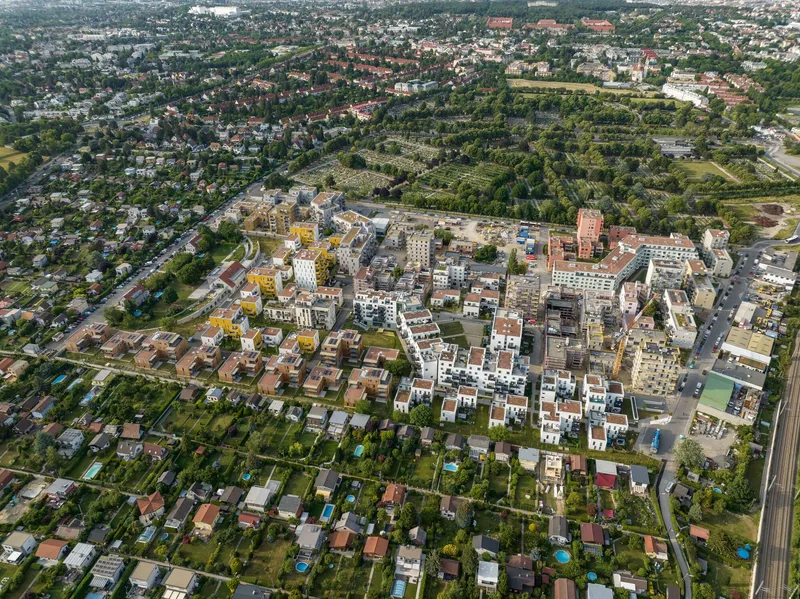
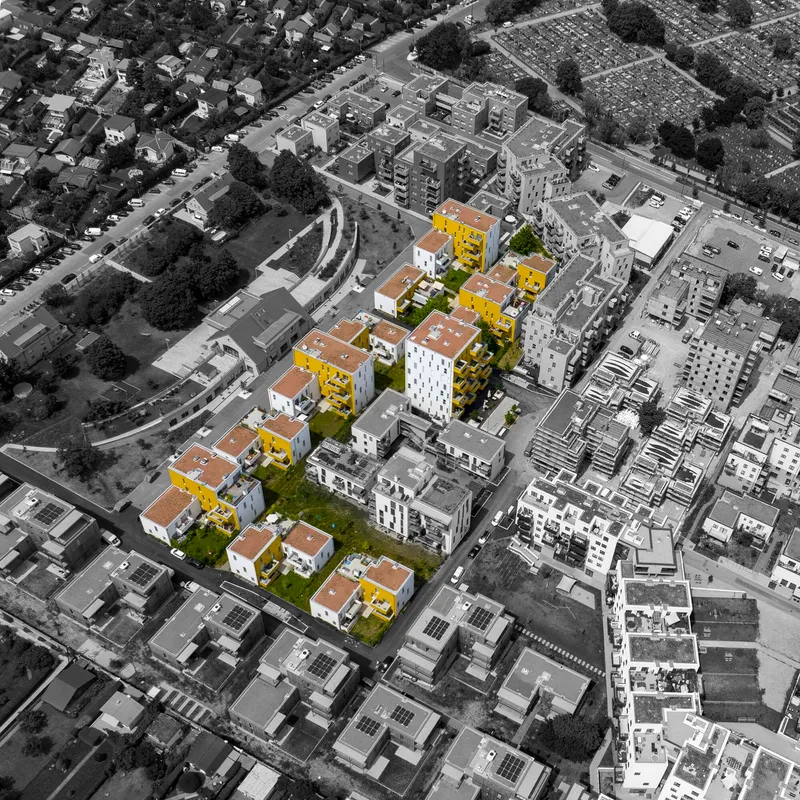
Seen from above, the logic is immediate. Buildings and gardens alternate in a chessboard pattern so that no block faces another block's back. Each volume was positioned only after its garden was located, reversing the usual developer sequence where landscape fills whatever space the buildings leave behind. The aerial views reveal green roofs, rooftop terraces, and courtyards that read as a continuous landscape punctuated by yellow and white solids rather than the other way around.
The district operates at three scales: small single-family houses and duplexes (size S), medium blocks (M), and taller apartment buildings (L). This graduated massing creates a convincing transition from the suburban allotment gardens to the northeast and the denser urban fabric to the west. It also ensures that every interior room and south-facing garden receives direct sunlight, a promise that would collapse if a single oversized block were dropped into the plan.
Yellow Ceramic Skin


The sun-yellow Argeton ceramic facade panels are the project's most visible gesture, and they carry more weight than color alone. The ribbed profile of the cladding catches light differently throughout the day: flat and bright at noon, shadowed and textural by late afternoon. This shifting quality gives the facades a life that painted stucco could never achieve, and it ties the buildings back to the solar orientation that generated the plan. The yellow appears only on south-facing walls, reinforcing the directional logic rather than wrapping every surface in a uniform brand.
Behind the ceramic skin, the walls are built from Porotherm 38 clay blocks filled with mineral wool, a construction system common in Austria but unfamiliar to the Spanish lead architects. These 38-centimeter-thick masonry walls integrate structure and insulation in a single layer, eliminating the need for a separate thermal envelope and simplifying the construction sequence. It is an honest wall: load-bearing, insulating, and finished in one material system.
Living Toward the South

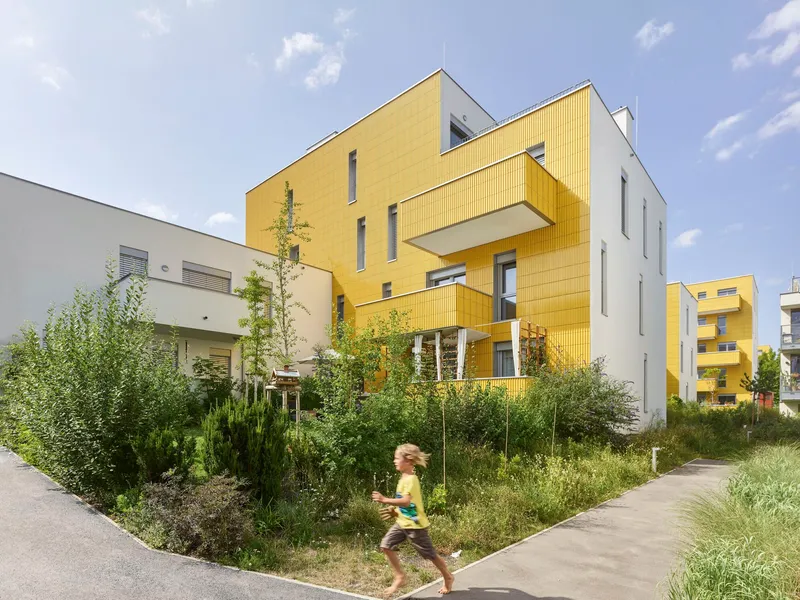
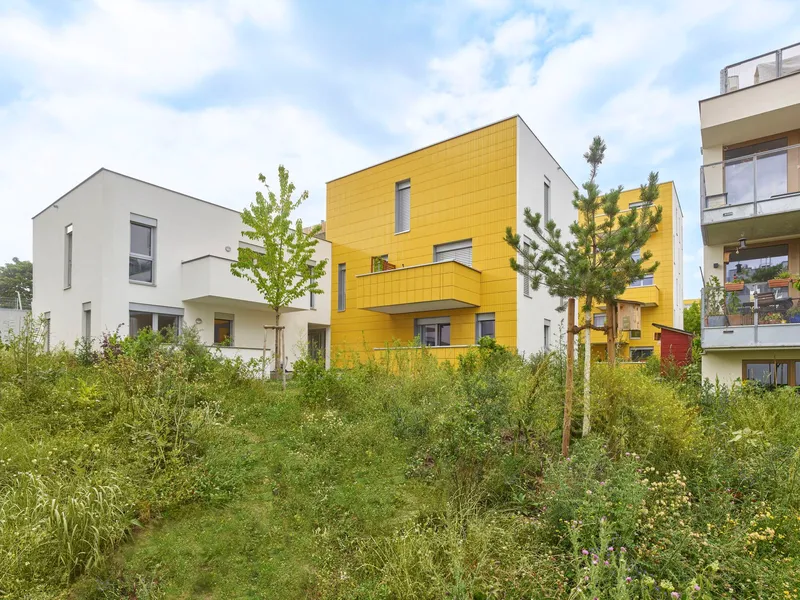
The interior layout follows a strict rule: kitchens and living rooms face south toward the garden; bedrooms and bathrooms face north. This is not a novel idea in passive solar design, but applying it consistently across 82 units of different types, from townhouses to stacked apartments, requires disciplined planning. The rooms themselves are described as neutral and reconfigurable, which suggests that the architects resisted the temptation to over-design each unit and instead invested their energy in the collective arrangement.
The staggered balconies visible from the garden side are generous enough to function as outdoor rooms, and they step in section to avoid shading the units below. Seen from the wildflower meadows, the yellow volumes with their cantilevered terraces and planted edges look less like conventional apartment blocks and more like fragments of a hillside village, which is an appropriate reading for a site that slopes gently toward the south.
Ground Plane Without Cars
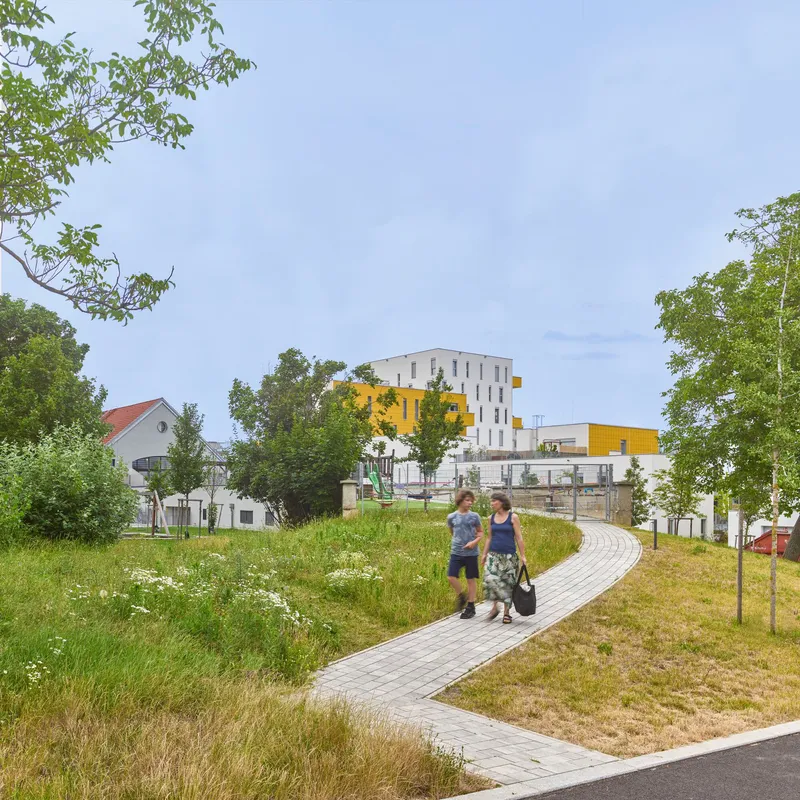


The car-free ground plane is the project's second major commitment after solar orientation, and it changes the character of every space between buildings. Curved pathways wind through wildflower meadows. Concrete stairs connect courtyard levels. Children run along asphalt paths without the constant negotiation between pedestrian and driver that defines most Viennese residential streets. Shared bicycle parking replaces garages, and commercial spaces occupy ground floors to give residents reasons to stay within the neighborhood.
Landscape architect Tomas Proksch designed the outdoor areas as low-maintenance wild green spaces intended for temporary community use. There are no fences. The commons operate on trust and shared stewardship, a model that works best when the architecture itself provides enough spatial definition to make formal boundaries unnecessary. The alternating solid-void rhythm of the chessboard plan does exactly that, giving each garden a sense of enclosure without walls.
Scale and Texture Up Close
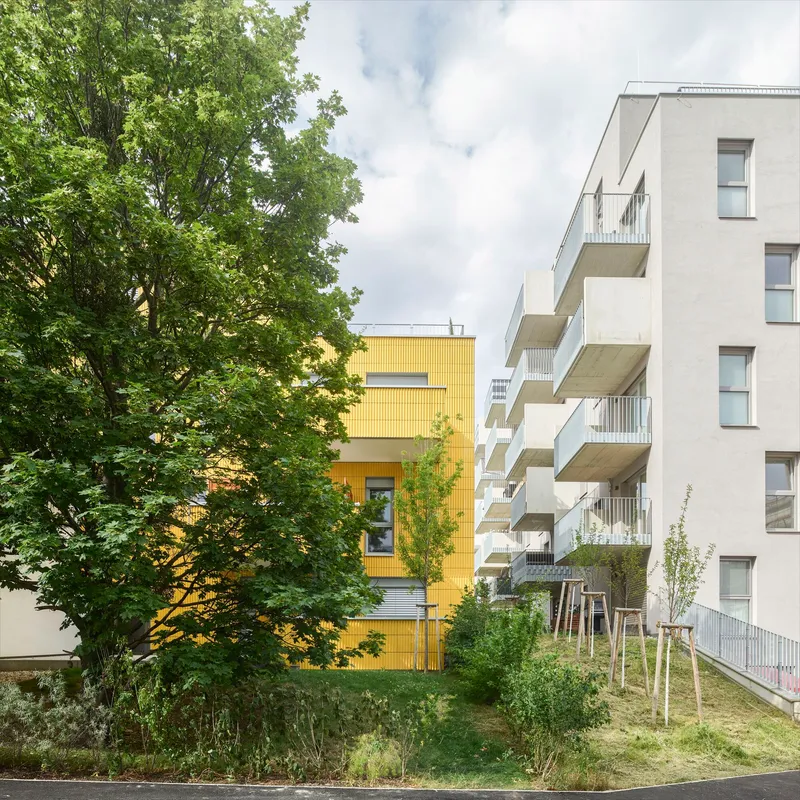

At street level, the buildings hold their own. The timber-clad blocks with inset balconies offer a warmer material counterpoint to the ceramic yellow, and the white volumes act as neutral buffers. The combination avoids the monotony that plagues many large-scale housing developments without resorting to the forced variety of mixing ten different cladding materials on a single facade. Three materials, used with discipline, do the job.
The stepped massing and cantilevered volumes create pockets of shade and shelter at the base of each building, softening the transition between interior and exterior. Mature trees, already taller than the ground-floor windows in some courtyards, suggest that the landscape will eventually absorb the architecture rather than merely decorate it.
Plans and Drawings


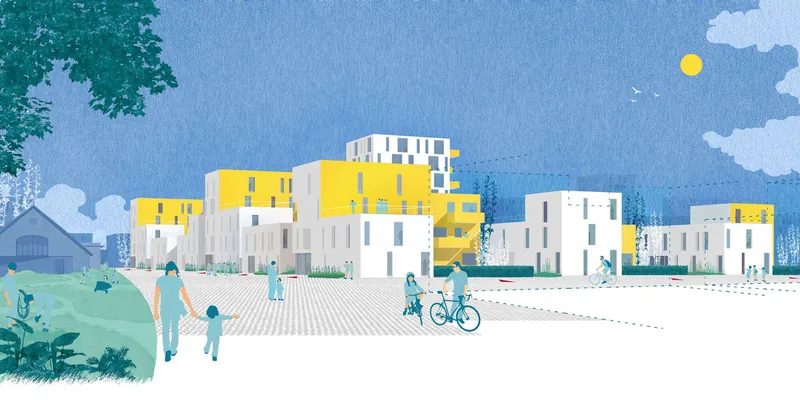


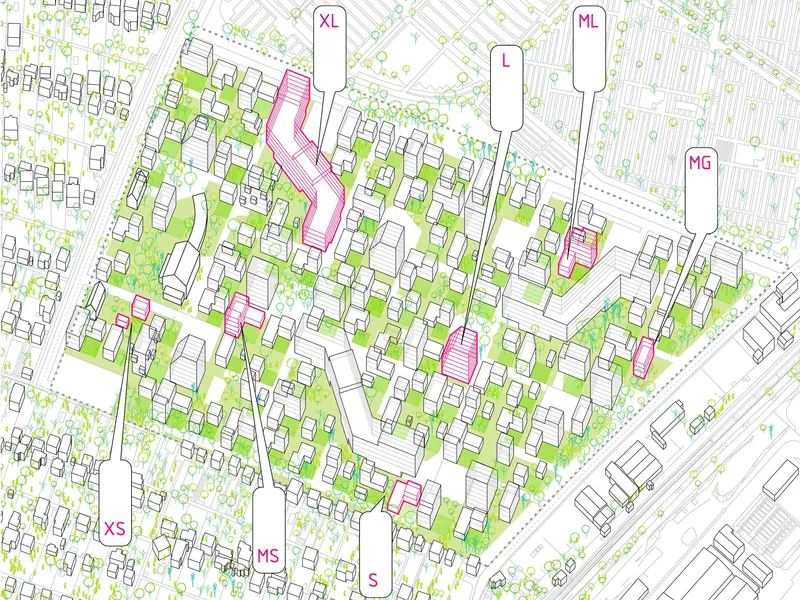

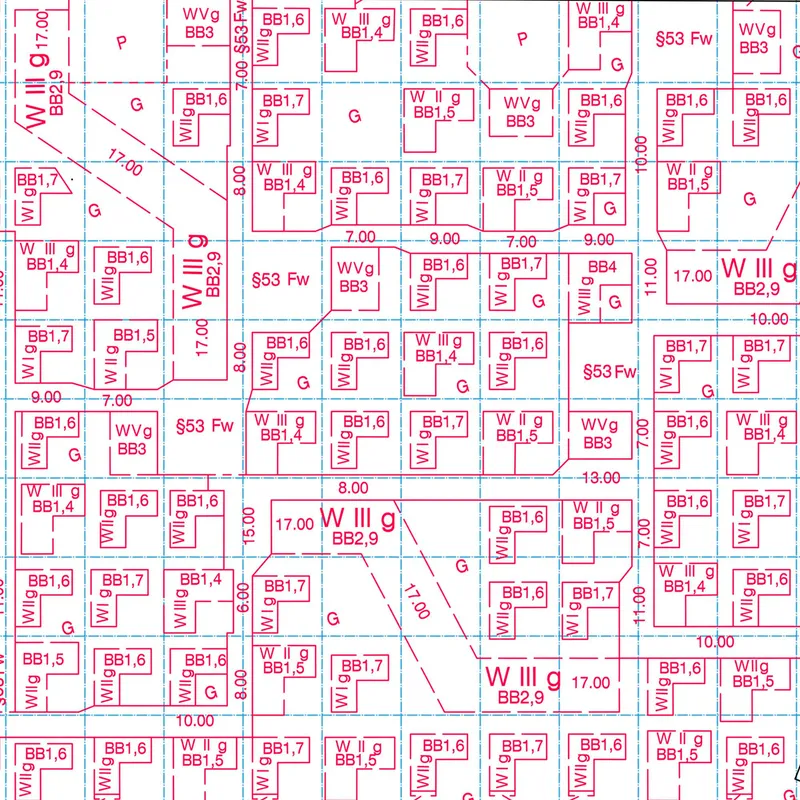


The axonometric and site plan drawings make the chessboard logic legible in a way the aerial photographs only hint at. Each courtyard is defined by the buildings around it, and the residential units wrap around large exterior voids that function as shared gardens. The illustrated perspectives show the architects' ambition clearly: a neighborhood where the space between buildings matters as much as the buildings themselves. The physical model, with its green foam volumes and small orange accents, reveals the massing strategy at its most abstract, confirming that the plan works as a spatial system before any facade decisions are made.
The technical site plan with its dimensional annotations and zoning codes tells a less glamorous but equally important story: this project survived the regulatory and bureaucratic apparatus of Viennese planning from Europan competition to building permit, a process that consumed more than a decade. That the built result retains the clarity of the original competition idea is remarkable.
Why This Project Matters
The Sunflower Houses demonstrate that passive solar design does not have to look like a textbook diagram. By committing to a single orientation rule, the architects generated a plan that is simultaneously efficient and spatially rich. The chessboard alternation of buildings and gardens, the three scales of housing, the car-free ground, and the consistent south-facing layout all derive from one decision: every dwelling faces the sun. That kind of generative clarity is rare in housing projects of this scale, where competing interests usually dilute the concept into a compromise.
The collaboration between a Spanish studio and an Austrian firm also produced a productive tension. Arenas Basabe Palacios brought the urban and conceptual framework; Buschina and Partner brought knowledge of local construction systems and regulatory landscapes. The result is a project that feels specific to Vienna, rooted in Austrian building traditions like ceramic masonry and allotment garden culture, yet informed by a Mediterranean instinct for living outdoors and orienting toward light. It is housing that argues for a position, not housing that tries to offend no one.
The Sunflower Houses, designed by Arenas Basabe Palacios and Buschina + Partner. Located in Meidling, Vienna, Austria. 9,500 m². Completed in 2022. Photography by Kurt Hoerbst.
About the Studio
Share Your Own Work on uni.xyz
If projects like this are the kind of work you want to make, uni.xyz is a place to publish your own, find collaborators, and enter design competitions.


Popular Articles
Popular articles from the community


Opera on the Sea: Driftwood Logic Shapes a Timber Opera House on Estonia's Coast
Trevor Orgill's opera house translates the entangled drift of floating timber into a civic building where wood, water, and music converge.
Opera by the Sea Estonia: Three Shells Dissolving Architecture into Tallinn's Coastline
A winning opera house proposal replaces monumental form with interconnected shells that blur the boundary between building, park and Baltic Sea.

The Amber Palace Opera: A Geological Fiction Surfaces on Tallinn's Baltic Waterfront
Pierre Brillard reimagines a Baltic legend as a public landscape, opera house, and waterfront promenade rooted in Tallinn's coastal identity.
Tsunami Convergenics: Turning Catastrophic Ocean Forces into Underwater Housing Infrastructure
A speculative underwater settlement off the coast of Onagawa, Japan, treats tsunamis and typhoons as energy sources rather than threats.

Similar Reads
You might also enjoy these articles

Bao Huynh Watercolor Atelier: A Serene Art Retreat in Hội An
Bao Huynh Watercolor Atelier in Hội An blends multifunctional art spaces, sustainable design, local materials, and family-friendly living in a serene environment.

Atelier Macri Concept Store Interior Design by CASE-REAL
Atelier Macri store features a "ko" counter, walnut wood details, cork displays, blending retail, gallery, and seamless customer experiences.

Manuel Vargas Izquierdo Stadium and High-Performance Sports Center: Architectural Excellence in Jalpa de Méndez
The Manuel Vargas Izquierdo Stadium blends sustainable design, inclusive sports facilities, and cultural-inspired architecture, revitalizing Jalpa de Méndez’s public spaces.

KAKR Buluh Awar Hall: Revitalizing Community and Ecology Through Bamboo Architecture
Community built bamboo hall revitalizes Buluh Awar village, empowering youth, restoring ecology, celebrating vernacular craftsmanship through sustainable architecture and culture.

Explore Green Houses Competitions
Discover active competitions in this discipline

Challenge to reimagine the Iron Throne

Photograph architecture without architects

Illustrate the lost glory of Angkor Wat - Render Challenge

Design challenge to reuse E-waste
Comments (0)
Please login or sign up to add comments
No comments yet. Be the first to comment!