
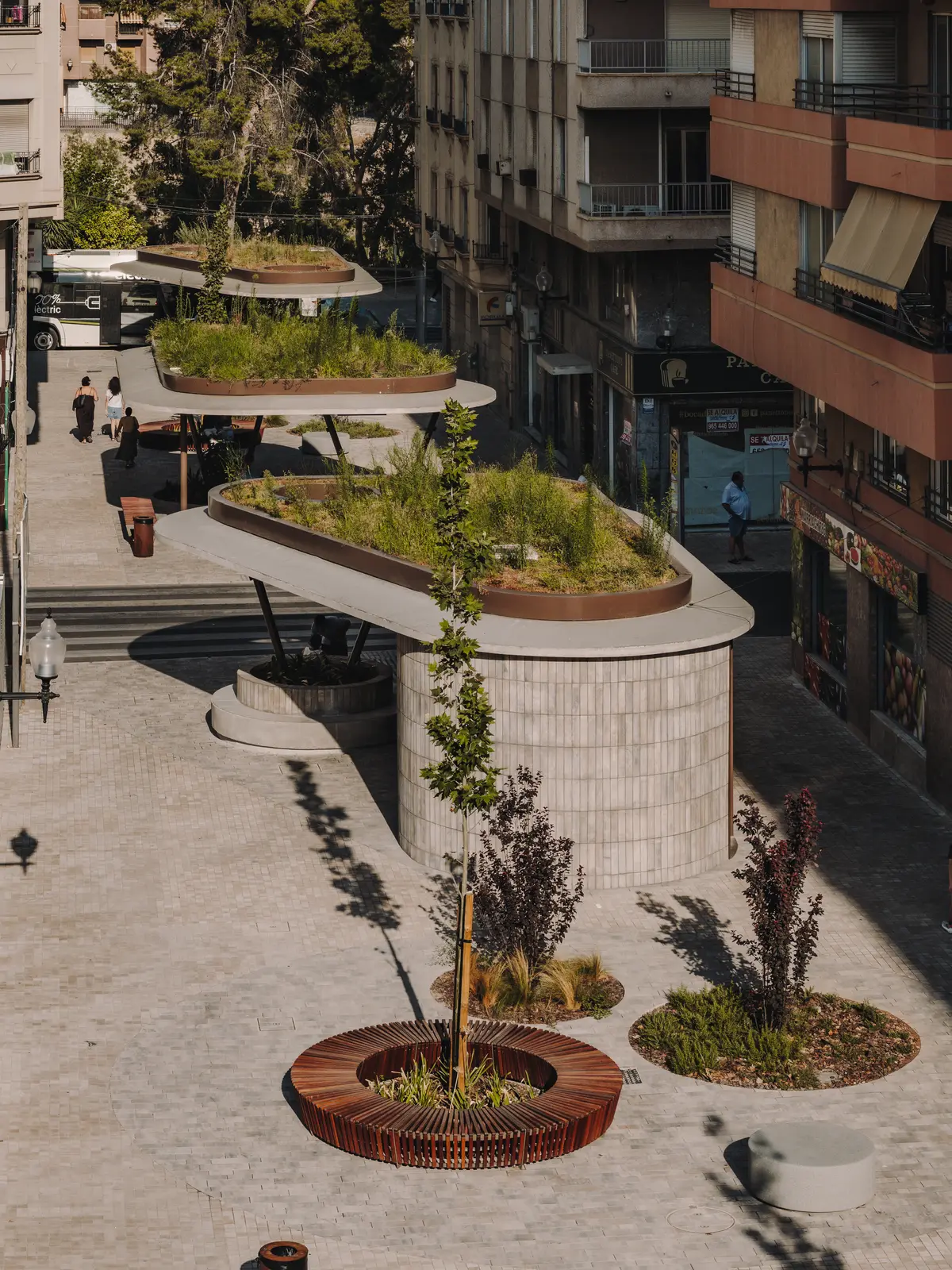
ARN Arquitectos Turns an Elche Bus Stop into a Green-Roofed Climate Refuge
Three concrete pergolas with planted roofs transform a neglected intersection near the Vinalopó River into a civic landmark.


A bus interchange is, almost by definition, a non-place. It exists to move people through, not to hold them. In Elche, at the convergence of Alfredo Llopis, Doctor Caro, and Valero streets, that description used to be literal: a stretch of asphalt where cars dominated and pedestrians were an afterthought. ARN / Arquitectos, led by José Amorós Gonzálvez, Luis Rubiato, and Patricia Navarro, saw the brief for a new urban bus interchange not as a transit engineering problem but as an opportunity to build a piece of public landscape. The result, completed in 2025 for under one million euros, occupies 4,650 square meters and replaces vehicular inertia with shade, vegetation, and a reason to stay.
What makes the Dr. Caro interchange genuinely interesting is the refusal to separate infrastructure from ecology. Three low-maintenance concrete pergolas carry extensive green roofs that cool the air through evapotranspiration, while photocatalytic concrete pavers on the ground actively reduce airborne toxins. The station provides ticket offices, real-time information displays, bicycle parking, and covered waiting areas, yet none of these functions read as utilitarian additions. They are woven into a continuous pedestrian street that opens toward the banks of the Vinalopó River, turning the daily commute into something closer to a walk through a garden.
Three Pergolas, One Microclimate
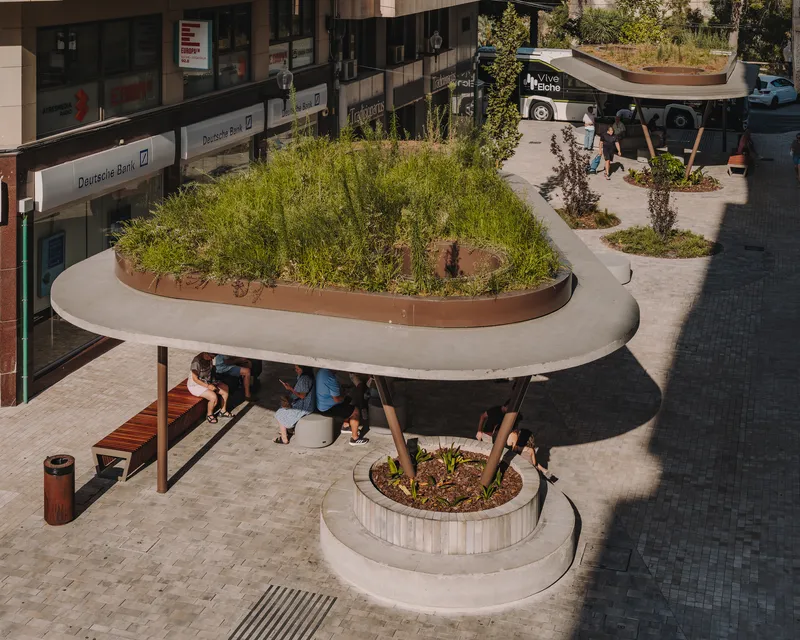
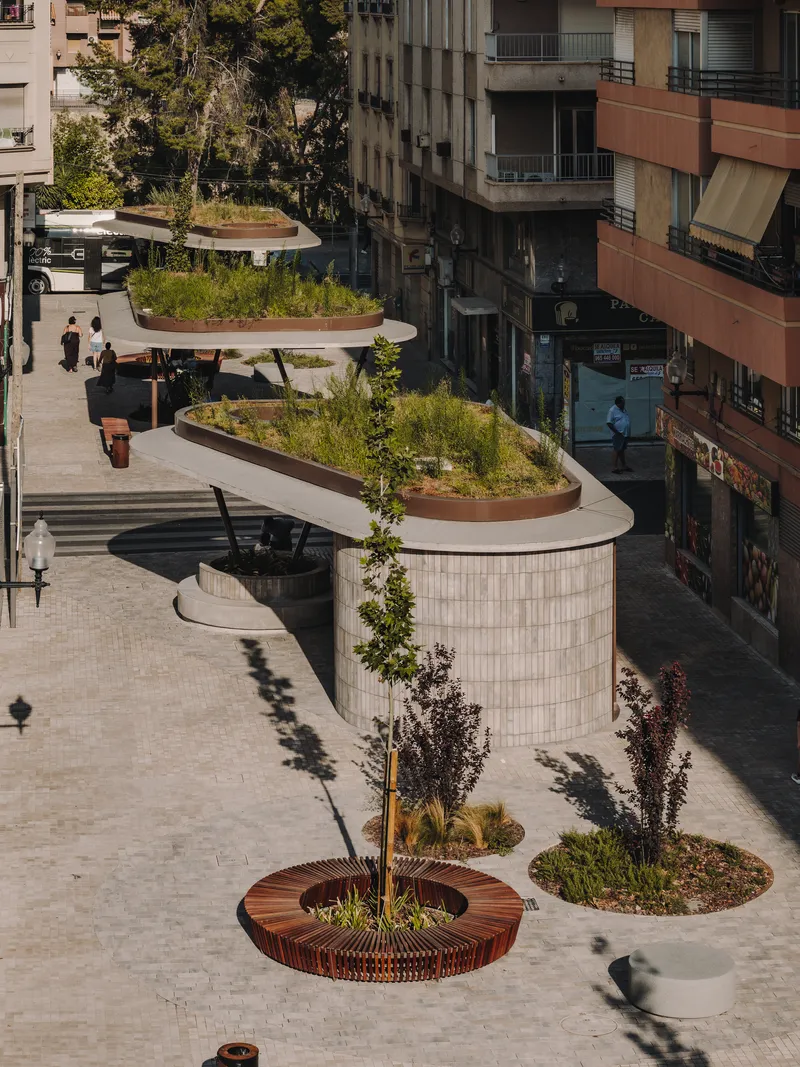
Seen from above, the intervention reads as three organic canopies stepping down the site, their green roofs providing a generous planted surface visible from the surrounding apartment blocks. That aerial consideration is not incidental. Elche is a dense Mediterranean city, and for residents looking out from upper floors, the previous condition was a parking lot. Now it is a sequence of living surfaces threaded with circular openings that admit light and frame small planted islands below.
The tiered arrangement also creates a cascading relationship to the Vinalopó, reinforcing a visual and ecological continuity between the interchange and the riverbank. Each pergola is dimensioned to provide deep shade across its footprint during the hottest hours, the green roof substrate, made partly from recycled ceramic building materials, lightens the structural load while retaining moisture for passive cooling.
The Oculus and the Column
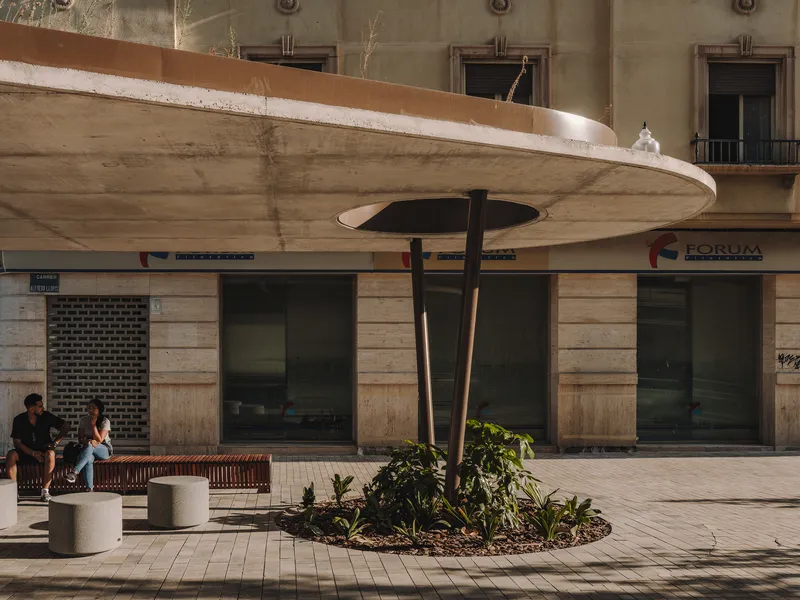
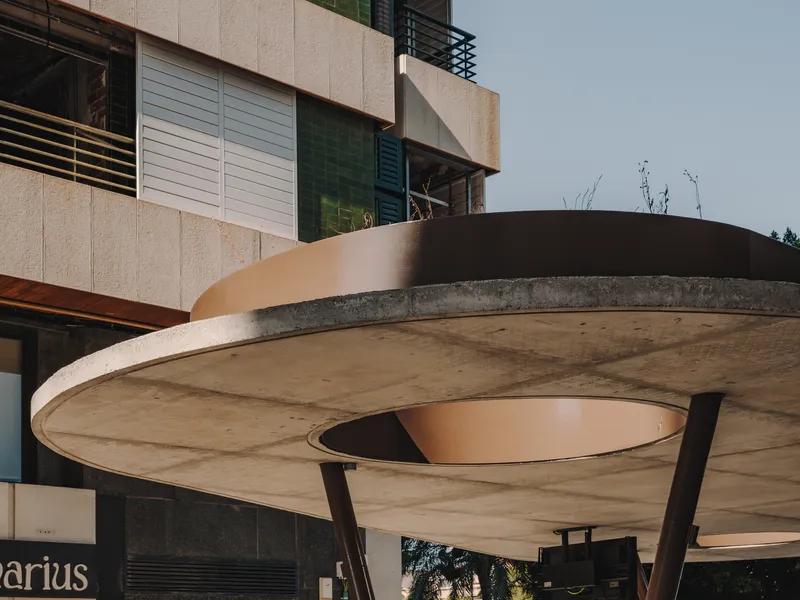
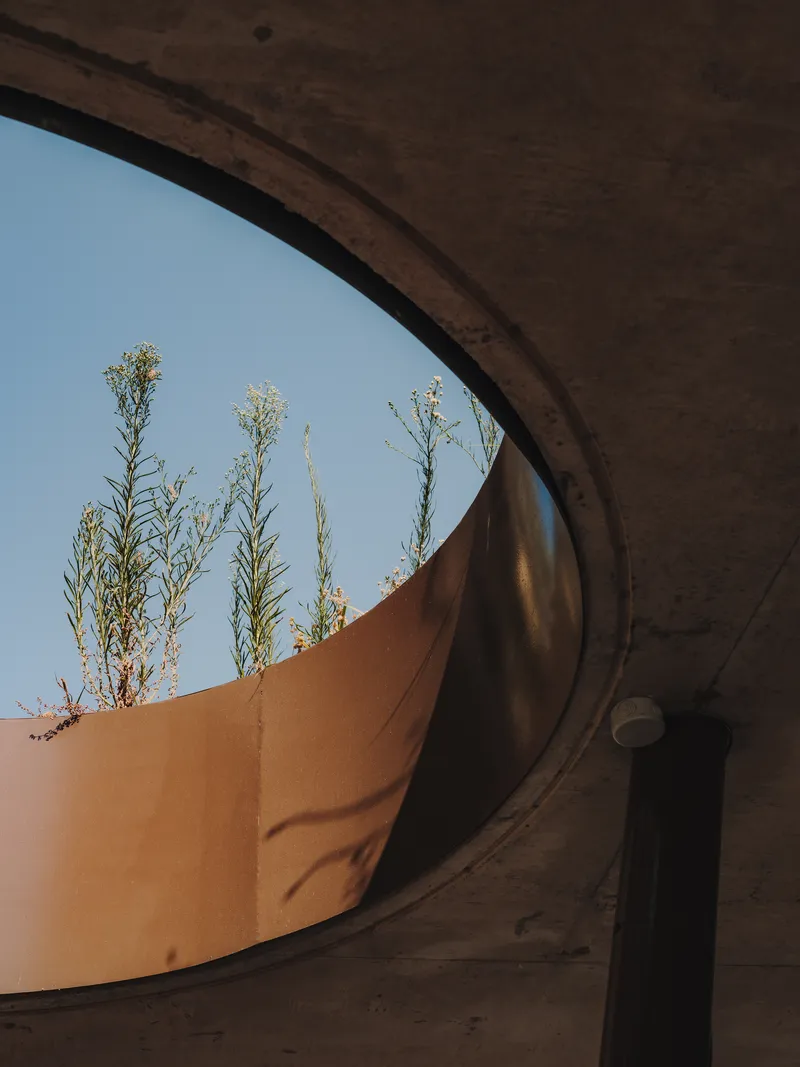
The most compelling detail of the pergolas is the circular oculus punched through each canopy. At dusk, looking up from the timber benches below, these openings become frames for sky and grasses, moments of unexpected intimacy in a piece of transit infrastructure. A single column rises through the center of each opening, its proportions slender enough to avoid any sense of heaviness. The concrete is left raw, its formwork grain legible, and the edges are finished with corten steel that will weather and darken over time.
Viewed from beneath, the arch profile of the canopy compresses and then releases, directing the eye outward toward the drought-tolerant grasses planted at the perimeter. It is a simple move, a hole in a roof, but it prevents the pergolas from reading as bunkers. Light, rain, and air pass through. The structure breathes.
Living Surfaces at Close Range
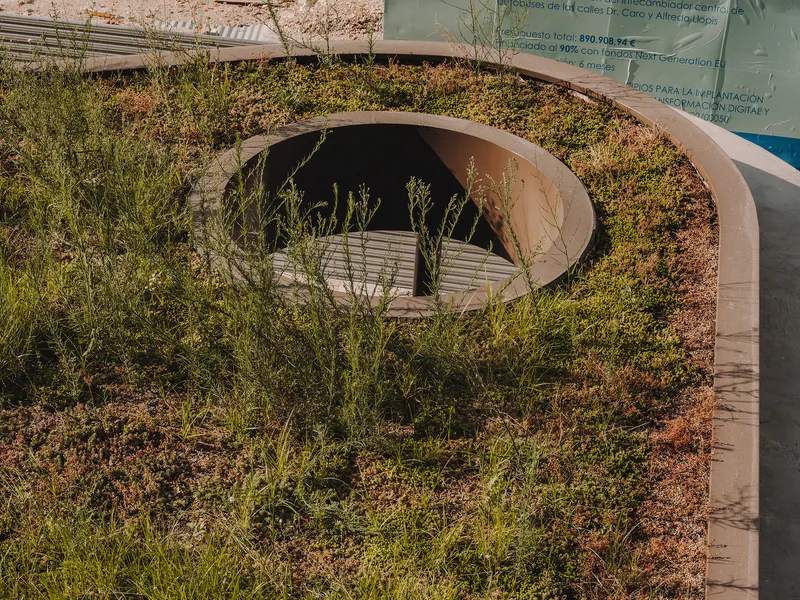
The planting palette is restrained and locally calibrated. Native grasses and low groundcover colonize the green roof substrates, requiring minimal irrigation and tolerating the intense Alicante summers. Close up, the circular openings reveal layered planting beds where ornamental species meet structural fill, a subtle demonstration that green infrastructure does not have to look like a meadow to perform like one.
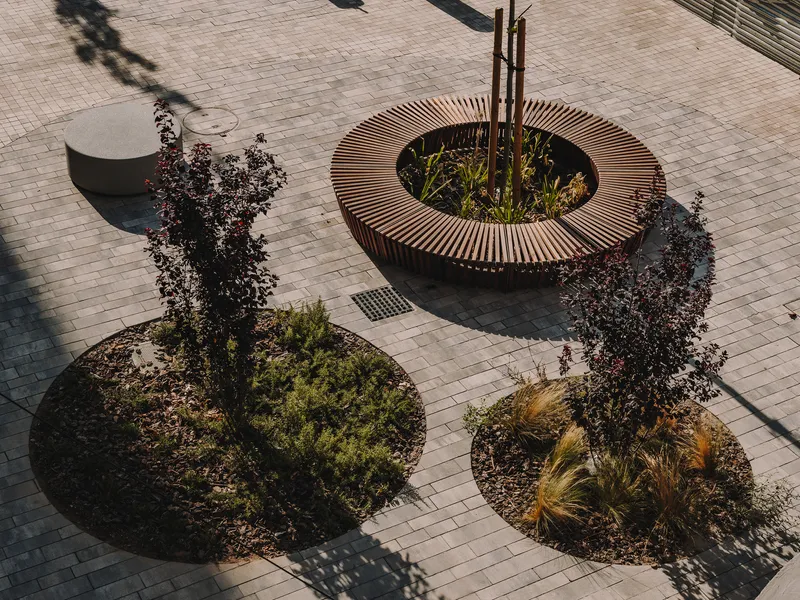
At ground level, circular planted beds repeat the roof geometry, each ringed by timber tree grates that double as informal seating. The repetition of the circle, overhead and underfoot, gives the project a graphic coherence that photographs well from the air but, more importantly, orients pedestrians on the ground. You know where you are by the pattern of green discs around you.
Furniture as Landscape
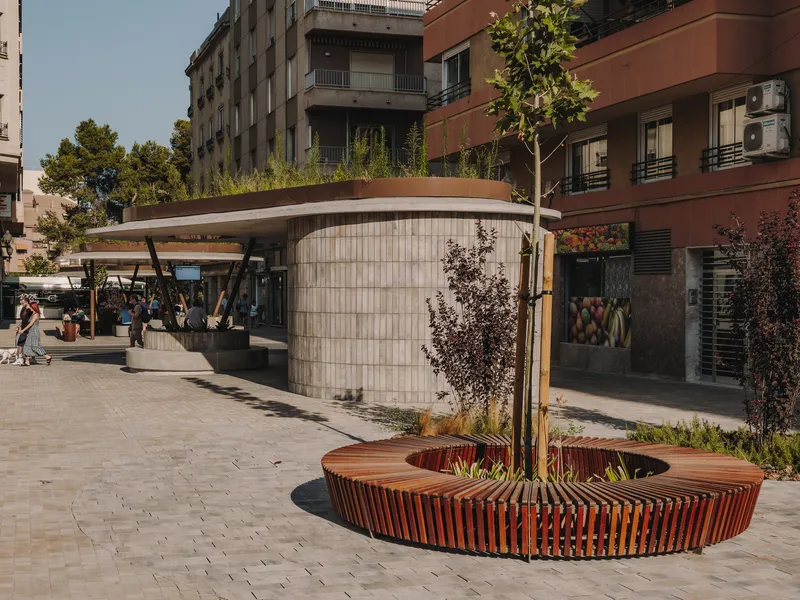
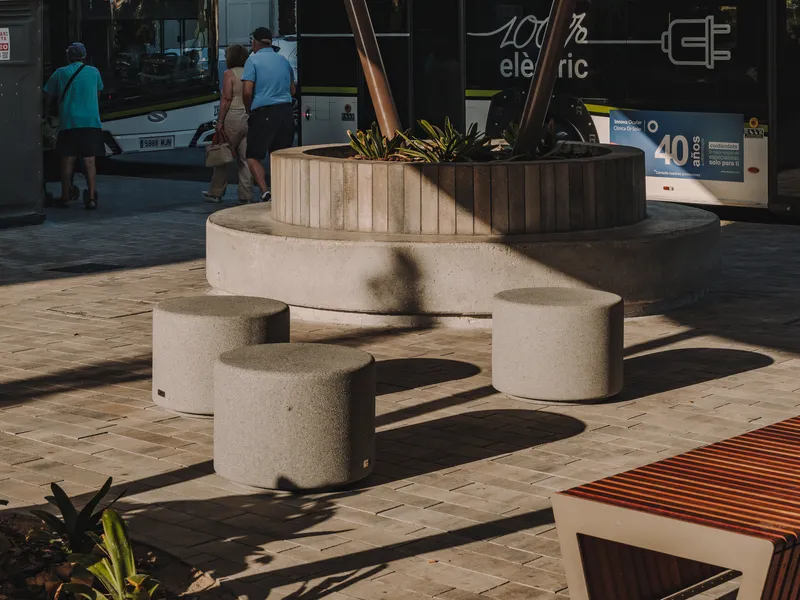
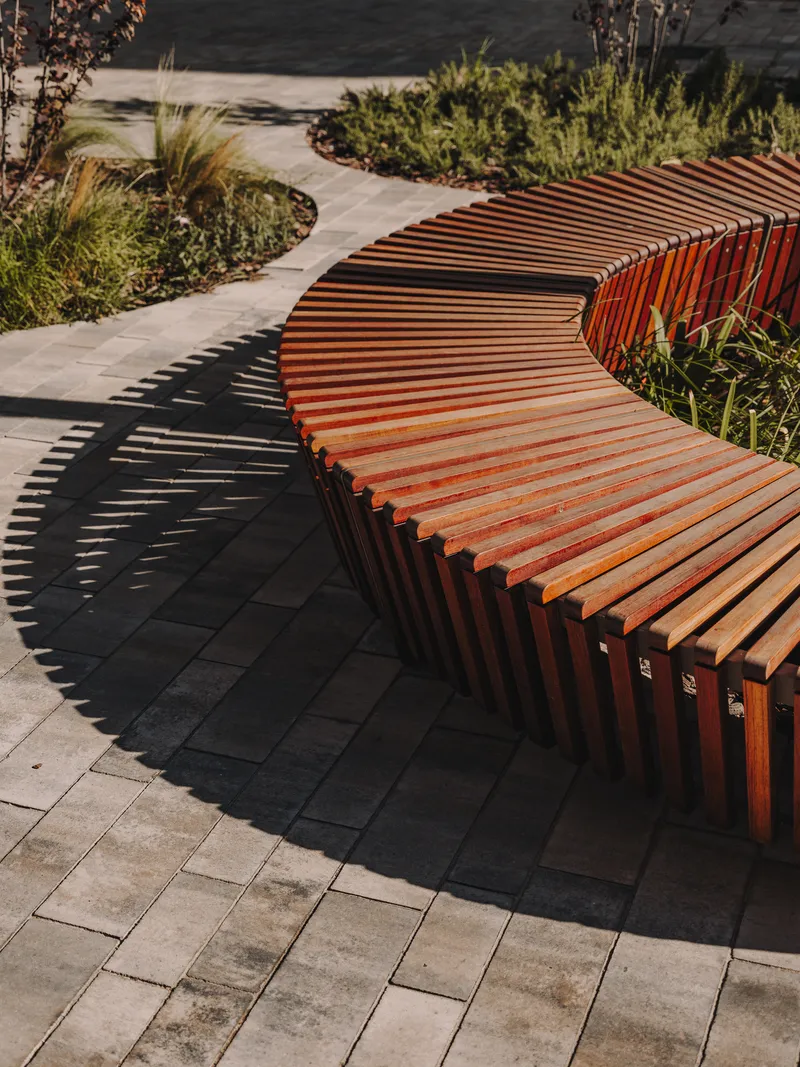
The seating strategy deserves attention because it quietly does three jobs at once. Circular timber benches wrap around young trees, inviting groups to gather. Linear concrete benches with integrated planters separate pedestrian flow from waiting zones without bollards or railings. And smaller cylindrical stools scattered across the paving offer solitary perches for anyone who just wants to sit in the shade with a phone. Each type casts a distinct shadow pattern on the photocatalytic pavers, animating the ground plane throughout the day.
The material language is consistent but not monotone. Timber slats warm the concrete frame, their curved profiles following the radial geometry of the planting beds. Morning light rakes across the slatted surfaces and produces a graphic quality that suggests careful prototyping. There are no standard catalog benches here; every element was designed as part of the landscape system.
Plans and Drawings
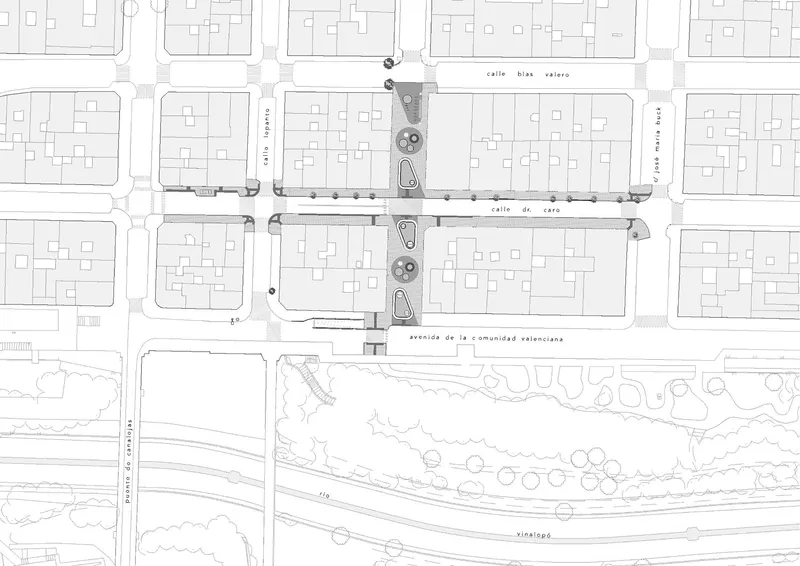
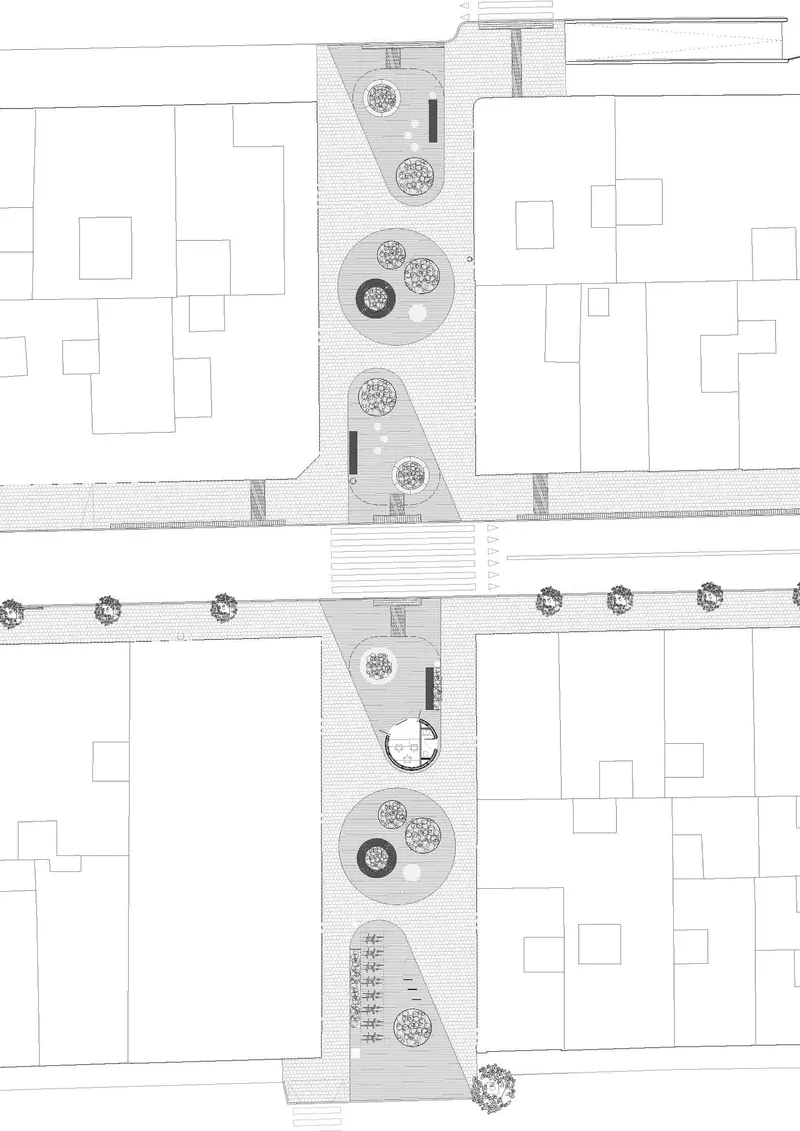
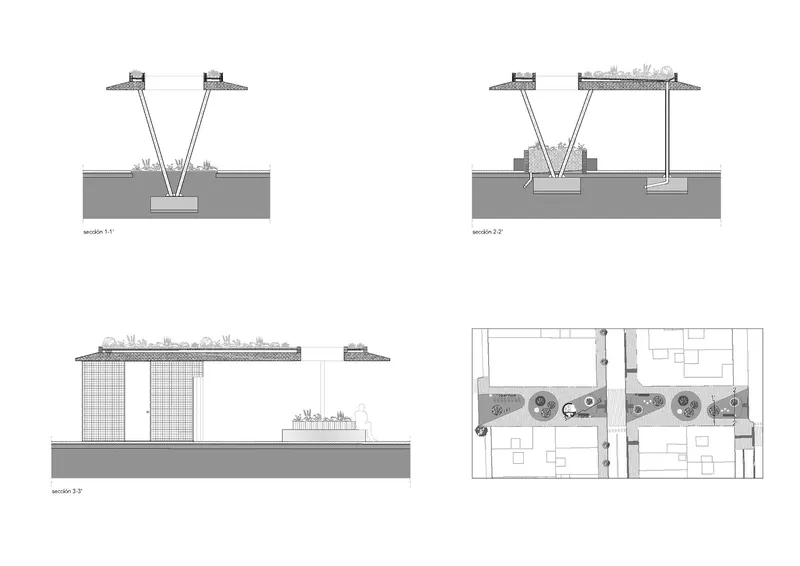
The site plan reveals how tightly the interchange is sandwiched between existing building footprints, which makes the generosity of the open space all the more remarkable. The linear pedestrian plaza threads between party walls, its circular planting elements calibrated to maintain clear sightlines for approaching buses while maximizing canopy coverage for pedestrians. The section drawing is perhaps the most instructive: it shows angled columns supporting the planted roof at a pitch that sheds rainwater toward collection zones while keeping the underside dry for waiting passengers. The substrate depth is modest, confirming that the green roof is extensive rather than intensive, a maintenance-conscious decision for a municipal budget of under one million euros.
Why This Project Matters
The Dr. Caro interchange proves that climate-responsive public space does not require a landmark budget or a signature architect. At roughly 975,000 euros for over 4,000 square meters of intervention, the cost per square meter is modest by any European standard. The design intelligence lies not in formal spectacle but in the layering of passive cooling strategies, photocatalytic air purification, recycled substrates, and low-water planting, into a coherent civic space that people will actually use. It is infrastructure that doubles as a park, and a park that functions as infrastructure.
For cities across southern Europe confronting hotter summers and tighter budgets, this project offers a replicable model. You do not need to bury a highway or build an iconic museum to reclaim a street from cars. Sometimes three concrete pergolas, a few hundred square meters of green roof, and a set of well-designed benches are enough to turn a forgotten intersection into the most comfortable spot in the neighborhood.
Dr. Caro Urban Bus Interchange by ARN / Arquitectos (José Amorós Gonzálvez, Luis Rubiato, Patricia Navarro). Elx, Spain. 4,650 m². Completed 2025. Photography by Oleh Kardash.
About the Studio
Share Your Own Work on uni.xyz
If projects like this are the kind of work you want to make, uni.xyz is a place to publish your own, find collaborators, and enter design competitions.


Popular Articles
Popular articles from the community


Manzana Morphosis: Stretching Barcelona's Grid into a Living Landscape for 2050
A radical reworking of the Eixample manzana turns density into a tool for generous public space, vertical ecology, and environmental performance.

Opera on the Sea: Driftwood Logic Shapes a Timber Opera House on Estonia's Coast
Trevor Orgill's opera house translates the entangled drift of floating timber into a civic building where wood, water, and music converge.


David Ortega Stacks a Two-Story Mexico City Penthouse Around a Steel Stair and a Pergola-Shaded Roof Terrace
In Colonia Roma, a 300 m² penthouse uses oak joinery, a planted steel stair and a slatted roof pergola to make a new-build apartment feel like a house.

FCC Arquitectura Expands a Portuguese Granite House with a Board-Marked Concrete Wing
In Portugal, JV House pairs a cleaned-up whitewashed and granite dwelling with a timber-shuttered concrete extension, courtyards and a garden pool.

Similar Reads
You might also enjoy these articles

LAVA Architecten Gives Vocational Education a Sawtooth-Roofed Face on a Mechelen School Campus
In Mechelen, Belgium, a 2,053 m² STEM school on a 6×6 m grid turns workshops and classrooms into rooms that can be rearranged as teaching changes.

KEMA Studio Turns a Derelict Marvila Attic into a 60 m² Lighthouse Apartment Above Lisbon
In Lisbon's Marvila district, a rebuilt roof, four skylights and two plywood volumes turn an unlivable attic into a bright home facing the Tagus.

Pixel Gardens: One Repeated Module Stacked Into a Terraced Social Housing Tower for Famagusta
Salem Bader's shortlisted housing tower builds a vertical neighbourhood from one repeated module, offsetting units to carve terraces, light and air.

Bao Huynh Watercolor Atelier: A Serene Art Retreat in Hội An
Bao Huynh Watercolor Atelier in Hội An blends multifunctional art spaces, sustainable design, local materials, and family-friendly living in a serene environment.

Comments (0)
Please login or sign up to add comments
No comments yet. Be the first to comment!