

Art: ACTION!
“Art is life and life is art.”

“Art is life and life is art.” Throughout the entire human history, art has always been by our side. Apart from the artists’ creation and the viewers’ appreciation, there’s something more to art itself. It is a celebration where everybody can participate in and connect with. It is an emotion that is so universal that it transcends any form of boundaries. It is a never-ending show where the audience and performers constantly exchange their roles. –This has eventually led me to the project of Art: ACTION!, with the intention of showing the process of creation also as a form of art, recreating the traditional open-air theater in a deconstruction manner.
“Action!”, directors would always use this cue as the start of a scene. In this project, the concept is to see art not only as a result but also as a process—just as a scene in the movies, weaving the creation of art with appreciation. Although with the advent of the Internet and social media, artists nowadays have had more opportunities to show themselves than ever before, collaborating and presenting artworks online also have its inevitable drawbacks: Sometimes, the nostalgia of meeting someone in person and having a face-to-face discussion is all we want. Therefore, I started with the idea of connecting co-working spaces to individual studio/living spaces, adding flexible features to boost the collaborative side of the design, creating an art-oriented environment.
When it comes to the site, however, the triangular shape has the geometric potential to a lot of possibilities. With one building block as the co-working/living artists’ space, another block could contain more public functions such as auditorium and exhibitions. By placing a half-sunken circular theater at the center, the two blocks become interconnected as visions cross each other. Then, adopting the method of de stijl and postmodern deconstruction, bridges and ramps merge in with the buildings, bringing more dynamics to the design.

For the artists’ building, I adopted a bottom-up practice. Starting from four individual houses for four types of art, each with a key concept. First is the house of photographers, with lighting as the concept. Using different forms of sunshade and unexpected light paths, the studio could open up to receive full sunlight as well as concealing to a dark space with only artificial lights in control, providing photographers with many creating options.
Second is the house of performing artists, for which the concept is anomaly. By compressing the living space to a minimum and leaving the rest as a rehearsal studio, the existence of many unconventional architectural elements can collaborate well with various performance props.
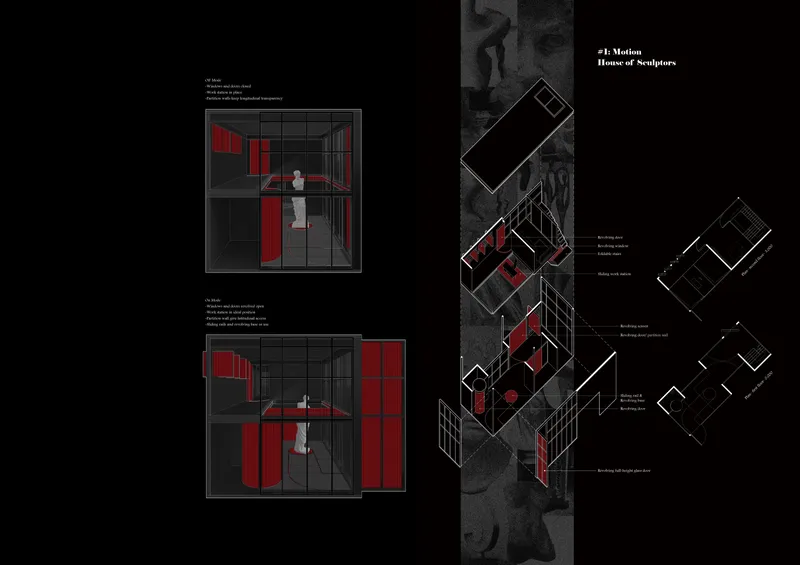
The third is the house of sculptors, following the concept of motion. The revolving doors and windows along with the sliding floor panels exhibit a high degree of flexibility in the studio. As a result, sculptors can work with different scales of work and also utilize the sliding rails to do the transport.
The last one is the house of painters, with medium as the keyword. Using sliding partition walls, semi-transparent glass, and also hanging veils, the studio can become an ambient space, offering an ideal environment for painting creation.

With the four individual houses ready, I integrate them into the co-working building with a certain angle, which results in a collection of similar yet variant grey spaces, which are then applied with the methodologies previously used in the individual houses. Consequently, these spaces, equipped with flexible features, also have different levels of privacy and scale, which leaves artists with many options to co-work. Some of these spaces can connect directly to the houses, enlarging their personal studio space while some can accommodate more people and become either an exhibition room or collaboration area.
In addition, the way houses are connected to the building is also different. The house of performing artists is slightly lower and can open up directly to the central theater. The house of sculptors can revolve 90 degrees, either attached to the building or stretch out to nature, changing the ground floor atmosphere. The house of photographers can potentially project light onto other spaces while the house of painters can connect to exhibitions by simply pushing out the partition walls.
As a final touch, a transparent screen covers the entire west elevation, exposing everything behind just like a stage play, where artists in their creative process can be viewed and appreciated. The audience gets the opportunity to witness their thought process, their struggles as well as their collaborations, and those eureka moments. In the meantime, the artists can also draw inspiration while watching the audience.
The project tries to obscure many boundaries: the public and private side of creation can be mutually transformed; the creation and the exhibition work in synergy; the placid and dynamic environments coexist, Most importantly, artists and audience are not defined: In this land of art, who’s the viewer and who’s being viewed no longer matters, the art is in ACTION and the director is life itself.



Popular Articles
Popular articles from the community


Co-Life: Senior Housing Design That Reconnects Older Adults With the City
Co-Life reimagines senior housing design through healing gardens, shared streets, workshops, and a sustainable community across generations.

AL-JANNAH: Sustainable Architecture and Permaculture for Afghan Widows
AL-JANNAH uses sustainable architecture and permaculture to create resilient oasis of housing, learning, work and renewal for Afghan widows.

The Musturak Paradise: Senior Living Architecture for a Connected Future in Temara, Morocco
The Musturak Paradise reimagines senior living architecture in Temara via private homes, social spaces, culture, community, and shared care.

Conexión: Biophilic Design Reimagines High-Rise Living in Hong Kong
Conexión reimagines high-rise living in Hong Kong through biophilic design, green facades, shared spaces, daylight, water and nature within.

Similar Reads
You might also enjoy these articles

Day and Night Park: A Time-Based Urban Newsstand in Beijing
A temporary urban newsstand in Beijing blending travel, light, and reading through poetic colors, compact form, and community-focused design.

Modernist Patio Renovation in El Masnou, Barcelona by Oliver Segura Arquitectura + Cebrià Arquitectura
Modernist patio renovation blending tradition and innovation with a movable pool, leveled floors, and Catalan materials in El Masnou.

Alto Residencial Coop: Cooperative Housing Development in Santiago de Compostela by Carbajo Barrios Arquitectos
A linear cooperative housing complex blending white volumes and perforated metal façades, enhancing community living, natural light, privacy, and urban integration.
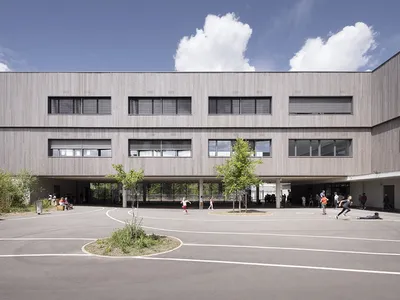
Vil Genis School by BPA ARCHITECTURE – Massy, France
Vil Genis School in Massy, France, features sustainable design, south-facing classrooms, community integration, accessible spaces, and modern educational architecture.




Comments (0)
Please login or sign up to add comments
No comments yet. Be the first to comment!