

Art Oasis: A Modular Timber Stage That Turns City Plazas into Planted Performance Grounds
A 7 by 7 meter grid of 49 wooden modules, nine of them planted, lifts street performers just above the crowd and carries shade wherever it lands.


Street performance has always been a negotiation with the city: a busker claims a patch of pavement, a crowd forms, and pedestrian traffic pushes back. Art Oasis resolves that tension with a deceptively simple move. It raises a timber deck just high enough to give performers a stage of their own, threads planting through the floor, and keeps every edge open to the public. The result is less a building than a portable piece of ground, an oasis of shade and greenery that can be assembled wherever a plaza needs it.
Designed by Alejandro Fleitas Valido, the project earned an Editor's Choice distinction in the Opera Truck competition. Fleitas Valido starts from a familiar diagnosis: cities are denser, faster, and increasingly saturated by digital distraction, and public squares that once hosted gathering and cultural exchange have shrunk into circulation zones dominated by traffic and noise. Rather than answering with a theatre or a formal pavilion, he proposes a hybrid platform where landscape, public art, and everyday urban life overlap.
A Deck That Sits Lightly on Its Triangular Legs
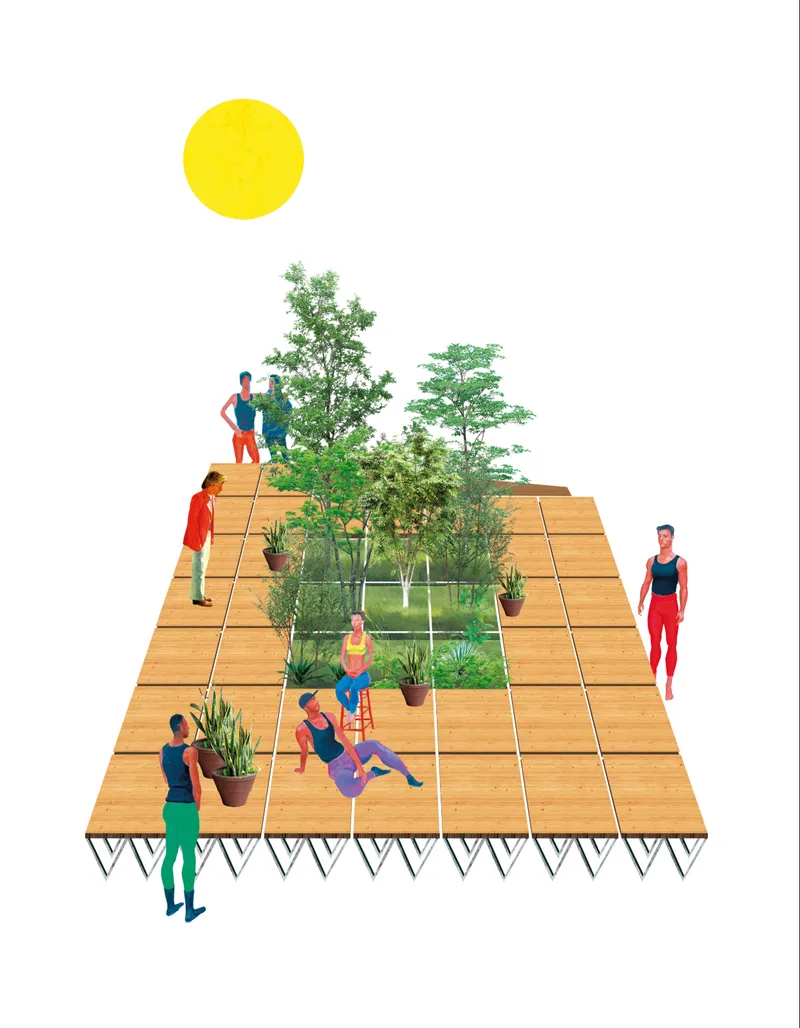
The opening collage sets the tone: a raised timber surface perched on triangular supports, a planted opening cut into its floor, potted plants scattered across the boards, and a cartoonish yellow sun overhead. The graphic language is playful, but the architectural point is precise. The structure barely touches the ground, which signals that it is a visitor to the site rather than a permanent fixture, and the planting is built into the deck itself rather than arranged around it.
That integration matters. Many temporary stages treat greenery as decoration added afterward. Here the vegetation is part of the floor plan, so shade, softness, and cleaner air arrive with the platform every time it is set up. Fleitas Valido argues that art belongs in everyday urban experience rather than behind institutional doors, and the deck makes the case physically: a citizen can pause, sit, and rest under the planting without ever deciding to attend a performance.
Elevation Without Isolation
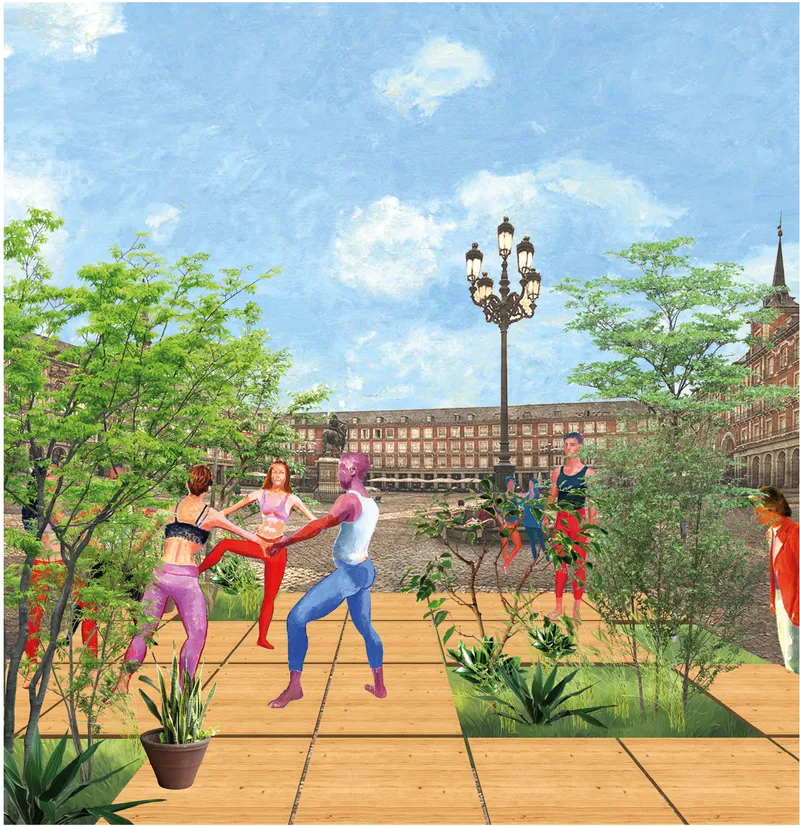
The second collage places the deck in an arcaded plaza under a blue sky, with figures dancing across the boards between planted beds, trees, and a lamppost. It shows the project's most valuable social idea at work. Street performers usually compete with the flow of foot traffic for visibility; a subtly elevated surface gives them the spatial identity of a stage while keeping them at conversational distance from the audience. There are no wings, no proscenium, and no barrier between performer and passerby.
Visitors can cross the platform freely, sit along its perimeter, watch from multiple angles, or simply occupy the shade. The boundary between audience and act becomes porous, and that porosity is the design. The architecture stops being an object to look at and becomes something to step onto, which is exactly the kind of intimate, unscripted encounter that busy plazas tend to squeeze out.
Forty-Nine Squares, Nine of Them Green
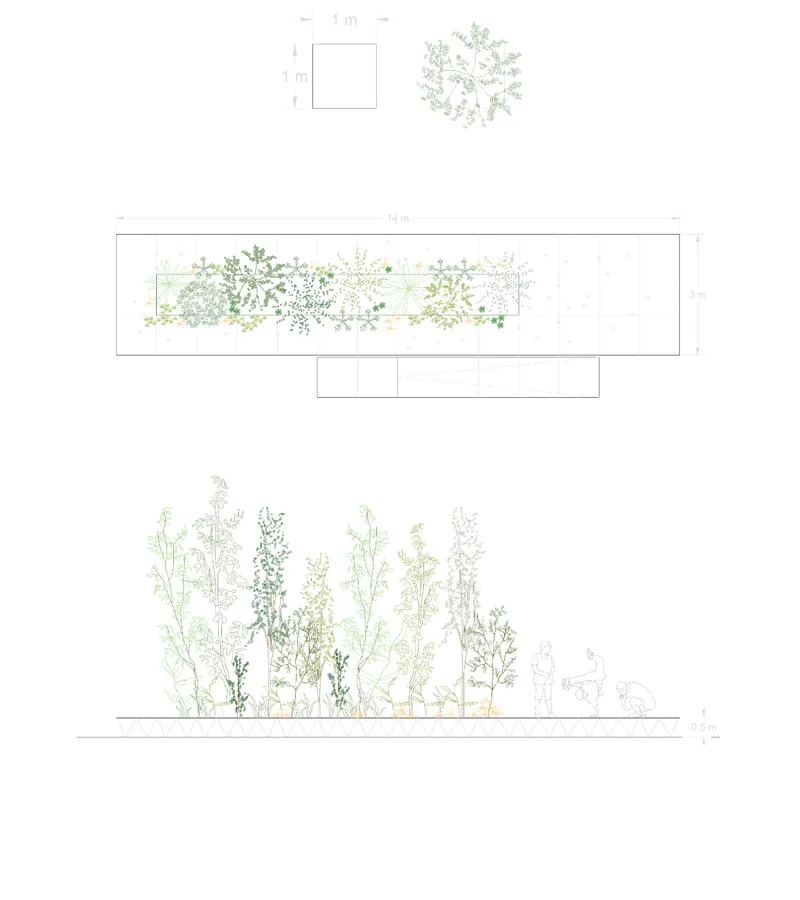
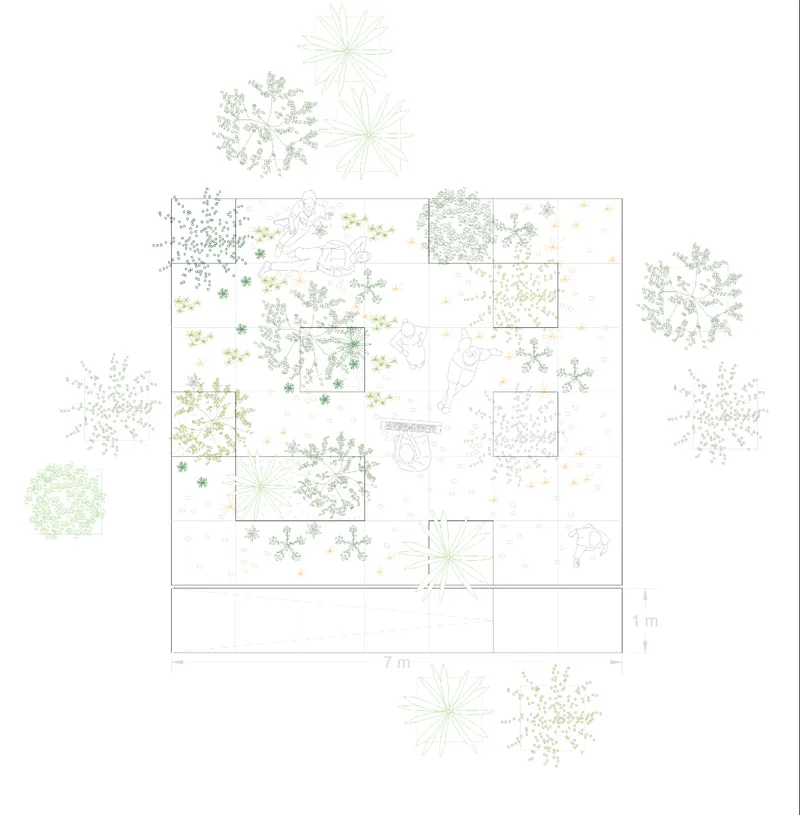
The drawings reveal the system behind the collages. The core platform is a modular grid of 1 by 1 meter wooden units, 49 in total, forming a 7 meter square, with nine modules given over to integrated planting beds. The plan shows those green cells distributed across the grid, with figures scattered over the deck and tree canopies gathering around its edges. A second plan and elevation stretches the deck to 14 meters, pairing tall, slender trees with small figures crouching and standing, a useful reminder of how the module scales and how vertical planting can frame an otherwise flat platform.
The square module is what makes the proposal credible as an urban device. Units can be rearranged to suit the type of event, the dimensions of a given site, or the needs of a particular performance, and the whole platform can be dismantled, transported, and reassembled elsewhere. That positions Art Oasis naturally for festivals, temporary cultural installations, civic events, and revitalization projects, where a city needs to test how a space might be used before committing to permanent change.
Why This Project Matters
Art Oasis succeeds because it refuses to overdesign. A timber grid, a modest change in level, and a handful of planted cells are enough to transform a pass-through plaza into a place that holds people. The proposal treats environmental quality and cultural activity as one problem rather than two, and it solves both with the same kit of parts, which is a discipline many larger pavilion projects lack.
The open questions are practical ones: how the planted modules are irrigated and maintained between moves, how the triangular supports handle uneven paving, and how many configurations the grid can realistically sustain. These are the right questions to have, because they come from a system concrete enough to be tested. For cities looking for low-cost ways to bring shade, greenery, and live performance back into everyday public life, this compact wooden oasis offers a persuasive starting point.
View the Full Project
About the Designers
Designer: Alejandro Fleitas Valido
Enter a Design Competition on uni.xyz
uni.xyz runs architecture and design competitions year-round that reward proposals with spatial conviction and real site intelligence.
Project credits: Art Oasis by Alejandro Fleitas Valido Opera Truck (uni.xyz).


Popular Articles
Popular articles from the community


FCC Arquitectura Expands a Portuguese Granite House with a Board-Marked Concrete Wing
In Portugal, JV House pairs a cleaned-up whitewashed and granite dwelling with a timber-shuttered concrete extension, courtyards and a garden pool.


Singing Woman: An Opera House That Performs Before the Curtain Rises
Ovidiu Cristian Pavel's conceptual opera house translates Estonia's choral identity into a sculpted waterfront landmark facing the Baltic Sea.

David Ortega Stacks a Two-Story Mexico City Penthouse Around a Steel Stair and a Pergola-Shaded Roof Terrace
In Colonia Roma, a 300 m² penthouse uses oak joinery, a planted steel stair and a slatted roof pergola to make a new-build apartment feel like a house.

graciastudio Turns a Viewless Tijuana Lot Inward Around a Courtyard of Concrete, Timber and Trees
In Tijuana, Jorge Gracia's GA2 House stacks a timber-clad private floor over exposed concrete and replaces a missing view with a planted interior patio.

Similar Reads
You might also enjoy these articles
Healing Façade: A Modular Chapel System That Restores Ethiopia's Sacred Forests
Winner of the Eco-Chapel competition, this circular timber façade collects water from air to rebuild soil and reforest degraded Ethiopian landscapes.
Kaffeebühnen: Where Coffee Shop Architecture Becomes a Civic Stage in Vienna
A linear sequence of timber boxes, transparent shells, and open yards turns the Viennese café tradition into a public performance space.
Eco Chapel: A Modular Forest Pavilion That Grows Like the Landscape It Protects
Hexagonal timber modules weave through existing trees, turning a chapel into a living system for prayer, education, and reforestation.


Urban Forest: A Vertical Ecosystem for 5,000 Workers in Singapore's Changi Business Park
Radially stacked pods and layered green decks turn a 7-acre plot into 47 acres of ecological workspace projected for 2040.

Comments (0)
Please login or sign up to add comments
No comments yet. Be the first to comment!