

AT-LARS Wraps a MotoGP Gallery in Scaffolding and Speed on the Coast of Lombok
A modular pavilion at Indonesia's Mandalika Circuit turns racing memorabilia into an architectural spectacle framed by steel and color.


Motorsport architecture tends toward two poles: slick corporate hospitality boxes or anonymous warehouses dressed up with sponsor decals. The Pertamina MotoGP Experience Gallery, designed by AT-LARS under the direction of Stephanie Larassati, refuses both options. Sitting at the edge of the Pertamina Mandalika International Circuit on the southern coast of Lombok, the 1,400 square meter pavilion is built almost entirely from tubular steel scaffolding and colored translucent panels, giving the structure the provisional energy of a pit stop and the visual punch of a racing livery.
What makes the project genuinely interesting is not just the material choice but the logic behind it. Scaffolding is designed to be assembled, disassembled, and reassembled. Using it as primary structure for a gallery that celebrates speed suggests a building that could, in theory, pack up and move to the next venue. That idea, modular construction expressing the nomadic calendar of a global racing series, gives the building a conceptual backbone that most exhibition pavilions lack entirely.
A Skeleton Made Visible


The gallery reads from a distance as a cage: a three-dimensional lattice of steel tubes and diagonal cross-bracing wrapped around two rectangular volumes. There is nothing concealed. Every connection, every brace, every clamp is exposed to the tropical air. The effect is part industrial yard, part kinetic sculpture. When the building catches the warm light of dusk, the framework silhouettes against Lombok's volcanic sky with a drama that few purpose-built galleries could match.
The decision to leave structure legible everywhere, from the canopy to the walkways to the facade, collapses the distinction between ornament and engineering. Diagonal truss members do real structural work, but they also pattern the facade in a way that evokes the cross-hatching of a racing chassis. AT-LARS treats the scaffolding not as a budget compromise but as an architectural language.
Color as Velocity
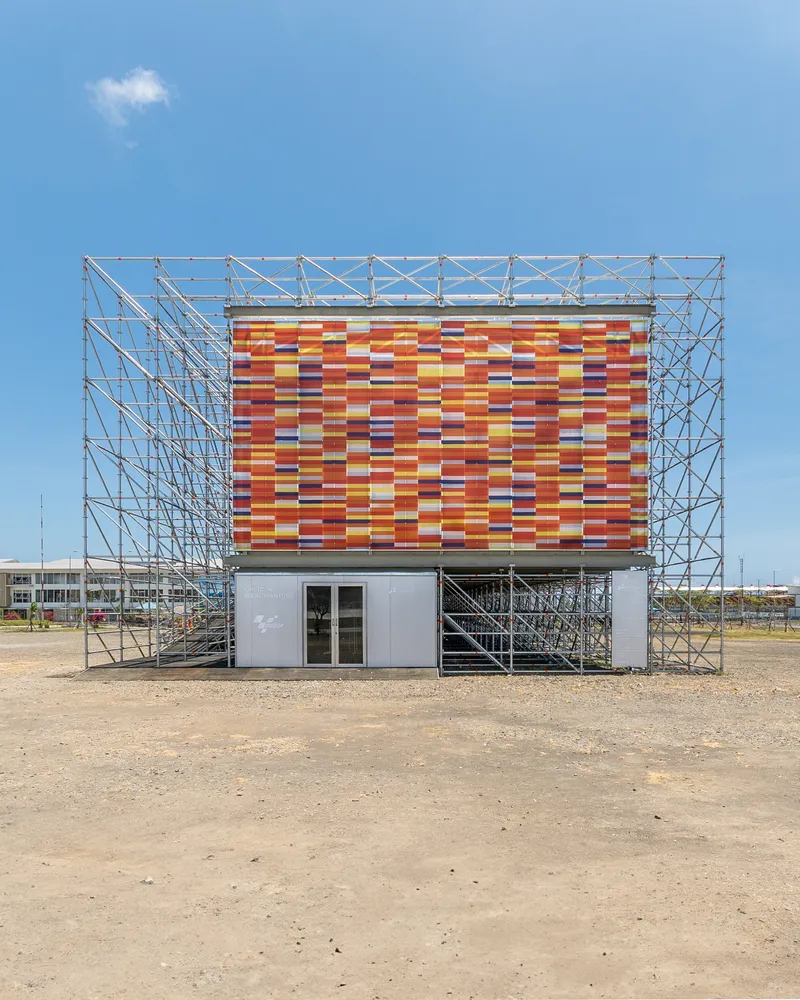

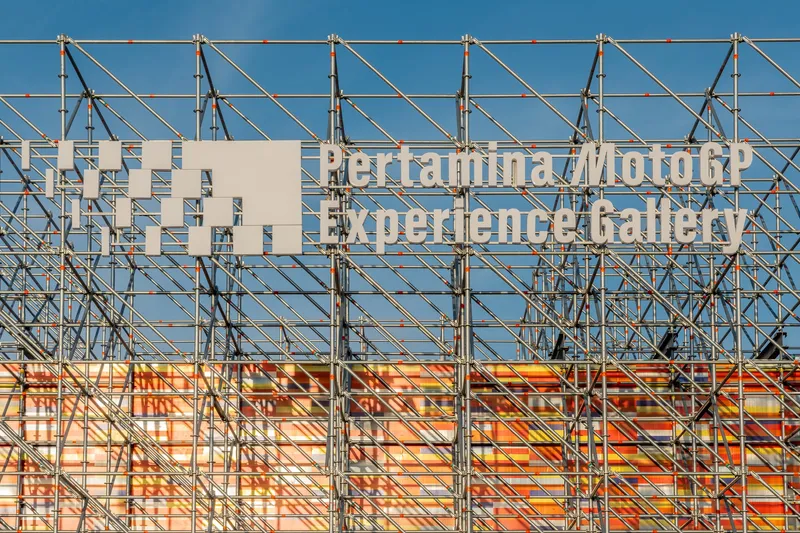
Panels in orange, amber, and warm-toned stripes stretch across the steel framework in horizontal bands, giving each elevation a distinct gradient. The color palette is clearly drawn from the Pertamina brand, but it does more than branding work. Against the blue equatorial sky and dry grass of the Mandalika landscape, the warm tones vibrate with an intensity that anchors the building in its surroundings while signaling its purpose from hundreds of meters away.
The panels are translucent. During the day, light passes through them into the interior as a filtered wash of warm color. At night, the internal lighting reverses the effect, turning the building into a glowing lantern on the circuit grounds. That dual performance, screen by day and beacon by night, is simple but effective. It gives the gallery two completely different architectural identities depending on the hour.
Light Through the Skin

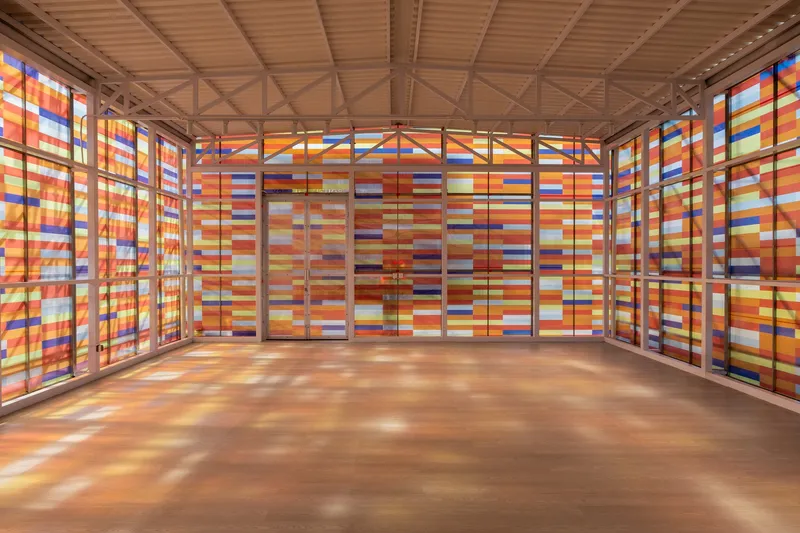

Inside, the backlit panels transform blunt industrial logic into something almost atmospheric. Daylight enters as bands of warm color, casting long amber shadows across the polished concrete floor. The timber framing behind the panels creates a secondary rhythm of vertical lines, layering depth into what could have been a flat wall. Walking alongside these screens feels closer to passing through a stained-glass corridor than a steel-framed shed.
The doorways punched through the panel walls are minimal: clean rectangular cuts that frame the landscape beyond. It is a straightforward gesture, but against the richness of the colored light inside, these openings work as thresholds between the immersive gallery world and the real circuit outside.
Elevated Walkways and the Circuit Beyond
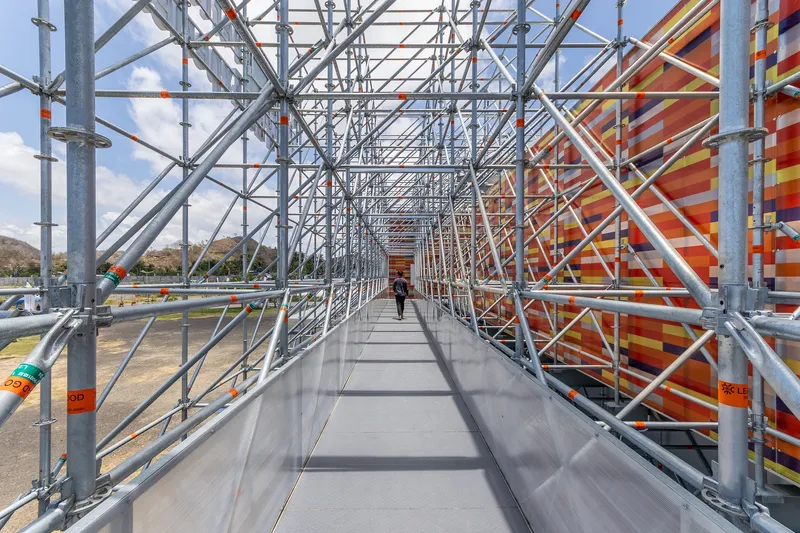

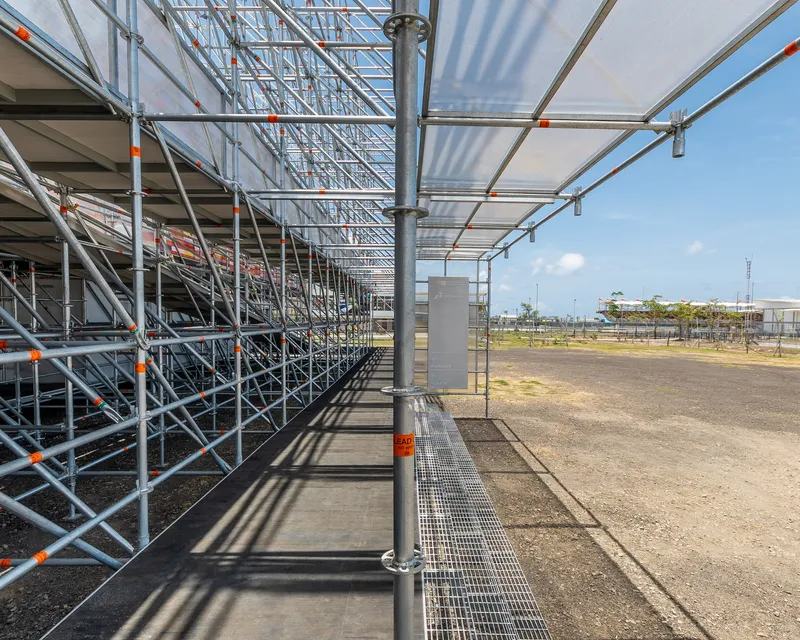
An elevated walkway threads through the scaffolding superstructure, offering visitors a second-story experience of the building as infrastructure. The narrow corridor, open to the sky and flanked by steel tubes, feels more like a service catwalk than a conventional gallery circulation route. That rawness is the point. Visitors are not just looking at MotoGP memorabilia; they are moving through a structure that borrows its spatial logic from the paddock, the pit lane, the behind-the-scenes zones that fans rarely access.
Below, a covered walkway with a tensile fabric canopy and an accessible ramp provides a more sheltered route. The contrast between the exposed upper path and the shaded lower one creates two registers of experience within the same structural system, one contemplative and breezy, the other functional and direct.
Inside the Galleries

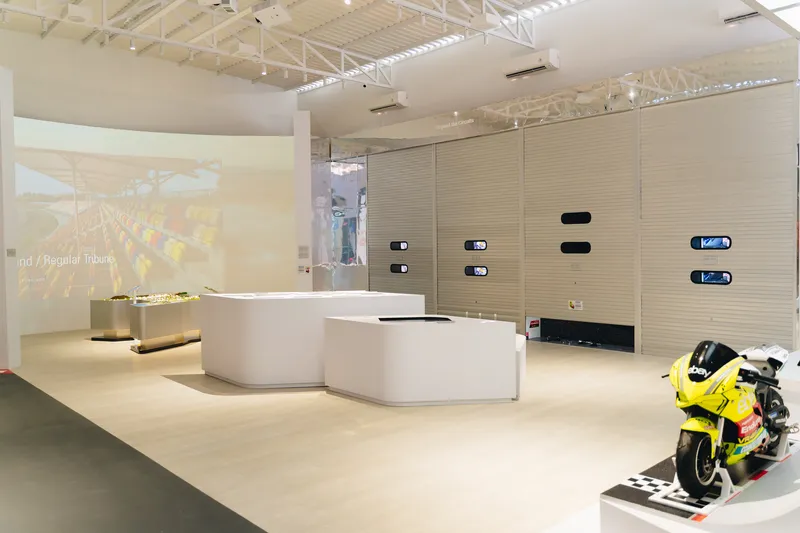

The program splits across two buildings: a North Gallery dedicated to displaying racing memorabilia, including suits, helmets, knee pads, and visors from MotoGP competitors, and a South Gallery functioning as a multifunctional space seating up to 50 people. The North Gallery interior uses ribbed timber walls and an exposed truss ceiling to maintain the industrial vocabulary of the exterior while creating a controlled environment for projection screens and display cases. The palette is dark, focused, almost theatrical.
The South Gallery takes a different tonal direction: curved white display counters, horizontal wood slat walls, and track lighting give it a showroom quality that feels calibrated for sponsor events and press conferences. Between the two, thematic zones like "Up to 366.1 Kilometers per Hour" and a kids' corner round out a program that serves both the hardcore fan and the casual circuit visitor. The architecture does not try to compete with the content. It frames it, then steps back.
Dusk and Drama

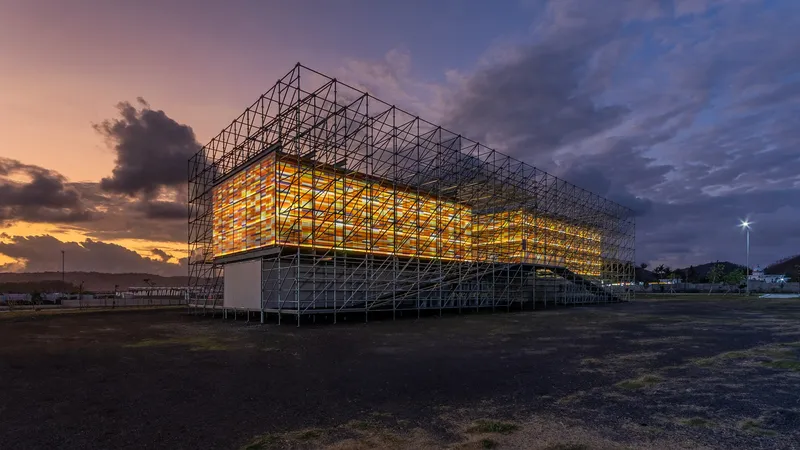
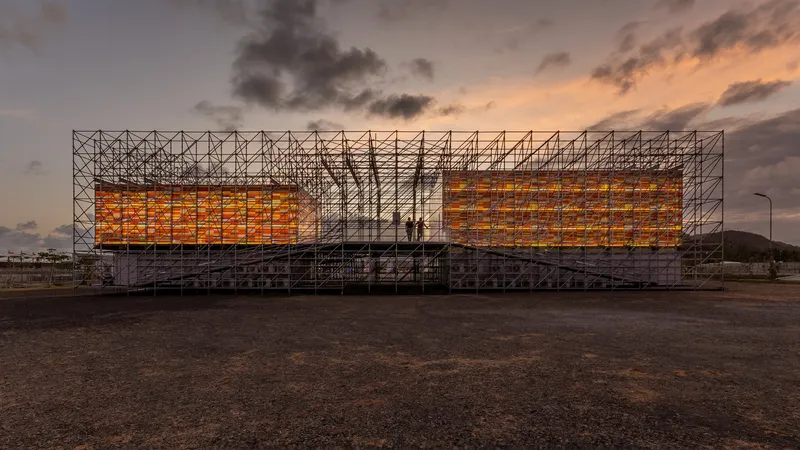
The building comes alive at twilight. When the translucent panels begin to glow from within, the steel skeleton recedes into silhouette and the gallery becomes a single luminous volume hovering over the Mandalika landscape. The photographers, Muhamad Putera Wicaksana and Fernanda Fattahalim, clearly understood this: several images capture the pavilion as a warm ember set against storm clouds and purple skies. The building performs best when nature cooperates with a dramatic backdrop.
There is a lesson here about how temporary or semi-permanent structures can carry genuine architectural weight. The scaffolding and panels could be dismantled tomorrow. But in the moments when light, weather, and steel align, this gallery holds its own against far more expensive and permanent buildings.
Plans and Drawings
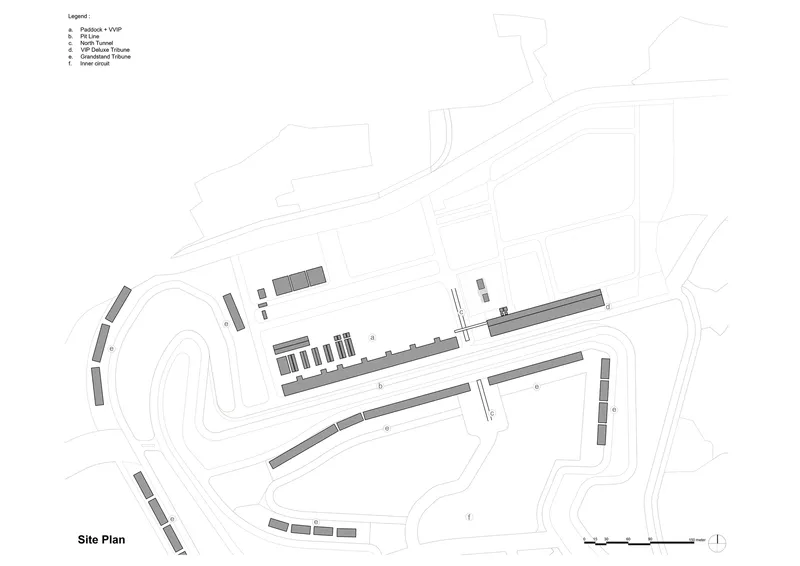


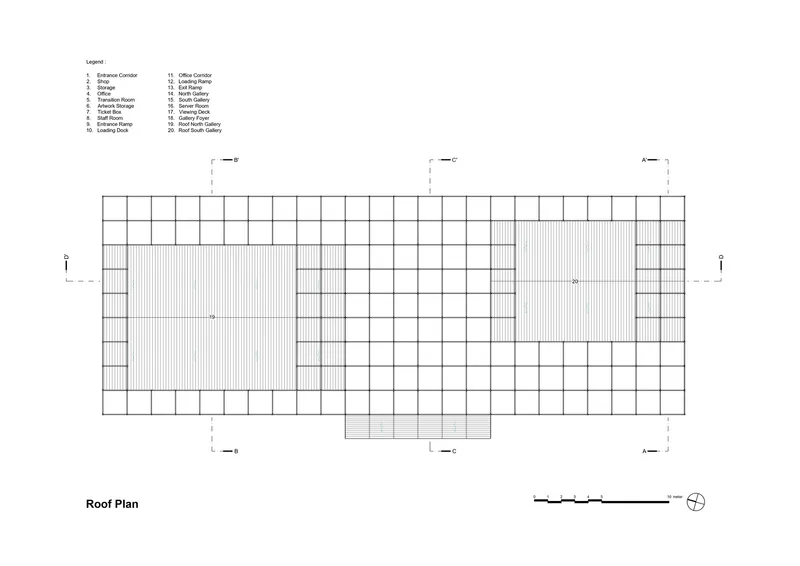


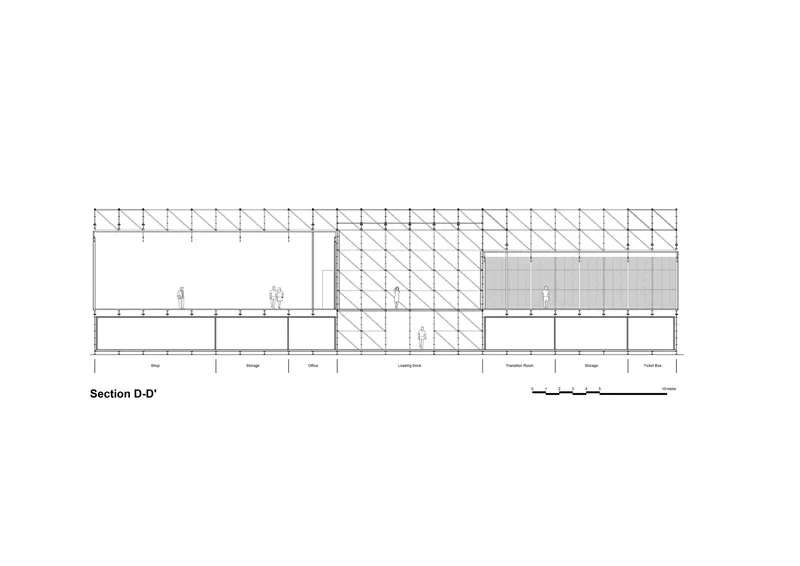
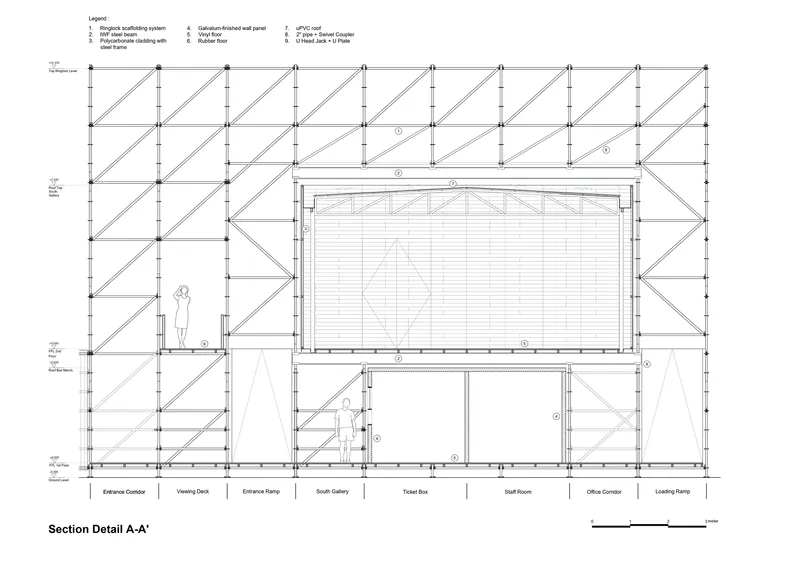

The site plan reveals two linear volumes arranged parallel to the site contours, with generous open space between them for outdoor circulation. The floor plans confirm a clear organizational logic: ground-level entrance corridors flanked by gallery spaces and terraces, with a second-floor bridge linking the two buildings. The sections are the most revealing documents. They show how the diagonal bracing wraps around the occupied volumes like a second skin, creating the interstitial walkways and elevated platforms that define the visitor experience. The roof structure spans wide and flat, with exposed trusses that maintain the honest, legible structural language all the way to the topmost member.
Why This Project Matters
The Pertamina MotoGP Experience Gallery is not trying to be permanent in the way a museum is permanent. It is trying to be memorable in the way a race weekend is memorable: intense, specific, tied to a moment. AT-LARS has found a material system that embodies that ambition without pretending to be something it is not. Scaffolding is honest. It declares its own logic and its own lifespan. Using it as the primary architectural expression for a gallery about speed and spectacle is a sharp conceptual move that avoids the bombastic formal gymnastics motorsport buildings usually indulge in.
More broadly, the project demonstrates that exhibition architecture in Southeast Asia does not need to default to either polished minimalism or parametric spectacle. A 1,400 square meter gallery made from off-the-shelf components, colored panels, and timber cladding can hold complex spatial ideas and deliver genuine atmosphere. The fact that it sits on the coast of Lombok, far from the usual architectural media centers, makes it all the more worth paying attention to.
Pertamina MotoGP Experience Gallery by AT-LARS, lead architect Stephanie Larassati. Pujut, Lombok, Indonesia. 1,400 m². Completed 2024. Photography by Muhamad Putera Wicaksana and Fernanda Fattahalim.
About the Studio
Share Your Own Work on uni.xyz
If projects like this are the kind of work you want to make, uni.xyz is a place to publish your own, find collaborators, and enter design competitions.


Popular Articles
Popular articles from the community


David Ortega Stacks a Two-Story Mexico City Penthouse Around a Steel Stair and a Pergola-Shaded Roof Terrace
In Colonia Roma, a 300 m² penthouse uses oak joinery, a planted steel stair and a slatted roof pergola to make a new-build apartment feel like a house.

U.GA Architects Wraps an Oval Rooftop Pool in Curved Board-Formed Concrete on Busan's Jeollidan-gil
In Busan's Jeonpo-dong, a 454 m² mixed-use block stacks a neighborhood facility, guest rooms and an oval rooftop pool inside spiraling concrete walls.

David Macias Steps a Doorless Stone and Plaster House Down a Tropical Colombian Hillside
In the humid hills of Colombia, Threshold House replaces the front door with an open void and terraces its 850 m² down the slope instead of fighting it.

GROUP A Strips a 1969 Rotterdam Harbor Headquarters to Its Frame and Wraps It in Timber Louvers
In Rotterdam's M4H harbor district, Ferro Offices reuses a 1969 frame, adds one timber storey and reaches BREEAM-NL Outstanding.

Similar Reads
You might also enjoy these articles


LAVA Architecten Gives Vocational Education a Sawtooth-Roofed Face on a Mechelen School Campus
In Mechelen, Belgium, a 2,053 m² STEM school on a 6×6 m grid turns workshops and classrooms into rooms that can be rearranged as teaching changes.

KEMA Studio Turns a Derelict Marvila Attic into a 60 m² Lighthouse Apartment Above Lisbon
In Lisbon's Marvila district, a rebuilt roof, four skylights and two plywood volumes turn an unlivable attic into a bright home facing the Tagus.

Pixel Gardens: One Repeated Module Stacked Into a Terraced Social Housing Tower for Famagusta
Salem Bader's shortlisted housing tower builds a vertical neighbourhood from one repeated module, offsetting units to carve terraces, light and air.

Bao Huynh Watercolor Atelier: A Serene Art Retreat in Hội An
Bao Huynh Watercolor Atelier in Hội An blends multifunctional art spaces, sustainable design, local materials, and family-friendly living in a serene environment.


Comments (0)
Please login or sign up to add comments
No comments yet. Be the first to comment!