
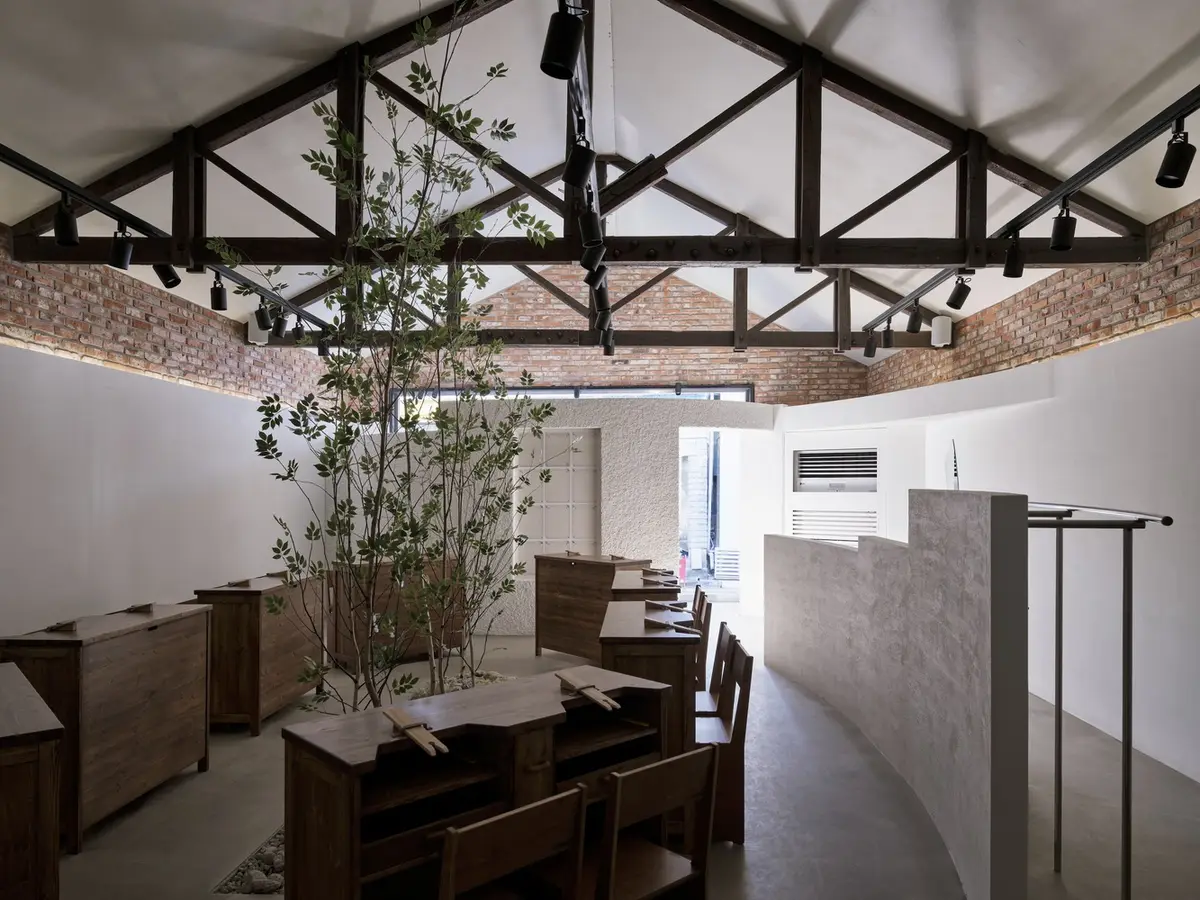
design by 83 Converts a Busan Warehouse into a Ring Workshop That Sells Experiences, Not Products
In Jeonpo-dong's tool shop alleyway, an old wooden truss roof shelters a tactile interior that mimics the journey from rough stone to polished ring.


Jeonpo-dong is one of those Busan neighborhoods that keeps reinventing itself. Once a dense corridor of tool shops and supply stores, it has become a magnet for young creatives in their twenties and thirties, the kind of crowd that values craft and tactile engagement over passive consumption. When Seoul-based ring workshop brand Atelier Hosoo decided to open in this district, design by 83 was tasked with turning a building that had already cycled through lives as a warehouse, a café, and a clothing store into something that could hold its own against a streetscape saturated with curated retail.
What makes the project genuinely interesting is the refusal to flatten the building's past. On their first visit, the architects found an upturned roof held up by old wooden trusses, the kind of structural honesty that most renovations either conceal behind drywall or fetishize with industrial lighting. design by 83 chose a third path: they preserved the trusses and the roof silhouette but lined the interior with ALC blocks finished at varying degrees of roughness, turning the entire space into a physical analogy for the act of making a ring. You walk from coarse to smooth, from raw to refined. The architecture doesn't just house a workshop; it rehearses the workshop's central gesture.
The Truss Overhead


The original wooden truss structure is the single most important element the architects chose to retain. Exposed and left largely untreated, it runs the length of the ceiling like a spine, anchoring every spatial decision below it. Black steel connectors and track lighting thread through the timber members without competing for attention. The result reads less like preservation for its own sake and more like a deliberate framing device: the old bones of the warehouse give scale and warmth to what would otherwise be a gallery-white interior.
Against the dark timber overhead, the textured grey and white walls below register with sharper contrast. It is a simple compositional trick, but it works because the architects resist the temptation to unify the palette. The ceiling belongs to the building's warehouse past; the walls belong to Atelier Hosoo's brand identity. The two coexist without merging.
Texture as Narrative
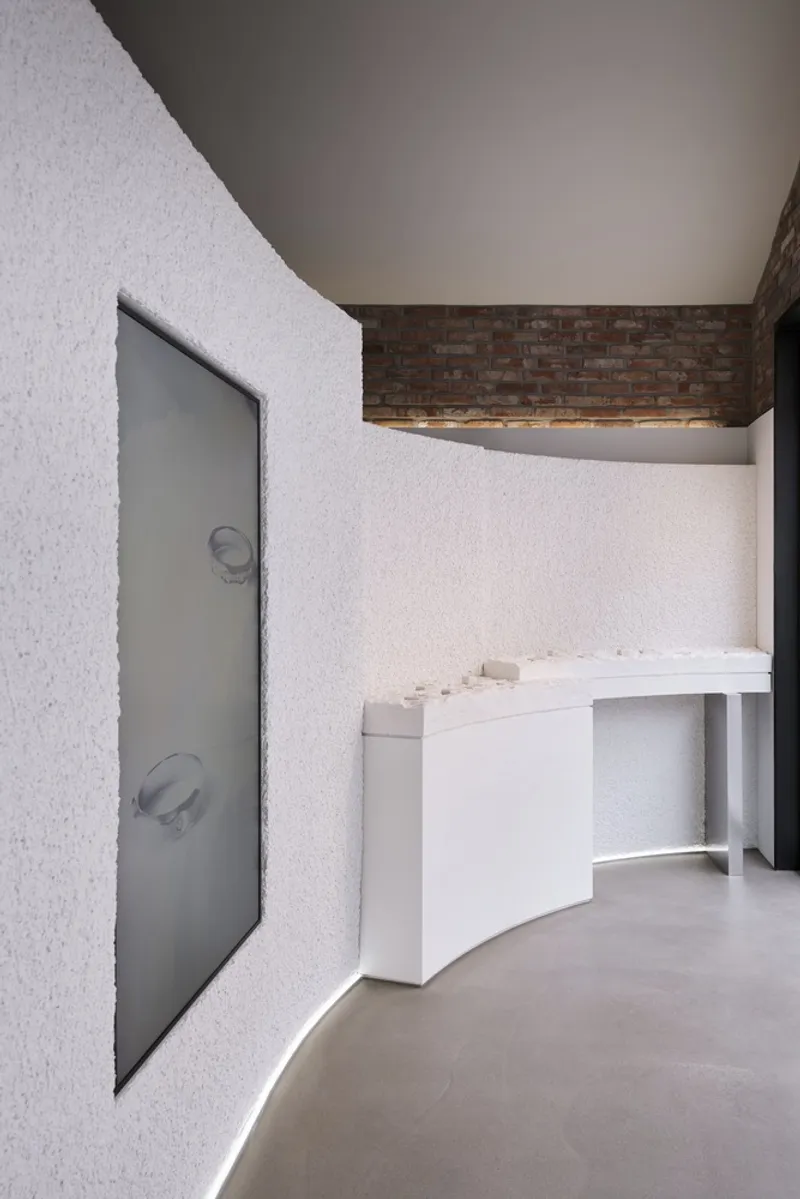

The interior walls tell a story about material transformation, and they do it without a single didactic placard. ALC blocks were finished in collaboration with artists at varying levels of roughness, from a coarse, almost geological surface near the entrance to smoother, more refined planes toward the display areas. The concept mirrors the process of crafting a ring: you start with an unworked blank and end with something polished and precise.
Recessed frosted glass panels and floating white display counters punctuate the textured walls, creating moments of visual pause. The stepped ledges that emerge from the plaster hold small objects and model forms, turning the wall itself into a display system rather than a backdrop. Strategic lighting, directed through opaque acrylic, catches the surface grain and throws subtle shadows that shift as you move through the space. The architecture does what good jewelry design does: it makes you notice the surface.
Curves and Flow
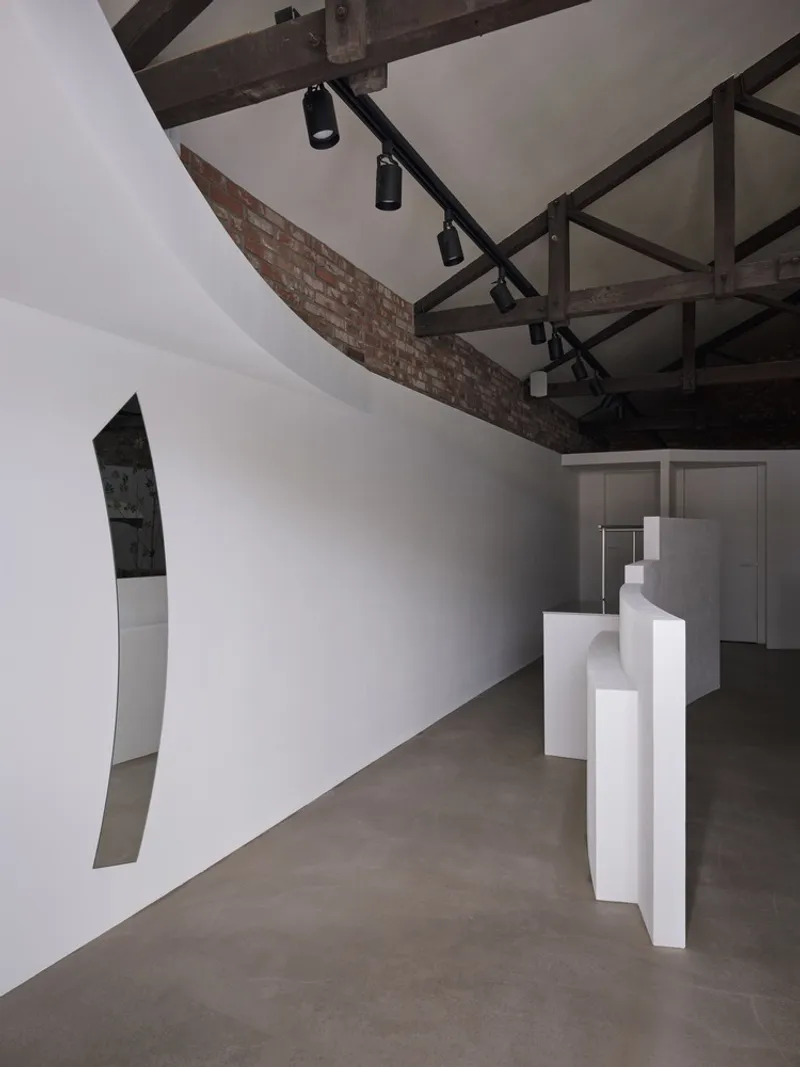

Straight lines are almost entirely absent from the plan at eye level. Curved partition walls with angular cutouts guide movement without channeling it. The walls vary in height and thickness, so sightlines open and close as visitors pass through the space. Floor-to-ceiling glass doors at the entrance yield to these curving forms, and the transition from street to interior feels gradual rather than abrupt.
The workshop area itself replaces the conventional rectangular table with an oval desk arrangement, a layout that references the organic geometry of rings and eliminates the hierarchy of a head-of-table position. It is a small decision, but it signals the difference between a classroom and a communal making space. Timber furniture with warm, muted tones anchors the room beneath the exposed trusses, giving the workshop zone a domestic scale that the gallery-like entry corridors deliberately lack.
Greenery Suspended
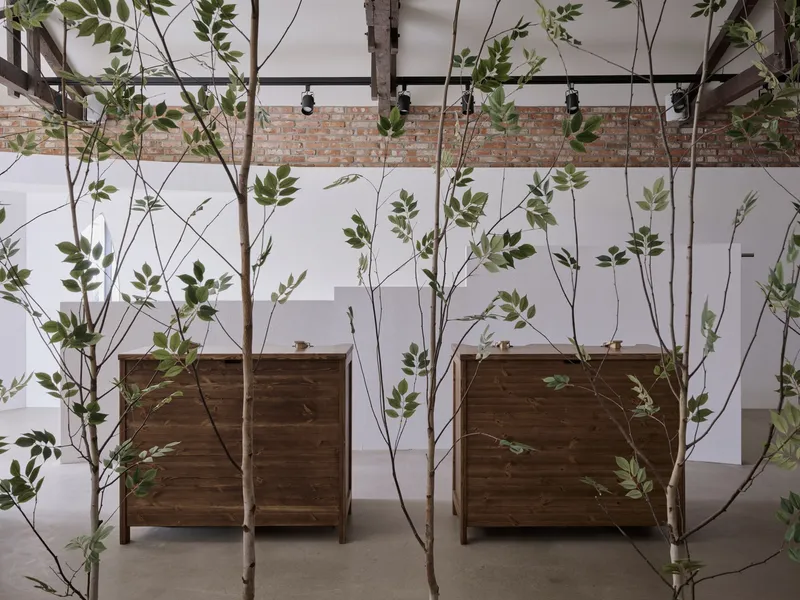
A landscaped area positioned in the middle of the space introduces living material into an otherwise mineral interior. Young trees hang in suspended planters behind timber cabinetry, their roots visible, their canopies brushing the underside of the trusses. The planting reads as intentional contrast: soft, growing, impermanent things set against hard, textured, durable surfaces. For a workshop that attracts a younger demographic looking for memorable experiences, the greenery adds a layer of sensory richness that stone and plaster alone cannot provide.
Beyond aesthetics, the central garden creates a natural pause in the floor plan. It separates the retail and display zones from the workshop tables, functioning as a psychological threshold. You browse, you breathe among the trees, and then you sit down to make something. The sequencing is deliberate.
Why This Project Matters
Atelier Hosoo is a small project, a single-story conversion in a Busan side street, but it tackles a question that much larger retail projects fumble: how do you make architecture do the work of branding without turning a building into a logo? design by 83's answer is material storytelling. The gradient from rough to smooth, the preserved warehouse trusses, the suspended greenery, all of it communicates craft, process, and care without ever needing to spell it out. The brand identity is embedded in the surfaces, not applied to them.
It also serves as a useful case study in adaptive reuse at a modest scale. Not every heritage conversion needs to be a museum or a cultural center. Sometimes the most convincing argument for keeping an old structure is simply demonstrating that its bones can support a completely new program while lending the new program a character that new construction could never replicate. That upturned wooden truss, survivor of decades of commercial turnover, is now the roof under which people learn to shape metal into rings. The building and the activity finally make sense together.
Atelier Hosoo by design by 83. Jeonpo-dong, Busanjin District, Busan, South Korea. Completed 2024. Photography by Donggyu Kim.
About the Studio
Share Your Own Work on uni.xyz
If projects like this are the kind of work you want to make, uni.xyz is a place to publish your own, find collaborators, and enter design competitions.


Popular Articles
Popular articles from the community


Faces of the Soviet Avant-Garde: Turning Moscow's Street Names into an Open-Air Museum
A network of sculptural installations across a Moscow residential district transforms forgotten architect names into spatial encounters with cultural memor

Singing Woman: An Opera House That Performs Before the Curtain Rises
Ovidiu Cristian Pavel's conceptual opera house translates Estonia's choral identity into a sculpted waterfront landmark facing the Baltic Sea.

Opera by the Sea Estonia: Three Shells Dissolving Architecture into Tallinn's Coastline
A winning opera house proposal replaces monumental form with interconnected shells that blur the boundary between building, park and Baltic Sea.

Manzana Morphosis: Stretching Barcelona's Grid into a Living Landscape for 2050
A radical reworking of the Eixample manzana turns density into a tool for generous public space, vertical ecology, and environmental performance.

Similar Reads
You might also enjoy these articles


Hodi-Mandai Geram
Project Function: Preservation and revitalization of the Intangible heritage and socio-spatial identity of the Hodi by Housing, Cultural Memory Center, Sacred Grove, landscape, local tourism economy


Olio Towers: A Mid-Rise for Performers That Fuses Housing, Rehearsal, and Stage
Located blocks from Houston's Theater District, this modular tower stacks living units around a central performance atrium.

Oasis: Modular Green Housing Carved into Dhaka's Urban Fabric
A shortlisted Plugin Housing entry reclaims unauthorized settlements in Dhaka with stepped concrete volumes, green roofs, and ventilation-driven design.

Black Hole: A Floating Megastructure for the Post-Physical Era
Emiliano Mazzarotto envisions a spherical, self-scaling arena where e-sports, digital hotels, and holographic stadiums replace traditional public space.

Explore Atelier Competitions
Discover active competitions in this discipline

Challenge to design luxury tourism on rails

Challenge to reimagine the Iron Throne

Photograph architecture without architects

VR headsets Storefront design competition
Comments (0)
Please login or sign up to add comments
No comments yet. Be the first to comment!