

Athenaeum: A Floating Cultural Habitat for Rio de Janeiro's Rising Waters
Marc Bönig reimagines the ancient Athenaeum as adaptive floating architecture, merging culture, education, and leisure on Rio's waterfront.


What happens when you take one of Western civilization's oldest institutional typologies and set it adrift? The Athenaeum, born as a sanctuary to the Greek goddess of wisdom, has cycled through identities for millennia: temple, library, public forum, university. In this proposal, it becomes something new entirely: a buoyant cultural habitat designed to ride the tides rather than resist them. Instead of fortifying against rising sea levels, the building embraces adaptation, sitting on interconnected buoyant chambers that adjust in real time to shifting water conditions. It is architecture that concedes the argument to the ocean and finds intelligence in that surrender.
Designed by Marc Bönig and published on uni.xyz, the project is sited on the dynamic waters of Rio de Janeiro, positioned near existing cultural institutions, metro access points, and ferry lines. Bönig traces the Athenaeum's lineage from Greece to Rome, Constantinople to Boston, and synthesizes those diverse historical identities into a single three-part program: culture, teaching, and leisure. The result is a floating civic building that doubles as a climate adaptation prototype for coastal cities worldwide.
Three Lobes on the Water: Reading the Site Plan

The site plan reveals a three-lobed building form nestled against Rio's waterfront, its rounded volumes arranged like overlapping petals. This tripartite geometry is not arbitrary; it maps directly onto the project's programmatic triad. One lobe accommodates large public exhibition areas and flexible cultural halls for curated installations and storytelling. A second hosts floating classrooms, auditoriums, and workshop zones rooted in what Bönig describes as the Renaissance Arte Liberalis model, alongside a dedicated research area and library. The third gives over to leisure: contemplative walkways, public gathering decks, and a membrane-roofed open space that functions as a floating plaza for concerts, film screenings, and community events.
Critically, the plan also shows how the Athenaeum integrates with Rio's marine mobility network. A proposed new ferry route brings visitors directly to the structure, extending the city's existing transit infrastructure onto the water. Landscaped grounds at the water's edge mediate between the urban fabric and the floating platform, making the building accessible without severing it from the city it serves.
Triangular Trusses and a Central Atrium That Draws Light Downward
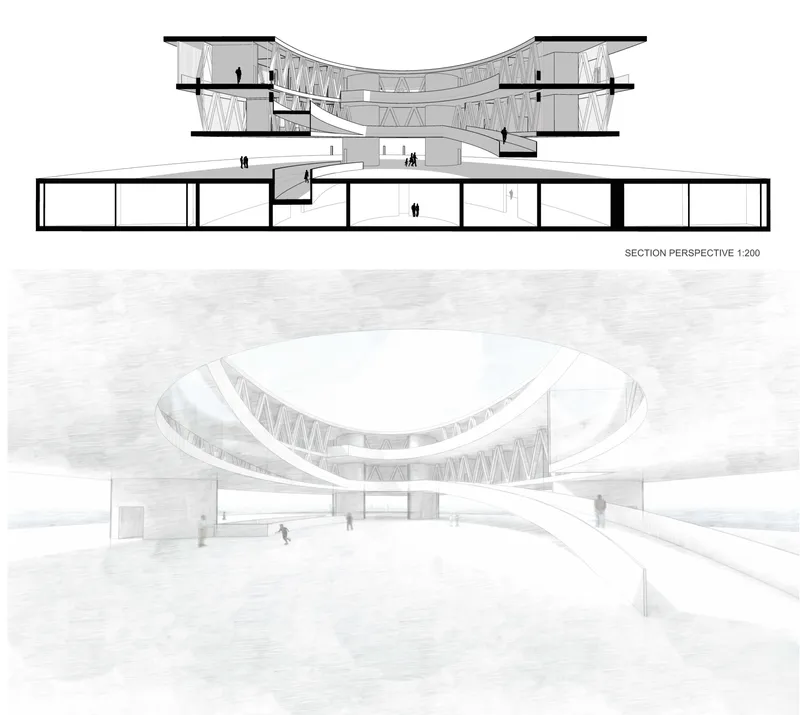
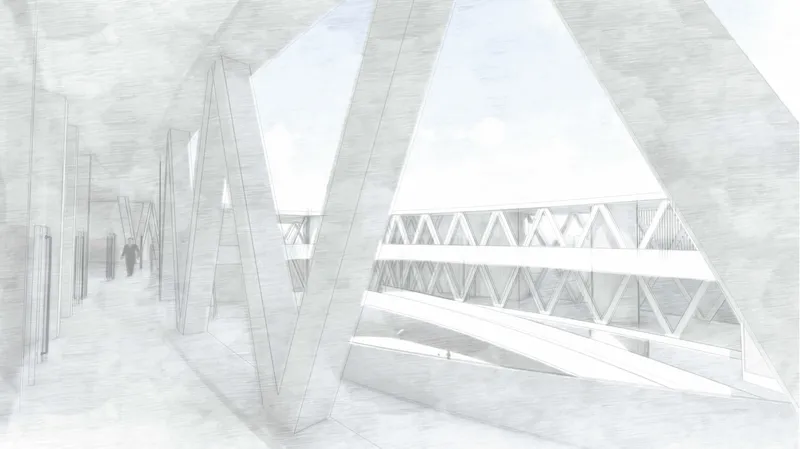
The section perspective cuts through the building's curved roof to expose its structural logic: a network of triangular trusses that span the interior, creating a deep structural zone above the occupied floors. These trusses carry the roof loads while freeing the interior from dense column grids, allowing the flexible, open-plan spaces the program demands. At the center, a generous atrium punches through the building's section, pulling daylight deep into the plan. The interior rendering confirms what the section suggests: angled columns and the exposed truss geometry become the dominant spatial experience, creating a forest of structural members overhead that filters and scatters light from large skylights.
The effect is both monumental and surprisingly intimate. The structural repetition gives the space rhythm and legibility, while the varying angles of the columns introduce visual complexity that keeps the eye moving. For a building dedicated to learning and contemplation, this is smart spatial choreography. The architecture never recedes into neutral background; it actively participates in the experience of inhabiting the space, reminding visitors that they are inside a structure that is, quite literally, floating.
An Oval Roof with Oculus: Monumental Calm Under Storm Clouds
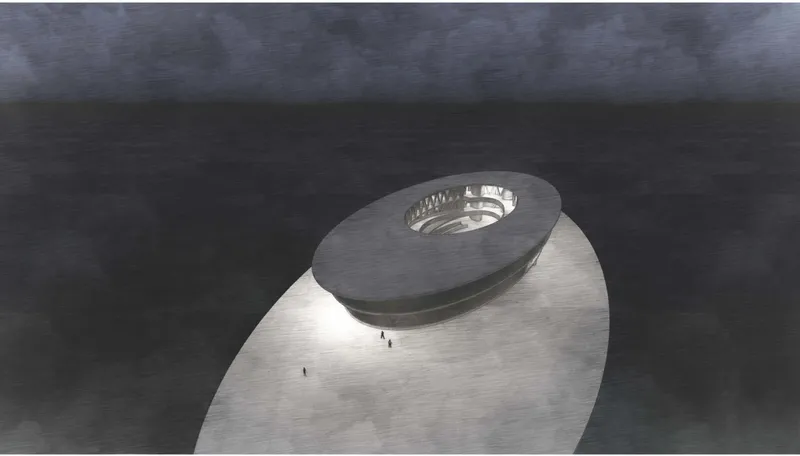
The aerial rendering is the project's most striking image. Seen from above, the Athenaeum reads as a smooth oval roof punctuated by a central oculus, a clear nod to the Pantheon and to the long tradition of sacred geometries that Athenaeums have historically borrowed. The dark storm clouds massing behind the structure are not just atmospheric staging; they underscore the building's reason for being. This is architecture designed for volatile weather, for a coastline where storm surges and rising tides are not hypothetical but imminent. The building's buoyant chamber system, which allows controlled flooding and emptying of embedded boxes to adjust buoyancy, means the structure can maintain level positioning even in these conditions.
The oval form also minimizes wind resistance and distributes wave loads evenly across the floating platform, a functional consequence of what initially reads as a purely formal decision. Bönig's three-part adaptation framework, which distinguishes between avoidance, resistance, and adaptation, finds its most visible expression here. The Athenaeum does not hunker down or retreat to higher ground. It sits on the water and holds its shape.
From Digital Rendering to Physical Model: Testing the Tiered Roof
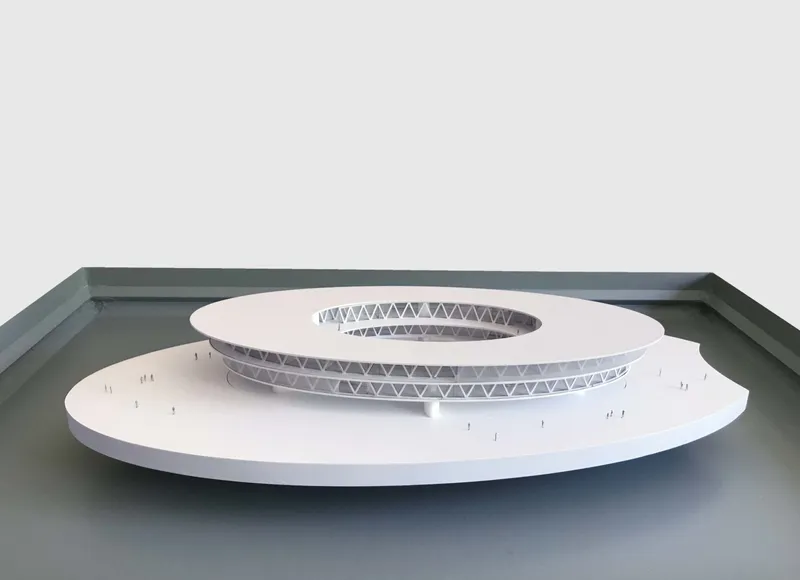
The physical model strips the project back to its structural and formal essentials. The tiered circular roof steps down toward the central opening, its concentric rings clearly visible. Around the perimeter, the triangular truss ring is exposed, confirming that the structural system is not just interior ornamentation but a continuous exoskeletal logic that wraps the building. The model makes the scalability of the buoyant platform legible too: the base reads as a series of modular elements, reinforcing Bönig's argument that as chamber groups are combined, the structure gains stability.
Physical models remain one of the most honest tests of an architectural idea. They reveal weaknesses in proportion, expose structural ambiguities, and force designers to commit to a tectonic hierarchy. Here, the model validates the digital renders: the roof's tiered profile creates a clear silhouette, the oculus reads as a deliberate void rather than an absence, and the truss system appears structurally coherent at a scale where fudging is difficult. It is convincing evidence that the formal ambition is grounded in buildable logic.
Why This Project Matters
Floating architecture often occupies the speculative fringe of design discourse, treated as a novelty or a last resort. Bönig's Athenaeum pushes back against that framing by anchoring the floating typology in one of architecture's deepest institutional traditions. The project argues that a building on water can carry the same civic weight as one on solid ground, that it can host libraries and lecture halls and public plazas without sacrificing programmatic seriousness. By threading the Athenaeum's 2,500-year history through a climate adaptation strategy, the project makes floating architecture feel not futuristic but inevitable.
For Rio de Janeiro specifically, the proposal addresses a real and worsening condition. Coastal flooding, storm surges, and sea level rise are already reshaping the city's relationship with its waterfront. Rather than treating these forces as threats to be engineered away, the Athenaeum proposes coexistence, a cultural institution that rises and falls with the tide. It is a compelling vision: a place of learning that learns from its own environment, adapting in real time to the conditions it was designed to inhabit.
View the Full Project
About the Designers
Designer: Marc Bönig
Enter a Design Competition on uni.xyz
uni.xyz runs architecture and design competitions year-round that reward proposals with spatial conviction and real site intelligence.
Project credits: ATHENAEUM, from sanctuary to cultural habitat by Marc Bönig.


Popular Articles
Popular articles from the community


Opera by the Sea Estonia: Three Shells Dissolving Architecture into Tallinn's Coastline
A winning opera house proposal replaces monumental form with interconnected shells that blur the boundary between building, park and Baltic Sea.

Tsunami Convergenics: Turning Catastrophic Ocean Forces into Underwater Housing Infrastructure
A speculative underwater settlement off the coast of Onagawa, Japan, treats tsunamis and typhoons as energy sources rather than threats.

Extended Shell: Retrofitting Kolkata's Balconies as Living Urban Thresholds
A modular retrofit system recovers the social and environmental intelligence of Kolkata's historic verandas for contemporary Park Street residents.

Temporary Home for Dogs: A Reversed Zoo Rethinks Animal Shelter Architecture
In Bucharest, a sinuous corridor and freed landscape flip the logic of containment, designing a shelter that works to make itself unnecessary.

Similar Reads
You might also enjoy these articles

Play: Fragments of Their World: Remembered Architecture Rebuilt as a Modular Playground for Refugee Camps
Tom Gardner abstracts domes, arches and towers from the homelands of displaced families into a kit of child-scaled play parts for camp settlements.
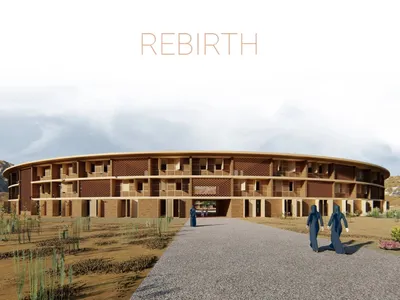
REBIRTH: A Circular Settlement Where Afghan Widows and Their Children Rebuild Life Together
A shortlisted Resile entry turns the circle into a protective ring of timber and brick, gathering homes, classrooms and gardens around a shared landscape.
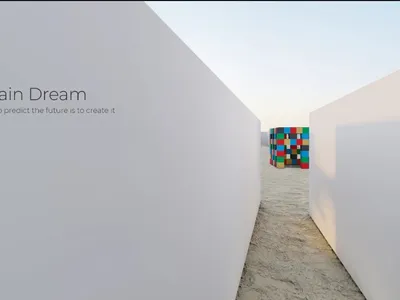
The Main Dream: A Recycled Plastic Kit That Lets Refugee Children Build Their Own Playground
Thirty-centimetre interlocking cubes that connect on three axes turn play into construction, letting children author the spaces they occupy.

Lunar Spiral: A Fibonacci-Driven Moon Settlement Rising from Shackleton Crater
Golden-spiral geometry organises buried infrastructure and orbiting habitable spheres into a lunar base designed to grow as life on the Moon expands.

Explore Athenaeum Competitions
Discover active competitions in this discipline

Challenge to reimagine the Iron Throne

Photograph architecture without architects

Illustrate the lost glory of Angkor Wat - Render Challenge

Design challenge to reuse E-waste
Comments (0)
Please login or sign up to add comments
No comments yet. Be the first to comment!