

AWM Architectes Urbanistes Wraps a Moroccan Data Center in Gabion, Terracotta, and a Double Roof
In the arid heat of Benguerir, a 37,000-square-meter server facility disappears behind passive cooling strategies and local materiality.


Data centers are, by nature, hostile to architecture. They are warehouses for machines, not people, and their programs demand sealed interiors, redundant systems, and a ruthless indifference to context. Most architects respond in kind, producing anonymous boxes clad in corporate grey. AWM Architectes Urbanistes took the opposite approach in Benguerir, Morocco, designing a Tier III/IV certified facility that reads less like an infrastructure shed and more like a civic building rooted in its landscape. Jointly launched by OCP and Mohammed VI Polytechnic University, the project occupies a 35,760-square-meter site in Benguerir's Tech Park, where summer temperatures push well past 40°C and any building that ignores climate does so at enormous energy cost.
The most consequential decision here is the double roof. A detached upper canopy, supported on a white metal structural grid, hovers above the main roof terrace and allows continuous air circulation through the void between the two planes. For a building whose 2,000 square meters of modular white rooms must stay below 20°C to protect servers carrying a 5 MW IT load, that passive temperature reduction is not decorative. It is the project's engineering backbone, and it gives the building its defining architectural gesture: a long, low cantilevered horizon that unifies otherwise disparate volumes and pushes against the sprawling flatness of the site.
The Double Roof as Unifying Move
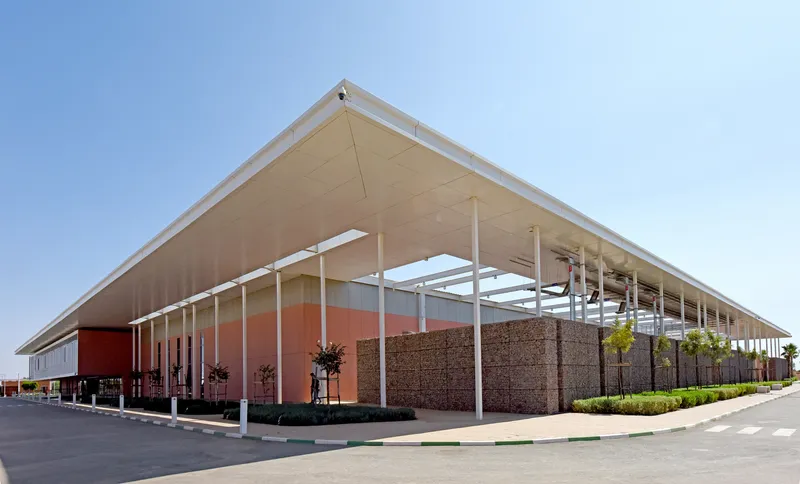


From every approach, the building presents itself as a single horizontal line. The upper roof's deep overhang, supported by slender white columns, extends beyond the envelope on all sides to shade the facade and reduce solar gain on the most exposed surfaces. The structural grid that holds this canopy is legible and repetitive, giving the building an almost civic rhythm. It is a deliberate counter to the industrial aesthetic that data centers typically embrace. AWM understood that a building of this scale, sitting in an emerging tech district, needed to project something beyond function.
The strategy also has a second, less obvious benefit: it allows the disparate programmatic volumes, server halls, offices, mechanical rooms, to sit beneath a single datum without forcing them into a uniform section. The roof floats over all of it, indifferent to what happens below, and the result is a building that looks composed rather than assembled.
Gabion Walls and Terracotta Panels


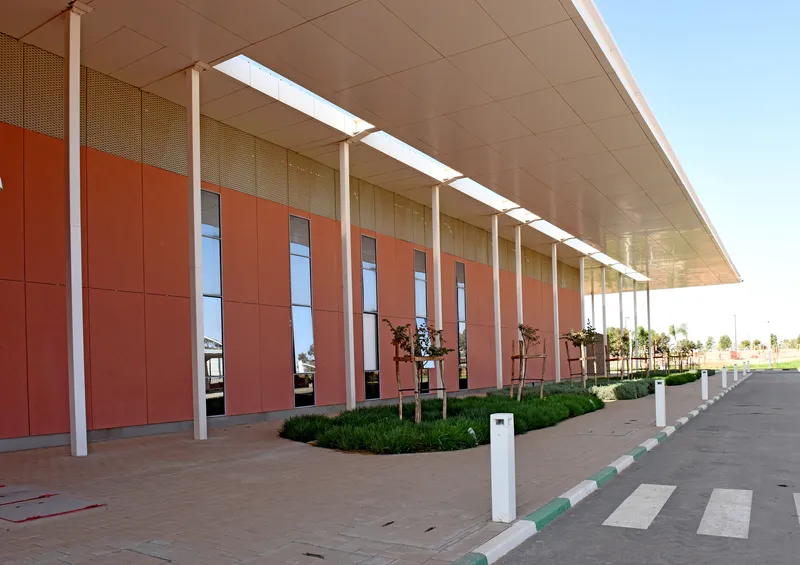
The material palette does a lot of work here. Gabion walls, filled with local stone, form the base of the building and define the entry sequence. They are heavy, textural, and explicitly of the ground. Above them, fiber cement prefabricated panels and decorative concrete panels in ochre tones reference Benguerir's characteristic earth colors. The panels carry a vegetal motif pressed into their surface, a detail that reads as subtle patterning from a distance and becomes more tactile up close.
This layering of rough base and refined upper cladding gives the facade a deliberate hierarchy. The gabion walls anchor the building visually and climatically, since the mass absorbs and releases heat slowly. The lighter panels above sit proud of the building envelope with a void space behind them, creating an additional layer of external insulation. Every material choice doubles as a passive cooling strategy.
Filtered Light and Shaded Circulation


The covered walkways that wrap portions of the building are among its strongest spatial moments. Perforated metal screens filter harsh sunlight into dappled patterns on the ground, turning otherwise utilitarian corridors into atmospheric passages. Timber soffits and diagonal bracing add warmth and rhythm, preventing these transitional spaces from feeling like afterthoughts. Palm trees and planted beds are threaded into the circulation routes, reinforcing the idea that even a high-security data facility can offer moments of sensory pleasure.
These outdoor corridors also serve a practical purpose. By keeping primary circulation outside the sealed envelope, AWM reduces the conditioned volume of the building. Every square meter that does not need to be cooled to 20°C is a square meter saved in energy costs, and the perforated screens ensure that these open-air routes remain usable even in the peak of Moroccan summer.
Courtyards and Reflecting Pools


The building is organized around four interior courtyards, a plan strategy with deep roots in Moroccan architecture. These voids pull daylight and ventilation into the building's core while creating planted microclimates that moderate temperatures at the facade. A reflecting pool along one elevation mirrors the glazed upper level and the cantilevered volume above, introducing evaporative cooling and a moment of visual calm into what is otherwise a high-performance industrial program.
The courtyards also break down the building's considerable mass. At nearly 37,400 square meters, this is a large facility, and without these openings it would read as a monolithic block. Instead, the plan creates a porous, breathing organism. The central outdoor terrace visible in the upper floor plan suggests that even on the more restricted levels, the building maintains a relationship with sky and air.
Plans and Drawings


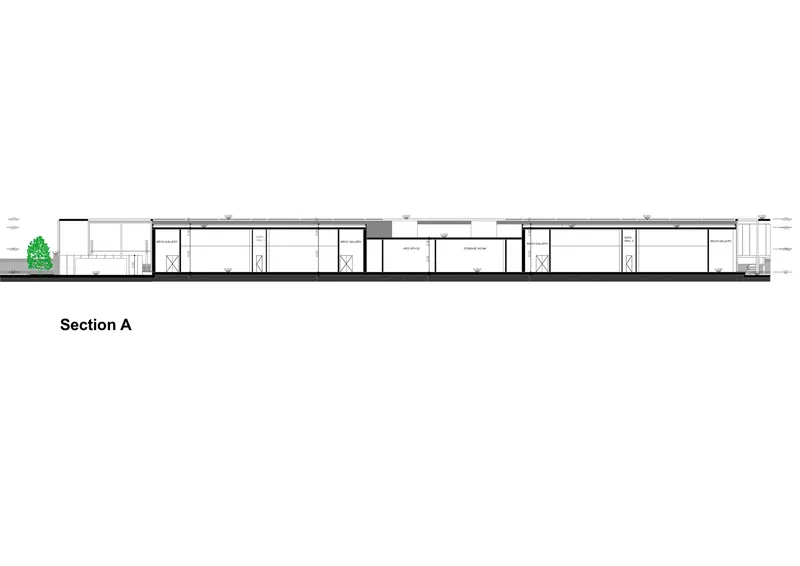


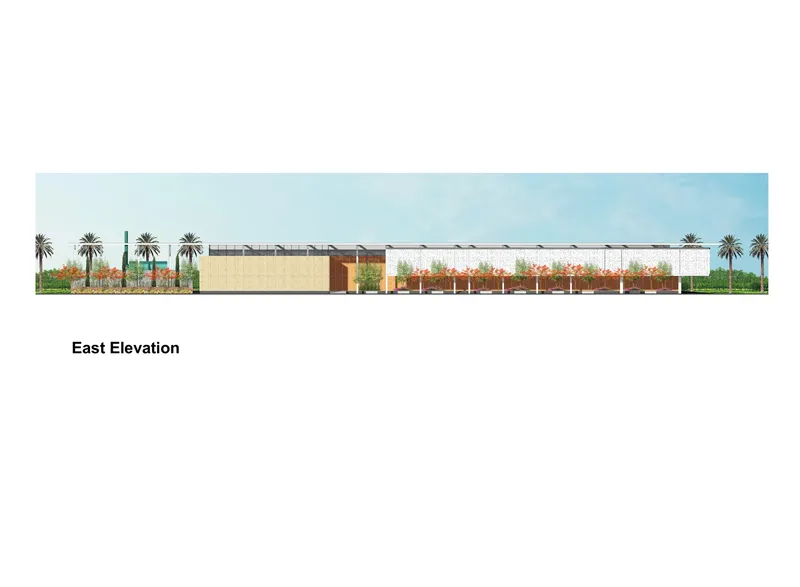

The ground floor plan reveals the four-courtyard organization clearly, with large rectangular server halls occupying the building's east and west wings while offices and support spaces fill the interstices. Parking wraps the perimeter. The upper floor plan shows a shift toward open rooms arranged around a central terrace, confirming the vertical differentiation between sealed technical floors and more habitable upper levels.
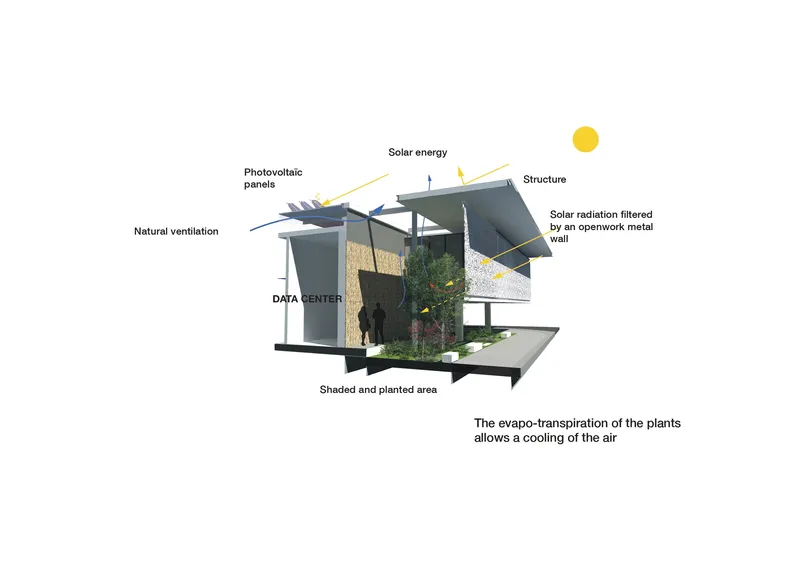
The sections are especially revealing. The construction detail section shows the wall assembly in full: the gap between cladding panels and structural wall, the insulation layer within, and the double roof above. The exploded axonometric diagram catalogues the building's integrated systems: photovoltaic panels on the upper canopy, ventilation louvers at key junctions, and planted beds embedded into the roof terraces. It is a concise inventory of passive and active strategies working in concert.
Why This Project Matters
The global data center boom has produced thousands of buildings that treat architecture as an afterthought, sealed boxes dropped onto cheap land with no regard for climate, context, or public presence. AWM's Benguerir facility is a pointed rebuttal. By deploying the double roof, external insulation voids, gabion thermal mass, courtyard ventilation, and evaporative cooling from reflecting pools, the building reduces its mechanical cooling load without compromising the stringent interior conditions its servers require. The fact that it also looks like a considered piece of architecture rather than a logistics warehouse is not incidental; it is the product of the same design logic.
More broadly, the project demonstrates that infrastructure buildings in arid climates do not have to import solutions wholesale from temperate zones. The courtyard plan, the ochre materiality, the shaded circulation routes: these are strategies drawn from Moroccan building traditions, updated and scaled to serve a 5 MW digital facility. That synthesis of local knowledge and global program is what makes the building worth studying, and what makes it a credible model for the next generation of data centers in hot, dry regions.
Data Center Benguerir by AWM Architectes Urbanistes, Ben Guerir, Morocco. 37,383 m². Completed 2019. Photography by Hafid Megouar.
About the Studio
Share Your Own Work on uni.xyz
If projects like this are the kind of work you want to make, uni.xyz is a place to publish your own, find collaborators, and enter design competitions.


Popular Articles
Popular articles from the community


Opera by the Sea Estonia: Three Shells Dissolving Architecture into Tallinn's Coastline
A winning opera house proposal replaces monumental form with interconnected shells that blur the boundary between building, park and Baltic Sea.

Extended Shell: Retrofitting Kolkata's Balconies as Living Urban Thresholds
A modular retrofit system recovers the social and environmental intelligence of Kolkata's historic verandas for contemporary Park Street residents.

Tsunami Convergenics: Turning Catastrophic Ocean Forces into Underwater Housing Infrastructure
A speculative underwater settlement off the coast of Onagawa, Japan, treats tsunamis and typhoons as energy sources rather than threats.

Opera on the Sea: Driftwood Logic Shapes a Timber Opera House on Estonia's Coast
Trevor Orgill's opera house translates the entangled drift of floating timber into a civic building where wood, water, and music converge.

Similar Reads
You might also enjoy these articles

Bao Huynh Watercolor Atelier: A Serene Art Retreat in Hội An
Bao Huynh Watercolor Atelier in Hội An blends multifunctional art spaces, sustainable design, local materials, and family-friendly living in a serene environment.

Atelier Macri Concept Store Interior Design by CASE-REAL
Atelier Macri store features a "ko" counter, walnut wood details, cork displays, blending retail, gallery, and seamless customer experiences.

Manuel Vargas Izquierdo Stadium and High-Performance Sports Center: Architectural Excellence in Jalpa de Méndez
The Manuel Vargas Izquierdo Stadium blends sustainable design, inclusive sports facilities, and cultural-inspired architecture, revitalizing Jalpa de Méndez’s public spaces.

KAKR Buluh Awar Hall: Revitalizing Community and Ecology Through Bamboo Architecture
Community built bamboo hall revitalizes Buluh Awar village, empowering youth, restoring ecology, celebrating vernacular craftsmanship through sustainable architecture and culture.


Comments (0)
Please login or sign up to add comments
No comments yet. Be the first to comment!