

Bakyta Architekti Sinks a School and Sports Hall into a Slovak Village Without Disrupting It
In Bernolákovo near Bratislava, a primary school extension buries its mass into the terrain to keep a village skyline intact.


Adding nearly 4,000 square meters of school to a village of family houses is a problem with no polite solution, unless you push most of it underground. That is exactly what Bakyta architekti, led by Róbert Bakyta and Ľubomíra Blašková, have done in Bernolákovo, a commuter settlement on the outskirts of Bratislava. Their extension to an existing primary school comprises two new buildings: a gabled classroom pavilion and a corrugated-metal multipurpose hall. Both are partially immersed into the terrain, trading vertical presence for horizontal generosity. The move frees the southern half of the site for landscape, playground, and courtyard, turning what could have been a crowded campus into a sequence of outdoor rooms.
What makes the project worth studying is the way it negotiates between institutional scale and domestic context. Bernolákovo's civic core, a cluster of library, town hall, and original school, sits among single-family plots where nothing rises above two or three stories. Bakyta architekti respond by keeping the classroom pavilion's profile close to its predecessor: same brizolit plaster, same tile roof, same tripartite window rhythm. The multipurpose hall, by contrast, disappears almost entirely, presenting a translucent mesh facade at ground level and hiding a full basketball court beneath a green roof that doubles as an outdoor play surface. One building is deferential; the other is subversive. Together they make a campus that feels both larger and quieter than it has any right to.
Reading the Village Grain
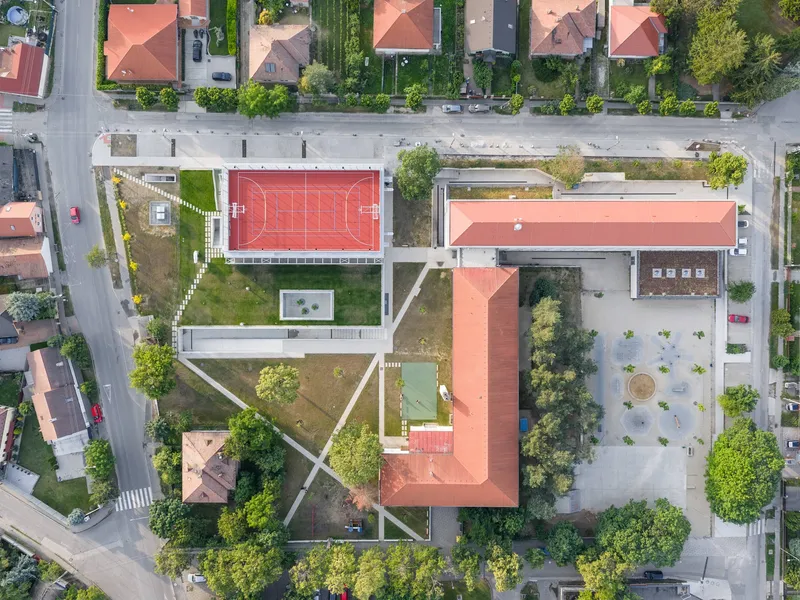
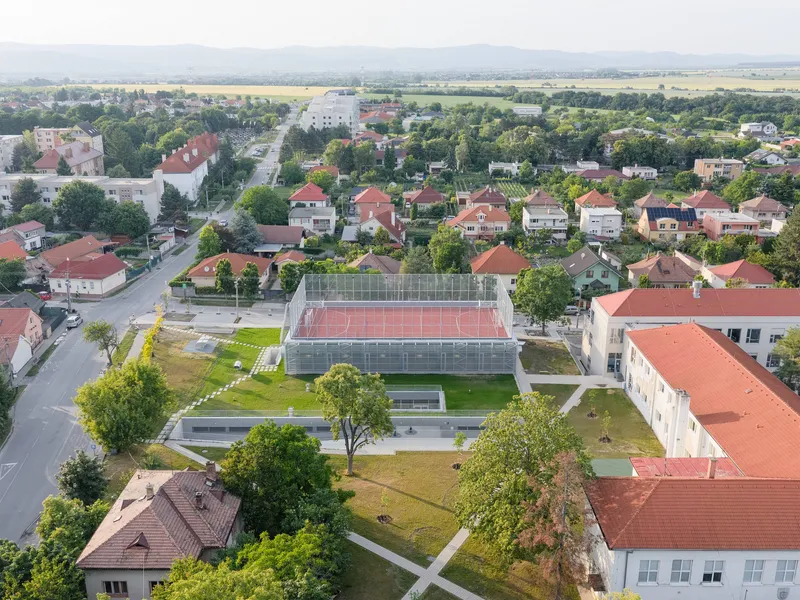
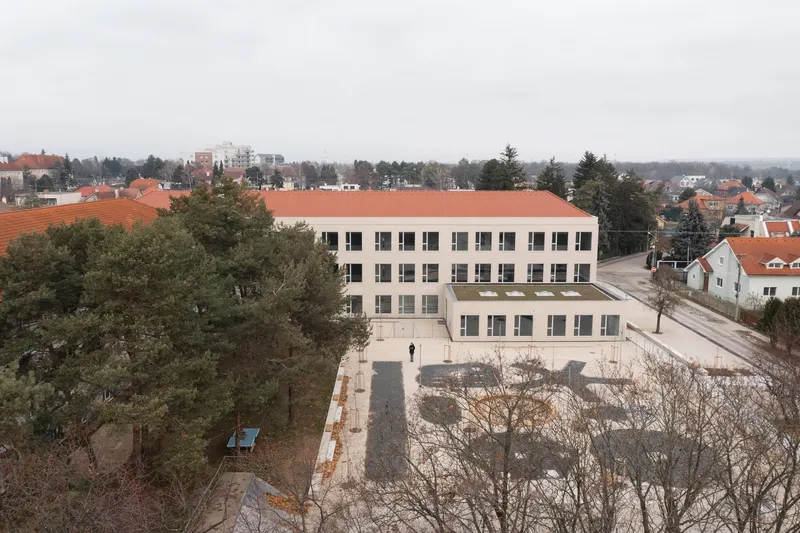
From above, the logic of the composition is legible. The new classroom pavilion extends an L-shape from the original school, defining the edges of a central courtyard while leaving the southern zone open. The multipurpose hall sits on the northern part of the plot, its green roof blending with the surrounding garden canopy. Between the two, diagonal pathways, circular play zones, and young trees create a landscape layer that stitches old and new together. The terracotta roofs of the pavilion align with the village's dominant material palette, making the extension read as a natural growth rather than a bolt-on.
The aerial views also reveal how carefully the buildings are positioned relative to the neighbourhood's fine grain. No elevation overwhelms its neighbours. The sports court, sitting atop the hall, is fenced with wire mesh that dissolves into the sky. Even the parking and service access are absorbed into the terrain manipulation, keeping the perimeter streets calm.
A Facade That Remembers
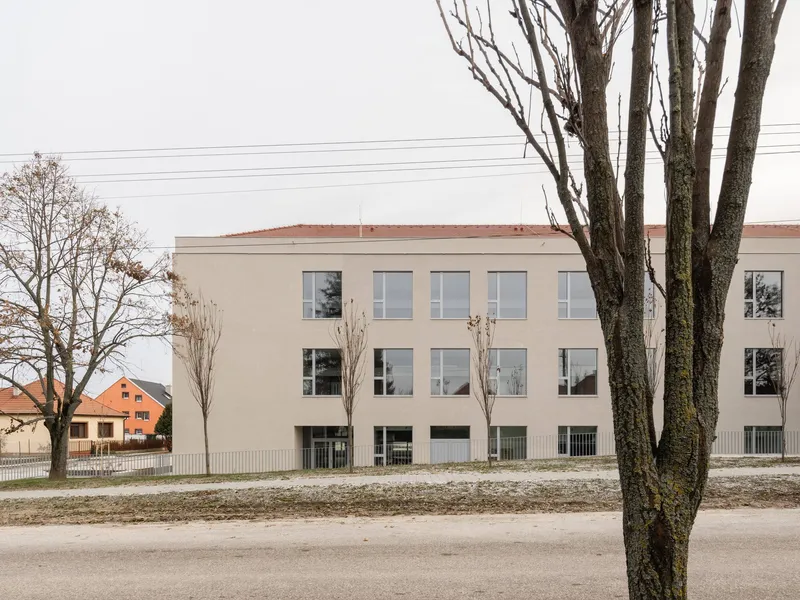

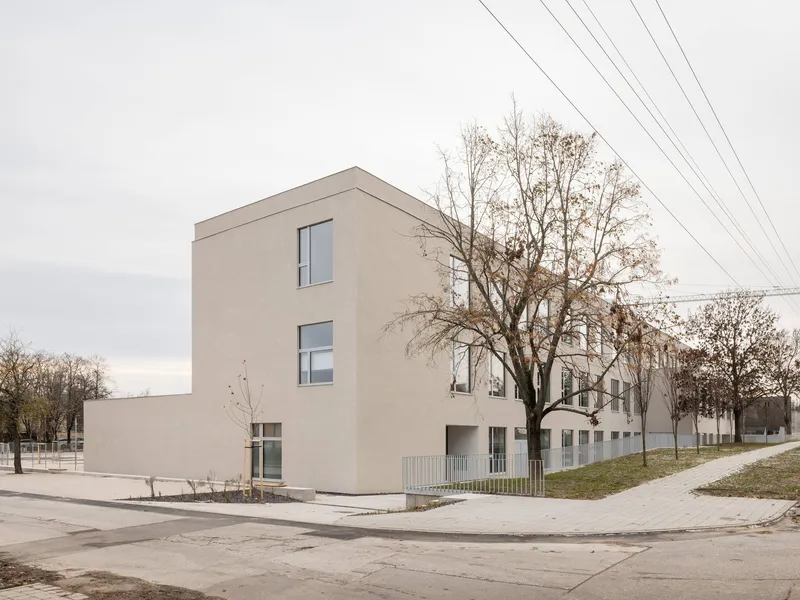
The classroom pavilion's street facade could easily be mistaken for the original school after a generous renovation. Cream-coloured brizolit plaster, a traditional Slovak render applied over mineral wool insulation, covers the walls. Window openings follow a tripartite composition that directly references the older building's formal language. The pitched tile roof completes the allusion. None of this is pastiche; the proportions are subtly different, the detailing crisper, the openings larger. But the intent is clear: the new building wants to belong to the same family.
This is a disciplined choice. In a context where the civic buildings carry the identity of the village centre, breaking away into expressive form would have destabilised the street. Instead, the architects save their formal invention for the multipurpose hall, where the corrugated metal and translucent mesh operate at a scale largely hidden from the main public frontage.
The Corridor as Living Room
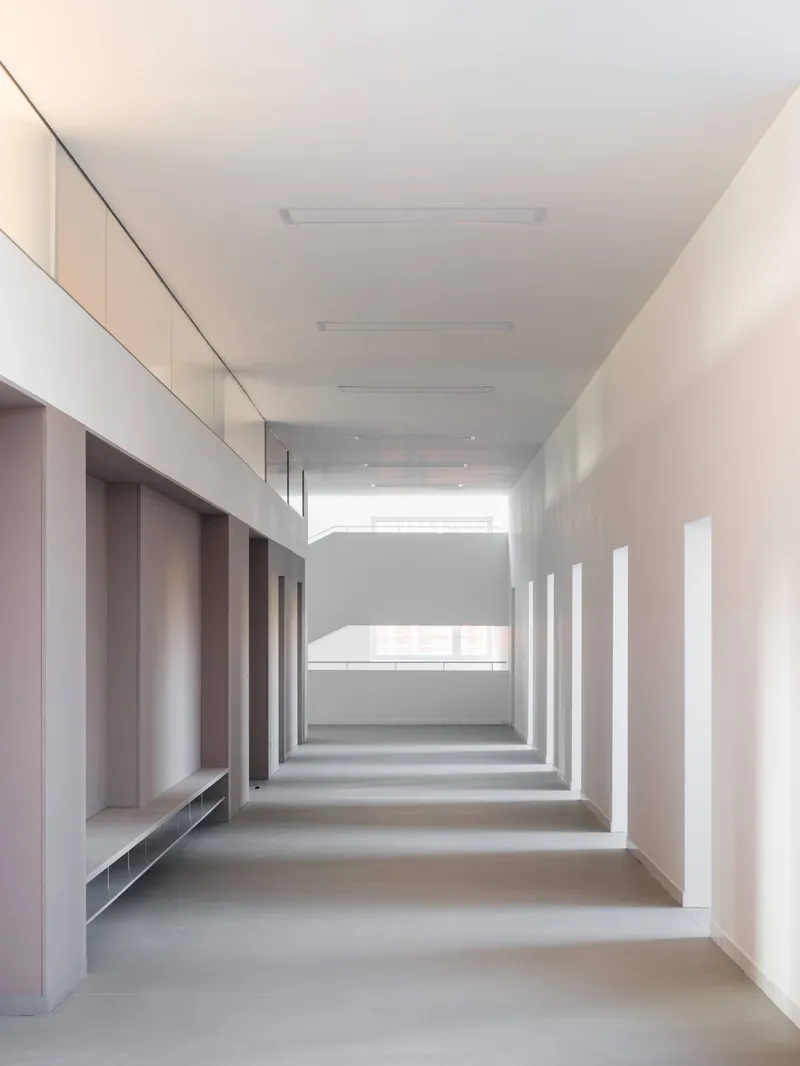
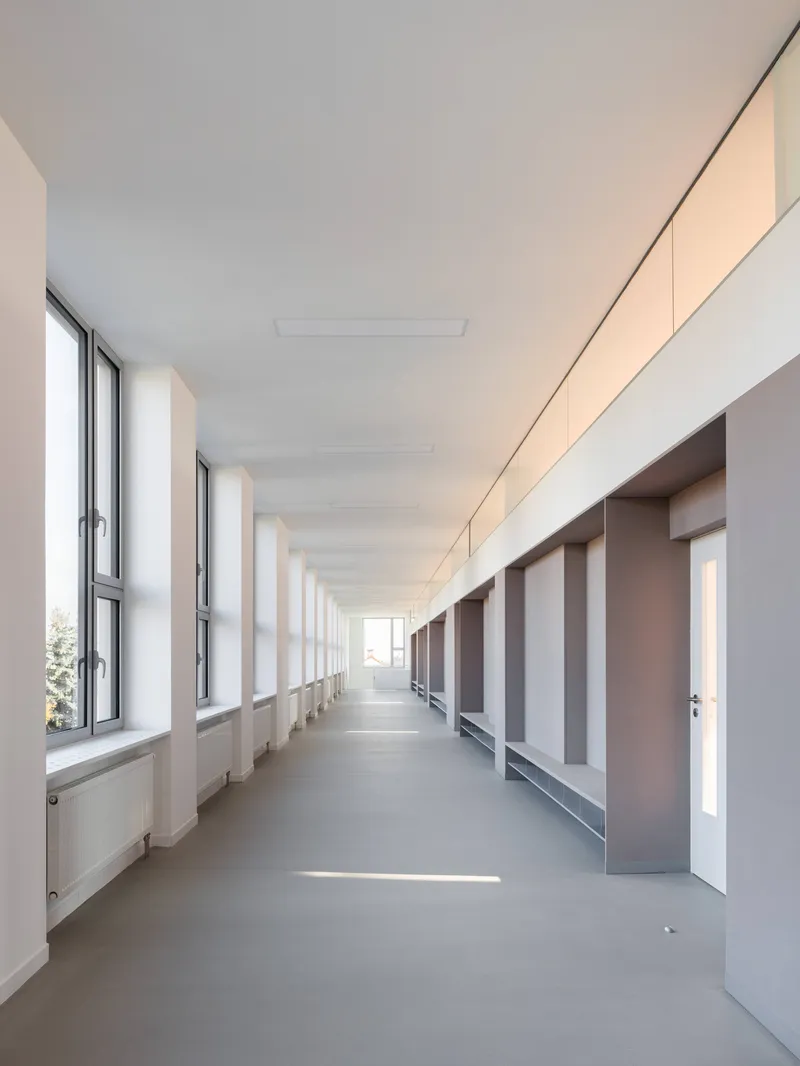
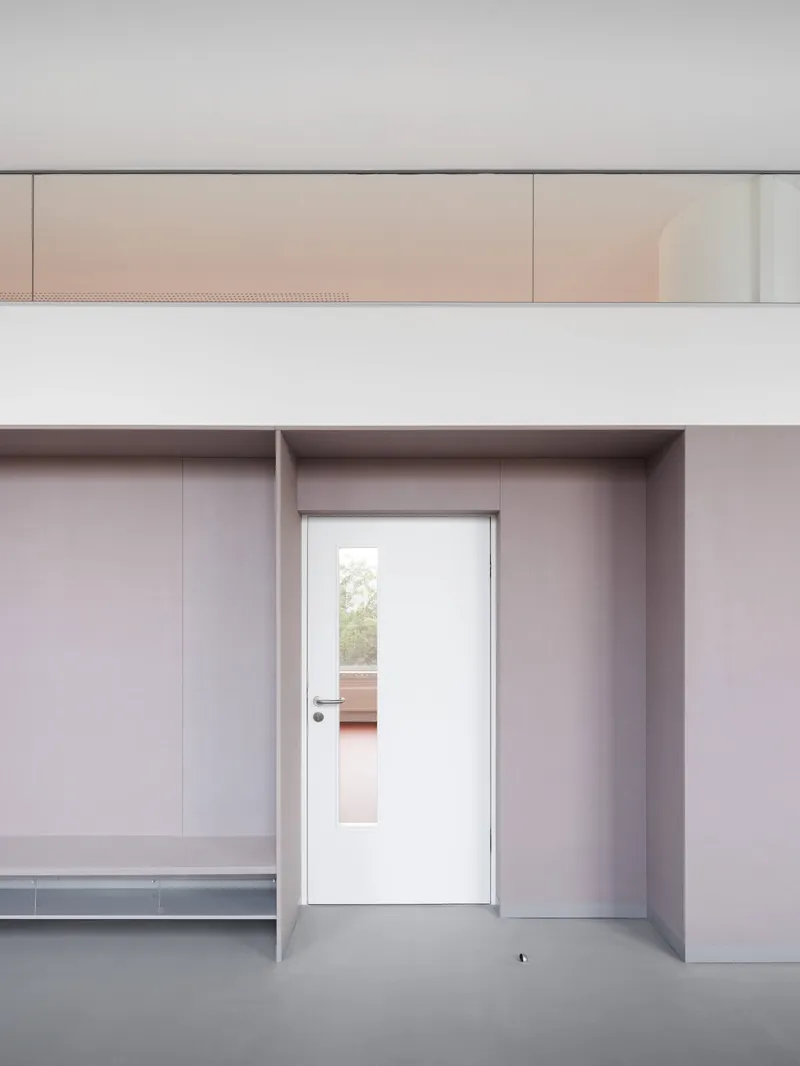
Inside the classroom pavilion, the generous corridor is the real protagonist. Bakyta architekti conceived it not as leftover circulation but as a habitable room for students during breaks. Rhythmic recessed alcoves along one wall accommodate built-in benches and cloakroom storage. Daylight enters from horizontal skylights positioned between the corridor and classrooms, pulling afternoon winter sun deep into the plan. The result is a space with the proportions and light quality of a gallery rather than a hallway.
The threshold details reinforce this reading. Deep grey door surrounds frame each classroom entry, turning what would be a simple swing door into a moment of compression and release. Perforated metal ceiling panels above clerestory glazing add another register of filtered light. You get the sense that the architects spent as much time designing the space between classrooms as they did designing the classrooms themselves.
Classrooms Built for Calm

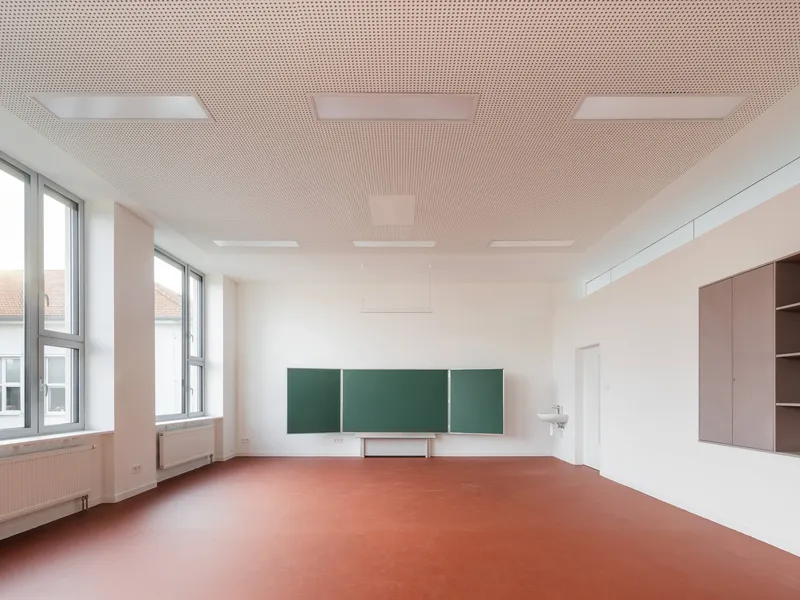
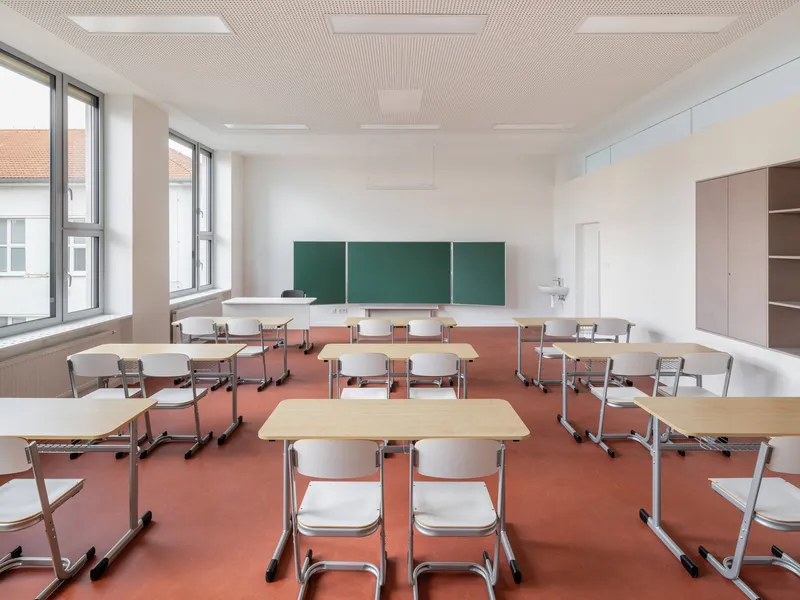
The classrooms are deliberately restrained. Perforated acoustic ceilings absorb noise, terracotta rubber flooring provides warmth underfoot, and green chalkboard panels serve as the only strong colour on otherwise white walls. Built-in storage cabinets in pale wood line the rear, keeping the rooms tidy without relying on ad hoc furniture. Natural light is abundant but controlled, entering from large windows on one side and the corridor skylight on the other.
The material palette, plaster, wood, linoleum, concrete, is modest by design. Nothing here ages badly or demands specialist maintenance. For a public school in a growing commuter village, that kind of pragmatism is arguably more important than any formal gesture.
The Multipurpose Hall: Hidden in Plain Sight

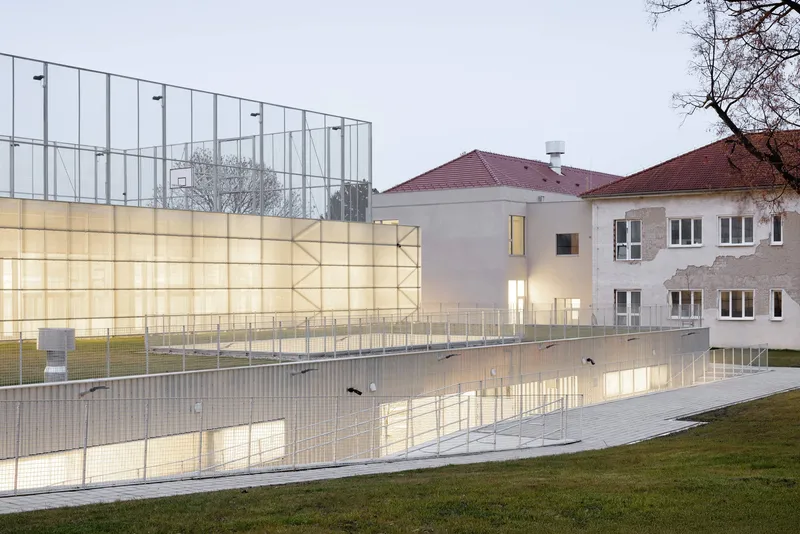
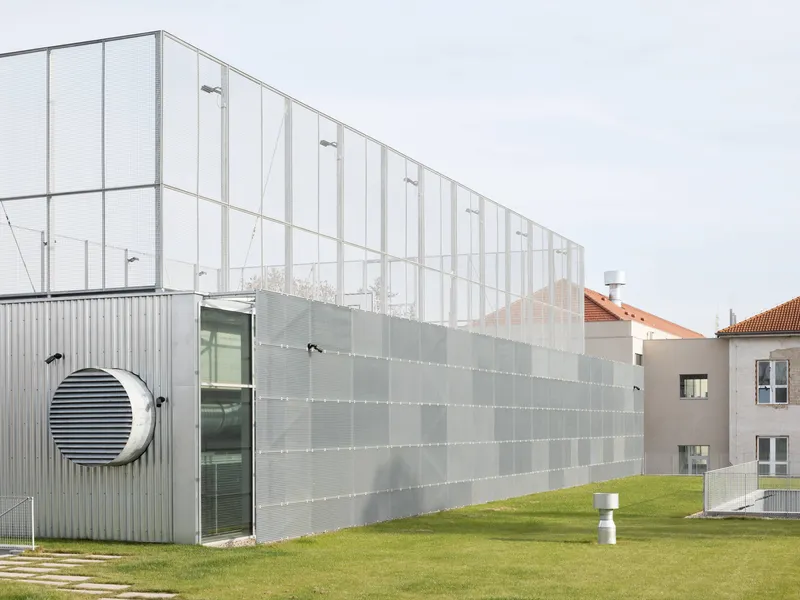
The multipurpose hall is the project's most radical element. Its corrugated metal facade, punctuated by circular openings and wrapped in translucent mesh, looks nothing like the school pavilion. At dusk, the polycarbonate screen glows from within, turning the building into a lantern set against the village's tiled rooftops. By day, the corrugated steel recedes into a neutral industrial tone. The circular windows add a playful counterpoint, hinting at the gymnasium inside without revealing it outright.
The real trick, however, is below grade. Prestressed concrete beams span the hall, engineered to support the weight of a rooftop playground and basketball court. An underground corridor connects the hall to the school pavilions, maintaining ground-level permeability so that the landscape flows uninterrupted across the site. The building literally gets out of the way, trading above-ground volume for below-ground ingenuity.
Inside the Hall

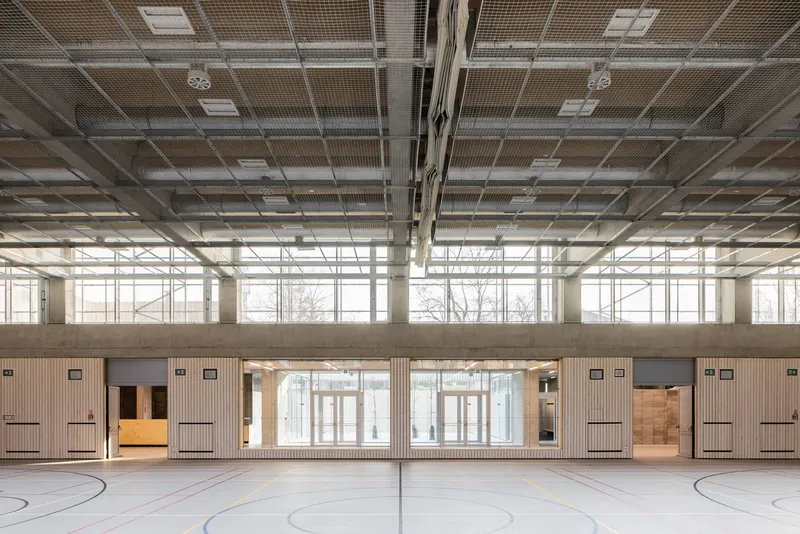

Step inside and the scale opens up dramatically. The sports hall is a full-size basketball court, enclosed by vertical timber wall panels and lit through clerestory windows that run along the upper perimeter. An exposed metal grid ceiling reveals the structural depth of the prestressed beams above, lending the interior a warehouse directness. Timber cladding warms the acoustic environment and softens the visual impact of what is essentially a large concrete box.
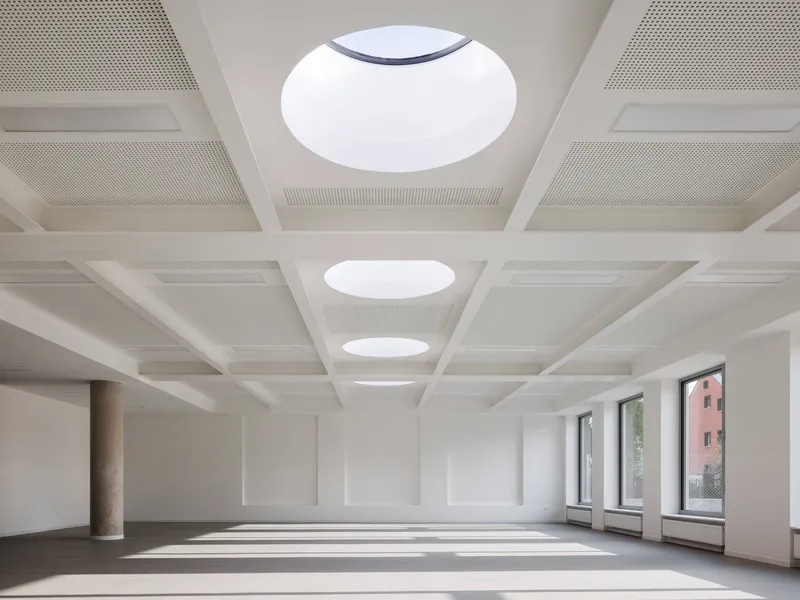
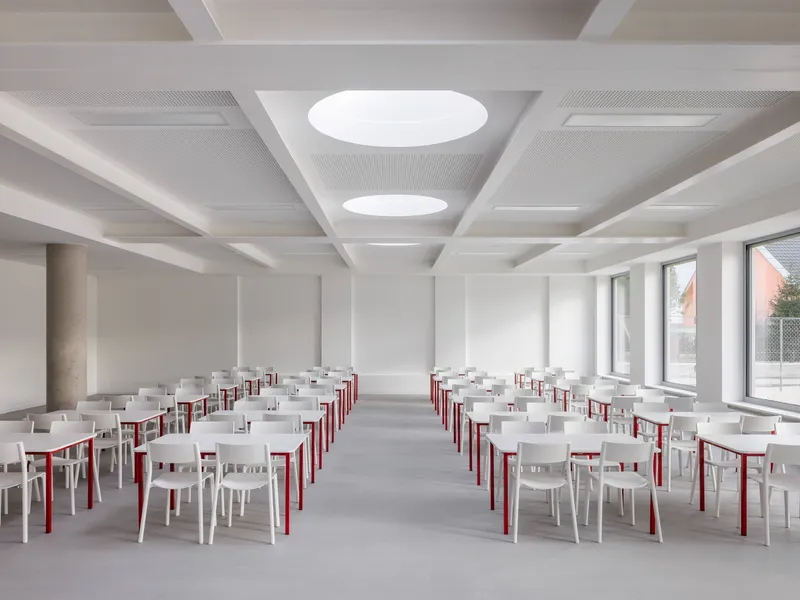
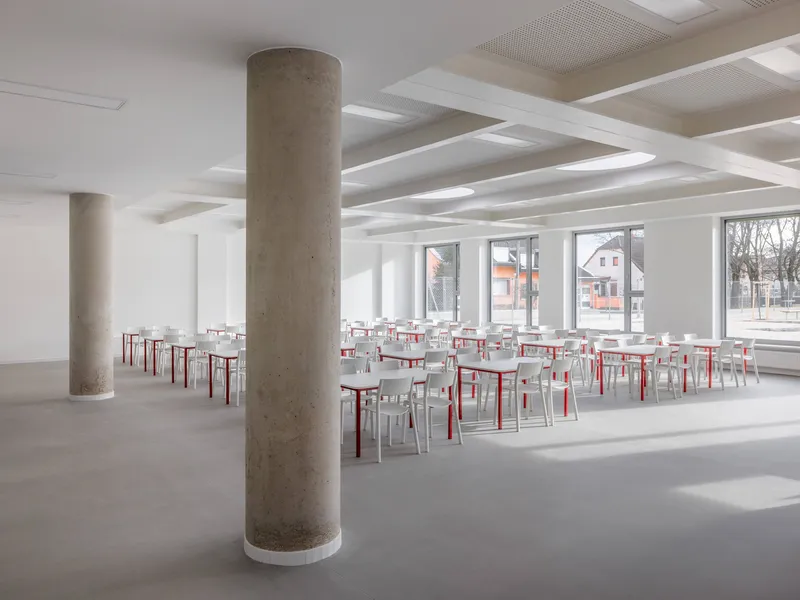
Adjacent to the gymnasium, the dining hall occupies a coffered ceiling volume with circular skylights that cast sharp sun patterns across the floor. Cylindrical concrete columns march through the space, their white bases grounding an otherwise floating canopy. Red and white chairs provide the only colour. It is a canteen that feels more like a civic hall, a quality that matters when this room will likely serve as the village's primary assembly space for decades.
Courtyard, Rooftop, and the Space Between
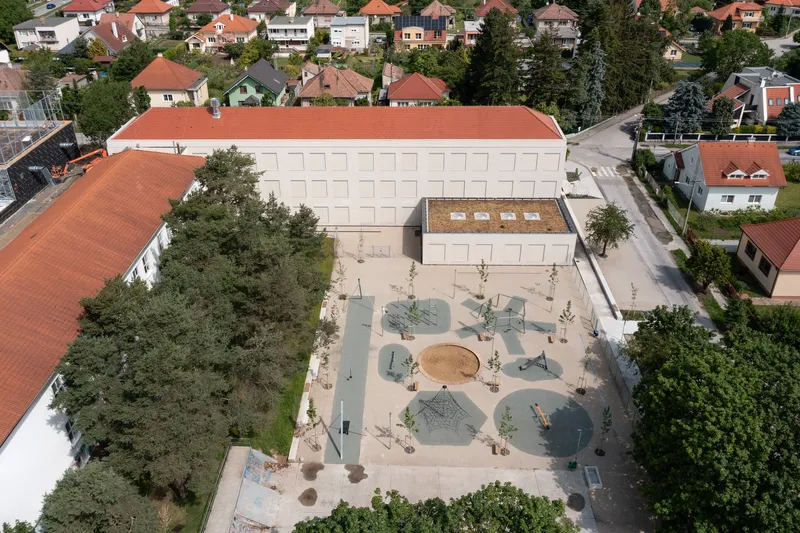
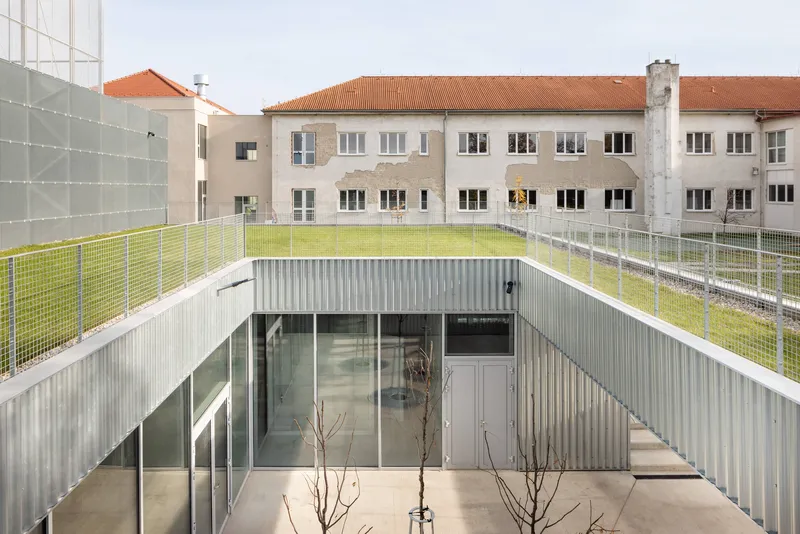
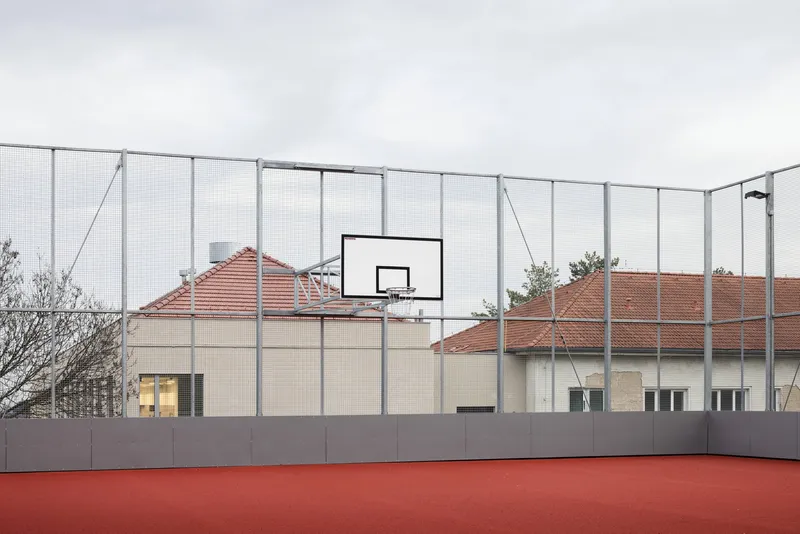
The L-shaped composition of old and new buildings creates a central courtyard fitted with circular play zones, benches, and young trees. It functions as an outdoor extension of the corridor: a break-time landscape visible from most classrooms. On the other side of the campus, the green roof of the multipurpose hall transitions into a red-surfaced rooftop sports court, fenced but open to the sky. These are not leftover spaces; they are programmed outdoor rooms that double the school's usable territory.
The decision to collect rainwater to irrigate the green roof closes a small ecological loop, but the larger environmental move is simply the terrain strategy itself. By sinking the hall into the ground and pulling the pavilion's mass tight against the slope, the architects freed up substantially more green area on the south-facing side than a conventional footprint would allow. Passive design here is not a checklist; it is embedded in the section.
Plans and Drawings

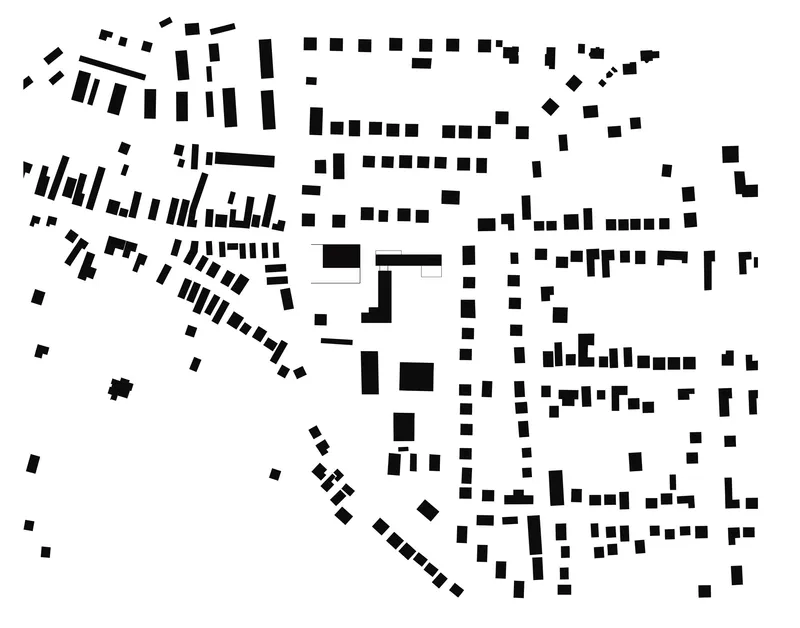
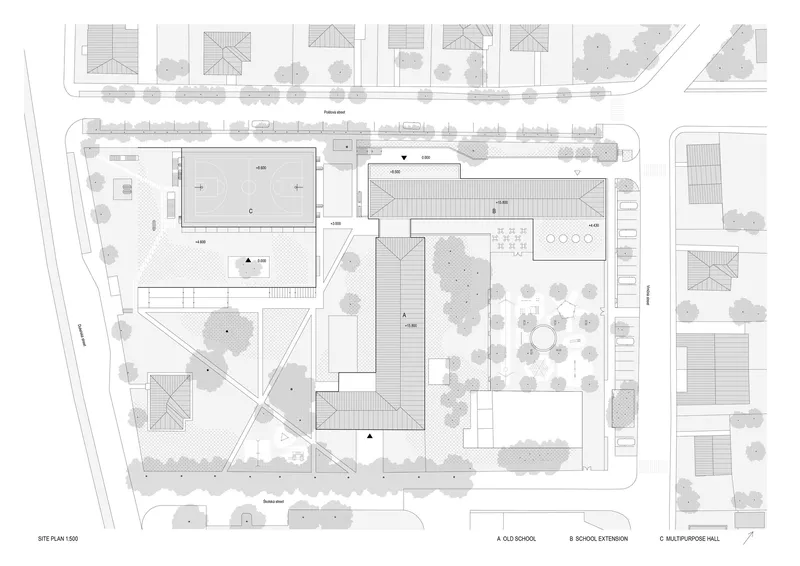


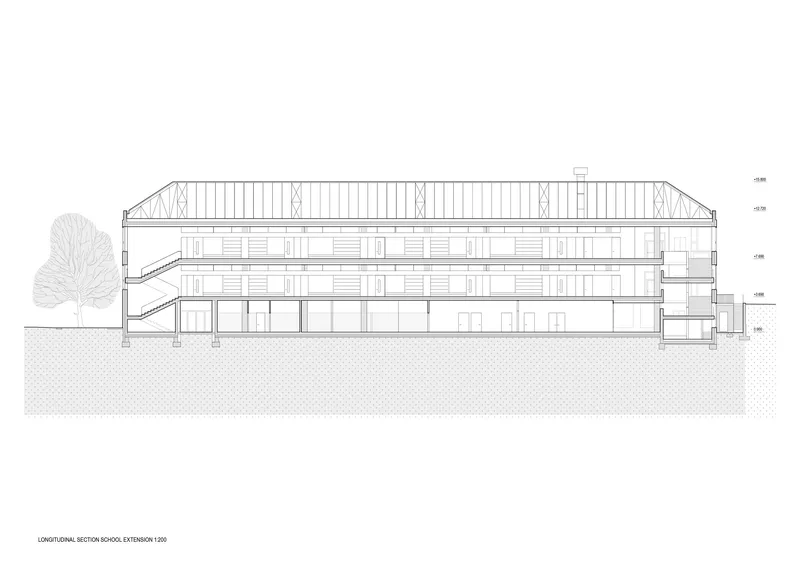
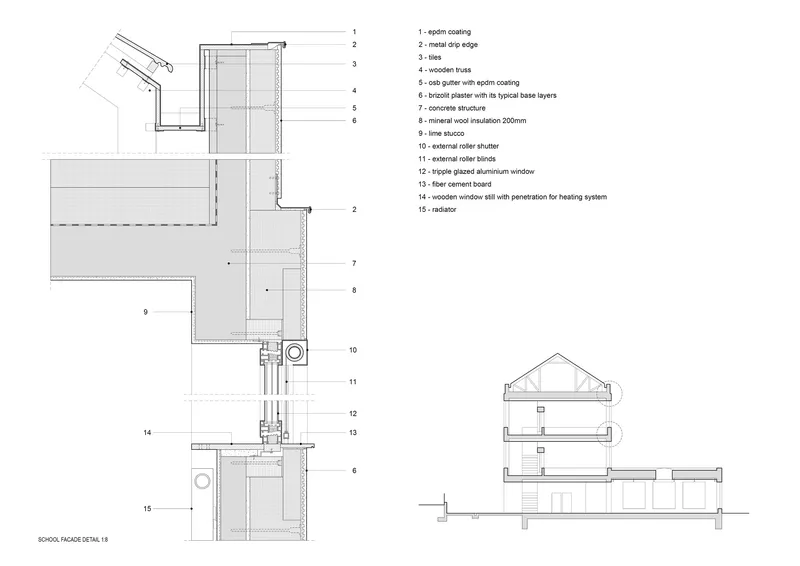

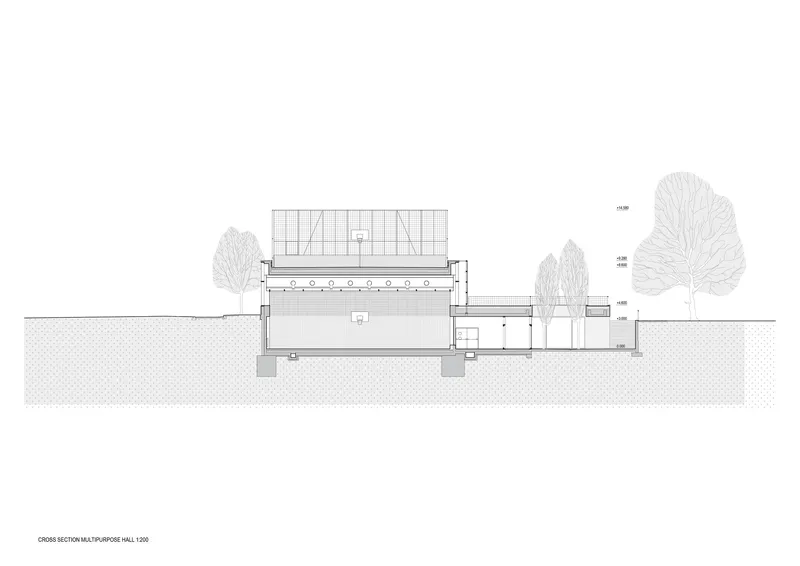
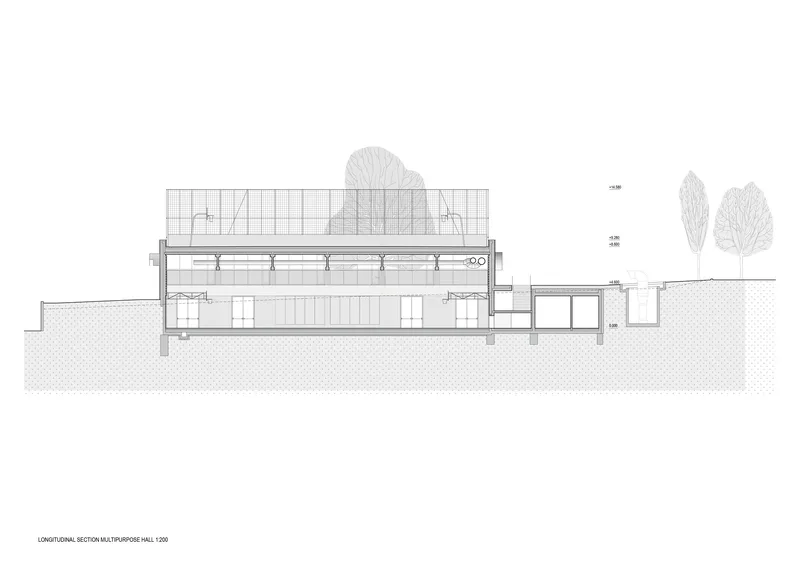


The axonometric drawing makes the three-volume campus composition immediately legible: the existing school, the new classroom pavilion, and the sunken multipurpose hall, each holding a distinct position around shared landscape. Floor plans show how the L-shaped pavilion wraps five classrooms per level around a generous corridor, with the linear bar narrowing as it rises. The hall plans reveal the full basketball court flanked by service rooms and the underground connection back to the school. Sections are perhaps the most telling documents: they expose the depth of terrain immersion and the prestressed beam structure that enables the rooftop playground. Facade details show the layered wall assemblies, brizolit plaster over mineral wool for the pavilion, corrugated metal with slatted roof structure for the hall, documenting a project that is as rigorous in construction as it is in concept.
Why This Project Matters
School extensions in small towns rarely receive this level of architectural attention. The default approach is a prefabricated wing bolted onto the existing building, designed to a budget and forgotten within a year. Bakyta architekti have done something categorically different. They treated the brief as an opportunity to rethink the campus as a whole: its relationship to the village, its distribution of indoor and outdoor space, and its material continuity with the buildings that define Bernolákovo's civic centre. The result is an extension that improves the original school rather than merely expanding it.
The terrain strategy is the detail worth carrying forward. By partially burying the largest volume and engineering its roof to carry active program, the architects created a school with nearly twice the expected outdoor area. That is not a formal decision; it is a spatial one with direct consequences for how children use the campus every day. In a profession that often prioritises the image of a building over the territory it creates, this project is a quiet corrective.
Extension of a Primary School: New School Pavilion and Multipurpose Hall by Bakyta architekti (Róbert Bakyta, Ľubomíra Blašková). Bernolákovo, Slovakia. 3,986 m². Completed 2024. Photography by Matej Hakár.
About the Studio
Share Your Own Work on uni.xyz
If projects like this are the kind of work you want to make, uni.xyz is a place to publish your own, find collaborators, and enter design competitions.


Popular Articles
Popular articles from the community

Extended Shell: Retrofitting Kolkata's Balconies as Living Urban Thresholds
A modular retrofit system recovers the social and environmental intelligence of Kolkata's historic verandas for contemporary Park Street residents.

Tsunami Convergenics: Turning Catastrophic Ocean Forces into Underwater Housing Infrastructure
A speculative underwater settlement off the coast of Onagawa, Japan, treats tsunamis and typhoons as energy sources rather than threats.

Opera on the Sea: Driftwood Logic Shapes a Timber Opera House on Estonia's Coast
Trevor Orgill's opera house translates the entangled drift of floating timber into a civic building where wood, water, and music converge.
Manzana Morphosis: Stretching Barcelona's Grid into a Living Landscape for 2050
A radical reworking of the Eixample manzana turns density into a tool for generous public space, vertical ecology, and environmental performance.

Similar Reads
You might also enjoy these articles

Bao Huynh Watercolor Atelier: A Serene Art Retreat in Hội An
Bao Huynh Watercolor Atelier in Hội An blends multifunctional art spaces, sustainable design, local materials, and family-friendly living in a serene environment.

Atelier Macri Concept Store Interior Design by CASE-REAL
Atelier Macri store features a "ko" counter, walnut wood details, cork displays, blending retail, gallery, and seamless customer experiences.

Manuel Vargas Izquierdo Stadium and High-Performance Sports Center: Architectural Excellence in Jalpa de Méndez
The Manuel Vargas Izquierdo Stadium blends sustainable design, inclusive sports facilities, and cultural-inspired architecture, revitalizing Jalpa de Méndez’s public spaces.

KAKR Buluh Awar Hall: Revitalizing Community and Ecology Through Bamboo Architecture
Community built bamboo hall revitalizes Buluh Awar village, empowering youth, restoring ecology, celebrating vernacular craftsmanship through sustainable architecture and culture.

Explore Building Extension Competitions
Discover active competitions in this discipline

Challenge to design a portable theatre

Challenge to design a portable music platform

Challenge to design public laboratory

Challenge to design an open learning module for the elderly
Comments (0)
Please login or sign up to add comments
No comments yet. Be the first to comment!