

Begin Again: Modular Shelters That Fill the Survival Gaps of Cities
Prefabricated units made from recycled waste paper, glass, and steel turn neglected urban corners into dignified sanctuaries for the homeless.


Cities grow upward and outward, yet the spaces they forget tell a more honest story than the ones they celebrate. Between buildings, under overpasses, at the dead ends of service roads: these residual voids are where the homeless are pushed, invisible to the architectural narratives that shape urban identity. Begin Again reframes these gaps not as leftover real estate but as survival voids, and proposes filling them with prefabricated modular shelters built from recycled waste paper, glass, and stainless steel.
Designed by LiangLiang Xian, 马志豪, 王佳朋, and 赵晓晨, the project sits at the intersection of humanitarian need and sustainable construction. Each unit is detachable, lightweight, and designed for rapid assembly in neglected urban corners. Solar panels generate clean energy for heating and lighting, insulated flooring and double glazing conserve warmth, and a "warm box" holds donated clothes and books, connecting social care infrastructure to the physical form of the shelter itself.
A Timber Pavilion on the Roadside
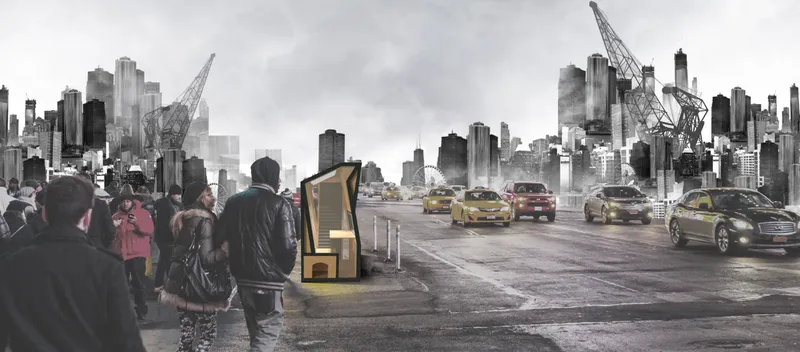
The rendering shows a compact shelter stationed along a waterfront roadway, pedestrians walking past, cars flowing by. What strikes immediately is the scale: this is not a monumental intervention. It is small, almost casual in its placement, yet its presence signals a different kind of civic intent. The shelter reads as street furniture upgraded to the status of architecture, a warm, enclosed volume dropped precisely into the kind of gap that planners typically overlook. Its modest footprint is the whole point. Begin Again does not ask cities to allocate prime land; it asks them to look at the land they already ignore.
Factory Prefabrication as Social Infrastructure

The interior workshop photograph reveals the production logic behind the modules: factory prefabrication using recycled materials, with fabrication tables laid out under exposed ceiling ducts and white columns. All components are manufactured off-site for modular assembly, meaning the shelters arrive at their urban destinations nearly complete. This is not a construction site dropped into a neighborhood; it is a logistics operation calibrated for minimal disruption.
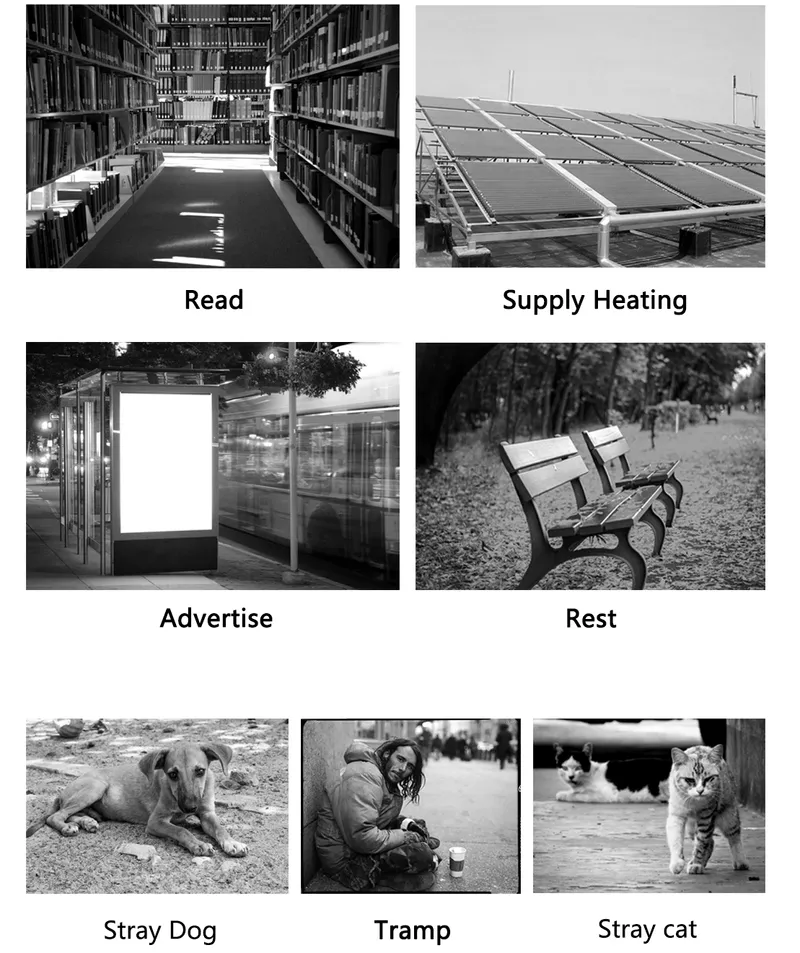
The accompanying diagram maps the programme across a range of typologies: library stacks, solar panels, transit shelters, park benches, and street furniture, all oriented toward vulnerable populations. The design team envisions a four-step process. First, factory prefabrication. Then, identification of functions and users, focused on the homeless, stray animals, and those without shelter. Next, on-site assembly in urban gaps. Finally, a social support layer where local communities and governments contribute through donations, clothing drives, and awareness campaigns. Architecture here is not a finished object; it is the trigger for a care system.
From Collaboration to Rooftop Installation

The process diagram traces the project from design collaboration through module fabrication to rooftop installation of urban furniture units. What it makes clear is the ambition of scale: Begin Again is not a one-off shelter but a replicable system. Modules can be placed on rooftops, in alleyways, at transit nodes. The diagram also underscores the collaborative dimension. Designers work with fabricators and community partners, positioning architecture as a shared act rather than a top-down imposition. The flexibility of placement, combined with standardized production, means the system could adapt to different cities and climates with relatively minor modifications.
Solar Layers, Heating Elements, and the Logic of Assembly
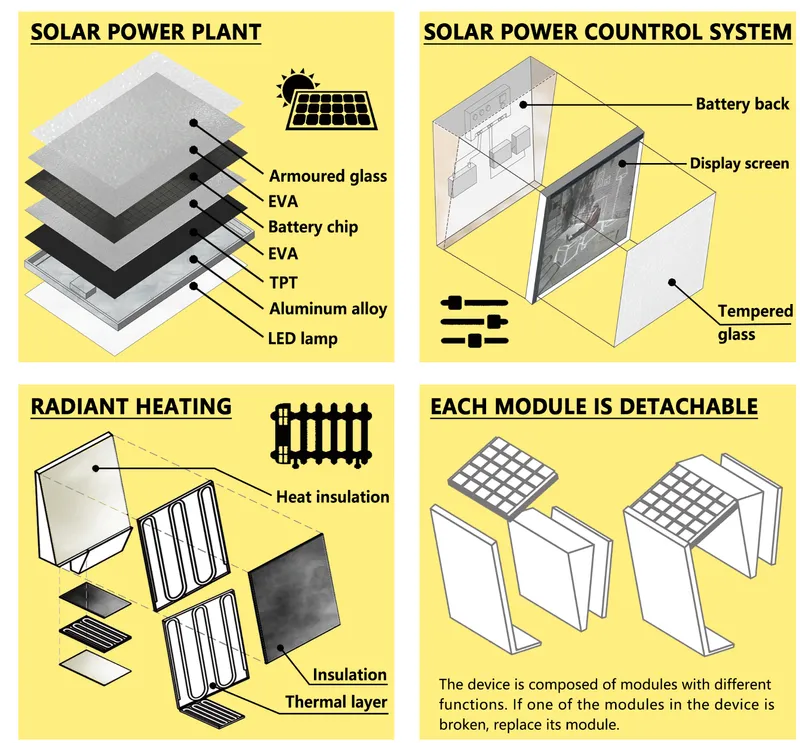
The exploded axonometric drawings lay bare the technical ambition of the modules. Solar panel layers sit atop control system components, which feed radiant heating elements beneath insulated flooring. Double glazing seals the interior envelope. Each layer is legible and, critically, each is replaceable. The detachable nature of the units means that a damaged heating element or a degraded solar panel can be swapped out without dismantling the whole shelter. This is design for maintenance, not just for the photograph, and it reflects a realistic understanding of how infrastructure ages in exposed urban conditions.
The material palette reinforces the sustainability thesis. Recycled waste paper and modular steel frames reduce environmental impact, while renewable energy from the solar systems cuts dependency on external grids. Radiant heating serves not only the human occupants but also stray animals, an unusually generous gesture that expands the definition of who urban architecture should serve.
Why This Project Matters
Begin Again is compelling because it refuses the premise that homelessness is a problem architecture cannot address. It does not promise to solve the systemic causes of displacement, but it does something equally important: it gives form to the idea that every person deserves a warm, safe, and dignified space within the city. The warm box for donated clothes and books is a small detail, but it collapses the distance between charity and design in a way that makes both more legible.
The real contribution here is the replicability of the system. Prefabricated modules, recycled materials, solar energy, and a clear four-step implementation process make Begin Again a framework rather than a singular building. It challenges architects and urban planners to see residual urban space not as waste but as opportunity, and to see vulnerable communities not as invisible but as the most urgent clients a city can have.
View the Full Project
About the Designers
Designers: LiangLiang Xian, 马志豪, 王佳朋, 赵晓晨
Enter a Design Competition on uni.xyz
uni.xyz runs architecture and design competitions year-round that reward proposals with spatial conviction and real site intelligence.
Project credits: Begin Again by LiangLiang Xian, 马志豪, 王佳朋, 赵晓晨.


Popular Articles
Popular articles from the community


Architekt Andreas Gruber Scatters 23 Dark Timber Chalets Across a South Tyrolean Forest Edge
In Molini di Tures, Amonti Chalets breaks a resort into a hamlet of gabled timber houses, with parking, storage and services pushed into the slope.

U.GA Architects Wraps an Oval Rooftop Pool in Curved Board-Formed Concrete on Busan's Jeollidan-gil
In Busan's Jeonpo-dong, a 454 m² mixed-use block stacks a neighborhood facility, guest rooms and an oval rooftop pool inside spiraling concrete walls.

LT2A and OPEN Architectes Thread a Brick and Glass High School Through a Wooded Belgian Campus
In Braine-l'Alleud, a 3,000 m² wing for Collège Cardinal Mercier pairs pale brick with a glazed colonnade, deferring to a small chapel and a dense wood.

GROUP A Strips a 1969 Rotterdam Harbor Headquarters to Its Frame and Wraps It in Timber Louvers
In Rotterdam's M4H harbor district, Ferro Offices reuses a 1969 frame, adds one timber storey and reaches BREEAM-NL Outstanding.

Similar Reads
You might also enjoy these articles


Aquadapt: An Underwater Habitat That Rewrites Its Rooms by the Hour
Curved modules ring the seabed while one shell shifts from breakfast room to cinema, farm and football pitch as residents' needs change.

Play: Fragments of Their World: Remembered Architecture Rebuilt as a Modular Playground for Refugee Camps
Tom Gardner abstracts domes, arches and towers from the homelands of displaced families into a kit of child-scaled play parts for camp settlements.
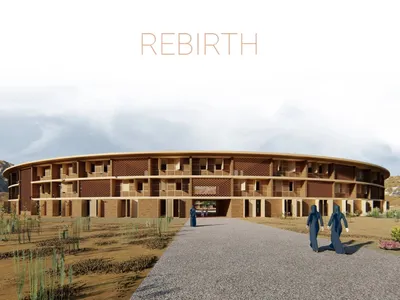
REBIRTH: A Circular Settlement Where Afghan Widows and Their Children Rebuild Life Together
A shortlisted Resile entry turns the circle into a protective ring of timber and brick, gathering homes, classrooms and gardens around a shared landscape.
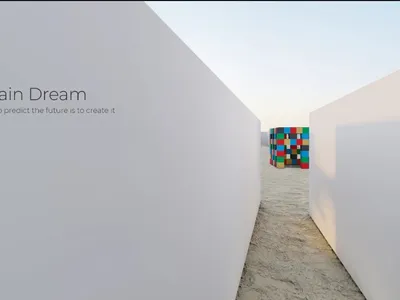
The Main Dream: A Recycled Plastic Kit That Lets Refugee Children Build Their Own Playground
Thirty-centimetre interlocking cubes that connect on three axes turn play into construction, letting children author the spaces they occupy.

Explore Furniture Design Competitions
Discover active competitions in this discipline

Design challenge to equip cities with modern furniture

Competition to design a workstation for architects

Packaging challenge - Design meets sustainability
Comments (0)
Please login or sign up to add comments
No comments yet. Be the first to comment!