

Redesigning bus stops: Making public transport fun again
Better Bus Stop - Result Story


Public Transport has been a very crucial part of enabling cities for a very long time. They are an inseparable element to any urban environment bringing the ability to scale cities while sustaining the quality of spanning them. There are several urban infrastructures planted across the city that help better use of this system more like a dock. A dock where the complex human population meets this huge network of mass transit means.
The approach to developing them is mostly top-down, because for many reasons - attributed to speed scaling and deployment. And it is true, every bus stop looks the same from a development plan perspective - a dot on a huge urban map. But conversely, every bus stand installed is an opportunity to solve the needs of a locality if we see it bottom-up.
Bus stands now serve a much larger demographic, especially in developing countries. And it is a lifeline for the middle class and migrant population. Its a system that is very old and has changed a lot from what it was in the past, but it still requires a lot of work especially as we see it in comparison to private automobile companies who are ahead by leaps and miles ahead which serves only people who can afford them.
While mobility technology is not the purview of architects, a significant part of the experience happens at these docks. If a bus stand in every locality is differently used, can this new update for public transit recognize this changing need? Can there be a new system of a bus stop design that can accommodate this type of usage that adapts from locality to locality?
The problem looks at the idea that each bus stand when looked at in isolation has a different urban condition they belong in, the number of people that use them, and who create a new pattern.
The challenge is to design a modular bus stand system that can change from locality to locality, that solves one neighborhood of your choice as a pilot of this system. The deliverable for this competition demands a single bus stand only.
The design has to be more like a system of parts, that has permutations and combinations that can adapt to varying needs of the urban intersections that they are placed in.
The jury for the competition consisted of esteemed designers, professionals, and academicians from around the world. The Lead Jurors for the competitions were as follows:
Hans Cool, Lead Architect, cepezed architects, Netherlands
Emilio Vicedo Ortiz, Architect, EVA arquitectura, Spain
Mateja Vehovar, Founding Partner, Vehovar & Jauslin, Switzerland
Stefan Jauslin, Founding Partner, Vehovar & Jauslin, Switzerland

Some of the Best of competition projects are:
Winning Project: The Bus Stop Gallery
By: Mai Tian
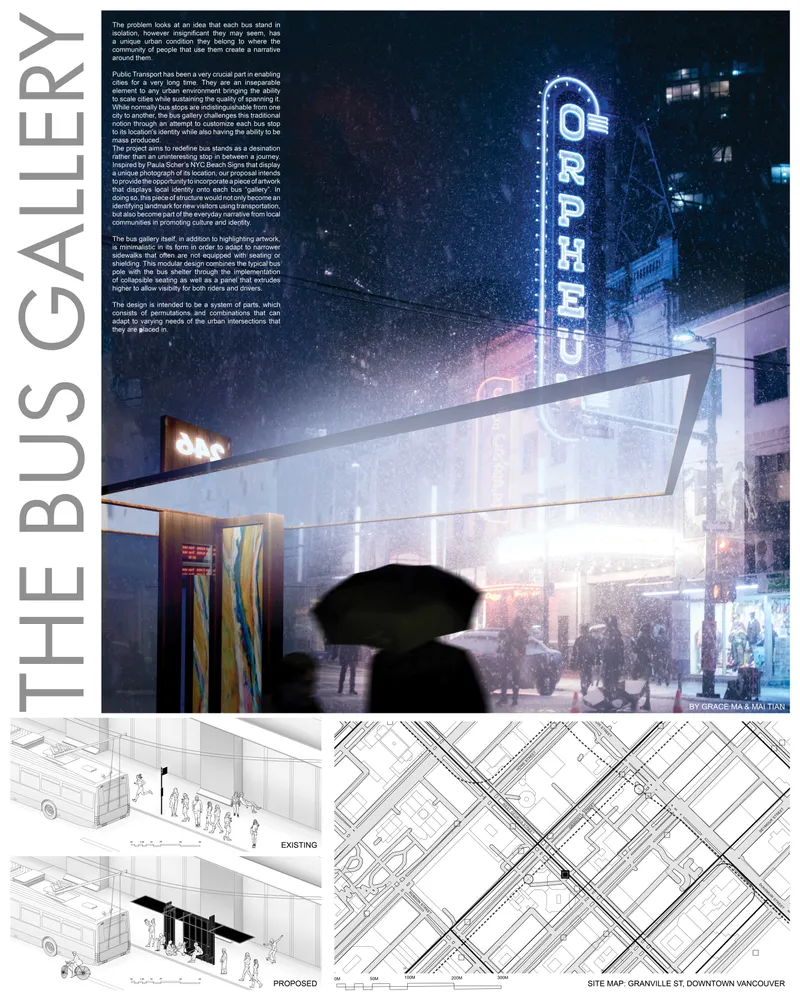
Fig: 1 Site Map and Image
Description: Our proposal intends to provide the opportunity to incorporate artworks that display local identity onto each bus “gallery”. In doing so, this piece of structure would not only become an identifying landmark for new visitors using transportation but also become part of the everyday narrative from local communities in promoting culture and identity.
-----------------
Runner Up: HONG KONG POWER STOPS
By: Henry Endemann

Fig: 2 Cover Image
Description: Small-Scale energy generation for environmental sustainability and economic feasibility. Adaptable modular design for people’s daily needs and visual identity.
--------------------
People’s Choice: ASHRAY- an extension to Public Space
By: Ninad Rewatkar, Aditya Sawalkar, Rushali Rokade & Siddharth Kadam
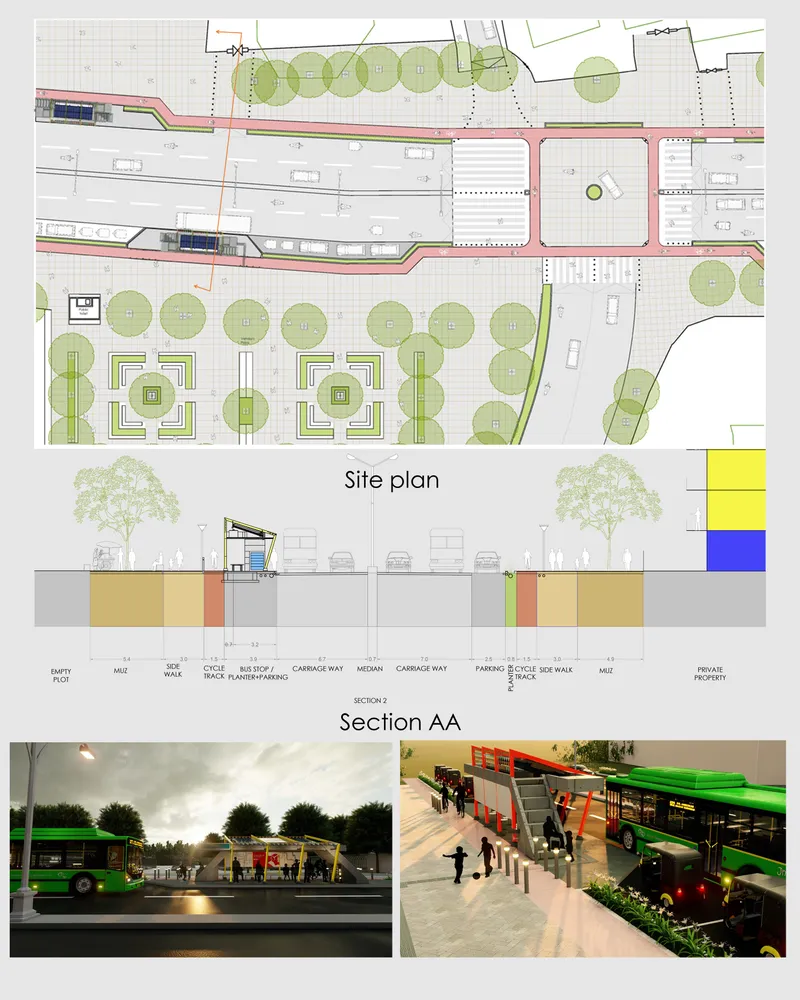
Fig: 3 Site Plan and Section
Description: This is the Bus Stop proposal for the city of Pune in India. This project aims to understand the needs of various local stakeholders of Pashan-Sus Link road adjacent to a Biodiversity park, which impacts heavy ridership by the Local bus service-PMPL. The project also tries to strike a balance between ideas of Sustainability and the Smart City mission in India.
--------------------
People’s Choice: Mud-Ular Bus Stop
By: Sule Kipel, Beyza Oktar, Buket Gürbüz & Gökçe Tekin
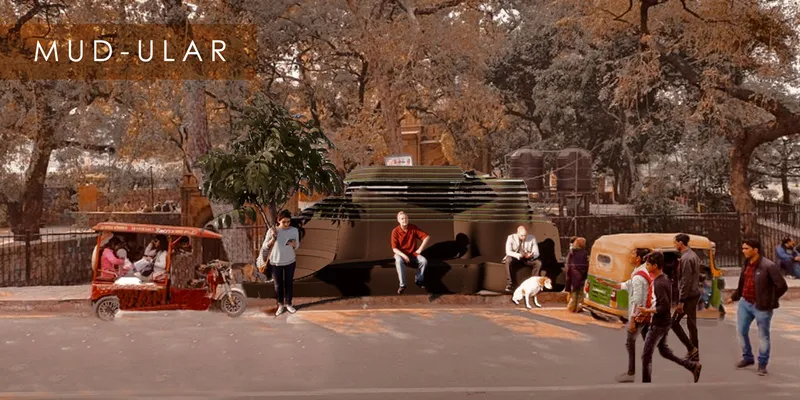
Fig: 4 Cover Image
Description: The concept of this project has a strong relation to the use of sustainable materials in order to promote recycling and a lifestyle that will benefit the clean air that future generations need. The region the project pilot was planned on goes by the name Chandni Chowk in New Delhi, India.
--------------------
Editor’s Choice: BUSTLE
By: Mahir Aritro, Mahbuba Tabassum Mou & Ruhama Rubai
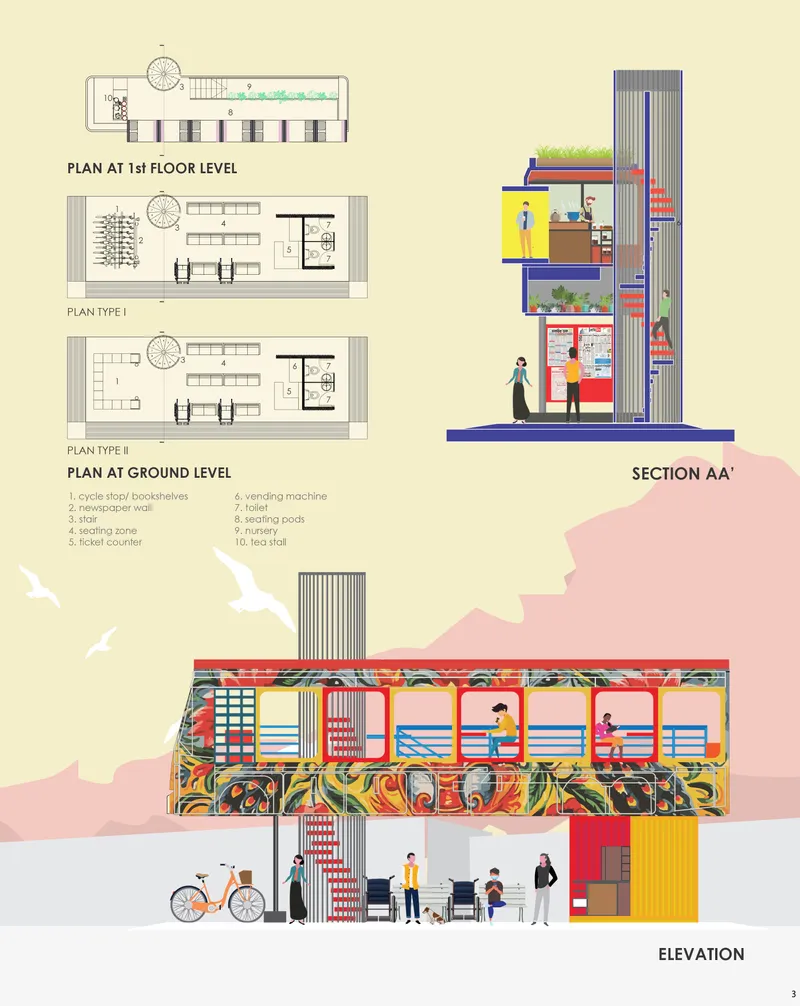
Fig: 5 Plan, Elevation and Section
Description: A bus stop is a designated space, where passengers board and alight from vehicles. The main idea behind the project was to create a system where the need of the locality can be accommodated while installing a stopover for public transit, that stands out amid the hustle and bustle of Dhaka city.
--------------------
Editor’s Choice: Art Station
By: Xiao Lyu & Zhiyu yang
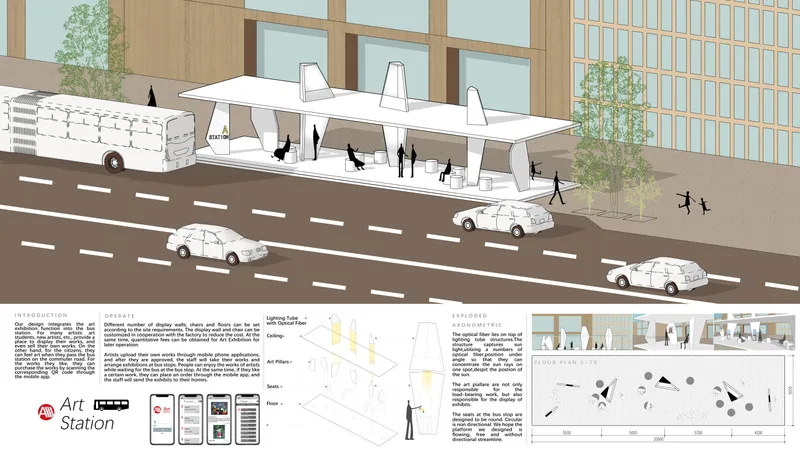
Fig: 6 Cover image
Description: Our design integrates the art exhibition function into the bus station. For many artists: art students, new artists, etc., provide a place to display their works, and even sell their own works. On the other hand, citizens can feel art when they pass the bus station on the commuter road.
--------------------
Editor’s Choice: TIRAVAM
By: Vasanth K S
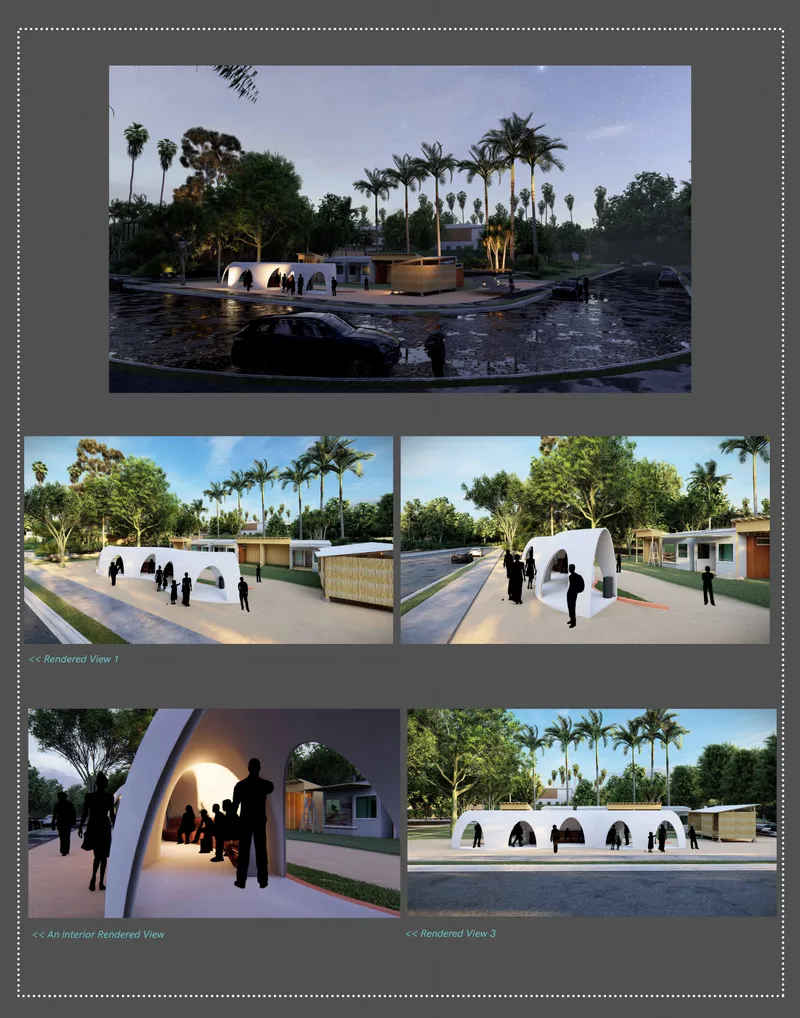
Fig: 7 Rendered Views
Description: The project “ tiravam” is set in the city of Baroda consisting of different types of residential, commercial, and mixed-use neighborhoods. The concept of designing the bus stop stemmed from the base idea of changing the perception of the people about the general ideas of bus stops.
--------------------
Editor’s Choice: Site Frames
By: Qianqin Zhou, Te Li & Qingyun Xu
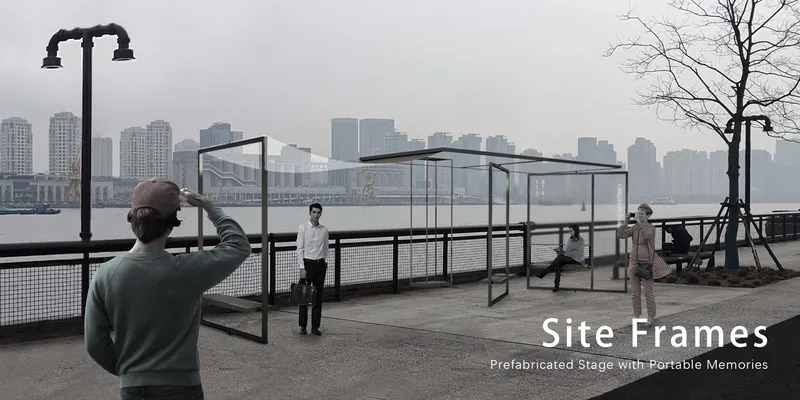
Fig: 8 Cover Image
Description: This prefabricated bus stop revealing the site spirit through customized materials, consists of a transparent frame system and an alternative fabric unit. It can offer spaces with different intimacy by rotating the vertical parts. As a special installation, this mobile bus stop also presents a certain meaning in praxiology and urban landscape ecology.
--------------------
Editor’s Choice: ELEVATED OASIS
By: Philipp Grassl
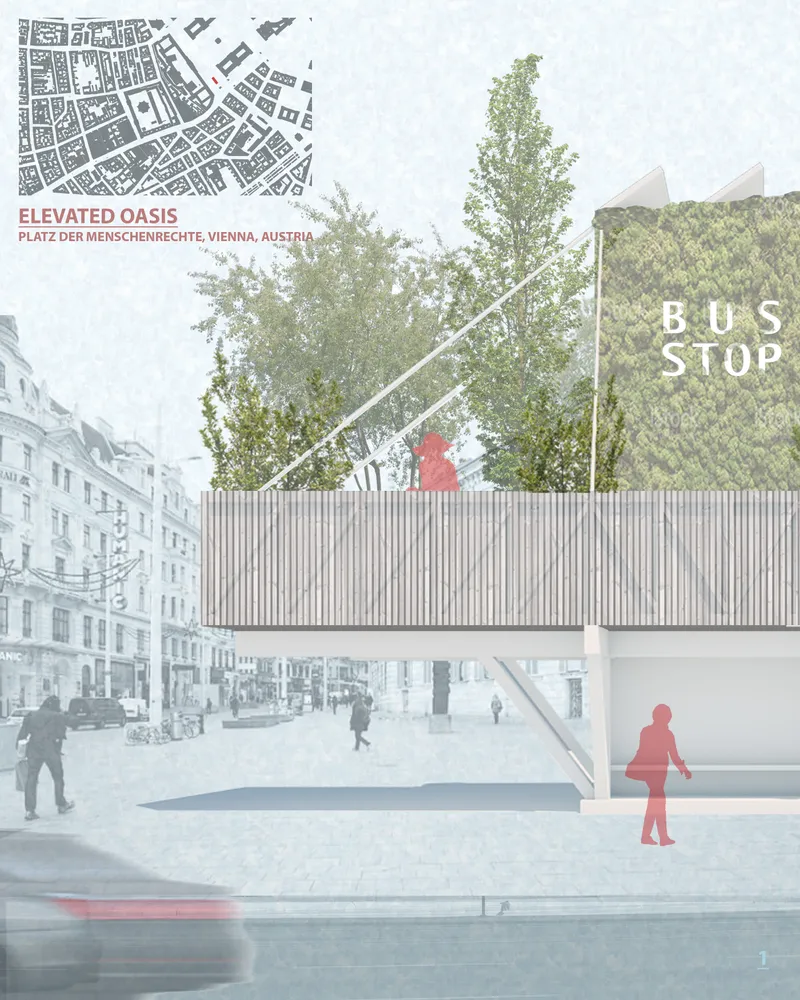
Fig: 9 Cover image
Description: The concept of this better bus stop is to add extra public space in an eco-friendly way. The elevated oasis functions by adding an extra layer of soil above the CLT slab which enables plants to grow.
Furthermore, a green wall uplifts the neighborhood.
--------------------
Editor’s Choice: MBS4E
By: Antonio Cioppa
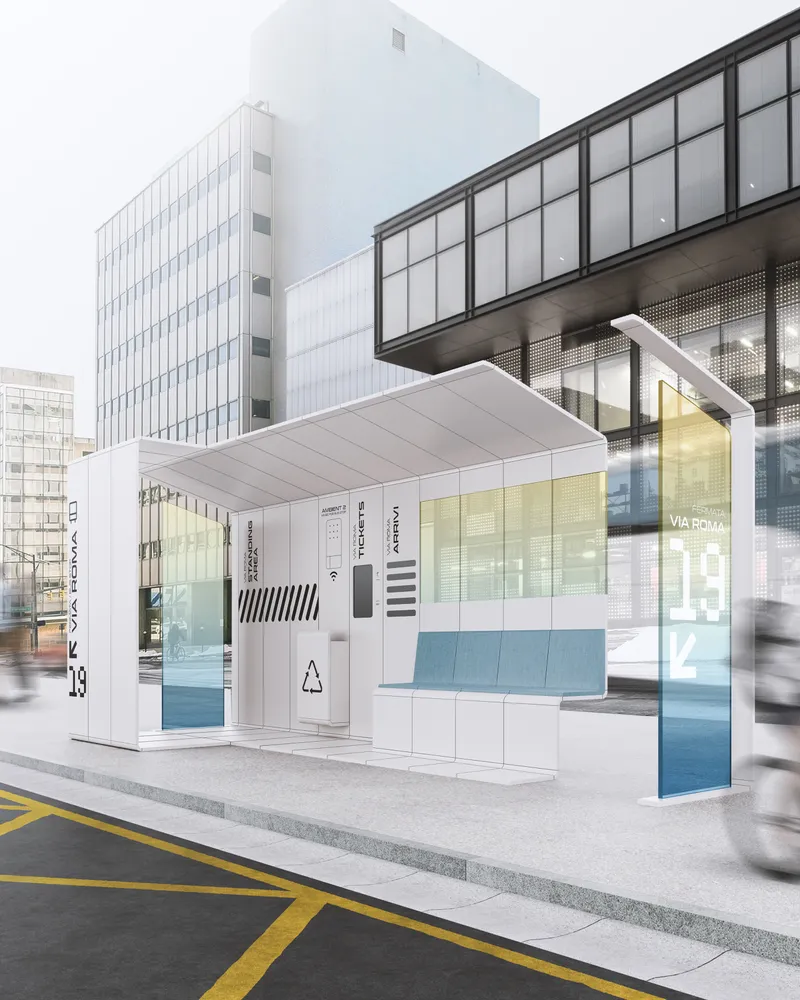
Fig: 10 Cover image
Description: MBS4E is a prototype of a modular bus station composed of 6 different modules, each of which consists of 6 submodules. Every single piece provides a specific service for the user. Assembly can be defined with no rules or can be chosen between 4 pre-assembled solutions that can fill any type of space: small, medium, large and extra-large.
--------------------
Editor’s Choice: UPCYCLING BUS STOP
By: JUN HOI KIM & Hakseong lee

Fig: 11 Cover image
Description: The bus stop to be formed was thought to be a place that could form the personalization of local issues, and I imagined that the behavior here would eventually change back to a local issue.
--------------------
Editor’s Choice: SECTIONS IN MODULES
By: Öykü Emiroğlu, Ekin Meşe & Deniz Şener
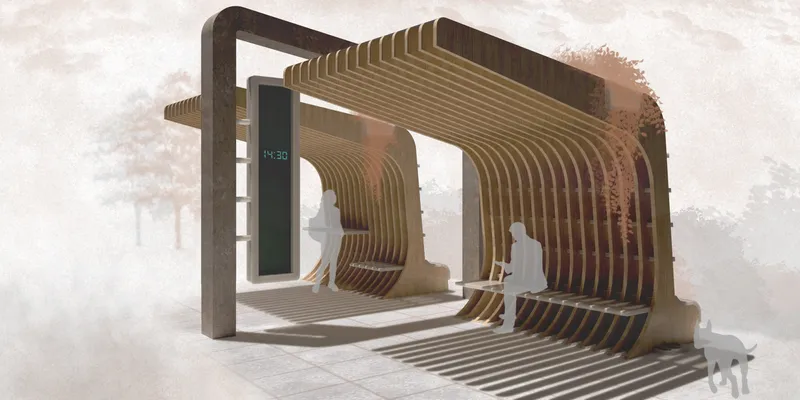
Fig: 12 Cover image
Description: Using sectioning as a design operation to create a modular bus stop.
--------------------
Editor’s Choice: Neon Revival
By: Robert Tang

Fig: 13 Cover image
Description: Bus is an essential means of public transport in Hong Kong. This project combines a fading aesthetic element and the cantilevered nature of buildings in the urban fabric to improve the lack of visibility and functionality of bus stops in urban districts.
--------------------
Editor’s Choice: TRANSPORT GRID
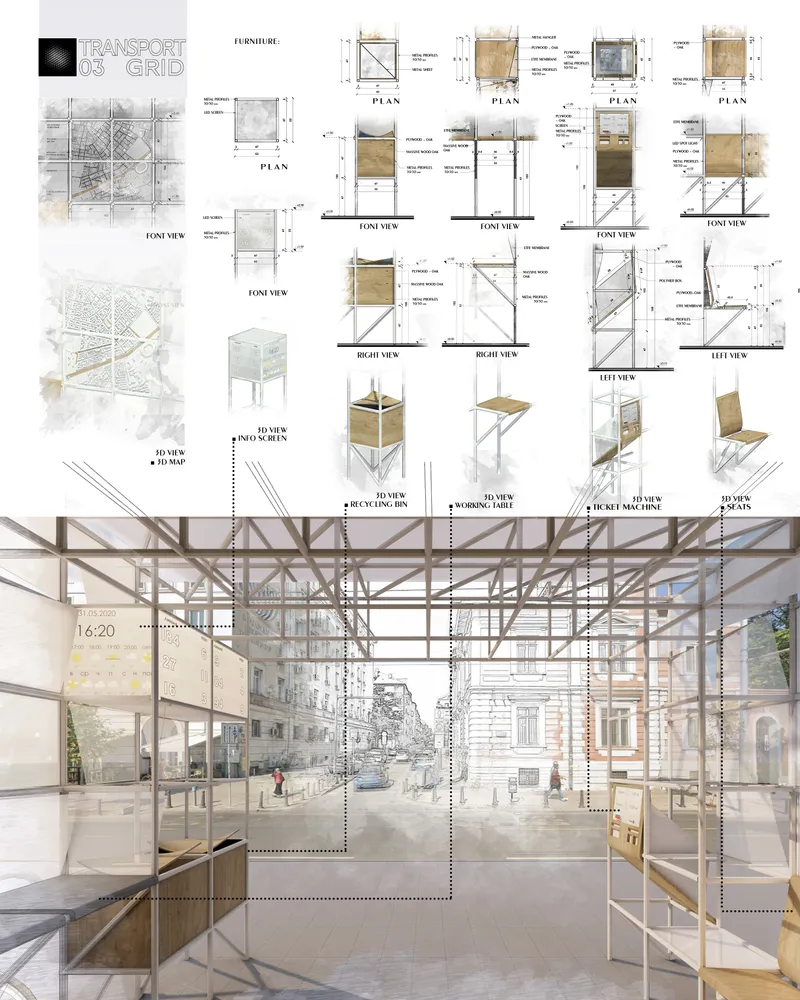
Fig: 14 Plan, View and Map
Description: Transport grid is a modular system for bus stops that aims to fit in the environment by using light, aerial, see-through materials. Reminding more of an art installation, the structure inspires and provokes the imagination of every citizen.
--------------------
Editor’s Choice: COLLECTING MOTION
By: Antoni Bielicki, Emilia Przydryga, Alicja Aydar & Michał Szymański

Fig: 15 Cover image
Description: Nowadays in Poland, public transport works on a schedule, but what will be the future? By “Collecting Motion” we wanted to make a bus stop a never-ending science research spot and a place for collecting information.
Follow us on social media: Facebook | Instagram | LinkedIn | Twitter | Youtube
References (3)




Popular Articles
Popular articles from the community


Co-life: Sustainable Architecture for Age-Friendly Community Living
Co-life reimagines sustainable architecture for seniors through courtyards, rammed earth, shared gardens, and spaces designed for belonging.

The Musturak Paradise: Senior Living Architecture for a Connected Future in Temara, Morocco
The Musturak Paradise reimagines senior living architecture in Temara via private homes, social spaces, culture, community, and shared care.

The Ocean Hive: Sustainable Architecture for a Self-Sufficient Civilization at Sea
The Ocean Hive imagines sustainable architecture at sea, where modular habitats, algae, wave power and ocean waste sustain a growing colony.

Lunar Spiral: Space Architecture Shaped by the Mathematics of the Universe
Lunar Spiral reimagines space architecture through Fibonacci geometry, lunar regolith, levitating habitats, and self-sustaining Moon living.


Similar Reads
You might also enjoy these articles
Lunar Spiral: Space Architecture Shaped by the Mathematics of the Universe
Lunar Spiral reimagines space architecture through Fibonacci geometry, lunar regolith, levitating habitats, and self-sustaining Moon living.
The Main Dream: Modular Architecture for Play, Learning, and Community
A modular playground turns recycled plastic into adaptable spaces where refugee children can play, build, learn, and reconnect.

Play: Fragments of Their World
Familiar architecture becomes modular playground design, creating safe spaces where displaced children can learn, connect, imagine and play.

Wadi Rum Observatory: Desert Architecture Designed for the Night Sky
Wadi Rum Observatory turns desert architecture into a quiet instrument for astronomy, hiding research spaces under Jordan's starlit terrain.

Comments (0)
Please login or sign up to add comments
No comments yet. Be the first to comment!