

BetterTogether: Co-Living in Rotterdam Built Around a Central Courtyard
A narrow townhouse in Rotterdam stacks shared and private zones around a light-filled void, housing seniors, parents, children, and guests as one.


What if the house itself could teach its residents how to live together? In Rotterdam, a narrow townhouse proposal answers that question by organizing domestic life around a vertical courtyard that stitches four floors of shared kitchens, communal play areas, and private sleeping nooks into a single breathing organism. The house is not zoned by function in the conventional sense. It is zoned by degrees of togetherness, from a ground floor kitchen that spills onto the street to compact bedrooms wrapped in timber and translucent rice paper curtains.
Designed by Kiara Helk, BetterTogether received an Honorable Mention in the Nano Nest 2020 competition. The project accommodates up to eight residents: two seniors, two parents, two children, and two guests, all living as a chosen family within a single co-living structure. Set in a city whose culture already prizes openness, shared festivals, and vibrant sidewalk life, the design takes Rotterdam's social fabric and folds it into architecture.
A Narrow Facade That Opens to the Street
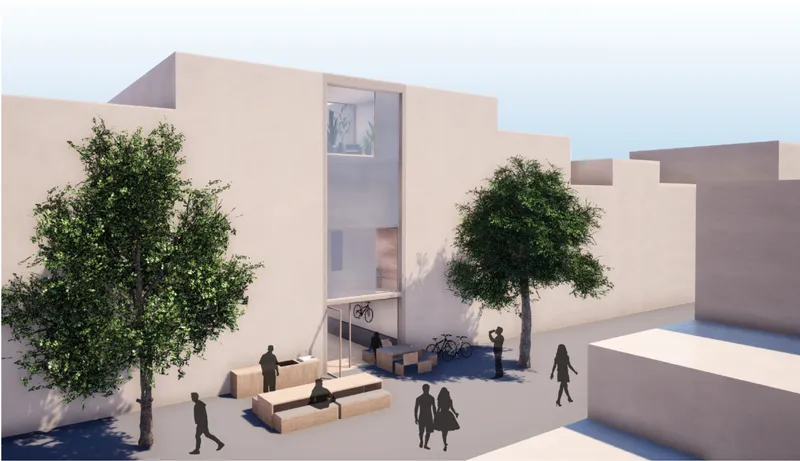
The physical model reveals the project's street presence: a narrow facade slotted between masonry volumes, with vertical glazing that exposes the interior life of the house to passersby beneath trees. This transparency is programmatic, not decorative. The ground floor kitchen can extend into the public realm during summer, turning the threshold between house and city into an active social zone. Pedestrians become potential guests, and the sidewalk becomes an extension of the dining table.
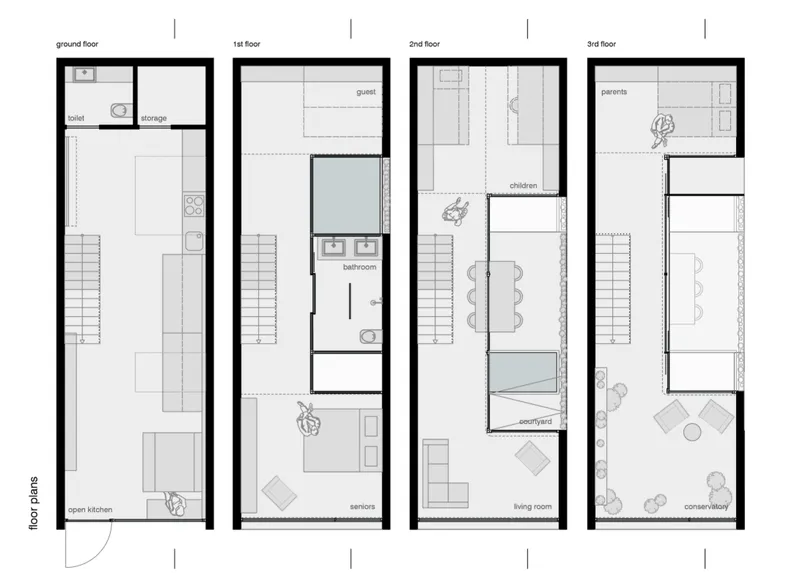
The floor plans across four levels show how the narrow footprint is organized with stair circulation running along one edge, freeing up the remaining width for rooms that shift between private and communal use. Each floor balances quiet areas for seniors with social zones for children and parents, ensuring the house accommodates different daily rhythms without forcing anyone into isolation or constant interaction.
Stacked Floor Plates and the Central Void
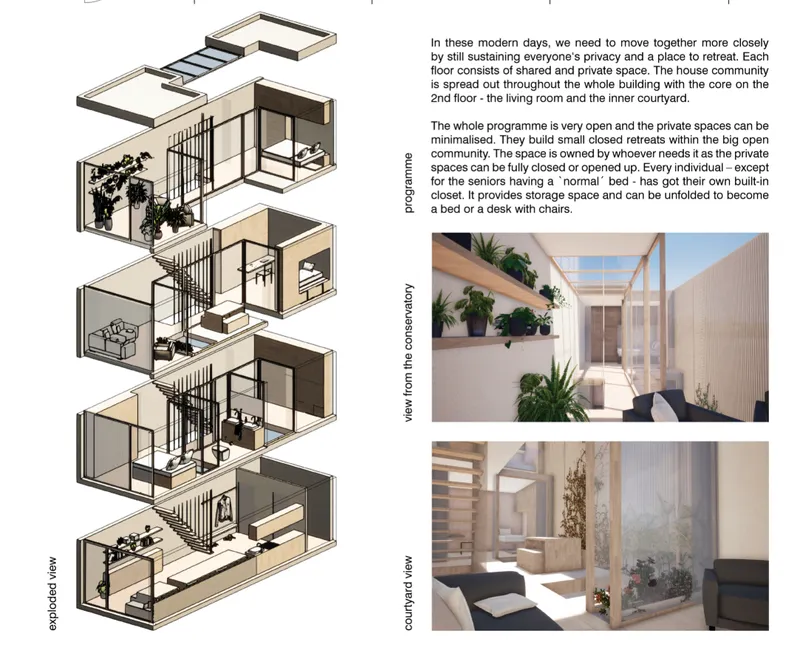
The exploded axonometric drawing is the project's clearest diagram of intent. Four floor plates hover above one another, connected by a central stairwell that doubles as the spatial and emotional core of the house. This vertical courtyard is not merely a light well. It is the mechanism that gives every room visual continuity, natural ventilation, and a sense of belonging to a larger collective volume. Natural light filters through internal voids, creating an airy atmosphere even within a dense urban site.
The strategy is legible: by pulling the circulation and the courtyard into the center, the perimeter walls can be given entirely to living spaces. This is how a narrow townhouse manages to feel generous. The stacking logic also supports the project's intergenerational program, placing quieter uses on upper levels and more public, social functions closer to the ground.
Compact Bedrooms Where Furniture Does the Work
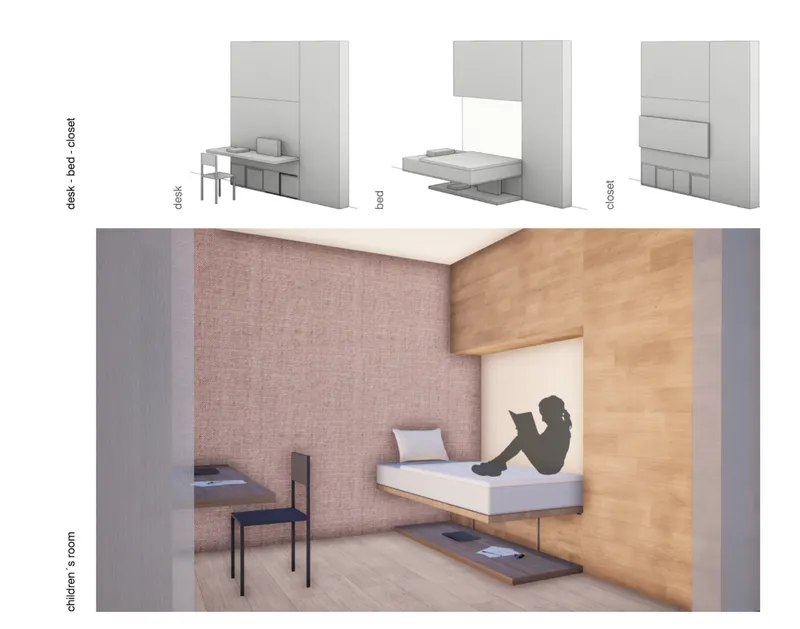
The interior view of a compact bedroom shows exactly how BetterTogether resolves the tension between communal living and personal retreat. A fold-down bed extends from timber-clad walls, flanked by textile surfaces that soften the room acoustically and visually. When folded away, the bed disappears, and the room converts into a workspace or a reading nook. Transformable furniture that shifts between bed, desk, and closet gives each resident a flexible retreat within the larger collective framework.
Privacy here is achieved not through heavy partitions but through material intelligence. Translucent rice paper curtains allow light and air to pass freely while maintaining visual separation. The palette of regional wood, lime plaster, and standardized glass elements keeps the build durable and budget-friendly, a deliberate choice that makes the co-living model replicable rather than bespoke.
Twin Units and Planted Terraces at the Section Scale
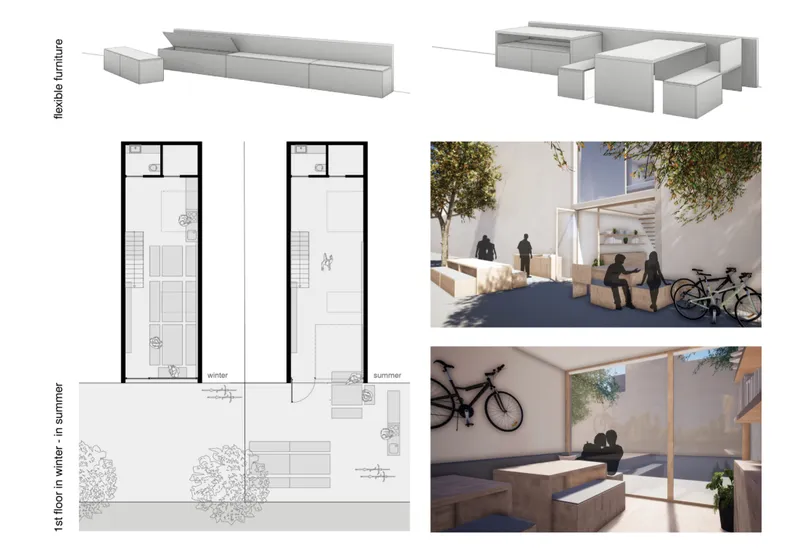
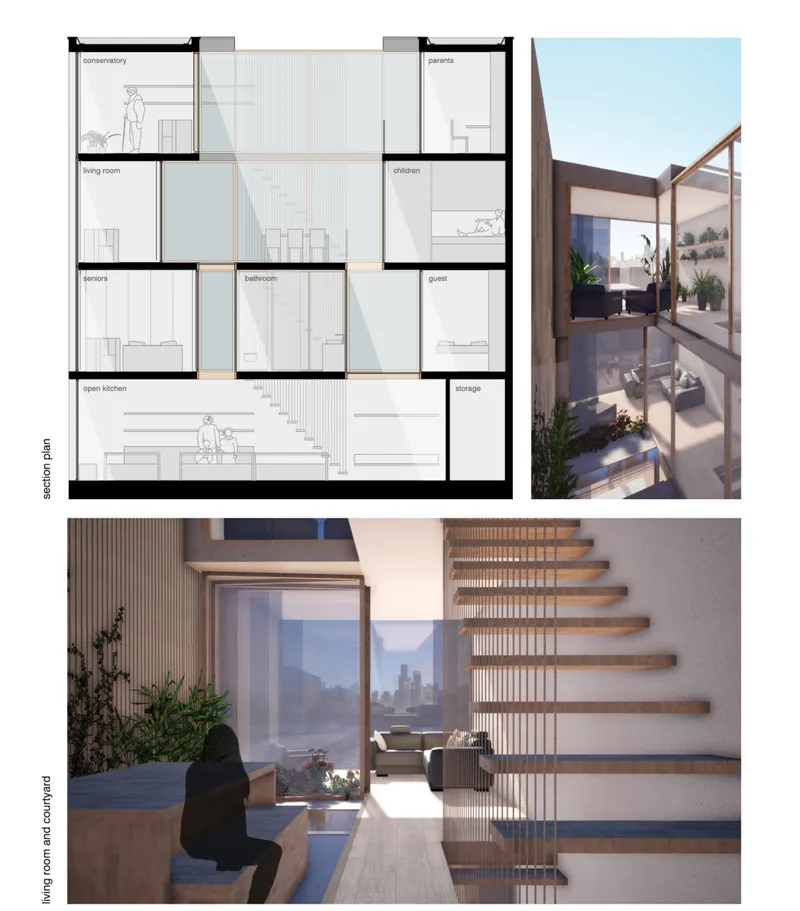
The section drawings and model diagrams reveal a second layer of the project's urban thinking: two adjacent narrow units share outdoor terraces punctuated by planted trees. These terraces extend the communal logic beyond the interior, offering residents open-air gathering spaces at different levels of the building. The planted courtyard visible in the section drawing, with floating timber stairs and vertical balusters running alongside it, confirms the courtyard as the house's true center of gravity.
At the scale of the section, you can see how the passive design strategy works. Large glass facades and the open central void maximize sunlight penetration even on a tight urban plot. A polyester fabric membrane on the facade provides both privacy and light permeability, filtering the boundary between inside and outside without closing it off. The straightforward cubic structure keeps construction logic simple, reinforcing the argument that co-living architecture does not require heroic engineering to be spatially rich.
Why This Project Matters
BetterTogether stands out not because it invents a new building type but because it takes the co-living concept seriously enough to design for it at every scale: from the fold-down bed to the street-facing kitchen to the twin-unit urban block. The intergenerational household of seniors, parents, children, and guests is not presented as a utopian fantasy. It is supported by specific spatial moves, including modular furniture, a light-delivering courtyard, and graduated zones of privacy and sociability.
In a moment when cities like Rotterdam face increasing density and housing pressure, the project offers a credible alternative to the single-family home and the anonymous apartment building alike. By rooting its design in Dutch cultural values of openness and communal life, Kiara Helk makes a persuasive case that architecture can do more than house people. It can organize the way they care for one another.
View the Full Project
About the Designers
Designer: Kiara Helk
Enter a Design Competition on uni.xyz
uni.xyz runs architecture and design competitions year-round that reward proposals with spatial conviction and real site intelligence.
Project credits: BetterTogether by Kiara Helk Nano Nest 2020 (uni.xyz).


Popular Articles
Popular articles from the community

Opera by the Sea Estonia: Three Shells Dissolving Architecture into Tallinn's Coastline
A winning opera house proposal replaces monumental form with interconnected shells that blur the boundary between building, park and Baltic Sea.

The Amber Palace Opera: A Geological Fiction Surfaces on Tallinn's Baltic Waterfront
Pierre Brillard reimagines a Baltic legend as a public landscape, opera house, and waterfront promenade rooted in Tallinn's coastal identity.
Temporary Home for Dogs: A Reversed Zoo Rethinks Animal Shelter Architecture
In Bucharest, a sinuous corridor and freed landscape flip the logic of containment, designing a shelter that works to make itself unnecessary.

Opera on the Sea: Driftwood Logic Shapes a Timber Opera House on Estonia's Coast
Trevor Orgill's opera house translates the entangled drift of floating timber into a civic building where wood, water, and music converge.

Similar Reads
You might also enjoy these articles

Shakur's House: Exposed Brick as an Interior Organiser in a 168 m² Mashhad Residence
Brick moves indoors in this Mashhad residence, where masonry walls, glass partitions and teal planes sequence a compact home without closing it off.

Day and Night Park: A Time-Based Urban Newsstand in Beijing
A temporary urban newsstand in Beijing blending travel, light, and reading through poetic colors, compact form, and community-focused design.

Modernist Patio Renovation in El Masnou, Barcelona by Oliver Segura Arquitectura + Cebrià Arquitectura
Modernist patio renovation blending tradition and innovation with a movable pool, leveled floors, and Catalan materials in El Masnou.

Alto Residencial Coop: Cooperative Housing Development in Santiago de Compostela by Carbajo Barrios Arquitectos
A linear cooperative housing complex blending white volumes and perforated metal façades, enhancing community living, natural light, privacy, and urban integration.

Explore Co-Living Competitions
Discover active competitions in this discipline

Challenge to design luxury tourism on rails

VR headsets Storefront design competition

Designing a staircase for a client

Design challenge to reuse E-waste
Comments (0)
Please login or sign up to add comments
No comments yet. Be the first to comment!