
Between Memory and Oblivion: A Refugee Cemetery Carved into the Landscape of Lesvos
Mourning Courses proposes a cemetery for refugees on the Greek island of Lesvos, where water, light, and carved ground guide visitors through grief.


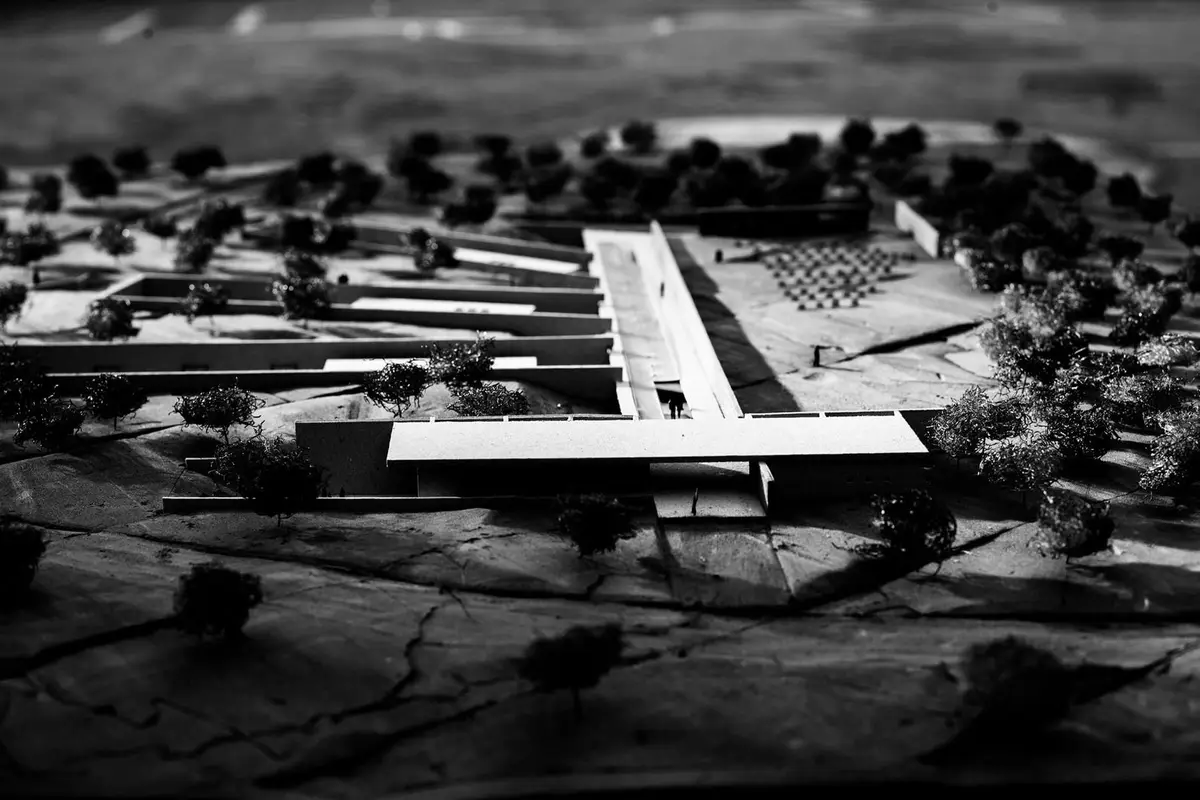
How do you design a cemetery for people whose names may never be recorded? On Lesvos, the Greek island that became synonymous with the refugee crisis, three designers propose an answer that refuses both spectacle and silence. Their project, Between Memory and Oblivion: Mourning Courses, reimagines the burial ground as an architectural sequence, a choreographed descent through water, light, and earth that transforms mourning from passive observation into bodily experience.
Designed by Konstantina Lola, Despoina Tsonidi, and Maria Karatsiompani as their senior thesis, the project was entered in the UnIATA '18 competition. Sited on an island where humanitarian memory is layered over ancient terrain, the cemetery does not impose itself on the landscape. Instead, it burrows into it, treating the ground as a thick, inhabitable mass rather than a neutral surface. The result is memorial architecture that is felt before it is seen.
Elongated Volumes Dispersed Among the Trees
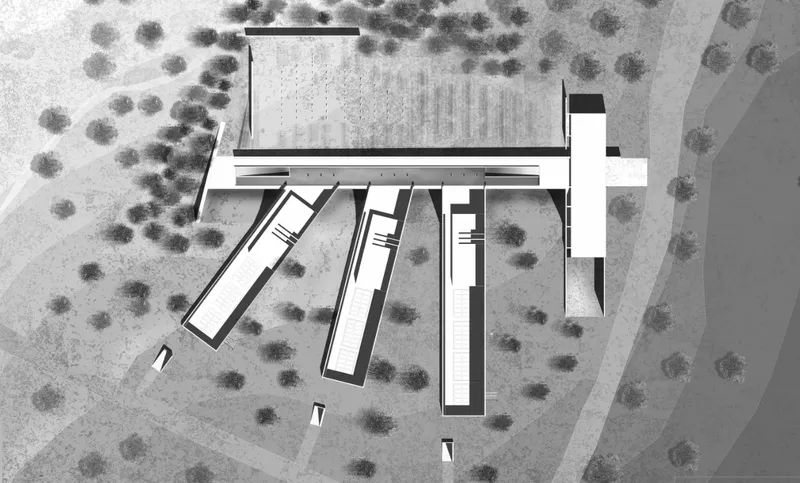
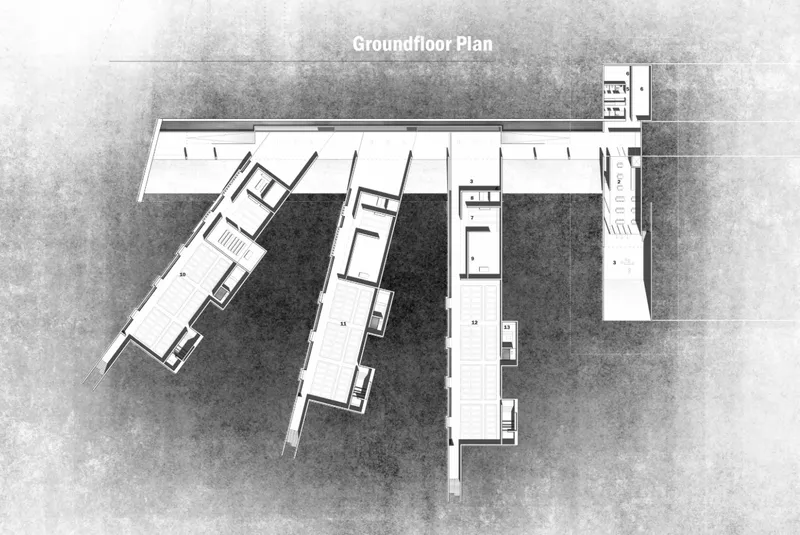
The site plan reveals the project's fundamental organizational logic: elongated volumes radiate outward from a central structure, threading between scattered trees rather than clearing them. The geometry is deliberate but not rigid. Angled wings extend from a horizontal bar, creating a fragmented plan that resists the monotony of conventional cemetery grids. Interior room divisions, visible in the ground floor plan, separate spaces of ceremony, body preparation, meditation, and ossuary storage, but these are never fully isolated. Transitional corridors, patios, and voids stitch the programme together, ensuring that movement through the complex is continuous and directional.
The layout mirrors the project's conceptual premise: that mourning is not a single event but a gradual course. Visitors do not arrive at a destination. They are guided through a sequence where collective memory, shared loss on a humanitarian scale, intersects with private grief experienced by individuals mourning specific loved ones. The architecture calibrates this intersection through spatial compression and release, interior and exterior, gathering and solitude.
Descending into the Earth: Sections as Emotional Diagrams
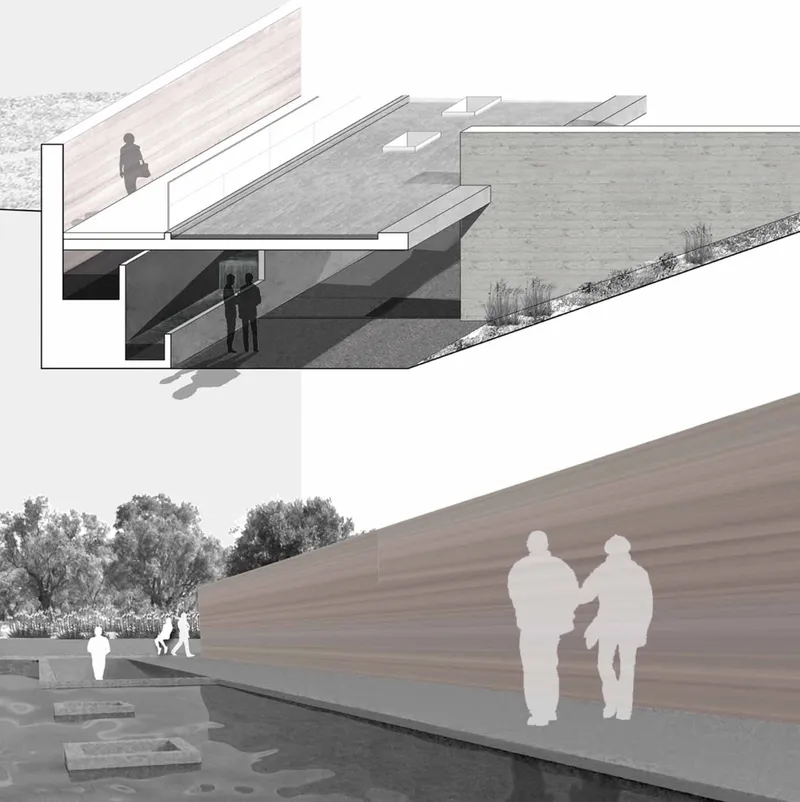
The section drawing is where the project's spatial intelligence becomes clearest. Sloped ramped pathways carry visitors downward from the public realm into subterranean spaces, and the descent is not merely functional. It is symbolic, mirroring the emotional progression from the surface of daily life toward the intimate depths of grief. Scale figures placed along the ramps reveal how the ceiling compresses overhead as one moves deeper, intensifying the sense of enclosure and interiority. Planted areas punctuate the section at ground level, reminding visitors of the living landscape above even as they inhabit the carved earth below.
The architecture negotiates constantly between above and below, reinforcing the passage between life and death without resorting to heavy-handed symbolism. Light enters these underground spaces through calculated openings, creating contrasts between darkness and illumination that track the emotional arc from loss toward acceptance. Ground here is not treated as a datum line but as a material with depth, weight, and meaning, a medium into which burial rituals are embedded both physically and metaphysically.
Timber Walls and Sunken Courts: Where Grief Finds a Room
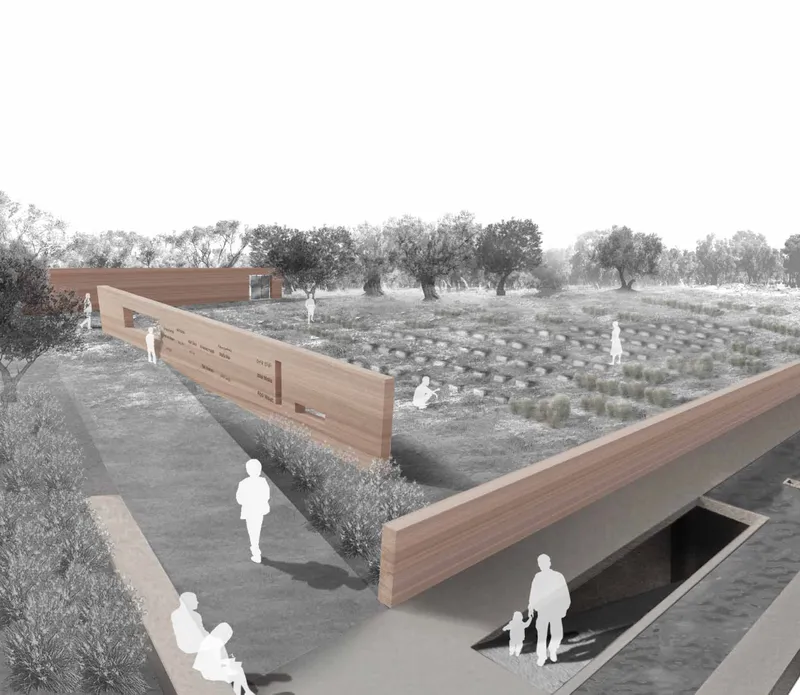
The perspective rendering offers the most visceral sense of what it would feel like to stand inside this cemetery. Timber-clad walls frame a sunken courtyard where planting beds grow at eye level and mature trees canopy overhead. Human figures occupy the space quietly, without ceremony, suggesting that this is a place designed for lingering rather than passing through. The material palette is restrained: warm timber against the coolness of excavated ground, vegetation softening hard edges. Water, one of the three conceptual pillars alongside light and ground, appears as a guiding element along the path, marking moments of pause and introspection rooted in traditions of purification and transition.
The courtyard operates as one of several meditation spaces within the complex, designed as silent chambers for reflection and remembrance. Its sunken condition means it is invisible from the surrounding landscape, preserving the terrain's visual integrity while creating an intensely private interior world. The designers achieve something rare here: a space that honors the dead without performing solemnity for an audience.
The Full Sequence: From Body Preparation to Ceremony
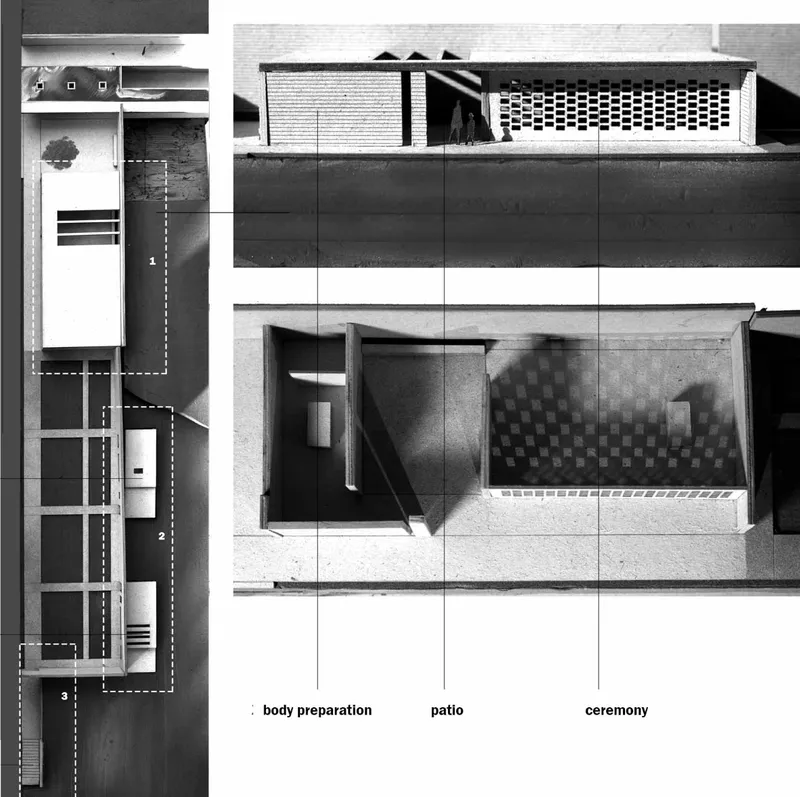
The composite drawing synthesizes plan and section into a single reading of the spatial sequence, tracing the path from body preparation through a transitional patio to the ceremony area. This drawing is critical because it demonstrates how each programmatic element is connected through processional movement rather than adjacency alone. Entry and exit routes are separated, allowing ritual processions to move without disruption while auxiliary circulation serves practical needs discreetly. The ossuary spaces, integrated within the architectural mass, appear as cavities within the section rather than standalone structures, reinforcing the idea that memory is embedded in the building itself.
The sequence asks visitors to slow down, to cross thresholds that mark emotional as much as spatial transitions. Corridors compress. Patios open. Voids interrupt solid mass. The architecture does not narrate grief; it creates the spatial conditions under which grief can unfold at its own pace. For a cemetery serving a population whose stories are too often reduced to statistics, this insistence on experiential specificity is a profound act of dignity.
Why This Project Matters
Memorial architecture often falls into one of two traps: it becomes so abstract that it loses emotional grip, or so literal that it forecloses the complexity of grief. Between Memory and Oblivion avoids both. By grounding its design in three elemental forces, water, light, and earth, and by organizing its programme as a sequential journey rather than a static field, the project gives form to mourning without prescribing how mourning should feel. The decision to embed the cemetery within the Lesvos landscape, minimizing visual impact while maximizing experiential depth, is architecturally confident and ethically considered.
Konstantina Lola, Despoina Tsonidi, and Maria Karatsiompani have produced a thesis that takes on one of architecture's most demanding briefs: designing for the unnamed dead. Their response is neither monumental nor modest. It is precise. Every ramp, courtyard, and threshold serves the argument that memory is spatial, that mourning requires movement, and that even the forgotten deserve architecture that acknowledges the full weight of their absence.
View the Full Project
About the Designers
Designers: Konstantina Lola, Despoina Tsonidi, Maria Karatsiompani
Enter a Design Competition on uni.xyz
uni.xyz runs architecture and design competitions year-round that reward proposals with spatial conviction and real site intelligence.
Project credits: Between Memory and Oblivion: Mourning Courses by Konstantina Lola, Despoina Tsonidi, Maria Karatsiompani UnIATA ’18 (uni.xyz).


Popular Articles
Popular articles from the community


U.GA Architects Wraps an Oval Rooftop Pool in Curved Board-Formed Concrete on Busan's Jeollidan-gil
In Busan's Jeonpo-dong, a 454 m² mixed-use block stacks a neighborhood facility, guest rooms and an oval rooftop pool inside spiraling concrete walls.

GROUP A Strips a 1969 Rotterdam Harbor Headquarters to Its Frame and Wraps It in Timber Louvers
In Rotterdam's M4H harbor district, Ferro Offices reuses a 1969 frame, adds one timber storey and reaches BREEAM-NL Outstanding.

David Ortega Stacks a Two-Story Mexico City Penthouse Around a Steel Stair and a Pergola-Shaded Roof Terrace
In Colonia Roma, a 300 m² penthouse uses oak joinery, a planted steel stair and a slatted roof pergola to make a new-build apartment feel like a house.

Jaramillo Van Sluys Arquitectura and Urbanismo Turn a Demolished Registry Lot in Quito into an Orchard Plaza
In Quito's Centro Histórico, a 2,800 m² plaza exposes the San Agustín convent wall and redraws its lost Augustinian orchard in volcanic stone.

Similar Reads
You might also enjoy these articles

Yenisei Monitoring Center: A Sun-and-Moon Sphere Anchors a Research Campus on Siberia's Great River
In Krasnoyarsk, shifting square blocks, a glazed central sphere and descending window rhythms turn river science into a public spectacle on the Yenisei.
Andretta Artist's Village: A Node-Based Masterplan That Lets the Hills Write the Plan
A cultural landscape strategy for Palampur's artist colony threads studios, residences and stages along a porous spine shaped by the Dhauladhar terrain.
Street Children Rehabilitation Center: A Brick Campus That Eases Children From Street to Safety
A low-rise courtyard campus where learning streets, uthans and shaded verandahs stage a gradual passage from street into protective, family-scale life.

The NEON Culture: A Field of Pavilions Built for the 24-Hour City
Smaran Alva spreads galleries, stages, clubs and markets across a varied site, treating light, sound and ramped movement as the real building materials.

Explore Mourning Spaces Competitions
Discover active competitions in this discipline

Challenge to reimagine the Iron Throne

Photograph architecture without architects

Illustrate the lost glory of Angkor Wat - Render Challenge

Design challenge to reuse E-waste
Comments (0)
Please login or sign up to add comments
No comments yet. Be the first to comment!