

Beyond Space and Fritschi Beis Build Holcim a Headquarters That Celebrates Cement as Architecture
A 9,000 m² office in Zug, Switzerland turns rammed earth, exposed aggregate, and terrazzo into a manifesto for material honesty.


When the world's largest cement company commissions a new headquarters, the building had better take its own product seriously. Beyond Space and Fritschi Beis Architektur have done exactly that in Zug, Switzerland, delivering a 9,000 m² office interior for Holcim that treats cementitious materials not as a hidden substrate but as the primary expressive medium. Every surface, from rammed earth partitions to exposed aggregate alcoves to terrazzo floors, reads as a direct argument that concrete and its relatives deserve the same sensory attention architects lavish on timber, stone, or copper.
What makes the project genuinely interesting is not the material choice alone but the restraint with which it is deployed. The palette is narrow: cement derivatives, timber, copper paneling, and metal mesh ceilings. Yet the spaces never feel monotonous. Curvature does much of the heavy lifting. Walls bend, columns wrap, and volumes lobe outward in organic geometries that catch raking light and create shifting shadow lines throughout the day. It is a corporate headquarters that manages to feel both rigorous and warm, which is a harder trick than most firms admit.
A Lobby Built from the Company's Own Story
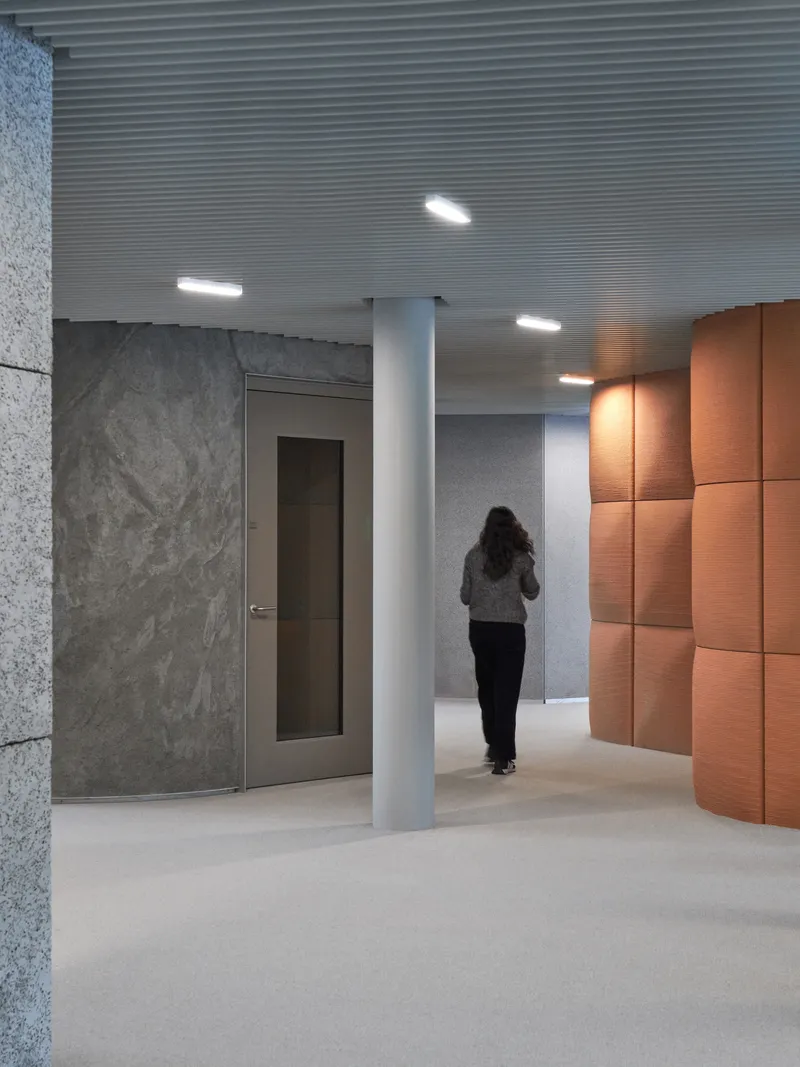
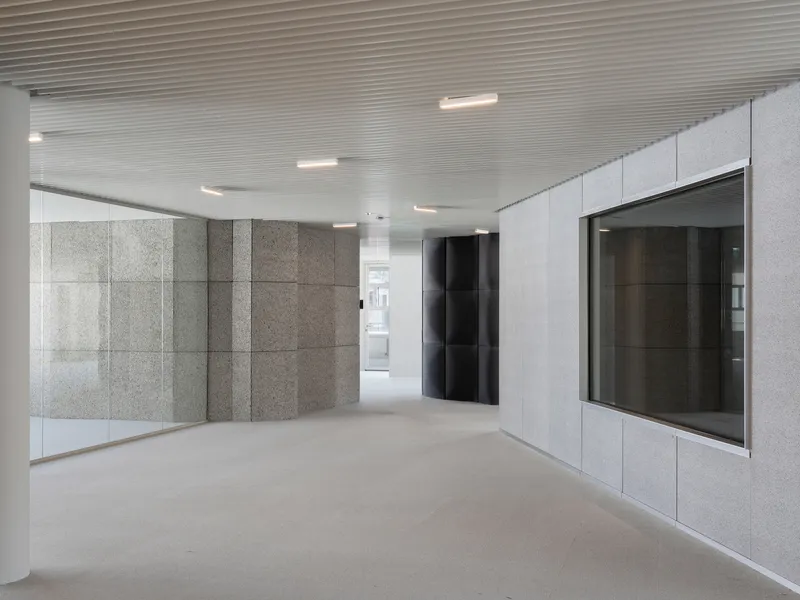
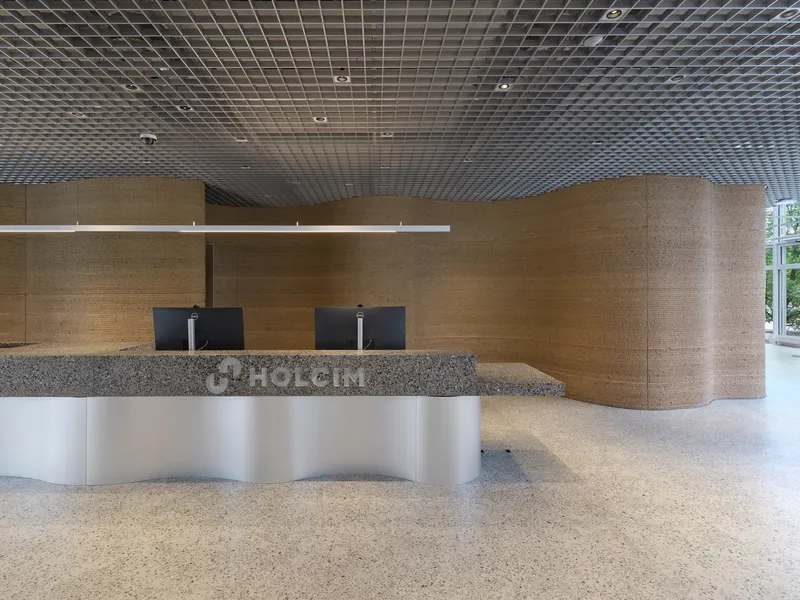
The lobby sets the tone immediately. Ribbed metal ceilings compress the vertical space just enough to push your eye toward the textured grey stone wall panels and copper accent surfaces. The material hierarchy is clear: mineral first, metal second, everything else in service. A white curved reception desk with a terrazzo countertop and timber wall cladding behind it anchors the arrival experience without competing with the heavier surfaces around it.
Black elevator doors sit flush against the stone walls, disappearing into the composition rather than punctuating it. A lone figure walking through the corridor in one view confirms the scale: these are not intimate passages but generous, almost civic lobbies that signal institutional confidence. Holcim wants you to know what it makes, and the lobby makes sure you feel it underfoot and at your fingertips.
Curved Volumes and Copper Columns

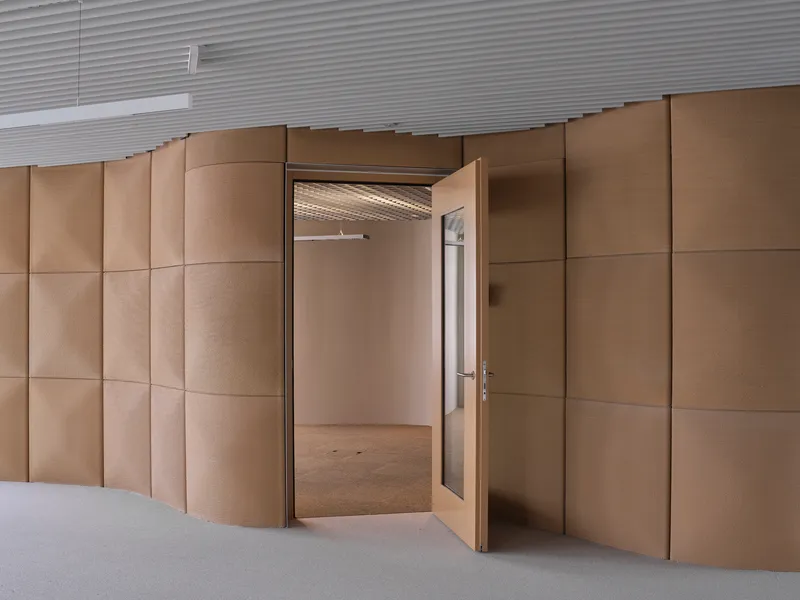
The most striking spatial move is the deployment of curved copper-paneled columns and walls that define thresholds without closing them off. Three copper columns stand in a row like sentries, their convex faces catching ambient light while the terrazzo floor stretches uninterrupted between them. Elsewhere, open double doors in a curved copper wall reveal an empty room beyond, the framing almost theatrical.
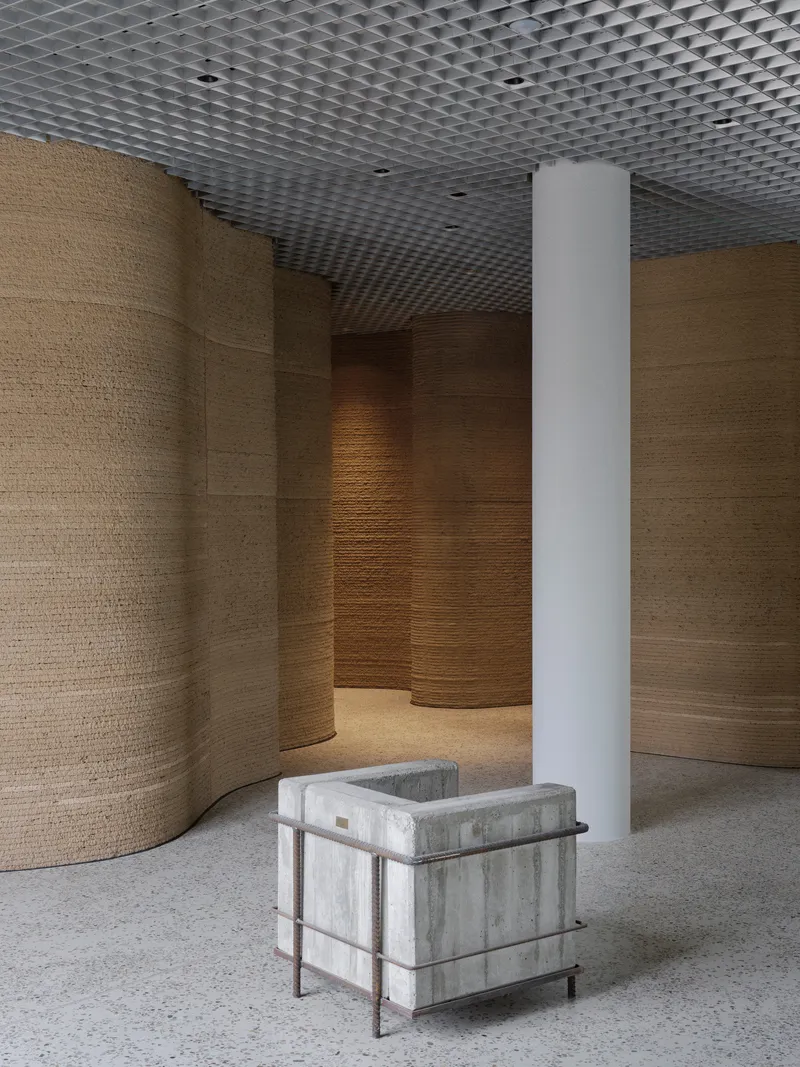
These copper elements serve a second purpose: they provide visual warmth against the dominant grey and white mineral palette. Without them the interiors would risk reading as austere. With them, the spaces oscillate between cool and warm, rough and refined, offering the eye constant relief. A white cylindrical column beside a concrete seating cube makes the contrast explicit, pairing smooth plaster with raw aggregate in a single glance.
Rammed Earth and the Poetry of Formwork


Several walls are constructed from rammed earth or board-formed concrete, and the architects let these surfaces speak without apology. Curved rammed earth panels catch diagonal sunlight in ways that reveal their laminated strata, each horizontal band a record of compaction. Nearby, a wall with deep horizontal striations and a recessed shadow line demonstrates how formwork technique becomes ornament when executed with care.
A close-up of one concrete surface shows vertical formwork markings and natural weathering that most corporate clients would have concealed behind paint or plasterboard. Leaving it visible is both a brand statement and an architectural conviction: that the process of making a wall is as worthy of attention as the finished plane. For a cement company, this is branding at its most literal and its most honest.
The Exposed Aggregate Alcove and Color Punctuation

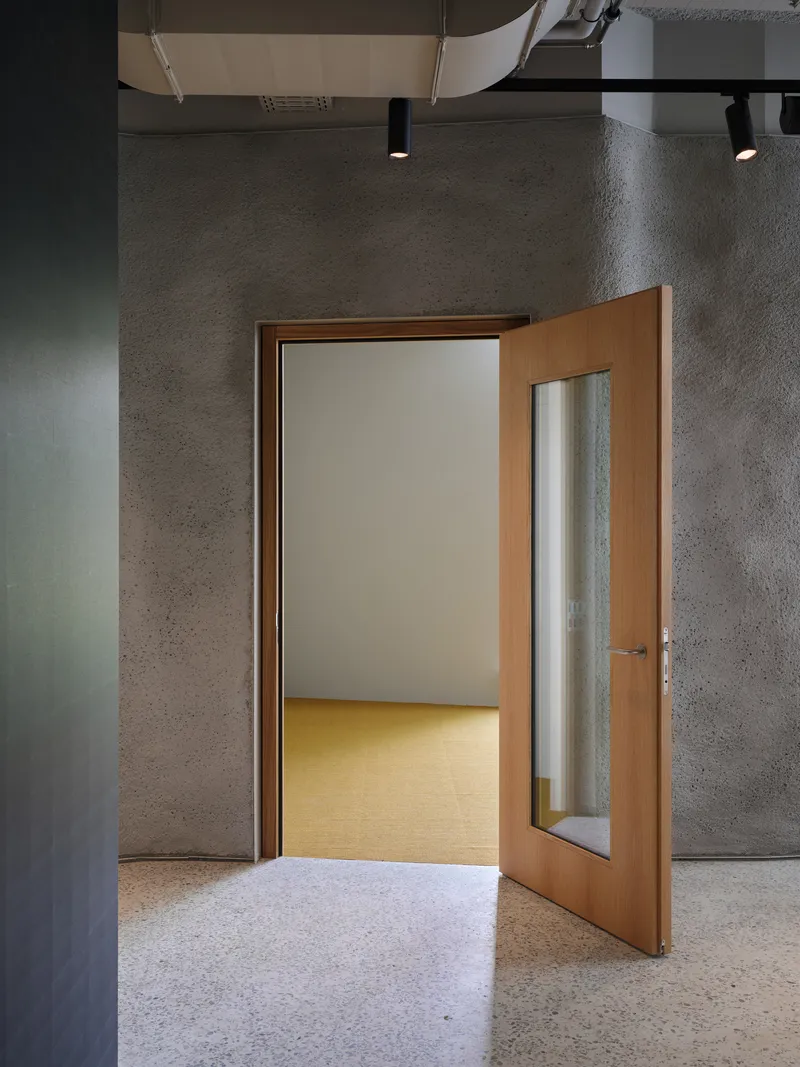
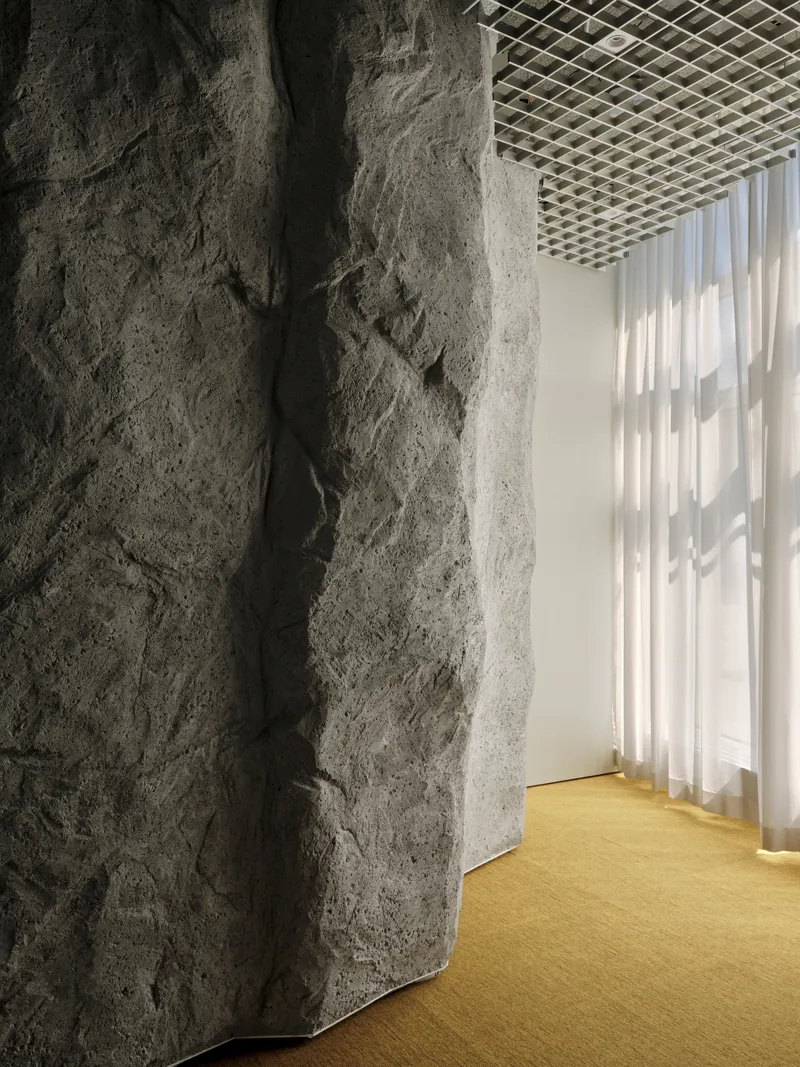
Not everything is grey. The designers use color as a surgical tool. An exposed aggregate concrete alcove with an orange interior recess stops you in your tracks, the warm hue radiating outward against the mineral surround. Timber-framed doors open into rooms with yellow floors, the color visible through narrow glazed panels like a preview of something livelier beyond the threshold. A rough concrete wall edge meets yellow carpet and sheer curtain under a perforated metal ceiling, the juxtaposition almost painterly.
These moments of color prevent the office from becoming a mausoleum of grey. They also signal program: warmer tones mark social or breakout zones, while the mineral corridors belong to circulation and focused work. It is a legible wayfinding strategy that happens to look good.
Timber and Light Along the Glazed Edge
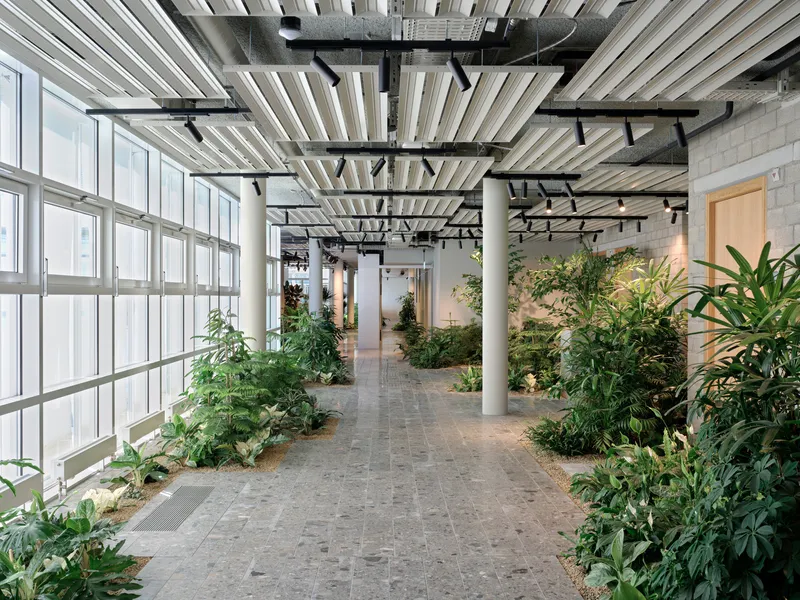


Along the building's perimeter, the character shifts. Diagonal timber ceiling slats filter light into interior corridors, and planted beds line the glazed facade, bringing greenery into what is otherwise a hard-surface environment. Curved timber-wrapped columns flank the glass wall, their warmth accentuated by the filtered daylight that pools on the terrazzo floor beneath.
An entrance corridor pairs grooved timber wall panels with exposed concrete and a slatted ceiling, layering textures without clutter. The timber never dominates; it defers to the mineral palette while softening acoustics and offering a tactile counterpoint. The balance suggests the architects understood that a building celebrating cement still needs to feel like a place people want to spend eight hours a day.
Workplace Zones and Quiet Details


The open-plan office areas maintain the same material discipline. A curved grey stone wall runs alongside workstations beneath a ribbed ceiling, grounding the space and shielding it from the corridor beyond. Green carpet flooring and white sheer curtains soften a corner where a stone wall meets an open grid metal ceiling, suggesting that comfort and austerity can coexist if the details are right.
Meeting rooms are wrapped in curved textured wall panels with perforated metal ceilings that diffuse light evenly. The rooms feel intimate without feeling closed, a quality achieved through the gentle curvature of the enclosing surfaces rather than through conventional right-angle partitions. It is a subtle move, but one that distinguishes these workspaces from the generic glass-box conference rooms that populate most corporate interiors.
Threshold and Passage
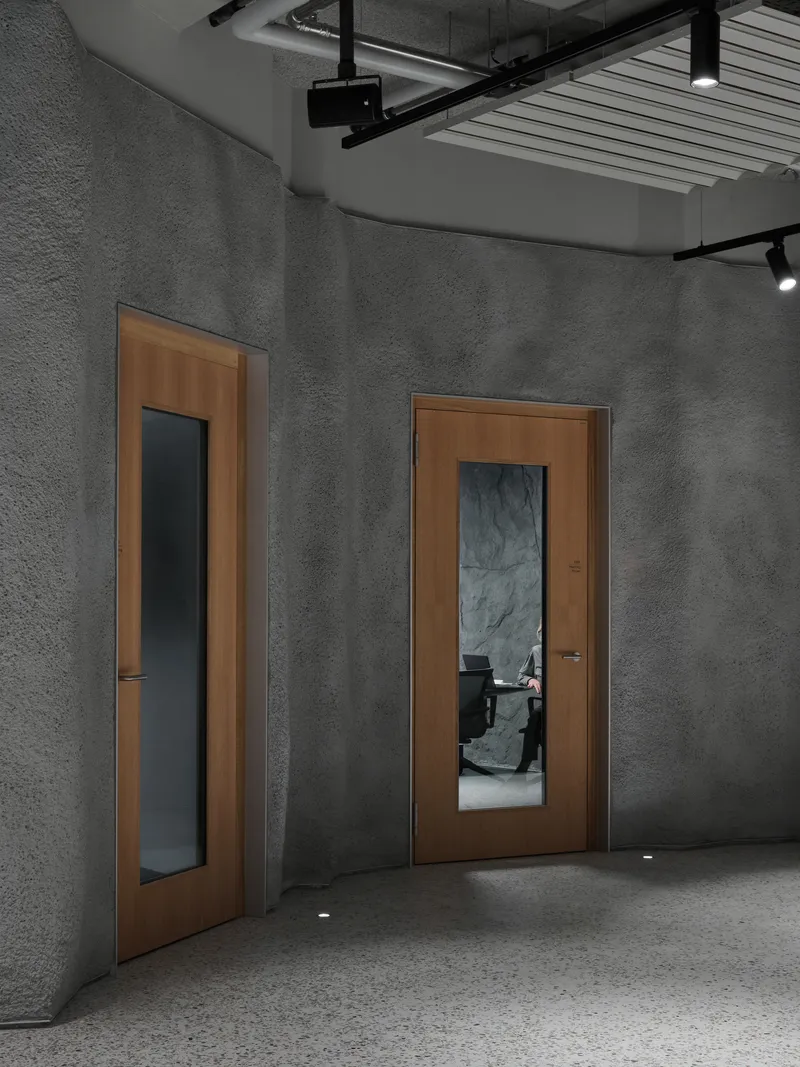
Doorways throughout the project are treated as moments of transition rather than mere openings. Two timber doors with vertical glazed panels sit within grey textured walls beneath exposed ceiling infrastructure, their proportions tall and narrow, almost ecclesiastical. These passages frame views into the rooms beyond and calibrate the experience of moving between zones of different character, from hard mineral corridors to warm timber thresholds to colorful breakout rooms.
Plans and Drawings


The section drawing reveals a series of lobed volumes nested under a continuous curving roof, confirming that the organic geometries experienced inside are not superficial wrapping but structural logic carried through the entire building. Two roof plan options shown in axonometric projection illustrate the landscape integration, with outdoor elements extending the organic forms beyond the building envelope.
An exploded axonometric breaks the project into stacked floor levels, each containing curved spatial volumes rendered in different materials. The drawing makes the organizational strategy legible: each floor has its own family of enclosed rooms, their curving footprints interlocking like puzzle pieces within a more regular structural grid. The result is that every floor feels unique while sharing a coherent formal language.
Why This Project Matters
Corporate headquarters tend to fall into two camps: the generic glass-and-steel shell that could belong to any company, or the heavy-handed brand exercise that substitutes logos for architecture. The Holcim HQ avoids both traps. By making cement and its derivatives the primary interior material, Beyond Space and Fritschi Beis Architektur align the building's identity with the company's purpose without resorting to signage or gimmickry. The building is the brand, at the level of surface, structure, and spatial experience.
More broadly, the project demonstrates that mineral materials can produce interiors of genuine warmth and variety when combined with disciplined color accents, thoughtful curvature, and generous daylight. In an era when timber is marketed as the only ethical and sensory alternative to steel-and-glass uniformity, this headquarters makes a persuasive counterargument. Cement, treated with craft and conviction, has plenty left to say.
The Future Office, Holcim HQ, Zug, Switzerland. 9,000 m², completed 2025. Architecture by Beyond Space and Fritschi Beis Architektur. Photography by Beat Schweizer and Max Hart Nibbrig.
About the Studio
Beyond Space
Official website of Beyond Space, one of the studios behind this project.
beyond-space.euShare Your Own Work on uni.xyz
If projects like this are the kind of work you want to make, uni.xyz is a place to publish your own, find collaborators, and enter design competitions.


Popular Articles
Popular articles from the community


The Amber Palace Opera: A Geological Fiction Surfaces on Tallinn's Baltic Waterfront
Pierre Brillard reimagines a Baltic legend as a public landscape, opera house, and waterfront promenade rooted in Tallinn's coastal identity.

Singing Woman: Contemporary Architecture Inspired by Estonia’s Voice and the Sea
Singing Woman turns Estonia’s song culture into flowing opera house architecture, blending public life, landscape, sea, and national memory.
Faces of the Soviet Avant-Garde: Turning Moscow's Street Names into an Open-Air Museum
A network of sculptural installations across a Moscow residential district transforms forgotten architect names into spatial encounters with cultural memor
Extended Shell: Retrofitting Kolkata's Balconies as Living Urban Thresholds
A modular retrofit system recovers the social and environmental intelligence of Kolkata's historic verandas for contemporary Park Street residents.

Similar Reads
You might also enjoy these articles

Bao Huynh Watercolor Atelier: A Serene Art Retreat in Hội An
Bao Huynh Watercolor Atelier in Hội An blends multifunctional art spaces, sustainable design, local materials, and family-friendly living in a serene environment.

Atelier Macri Concept Store Interior Design by CASE-REAL
Atelier Macri store features a "ko" counter, walnut wood details, cork displays, blending retail, gallery, and seamless customer experiences.

Manuel Vargas Izquierdo Stadium and High-Performance Sports Center: Architectural Excellence in Jalpa de Méndez
The Manuel Vargas Izquierdo Stadium blends sustainable design, inclusive sports facilities, and cultural-inspired architecture, revitalizing Jalpa de Méndez’s public spaces.

KAKR Buluh Awar Hall: Revitalizing Community and Ecology Through Bamboo Architecture
Community built bamboo hall revitalizes Buluh Awar village, empowering youth, restoring ecology, celebrating vernacular craftsmanship through sustainable architecture and culture.


Comments (0)
Please login or sign up to add comments
No comments yet. Be the first to comment!