

BIG, William Rawn Associates, and HASTINGS Wrap Nashville's New Performing Arts Center in a Metal Curtain
A 307,000-square-foot cultural campus on Nashville's East Bank clusters four venues beneath a rippling aluminum facade along the Cumberland River.


Nashville's identity has always been sonic. The city exports sound the way other cities export steel or software. But for all its musical credibility, its performing arts infrastructure has never quite matched the ambition of its creative economy. The Tennessee Performing Arts Center, currently housed west of the Cumberland River near the State Capitol, is preparing to leap across the water to the East Bank, landing on a pentagonal site at the terminus of Broadway, the very street whose honky-tonks made Nashville a pilgrimage destination. The new building, designed by BIG (Bjarke Ingels Group), William Rawn Associates, and HASTINGS Architecture, is a 307,000-square-foot complex that clusters four venues, rehearsal studios, classrooms, and a rooftop terrace beneath a single undulating canopy of bundled aluminum tubes.
What makes the project genuinely interesting is not the sculptural roof, though that is the most photogenic element. It is the sectional game. The site sits adjacent to the John Seigenthaler Pedestrian Bridge, which crosses the Cumberland at an elevated level. Rather than treating that grade change as a constraint, the design team exploits it: back-of-house functions disappear beneath the bridge, a ground-level lobby opens toward the river, and a second elevated lobby engages the bridge directly. The cabaret and black box theater sit at bridge level on a public plaza, while the 2,500-seat Grand Broadway Theater and the dance and opera hall anchor the ground plane. The result is a building you can enter from two elevations, circumnavigate entirely, and peek into through glass-walled rehearsal studios. It is a performing arts center that refuses the fortress typology.
The Curtain Call Facade

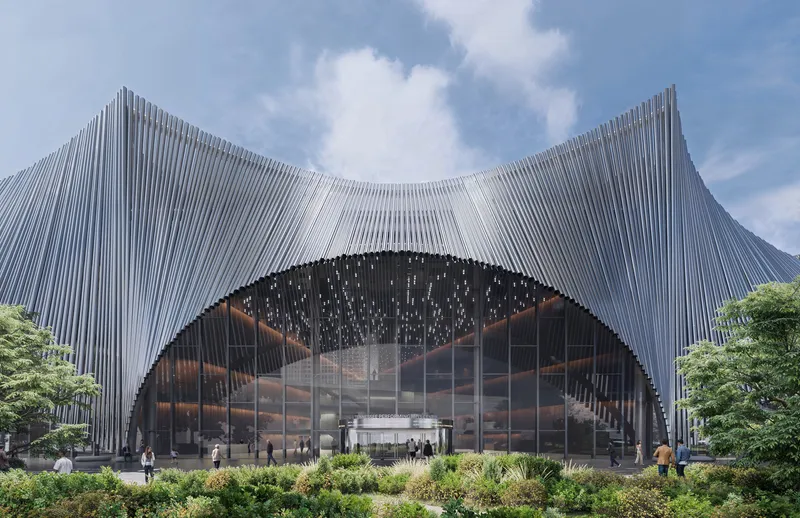
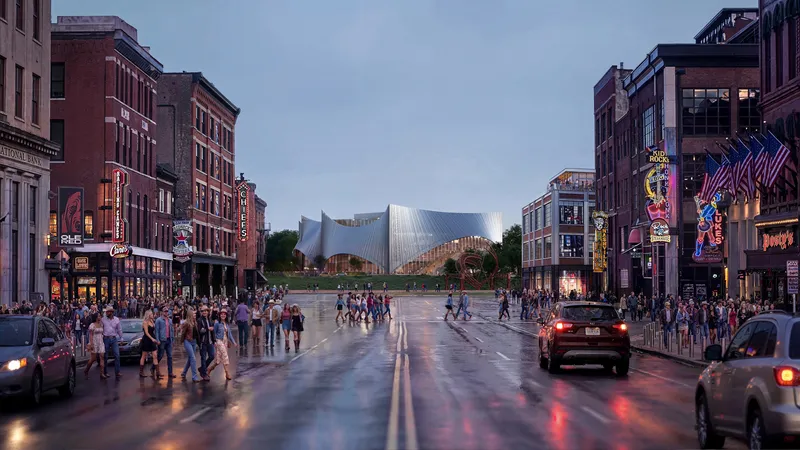
The exterior reads as a single gesture: vertical aluminum tubes bundled into a rippling skin that the architects describe as a reference to a theater curtain. It is a metaphor that could easily feel forced, but the geometry earns it. The tubes rise and dip to form three saddle-shaped peaks, creating deep overhangs that shelter glazed openings at the base. At the main entrance, an arched void carved through the perforated metal canopy reveals the lobby behind, pulling pedestrians inward almost involuntarily.
Seen from Broadway at dusk, the building glows from within, its ribbed surface catching the warm light and reflecting it in long vertical streaks. The facade works simultaneously as ornament, structure, and environmental mediator, shading the glass curtain walls below while giving the roofline a textile softness unusual for a civic building at this scale.
A Waterfront Anchor

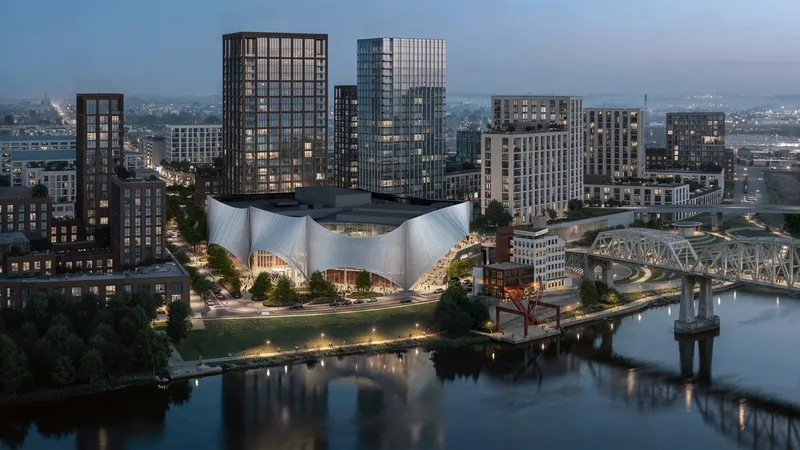

The East Bank site places the building between the Cumberland River, Cumberland Park, and the future Nissan Stadium precinct. Landscape architect OLIN has integrated planting, gathering areas, and zones for informal performance into the surrounding terrain, while exterior staircases link the center down to the riverfront. The aerial views make the strategy legible: the folded roof volumes nestle among planned residential towers and parkland, anchoring a neighborhood that does not yet fully exist.
The building is part of a larger East Bank masterplan by Perkins Eastman that includes a grand park and roughly 1,550 new homes. Positioning TPAC here is a bet that culture can catalyze urbanism, not merely decorate it. The rooftop terrace, offering panoramic views of both the river and the Nashville skyline, ensures the building remains a destination even when no curtain is rising.
The Timber-Lined Interior
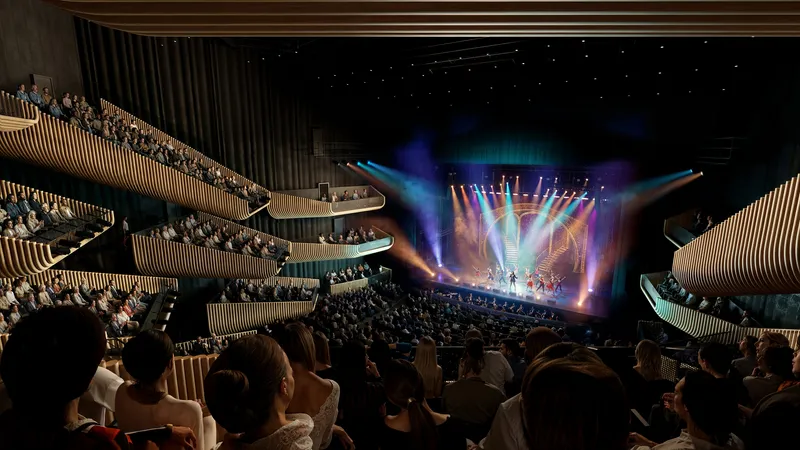


If the exterior is all metal and movement, the interior pivots to warmth. The Grand Broadway Theater wraps its 2,500 seats in timber-clad balconies that cantilever outward in stacked trays, optimizing sightlines while giving the room a domestic grain. Vertical wood slats run across the balcony fronts, breaking down the scale and providing acoustic diffusion. The ceiling undulates overhead, a softer echo of the aluminum canopy outside, studded with spotlights that cut through haze during performance.
The second hall, designed for dance and opera, shares the wood vocabulary but organizes its seating volumes differently. The black box theater eliminates the fixed proscenium entirely, allowing flexible configurations, while the cabaret space pushes its stage into the audience. Four distinct venue types under one roof, each with its own acoustic personality, is an ambitious program. Getting the isolation right between them will be the real engineering challenge.
Lobbies as Public Living Rooms


The lobbies are not corridors. They are multi-level social spaces with crossing bridges, backlit timber screens, cascading metal scrims near floor-to-ceiling glass walls, and patterned acoustic ceilings. Suspended globe pendants punctuate the vertical slat curtain in the ground-level lobby, while the elevated lobby uses terraced seating to blur the line between intermission lounge and amphitheater.
The dual-lobby strategy is the building's most urbanistically generous move. By activating both the river-facing ground plane and the bridge-level plaza, the design creates two distinct public thresholds. You arrive from downtown Nashville across the bridge and enter at the upper lobby; you arrive from the East Bank neighborhood and enter at the lower one. Neither entrance feels like a back door.
Gathering and Support Spaces
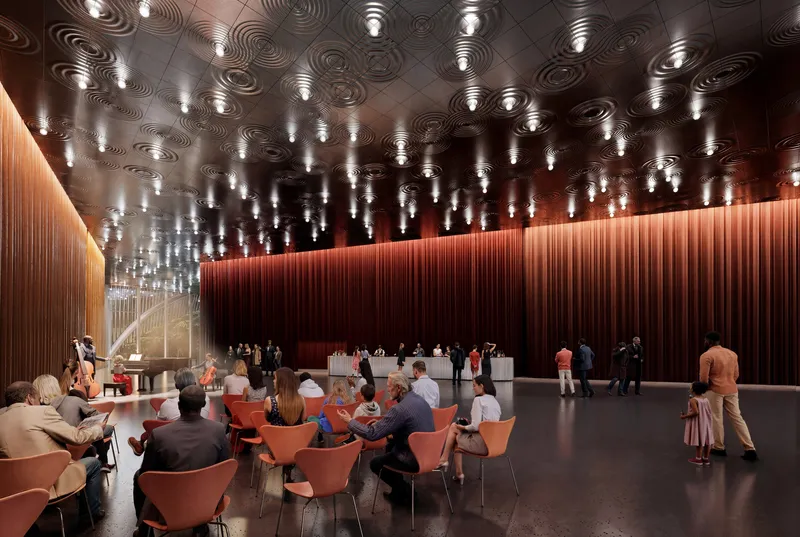
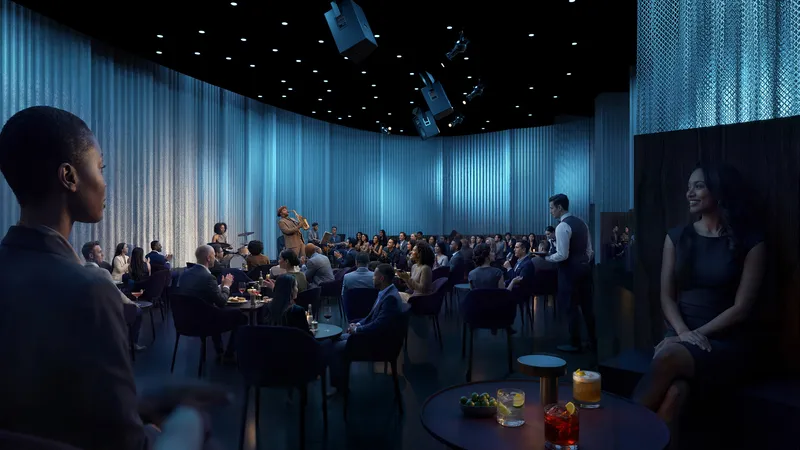

Beyond the performance halls, the building packs in rehearsal studios, classrooms, a banquet hall with translucent curtain walls, and a dedicated sensory room for neurodiverse audiences. That last detail is worth noting. Performing arts venues have historically been designed for a narrow slice of the public, and the inclusion of a sensory room signals an understanding that accessibility is not just about ramps and elevators.
The glass-walled rehearsal studios, visible to passersby, intentionally collapse the barrier between the creative process and the street. It is a small decision with outsized implications: it positions artmaking as something that happens in view, not behind closed doors, reinforcing the idea that this building belongs to the city, not only to ticket holders.
Plans and Drawings

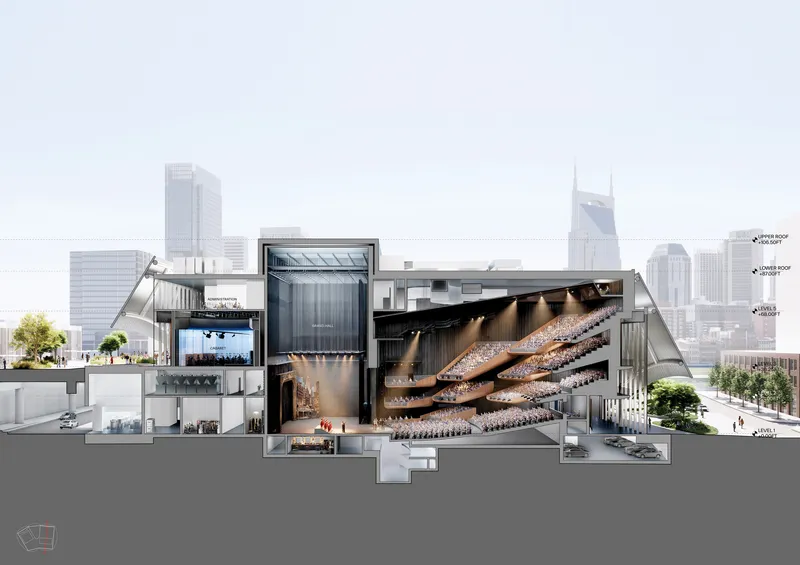


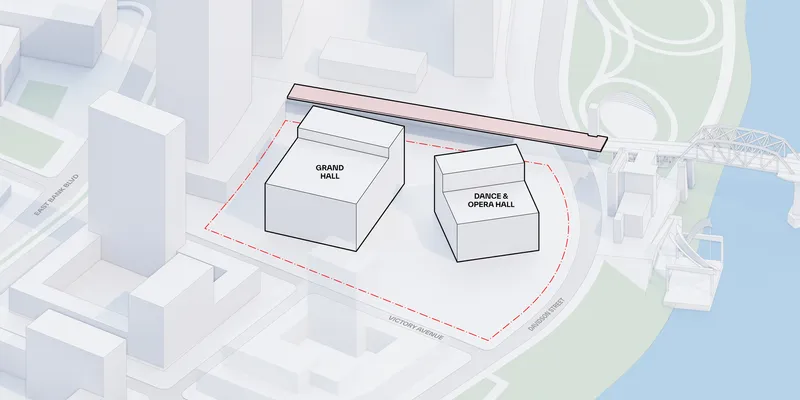


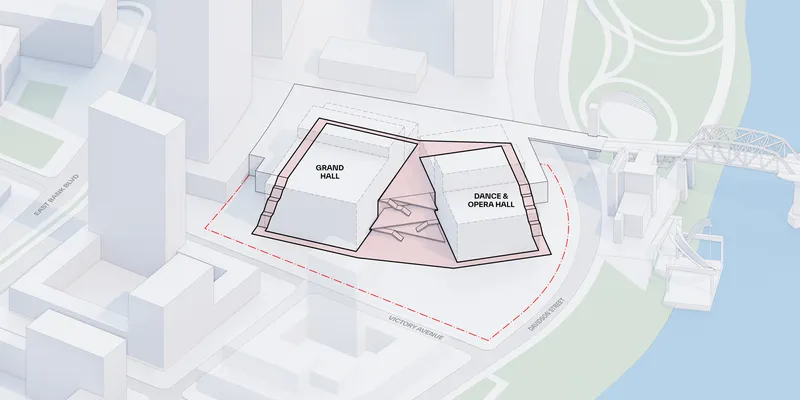
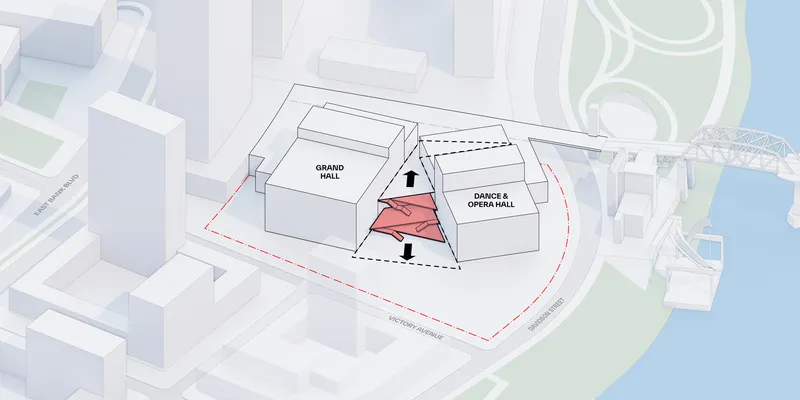


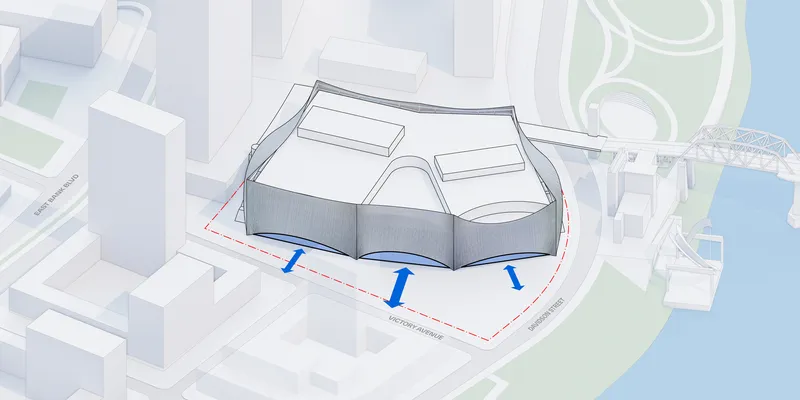
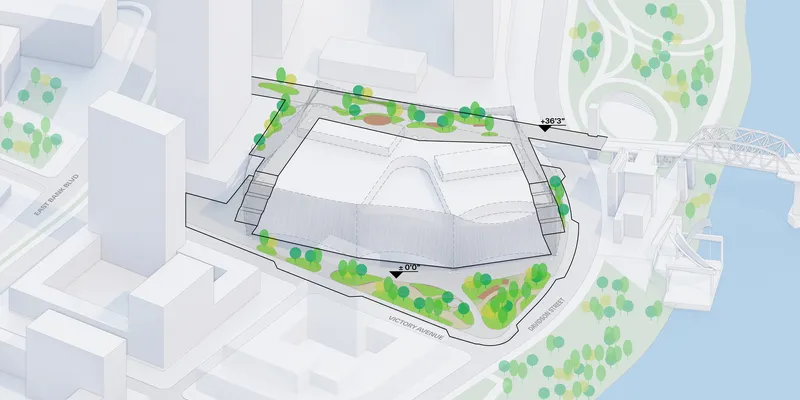
The section drawings are the most revealing documents in the set. They show how the two primary halls sit at slightly different angles, joined by a triangular lobby wedge that functions as the building's social hinge. Back-of-house volumes tuck beneath the bridge grade, freeing the perimeter for public program. The axonometric sequence diagrams the additive logic clearly: two halls placed on site, a canopy draped over them, cabaret and black box volumes inserted in the gaps, and circulation towers positioned at the four corners to frame everything.
The site plan confirms the pentagonal parcel geometry and shows how perimeter tree plantings soften the building's relationship to the adjacent roads and waterfront. The entry diagram marks access points along the curved base, emphasizing that this is not a building with a single front door but a permeable civic object intended to be approached from any direction.
Why This Project Matters
Nashville is a city that has long punched above its weight culturally while building below its ambitions architecturally. TPAC's relocation to the East Bank is not just a facilities upgrade; it is a declaration that the performing arts deserve landmark infrastructure on par with the stadium across the road. The collaboration between BIG, William Rawn Associates, and HASTINGS Architecture produces a building that leverages its split-level site condition into a genuinely public section, one that offers two entrances, wrap-around lobbies, visible rehearsal spaces, and a rooftop terrace. Construction is expected to begin in 2027, with completion targeted for 2030.
The risk, as always with civic megaprojects, is that the renders promise a porosity the finished building cannot deliver. Security protocols, operational budgets, and programming schedules have a way of sealing off the open lobbies and glass walls that look so inviting in visualization. But the fundamental architectural moves here, burying the back-of-house, splitting the lobby across two levels, wrapping the perimeter in public space, are hard to undo. If the operators honor what the architects have drawn, Nashville will gain something rarer than a concert hall: a performing arts center that truly belongs to its street.
Tennessee Performing Arts Center (TPAC) by BIG (Bjarke Ingels Group), William Rawn Associates (WRA), and HASTINGS Architecture. Nashville, Tennessee, United States. 307,000 sq ft. Expected completion 2030. Landscape by OLIN.
About the Studio
Share Your Own Work on uni.xyz
If projects like this are the kind of work you want to make, uni.xyz is a place to publish your own, find collaborators, and enter design competitions.


Popular Articles
Popular articles from the community

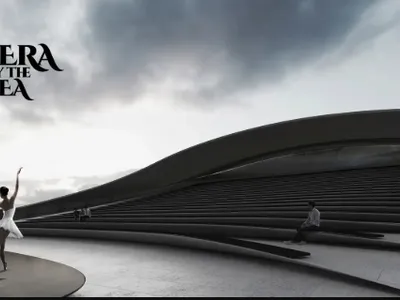
Opera by the Sea Estonia: Three Shells Dissolving Architecture into Tallinn's Coastline
A winning opera house proposal replaces monumental form with interconnected shells that blur the boundary between building, park and Baltic Sea.

Singing Woman: Contemporary Architecture Inspired by Estonia’s Voice and the Sea
Singing Woman turns Estonia’s song culture into flowing opera house architecture, blending public life, landscape, sea, and national memory.

The Amber Palace Opera: A Geological Fiction Surfaces on Tallinn's Baltic Waterfront
Pierre Brillard reimagines a Baltic legend as a public landscape, opera house, and waterfront promenade rooted in Tallinn's coastal identity.

Opera on the Sea: Driftwood Logic Shapes a Timber Opera House on Estonia's Coast
Trevor Orgill's opera house translates the entangled drift of floating timber into a civic building where wood, water, and music converge.

Similar Reads
You might also enjoy these articles

Bao Huynh Watercolor Atelier: A Serene Art Retreat in Hội An
Bao Huynh Watercolor Atelier in Hội An blends multifunctional art spaces, sustainable design, local materials, and family-friendly living in a serene environment.

Atelier Macri Concept Store Interior Design by CASE-REAL
Atelier Macri store features a "ko" counter, walnut wood details, cork displays, blending retail, gallery, and seamless customer experiences.

Manuel Vargas Izquierdo Stadium and High-Performance Sports Center: Architectural Excellence in Jalpa de Méndez
The Manuel Vargas Izquierdo Stadium blends sustainable design, inclusive sports facilities, and cultural-inspired architecture, revitalizing Jalpa de Méndez’s public spaces.

KAKR Buluh Awar Hall: Revitalizing Community and Ecology Through Bamboo Architecture
Community built bamboo hall revitalizes Buluh Awar village, empowering youth, restoring ecology, celebrating vernacular craftsmanship through sustainable architecture and culture.


Comments (0)
Please login or sign up to add comments
No comments yet. Be the first to comment!