
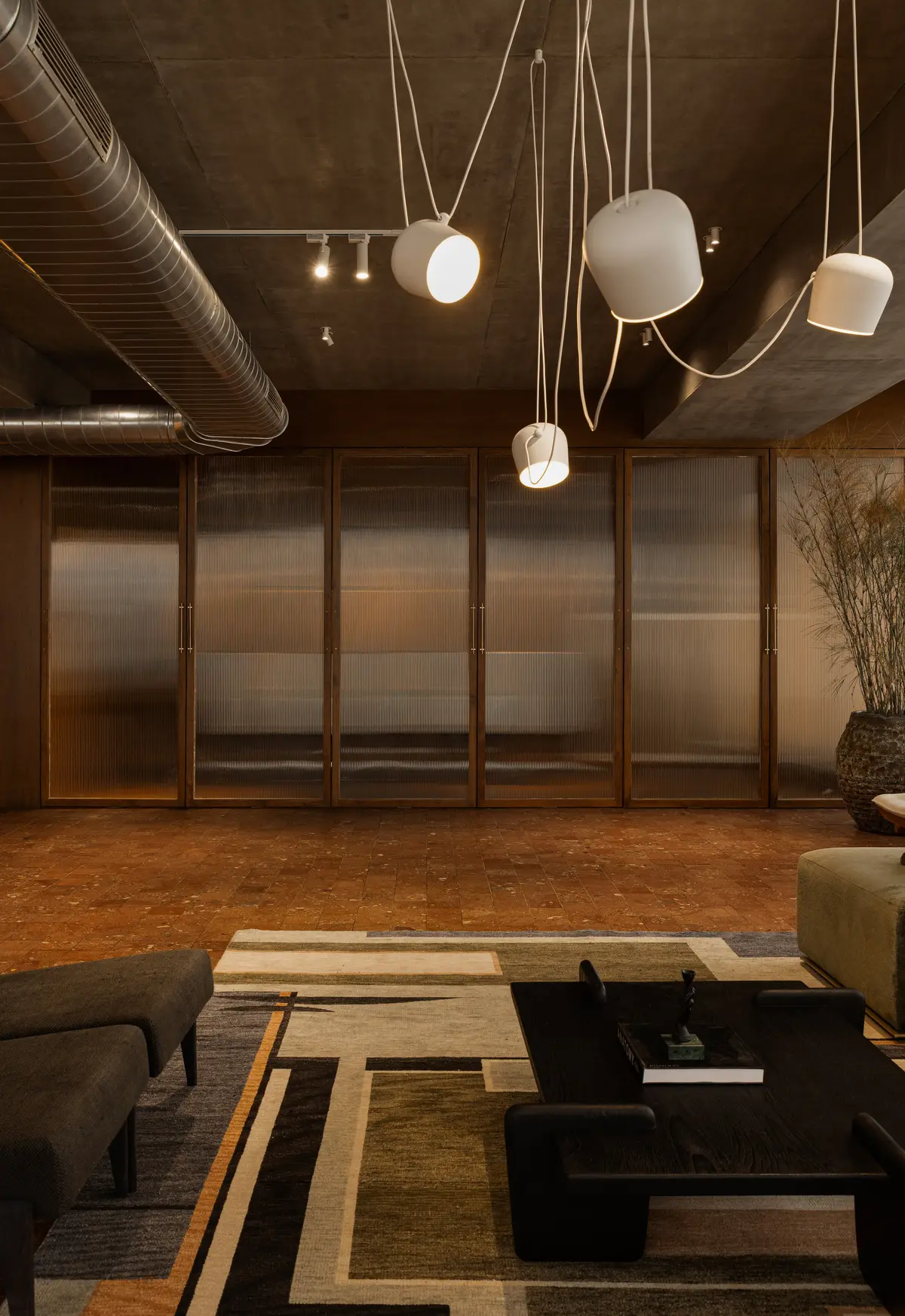
Billboards Turns a Bengaluru Office into a Three-Dimensional Manifesto for How We Inhabit Land
A real estate studio in Bengaluru dissolves the boundary between workspace and exhibition through clay, brass, and raw concrete.


Most real estate offices exist to sell a lifestyle they themselves fail to embody. A brochure rack, a model under plexiglass, a glass boardroom: the architecture of the pitch is rarely the pitch itself. Landforms, designed by Bengaluru practice Billboards and led by architects Arun Prabhu N G and Vincy Victor, rejects that split entirely. Completed in 2025, the office for a land development firm operates as a built argument, a space where workspaces, master planning displays, and model homes coexist under one roof without the usual hierarchy of function.
What makes the project worth paying attention to is not any single material gesture, though there are several good ones. It is the decision to treat an office as a spatial manifesto: every surface, every threshold, every shift in light is calibrated to demonstrate the company's philosophy about land, structure, and habitation. The result is a space that feels more like a lived-in exhibition than a corporate interior, one where the act of working and the act of experiencing architecture are genuinely the same thing.
Concrete Canopy, Brass Spine
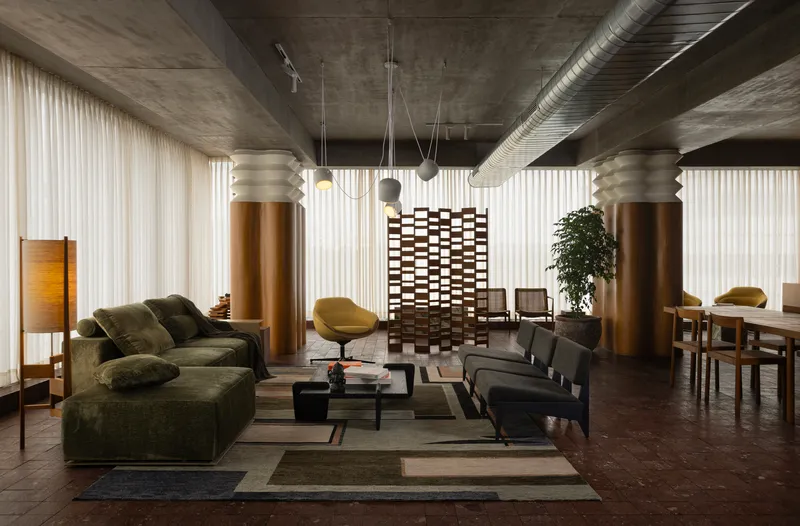
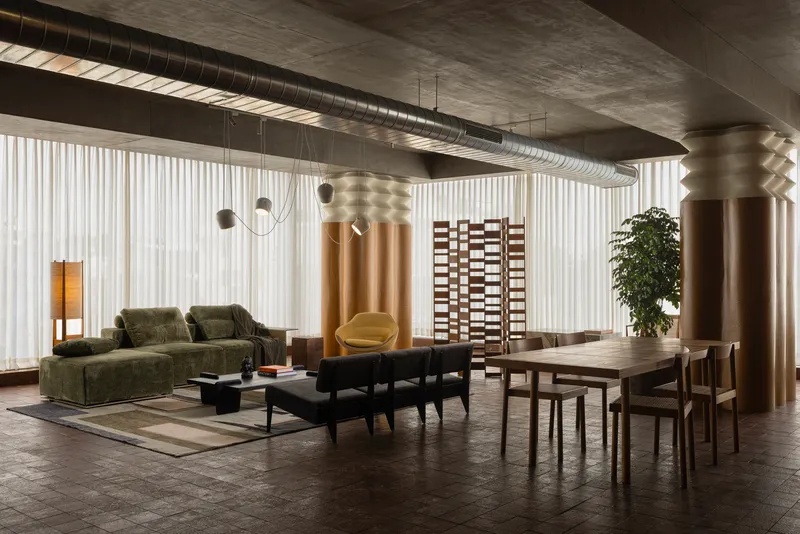
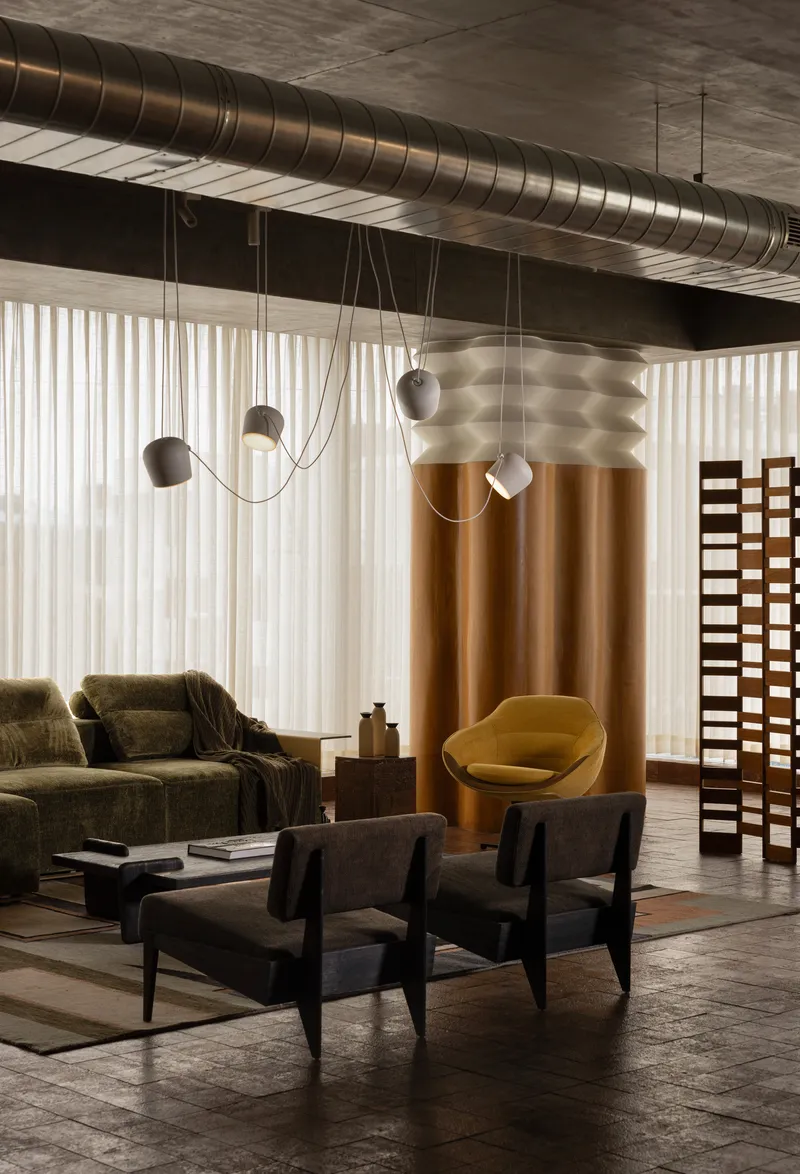
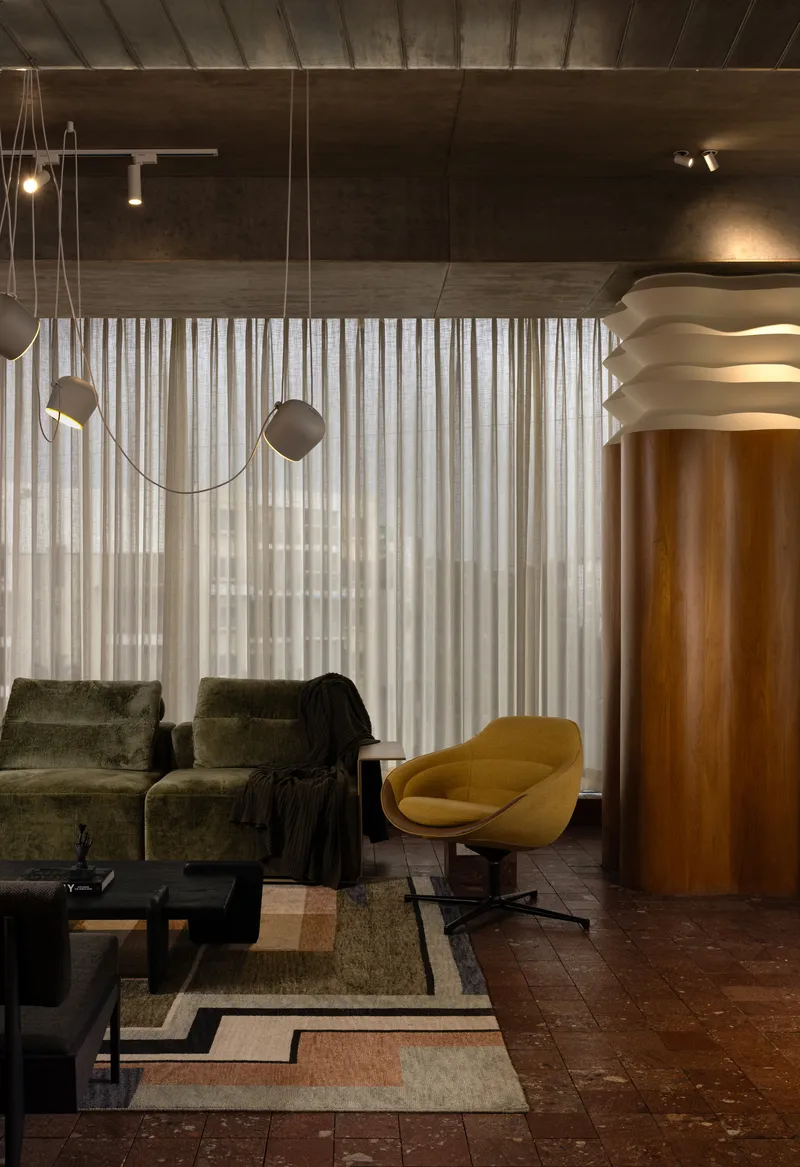
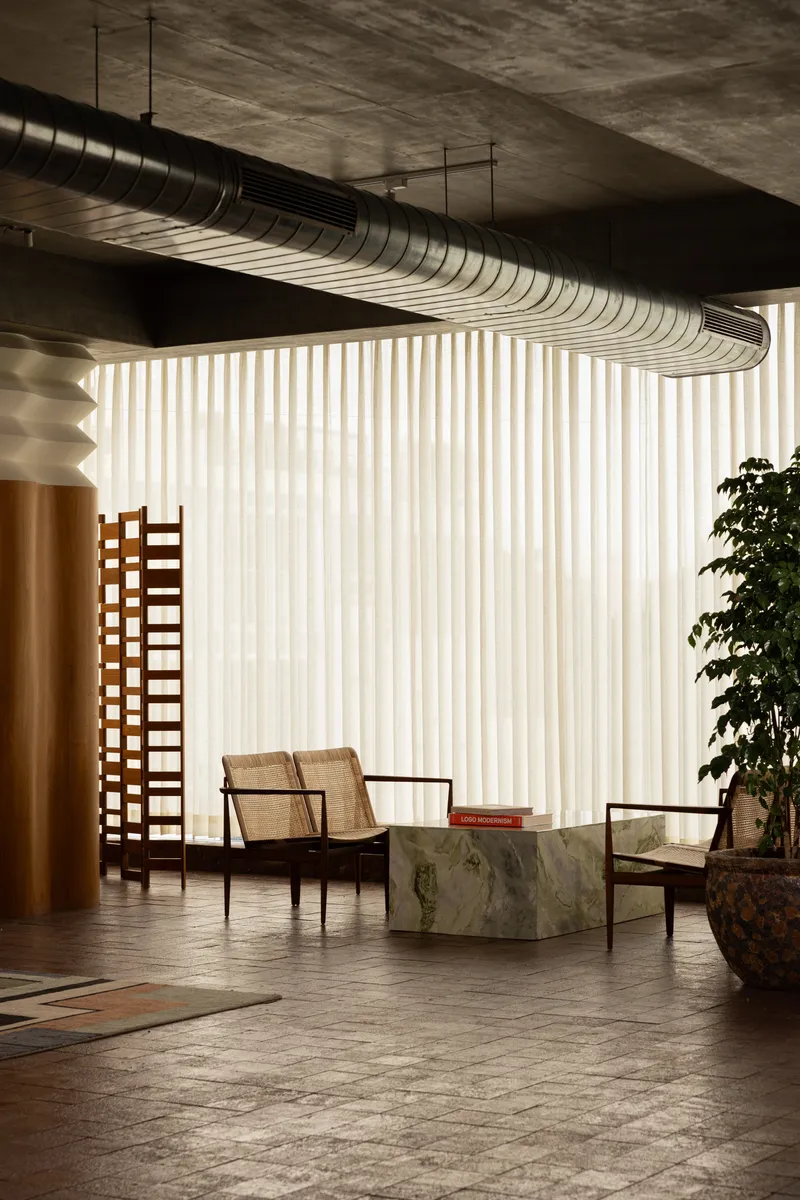
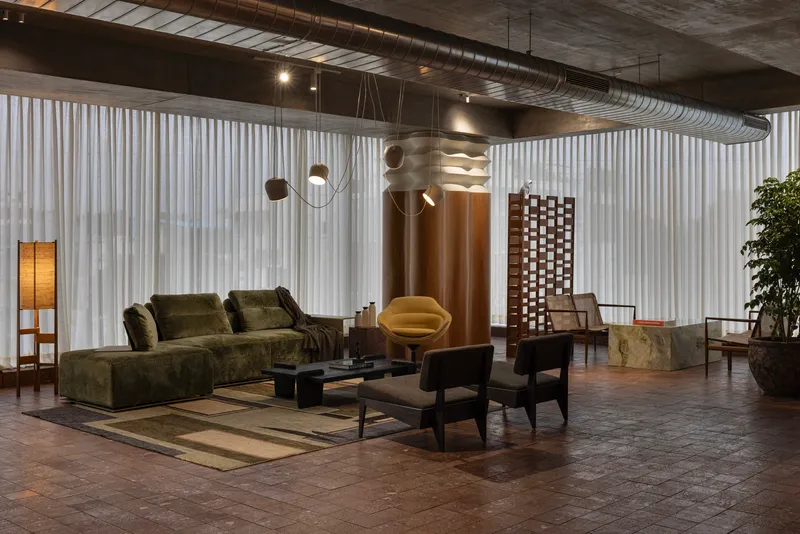
The ceiling is the most honest surface in the building. Board-formed concrete runs overhead without apology, its grain still legible, its exposed spiral ductwork threaded through like the circulatory system of some industrial organism. Against this raw backdrop, cylindrical bronze columns rise as deliberate counterpoints: warm, tactile, almost ornamental in their ridged profiles. The juxtaposition is pointed. Concrete speaks of weight and economy; brass speaks of craft and ceremony.
Pendant lights hang from draped cables at varying heights, introducing a softness the structure alone would never permit. The overall effect in the main lounge areas is of a generous, loft-like volume that refuses to declare whether it is a living room, a showroom, or a place of work. That ambiguity is the design's engine.
Thresholds That Don't Close
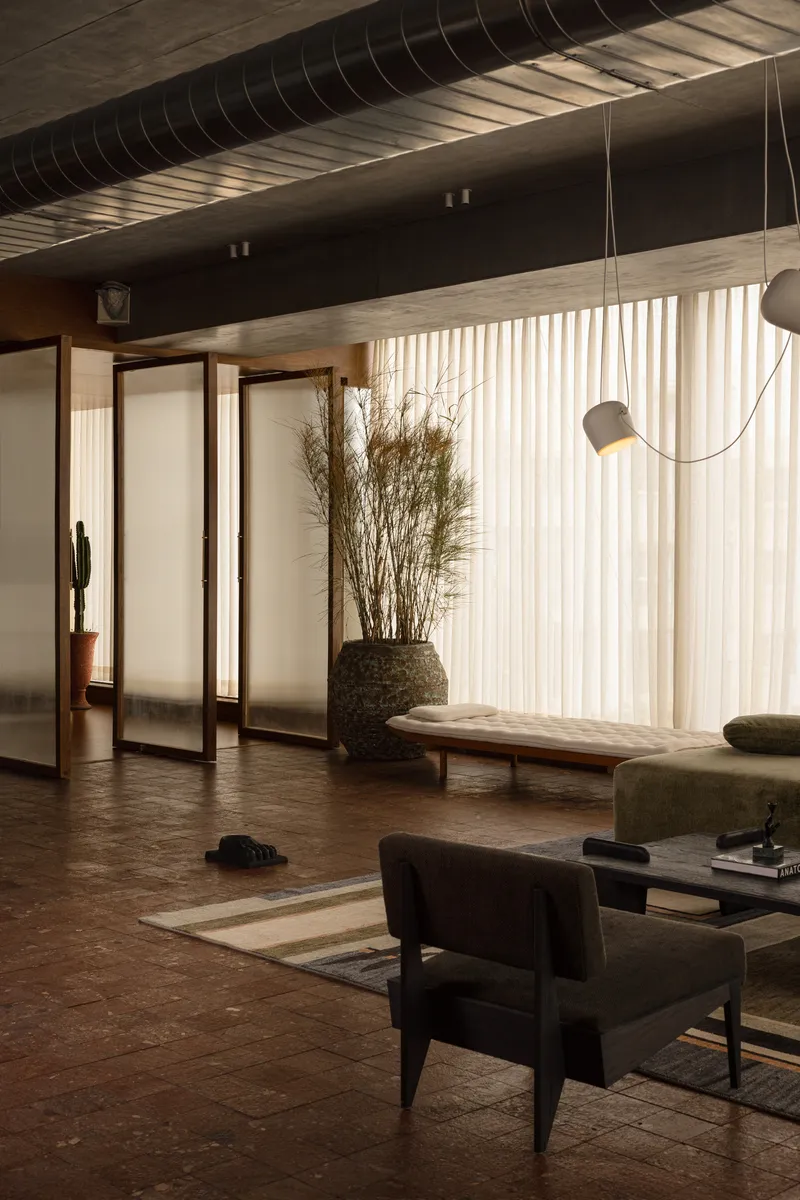
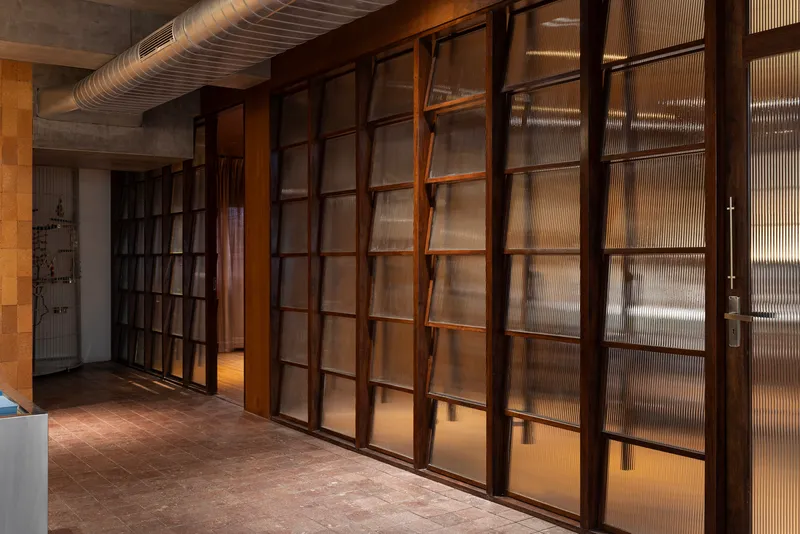
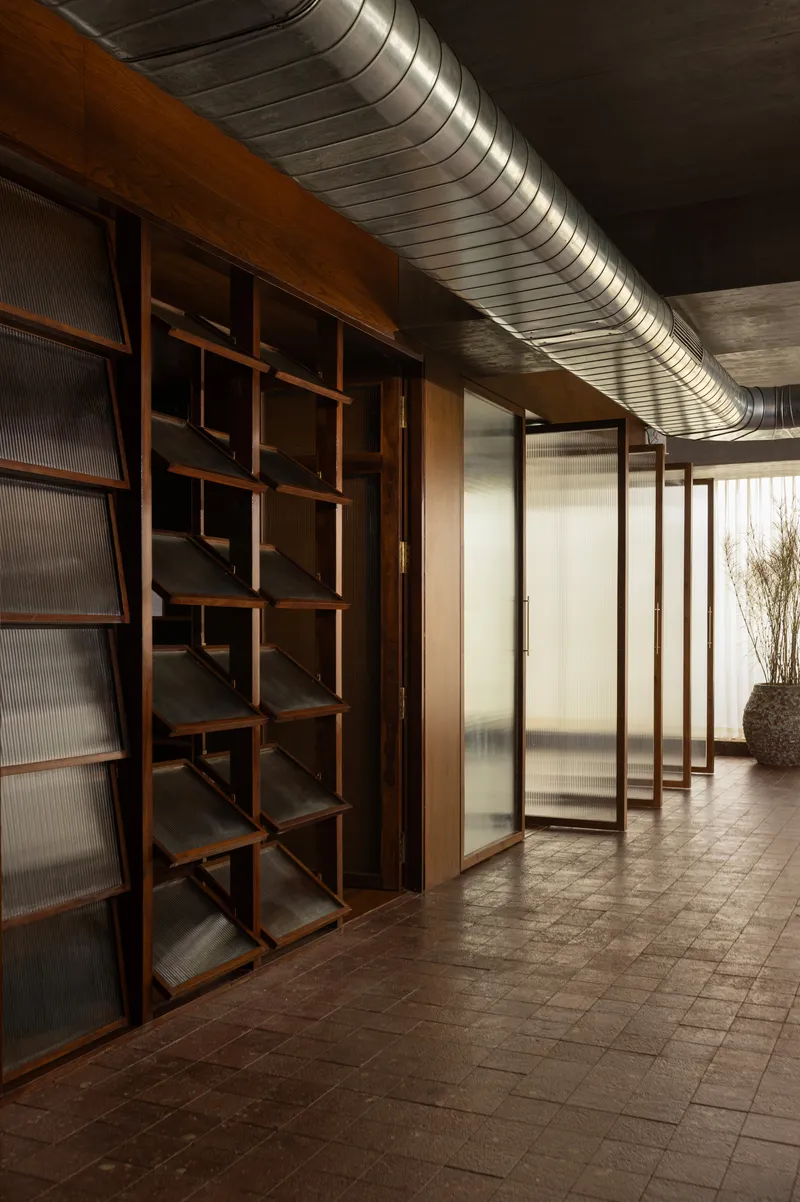
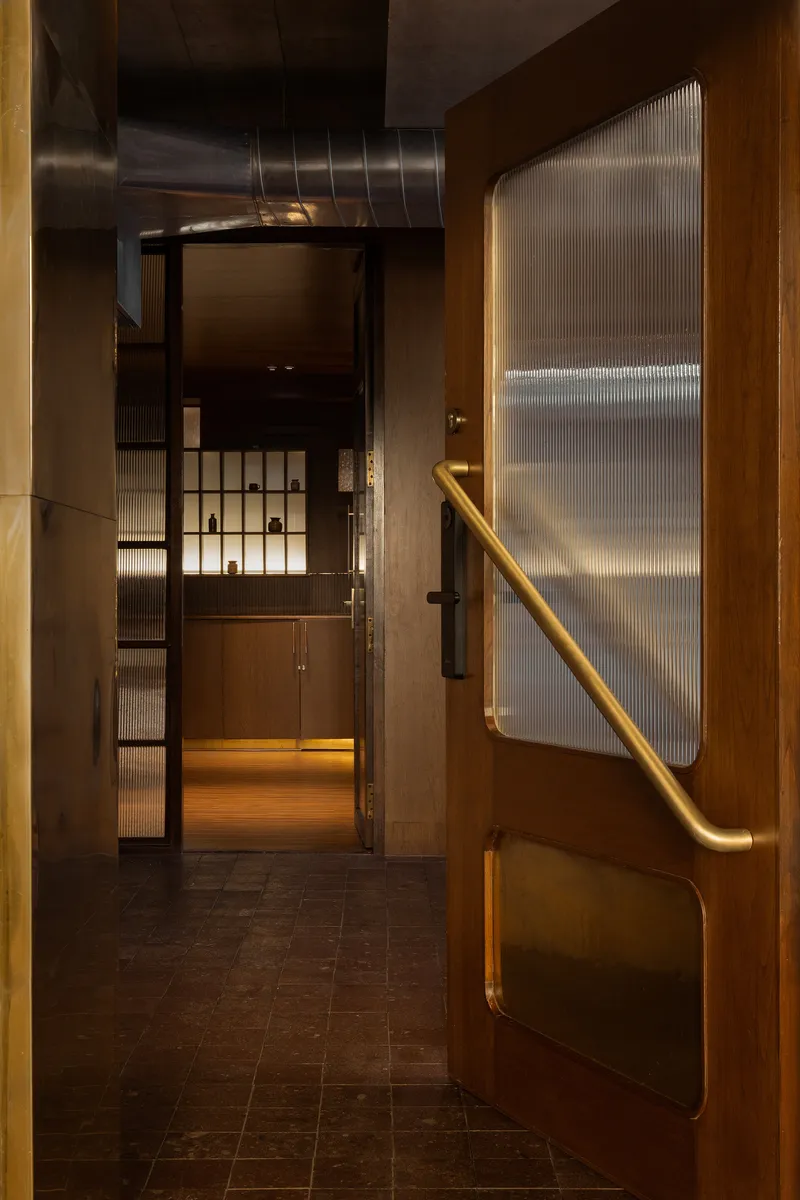
Billboards builds its partitions to suggest separation without enforcing it. Translucent sliding panels, timber-framed glass doors with reeded glazing, and geometric wooden shelving units all serve as thresholds that allow light and silhouette to pass through. Nothing slams shut. The corridor with its exposed ductwork ceiling and translucent glass partitions reads almost as a gallery, channeling movement while keeping sight lines open.
The translucent panels are particularly well handled. They filter daylight into soft, milky gradients, framing objects like the woven basket with its planted interior as if they were artifacts in a vitrine. This is architecture doing the work of curation: half-height pedestals and recessed wall niches share the same textures and construction methods as the surrounding surfaces, making every pause in circulation feel intentional rather than leftover.
Cork, Walnut, and the Material Argument
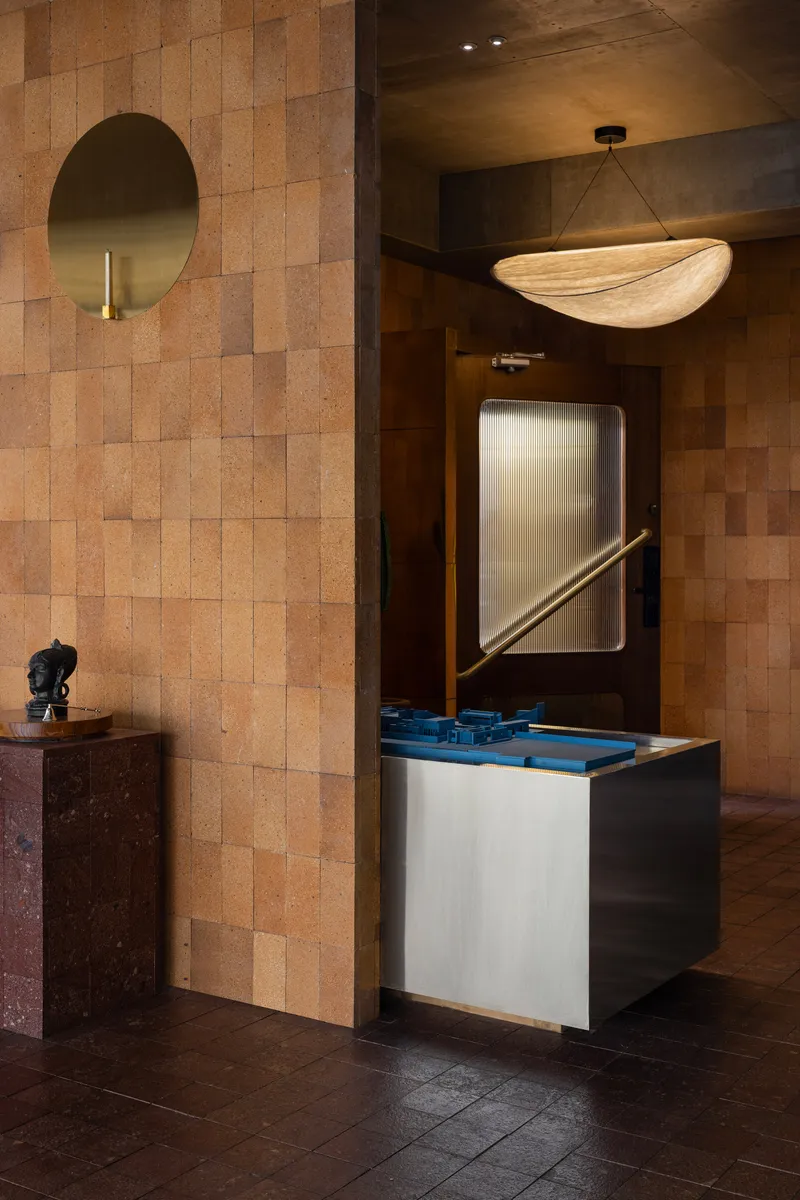
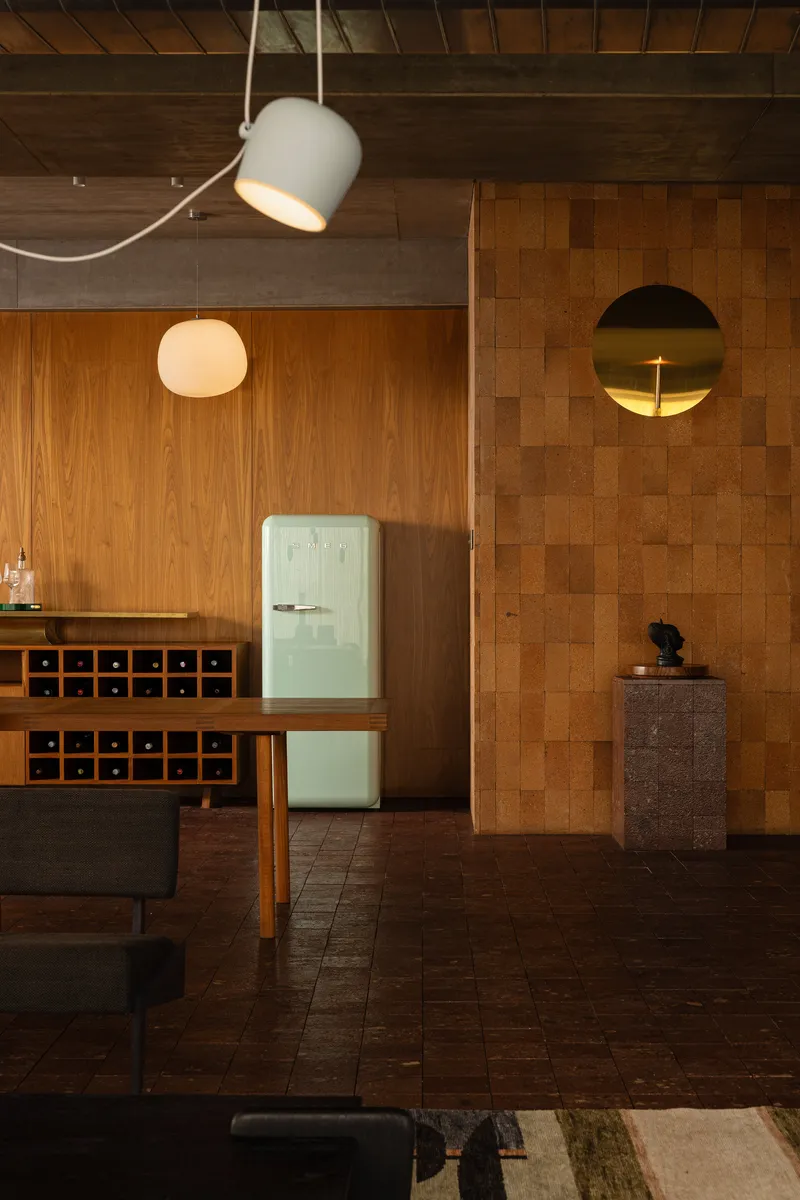
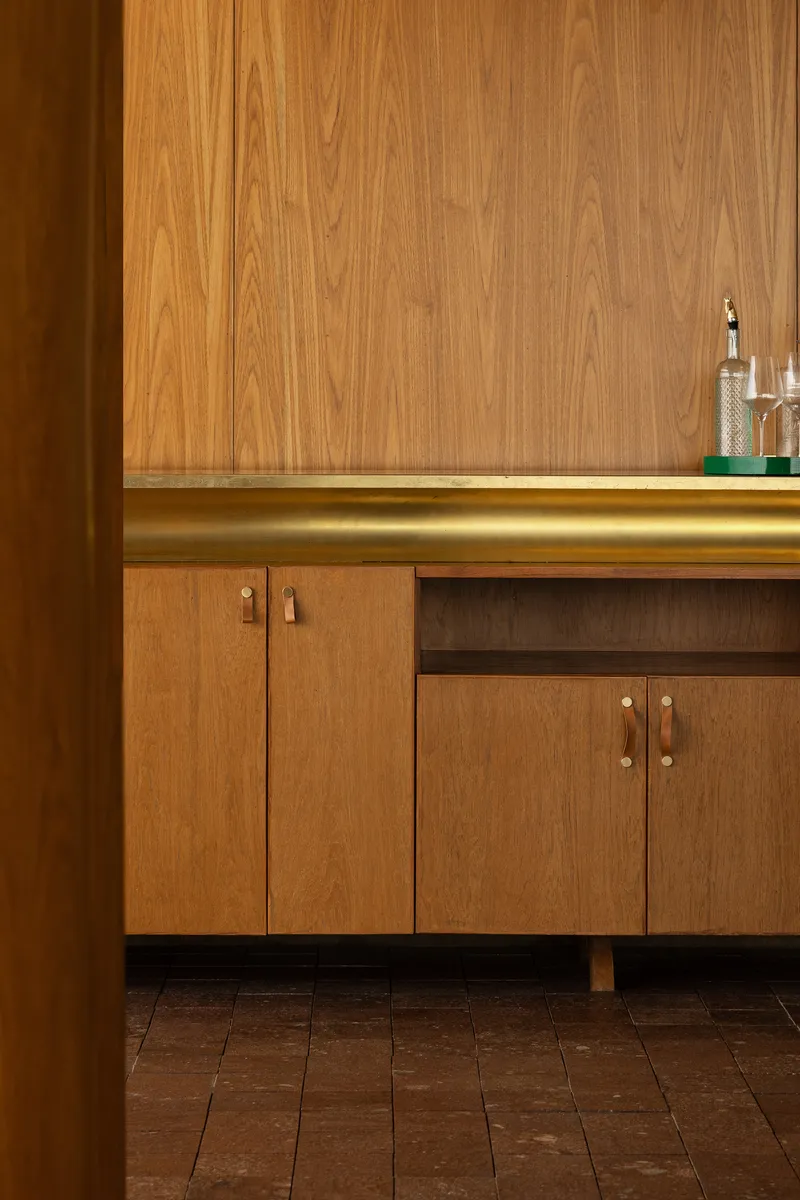
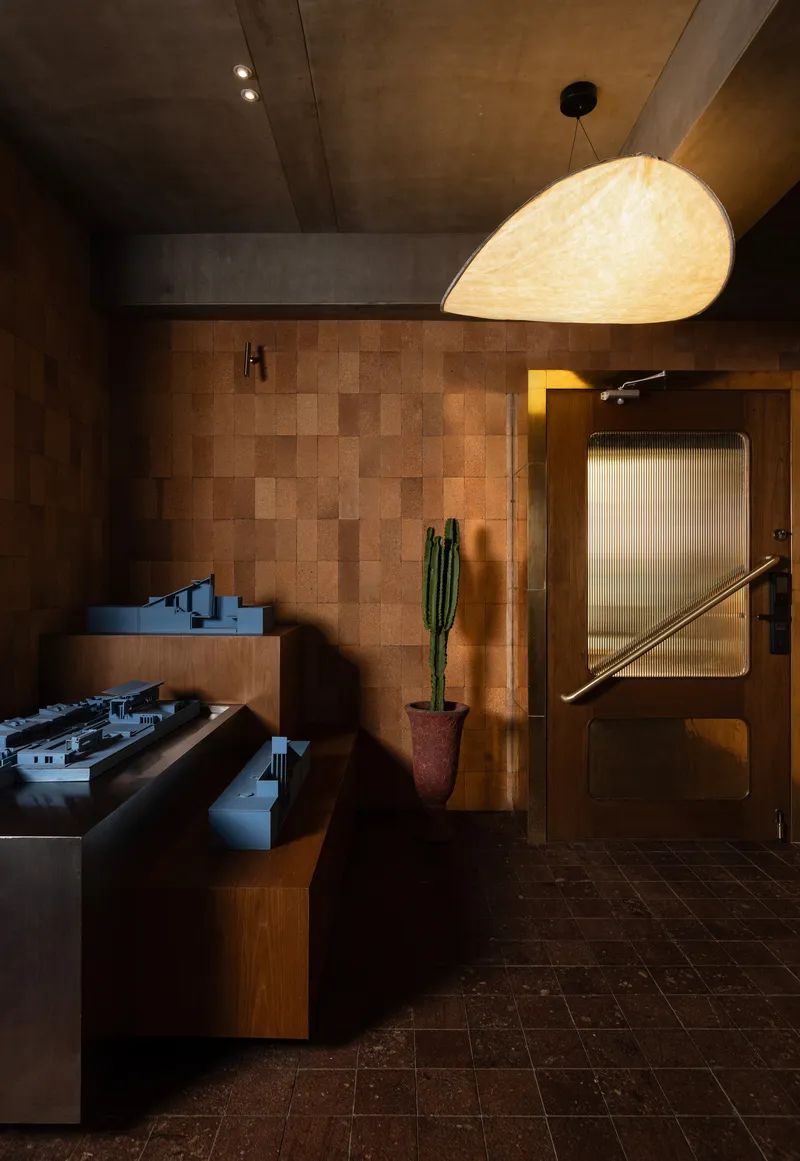
The entry nook establishes the palette immediately: cork tile walls, an oval brass mirror, a walnut bar with integrated LED strip lighting at the countertop. These are not decorative selections. Cork is warm and absorptive, cutting acoustic harshness in a building that otherwise celebrates hard surfaces. Walnut cabinetry with brass hardware signals a precision of joinery that asks you to look closely. The countertop lighting turns a functional bar into an object lesson in how millwork can hold attention.
This material layering carries a quiet argument about locality. Terracotta bricks appear elsewhere, stacked to form a small plinth with intentional gaps that let air and light through. The brass, forged into lotus bells that hang in a chain, honors a millennium-old tradition of metalwork from the subcontinent. Nothing here is imported wholesale from a global minimalism catalogue. Billboards roots its choices in clay and fire, in metal and hand.
Living Inside the Model Home
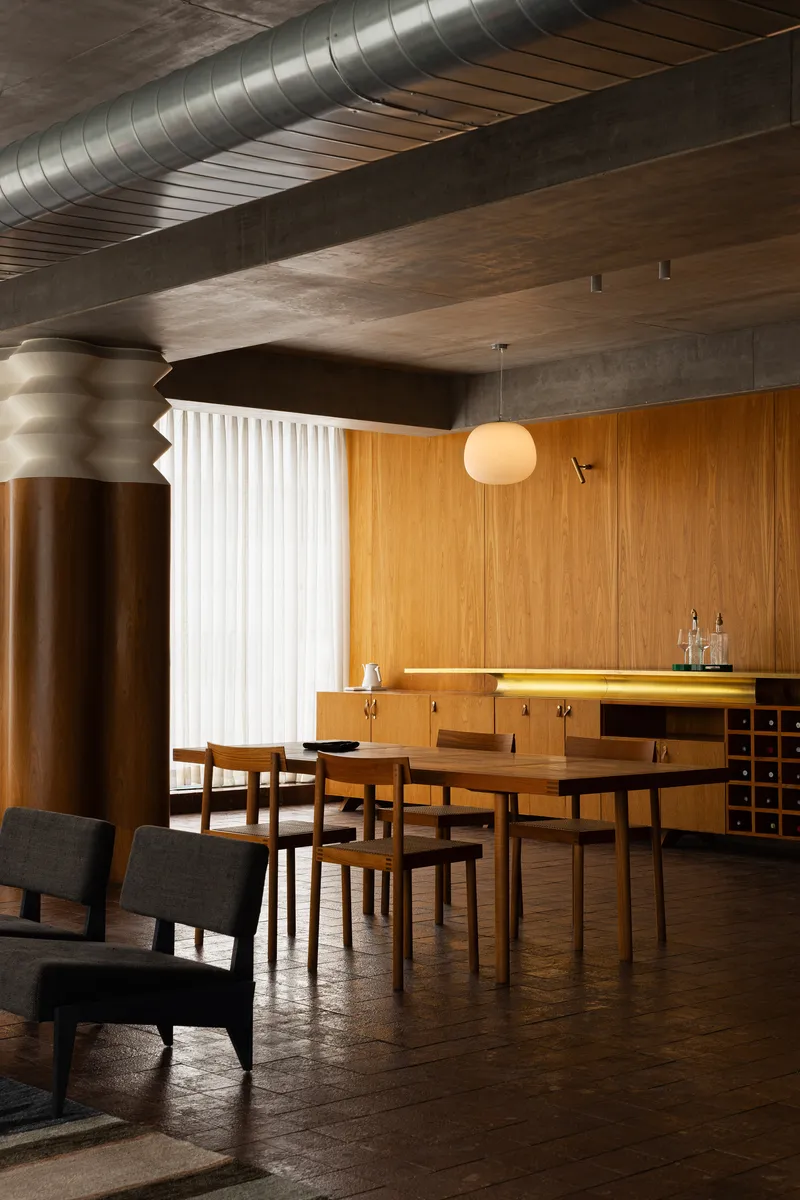
The dining and kitchen areas are where the manifesto gets most literal. These are sample residential units embedded within the office, rooms you could plausibly eat dinner in. The timber credenza, the spherical pendant light, the block-pattern timber wall behind the cooking island: they are furnishings for a life that hasn't started yet, staged not under showroom spotlights but under the same exposed ductwork that runs through the workspaces. The seamlessness is the point. You are never entirely sure whether you are visiting a home or visiting the idea of one.
Linear pendant lights over the dining table and carefully framed views through wooden doorways with fluted glass reinforce a sense of inhabitation rather than display. The kitchen island lit at dusk, with warm light falling across the timber, feels genuinely domestic. For a real estate client, seeing yourself in the space is the most powerful sales tool that exists, and Billboards delivers it without a single rendering on a wall.
Red Walls and Green Terrazzo
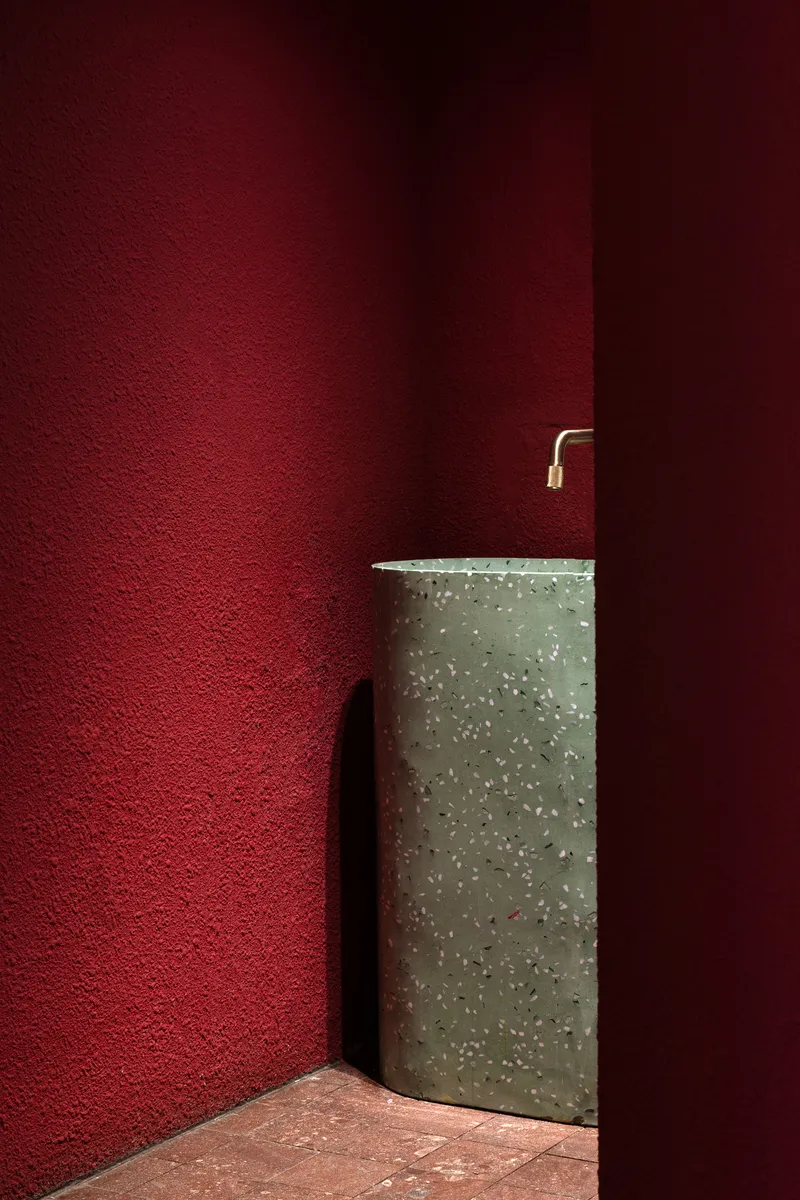
The washroom is a small detonation of color inside an otherwise restrained palette. A deep red plaster wall meets a terrazzo pedestal sink, and a brass wall-mounted tap completes the trio. Wine-red and green terrazzo is a combination that should, by most safe design logic, feel garish. Here it feels celebratory, almost sacred, recalling the painted walls of South Indian temple architecture more than any corporate powder room.
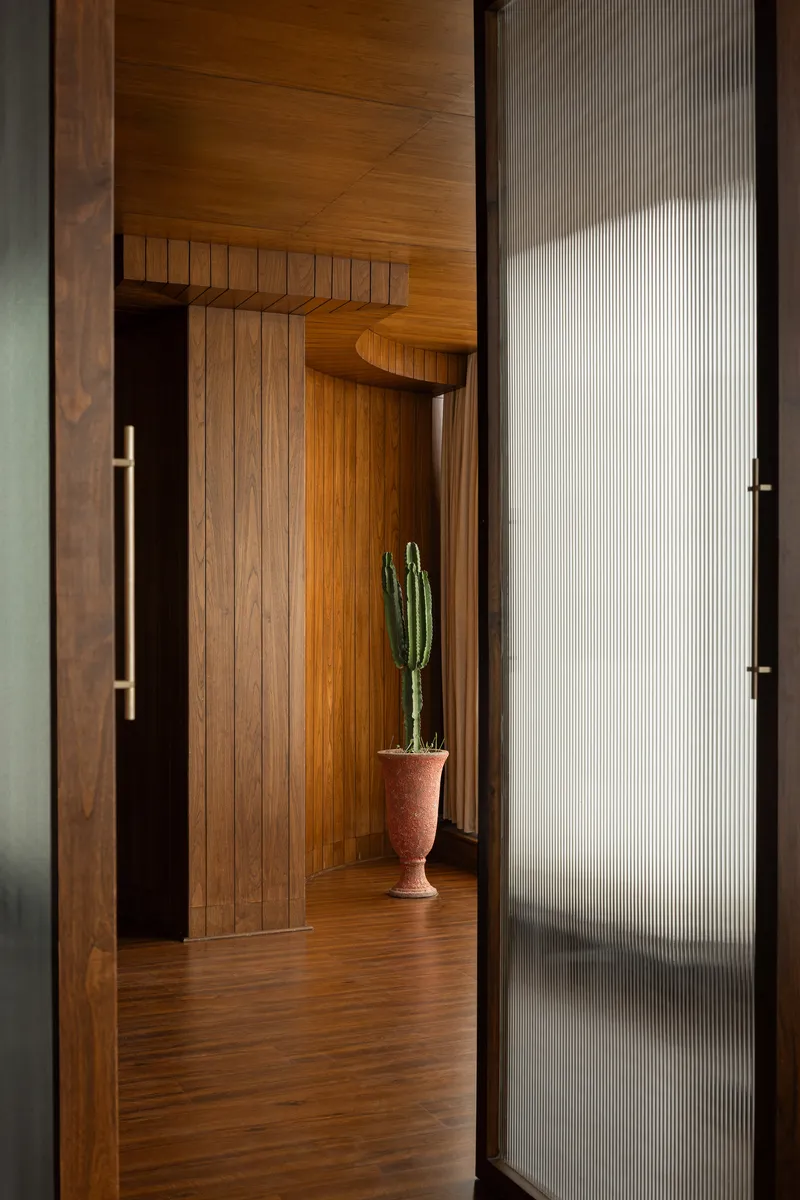
The passage leading to it, with its terracotta planter and fluted glass panel, acts as a decompression chamber between the main workspace and this intensely chromatic volume. It is a small proof of Billboards' larger thesis: that fundamental architectural gestures, stacking, gravity, the manipulation of light, can turn even a utilitarian program into something worth remembering.
Ritual Objects, Working Atmosphere
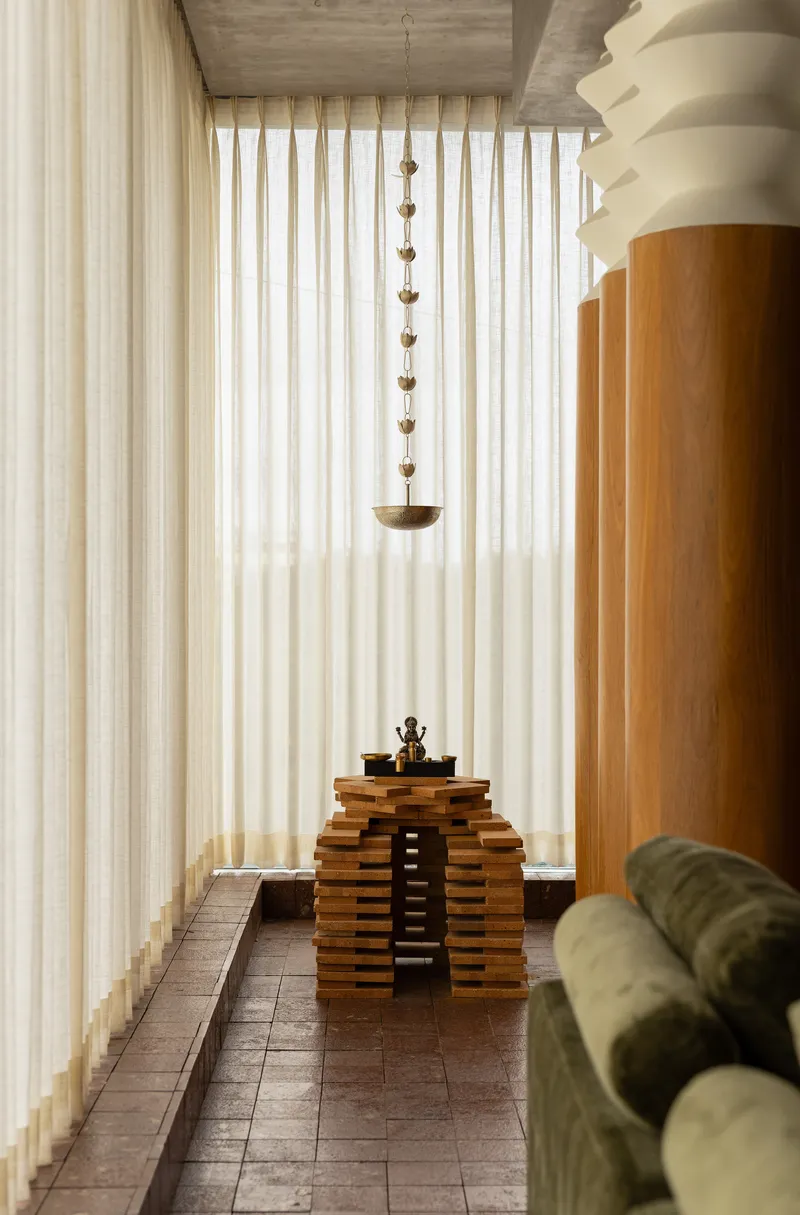
A narrow passage houses a tiered timber altar beneath a suspended brass pendant, flanked by a vertical curtain wall. It is not a conference room or a reception desk; it is something closer to a shrine, a deliberate pause in the plan that acknowledges ritual as part of daily life. The brass lotus bells mentioned in the design concept likely find their home here, connecting craft tradition to the workplace without irony.
In the lounge areas at evening, suspended geometric pendant lights glow against the concrete ceiling like lanterns in a courtyard. The exposed spiral ductwork and fabric curtains filtering natural light create a layered atmosphere that shifts by the hour. Morning is sharp and productive; dusk is warm and contemplative. The architecture does not need a mood setting on a thermostat. It has one built in.
Work Zones That Breathe
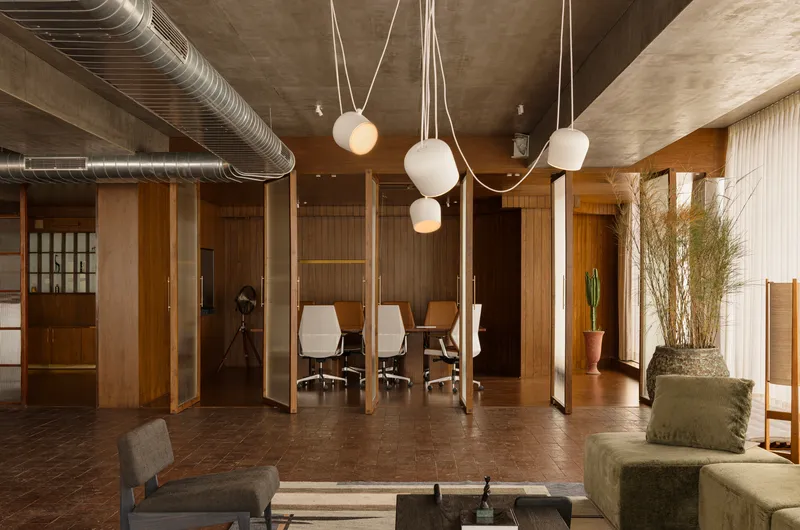
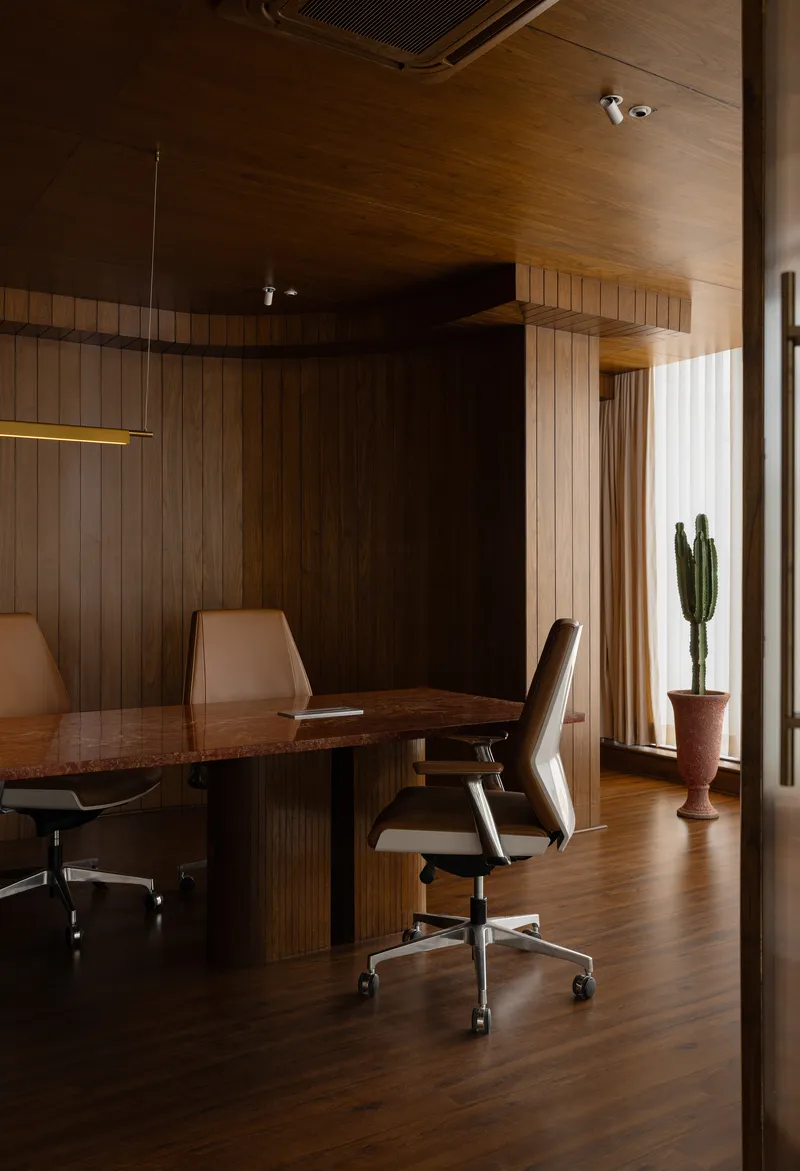
The actual workspace occupies a glass-walled meeting room flanked by clusters of globe pendants and potted grasses by the curtains. It is generous without being ostentatious, open enough to feel connected to the exhibition spaces but enclosed enough to host a focused planning session. The board-formed concrete ceiling continues overhead, maintaining visual continuity with the rest of the building.
A passageway with a brass handrail on a timber-framed door connects the working and exhibition zones, reinforcing the idea that movement through the building is itself a form of engagement. There is no back-of-house here, no staff corridor hidden behind drywall. Every passage is designed to be experienced, which is either a generous spatial philosophy or an exhausting one, depending on your tolerance for architecture that refuses to turn off.
Plans and Drawings
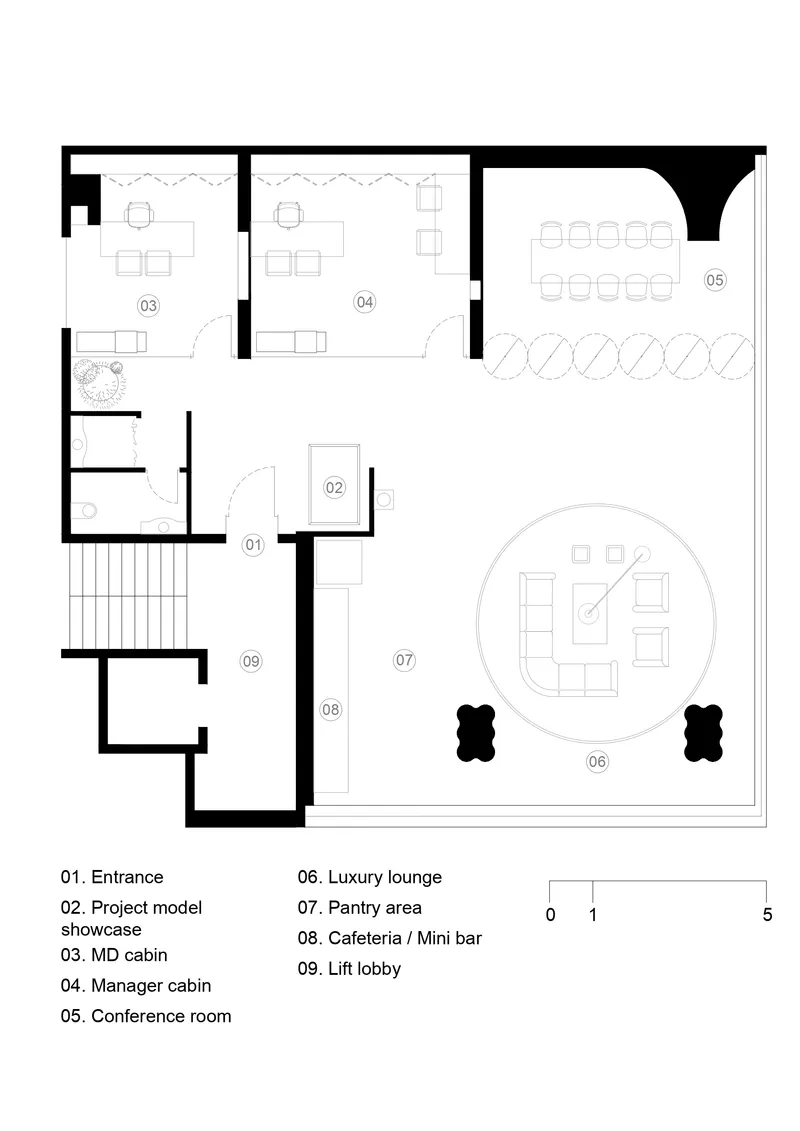
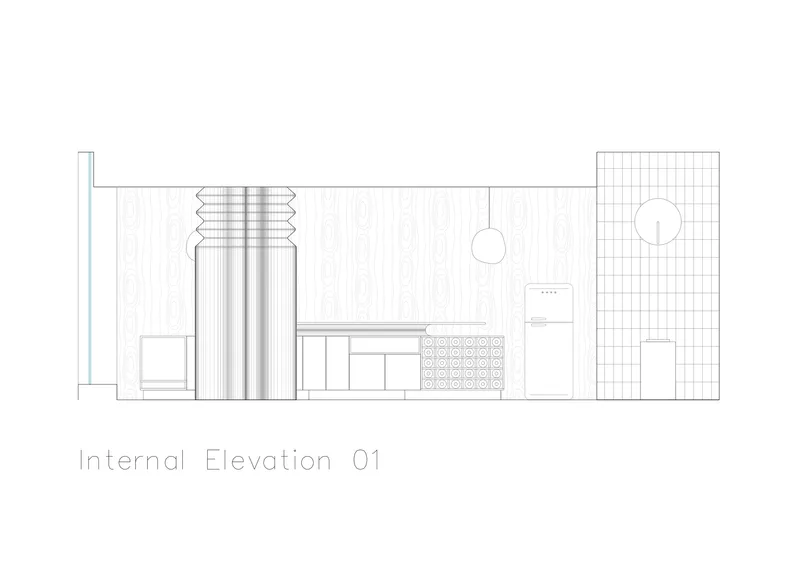
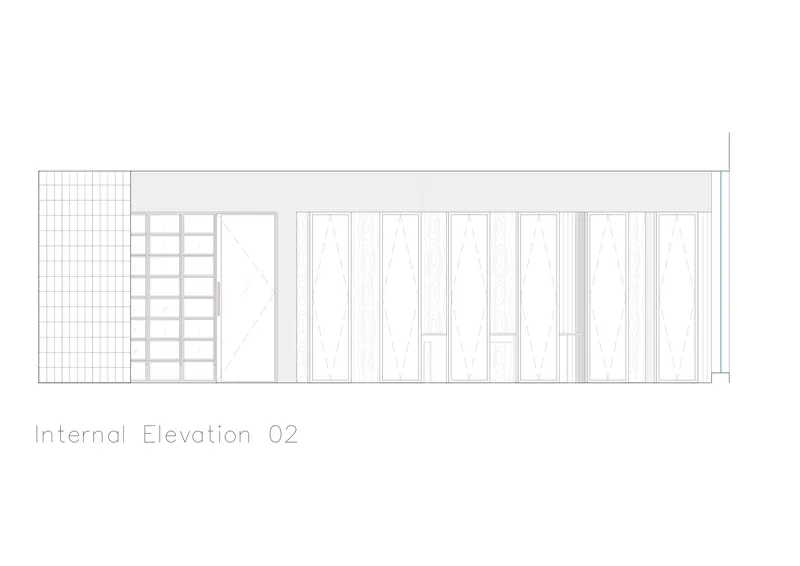
The floor plan confirms what the photographs suggest: a non-linear sequence of rooms organized around an entrance lobby that opens to work cabins, a conference room, and a circular luxury lounge. The circular element is a deliberate social attractor, pulling the plan away from corridor logic toward something more gravitational. Internal elevations reveal the care taken with surface transitions: wood paneling meets decorative tile backsplash, vertical wood slats butt against tiled surfaces, and every junction is drawn with the precision of furniture rather than construction.
These drawings also make clear how much of the design's character comes from layering rather than form-making. The plan is not particularly dramatic in outline. Its power comes from the accumulation of material decisions at every wall face and every threshold, a strategy that rewards slow reading more than an aerial photograph.
Why This Project Matters
Landforms matters because it treats a commercial brief as an intellectual opportunity rather than a fit-out exercise. Billboards could have delivered a polished office with some nice material samples on a shelf. Instead, the studio dissolved the boundary between the office and the product it sells, creating a space where work, exhibition, and habitation overlap without any one function dominating. For a real estate company, this is the most honest possible architecture: a building that is simultaneously the pitch, the prototype, and the proof.
The material choices, rooted in local craft and tradition but assembled with contemporary discipline, offer a model for how Indian commercial interiors can resist the pull of imported minimalism without retreating into nostalgia. Terracotta, brass, cork, walnut, and board-formed concrete form a palette that is specific to its place and moment. In a city growing as fast as Bengaluru, where offices tend to be either aggressively global or reflexively traditional, Landforms occupies rare and valuable middle ground.
Landforms Office by Billboards (lead architects Arun Prabhu N G and Vincy Victor), Bengaluru, India, completed 2025. Photography by Phosart Studio.
About the Studio
Share Your Own Work on uni.xyz
If projects like this are the kind of work you want to make, uni.xyz is a place to publish your own, find collaborators, and enter design competitions.


Popular Articles
Popular articles from the community

Extended Shell: Retrofitting Kolkata's Balconies as Living Urban Thresholds
A modular retrofit system recovers the social and environmental intelligence of Kolkata's historic verandas for contemporary Park Street residents.

Singing Woman: An Opera House That Performs Before the Curtain Rises
Ovidiu Cristian Pavel's conceptual opera house translates Estonia's choral identity into a sculpted waterfront landmark facing the Baltic Sea.
Faces of the Soviet Avant-Garde: Turning Moscow's Street Names into an Open-Air Museum
A network of sculptural installations across a Moscow residential district transforms forgotten architect names into spatial encounters with cultural memor
Tsunami Convergenics: Turning Catastrophic Ocean Forces into Underwater Housing Infrastructure
A speculative underwater settlement off the coast of Onagawa, Japan, treats tsunamis and typhoons as energy sources rather than threats.

Similar Reads
You might also enjoy these articles

Pixel Gardens: One Repeated Module Stacked Into a Terraced Social Housing Tower for Famagusta
Salem Bader's shortlisted housing tower builds a vertical neighbourhood from one repeated module, offsetting units to carve terraces, light and air.

Bao Huynh Watercolor Atelier: A Serene Art Retreat in Hội An
Bao Huynh Watercolor Atelier in Hội An blends multifunctional art spaces, sustainable design, local materials, and family-friendly living in a serene environment.

Atelier Macri Concept Store Interior Design by CASE-REAL
Atelier Macri store features a "ko" counter, walnut wood details, cork displays, blending retail, gallery, and seamless customer experiences.

Manuel Vargas Izquierdo Stadium and High-Performance Sports Center: Architectural Excellence in Jalpa de Méndez
The Manuel Vargas Izquierdo Stadium blends sustainable design, inclusive sports facilities, and cultural-inspired architecture, revitalizing Jalpa de Méndez’s public spaces.


Comments (0)
Please login or sign up to add comments
No comments yet. Be the first to comment!