
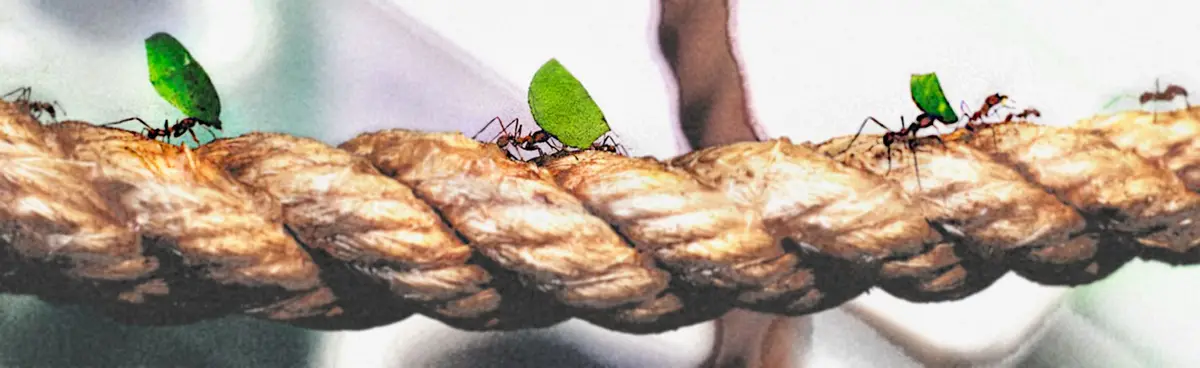
Biomimetics: Bamboo Aqueducts as Flood Lifelines for Kerala
A community-driven system of elevated bamboo refuges parasitizes existing infrastructure to prepare Kerala for the next deluge.


What if the infrastructure meant to carry water could also save people from it? Biomimetics reinterprets the aqueduct, not as a relic of Roman engineering, but as a multi-functional spine for flood-prone communities. Bamboo boxes, each sized for a single family, latch onto elevated platforms along these structures, turning them into collective refuges that rise above the floodline. The logic is disarmingly simple: plant the material before the crisis, build the shelters before the rain, and let the community do both.
Designed by Pol Miret and shortlisted for the HEAL+ competition, the project responds directly to the devastating floods that have repeatedly struck Kerala. Rather than proposing a top-down relief apparatus, Biomimetics roots itself in local labor, local knowledge, and a single renewable material: bamboo. The Kerala State Bamboo Mission provides the initial seed, nursery plants, manuals, and tools, but from that point forward the system belongs to the people who build it.
Prevent and Anticipate: Four Pillars Against Disaster
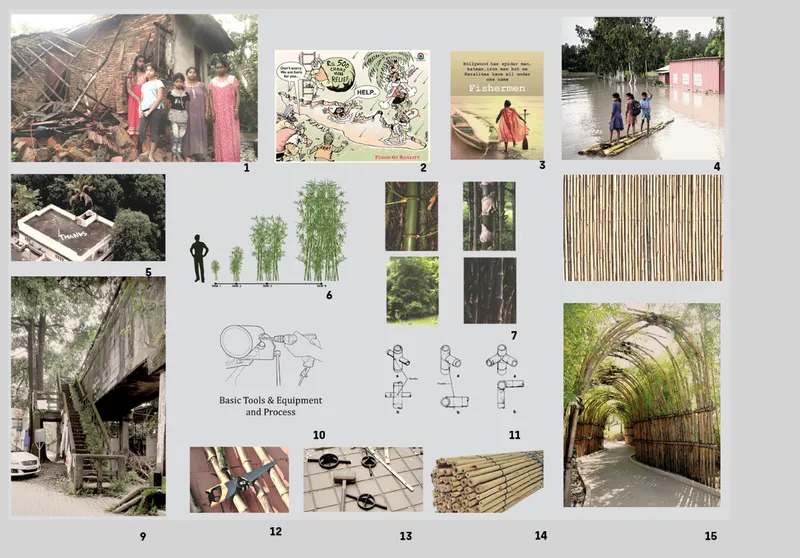
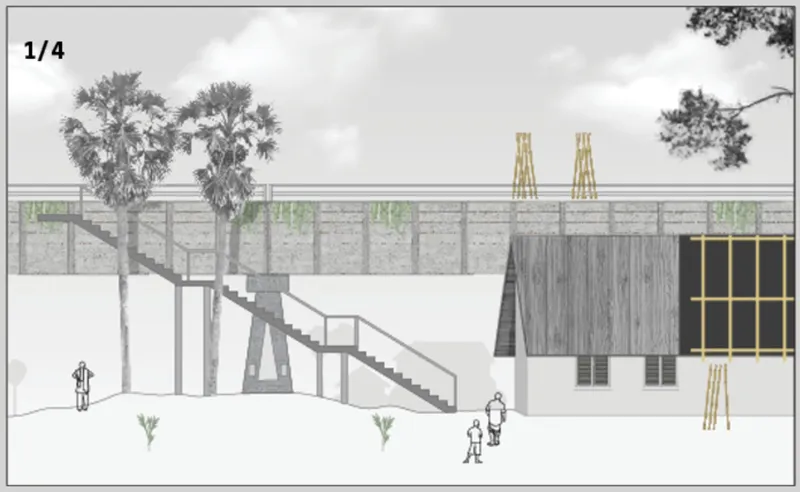
The presentation board lays out the full material and constructive logic: bamboo beams, bamboo walls, bamboo floats. Everything traces back to a fast-growing plant that can be cultivated in public areas and near homes. The accompanying section drawing reveals how the elevated platform works spatially, with timber structures sitting above potential flood levels while a stairway provides vertical escape. Palm trees punctuate the scene as a reminder that this is landscape as much as architecture.
Miret organizes the design philosophy around four interlocking pillars. Refuge and Transport positions aqueduct-inspired structures as evacuation lifelines. Faster and Together connects community refuges via boats, trucks, and helicopters. Existing and Beforehand parasitizes and adapts existing infrastructure rather than building from scratch. Community and Inside-Out ensures local knowledge and raw materials form the backbone of every intervention. Together, these principles describe a decentralized, low-tech system that scales through replication, not centralization.
Bamboo Boxes on the Aqueduct Spine
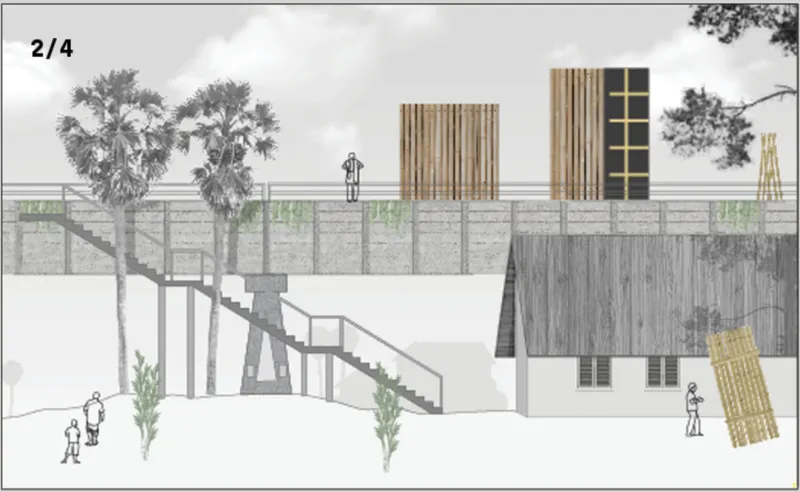
The section drawing showing bamboo volumes on a raised platform captures the core architectural move. Workers assemble modular units on a concrete base, with diagonal staircases providing access. Each box represents one family, and each box is designed to be constructed by that family using bamboo harvested from nearby plantations. The construction sequence shown in the drawing is critical: this is architecture that teaches through making, with the assembly process itself building community capacity.
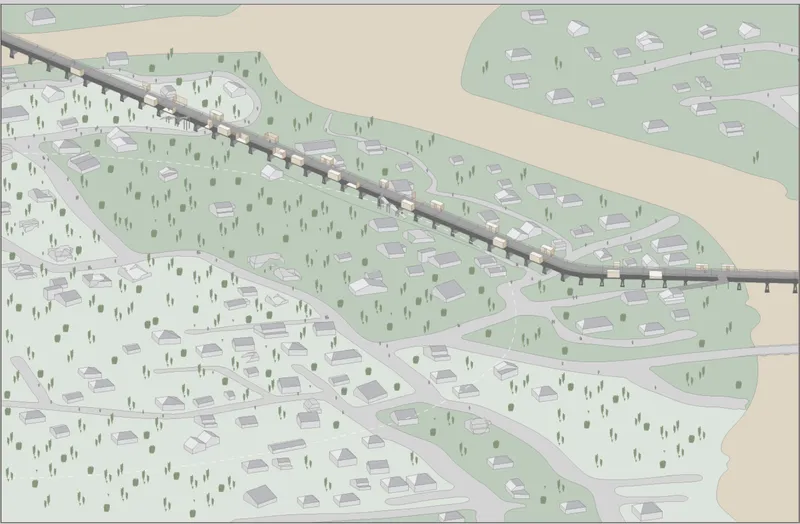
The axonometric settlement view pulls back to show how these clusters organize across terrain. A curved roadway divides residential groups on a green hillside, with scattered trees maintaining ecological continuity. The layout is neither grid nor sprawl but something closer to a village pattern, where proximity fosters the cooperation that the project depends on. During a flood, these clusters function as interconnected nodes; during calm periods, they are simply homes.
Screens, Stilts, and the Space Between Ground and Shelter
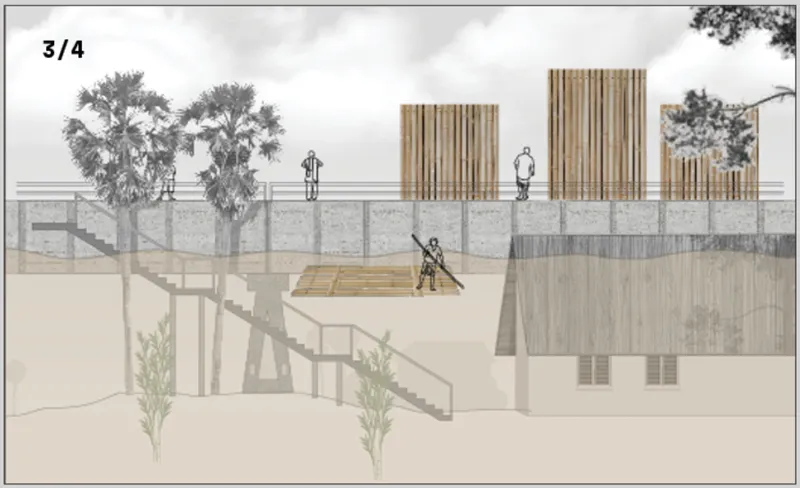
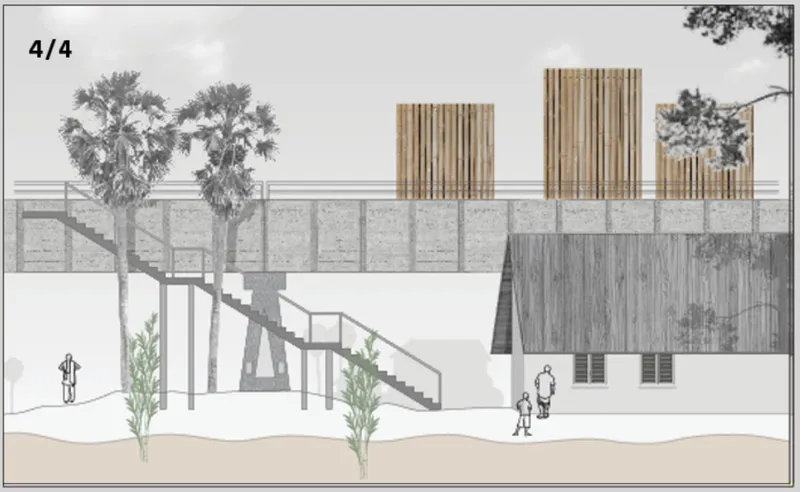
Two section drawings detail the tectonic vocabulary at close range. In one, a worker stands on a bamboo platform framed by vertical screen elements rising above a concrete base. The screens do double duty: they filter light and air while providing structural bracing. In the other, stilt houses with bamboo screens and external staircases demonstrate how the system adapts to different conditions. The stilts lift living space clear of flood waters, while the external circulation keeps the interior volume uninterrupted.
What holds both drawings together is the relationship between heaviness and lightness. The concrete base anchors the structure against floodwater forces. Everything above it, the bamboo frames, the woven screens, the lightweight floor plates, is buoyant by nature. Bamboo's natural buoyancy is not incidental here; it is structural insurance. If the water rises past the platform, components can detach and float, serving as emergency rafts or supply boats.
Scaling Beyond Kerala: A Linear Settlement Model
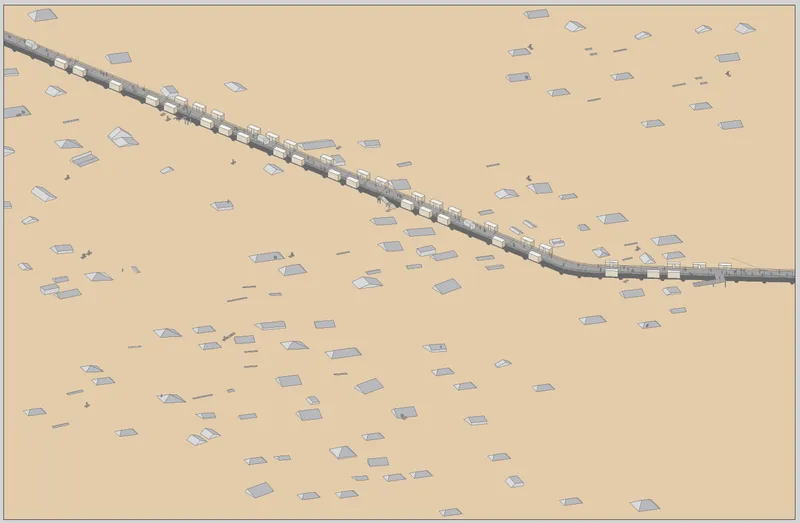
The final axonometric drawing strips the system to its most abstract form: a linear settlement of clustered structures extending across open terrain. The shift from Kerala's lush hillside to what reads as arid, flat ground is deliberate. It argues that the bamboo aqueduct model is not site-specific but transferable. Flood-prone regions around the world face the same convergence of displacement, vulnerability, and inadequate infrastructure. The modularity of the bamboo box, the parasitic logic of latching onto existing infrastructure, and the community-driven construction process all travel well.
Why This Project Matters
Biomimetics matters because it reframes disaster architecture as something communities do for themselves, not something done to them. The project does not arrive with a fleet of trucks and prefabricated panels. It arrives with bamboo seedlings, a manual, and the assumption that people who have survived floods before know something about surviving floods again. The Kerala State Bamboo Mission catalyzes the process, but ownership remains local. That distinction between catalyst and controller is where the design's real intelligence lies.
Miret's proposal also challenges the temporal logic of most disaster response: act after the event. By planting bamboo along streets and integrating refuges into existing infrastructure well before the monsoon, the project collapses the gap between preparedness and architecture. The aqueduct is not a monument to engineering. It is a scaffold for collective survival, built from the ground up with a material that grows back every year.
View the Full Project
About the Designers
Designer: Pol Miret
Enter a Design Competition on uni.xyz
uni.xyz runs architecture and design competitions year-round that reward proposals with spatial conviction and real site intelligence.
Project credits: Biomimetics by Pol Miret HEAL+ (uni.xyz).


Popular Articles
Popular articles from the community


David Ortega Stacks a Two-Story Mexico City Penthouse Around a Steel Stair and a Pergola-Shaded Roof Terrace
In Colonia Roma, a 300 m² penthouse uses oak joinery, a planted steel stair and a slatted roof pergola to make a new-build apartment feel like a house.

FCC Arquitectura Expands a Portuguese Granite House with a Board-Marked Concrete Wing
In Portugal, JV House pairs a cleaned-up whitewashed and granite dwelling with a timber-shuttered concrete extension, courtyards and a garden pool.

Cube Design Draws an Ecological Corridor Between Two Shenzhen Hills with the Nankai Building
Beside Shenzhen's container docks, the Nankai Building pairs stacked balconies with a climbing green screen to connect two hillsides across its height.


The Amber Palace Opera: A Geological Fiction Surfaces on Tallinn's Baltic Waterfront
Pierre Brillard reimagines a Baltic legend as a public landscape, opera house, and waterfront promenade rooted in Tallinn's coastal identity.

Similar Reads
You might also enjoy these articles
Cube Design Draws an Ecological Corridor Between Two Shenzhen Hills with the Nankai Building
Beside Shenzhen's container docks, the Nankai Building pairs stacked balconies with a climbing green screen to connect two hillsides across its height.

Praksis A and Studio Sted Bend a Red Timber Cabin Across the Granite of Norway's Southern Coast
On the southern Norwegian coast, a 105 m² cabin follows the rock on slender posts, pairing red cladding outside with pine, brick and plywood within.
David Ortega Stacks a Two-Story Mexico City Penthouse Around a Steel Stair and a Pergola-Shaded Roof Terrace
In Colonia Roma, a 300 m² penthouse uses oak joinery, a planted steel stair and a slatted roof pergola to make a new-build apartment feel like a house.

PARALELA and LB2 Thread a Public Walkway Through the Base of a Las Condes Residential Tower
In Las Condes, Santiago, the Hamlet Building gives its fenceless ground floor to a 70-metre wooded passage linking two streets and the metro.

Comments (0)
Please login or sign up to add comments
No comments yet. Be the first to comment!