

Tahvonlahti Peruskoulu: A School Designed as a Living Micro-City in Helsinki
Biophilic design meets civic architecture in a comprehensive school where students grow food, build community, and learn through nature.


What if a school functioned less like an institution and more like a small city? Tahvonlahti Peruskoulu takes that question seriously. Designed for a site in Helsinki's Tahvonlahti district, the comprehensive school organizes itself around a common square, with classrooms radiating outward like city blocks, a sunken amphitheater acting as the civic heart, and a greenhouse that transforms into a weekly farmers' market. The architecture treats education as something rooted in physical engagement: growing food, building with your hands, cooperating with neighbors.
The project was designed by Avik Bal and shortlisted in the Learn Better competition. Starting with capacity for 160 students and designed to scale up to 350, the school embeds biophilic principles into every layer of its organization, from the south-east oriented classrooms that capture early morning light to the outdoor farming patches and play areas that blur the line between curriculum and landscape.
A Horizontal Timber Facade That Settles Into the Landscape
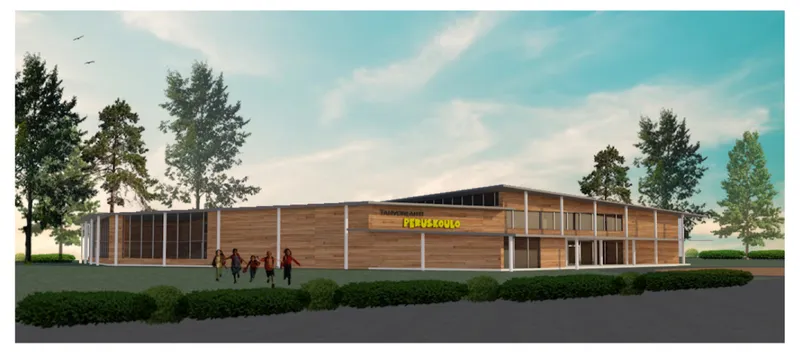
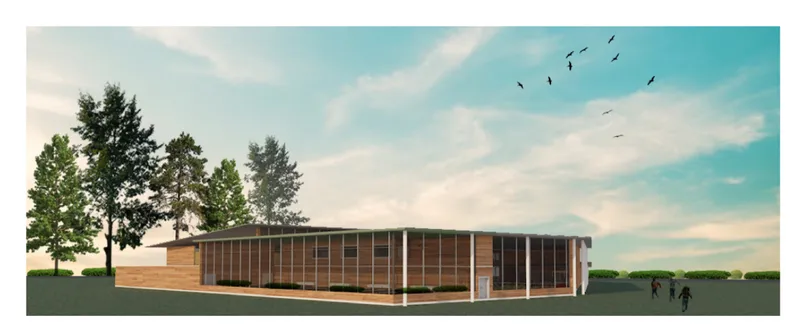
The building reads as a low, deliberate presence against Helsinki's green periphery. Timber cladding wraps the facade in warm, horizontal lines, punctuated by white structural columns that lend rhythm without asserting dominance. The massing stays modest, a single story rising gently above the lawn, refusing the institutional bulk that so many school buildings default to. People walk along the grass as if approaching a park pavilion rather than a place of compulsory attendance.
From the corner view, the interplay of glass and timber becomes clearer. Generous glazing opens classrooms to the surrounding landscape, while the roofline keeps low enough to avoid competing with the tree canopy. It is a building designed to be part of its site, not placed on it. The 150 bicycle parking slots and battery-operated school minibus reinforce this commitment to an architecture that takes ecological mobility as seriously as spatial quality.
Vertical Louvers and the Rhythm of Repetition
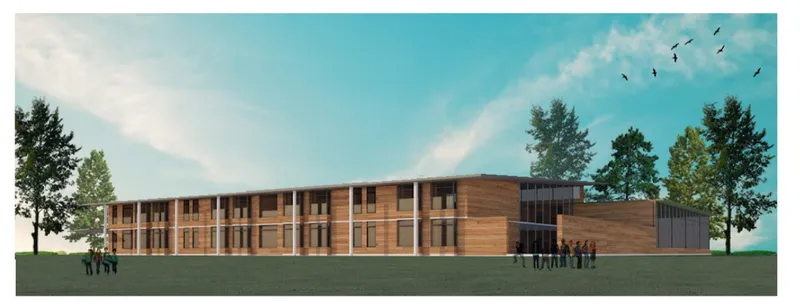
The longitudinal elevation reveals a second, finer grain to the facade: repetitive vertical timber louvers that modulate daylight and give the building a textile-like quality when seen at length. These louvers are not decorative. With classrooms oriented to the south-east for maximum morning light exposure, the vertical elements become passive solar tools, filtering glare while maintaining the connection to outdoors that biophilic design demands. Figures gathered on the grass in front of the elevation suggest the school's permeability; there is no hard boundary between learning space and open ground.
Three Levels of Program, Organized as a Civic Diagram
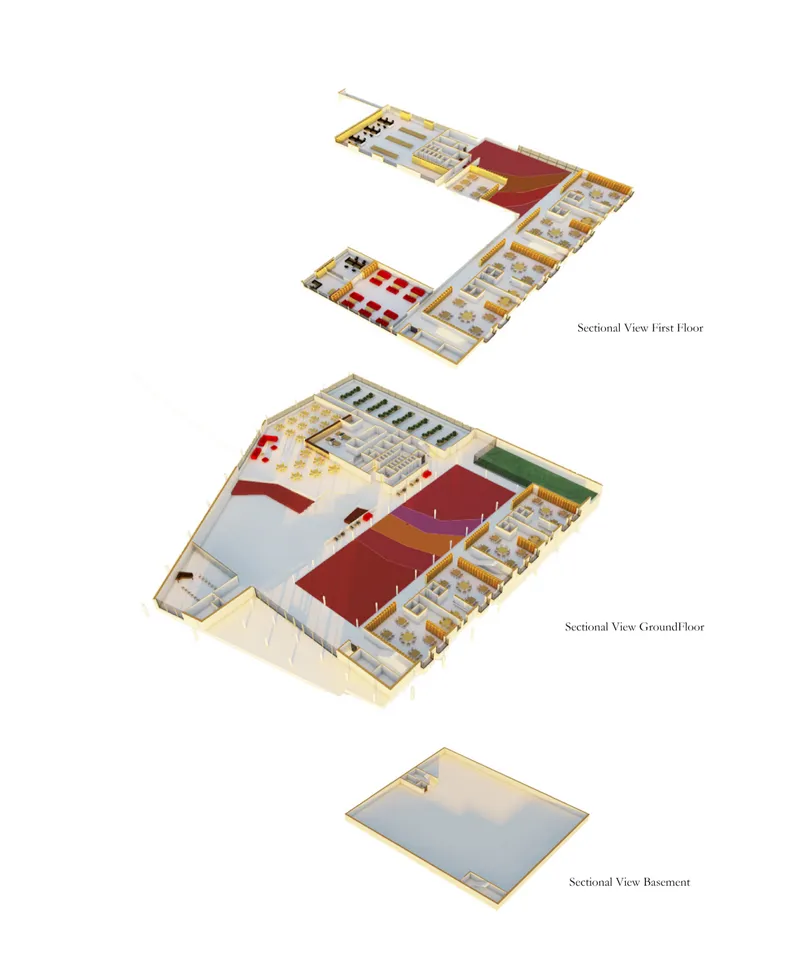
The exploded axonometric drawing lays bare the school's organizational logic. The ground floor holds four classrooms, each scaled for 20 students, arranged around a central sunken space called "The Arena." This amphitheater-like zone serves as stage, gathering area, and, on Fridays, a marketplace where students sell vegetables grown in the adjacent greenhouse. The cafeteria sits next to the greenhouse, tying nourishment to cultivation in a single spatial gesture.
Below ground, technical and service areas are tucked into the basement, keeping the educational floors free of mechanical intrusion. The first floor mirrors the ground-level classroom layout while layering in administrative offices, science labs, and a teacher's corner designed for 20 staff members. Color-coded zones in the axonometric make it immediately legible: each programmatic function has a spatial address, and the common square stitches them all together, exactly the way a town center organizes civic life.
Concentration Alcoves and Skylights That Shape Interior Mood
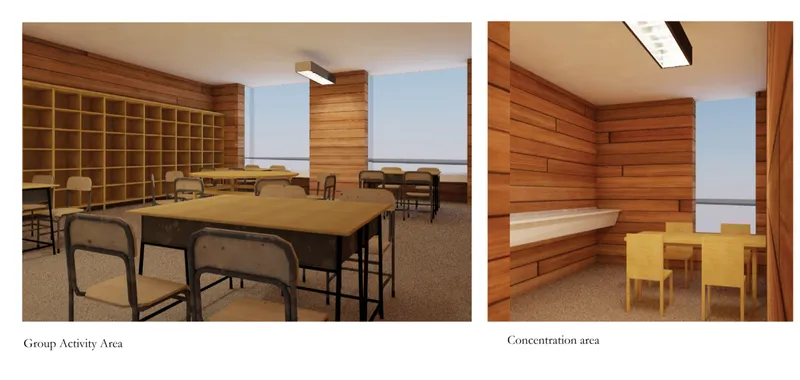
The interior renderings show two complementary modes of learning coexisting under the same roof. On one side, a timber-lined group activity space opens up for collaborative work, its warm material palette and generous proportions encouraging social interaction. On the other, a concentration alcove shrinks down to a cozy, almost domestic scale, topped by a skylight that washes the small room in diffused natural light. These miniature rooms are designed for quiet reflection, the spatial opposite of the Arena's public energy.
Movable furniture throughout the school supports varied pedagogical approaches, allowing teachers to reconfigure rooms between lecture, workshop, and independent study formats. The design recognizes that children learn differently at different moments of the day, and that architecture should accommodate that variability rather than dictate a single posture.
Why This Project Matters
Tahvonlahti Peruskoulu demonstrates that biophilic design in education is not a question of adding plants to corridors. It is a structural proposition: orient classrooms to harvest morning light, connect the cafeteria to a greenhouse, turn a sunken floor into a civic arena, and let the school's spatial logic teach values like cooperation and ecological responsibility before a single lesson plan is delivered. The Friday farmers' market, where students sell what they have grown, is perhaps the clearest proof that the architecture is doing pedagogical work on its own terms.
Avik Bal's design earns its shortlisted position in the Learn Better competition by refusing to separate the act of learning from the act of living. The school is a micro-city, a farm, a marketplace, and a set of quiet rooms where a child can sit alone under a skylight. That range of spatial experience, compressed into a modest timber building on a Helsinki site, is what makes the project worth studying closely.
View the Full Project
About the Designers
Designer: Avik Bal
Enter a Design Competition on uni.xyz
uni.xyz runs architecture and design competitions year-round that reward proposals with spatial conviction and real site intelligence.
Project credits: Tahvonlahti Peruskoulu, by Avik Bal Learn Better (uni.xyz).


Popular Articles
Popular articles from the community


Architekt Andreas Gruber Scatters 23 Dark Timber Chalets Across a South Tyrolean Forest Edge
In Molini di Tures, Amonti Chalets breaks a resort into a hamlet of gabled timber houses, with parking, storage and services pushed into the slope.

Cube Design Draws an Ecological Corridor Between Two Shenzhen Hills with the Nankai Building
Beside Shenzhen's container docks, the Nankai Building pairs stacked balconies with a climbing green screen to connect two hillsides across its height.

David Macias Steps a Doorless Stone and Plaster House Down a Tropical Colombian Hillside
In the humid hills of Colombia, Threshold House replaces the front door with an open void and terraces its 850 m² down the slope instead of fighting it.

Juan García Correa, John González and Claudia Rueda Sink a Circular Amphitheater into a Manizales Engineering Building
On the La Nubia campus in Manizales, Colombia, the S1 Building folds labs and offices into a hillside of ramped lawns that double as a campus route.

Similar Reads
You might also enjoy these articles


Vereda Arquitetos Renovates a 40-Square-Meter Apartment Inside Niemeyer's Copan Building
A compact unit in São Paulo's most iconic residential tower gets a material overhaul that pairs exposed concrete with bold blue Formica.

Shakur's House: Exposed Brick as an Interior Organiser in a 168 m² Mashhad Residence
Brick moves indoors in this Mashhad residence, where masonry walls, glass partitions and teal planes sequence a compact home without closing it off.

Day and Night Park: A Time-Based Urban Newsstand in Beijing
A temporary urban newsstand in Beijing blending travel, light, and reading through poetic colors, compact form, and community-focused design.

Modernist Patio Renovation in El Masnou, Barcelona by Oliver Segura Arquitectura + Cebrià Arquitectura
Modernist patio renovation blending tradition and innovation with a movable pool, leveled floors, and Catalan materials in El Masnou.

Explore Pyht - Bio Architects Competitions
Discover active competitions in this discipline

Challenge to design public laboratory

Design challenge to equip cities with modern furniture
Comments (0)
Please login or sign up to add comments
No comments yet. Be the first to comment!