
Bon Studio Wraps a Colombian Hillside Home in Timber, Stone, and Tropical Courtyards
Sunset Shelter in Rionegro, Colombia uses courtyards as sensory ventilators between day and night, solid and void.


A house organized around the movement of light across a day is not a new idea. But Sunset Shelter, designed by Bon Studio and led by architect Daniela Vélez Montoya, commits to that premise with unusual rigor. Located in Rionegro, a highland municipality east of Medellín, the 335 square meter residence treats its courtyards not as decorative flourishes but as the primary architectural device: visual ventilators, thermal regulators, and spatial thresholds that calibrate the boundary between interior life and the Colombian landscape.
What makes the project genuinely interesting is the pairing strategy. Every enclosed, programmed room is answered by an open courtyard. Filled space meets empty space in a deliberate rhythm, and the materials, dark vertical timber cladding, rough limestone walls, red brick, shift in register depending on whether you are inside or out, sheltered or exposed. The result is a house that feels like a sequence of compression and release, where the threshold zones carry as much weight as the rooms themselves.
A Facade That Curves and Conceals
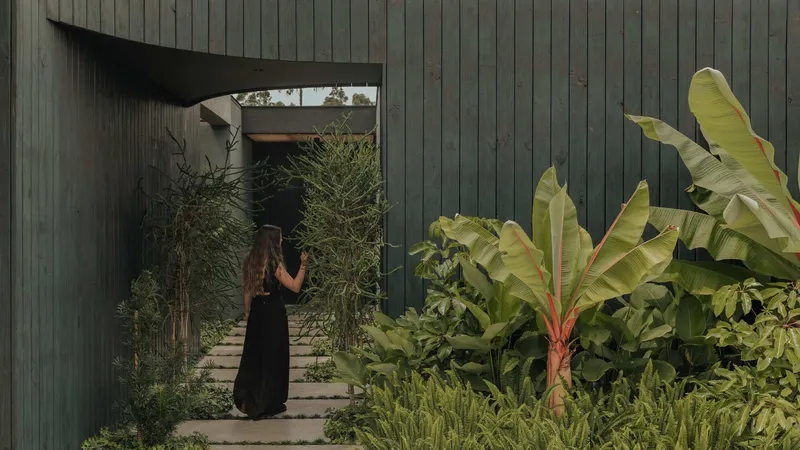
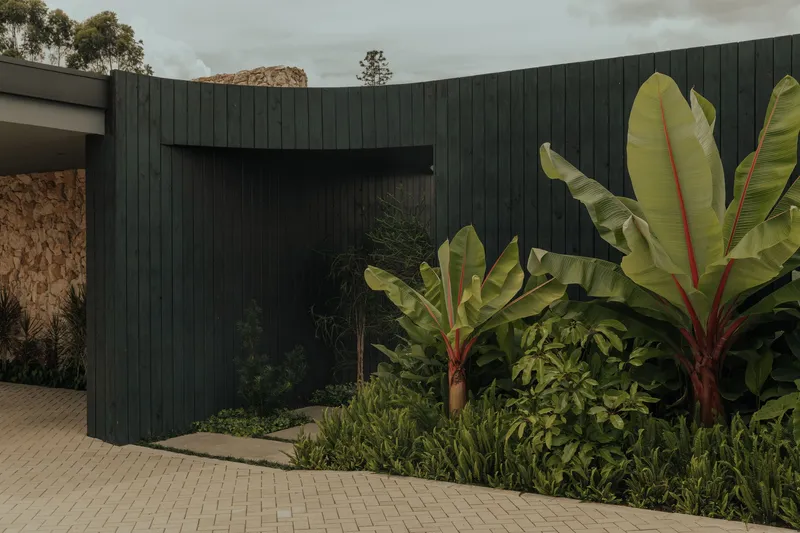
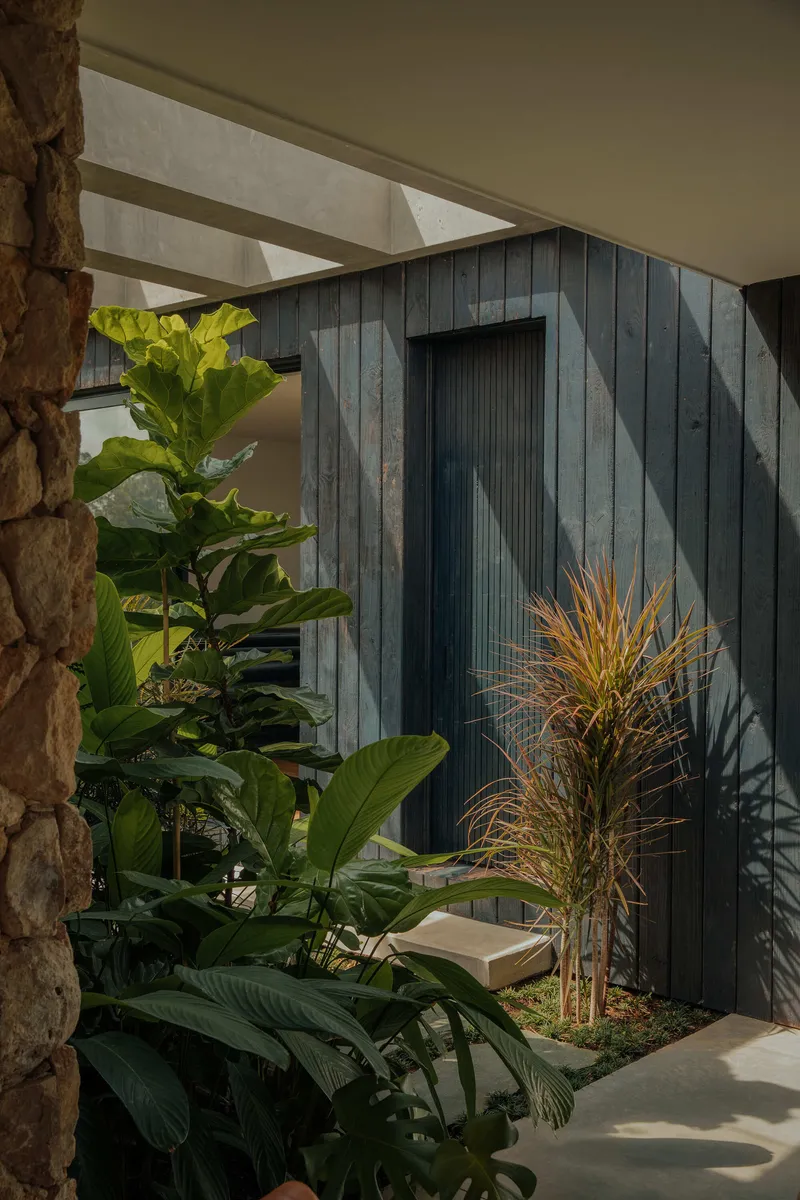
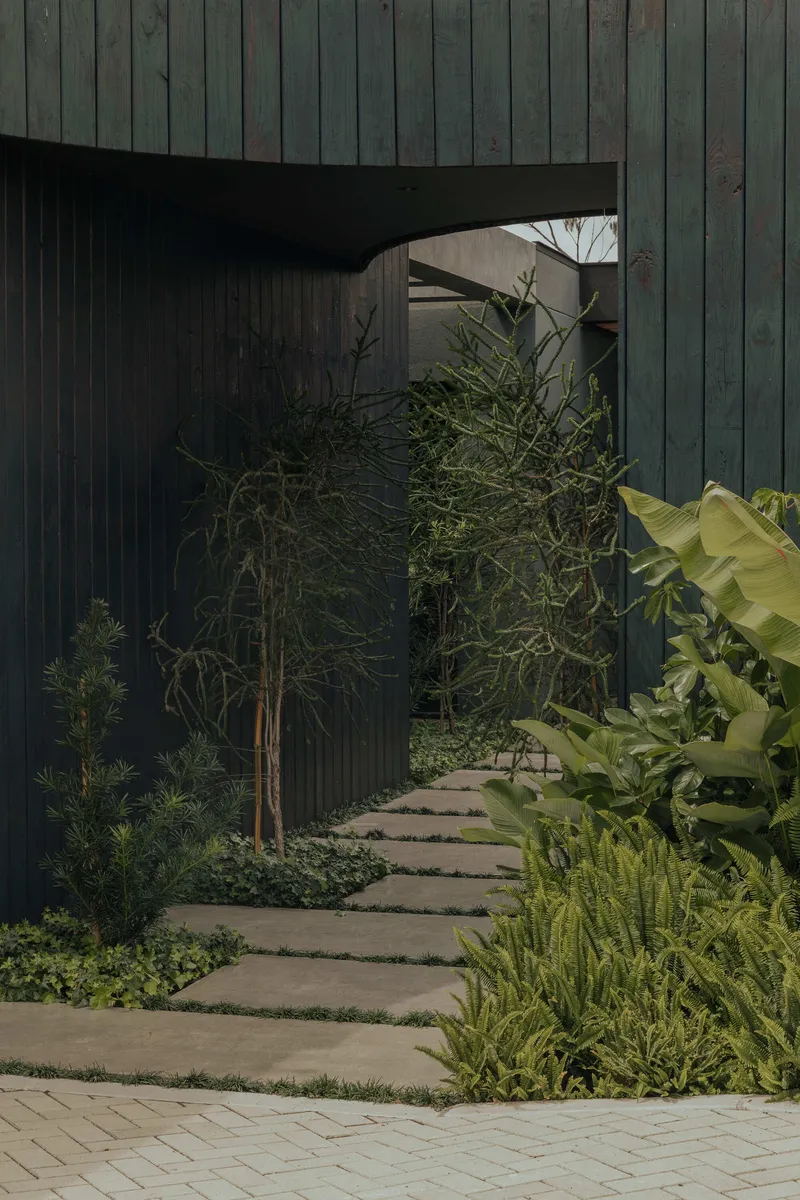
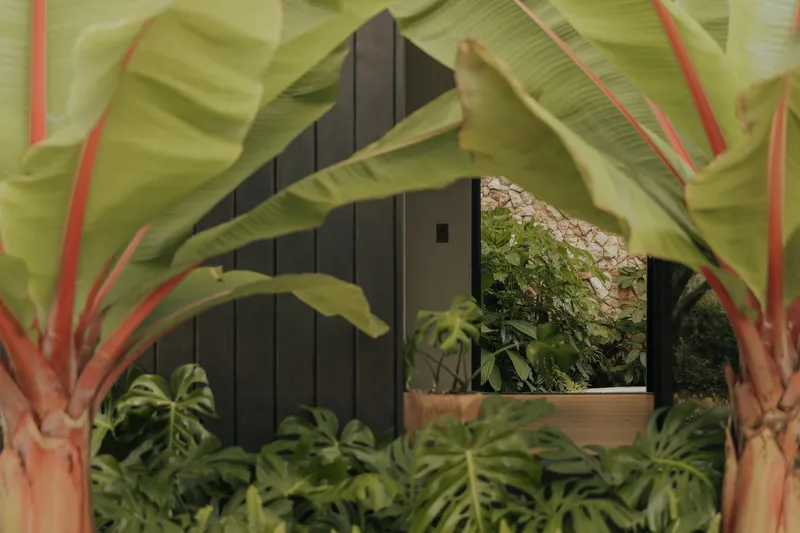
From the outside, Sunset Shelter presents itself through dark vertical timber cladding that wraps in gentle curves around planted courtyards. The effect is simultaneously warm and guarded. You see slices of banana palms through narrow gaps, a paved entry path, and angular openings that suggest a pathway deeper into the plan without giving anything away. The timber reads as a continuous screen rather than a wall, blurring the line between enclosure and garden fence.
The curves matter. They soften what could be a fortress-like exterior and allow the planting beds to push up against the facade in organic clusters. Bamboo, banana palms, and ornamental grasses accumulate around the building's perimeter, so the house appears to be growing out of its own landscape rather than sitting on top of it.
Stone, Brick, and the Weight of Material
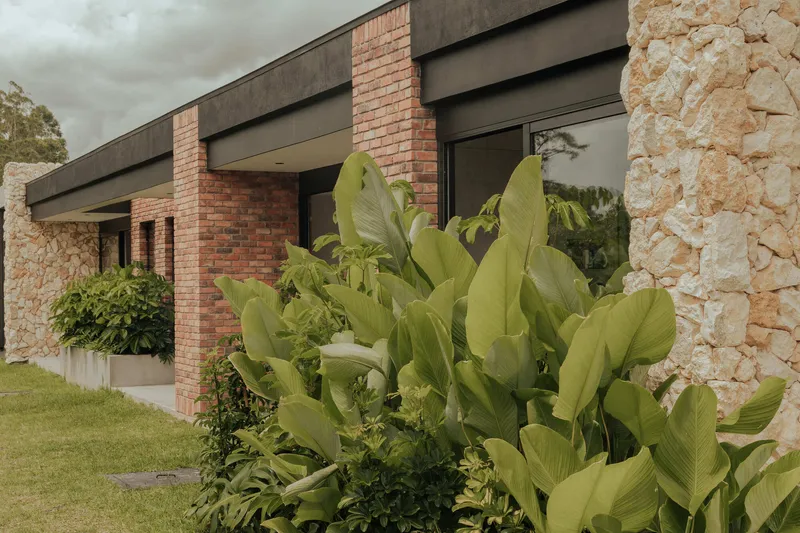
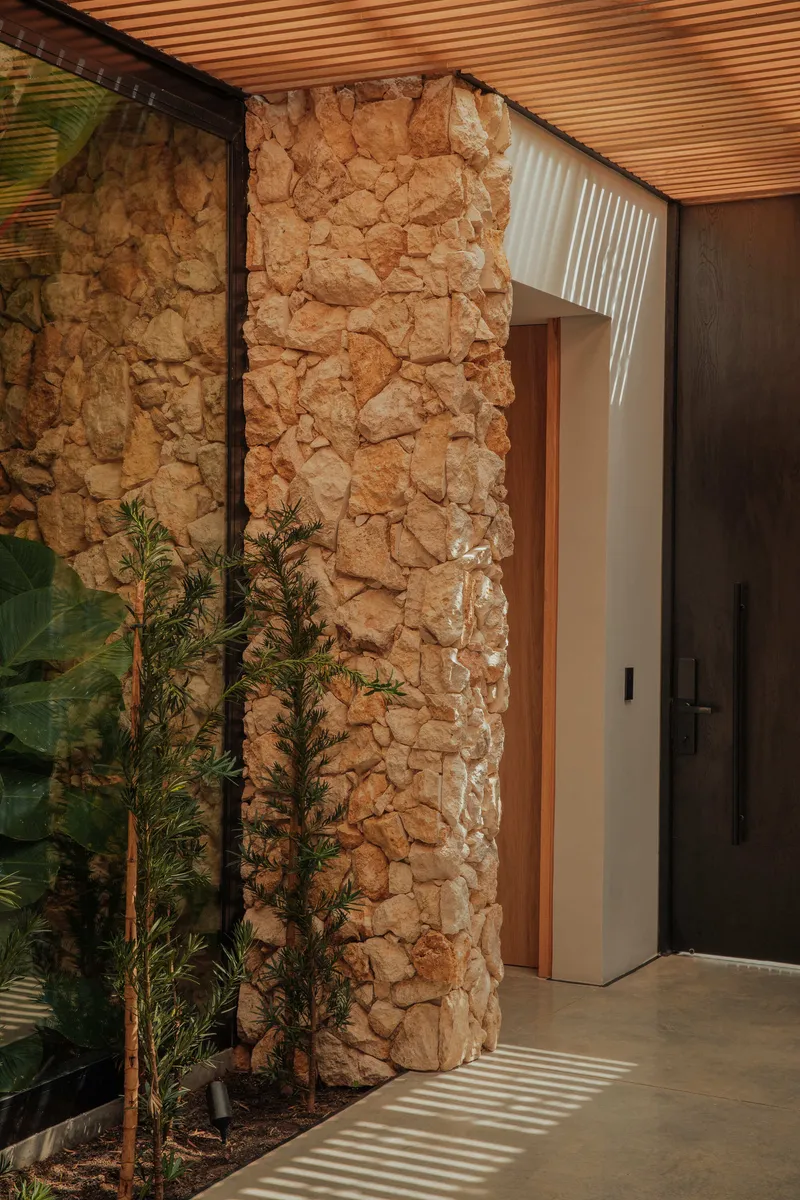
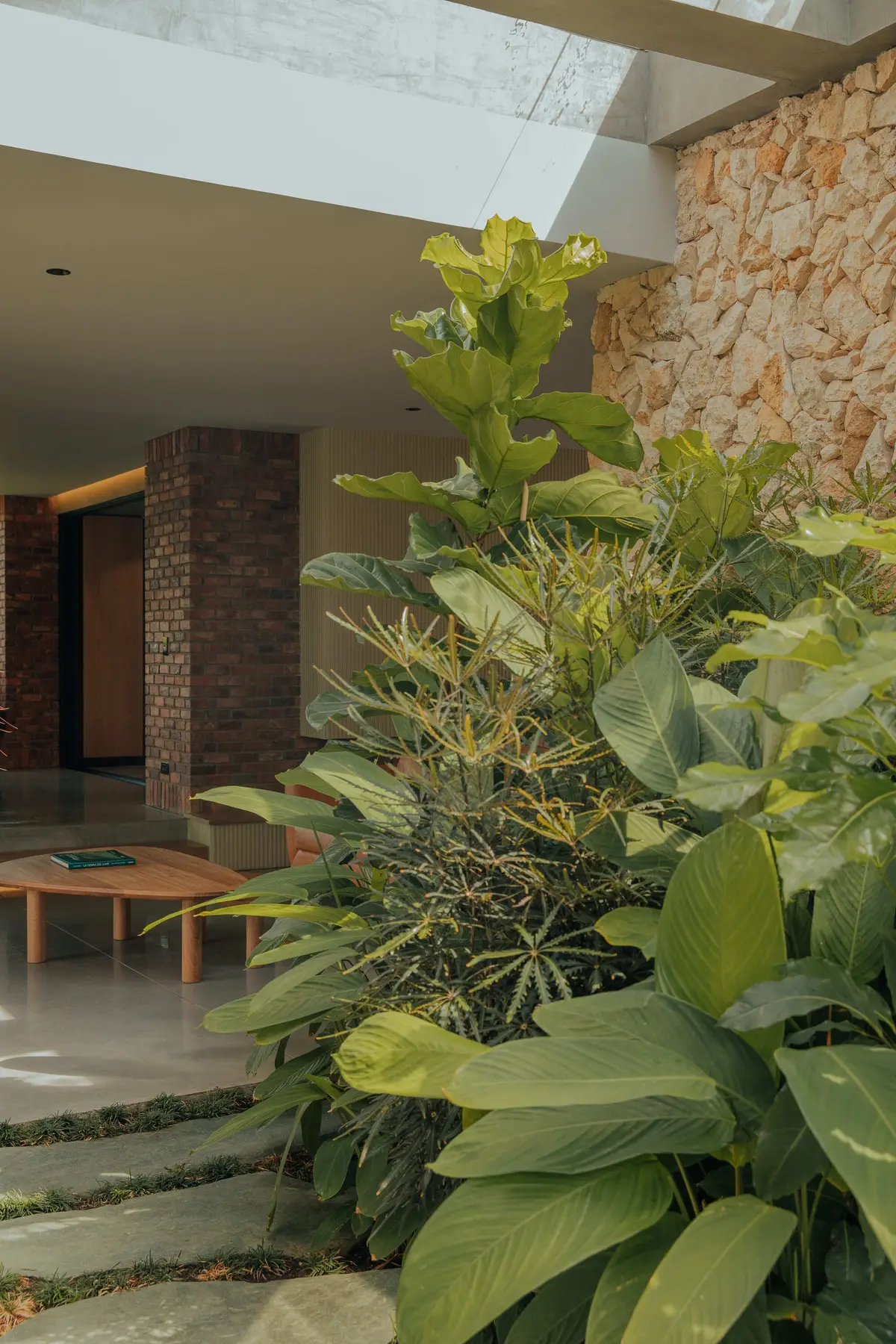
Bon Studio works with three primary materials here: dark timber, rough-cut limestone, and red brick. Each is deployed for a different spatial condition. The limestone appears at thresholds and in courtyard walls, its unfinished surface catching raking light and casting deep textural shadows. Red brick punctuates the interior as structural columns and feature walls. The slatted timber ceiling overhead projects linear shadow patterns that shift as the sun moves, turning the hallways into sundials.
None of these materials are precious. They are regionally available, robust, and they age well in a climate that oscillates between tropical sun and highland rain. The rough finishes absorb moisture and patina rather than fighting them, which means the house will look better in ten years than it does now.
Courtyards as Lungs
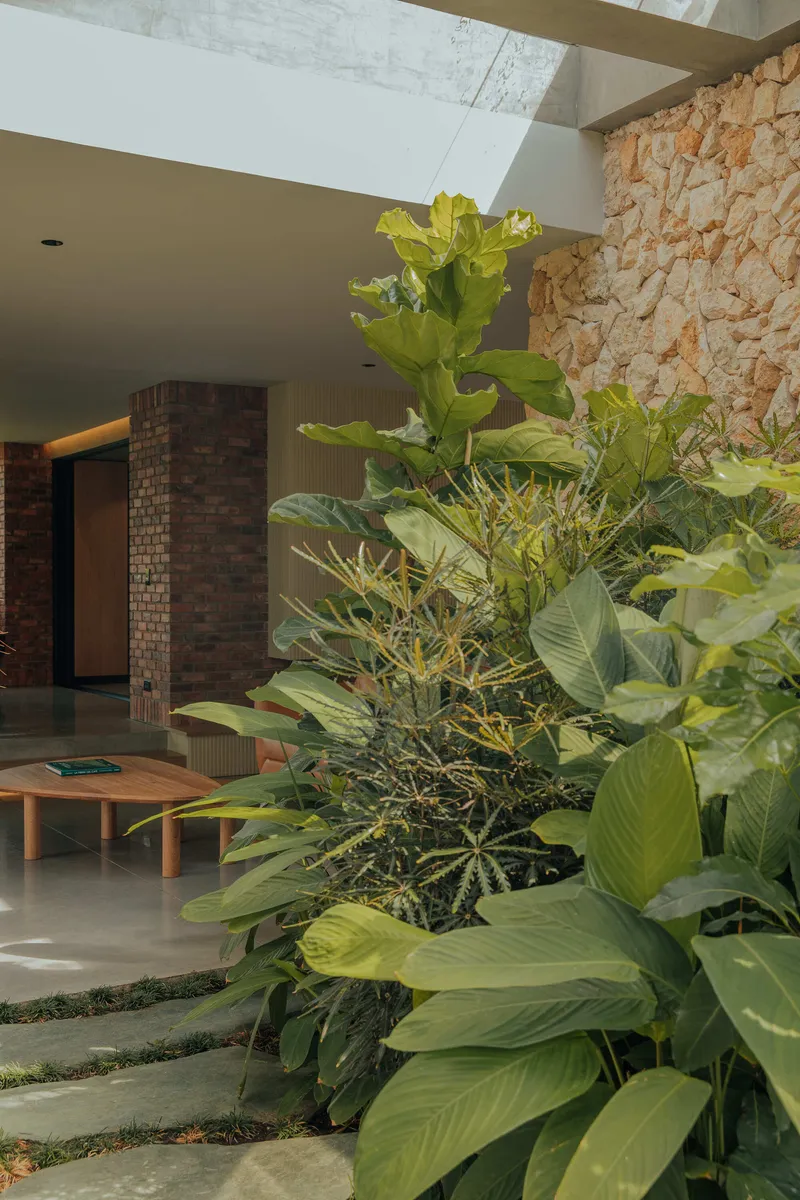
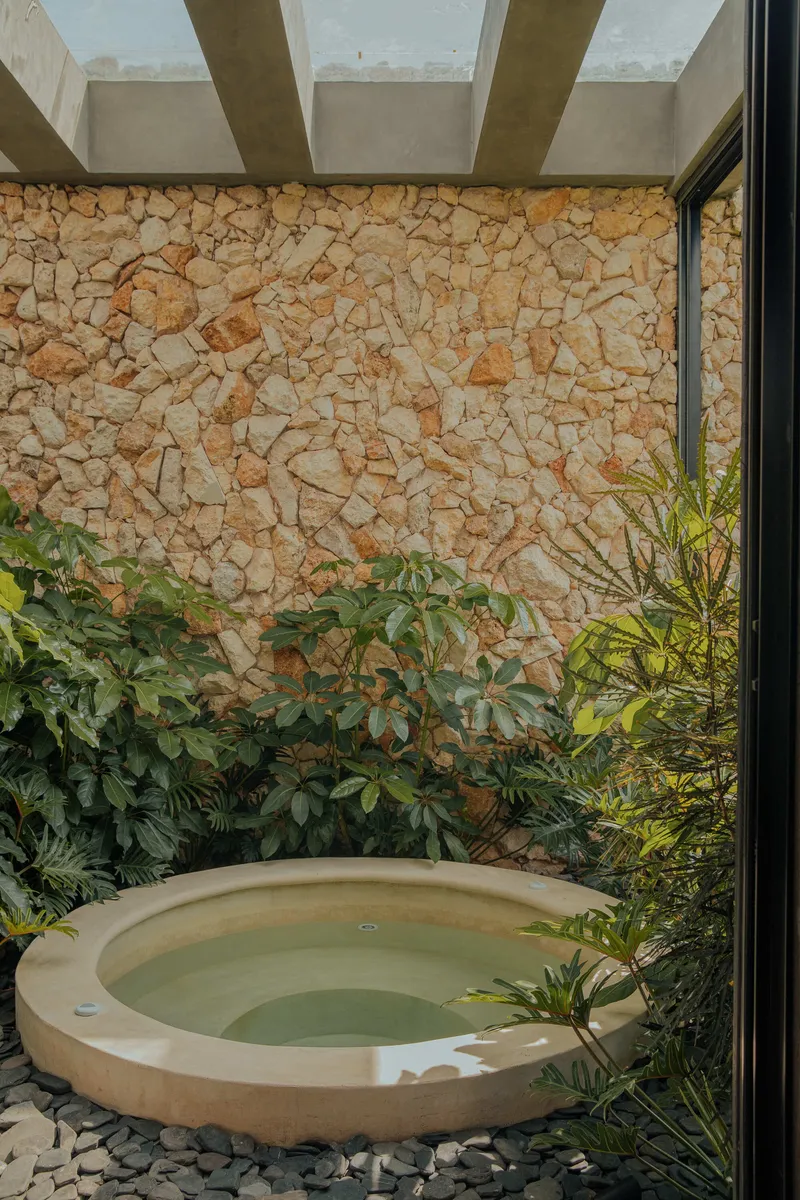
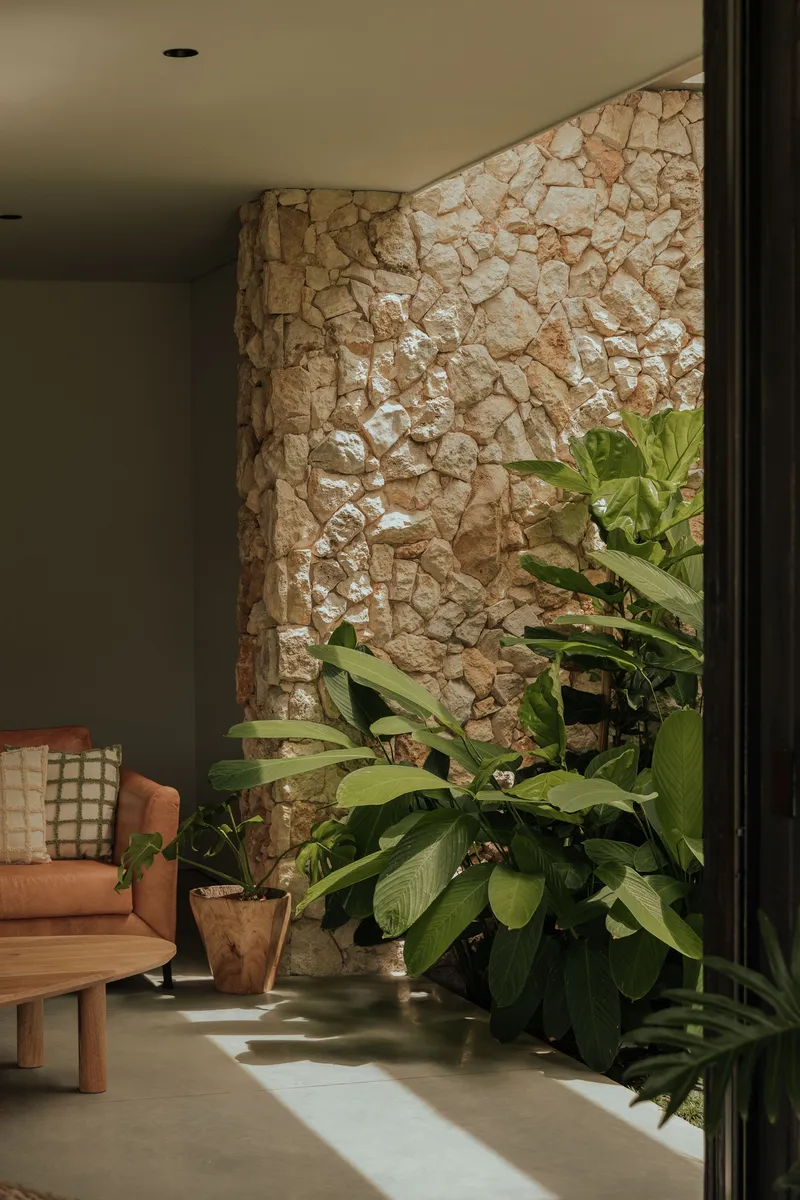
The courtyards are the beating heart of the project. One opens onto a sunken circular plunge pool set against a rough stone wall, its edges softened by dense tropical planting and framed by concrete beams overhead. Another is a paved clearing flanked by limestone and filled with potted plants, where dappled sunlight plays across the concrete floor. These are not leftover spaces between rooms. They are rooms themselves, just roofless ones.
Functionally, the courtyards pull fresh air through the plan and provide every interior space with at least one view toward greenery and sky. In a region where daytime temperatures are mild but humidity is persistent, this cross-ventilation strategy is practical, not decorative. The courtyards also break the building mass into smaller volumes, reducing the visual weight of the house from any single vantage point.
Inside: Threshold Over Spectacle
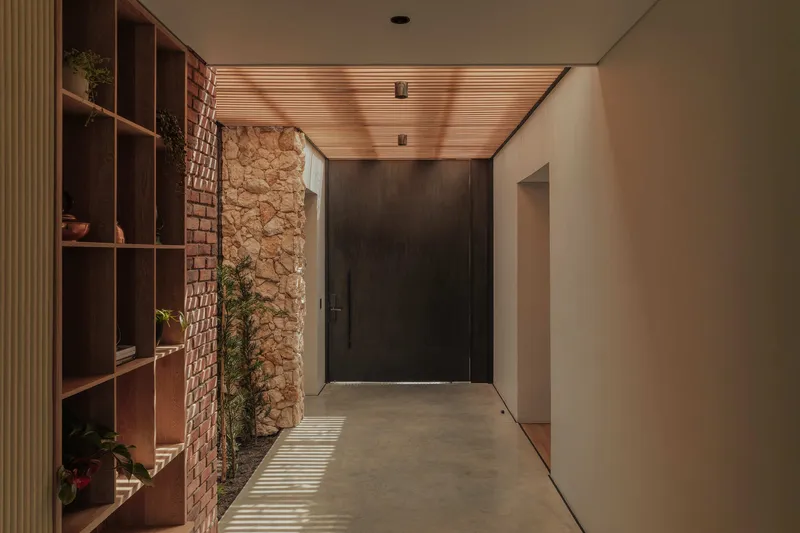
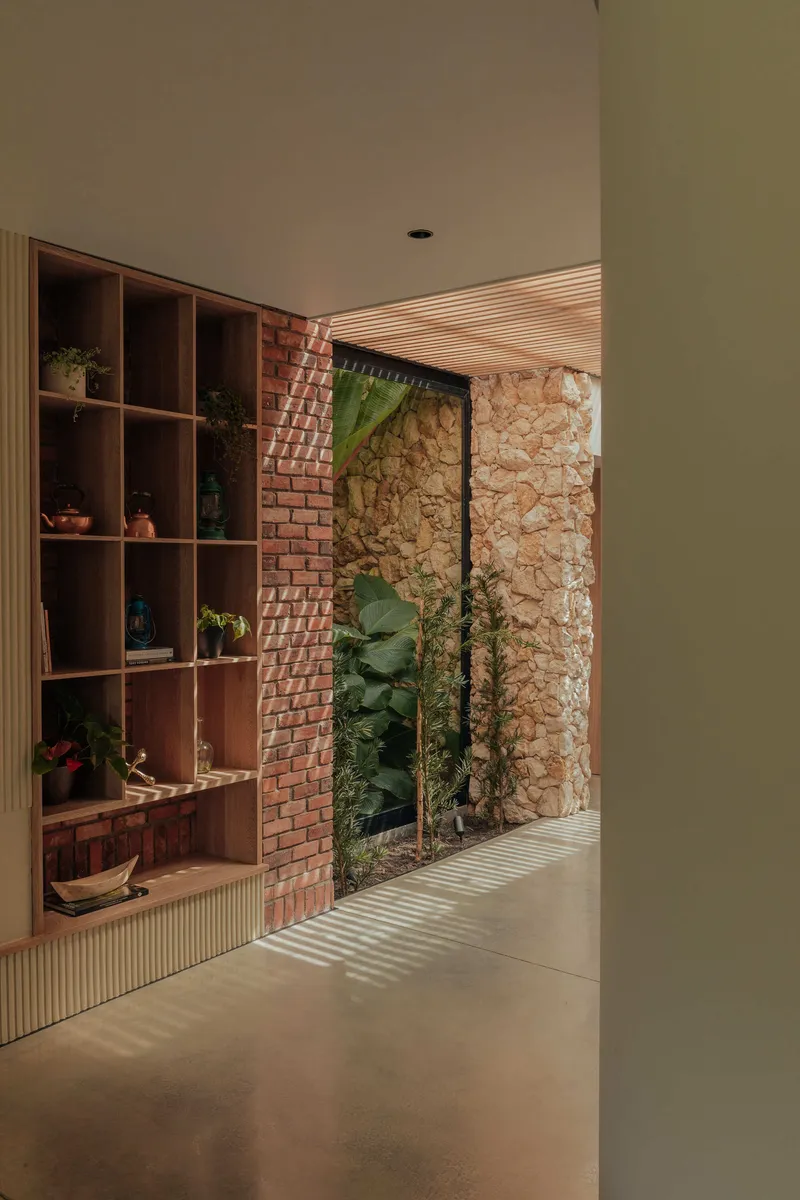
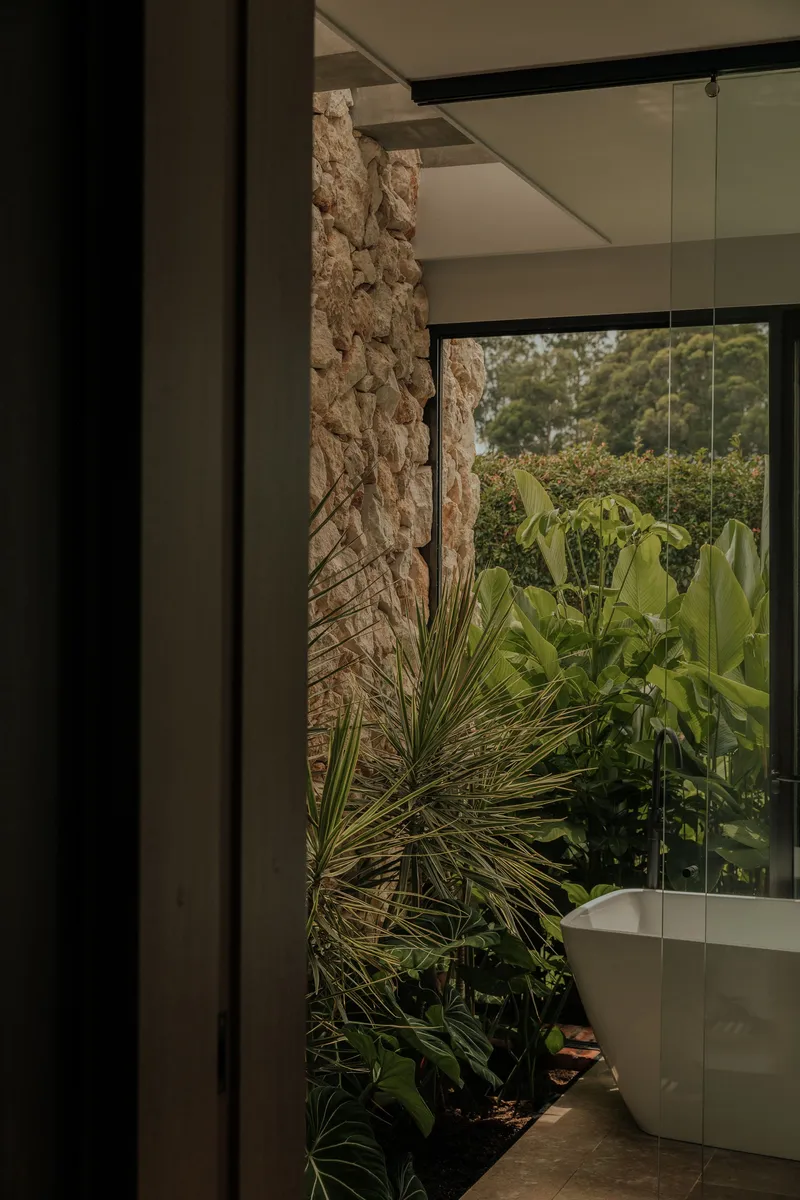
The interiors read as a series of carefully framed transitions. A hallway with timber shelving, a red brick column, and a limestone wall opens onto a courtyard view. A glass wall in a corner room looks directly into a planted bed backed by rough stone. There is no single dramatic reveal, no double-height living room competing for attention. Instead, the architecture earns its effect through accumulation: one considered threshold after another.
The material palette continues indoors without interruption. Stone walls that begin outside carry through into interior corners. The slatted timber ceilings run from covered walkways into enclosed rooms. This continuity makes the distinction between inside and outside feel genuinely porous, which is the whole point.
Domestic Life at Dusk
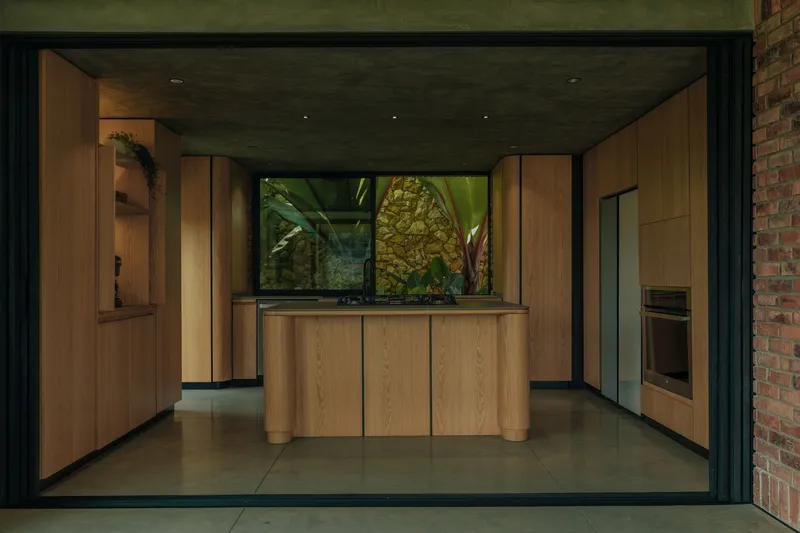
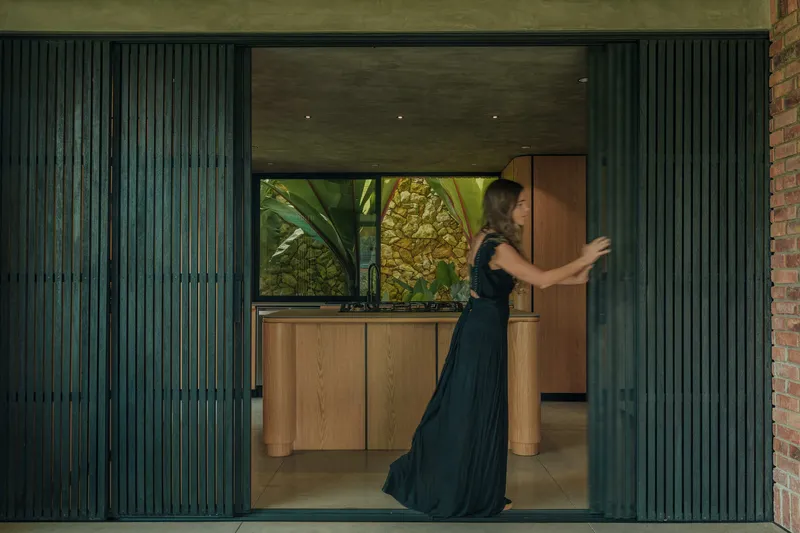
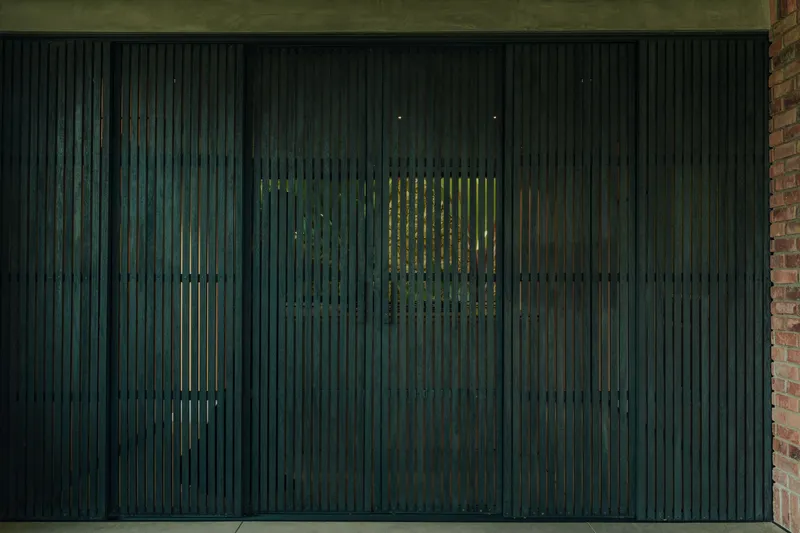
The kitchen is a grounded, practical space: oak cabinetry, a central island, sliding glass doors that open fully to the garden at dusk. There is something appealing about the directness of it. No overwrought statement island, no floating shelves for the sake of minimalism. Folding dark green slatted panels elsewhere hint at a house designed to be opened and closed depending on the time of day and the angle of the sun.
The stepping stone pathway that winds through bamboo and banana palms toward the timber facade captures the approach experience well. You arrive on foot, at ground level, through a garden. The car is tucked behind a stone wall and curved timber screen. The house privileges pedestrian arrival and the slow unfolding of its sequence over vehicular convenience.
Carport and Approach
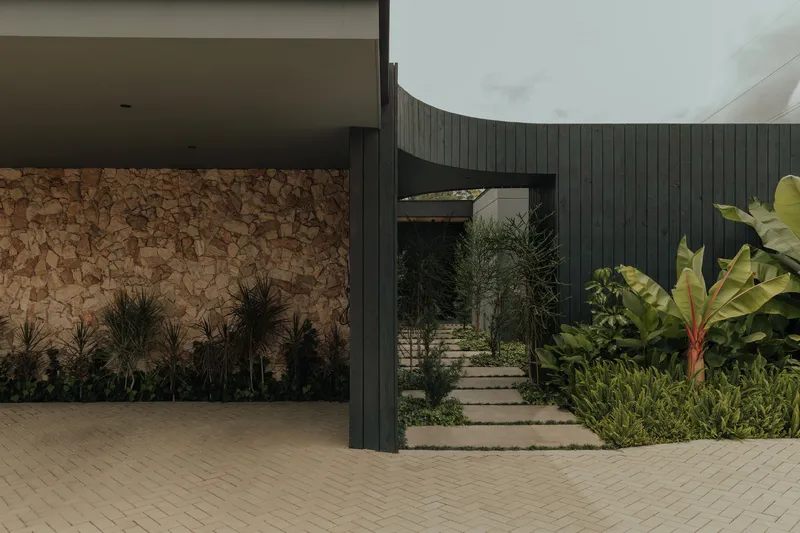
Even the carport is handled with care. A stone wall anchors one side while curved vertical timber cladding wraps the other, and a planted pathway of banana palms runs alongside. The building does not announce its program hierarchy from the street. Storage, parking, and service spaces receive the same material attention as living areas, which elevates the overall coherence of the project.
Plans and Drawings
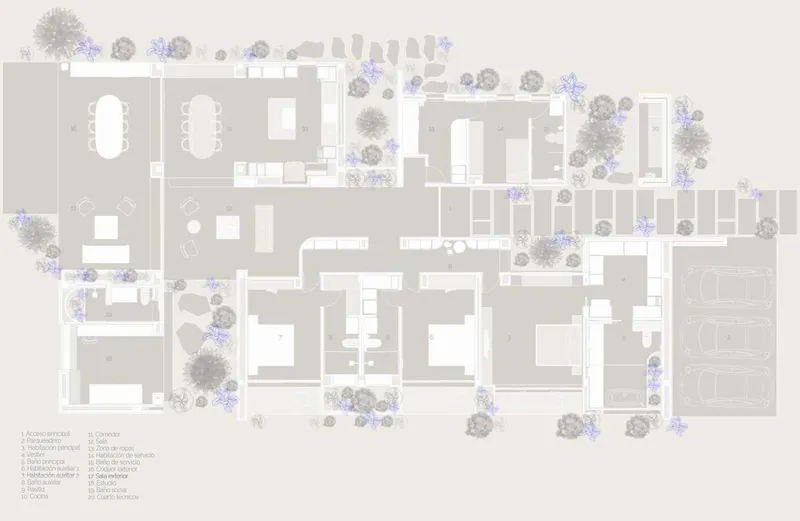
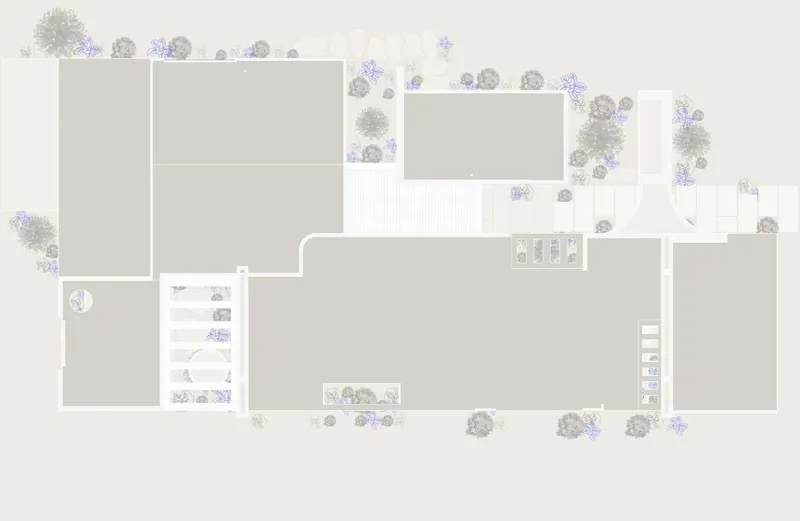
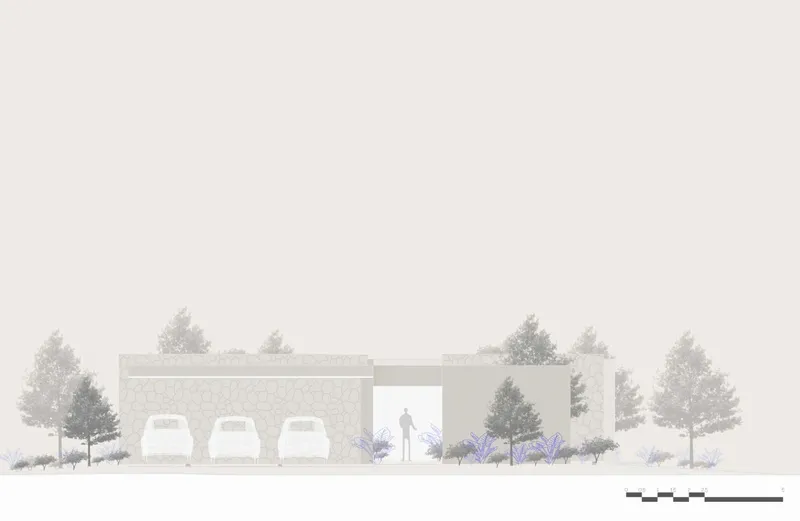
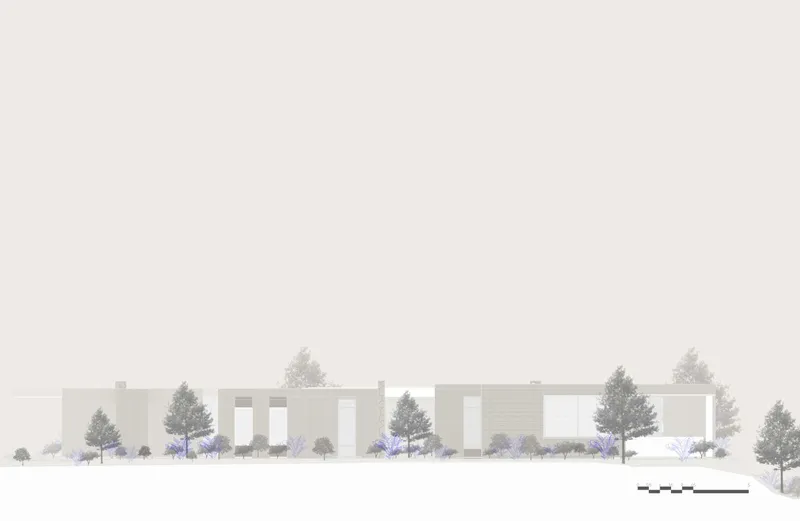
The site plans reveal a strategy of scattered rectangular volumes embedded in a generous landscape of trees and planting zones. The building footprint is not compact; it sprawls deliberately, allowing courtyards and garden beds to infiltrate between programmed rooms. The elevations confirm the project's low horizontal profile, with vertical window openings punched into long walls that sit close to the ground. Three garage doors on one facade suggest a utilitarian edge that the photography downplays, while the central entrance is framed symmetrically by trees.
What the drawings make clear is how much of the 335 square meter floor area is given over to threshold and transition. The ratio of enclosed space to courtyard space appears nearly equal, which is a bold commitment for a residential project. It means the livable square footage, in the conventional sense, is much smaller than the total footprint suggests. The house is less a container and more a landscape you happen to sleep in.
Why This Project Matters
Sunset Shelter is not trying to reinvent the courtyard house. Its ambition is more specific: to demonstrate that the transition between filled and empty space can be the primary experience of a home, not a secondary effect. By pairing every room with a courtyard and allowing materials to flow continuously across interior and exterior surfaces, Bon Studio collapses the usual hierarchy between served and servant spaces, between living room and corridor, between house and garden.
In a region where many new residential projects default to panoramic glass walls and imported finishes, this house argues for something quieter. Limestone, brick, and timber. Courtyards instead of air conditioning. Threshold over spectacle. It is a house calibrated to its climate, its site, and the daily rhythm of light that gives it its name. That specificity is its strength.
Sunset Shelter by Bon Studio, led by architect Daniela Vélez Montoya. Located in Rionegro, Colombia. 335 m². Completed in 2024. Photography by Mateo Soto Ph.
About the Studio
Bon Studio
Share Your Own Work on uni.xyz
If projects like this are the kind of work you want to make, uni.xyz is a place to publish your own, find collaborators, and enter design competitions.


Popular Articles
Popular articles from the community


Temporary Home for Dogs: A Reversed Zoo Rethinks Animal Shelter Architecture
In Bucharest, a sinuous corridor and freed landscape flip the logic of containment, designing a shelter that works to make itself unnecessary.

Faces of the Soviet Avant-Garde: Turning Moscow's Street Names into an Open-Air Museum
A network of sculptural installations across a Moscow residential district transforms forgotten architect names into spatial encounters with cultural memor

Opera by the Sea Estonia: Three Shells Dissolving Architecture into Tallinn's Coastline
A winning opera house proposal replaces monumental form with interconnected shells that blur the boundary between building, park and Baltic Sea.

Extended Shell: Retrofitting Kolkata's Balconies as Living Urban Thresholds
A modular retrofit system recovers the social and environmental intelligence of Kolkata's historic verandas for contemporary Park Street residents.

Similar Reads
You might also enjoy these articles

Bao Huynh Watercolor Atelier: A Serene Art Retreat in Hội An
Bao Huynh Watercolor Atelier in Hội An blends multifunctional art spaces, sustainable design, local materials, and family-friendly living in a serene environment.

Atelier Macri Concept Store Interior Design by CASE-REAL
Atelier Macri store features a "ko" counter, walnut wood details, cork displays, blending retail, gallery, and seamless customer experiences.

Manuel Vargas Izquierdo Stadium and High-Performance Sports Center: Architectural Excellence in Jalpa de Méndez
The Manuel Vargas Izquierdo Stadium blends sustainable design, inclusive sports facilities, and cultural-inspired architecture, revitalizing Jalpa de Méndez’s public spaces.

KAKR Buluh Awar Hall: Revitalizing Community and Ecology Through Bamboo Architecture
Community built bamboo hall revitalizes Buluh Awar village, empowering youth, restoring ecology, celebrating vernacular craftsmanship through sustainable architecture and culture.


Comments (0)
Please login or sign up to add comments
No comments yet. Be the first to comment!