

BOS Arquitectes Shelters a Mallorcan Nursery School Under Undulating Timber Vaults
In Muro, Mallorca, six curved laminated timber bays and ochre ceramic tiles create a landscape-scaled shelter for early learning.


From the rooftops of Muro, the new nursery school barely registers as a building. Its ochre ceramic tiles ripple across six parallel vaults that track the color of the local marés stone, blending into the horizon line between the village and the agricultural plain beyond. BOS Arquitectes, led by Miquel Barceló Ordinàs and Margalida Seguí Tugores, has produced a 745-square-meter building that reads less like an institution and more like a landform: low, rhythmic, protective.
What makes this project genuinely interesting is its refusal to treat early childhood architecture as either miniaturized adult space or candy-colored novelty. The nursery school is instead structured around a serious material proposition: curved laminated timber beams repeated across six bays, each seven meters wide, forming concave vaults that create an enveloping, almost primal sense of shelter. Every surface is left legible. Stone, brick, concrete, timber, and ceramic are exposed as a kind of didactic environment where the building itself becomes a tactile teaching tool.
A Roofline That Disappears into the Landscape


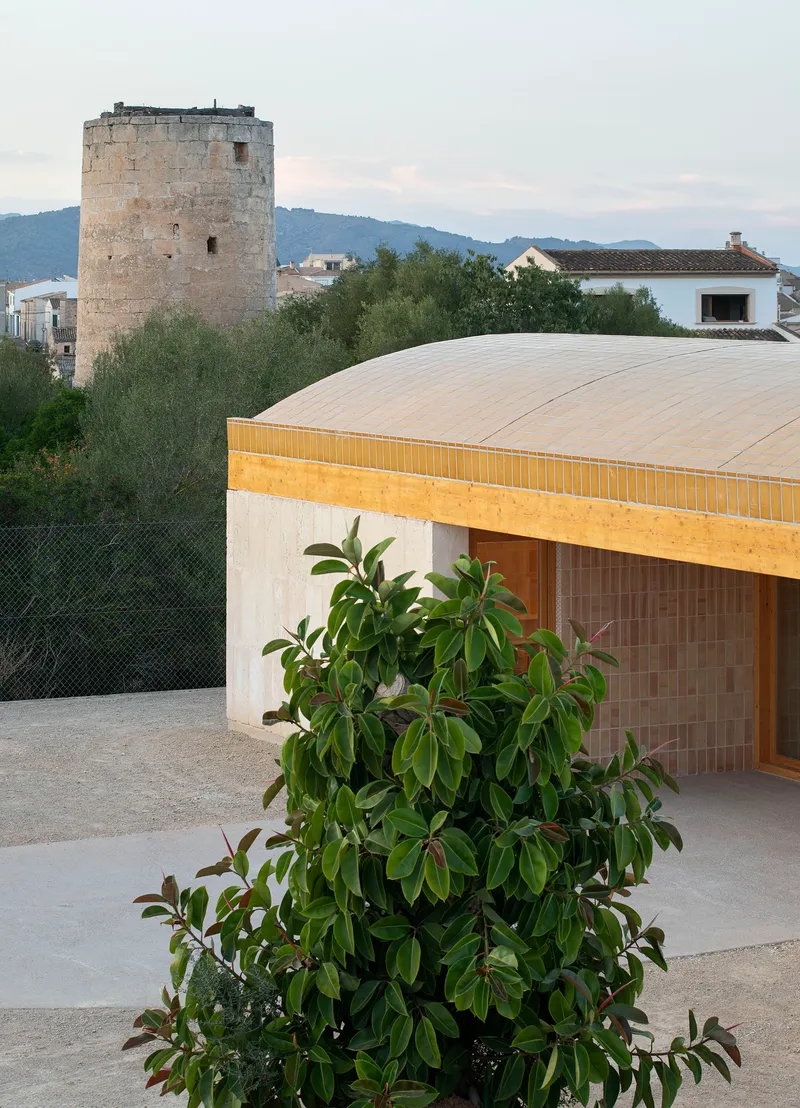
The roof is the building's most visible and most considered gesture. A continuous undulation of yellow-ochre glazed ceramic tiles catches the Mallorcan sun without absorbing too much of it. The light color reduces solar gain in summer, and the lightweight, ventilated construction beneath ensures low thermal inertia, letting the roof shed heat rather than store it. The tile color is not arbitrary: it echoes the sand-toned marés stone that defines Muro's vernacular architecture and the clay tiles on neighboring roofs.
Seen from the bell tower of the Church of Sant Joan Baptista or from the football field stands nearby, the roof reads as a gentle topographic extension of the elevated site. The ceramic surface also does real work, articulating the path of rainwater across the vaults into channels. Form, material, and environmental performance are aligned without needing to announce themselves.
Timber Vaults as Primal Shelter


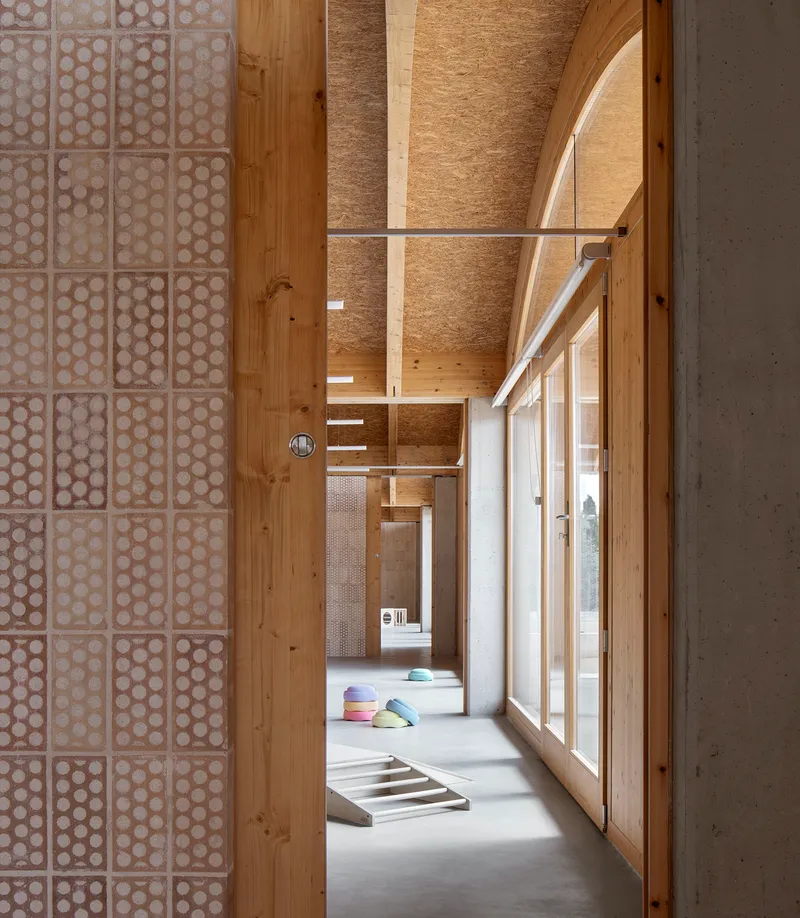
Inside, the repeated curved laminated timber beams give every room a shared spatial character without making them identical. The concave form overhead produces a psychological effect that goes beyond aesthetics: it wraps the space inward, creating an enveloping quality that feels genuinely sheltering. For children under the age of three, this matters. The ceiling is close enough to register, open enough to breathe, and warm enough in tone to feel safe.
The structural logic is deliberately repetitive. Each bay follows the same beam profile, making the system legible to anyone who walks through the building. Where the timber meets columns, the connection details are exposed rather than concealed. Hempcrete panels fill between the arches, providing insulation while remaining tactile and visible. Nothing here pretends to be something it is not.
Three Strips and a Courtyard Loop
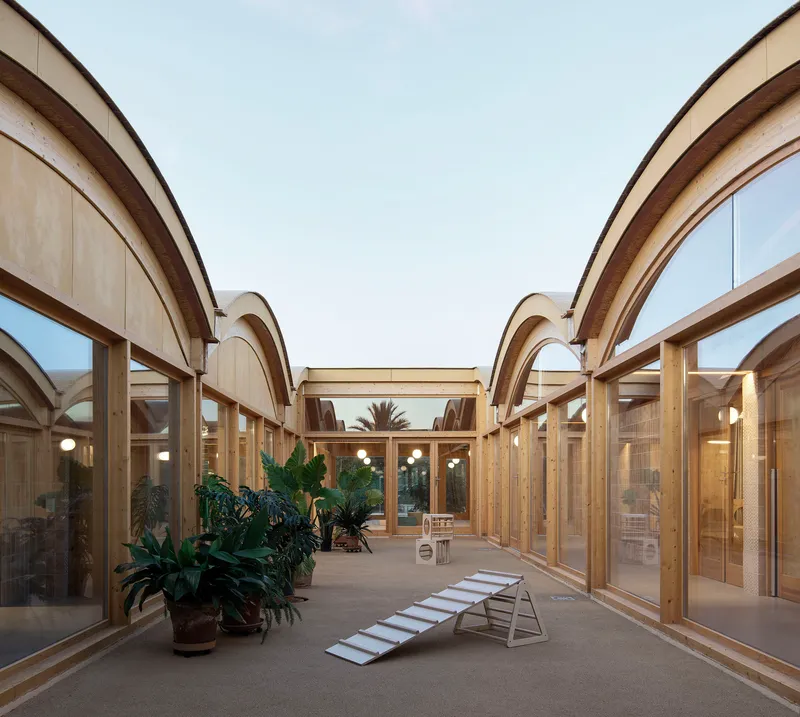
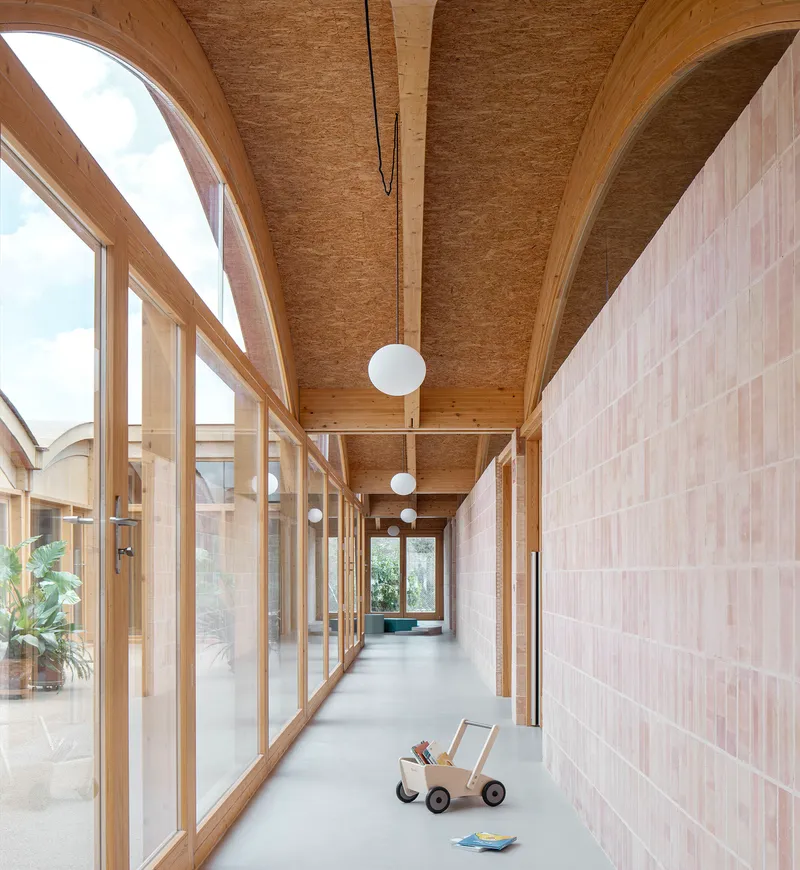
The plan organizes into three longitudinal strips arranged around a central courtyard, with a continuous circulation loop wrapping the open-air center. Classrooms sit along the south, capturing light and opening onto individual patios. A shared patio to the east offers a larger collective space. Services line the north, acting as a buffer between the children's world and the street.
The courtyard is the building's lung, both literally and organizationally. It promotes cross ventilation by drawing air through large south-facing openings and exhausting it through smaller, higher openings on the north side. Protected from wind, the courtyard also admits daylight deep into the plan while offering solar control through classroom porches and vegetation. At dusk, the glazed walls around the courtyard glow with pendant lights, and the building reveals its full depth from the inside out.
Materials as a Teaching Tool
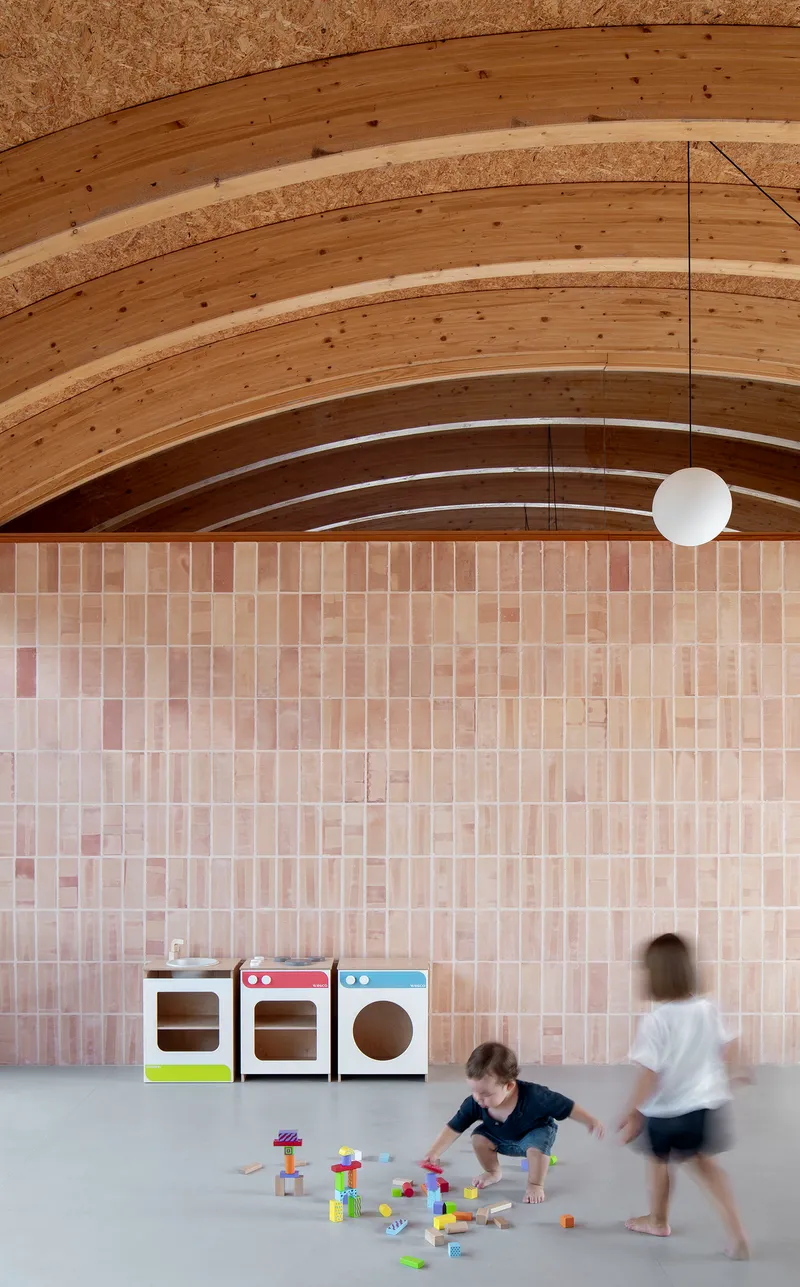

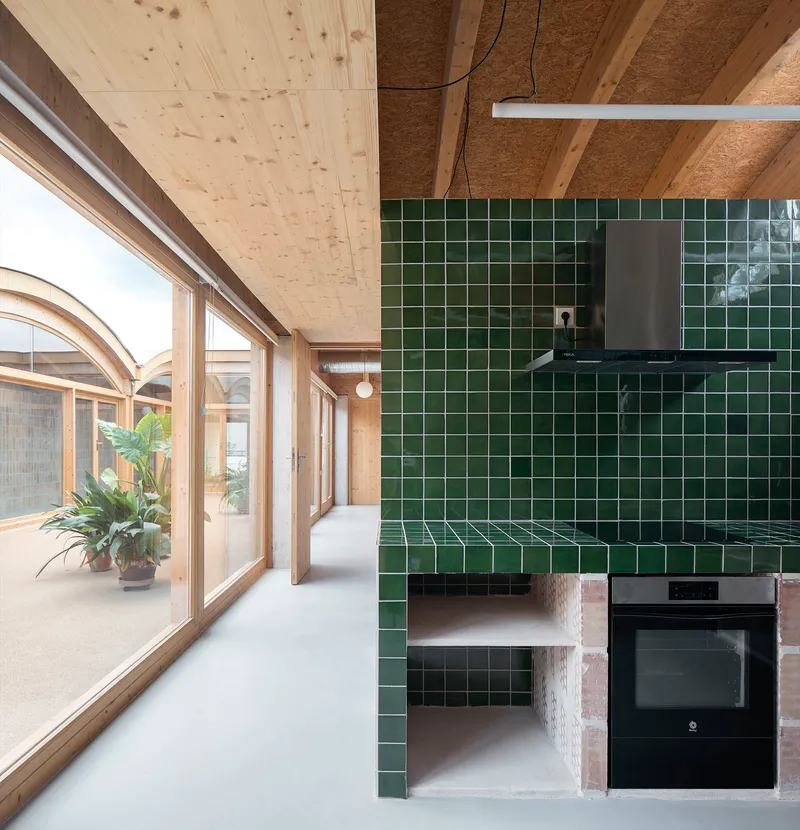
One of the strongest decisions here is the use of exposed materials as a pedagogical strategy. Pink and dark green ceramic tiles define individual volumes, giving rooms distinct identities while remaining part of a family. Polished concrete floors reflect timber overhead. Stone walls carry weight visibly. Brick masonry is left unfinished. Children in this building encounter real materials at eye level and hand height, not laminated surfaces or suspended ceilings hiding ducts.
The dark green tiled kitchen volume, for instance, is a compact object lesson in how a room can be made from a single material decision. Arched timber windows frame views outward while the tile wraps counters, walls, and the built-in oven surround. It is legible, robust, and beautiful without being precious.
Thresholds and In-Between Spaces
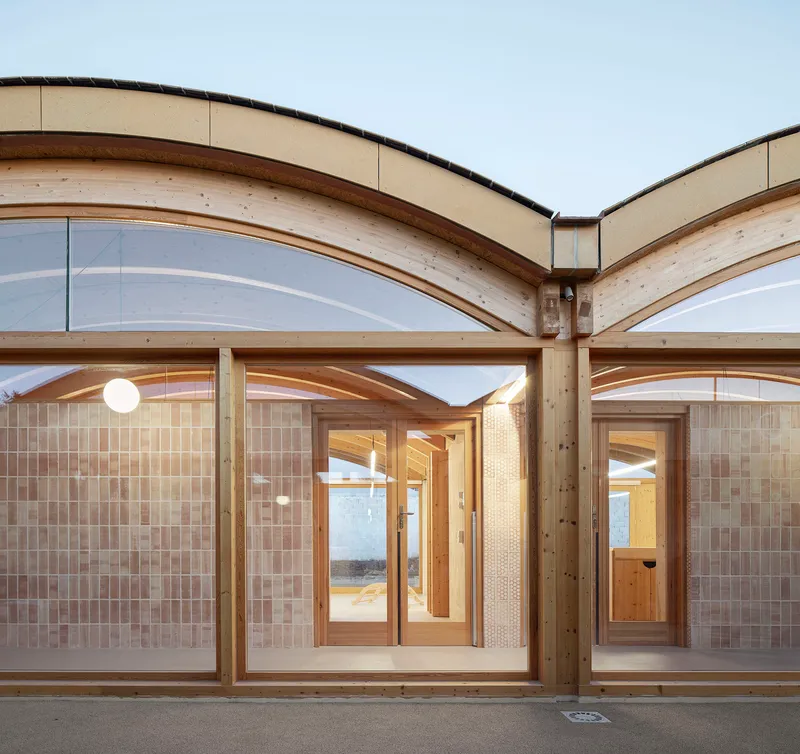

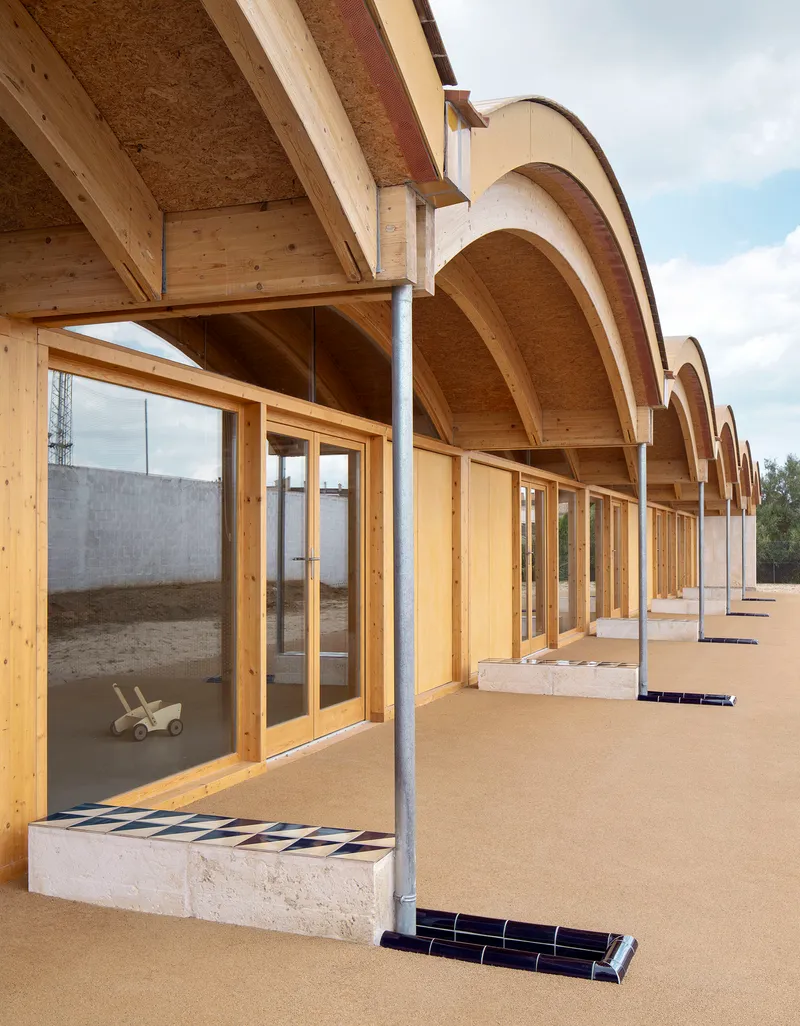
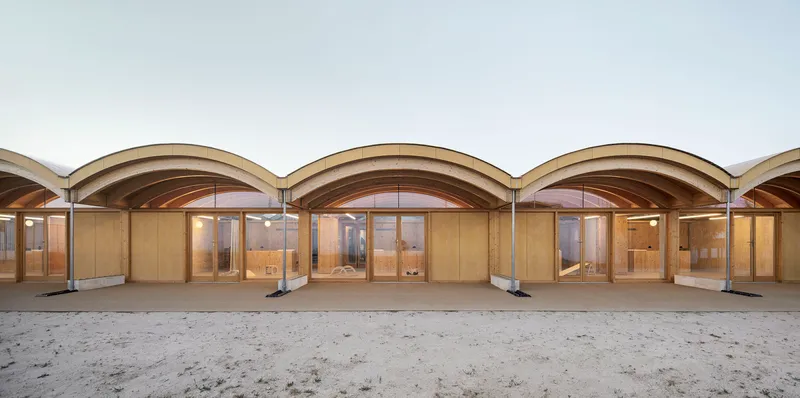
The nursery treats its edges as inhabited space rather than boundary conditions. A covered colonnade of repeated arched vaults runs along one side, creating an outdoor room between inside and landscape. Timber-framed sliding doors allow classrooms to open fully onto patios, dissolving the distinction between interior play and outdoor exploration. At the entrance, timber banding above pale tile walls frames a threshold that is generous and slow, not a corridor to rush through.
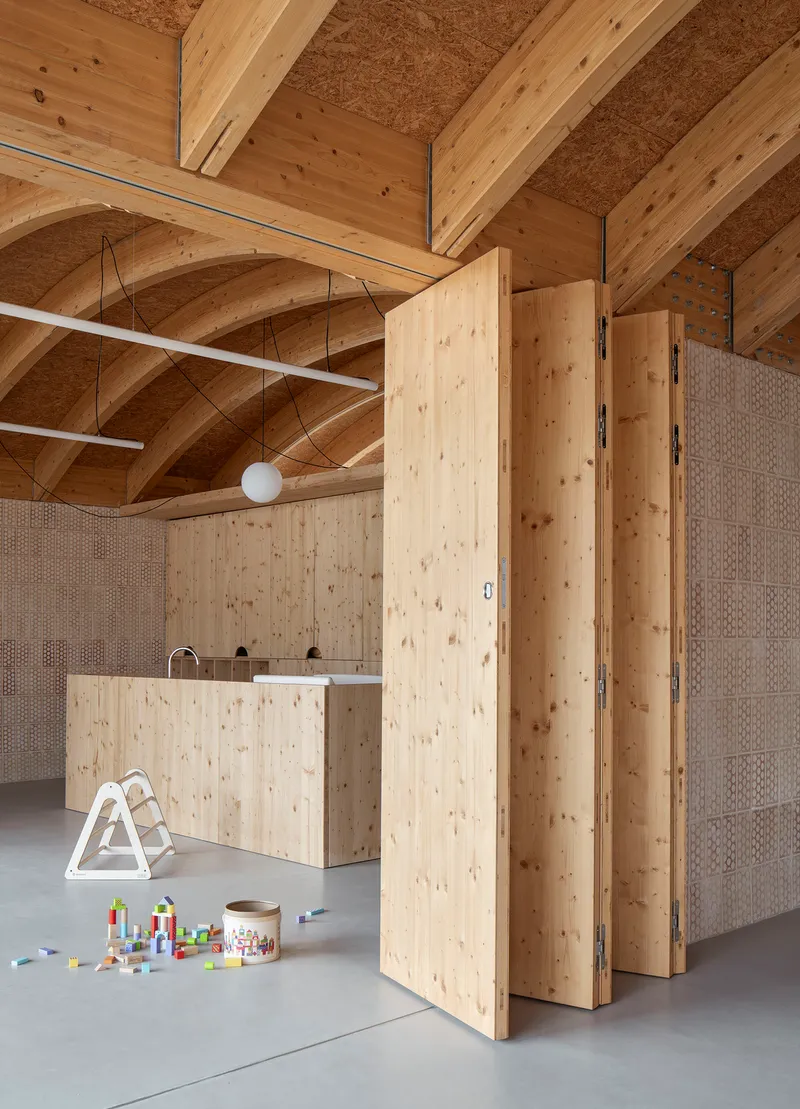
At the building's corners, arched timber openings meet patterned screen walls to create junctions that are spatially rich. These are not residual spaces but deliberate zones of transition, places where children can pause, observe, and choose their direction. The folding timber screens in several classrooms reinforce this idea at a smaller scale, allowing rooms to reconfigure without permanent walls.
Scaled for Small Bodies
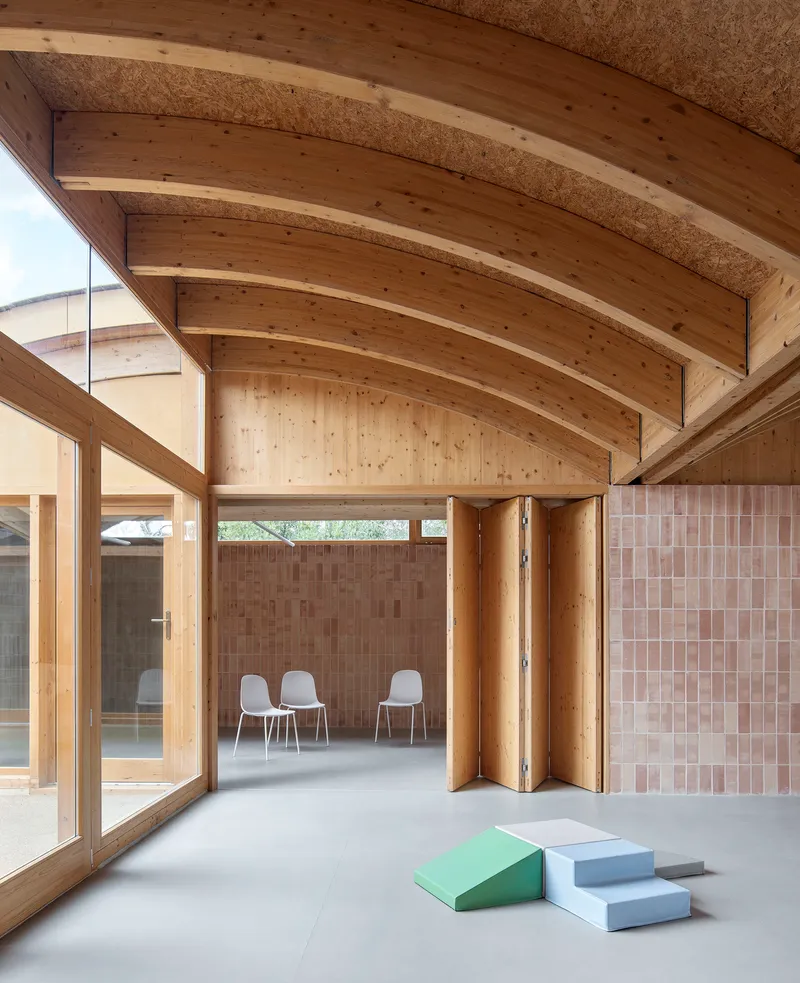
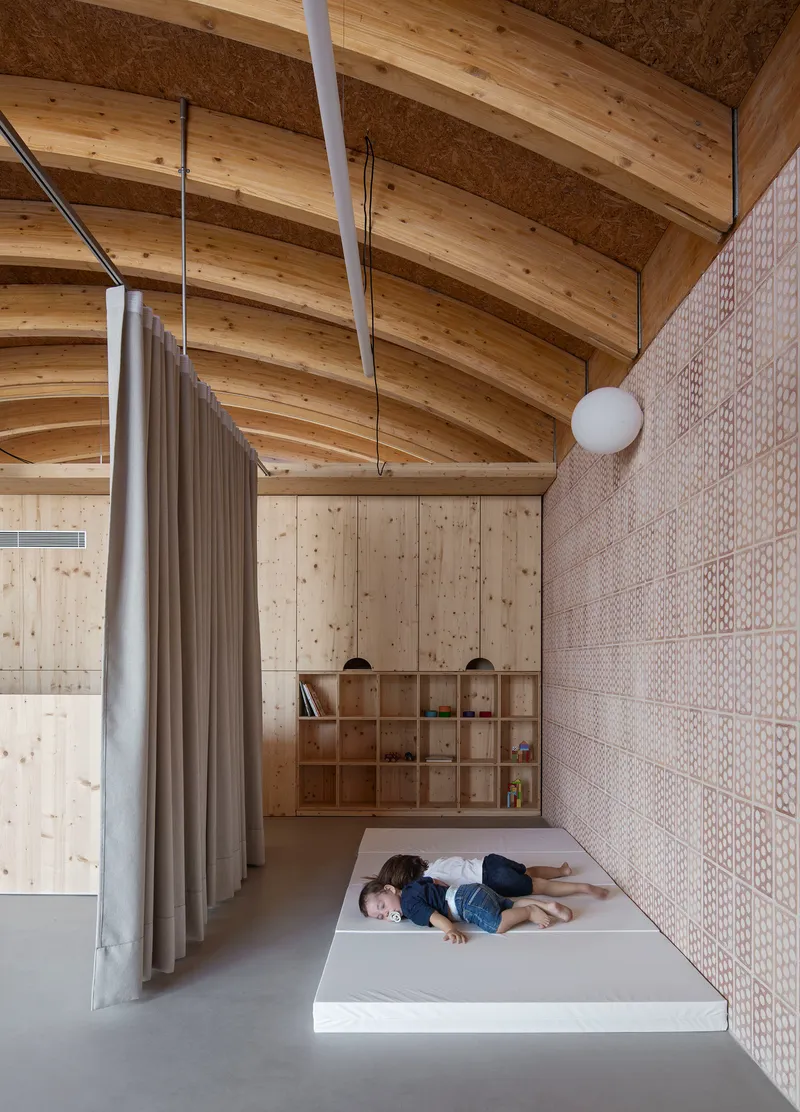

The furniture and fixtures commit to the same material logic as the architecture. Plywood storage cubbies, timber vanities with circular mirrors, and raised platforms with grey curtain dividers are all scaled to the children who use them. The bathroom, with its perforated panel wall and paired sinks, treats even the most utilitarian room as a considered space. Foam play blocks scattered across polished concrete floors look deliberate rather than chaotic, because the rooms are robust enough to absorb disorder.
This attention to child-scale detail is not incidental. It follows directly from the building's larger argument: that architecture for young children should be materially honest, spatially generous, and structured enough to provide security without being rigid.
Facade and Public Address
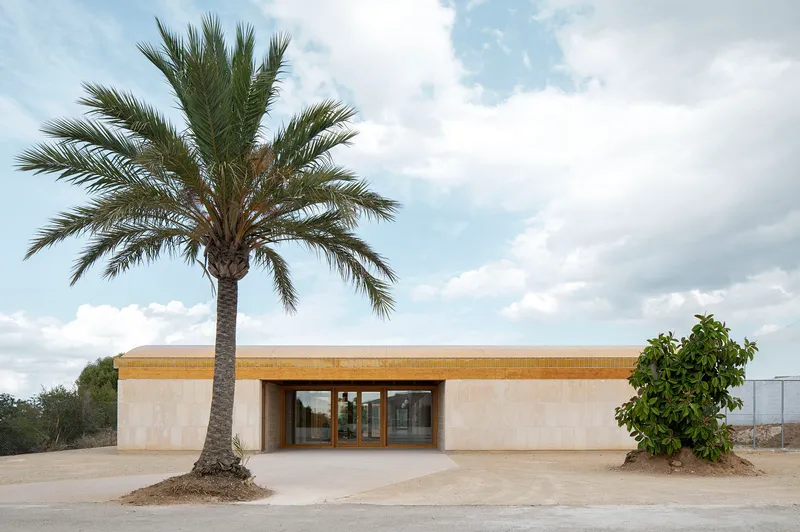
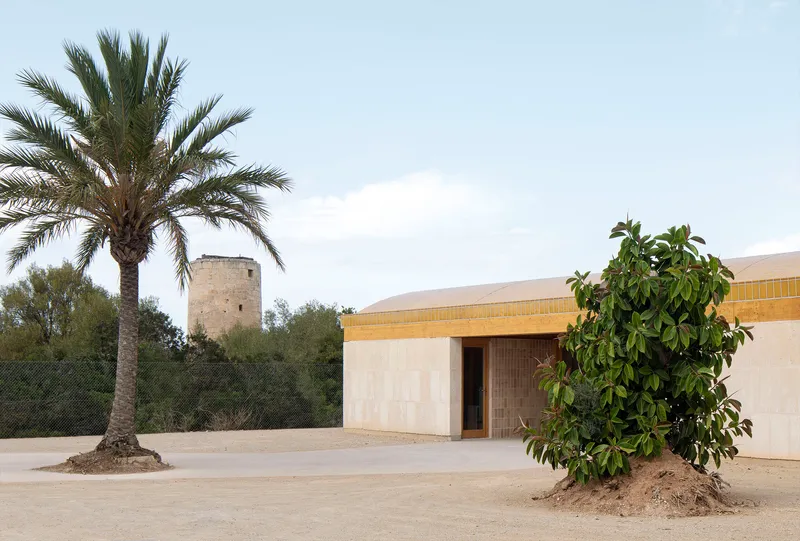
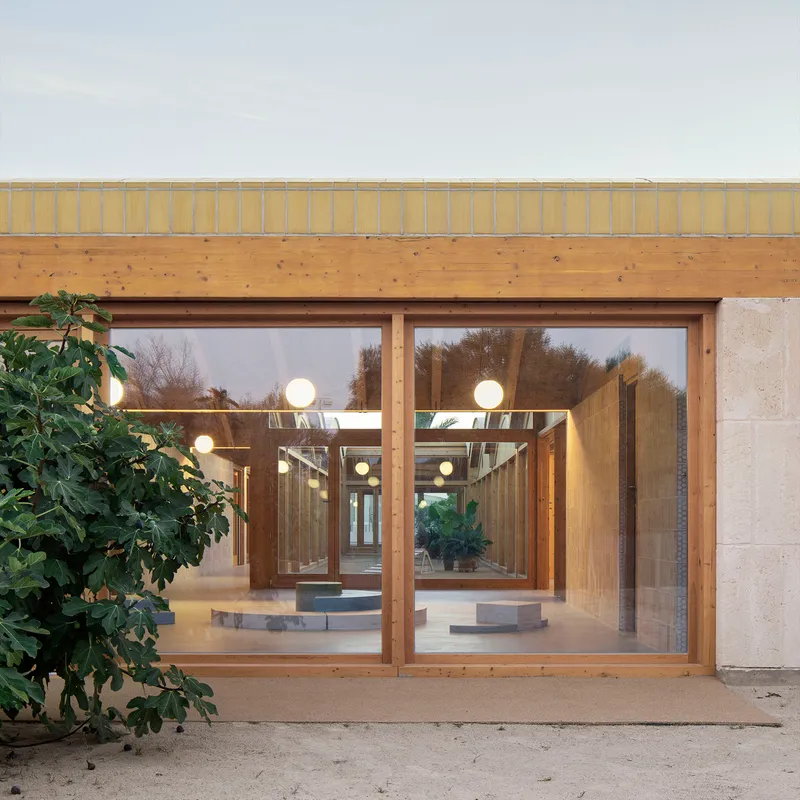
From the street, the building presents a modest, almost domestic face. The entrance facade pairs pale tile walls with timber banding beneath the curved roofline, flanked by a palm tree and a citrus tree on sandy ground. It defines a public square on the access side, contributing to the village's fabric rather than withdrawing from it. The building is introverted, yes, but it gives back to its context at the urban edge.
At night, the glazed facade transforms the building into a lantern. Suspended globe lights illuminate the timber frame from within, and the repeating vault geometry becomes a silhouette against the sky. The shift from daytime discretion to evening presence is one of the building's quieter achievements.
Plans and Drawings
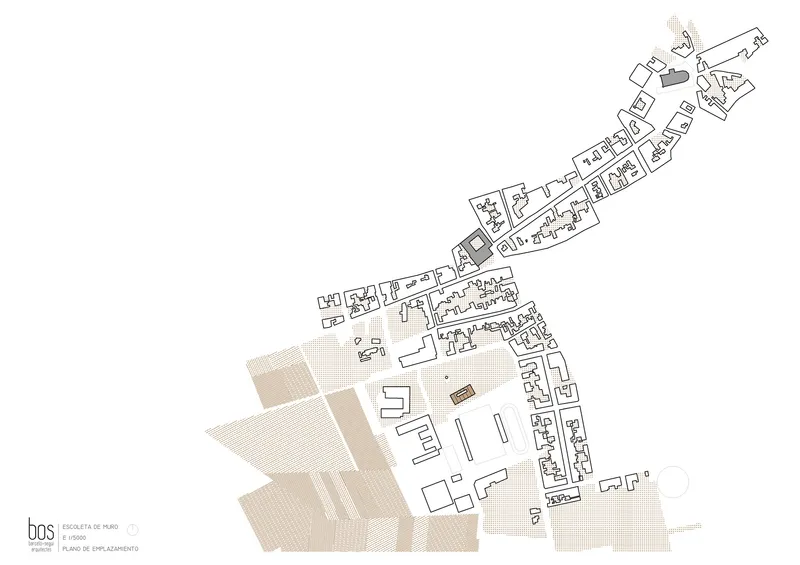
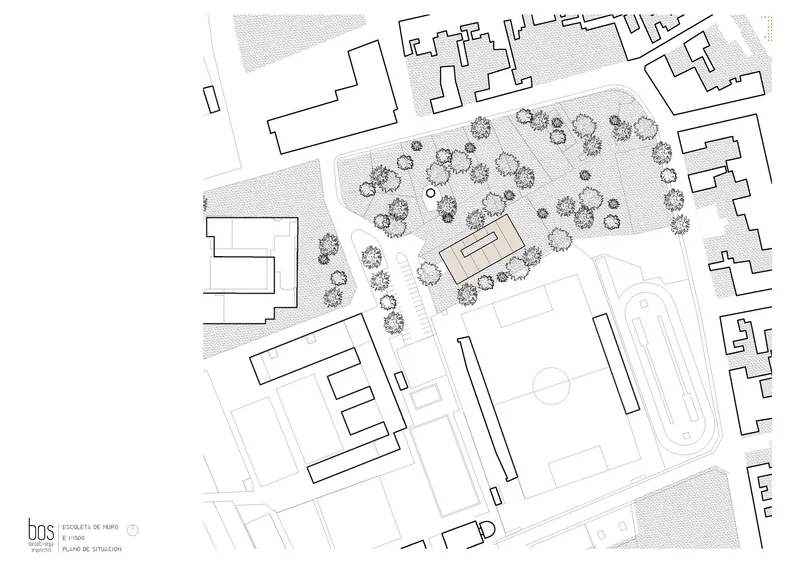

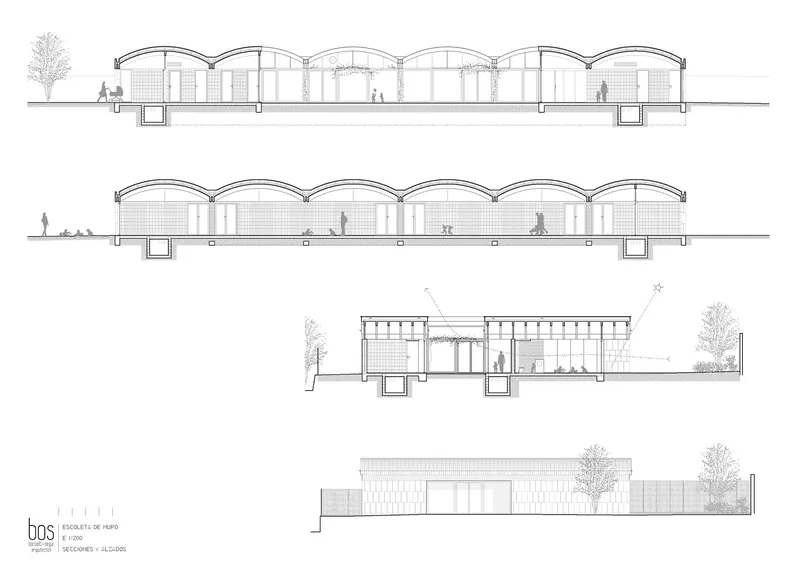


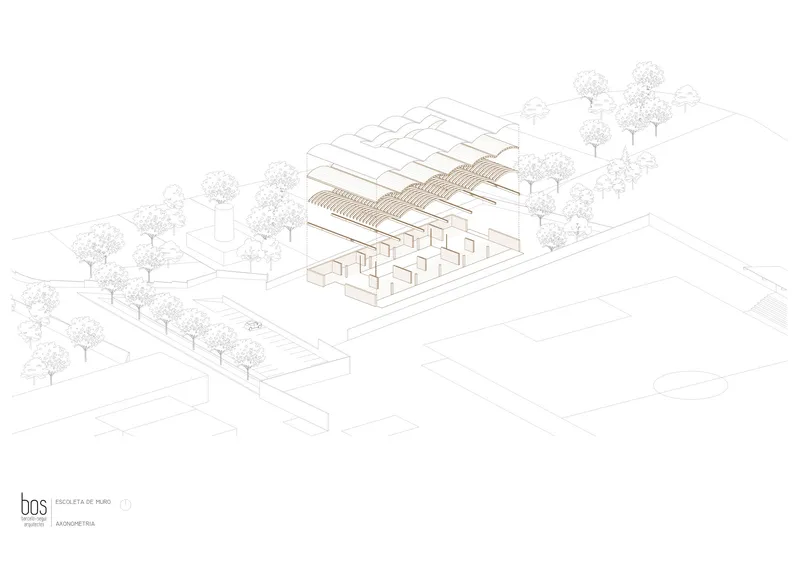
The site plans reveal how carefully the building negotiates its position between Muro's urban grain and the open agricultural landscape. The floor plan makes the three-strip organization and courtyard loop legible at a glance: classrooms south, services north, courtyard center. The section and elevation drawings confirm the structural repetition of the barrel vaults while showing how the lightweight roof sits above the thermal mass of the ground-level construction. A construction detail drawing traces the precise junction between curved roof assembly and vertical column, demonstrating that the apparent simplicity of the vault system rests on considered engineering.
The axonometric drawing provides the clearest reading of the building as a whole: a compact, tree-surrounded complex whose sawtooth section and courtyard logic work together to modulate light, air, and enclosure across every room.
Why This Project Matters
Nursery schools are among the most common building types in contemporary European practice, and most of them are forgettable. They either default to exuberant color as a proxy for childhood or retreat into institutional blandness. BOS Arquitectes has done neither. The Muro nursery builds its identity from structure, material, and environmental logic, producing spaces that are warm, legible, and specific to their climate and place. The curved timber vaults are not a stylistic gesture. They are a structural system that generates shelter, organizes services, and shapes the building's relationship to the Mallorcan landscape.
More broadly, this project demonstrates that passive design strategies and local material palettes do not require formal austerity. The ochre ceramic roof, the stone and brick walls, the cross-ventilated courtyard plan: these are not compromises or constraints. They are the building's architecture, fully and without apology. For a project at 745 square meters on the edge of a small Mallorcan village, that kind of conviction is worth paying attention to.
Nursery School in Muro, designed by BOS Arquitectes (Miquel Barceló Ordinàs and Margalida Seguí Tugores). Located in Muro, Mallorca, Spain. 745 m². Completed in 2025. Photography by Del Río Baní.
About the Studio
Share Your Own Work on uni.xyz
If projects like this are the kind of work you want to make, uni.xyz is a place to publish your own, find collaborators, and enter design competitions.


Popular Articles
Popular articles from the community


Opera on the Sea: Driftwood Logic Shapes a Timber Opera House on Estonia's Coast
Trevor Orgill's opera house translates the entangled drift of floating timber into a civic building where wood, water, and music converge.

Manzana Morphosis: Stretching Barcelona's Grid into a Living Landscape for 2050
A radical reworking of the Eixample manzana turns density into a tool for generous public space, vertical ecology, and environmental performance.
Cloaked Colonization: A Mobile Underwater Habitat That Moves Like a Fish
Micah Abaya's shortlisted EHC Pacific entry reimagines ocean settlement as a dispersed network of self-sustaining architectural organisms.
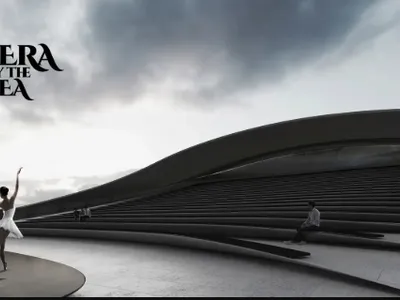
Opera by the Sea Estonia: Three Shells Dissolving Architecture into Tallinn's Coastline
A winning opera house proposal replaces monumental form with interconnected shells that blur the boundary between building, park and Baltic Sea.

Similar Reads
You might also enjoy these articles

Bao Huynh Watercolor Atelier: A Serene Art Retreat in Hội An
Bao Huynh Watercolor Atelier in Hội An blends multifunctional art spaces, sustainable design, local materials, and family-friendly living in a serene environment.

Atelier Macri Concept Store Interior Design by CASE-REAL
Atelier Macri store features a "ko" counter, walnut wood details, cork displays, blending retail, gallery, and seamless customer experiences.

Manuel Vargas Izquierdo Stadium and High-Performance Sports Center: Architectural Excellence in Jalpa de Méndez
The Manuel Vargas Izquierdo Stadium blends sustainable design, inclusive sports facilities, and cultural-inspired architecture, revitalizing Jalpa de Méndez’s public spaces.

KAKR Buluh Awar Hall: Revitalizing Community and Ecology Through Bamboo Architecture
Community built bamboo hall revitalizes Buluh Awar village, empowering youth, restoring ecology, celebrating vernacular craftsmanship through sustainable architecture and culture.


Comments (0)
Please login or sign up to add comments
No comments yet. Be the first to comment!