
Bubble Hub: Co-Living Under a Single Dome
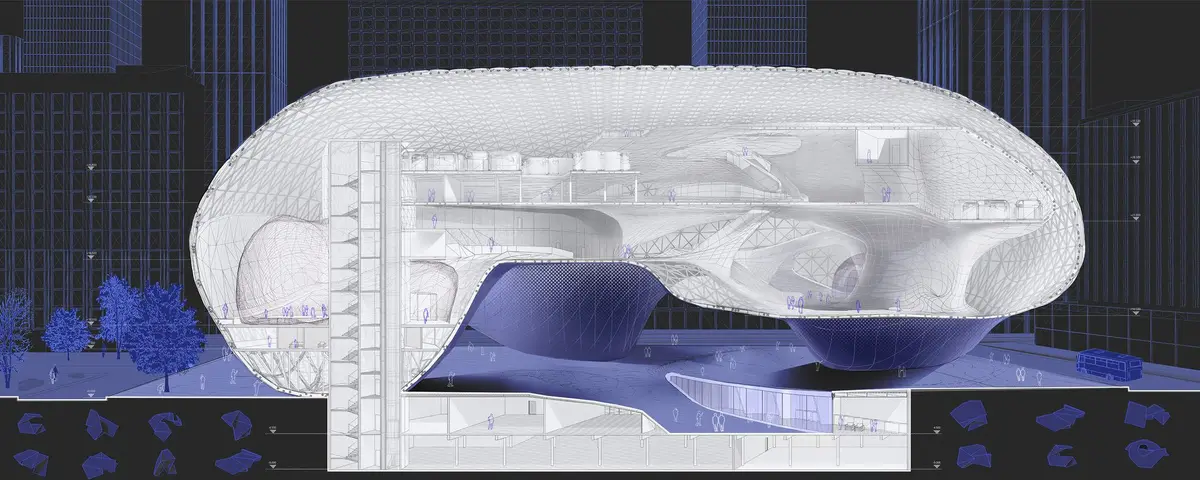
A translucent dome containing an entire co-living village with no corridors and no walls between shared spaces, only private sleeping pods.


A bubble has no walls. It has a surface that encloses a volume, and inside it everything is connected to everything else. Bubble Hub, a co-living project by Tatiana Taratuta and Danil Nazarov, takes this literally. It proposes a single translucent dome containing an entire co-living village: private pods, communal libraries, lounges, workspaces, and public plazas, all under one continuous shell with no corridors and no doors between shared spaces.
The project received an Honorable Mention in the Hustle Hub '19 competition on uni.xyz. It is the most formally radical entry in the series: not a building with rooms, but a single volume with furniture.
The Shell: A Dome on Legs
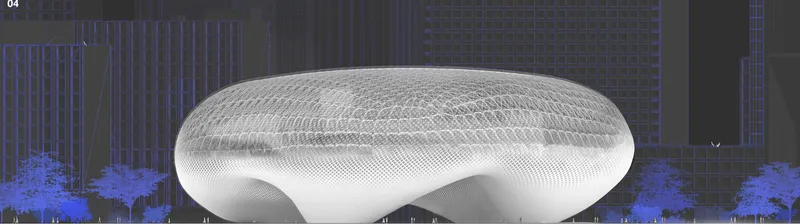
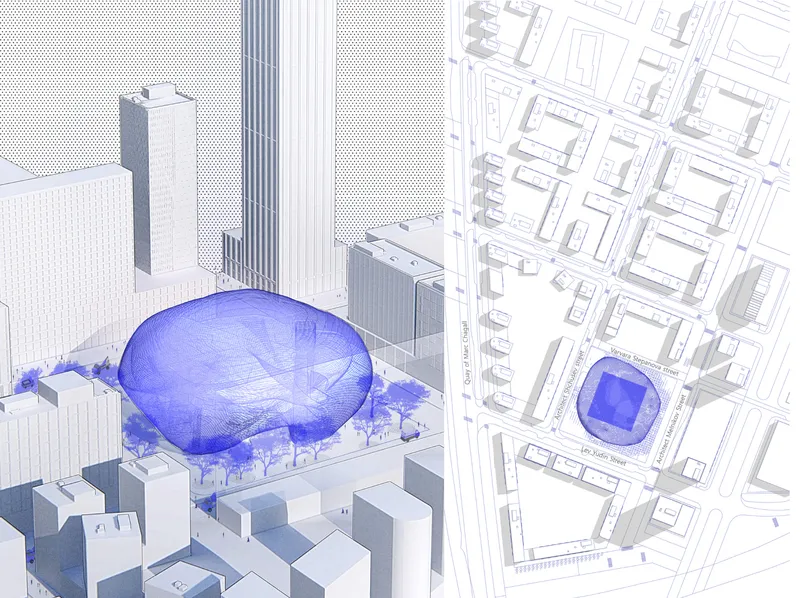
The exterior is a translucent, organic dome raised above the ground on legs. The form is soft, blobby, and immediately recognisable. It does not look like housing. It looks like a greenhouse, a tent, or a soap bubble that landed in the middle of a city block. The aerial view and site plan show it sitting among conventional urban fabric, occupying a single block footprint.
Raising the dome on legs creates a public ground level beneath it: covered, shaded, and open to the street. The co-living begins above. This separation means the building contributes to the city at ground level (public passage, market space) while housing its community above.
The Interior: No Walls, Only Furniture
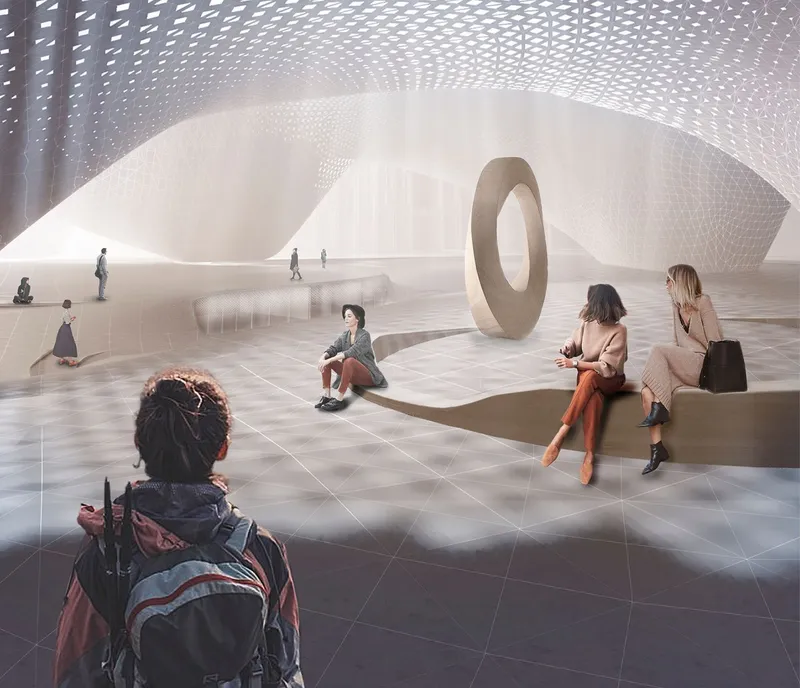
The main interior render shows the communal hub beneath the perforated dome shell. The space is open, vast, and softly lit through the dome's triangulated skin. Curved organic seating, a ring sculpture, and informal gathering points replace conventional rooms. People sit, walk, and talk. There are no corridors. There are no partition walls. The space is defined by furniture, level changes, and the curvature of the shell itself.
This is the project's central argument: that co-living works best when the distinction between public and private is spatial rather than physical. You do not close a door to be alone. You move to a quieter zone. You do not open a door to be social. You sit down where people are. The architecture does not enforce behaviour. It offers positions.
Private Pods: Three Typologies
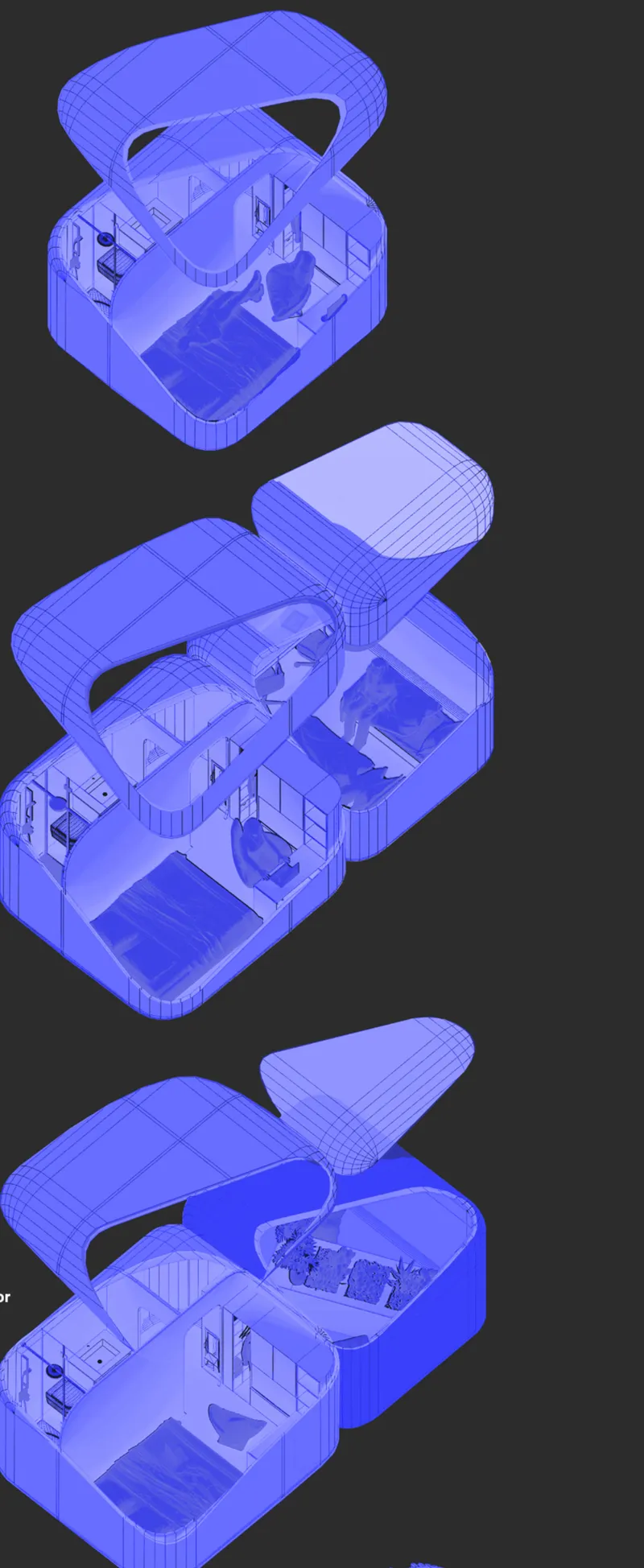
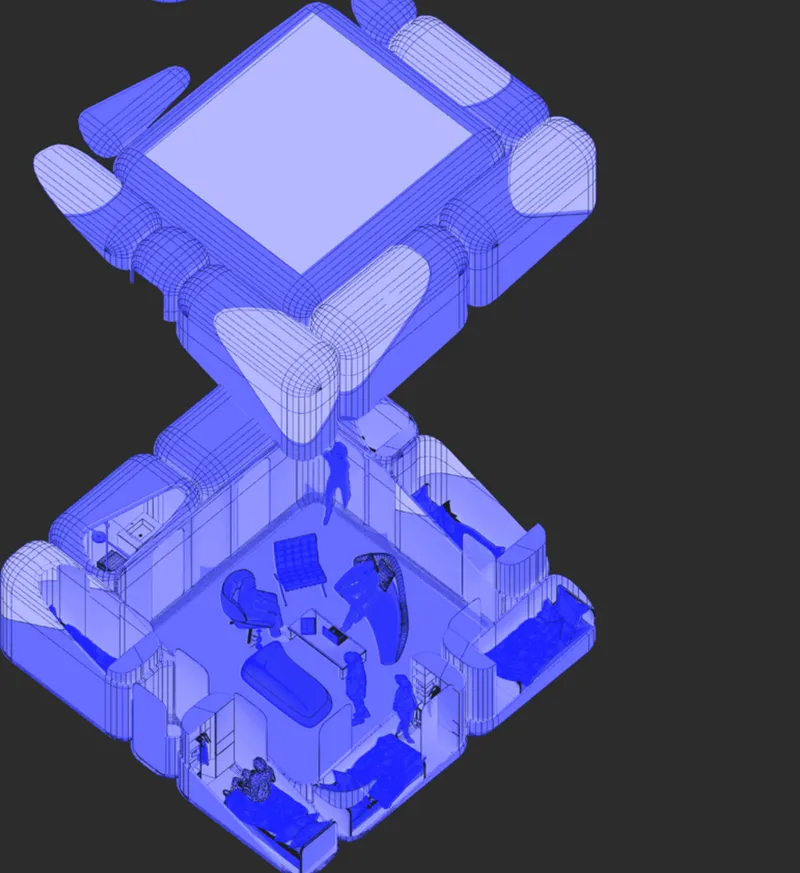
The blue wireframe drawings show the private units. Three pod types are stacked vertically, each containing a bed, kitchen, bathroom, and a curved rooftop terrace. The pods are compact, self-contained, and clearly defined. They are the only enclosed spaces in the building. Everything outside them is shared.
The hourglass-shaped shared module is the counterpart: a double-height communal volume with workstations, soft furniture, and a pinched waist that creates visual separation between upper and lower zones without walls. The shape itself is the partition. This is spatial design at its most inventive: using geometry instead of construction to create different atmospheres within a single open volume.
The Library and the Lounge
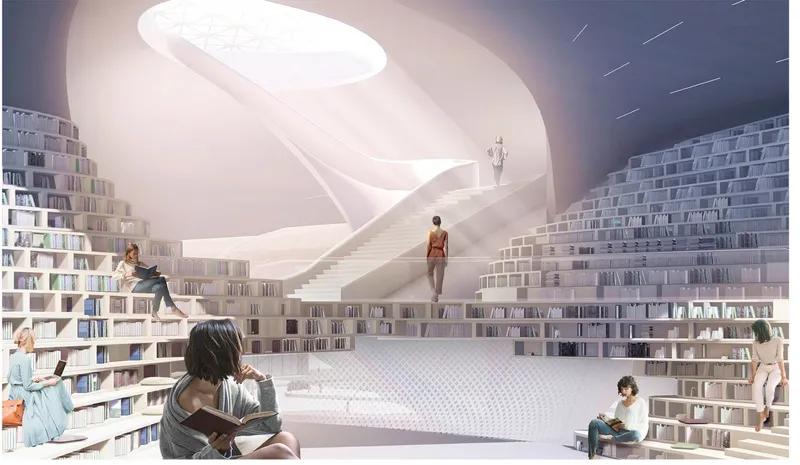
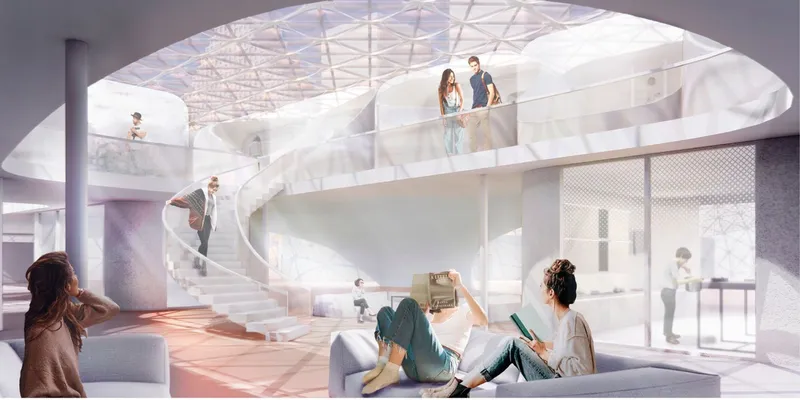
The two most developed interior renders show a library and a lounge. The library has curved bookshelves rising to the dome ceiling, a central skylight, and a spiral staircase connecting levels. The lounge has soft seating, a triangulated dome overhead, and residents reading and relaxing across two levels connected by the same spiral stair.
These spaces prove that shared rooms in a co-living building can be extraordinary. The library is not a shelf in a hallway. It is a room that would justify a visit even if you did not live there. The lounge is not a sofa in a lobby. It is a multi-level living room with the spatial quality of a museum atrium. This generosity is what makes the shared model attractive. People give up private living rooms because the communal ones are better.
Why This Project Matters
The Hustle Hub competition received entries that ranged from conventional apartments with shared kitchens to vertical campuses with programme towers. Bubble Hub occupies a different position: it eliminates the building envelope as a series of rooms and replaces it with a single continuous interior. The dome is the room. Everything inside is furniture.
This is not a practical proposal for most sites. But as a spatial provocation, it is the competition's most memorable entry. It asks: what is the minimum number of walls a co-living building actually needs? The answer, according to Bubble Hub, is the walls around your bed. Everything else can be open.
View the Full Project
About the Designers
Designers: Tatiana Taratuta, Danil Nazarov
Enter a Design Competition on uni.xyz
If radical co-living, dome architecture, or the elimination of conventional room boundaries is the kind of thinking you want to explore, uni.xyz runs competitions year-round that reward spatial provocation.
Project credits: Bubble Hub by Tatiana Taratuta and Danil Nazarov. Honorable Mention, Hustle Hub '19 (uni.xyz).


Popular Articles
Popular articles from the community

Faces of the Soviet Avant-Garde: Turning Moscow's Street Names into an Open-Air Museum
A network of sculptural installations across a Moscow residential district transforms forgotten architect names into spatial encounters with cultural memor

Singing Woman: An Opera House That Performs Before the Curtain Rises
Ovidiu Cristian Pavel's conceptual opera house translates Estonia's choral identity into a sculpted waterfront landmark facing the Baltic Sea.
Temporary Home for Dogs: A Reversed Zoo Rethinks Animal Shelter Architecture
In Bucharest, a sinuous corridor and freed landscape flip the logic of containment, designing a shelter that works to make itself unnecessary.

Cloaked Colonization: A Mobile Underwater Habitat That Moves Like a Fish
Micah Abaya's shortlisted EHC Pacific entry reimagines ocean settlement as a dispersed network of self-sustaining architectural organisms.

Similar Reads
You might also enjoy these articles

Shakur's House: Exposed Brick as an Interior Organiser in a 168 m² Mashhad Residence
Brick moves indoors in this Mashhad residence, where masonry walls, glass partitions and teal planes sequence a compact home without closing it off.

Day and Night Park: A Time-Based Urban Newsstand in Beijing
A temporary urban newsstand in Beijing blending travel, light, and reading through poetic colors, compact form, and community-focused design.

Modernist Patio Renovation in El Masnou, Barcelona by Oliver Segura Arquitectura + Cebrià Arquitectura
Modernist patio renovation blending tradition and innovation with a movable pool, leveled floors, and Catalan materials in El Masnou.

Alto Residencial Coop: Cooperative Housing Development in Santiago de Compostela by Carbajo Barrios Arquitectos
A linear cooperative housing complex blending white volumes and perforated metal façades, enhancing community living, natural light, privacy, and urban integration.


Comments (0)
Please login or sign up to add comments
No comments yet. Be the first to comment!