

bureau^proberts Wraps a Brisbane Commercial Center in a Clay Screen That Inverts the Brick
A mass timber retail building in West End uses custom T-shaped clay units to reimagine the masonry heritage of a former ice cream factory precinct.


Most commercial buildings that reference their heritage neighbors do so through proportion or color. bureau^proberts takes a more conceptual route with The Eaves, a three-storey retail and wellness building in Brisbane's West Village precinct. The defining move is a perforated clay screen that wraps the upper facade, but the screen is not conventional brickwork. It is brickwork turned inside out: T-shaped clay elements represent the mortar joints, and the voids between them carry the exact dimensions of a standard brick. The result is a facade that acknowledges the red masonry of the heritage-listed 1920s Peters Ice Cream Factory nearby while producing something genuinely new.
The name itself signals intent. "The Eaves" is less a description of a building part and more a provocation about what a building's edge can do. bureau^proberts designed this project as much for its perimeter as for its interior, wrapping the L-shaped plan around a landscaped public park and pulling its timber superstructure out onto Boundary Street like a verandah. In a subtropical city where shade is civic infrastructure, the building operates as a filter between interior and exterior, between the precinct's commercial life and its green spaces.
A Screen That Flips Masonry Logic
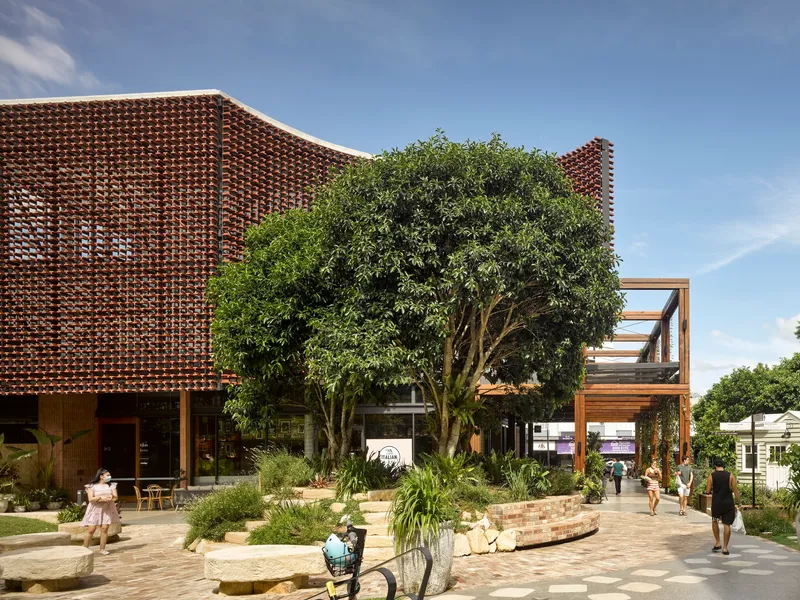
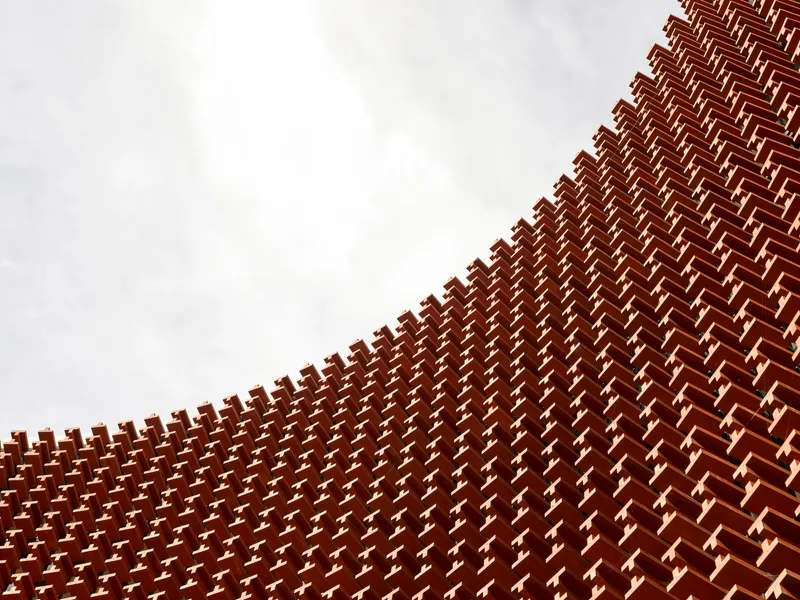
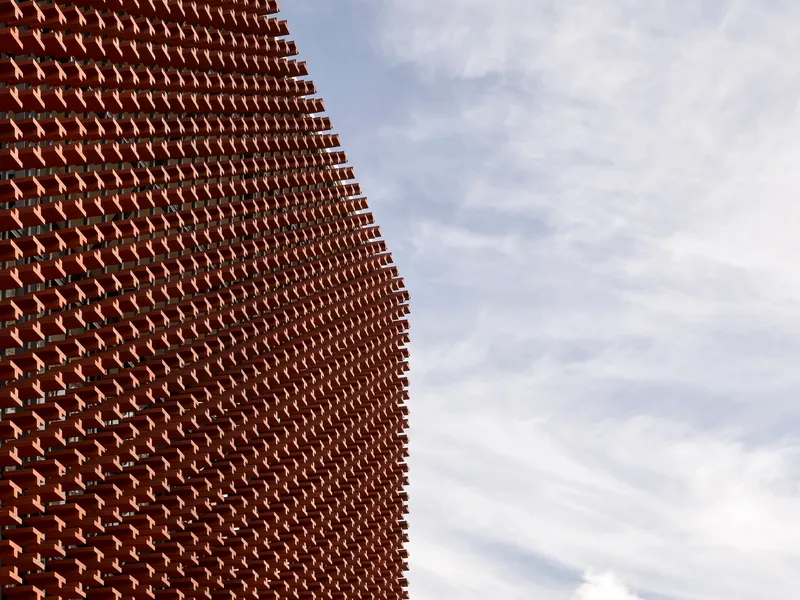
The clay screen is the building's most legible idea and its most technically precise one. Each unit is custom-made, a T-shaped terracotta element that frames a void the size of a common brick. Where a traditional masonry wall reads as solid with mortar in between, this screen reads as mortar with solid in between. It is a simple inversion, but it produces an entirely different visual and environmental character: the facade breathes, filtering western sun while allowing ventilation and inviting complex shadow play across the interior.
The screen is supported by a steel frame independent of the building's timber structure, which lets it curve and undulate without structural compromise. Seen close up, the depth of each clay unit creates a textured surface that shifts in appearance with the angle of light. From a distance, the screen reads as a single warm surface that absorbs the red tones of the Peters factory without mimicking its solidity.
Curving Around the Canopy
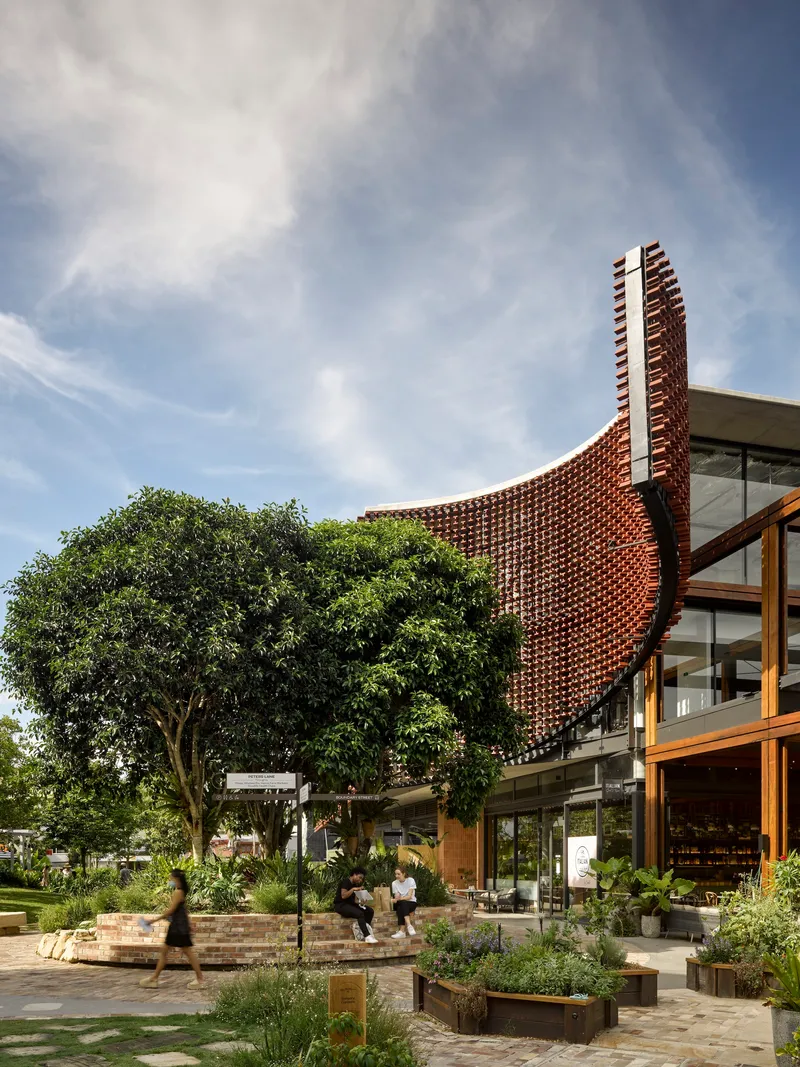
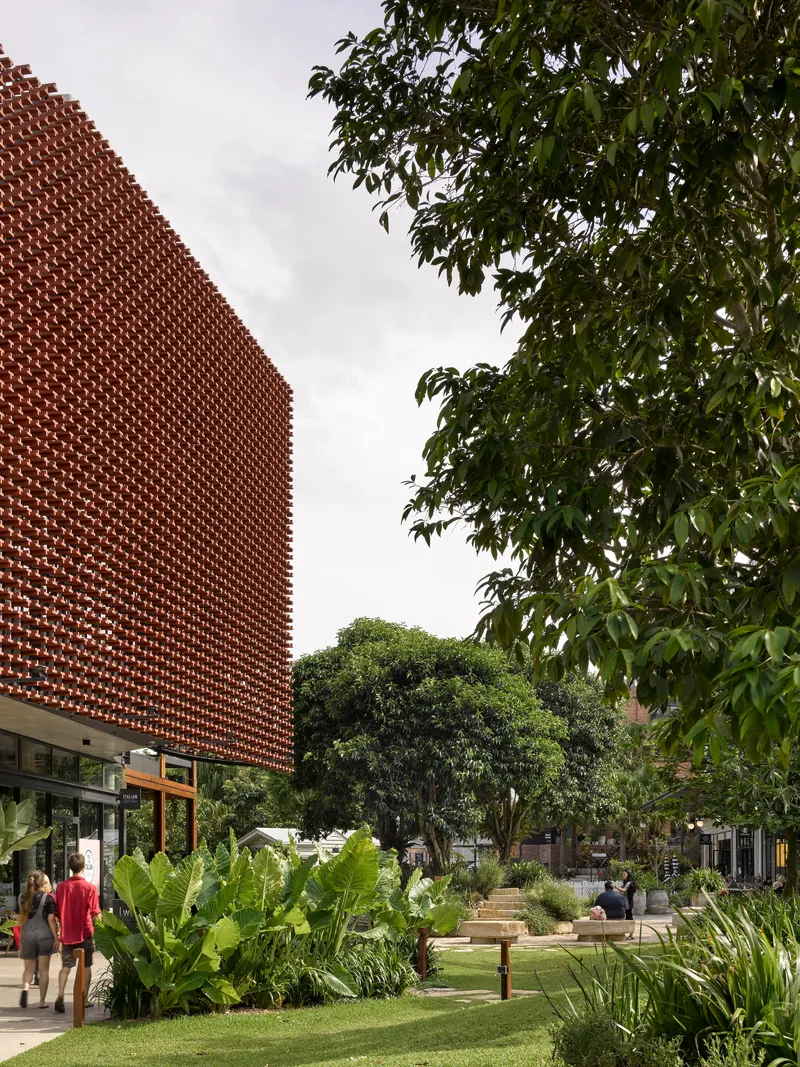
The most telling detail in the site strategy is the sweeping curve in the building's facade, which exists to accommodate the canopy of an established fig tree. That gesture reveals the project's priorities. The building does not simply sit next to landscape; it defers to it. A cluster of fig trees forms a natural gathering point in the landscaped public square at the juncture of two outdoor spaces, and the building wraps around this moment rather than displacing it.
West Village added over 2,200 square meters of public open space to the neighborhood, including 376 square meters of deep planting. One hundred mature trees and more than 10,000 plants populate the site. The park wraps around the building in an L-shape, and the building follows that geometry, creating a continuous threshold of retail, terrace, and garden that collapses the distinction between commercial frontage and public ground.
Timber as Verandah and Trellis
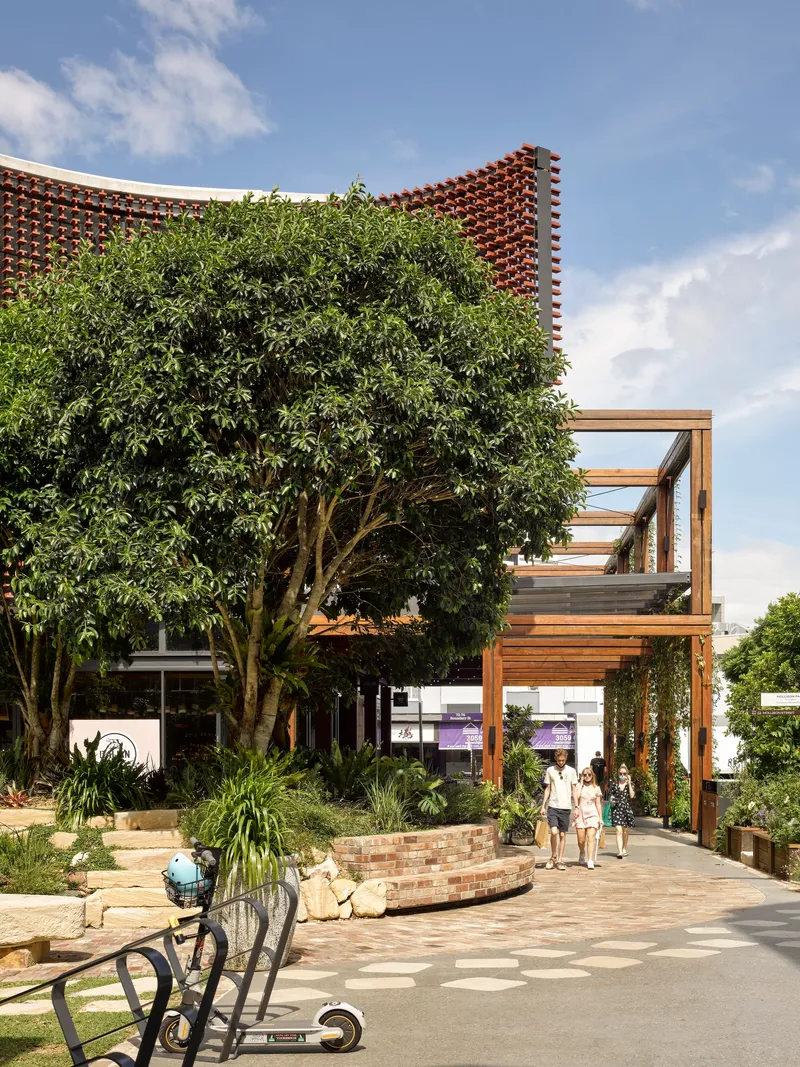
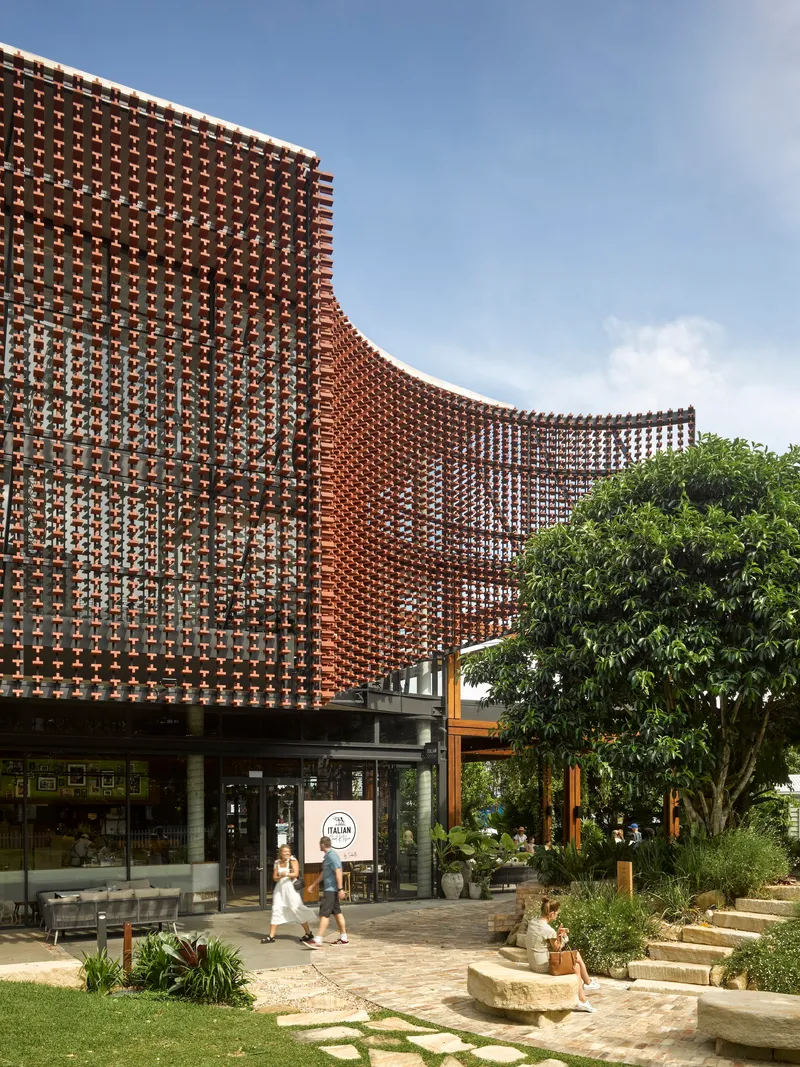
The building's superstructure is mass timber, specifically glulam beams and columns that span the full length of the plan. bureau^proberts extends this timber frame beyond the building envelope, projecting it onto Boundary Street as a shade structure and landscape arbour. The structural grid deliberately echoes the rhythm of the heritage brick buildings in the precinct, establishing a visual continuity that works at the scale of the street rather than the individual elevation.
The timber serves a dual environmental role. As a verandah, it provides the deep shade that subtropical Brisbane demands. As a trellis, it supports climbing vegetation that will, over time, soften the building's edges and further integrate it with the park. The concept is explicitly drawn from the Queensland verandah tradition: retail spills onto terraces, terraces open onto green spaces, and the boundary between inside and outside becomes a spectrum rather than a line.
Facade as Environmental Device
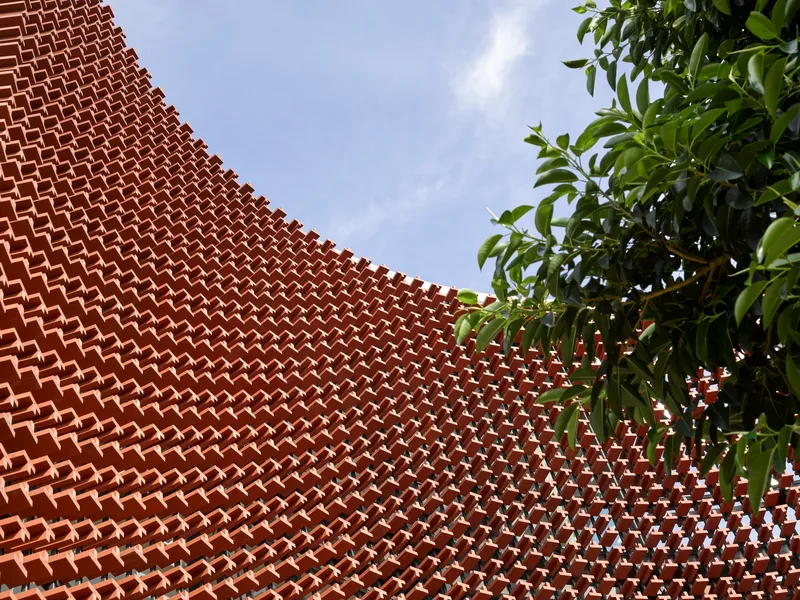
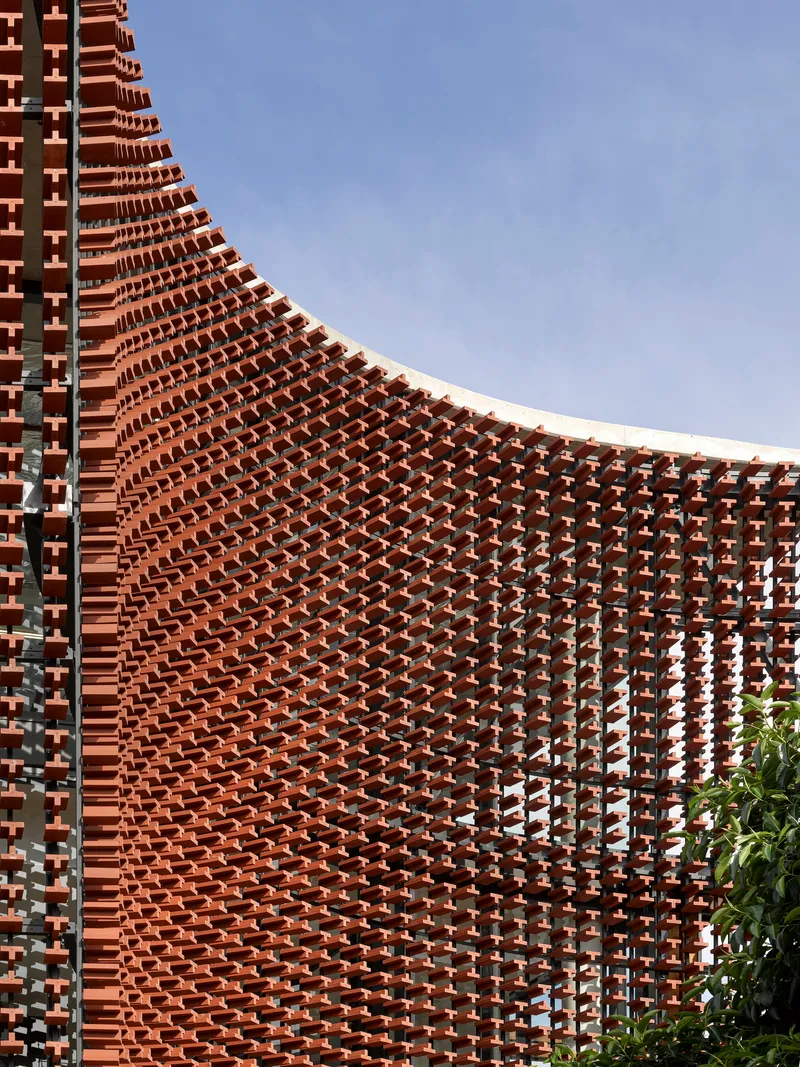
The clay screen faces west, the most punishing orientation in Brisbane's climate. Its perforations are calibrated to shade commercial tenancies from the afternoon sun while maintaining light transmission and airflow. The screen takes its cue from the durable and thermal qualities of the Peters factory masonry, recognizing that those early industrial builders understood passive performance even if they would not have used the term.
From below, the screen's curvature and the staggered coursing of its clay elements create a visual rhythm that is both systematic and slightly unpredictable. The negative spaces catch the sky at different angles, so the facade's opacity shifts as you move along the path beneath it. This is not ornament in any decorative sense; it is a wall doing three things at once: shading, ventilating, and establishing material dialogue with its context.
Why This Project Matters
The Eaves is a useful counterpoint to the common complaint that commercial architecture in mixed-use precincts defaults to neutral glass boxes with heritage-colored cladding. bureau^proberts has produced a building that engages its industrial neighbors at the level of material logic rather than surface style. By inverting brick into void and mortar into solid, the clay screen creates genuine architectural novelty from an honest reading of context. That is harder than it sounds.
The project also makes a compelling case for the building edge as public infrastructure. In a city where shade, breeze, and gathering space are not amenities but necessities, the decision to treat the perimeter as the primary design problem feels exactly right. The Eaves does not just occupy its site. It extends the neighborhood's public realm by over 2,000 square meters and uses its own structure to shelter it. West Village's 6 Star Green Star Communities rating may be the certification, but the real measure of success here is simpler: people sitting under fig trees in the shade of a building that curved to keep them.
The Eaves Commercial Center by bureau^proberts, West End, Brisbane, Australia. 3,300 m². Completed 2022. Photography by Christopher Frederick Jones.
About the Studio
Share Your Own Work on uni.xyz
If projects like this are the kind of work you want to make, uni.xyz is a place to publish your own, find collaborators, and enter design competitions.


Popular Articles
Popular articles from the community


Extended Shell: Retrofitting Kolkata's Balconies as Living Urban Thresholds
A modular retrofit system recovers the social and environmental intelligence of Kolkata's historic verandas for contemporary Park Street residents.

The Amber Palace Opera: A Geological Fiction Surfaces on Tallinn's Baltic Waterfront
Pierre Brillard reimagines a Baltic legend as a public landscape, opera house, and waterfront promenade rooted in Tallinn's coastal identity.

Cloaked Colonization: A Mobile Underwater Habitat That Moves Like a Fish
Micah Abaya's shortlisted EHC Pacific entry reimagines ocean settlement as a dispersed network of self-sustaining architectural organisms.

Opera on the Sea: Driftwood Logic Shapes a Timber Opera House on Estonia's Coast
Trevor Orgill's opera house translates the entangled drift of floating timber into a civic building where wood, water, and music converge.

Similar Reads
You might also enjoy these articles

Pixel Gardens: One Repeated Module Stacked Into a Terraced Social Housing Tower for Famagusta
Salem Bader's shortlisted housing tower builds a vertical neighbourhood from one repeated module, offsetting units to carve terraces, light and air.

Bao Huynh Watercolor Atelier: A Serene Art Retreat in Hội An
Bao Huynh Watercolor Atelier in Hội An blends multifunctional art spaces, sustainable design, local materials, and family-friendly living in a serene environment.

Atelier Macri Concept Store Interior Design by CASE-REAL
Atelier Macri store features a "ko" counter, walnut wood details, cork displays, blending retail, gallery, and seamless customer experiences.

Manuel Vargas Izquierdo Stadium and High-Performance Sports Center: Architectural Excellence in Jalpa de Méndez
The Manuel Vargas Izquierdo Stadium blends sustainable design, inclusive sports facilities, and cultural-inspired architecture, revitalizing Jalpa de Méndez’s public spaces.

Explore Shopping Center Competitions
Discover active competitions in this discipline

Challenge to reimagine the Iron Throne

Photograph architecture without architects

Illustrate the lost glory of Angkor Wat - Render Challenge

Design challenge to reuse E-waste
Comments (0)
Please login or sign up to add comments
No comments yet. Be the first to comment!