
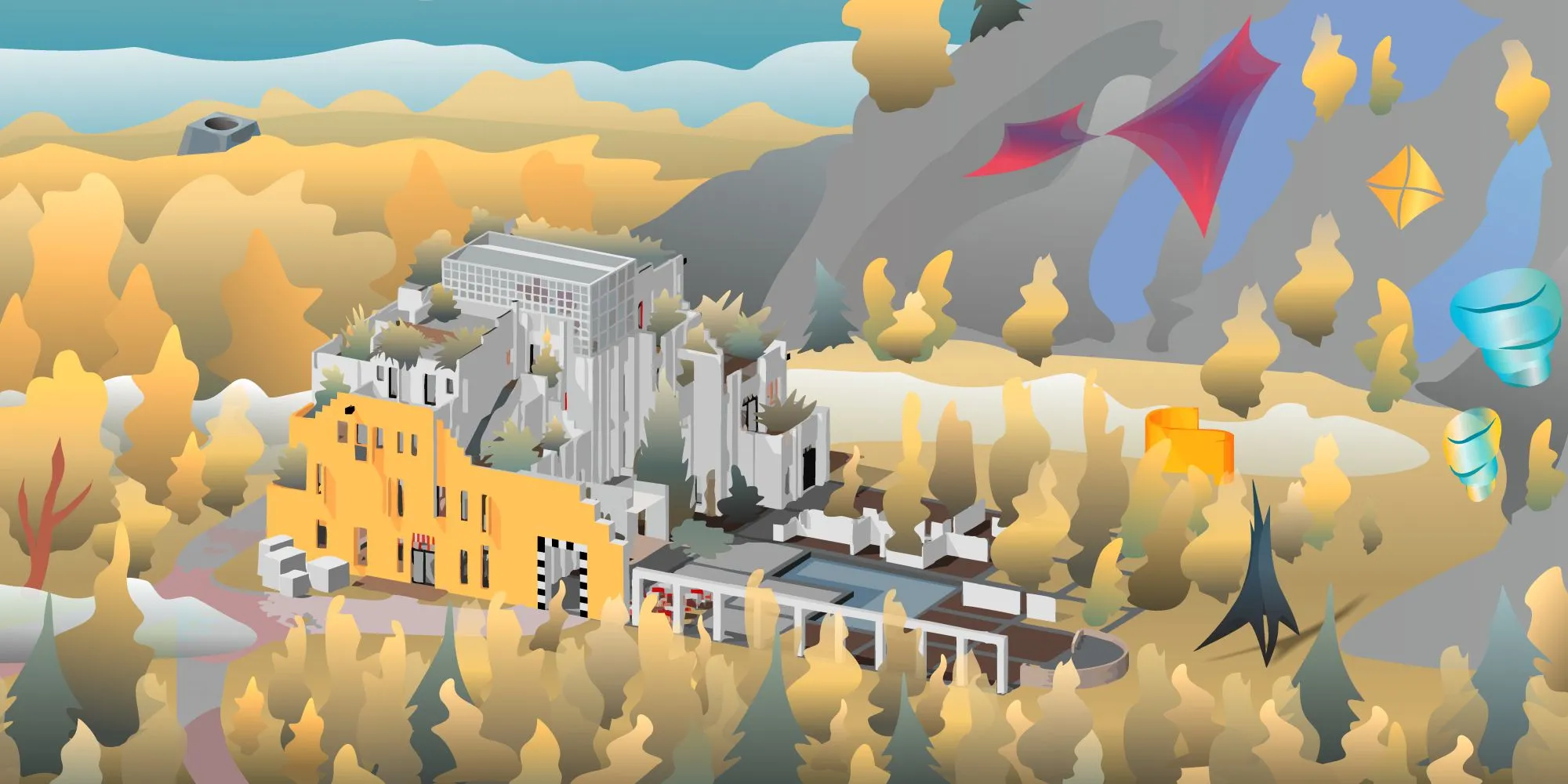
Center for Entheogenic Treatment in Rogozka
Center for Entheogenic Treatment in Rogozka is a space for experimental entheogenic therapy. The center consists of a four storey multi-functional building and a park. Set in a calm scenery of an abandoned quarry in the Kłodzko Valley.

Entheogens have been with us since the beginning of our species. They were associated with all primal belief systems which then they evolved into religions we know today - Christianity, Islam, Hinduism. Same substances were used all over the world - in the rituals of the Siberian autochthons and the Amazon Natives. Nevertheless, in our Western civilization, they have became almost completely forgotten. In common knowledge, that there is no difference between a heroin and a psychonaut.
Psychedelics aren't just fun. Contemporary research shows that these long ingnored substances can be used in the treatment of a number of diseases, including post-traumatic stress, depression, social phobia, alcoholism, obsessive-compulsive disorders, drug addiction and cluster pains. The healing potential is enormous. In studies conducted with alcoholics, entheogenic treatment was 20% more effective than conventional treatment. In the treatment of post-traumatic stress disorder, MDMA therapy was four times more effective. Psilocybin is administered to terminally ill patients, which significantly improves their psychological comfort and makes them easier to cope with anxiety. Many people suffering with depression had their lives saved by psychedelics. A psychedelic experience resulting from the sudden bombardment of serotonin receptors acts as a reset for the mind tormented by depression. It allows one to look at their life from a new perspective, break out of harmful thought loops. Moreover, psychedelics are not addictive, unlike conventional psychotropics.
Many people wish to take part in entheogenic therapy, but access to safe substances is difficult. Many give up because they are afraid of conflict with law or simply do not have access to a safe place. I would like to provide a safe haven for these people. A place where they could experience something new in an unusual setting and permanently improve their psychological comfort. So far, no one has designed a similar place from scratch. Usually entheogenic treatment centers are established in appropriately adapted, already existing facilities. The conditions are usually modest, because it is still a young field.
Location
Kłodzko Valley gives the impression of a somewhat sleepy and forgotten place. The low mountains are covered with vast forests and meadows. Tens of almost abandoned villages and decaying health resorts, which before the war were among the most popular in Europe. There are not many places in Poland where you can feel such a wild atmosphere. Rogóżka is a village situated in a picturesque valley, a few kilometers west of Stronie Śląskie. Formerly known as Wolmsdorf, it was founded in the 14th century.
The facility will be a medical hospitality building with several additional functions. Ground floor will be acessible for everyone. A space for exhibition and a restaurant. The upper floors will hold medical and residential functions. Like therapy rooms where yoga, meditation and painting workshops will be held. Entheogenic therapies are not fully researched and completely safe, therefore the health of patients will be supervised by psychologists. It is necessary to provide about 30 beds in rooms located at some distance from the paths intended for tourists. Interiors should be cozy and natural, full of wood, carpets and fabrics. Each room is supposed to be a safe zone. There are many concepts regarding the course of entheogenic therapy, therefore the object should be as easy to adapt as possible. A sculpture park will be arranged around the building. Here guests will go on their journeys. Abstract installations will be placed throughout the quarry. Their interactivity is important. I think of this space as a huge playground, accessible to everyone.
Three-day stays will be organized in the facility. On the first day, patients will be calmed. There will be walking tours around the area, meditation, yoga, painting. Everything will be supervised by the so-called tripsitteers - psychonautical experts and psychologists. The second day will be for Travel. The patient will be able to choose the substance and the course of his journey. During the psilocybin experience, the visitor will be placed in a comfortable colorful tent, where he will explore his own interior for 8-10 hours in a pleasant space. The treatment of patients who choose LSD or MDMA will be different. These therapies are usually conducted in groups. The specificity of these substances is slightly different than that of psilocybin - instead of running inside, there is a desire to explore the surroundings. Therefore, the quarry space should provoke as many stimuli as possible. The third day will be dedicated to the so-called "landing", a state of re-reality in which the patient returns to his daily routine. Many suggest that the psychedelic experience is best enjoyed when alone. Others say otherwise. At this center, I would like to meet the needs of both groups. The building should have spaces for integration and insulation. Every place should have a quiet place to calm down easily accessible. The priority is to provide guests with a nice and friendly place that provokes the most interesting experiences.




Popular Articles
Popular articles from the community


Riyadh For All: Intergenerational Urban Design for Active Aging in Rabat
Riyadh For All reimagines urban design in Rabat with intergenerational co-living, adaptive courtyards, and Moroccan cultural exchange today.

The Ocean Hive: Sustainable Architecture for a Self-Sufficient Civilization at Sea
The Ocean Hive imagines sustainable architecture at sea, where modular habitats, algae, wave power and ocean waste sustain a growing colony.

Co-Life: Senior Housing Design That Reconnects Older Adults With the City
Co-Life reimagines senior housing design through healing gardens, shared streets, workshops, and a sustainable community across generations.

Lunar Spiral: Space Architecture Shaped by the Mathematics of the Universe
Lunar Spiral reimagines space architecture through Fibonacci geometry, lunar regolith, levitating habitats, and self-sustaining Moon living.

Similar Reads
You might also enjoy these articles

Day and Night Park: A Time-Based Urban Newsstand in Beijing
A temporary urban newsstand in Beijing blending travel, light, and reading through poetic colors, compact form, and community-focused design.

Modernist Patio Renovation in El Masnou, Barcelona by Oliver Segura Arquitectura + Cebrià Arquitectura
Modernist patio renovation blending tradition and innovation with a movable pool, leveled floors, and Catalan materials in El Masnou.

Alto Residencial Coop: Cooperative Housing Development in Santiago de Compostela by Carbajo Barrios Arquitectos
A linear cooperative housing complex blending white volumes and perforated metal façades, enhancing community living, natural light, privacy, and urban integration.
Vil Genis School by BPA ARCHITECTURE – Massy, France
Vil Genis School in Massy, France, features sustainable design, south-facing classrooms, community integration, accessible spaces, and modern educational architecture.


Comments (0)
Please login or sign up to add comments
No comments yet. Be the first to comment!