

Chameleon: Modular Steel-and-Wood Seating That Reconfigures Public Space
A system of four interlocking stools built from hollow steel pipes and wooden planks adapts to parks, hospitals, and transit stations.


Most public seating is bolted down and forgotten. It assumes one posture, one crowd size, one social dynamic, and it gets all three wrong at least half the time. Chameleon starts from the opposite premise: that a seat in a metro station and a seat in a community park serve fundamentally different relationships between people and space, and that a single furniture system should be able to serve both without compromise.
Designed by Sashi Malik, Chameleon is a modular seating system comprising four sturdy stools made from hollow steel pipes and topped with durable wooden planks. The units connect, extend, and rearrange into linear, circular, and organic configurations. Published as a project on uni.xyz, the design targets parks, hospitals, bus stops, train stations, airports, and government offices: any public context where the number of users and their spatial needs shift throughout the day.
Triangular Geometry and X-Braced Legs

The technical drawings reveal Chameleon's structural logic. Each stool uses a triangular seat plan supported by X-braced legs fabricated from hollow steel pipe. The triangular footprint is a deliberate choice: it allows units to tessellate in ways that rectangular or circular seats cannot, opening up hexagonal clusters and radial patterns. Top, side, and front views show how the geometry keeps the centre of gravity low while minimizing material, making each unit both stable and light enough to reposition without tools.
Connection Details That Hold the System Together

A modular system is only as good as its joints. The construction detail drawings show how individual stools link through circular base connectors, locking adjacent units into rigid assemblies when needed and releasing them just as easily. The connection method is designed to be child-proof and elderly-friendly, with no pinch points or small removable parts. Steel-to-steel contact at the joints transfers lateral loads cleanly, so a row of linked stools behaves structurally as a single bench rather than a chain of wobbly individuals.
From Two Stools to Twenty: Arrangement Possibilities

The arrangement diagram is where Chameleon's scalability becomes tangible. Colour-graded hexagonal modules branch outward in linear runs, compact clusters, and freeform organic shapes. A pair of stools can serve a quiet hospital corridor; a dozen can wrap around a tree in a public park, encouraging group conversation. The gradient coding is more than graphic flourish: it maps how individual units aggregate into larger social geometries, illustrating the leap from object design to spatial planning.
Deployed on Site: Transit, Parks, and Waiting Areas
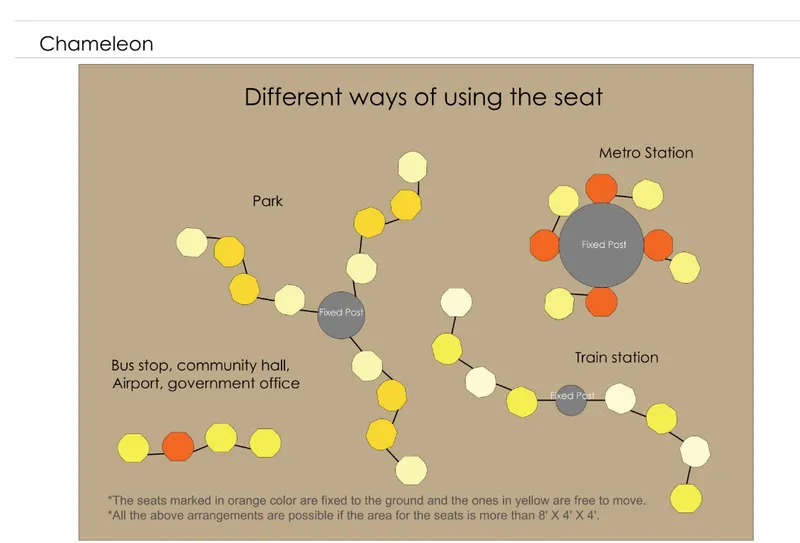
The site plan diagram grounds the concept in real-world conditions. Seating configurations wrap around fixed posts at bus stops, fill gaps in park landscapes, and line the walls of government waiting rooms. Each scenario demonstrates a different configuration responding to its specific constraints: limited pavement depth at a transit stop, circular social zones in a park, or linear queues in an office lobby. The diagram makes clear that Chameleon is not one product placed in many locations but one system producing many products, each shaped by context.
Why This Project Matters
Urban furniture occupies an awkward gap between architecture and industrial design, often claimed by neither discipline with full conviction. Chameleon bridges that gap by treating a stool as an architectural component: something with structural joints, spatial consequences, and a responsibility to the people around it. The choice of steel and wood keeps fabrication straightforward and maintenance low, qualities that matter far more in a municipal budget than formal novelty.
What elevates Sashi Malik's proposal beyond a product pitch is its insistence on systemic thinking. The project does not offer a single beautiful bench; it offers a kit of parts whose value multiplies with each unit added. In cities where public space is contested and budgets are thin, that kind of scalable, reconfigurable logic is not a luxury. It is a baseline requirement, and Chameleon meets it convincingly.
View the Full Project
About the Designers
Designer: Sashi Malik
Enter a Design Competition on uni.xyz
uni.xyz runs architecture and design competitions year-round that reward proposals with spatial conviction and real site intelligence.
Project credits: Chameleon by Sashi Malik.


Popular Articles
Popular articles from the community

Extended Shell: Retrofitting Kolkata's Balconies as Living Urban Thresholds
A modular retrofit system recovers the social and environmental intelligence of Kolkata's historic verandas for contemporary Park Street residents.

Cloaked Colonization: A Mobile Underwater Habitat That Moves Like a Fish
Micah Abaya's shortlisted EHC Pacific entry reimagines ocean settlement as a dispersed network of self-sustaining architectural organisms.

Manzana Morphosis: Stretching Barcelona's Grid into a Living Landscape for 2050
A radical reworking of the Eixample manzana turns density into a tool for generous public space, vertical ecology, and environmental performance.

Opera on the Sea: Driftwood Logic Shapes a Timber Opera House on Estonia's Coast
Trevor Orgill's opera house translates the entangled drift of floating timber into a civic building where wood, water, and music converge.

Similar Reads
You might also enjoy these articles

Pixel Gardens: One Repeated Module Stacked Into a Terraced Social Housing Tower for Famagusta
Salem Bader's shortlisted housing tower builds a vertical neighbourhood from one repeated module, offsetting units to carve terraces, light and air.

Bao Huynh Watercolor Atelier: A Serene Art Retreat in Hội An
Bao Huynh Watercolor Atelier in Hội An blends multifunctional art spaces, sustainable design, local materials, and family-friendly living in a serene environment.

Atelier Macri Concept Store Interior Design by CASE-REAL
Atelier Macri store features a "ko" counter, walnut wood details, cork displays, blending retail, gallery, and seamless customer experiences.

Manuel Vargas Izquierdo Stadium and High-Performance Sports Center: Architectural Excellence in Jalpa de Méndez
The Manuel Vargas Izquierdo Stadium blends sustainable design, inclusive sports facilities, and cultural-inspired architecture, revitalizing Jalpa de Méndez’s public spaces.

Explore Flexible Seating Competitions
Discover active competitions in this discipline

Design challenge to equip cities with modern furniture

Competition to design a workstation for architects

Packaging challenge - Design meets sustainability
Comments (0)
Please login or sign up to add comments
No comments yet. Be the first to comment!