

Choco Hive: A Hexagonal Resort Where Guests Harvest Cocoa Instead of Paying Rent
Modular timber pergolas and Maya cyclical building philosophy frame a resort that trades accommodation for cocoa farming labor.


What if the price of a hotel room was not money but labor? Choco Hive proposes a resort where guests stay free of charge in exchange for volunteering in cocoa harvests, collapsing the boundary between tourism and agricultural participation. The result is a hexagonal timber campus that reads less like a hospitality venue and more like a living classroom, one where the sacred Mesoamerican bean becomes the currency of cultural exchange.
Designed by Mervenaz Erkan and Deniz Can Çoban, Choco Hive was shortlisted in the Xocolatl competition. The project draws on Maya architectural philosophy, specifically the ancient practice of building durable stone foundations topped by impermanent wooden or adobe forms. That cyclical logic of permanence and renewal becomes the conceptual engine for a modular resort set within a cocoa plantation landscape.
Hexagonal Modules as Spatial Traces
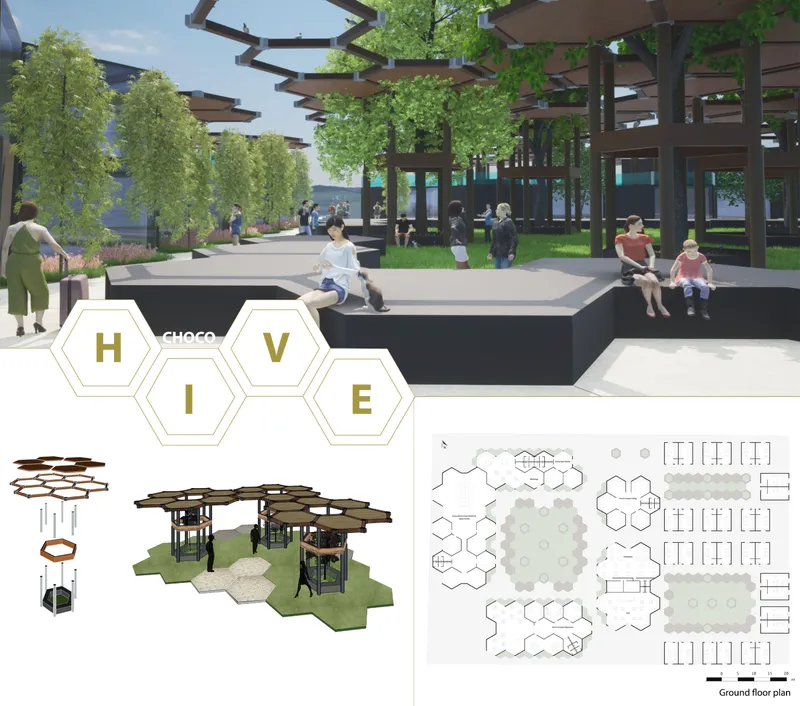
The composite board above reveals the project's organizing geometry: hexagonal modules that tile across the site like cells in a honeycomb. The axonometric views break down how timber pergola elements stack and interlock, while the ground floor plan shows the resulting spatial network of covered walkways, gathering zones, and planting beds. Each hexagon operates as an independent unit that can be assembled, adapted, or dismantled without disrupting its neighbors, echoing what Erkan and Çoban describe as the Maya belief that architecture is a living system rather than a static monument.
The modular grid is not merely structural convenience. It functions as what the designers call "spatial traces," a pattern that endures through future transformations. A module might serve as a workshop space today, a museum exhibit tomorrow, and a shaded cocoa drying area next season. The geometry persists; the program evolves. It is a compelling reinterpretation of cyclical Maya construction logic translated into lightweight, low-impact timber components designed for easy recycling or reassembly.
Timber Canopies Wrapping Mature Trees
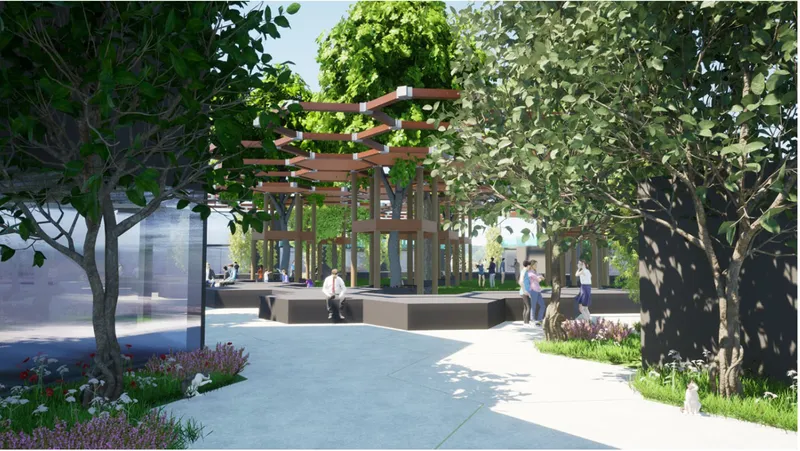
The timber pergola structure does not clear the landscape; it negotiates with it. Steel columns thread between mature trees, allowing the canopy to hover above existing root zones and planted beds. Concrete seating platforms anchor the shaded ground plane, offering rest points that feel embedded in the plantation rather than imposed on it. The effect is a resort architecture that defers to the ecology it occupies, maximizing natural ventilation and daylighting while keeping its material footprint deliberately restrained.
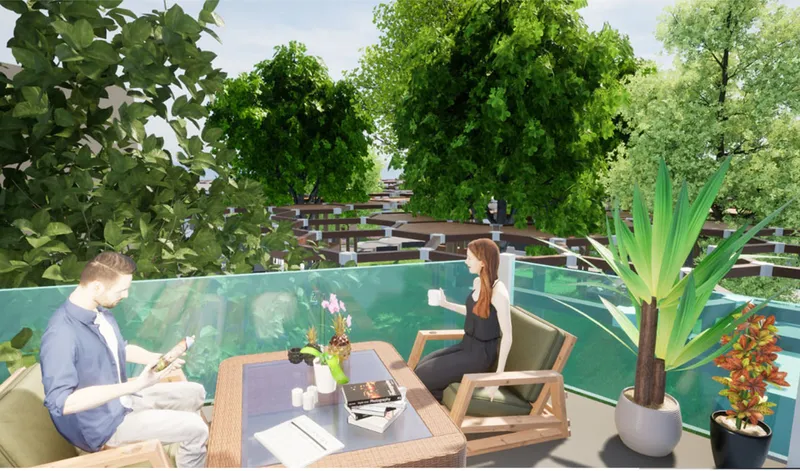
An outdoor terrace enclosed by translucent green glass panels introduces a softer threshold between interior comfort and the surrounding cocoa landscape. Potted plants blur the edges further. These transitional zones reflect the project's broader ambition to dissolve the conventional resort hierarchy of serviced interior versus decorative exterior. Here, every space is simultaneously social, educational, and agricultural.
Dappled Light and the Rhythm of Steel and Wood
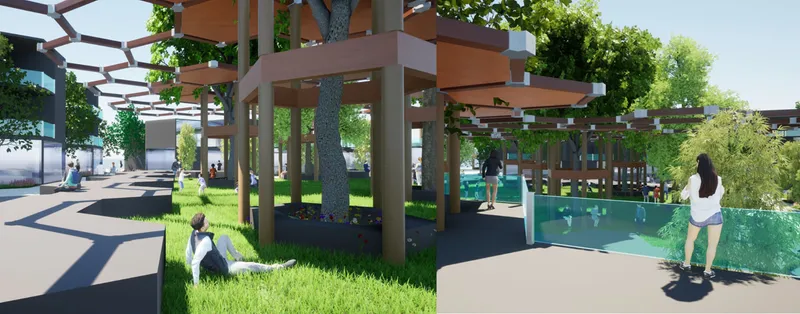
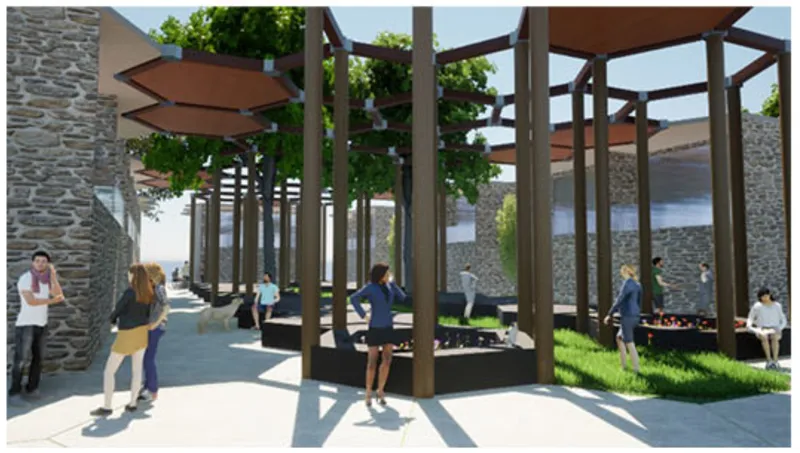
Walking beneath the pergola canopy, you experience the interlocking timber lattice as a rhythmic filter of light. Steel columns rise at regular intervals, their slender profiles contrasting with the warmth and grain of the wood overhead. Translucent green screening panels appear intermittently, tinting the light and providing partial enclosure without sealing off airflow. The canopy casts dappled shadows onto the paved plaza below, creating a ground pattern that shifts with the sun, reinforcing the cyclical temporal awareness built into the project's DNA.
Materially, this is architecture that stays within the logic of assembly rather than permanent construction. The lightweight timber and steel components can be disassembled, relocated, or recycled, a crucial step toward the carbon-conscious building practices the designers advocate. The pergola system defines gathering and shading zones while serving as a visual metaphor for connection: between guests, between people and the cocoa landscape, and between contemporary ecological design and the cultural memory of Maya building traditions.
A Regenerative Grid Scaled to Community
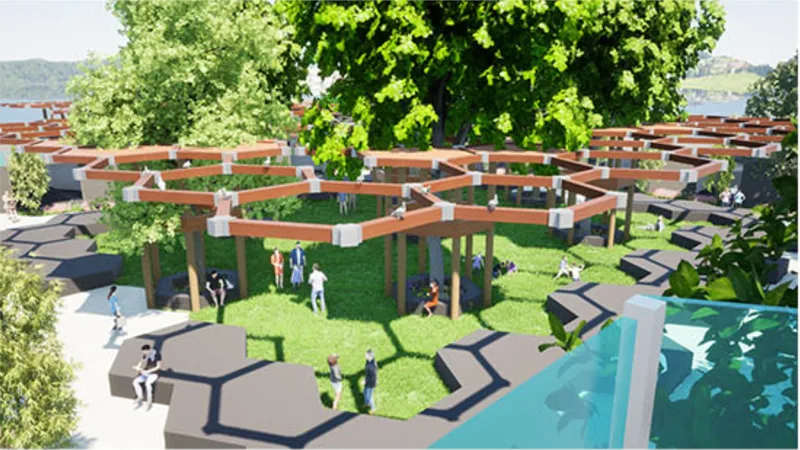
From above, the hexagonal timber grid reads as an architectural topography layered onto a landscaped lawn. People gather beneath the canopy modules in loose clusters, suggesting the informal social patterns the designers intended. The layout recalls a Maya courtyard organization: spaces for gathering, storytelling, and reflection that prioritize community over consumption. The site planning supports rainwater collection, pervious pathways, and biodiversity-friendly planting, ensuring the architectural intervention contributes positively to the site's ecological health rather than merely minimizing harm.
Choco Hive's program extends well beyond sleeping quarters. Hotel and villa units sit within a network of museums, workshops, and exhibitions that trace the entire cocoa production process, from mythology to economics. Visitors learn about the significance of cocoa in Maya civilization while physically participating in its harvest. The resort becomes a social catalyst for ethical awareness about cocoa farming and fair labor, turning leisure into genuine participation and fostering mutual respect between host and visitor.
Why This Project Matters
Choco Hive challenges two assumptions at once: that resort architecture must be extractive, and that cultural heritage can only be preserved behind glass. By making cocoa harvesting the literal ticket to accommodation, Erkan and Çoban propose an economic model where tourism and agriculture sustain each other. The hexagonal module system gives this idea a spatial form that is replicable, adaptable, and grounded in a credible reading of Maya cyclical construction philosophy.
The strength of the project lies in its refusal to separate design ambition from social program. Architecture, agriculture, and anthropology are woven into a single proposition. The timber pergolas are not ornamental; they structure the encounter between visitor and landscape. The modular grid is not formalist play; it enables a building system that can regenerate alongside the cocoa plantation it serves. In a competition field that asked designers to think seriously about cocoa's cultural weight, Choco Hive delivers a convincing answer built on generosity, solidarity, and spatial intelligence.
View the Full Project
About the Designers
Designers: Mervenaz Erkan, Deniz Can Çoban
Enter a Design Competition on uni.xyz
uni.xyz runs architecture and design competitions year-round that reward proposals with spatial conviction and real site intelligence.
Project credits: Choco Hive by Mervenaz Erkan, Deniz Can Çoban Xocolatl (uni.xyz).


Popular Articles
Popular articles from the community


Juan García Correa, John González and Claudia Rueda Sink a Circular Amphitheater into a Manizales Engineering Building
On the La Nubia campus in Manizales, Colombia, the S1 Building folds labs and offices into a hillside of ramped lawns that double as a campus route.

U.GA Architects Wraps an Oval Rooftop Pool in Curved Board-Formed Concrete on Busan's Jeollidan-gil
In Busan's Jeonpo-dong, a 454 m² mixed-use block stacks a neighborhood facility, guest rooms and an oval rooftop pool inside spiraling concrete walls.

GROUP A Strips a 1969 Rotterdam Harbor Headquarters to Its Frame and Wraps It in Timber Louvers
In Rotterdam's M4H harbor district, Ferro Offices reuses a 1969 frame, adds one timber storey and reaches BREEAM-NL Outstanding.

Architekt Andreas Gruber Scatters 23 Dark Timber Chalets Across a South Tyrolean Forest Edge
In Molini di Tures, Amonti Chalets breaks a resort into a hamlet of gabled timber houses, with parking, storage and services pushed into the slope.

Similar Reads
You might also enjoy these articles


Aquadapt: An Underwater Habitat That Rewrites Its Rooms by the Hour
Curved modules ring the seabed while one shell shifts from breakfast room to cinema, farm and football pitch as residents' needs change.

Play: Fragments of Their World: Remembered Architecture Rebuilt as a Modular Playground for Refugee Camps
Tom Gardner abstracts domes, arches and towers from the homelands of displaced families into a kit of child-scaled play parts for camp settlements.
REBIRTH: A Circular Settlement Where Afghan Widows and Their Children Rebuild Life Together
A shortlisted Resile entry turns the circle into a protective ring of timber and brick, gathering homes, classrooms and gardens around a shared landscape.
The Main Dream: A Recycled Plastic Kit That Lets Refugee Children Build Their Own Playground
Thirty-centimetre interlocking cubes that connect on three axes turn play into construction, letting children author the spaces they occupy.


Comments (0)
Please login or sign up to add comments
No comments yet. Be the first to comment!