
Choi Studio Lifts a Seven-Storey Office Above a Civic Colonnade in Sydney's Macquarie Park
15 Khartoum Road reimagines the suburban business park as a piece of urban infrastructure, threading park, retail, and workplace together.


Macquarie Park has long been one of Sydney's most productive employment corridors and one of its least loveable places to spend time on foot. The area's default setting, surface parking wrapped around glass boxes, has been a textbook case of how commercial density can coexist with spatial poverty. Choi Studio's competition-winning design for 15 Khartoum Road tries to break that pattern by treating the office building not as an object but as a piece of civic scaffolding: a structure that gives something to the street before it asks anything of the tenant.
The move that makes the project worth watching is the colonnade. Rather than plant the seven-storey volume directly on the ground, Choi Studio elevates it on a system of branching white columns that create a generous, publicly oriented undercroft. That space is neither lobby nor plaza in the conventional sense. It is an in-between zone designed to accommodate future retail, connect diagonal pedestrian paths across the site, and frame views into the adjacent 2,500 square metre park. The building, in other words, earns its height by giving ground level back to the precinct.
A Colonnade That Does Real Work
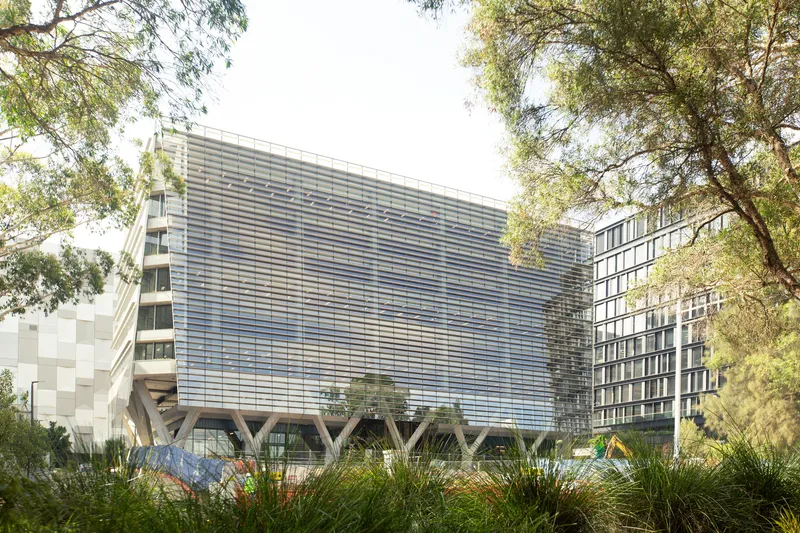
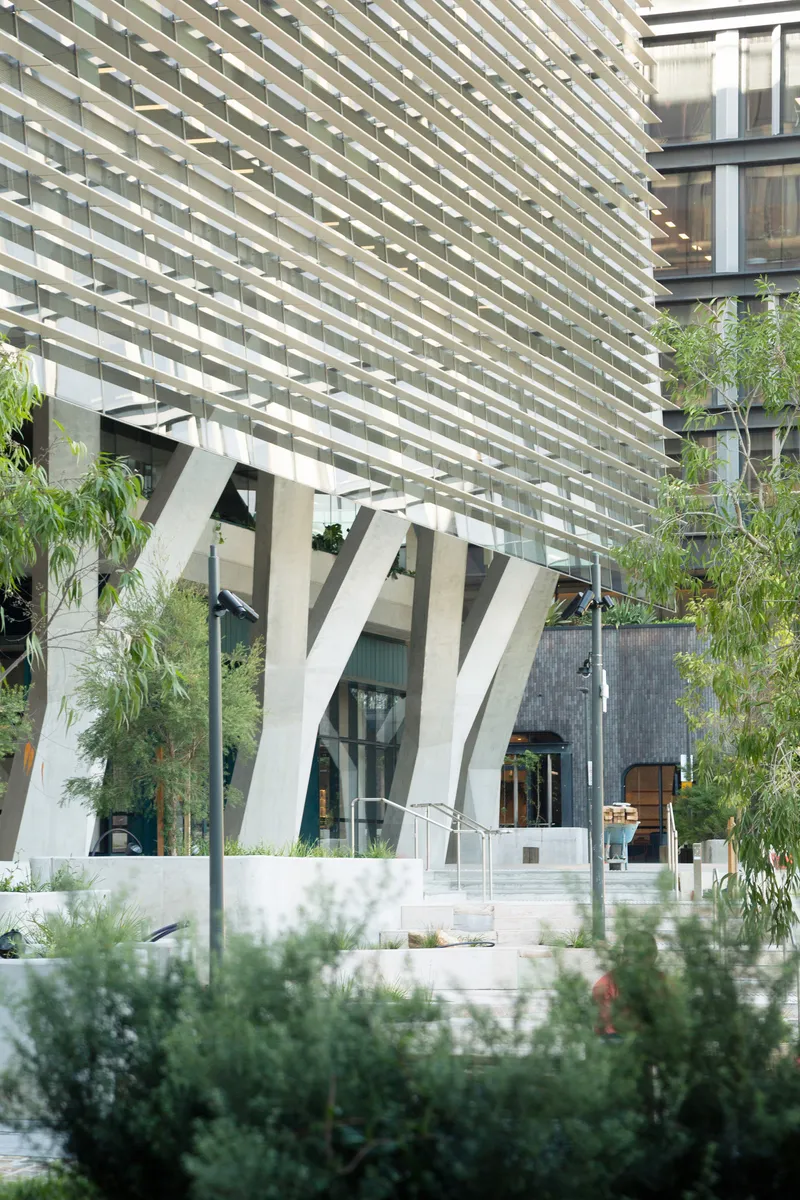
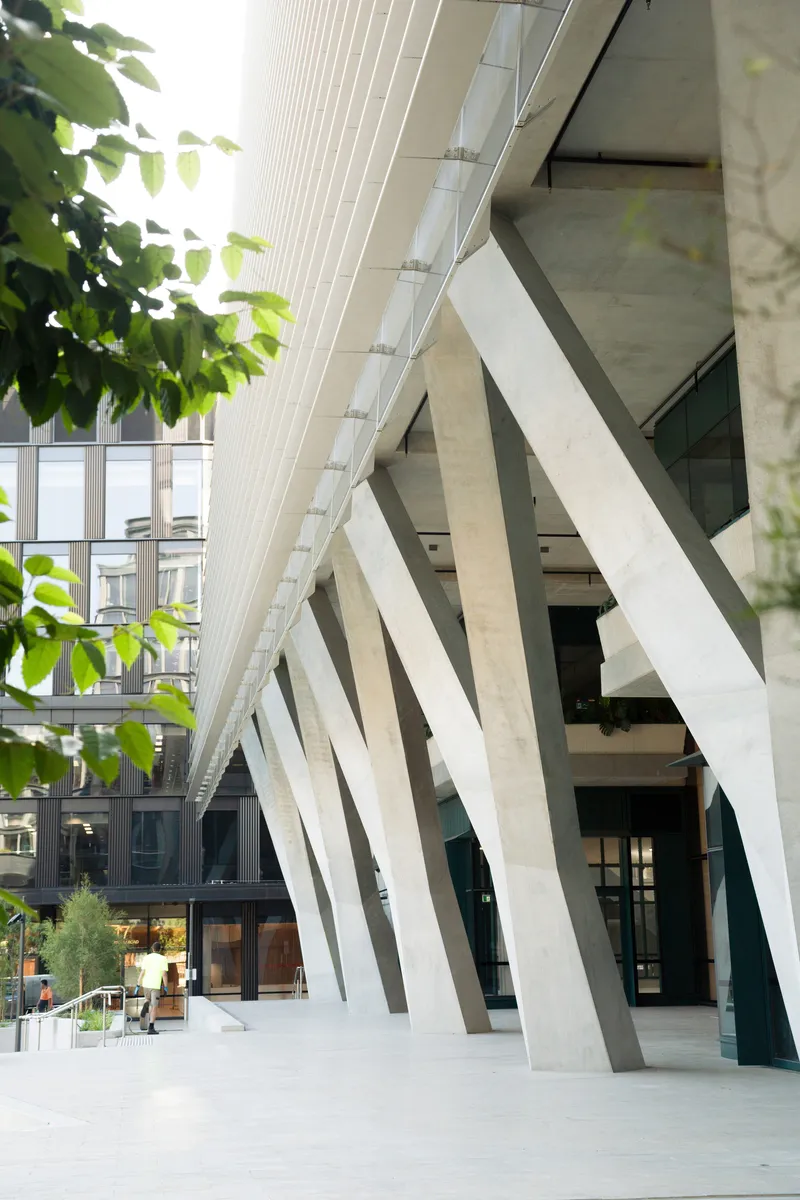
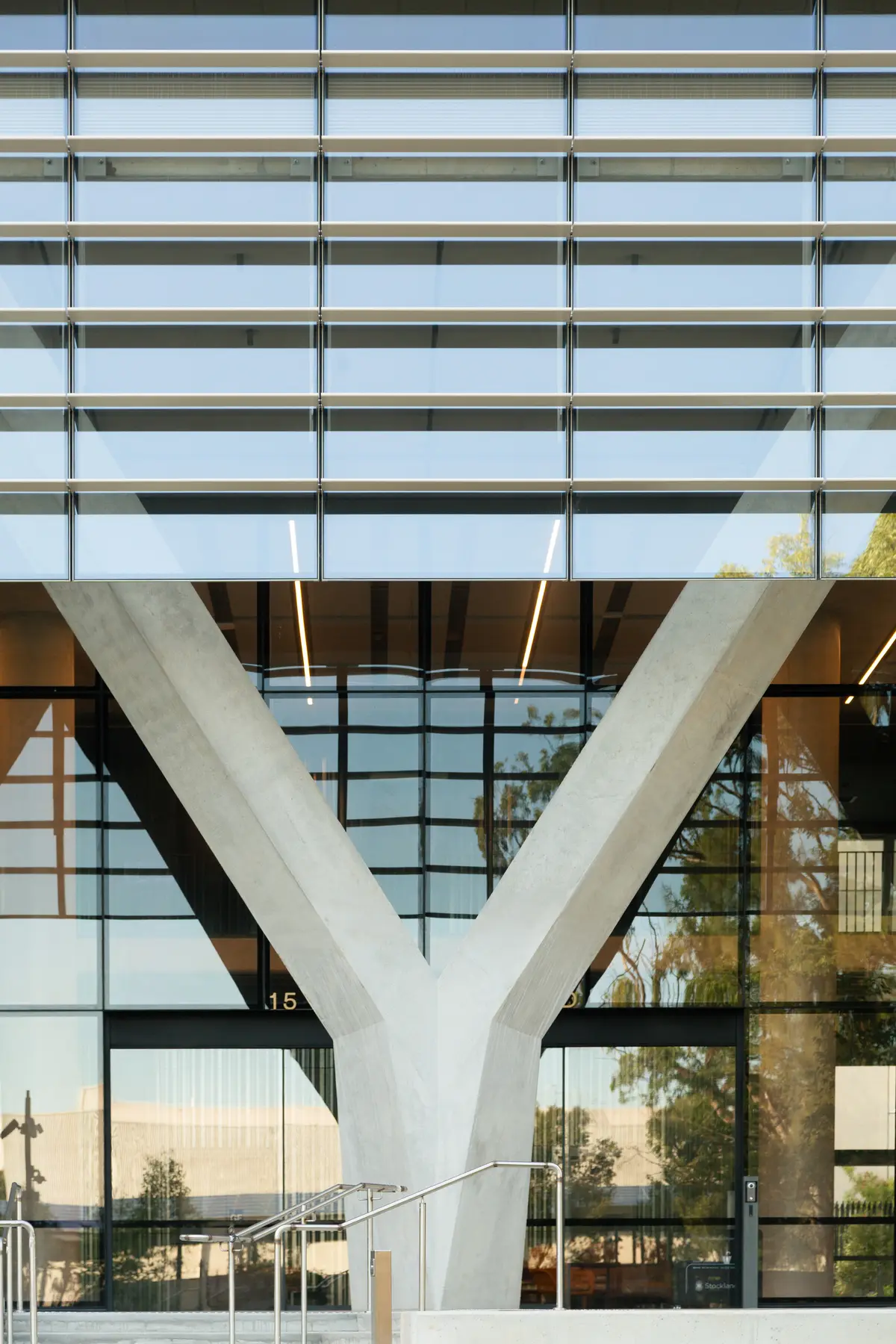
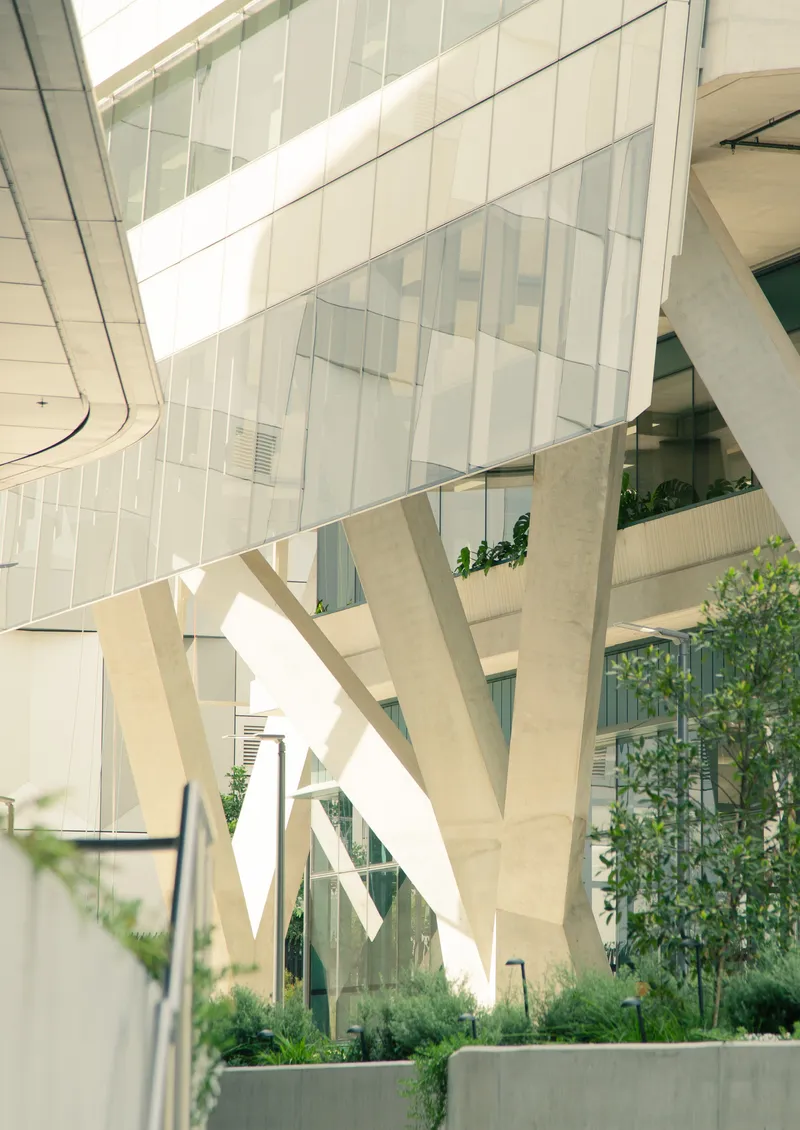
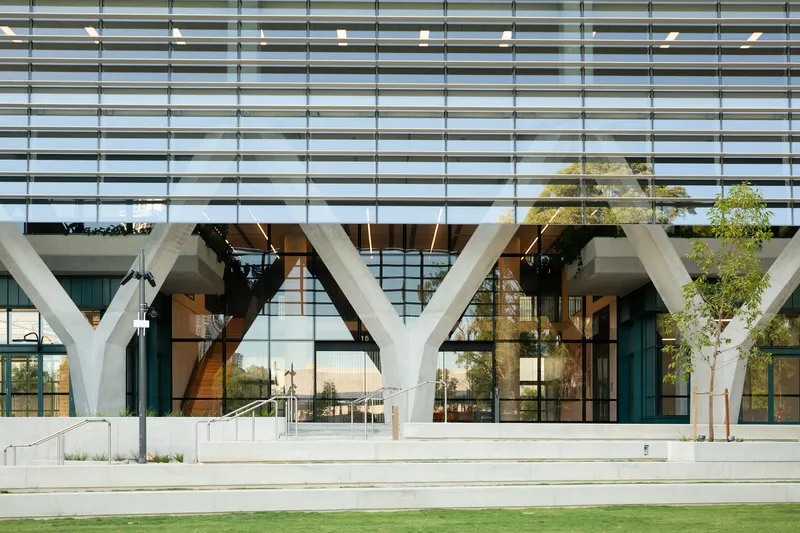
The branching columns are the defining gesture. Each one splits into a V-shaped canopy that transfers the load of the upper floors while opening up a generous clear span at ground level. The effect is part structural logic, part theatrical staging: arriving at the building, you pass through a forest of white limbs before entering the glazed lobby. The colonnade also carries horizontal louvers above, establishing a datum line that distinguishes the public base from the private workplace floors. It is a detail that reads clearly from the street and gives the building a legible front door without a conventional portico.
What keeps this from being merely decorative is the program it supports. The undercroft is wide enough to host retail tenancies and deep enough to serve as a genuine weather-protected passage linking the park to the street. In a precinct master planned by 3XN, where three commercial buildings cluster around shared open space, this permeability matters. A sealed lobby would have walled off the park from the road; the colonnade keeps the sightline and the pedestrian flow open.
Grounding the Building in Landscape
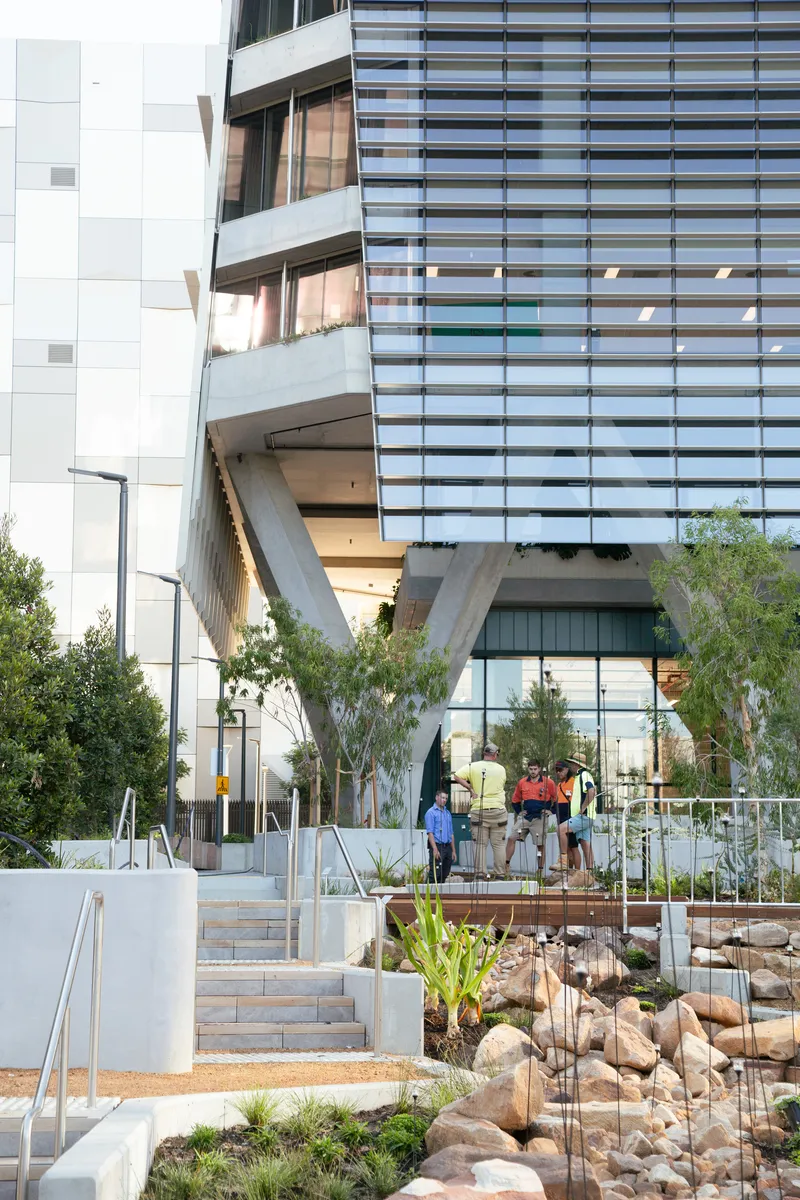
The landscaped entry plaza, designed in collaboration with Square One Landscape Architects, Ngurra, and the Dharug Working Group, uses stone terraces and native plantings to dissolve the boundary between building and park. The planting strategy is deliberate: native grasses and low shrubs step up in terraces that absorb grade changes without retaining walls, giving the cantilevered volume above the appearance of sitting lightly on a continuous green surface.
Planted beds recur inside the colonnade itself, threading green between the branching columns and softening the concrete soffit. The result is a ground plane that feels continuous rather than zoned: you walk from park to plaza to lobby without a clear threshold. For a car parking ratio of 1:60 square metres of gross floor area, this is a necessary investment. If fewer people drive in, the ground condition has to be good enough to make walking and cycling feel rewarded.
The Double-Height Lobby as Threshold
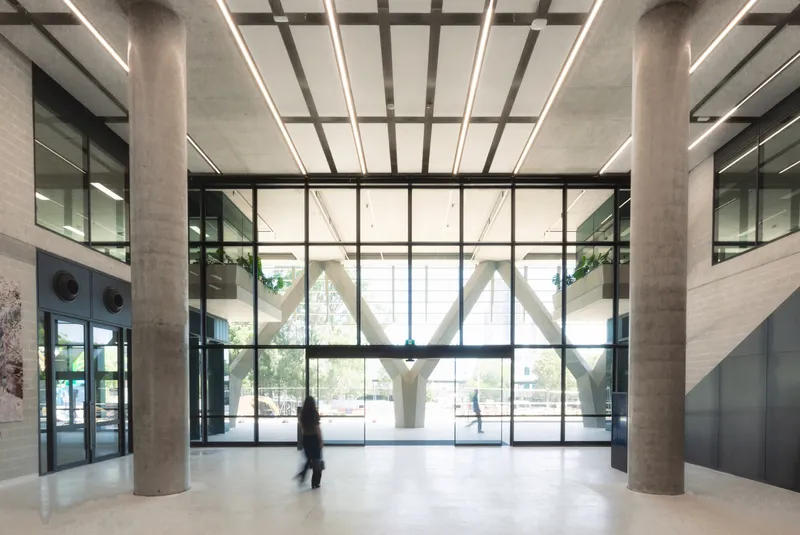
Step past the colonnade and the lobby reveals itself through a full-height glass curtain wall. The ceiling adopts a concrete grid that echoes the column rhythm outside, establishing material continuity between the civic undercroft and the interior gathering space. A single figure crossing the frame in one shot captures the scale: the lobby is generous enough to function as a meeting ground for the building's multiple tenants, not just a turnstile between the street and the lifts.
The transparency works both ways. From inside, uninterrupted views extend across the park on every floor. From outside, the glazed base exposes the life of the building at street level, reinforcing the idea that this is a workplace embedded in its neighbourhood rather than sealed off from it. The horizontal sunshades above the curtain wall temper solar gain while preserving the visual connection, a calibration that will be tested in Sydney's increasingly punishing summers.
Facade Logic: Louvers and Load
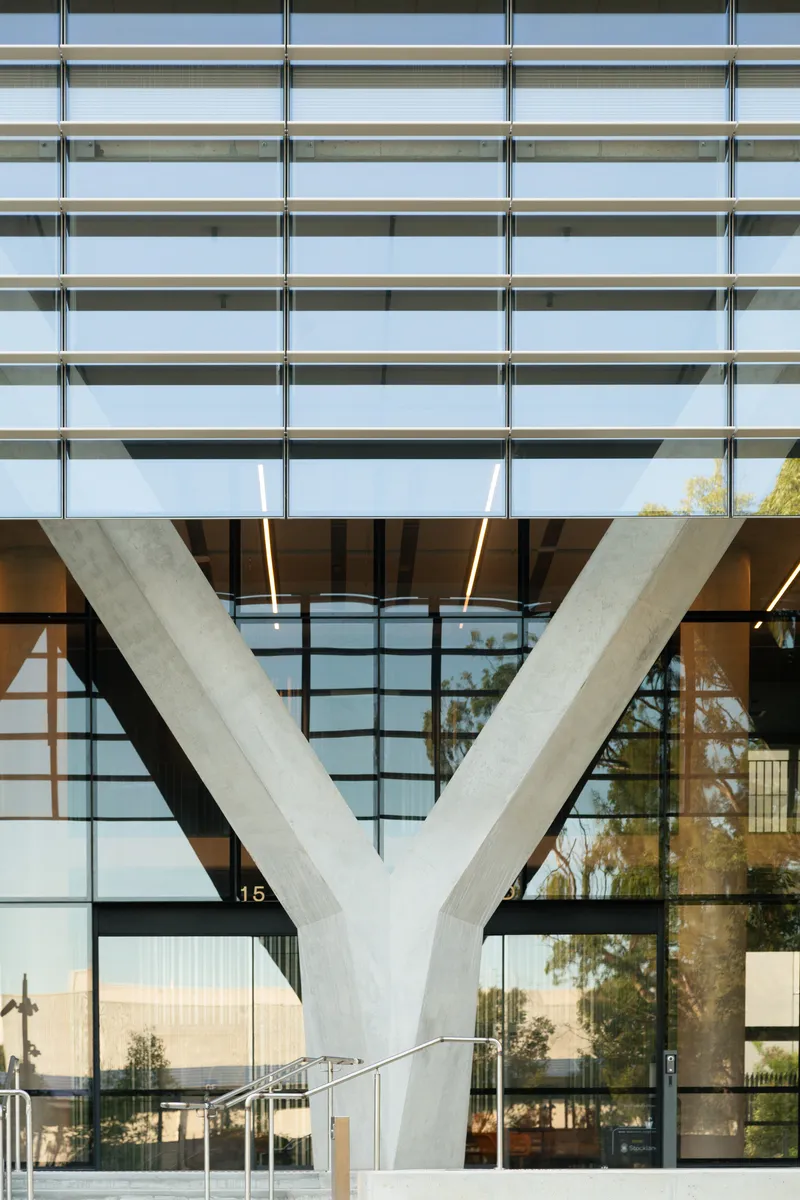
The upper floors present a more restrained face: horizontal louvers wrap the volume in a consistent rhythm that manages daylight and gives the building a calm, stacked profile against the sky. Facade engineering by Inhabit and construction by Facade Innovations suggest a system designed for repeatability, with the louvers acting as a passive solar filter that reduces the cooling load across all seven storeys.
Afternoon light raking across the branching columns reveals the interplay between the heavy concrete structure and the lightweight screen above it. The columns are cast in a smooth white finish that catches shadow; the louvers, by contrast, dissolve the upper mass into thin lines. That contrast, heavy base and light crown, is a familiar composition, but the branching geometry keeps it from reading as generic. Each column is an event, not just a support.
Sustainability as Operational Target
The sustainability ambitions here are significant: 6 Star Green Star, 5.5 Star NABERS Energy, 4.5 Star NABERS Water, Platinum WiredScore, and a fully electric, net zero carbon commitment in operation. Those are not design aspirations; they are operational targets that will be measured against real consumption data. The three basement levels consolidate parking below grade, keeping the surface free for landscape and pedestrian movement.
The real test will come in the first few years of occupancy. Macquarie Park is not yet a walkable neighbourhood in the way that the design assumes. Public transport connections are improving, but the precinct still relies heavily on car access. The low parking ratio signals intent, betting that tenants will accept fewer spots in exchange for better public space. Whether that bet pays off depends as much on the precinct's broader transformation as on this single building.
Plans and Drawings
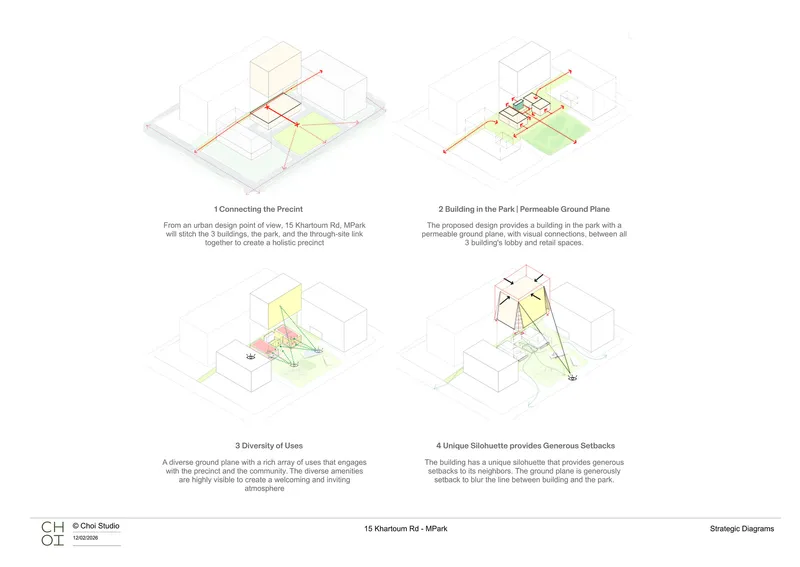
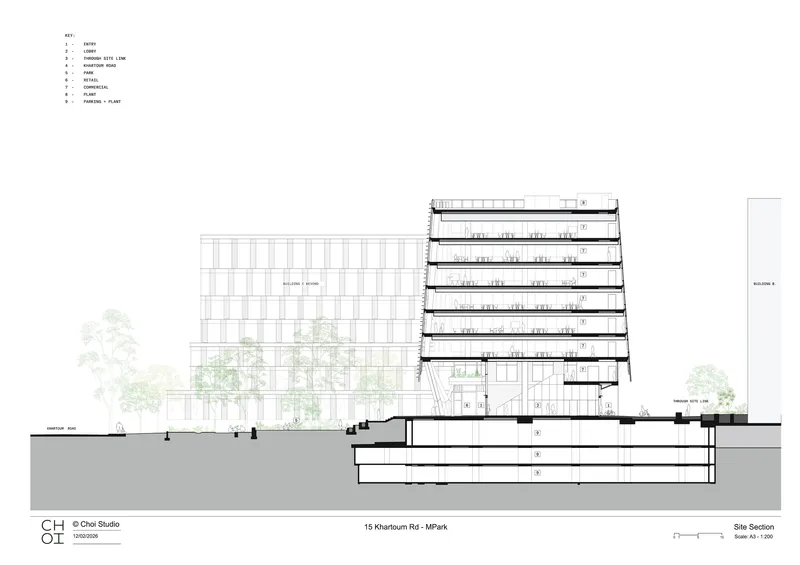
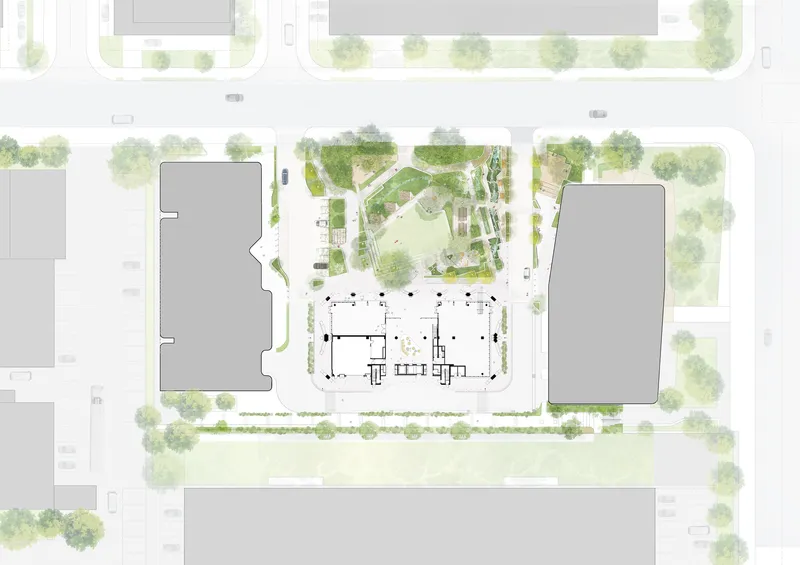
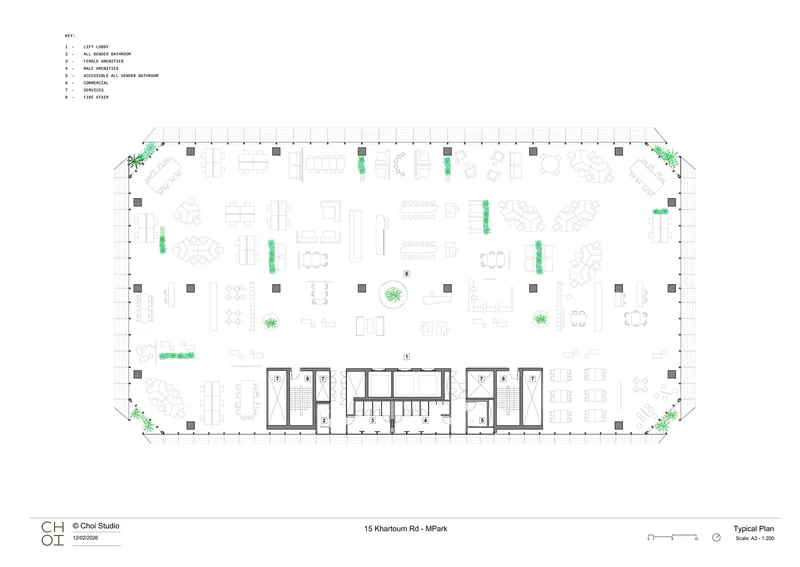
The axonometric diagrams lay out four urban design strategies that stitch the building into its context: diagonal pedestrian routes, shared park frontage, activated ground planes, and visual connections between adjacent commercial volumes. The section drawing confirms the three-level basement and shows how the horizontal louvers step back at the upper levels to create planted terraces. The site plan reveals the diagonal pathways that cross the ground floor, giving pedestrians a choice of routes through the precinct rather than funnelling them along a single axis.
The typical floor plan is straightforward: an open office plate with a central service core, structural columns at regular intervals, and corner planters that bring greenery up the building's full height. It is an efficient layout, not a heroic one, and that is precisely the point. The architectural ambition is concentrated at the ground level, where the building meets the city. Upstairs, the plan gets out of the way and lets the views and the louvers do the work.
Why This Project Matters
15 Khartoum Road matters because it takes a building type that Australian business parks have relentlessly optimized for lease efficiency and reframes it as civic infrastructure. The colonnade is not a decorative appliqué; it is a spatial commitment that gives the precinct a covered public room where none existed before. In a context where every square metre of ground floor is typically monetized as lobby or parking access, the decision to leave that space open and program it for the public is genuinely generous.
It also matters as a signal for Macquarie Park's next chapter. Stockland's MPark precinct is attempting to prove that a suburban business district can evolve into a mixed-use neighbourhood without demolishing everything and starting over. Choi Studio's contribution is a building that behaves as if that neighbourhood already exists: porous, walkable, oriented to the park rather than the car. If the precinct delivers on that promise, this building will look prescient. If it doesn't, the colonnade will still be a very good place to wait.
15 Khartoum Road MPark, designed by Choi Studio, Sydney, Australia, completed 2026. Landscape design by Square One Landscape Architects in collaboration with Ngurra and the Dharug Working Group. Builder: ADCO Constructions. Structural engineer: TTW. Facade engineer: Inhabit. Facade contractor: Facade Innovations. Photography by Thomas Li and Clinton Weaver.
About the Studio
Share Your Own Work on uni.xyz
If projects like this are the kind of work you want to make, uni.xyz is a place to publish your own, find collaborators, and enter design competitions.


Popular Articles
Popular articles from the community

Faces of the Soviet Avant-Garde: Turning Moscow's Street Names into an Open-Air Museum
A network of sculptural installations across a Moscow residential district transforms forgotten architect names into spatial encounters with cultural memor
Opera on the Sea: Driftwood Logic Shapes a Timber Opera House on Estonia's Coast
Trevor Orgill's opera house translates the entangled drift of floating timber into a civic building where wood, water, and music converge.
Tsunami Convergenics: Turning Catastrophic Ocean Forces into Underwater Housing Infrastructure
A speculative underwater settlement off the coast of Onagawa, Japan, treats tsunamis and typhoons as energy sources rather than threats.

Cloaked Colonization: A Mobile Underwater Habitat That Moves Like a Fish
Micah Abaya's shortlisted EHC Pacific entry reimagines ocean settlement as a dispersed network of self-sustaining architectural organisms.

Similar Reads
You might also enjoy these articles

Bao Huynh Watercolor Atelier: A Serene Art Retreat in Hội An
Bao Huynh Watercolor Atelier in Hội An blends multifunctional art spaces, sustainable design, local materials, and family-friendly living in a serene environment.

Atelier Macri Concept Store Interior Design by CASE-REAL
Atelier Macri store features a "ko" counter, walnut wood details, cork displays, blending retail, gallery, and seamless customer experiences.

Manuel Vargas Izquierdo Stadium and High-Performance Sports Center: Architectural Excellence in Jalpa de Méndez
The Manuel Vargas Izquierdo Stadium blends sustainable design, inclusive sports facilities, and cultural-inspired architecture, revitalizing Jalpa de Méndez’s public spaces.

KAKR Buluh Awar Hall: Revitalizing Community and Ecology Through Bamboo Architecture
Community built bamboo hall revitalizes Buluh Awar village, empowering youth, restoring ecology, celebrating vernacular craftsmanship through sustainable architecture and culture.

Explore Power Station Competitions
Discover active competitions in this discipline

Challenge to reimagine the Iron Throne

Photograph architecture without architects

Illustrate the lost glory of Angkor Wat - Render Challenge

Design challenge to reuse E-waste
Comments (0)
Please login or sign up to add comments
No comments yet. Be the first to comment!