
Eigh-T Architects Carves Light Wells and Angled Walls into a Vietnamese Restaurant of Quiet Geometry
CieL Dining in Vietnam layers circular skylights, folded white surfaces, and garden courtyards into a precise culinary architecture.

Restaurants that take architecture seriously tend to fall into one of two traps: either the design overwhelms the food, turning every meal into a theme park experience, or it recedes so far into neutrality that it could be any white-walled café anywhere. CieL Dining, designed by Eigh-T Architects in Vietnam, does neither. It uses a restrained palette of exposed concrete, white render, and timber to build a sequence of spaces that are genuinely spatial, where the quality of light and the angle of a wall matter as much as the plate in front of you.
What makes the project interesting is the way it treats a modest residential scale with the rigor of something much larger. The building reads from the street as a gabled house with planted terraces, but inside it unfolds into split levels, double-height voids, circular skylights, and carefully tapered columns that frame garden views. Every room has a different relationship to daylight, and the architects exploit that variety to give each dining area its own character without resorting to decoration.
A Facade That Hints Without Revealing
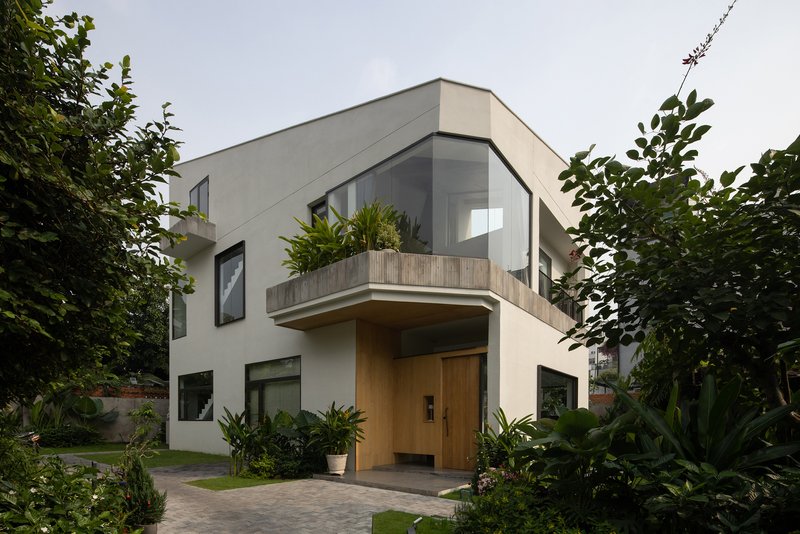
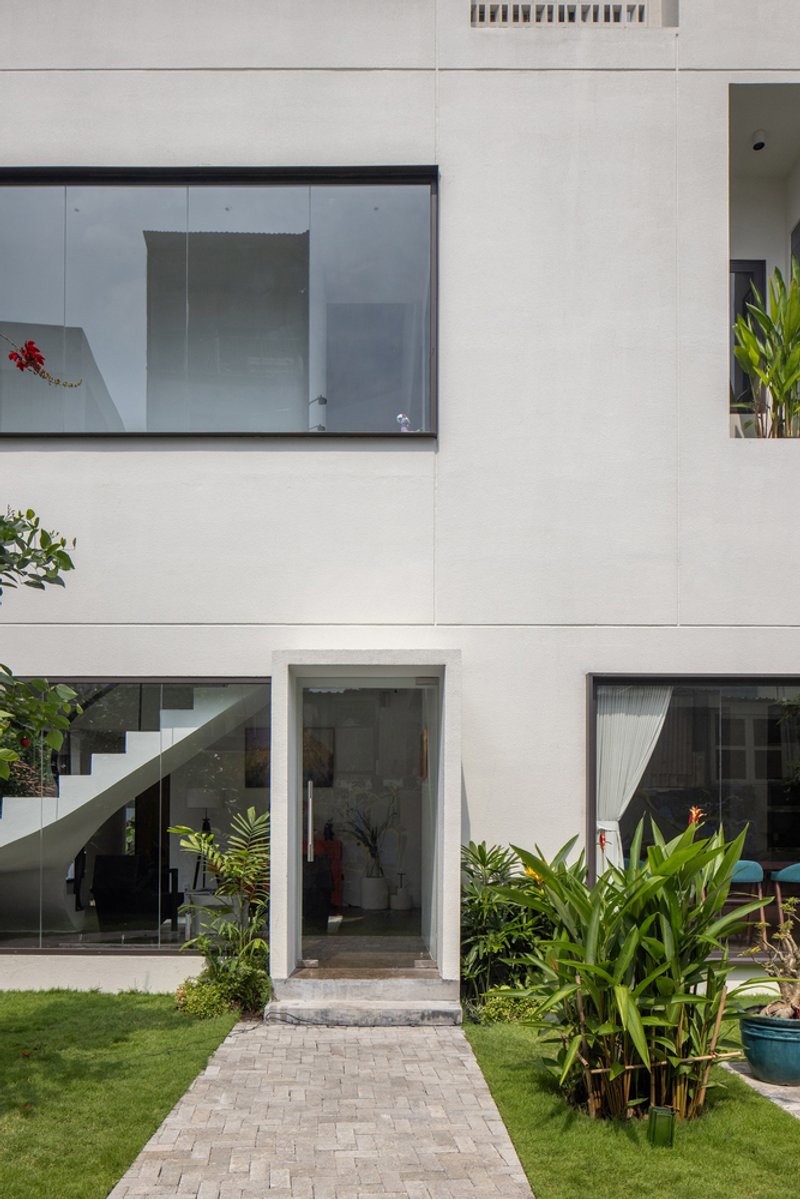
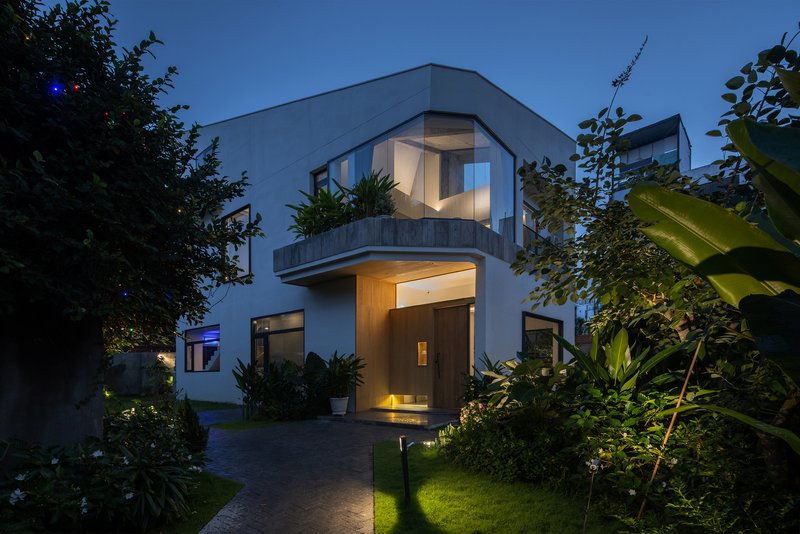
The exterior presents a white stucco volume with stacked rectangular openings and a timber balcony overhanging the entrance. Tropical plantings climb along the base and the upper terrace, softening what is otherwise a fairly austere composition. Photographed at dusk, the building glows from within, the gabled roof silhouette suggesting domesticity while the scale of the openings signals something more public.
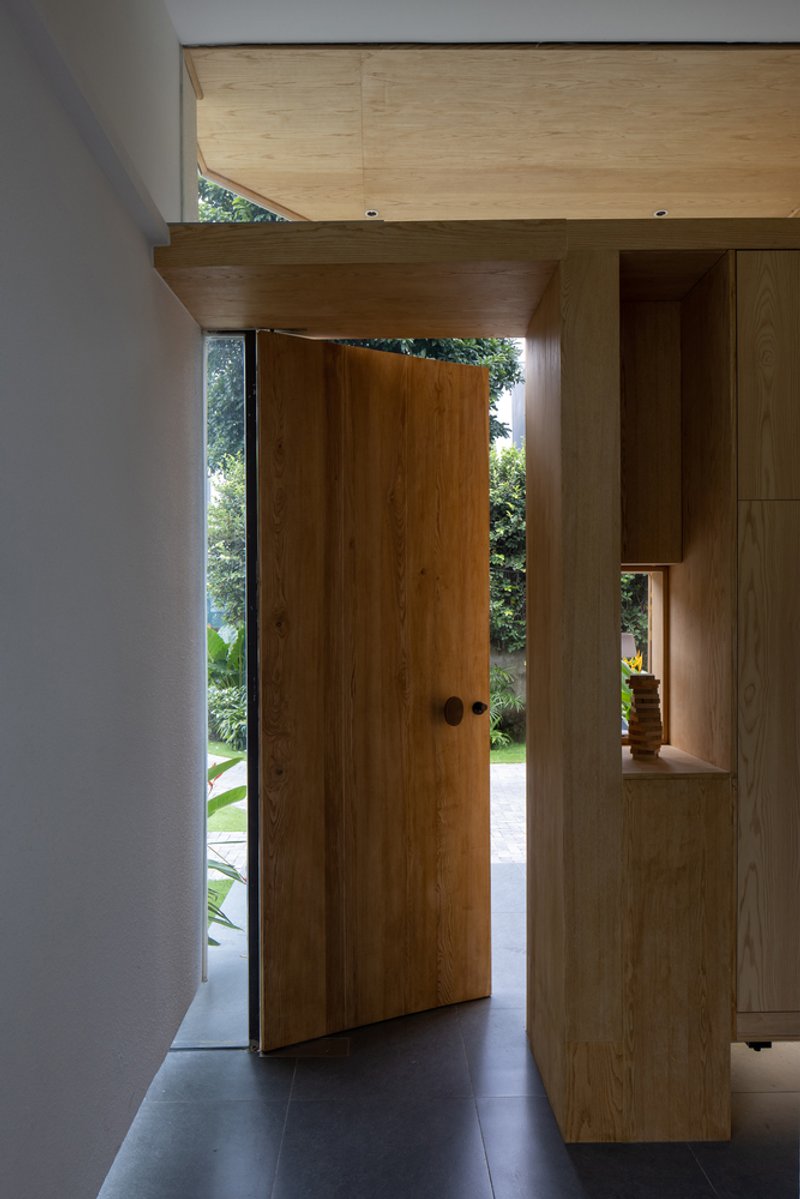
The decision to keep the facade relatively closed is deliberate. Rather than advertising the interior through floor-to-ceiling glass, Eigh-T controls what you see from outside. You get glimpses of light and greenery through stacked apertures, enough to generate curiosity but not enough to resolve the plan. The entrance itself, a timber-clad vestibule with a pivoting door, reinforces this threshold between street and interior world.
Entry and Vertical Circulation
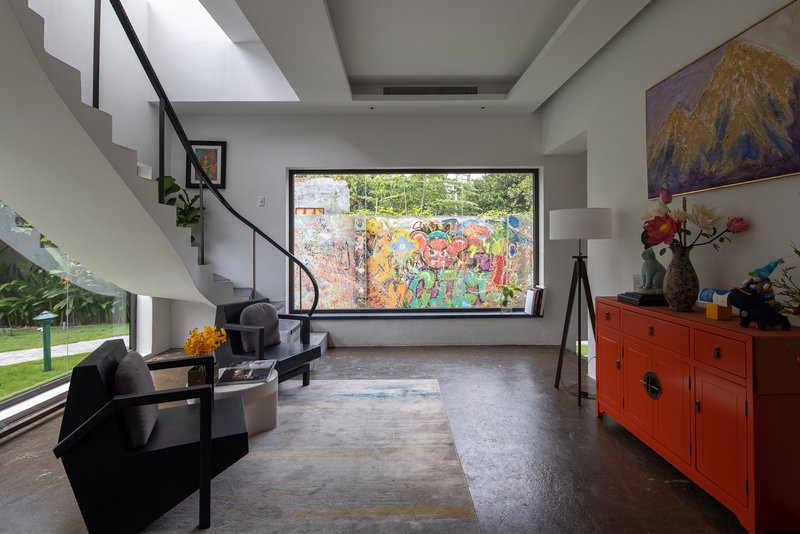
Passing through the timber entry vestibule, you arrive in a double-height space where a steel-and-glass staircase rises against a graffiti wall visible through a large window. It is a surprising moment of looseness in an otherwise disciplined building, and it works precisely because the surrounding architecture is so composed. The stair becomes a vertical event, not just a connector.
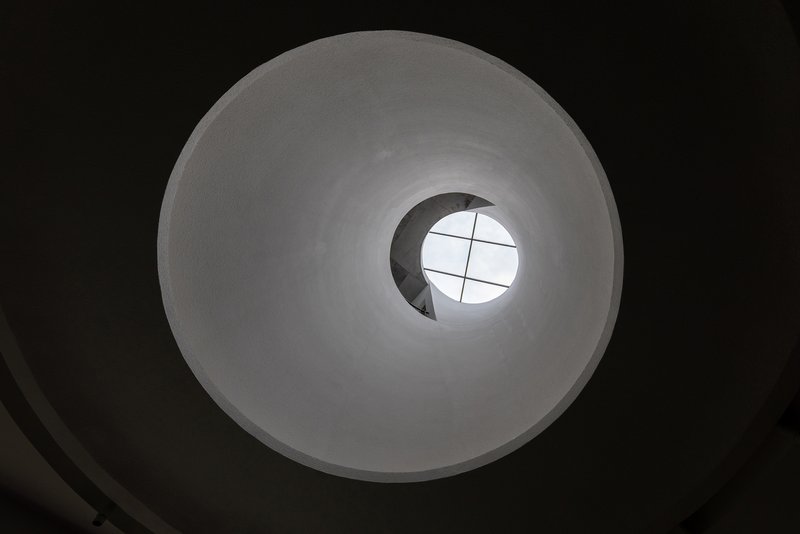
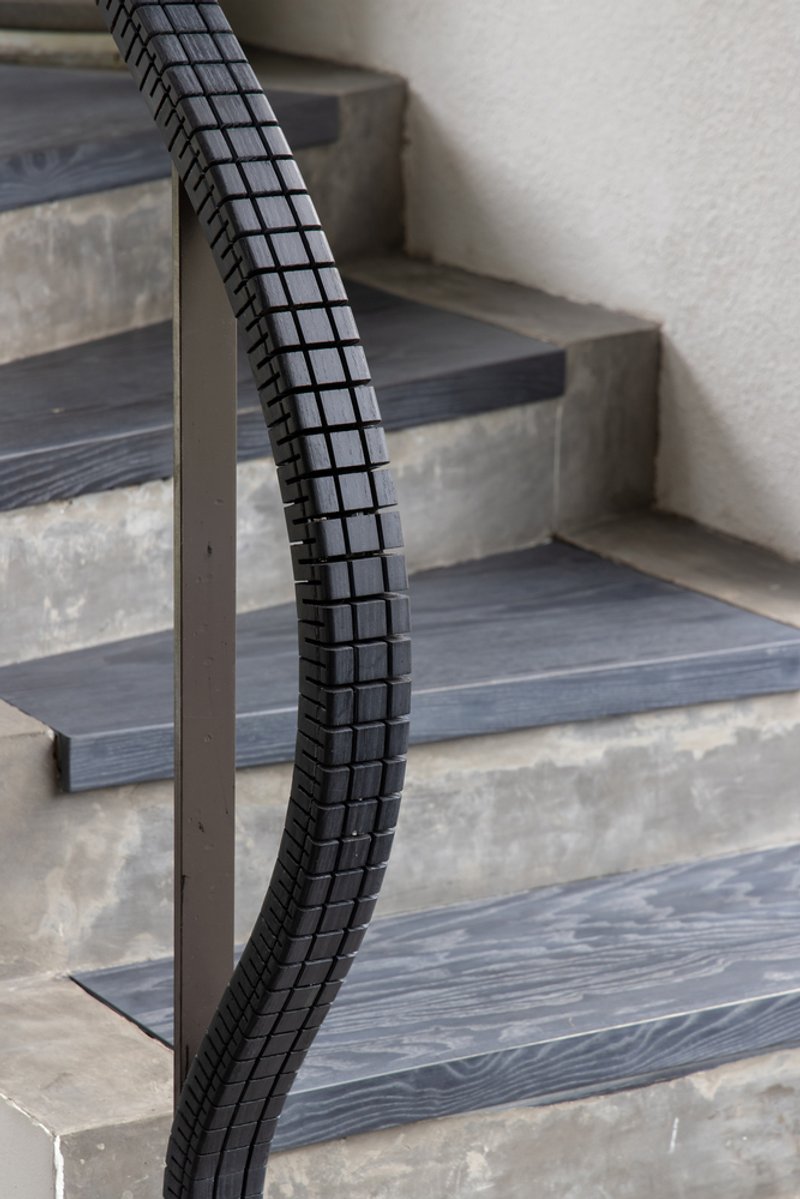
Looking straight up through the circular stairwell, a round skylight with cross mullions punches through the roof, pulling light deep into the core of the plan. This oculus is the project's most recognizable gesture, and it reappears in several rooms as both a structural motif and a source of atmosphere. The mosaic-tiled stair rail and concrete steps with timber treads add tactile richness to what could have been a purely visual composition.
Dining Rooms Shaped by Light
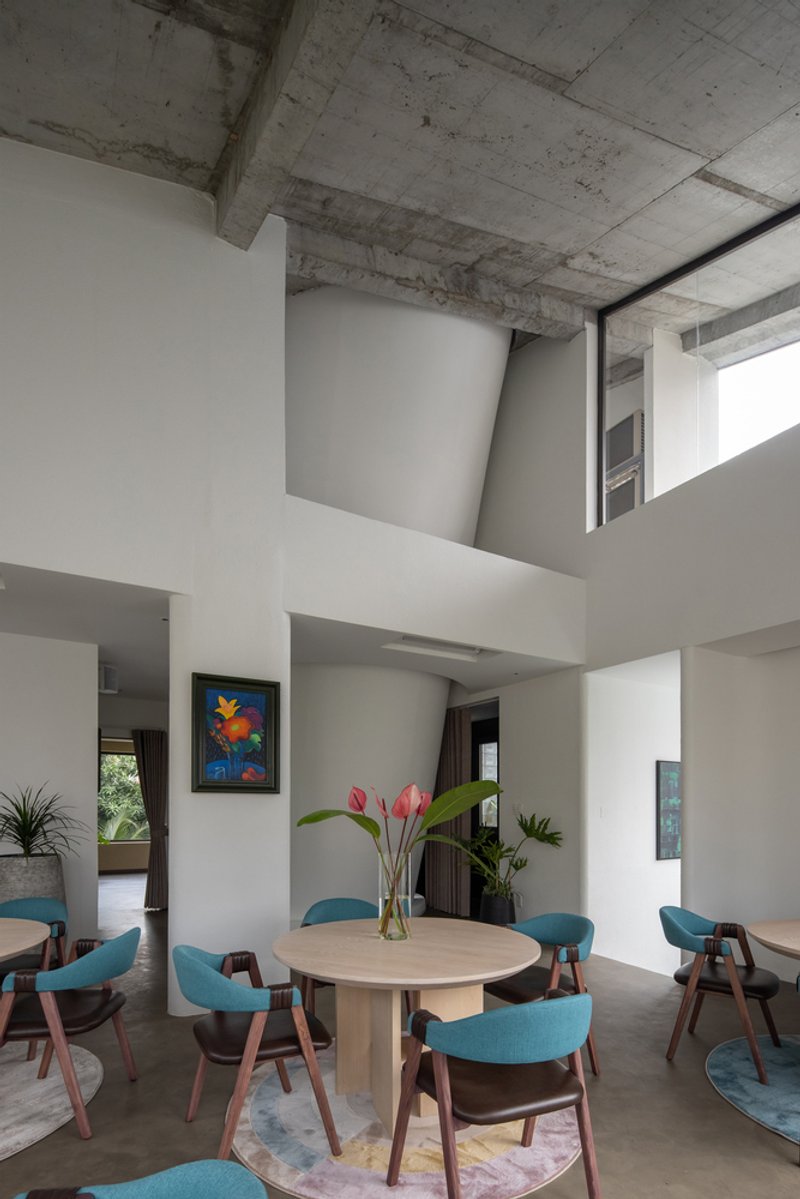
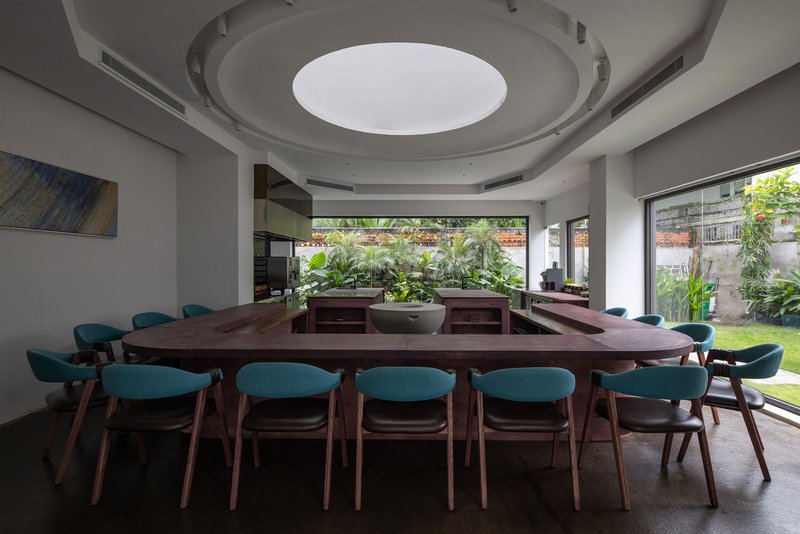
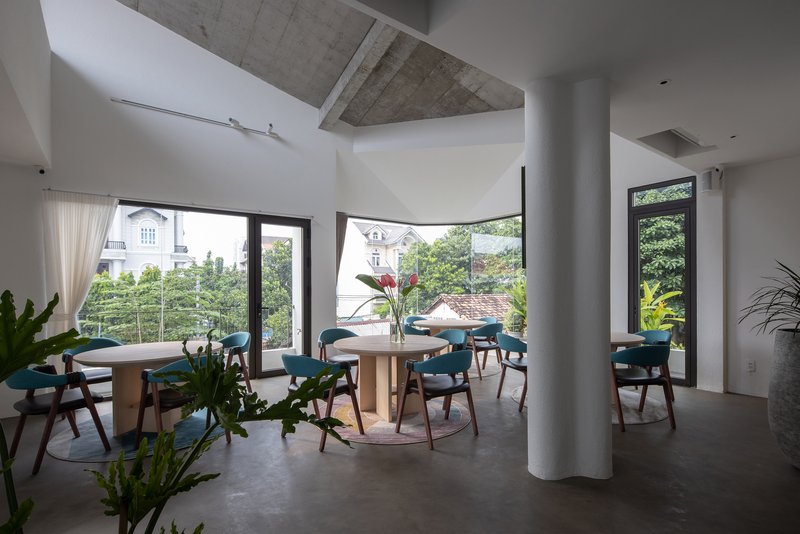
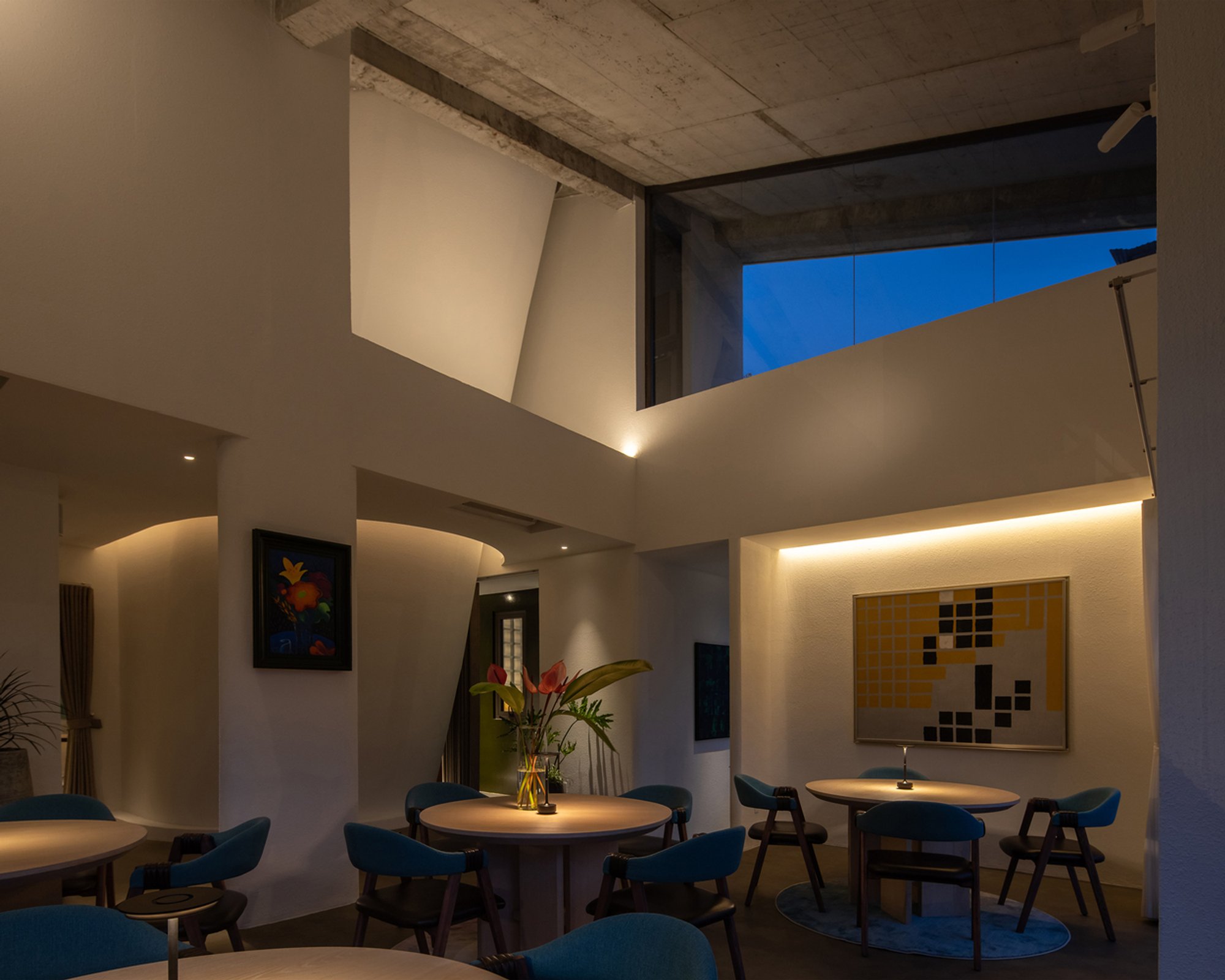
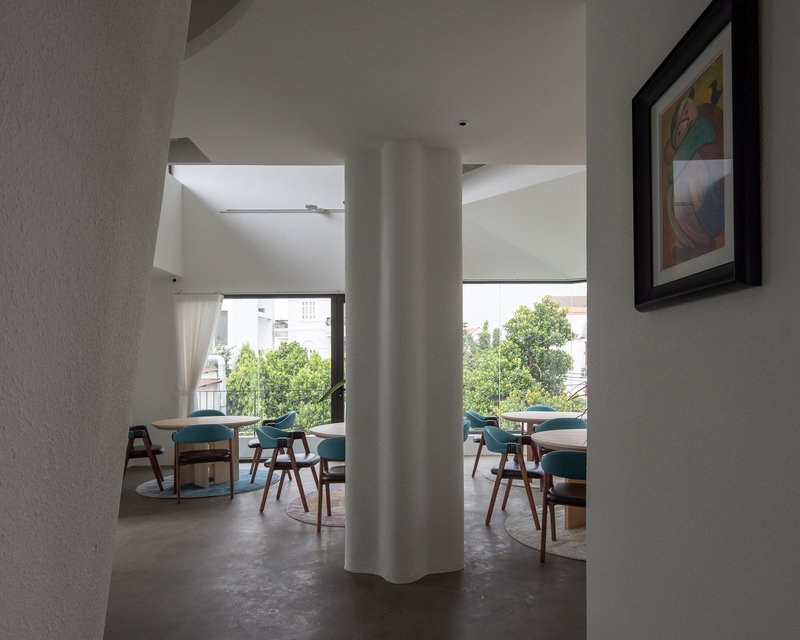
Each dining space has its own ceiling condition, and that is what distinguishes them. One room features a recessed circular skylight that washes an extended timber table with diffuse light, drawing your eye upward before settling it back on the garden view beyond. Another is anchored by a cylindrical white column that acts as both structure and spatial divider, framing the planted courtyard like a lens.
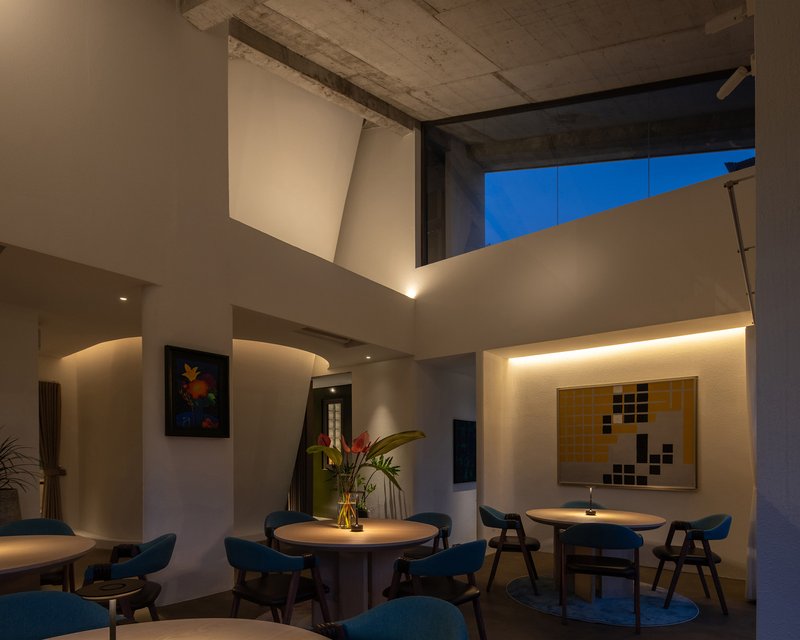
The exposed concrete ceilings are left raw, their formwork imprints visible, while the walls below are finished in smooth white render. This contrast is simple but effective. It gives the upper plane weight and the vertical surfaces a sense of openness, so the rooms feel simultaneously grounded and airy. The round table in the double-height room reads almost ceremonially, a deliberate centering device in a space that might otherwise feel too tall for its footprint.
Garden as a Constant Companion
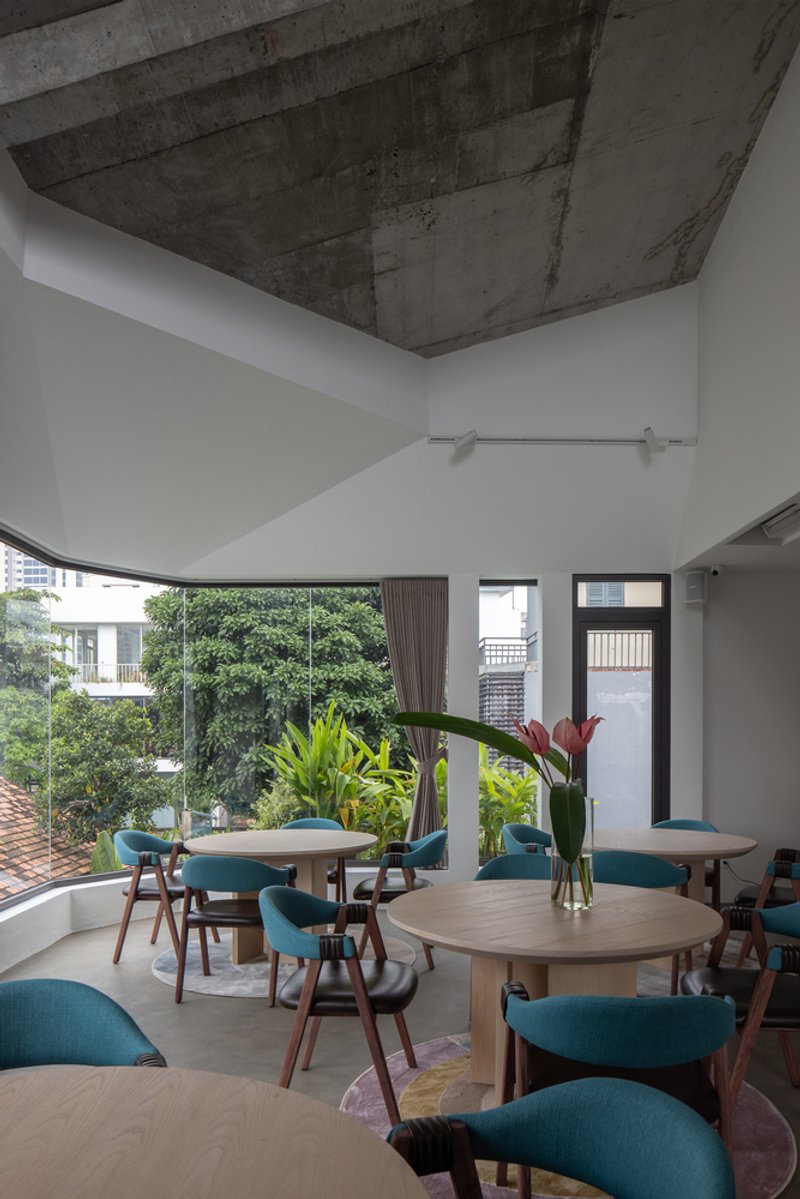
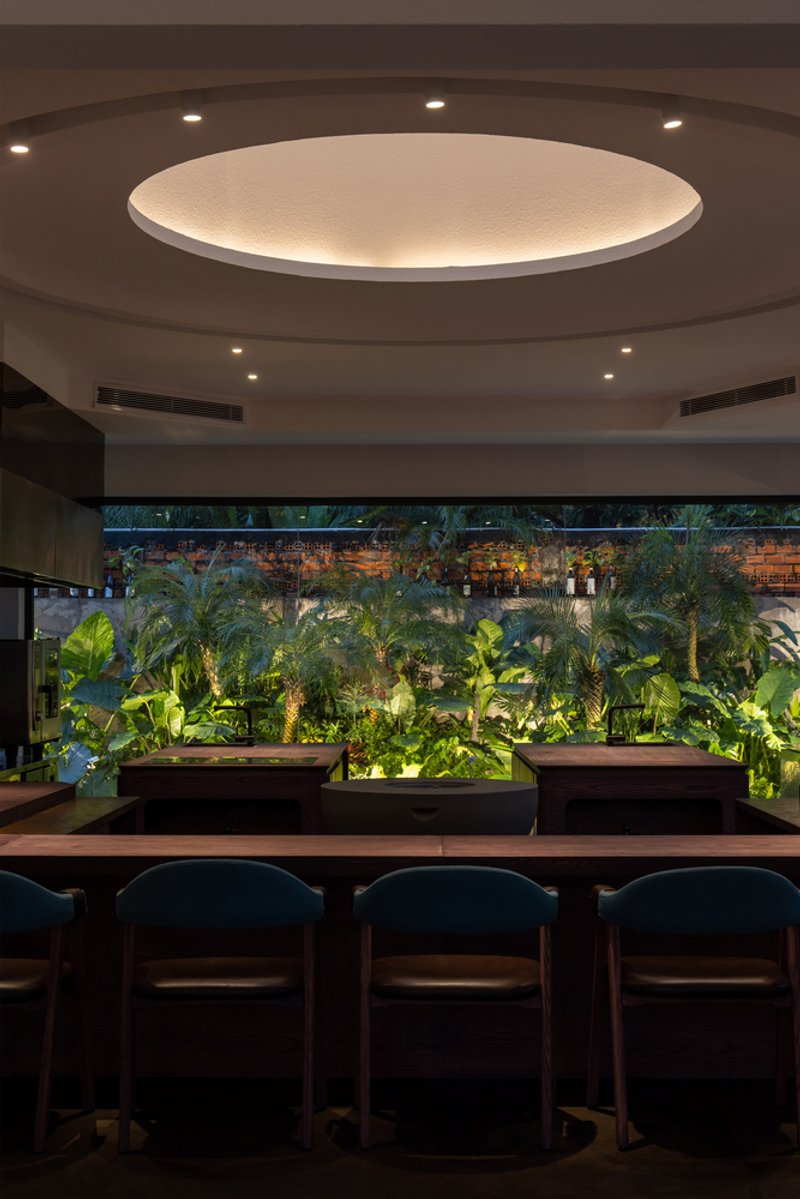
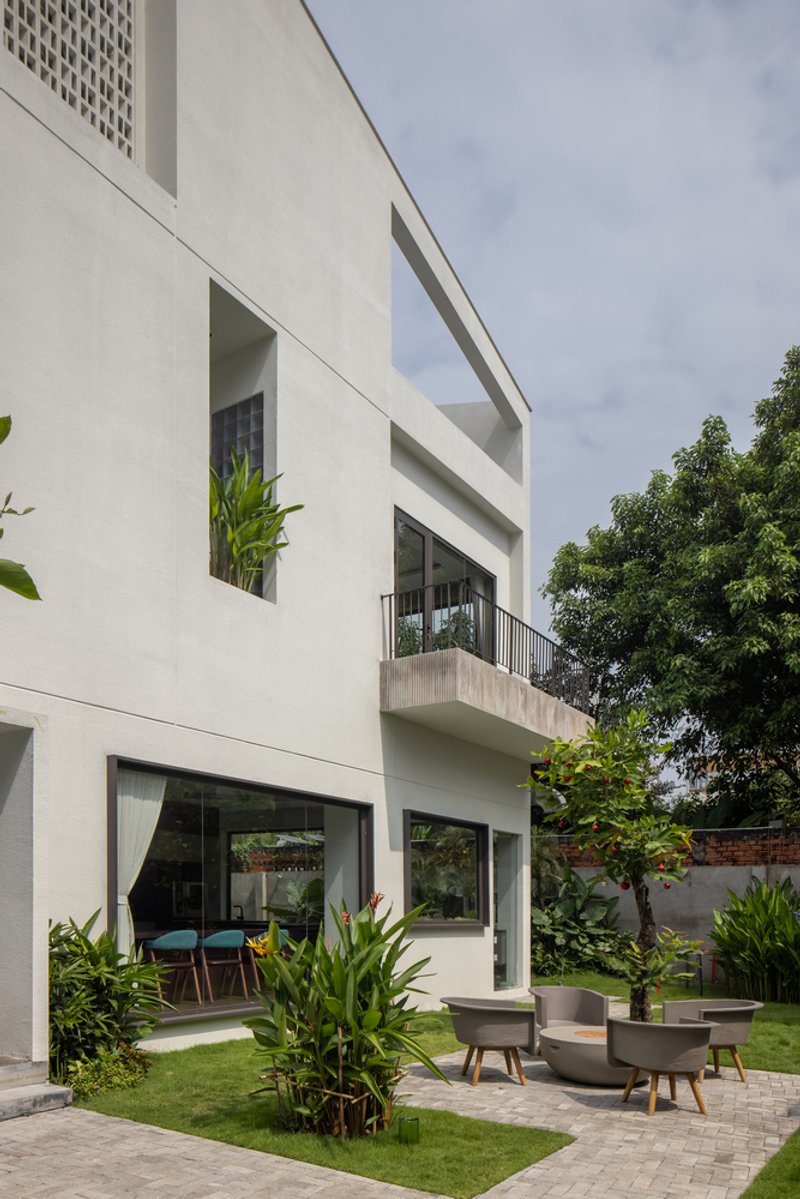
Tropical vegetation is never far from any seat in the restaurant. The dining terrace at ground level opens directly onto the garden through folded white walls that angle views outward. At dusk, the planted interior courtyard visible from the counter area takes on a different quality, the circular recessed ceiling light casting a warm glow over food and foliage alike. The garden elevation shows how the cantilevered balcony and ground-floor terrace work together to create layered outdoor rooms.
What prevents this from feeling like generic "biophilic design" is the precision with which each opening is calibrated. The gardens are not wallpaper; they are composed views, framed by tapered columns and angled walls that determine exactly how much green you see and from what angle. This is landscape as architecture, not decoration.
Upper Levels and the Curved Balcony
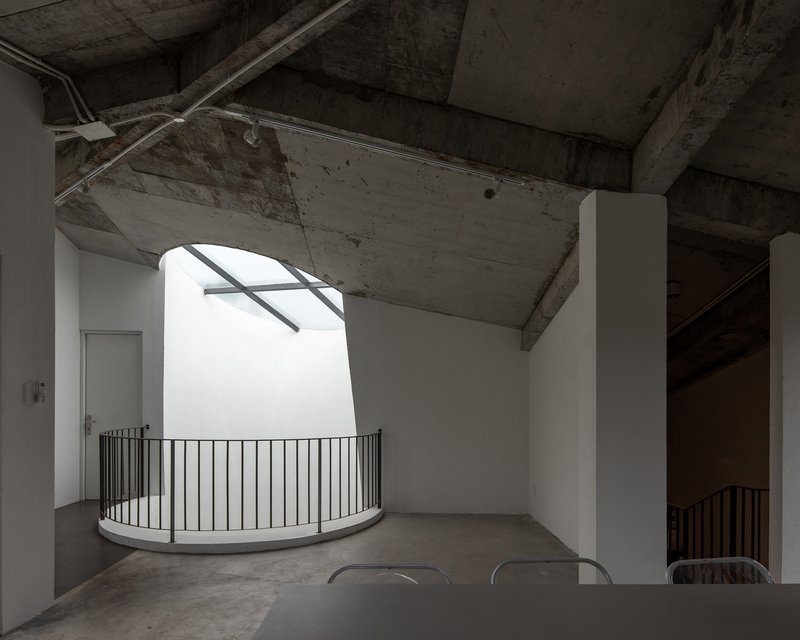
The curved balcony beneath a skylight, ringed with vertical metal railings, is one of the project's most compelling moments. It introduces a geometry that is neither orthogonal nor arbitrary, a controlled curve that softens the transition between the open void below and the intimate upper dining rooms. The vertical railing pattern filters light into fine lines across the concrete floor.
From the upper level, the view through a tapered white column toward the dining area below compresses and expands space in a single glance. The architects use these moments of sectional connection to keep the building feeling like one continuous interior rather than a stack of independent floors. The double-height space at twilight, with its upper-level opening to the sky, confirms that the building was conceived as a vessel for changing light as much as for serving food.
Material Details at Close Range
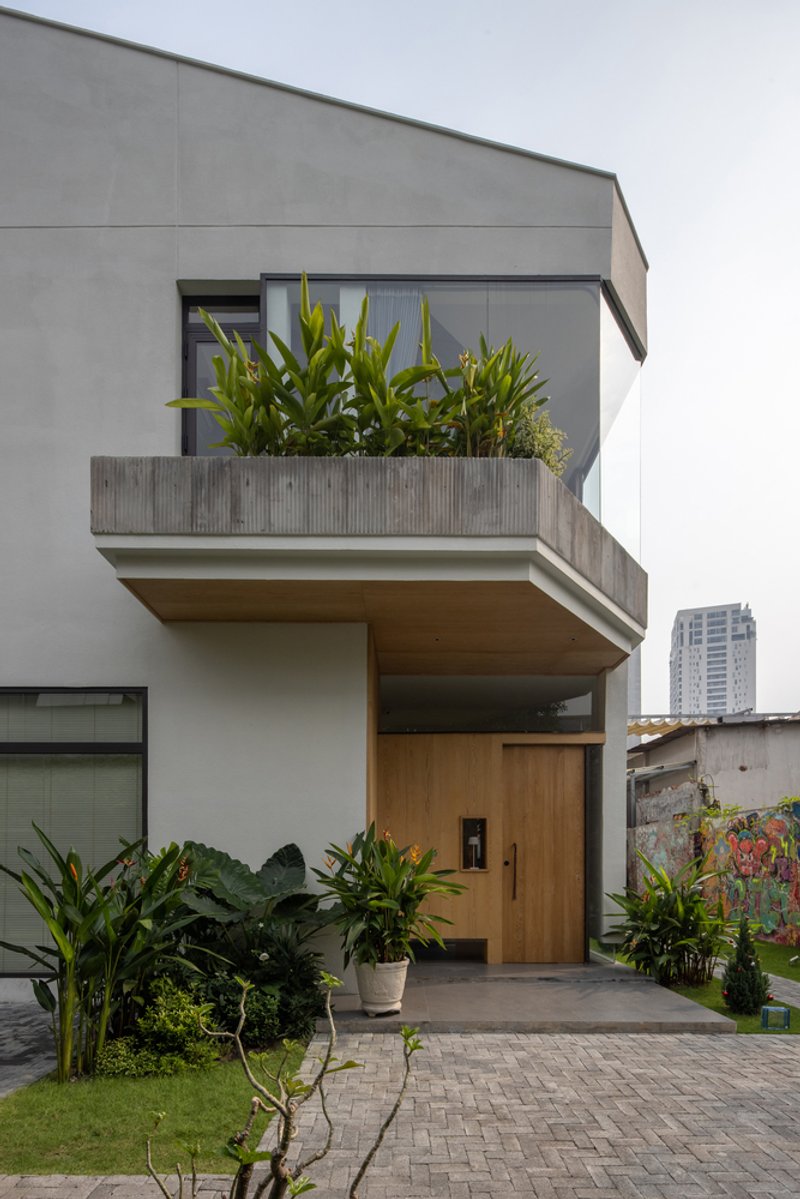
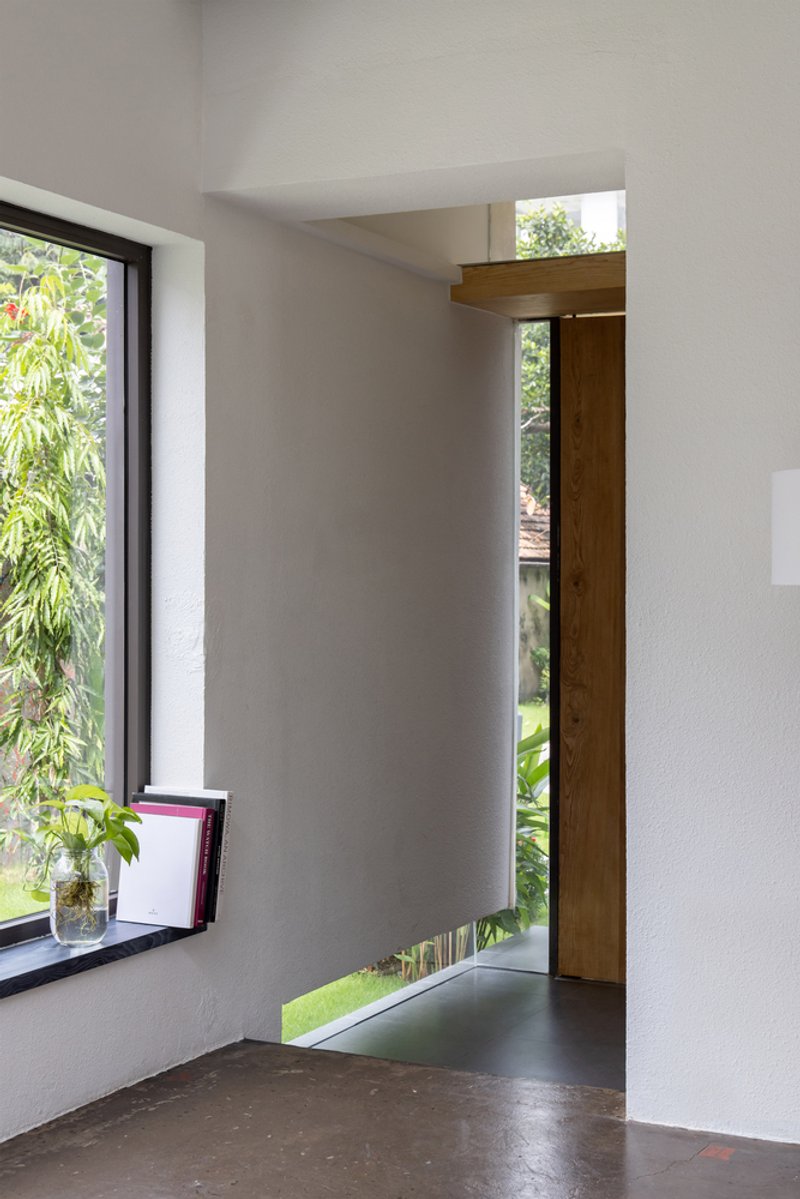
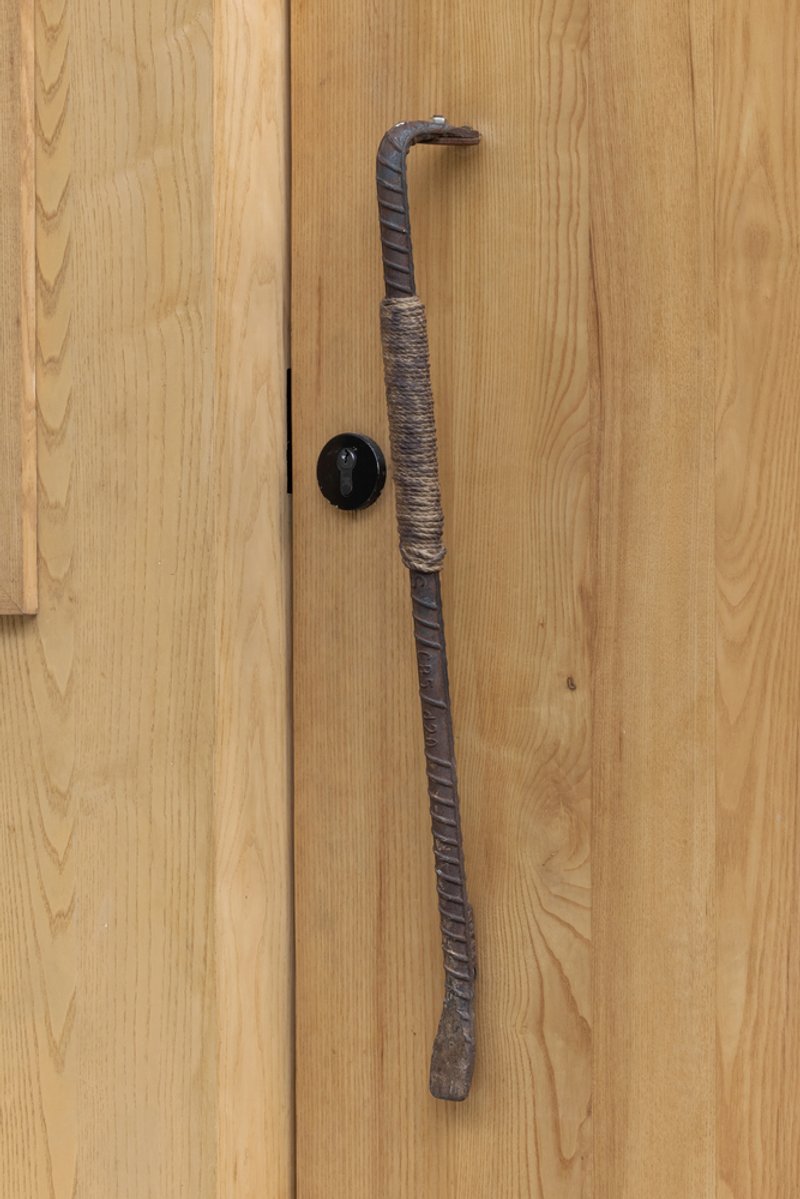
The forged metal door pull with its wrapped cord detail, mounted on light wood cabinet panels, signals the level of attention applied at every scale. Similarly, the timber-clad entry door with its clerestory window is not a standard fitting but a piece of joinery that sets the tone before you even step inside. These details do not shout, but they accumulate into a sense of care that guests register even if they cannot articulate it.
The timber balcony with planted beds and the mosaic-tiled stair rail are other moments where material specificity lifts the project above generic minimalism. Eigh-T clearly values the handmade, and the combination of forged metal, mosaic tile, and rough-sawn timber gives the building a warmth that pure concrete and white walls alone could never achieve.
Plans and Drawings
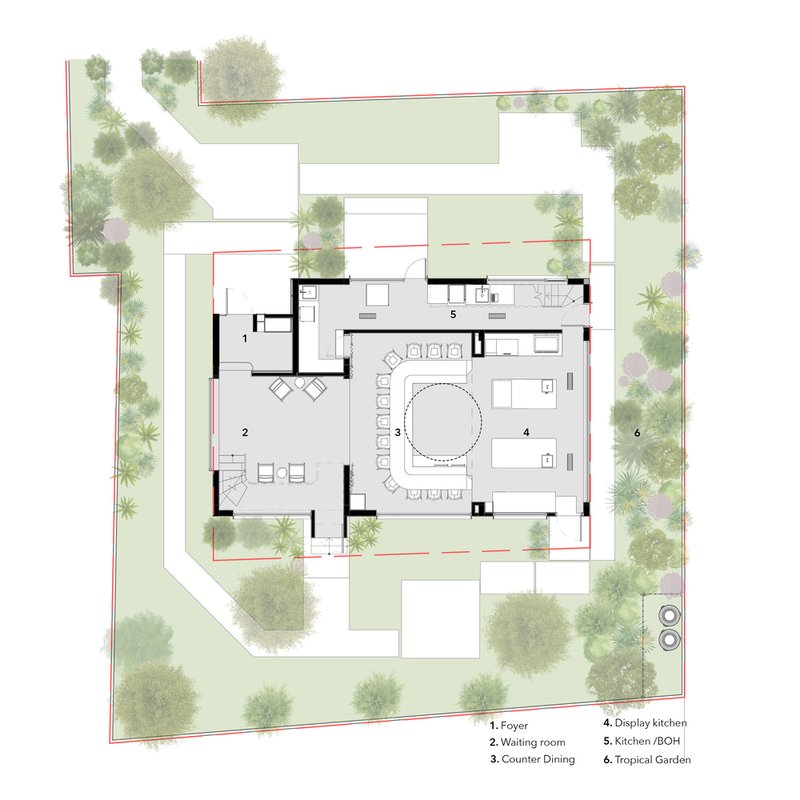
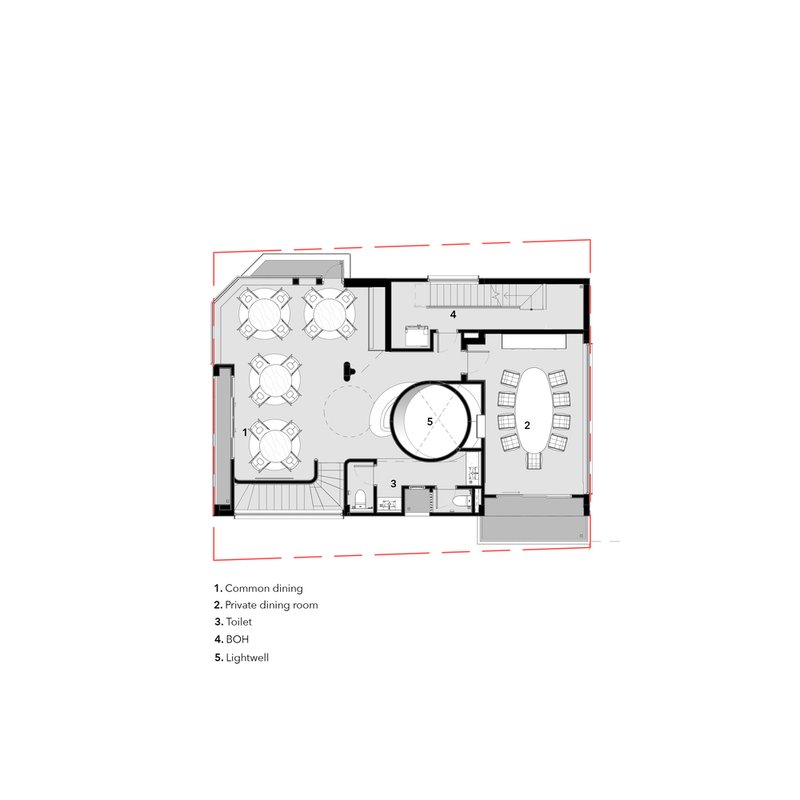
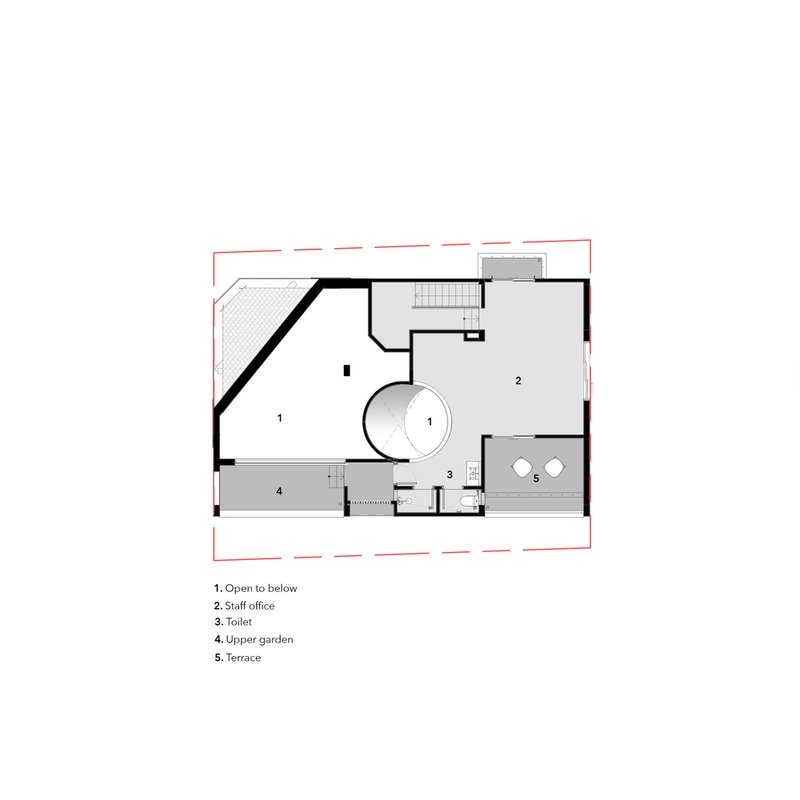
The ground floor plan reveals an open dining and kitchen layout organized around a circular seating element, with garden wrapping the perimeter. The upper floors show how the circular lightwell and angled terrace corner create the sectional drama experienced inside. By the second floor, the plan opens into a void that looks down to the levels below, confirming the building's vertical ambition.
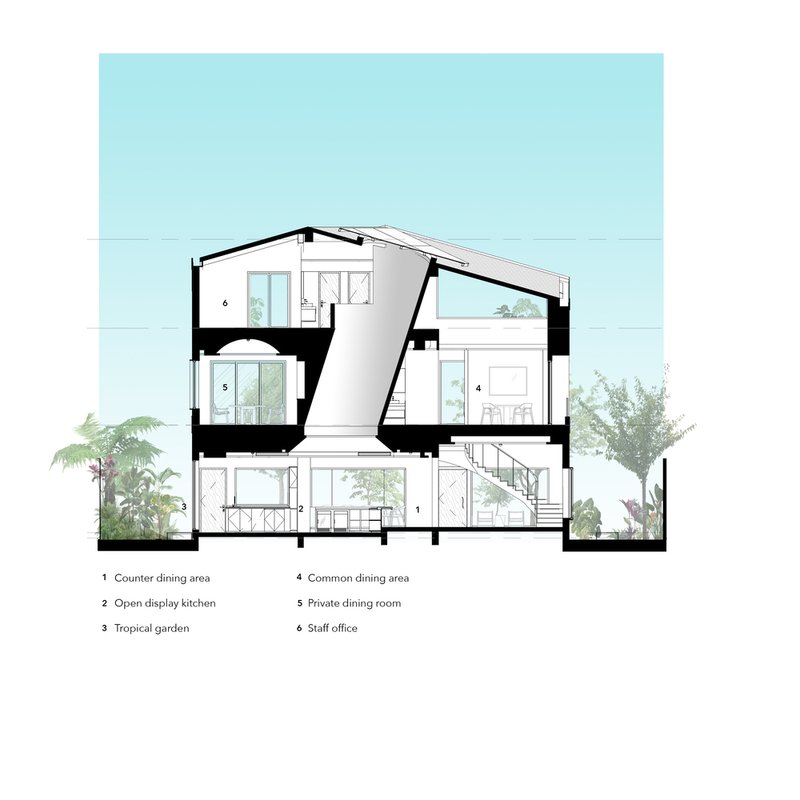
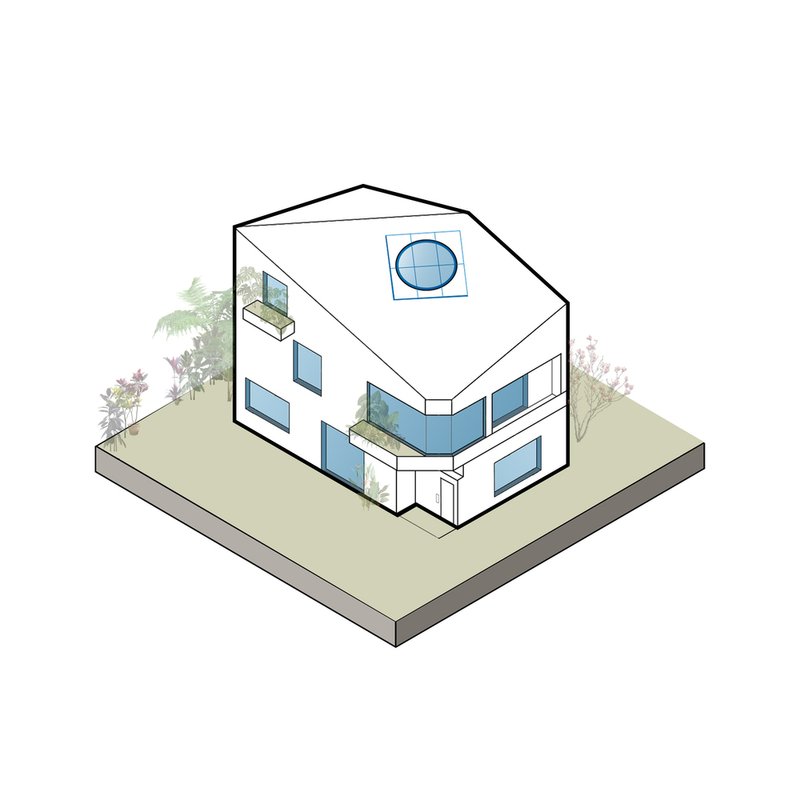
The section drawing is the most revealing: split-level interior volumes stack beneath an angled roof, with planted areas at the base and upper terrace sandwiching the dining rooms in greenery. The isometric drawing of the full building shows how the glazed corner windows and surrounding tropical vegetation are integrated from the earliest design moves, not added as afterthoughts.
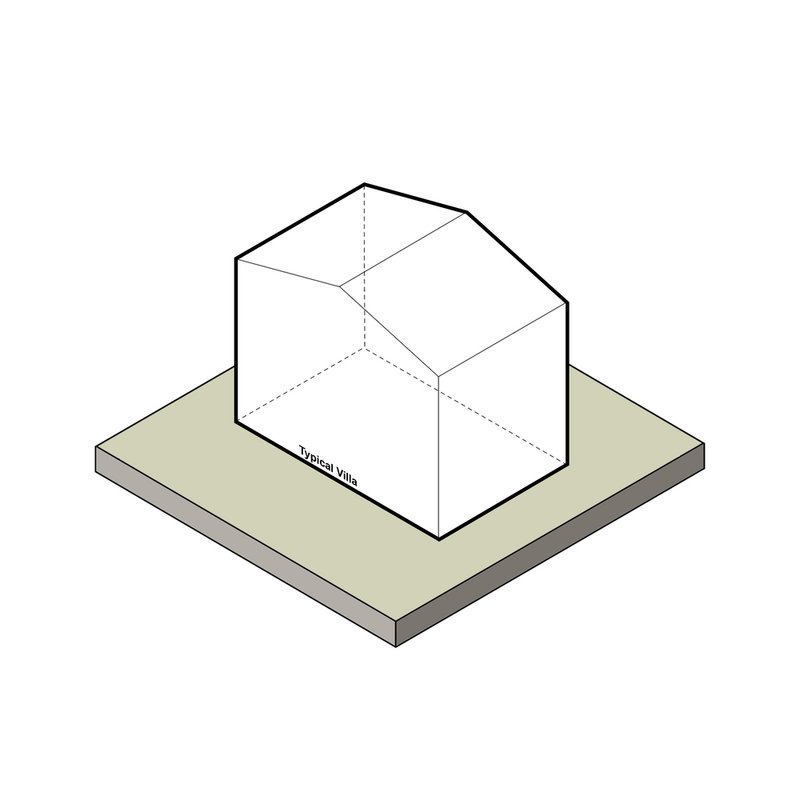
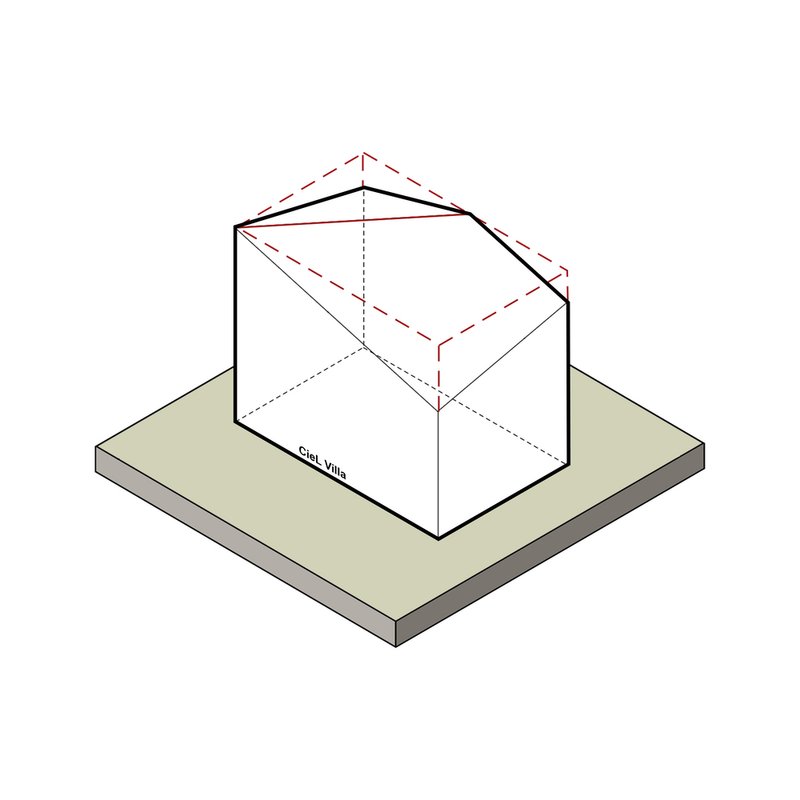
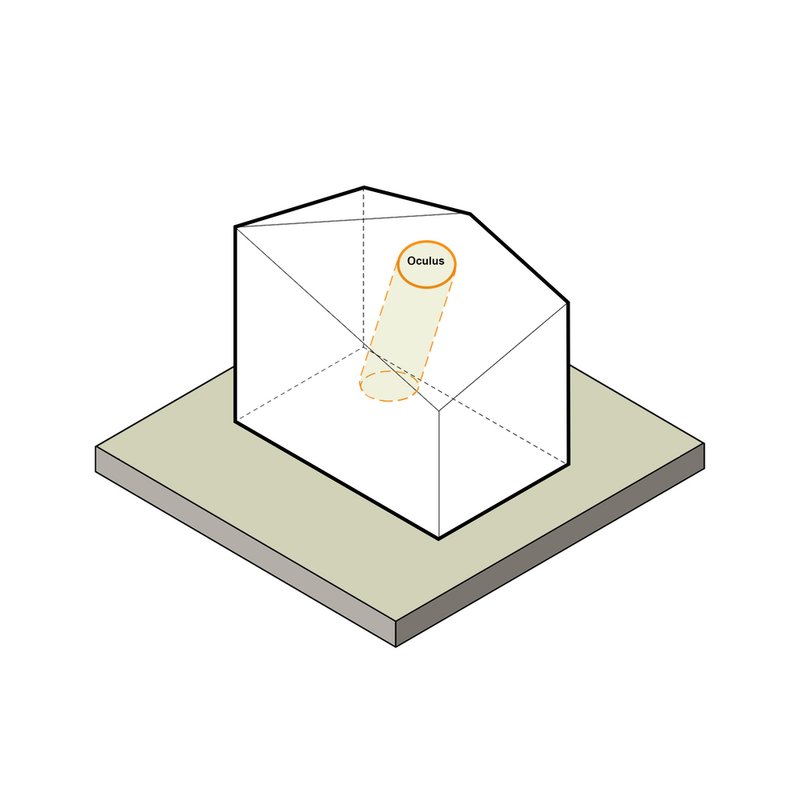
The axonometric diagrams break the building into legible moves. A polygonal gabled roof sits on a square base platform. Dashed lines reveal the roof structure and interior geometry beneath. Most tellingly, one diagram isolates the cylindrical oculus penetrating through the sloped roof, making explicit the project's central idea: punching a circle of sky through a folded plane.
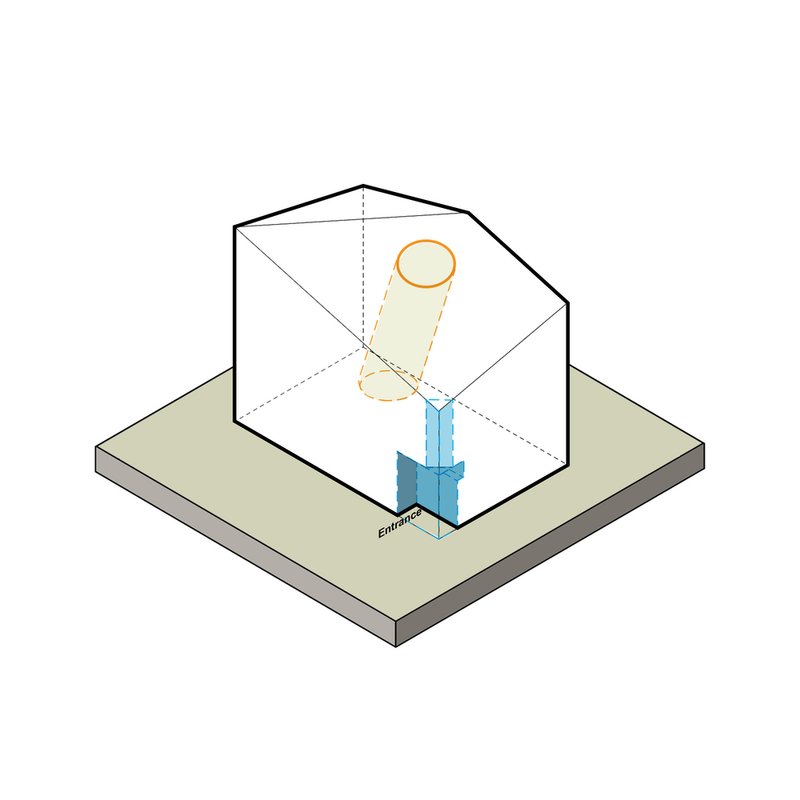
The final axonometric shows the entry sequence with a vertical circulation tower beneath the roof oculus, confirming that the stairwell and skylight are not separate elements but a single vertical figure around which the entire building is organized.
Why This Project Matters
CieL Dining demonstrates that hospitality architecture does not need spectacle to be memorable. Eigh-T Architects built a restaurant where the quality of a meal is shaped by the angle of light falling on the table, the framed view of a garden through a tapered column, the sound of footsteps on timber treads ascending toward a circular sky. These are spatial experiences, not decorative ones, and they require a level of architectural control that most restaurant projects never attempt.
The project also shows that geometric ambition and material warmth are not opposites. The angled walls, circular voids, and split-level sections could easily feel cold or academic, but the timber, mosaic, forged metal, and pervasive garden planting keep every room feeling inhabitable and generous. It is a building that rewards the attentive diner and the attentive architect equally, which is exactly what good restaurant architecture should do.
CieL Dining Restaurant by Eigh-T Architects, Vietnam. Photography by Hoang Le.
About the Studio
Share Your Own Work on uni.xyz
If projects like this are the kind of work you want to make, uni.xyz is a place to publish your own, find collaborators, and enter design competitions.




Popular Articles
Popular articles from the community

Noue Studio Organizes a Swiss Restaurant Around a Single Concrete Wall
In Granges-Paccot, Switzerland, a 216-square-meter renovation turns raw materials and a central spine into a legible dining experience.
Cro&Co Architecture Builds a 150-Meter Tower on Top of a Seven-Lane Highway in La Défense
Trinity Tower reimagines the office high-rise as a bioclimatic organism threaded with terraces, trees, and public ground in Paris's business district.
S.O.S Architects Scatters a Cluster of Timber Pavilions Across a Chiang Rai Hillside
The Wood Cabin arranges shingled gabled volumes along the slopes of Doi Chang, framing mountain vistas from every room and courtyard.

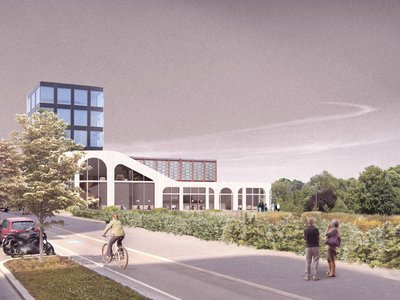
The Flow: Coffee Shop Interior Design Where Time, People, and Process Intertwine
The Flow reimagines Viennese coffee culture through arched forms, warm interiors, music, reading, work, and social gathering.


Similar Reads
You might also enjoy these articles

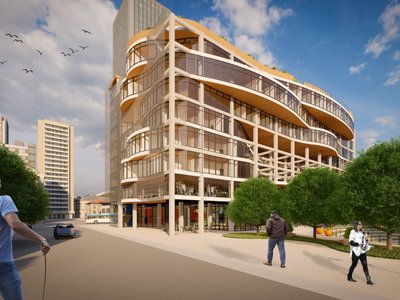
Olio Towers: A Mid-Rise for Performers That Fuses Housing, Rehearsal, and Stage
Located blocks from Houston's Theater District, this modular tower stacks living units around a central performance atrium.
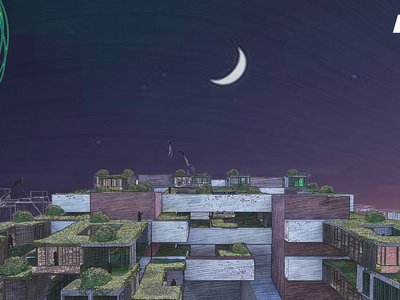
Oasis: Modular Green Housing Carved into Dhaka's Urban Fabric
A shortlisted Plugin Housing entry reclaims unauthorized settlements in Dhaka with stepped concrete volumes, green roofs, and ventilation-driven design.

Black Hole: A Floating Megastructure for the Post-Physical Era
Emiliano Mazzarotto envisions a spherical, self-scaling arena where e-sports, digital hotels, and holographic stadiums replace traditional public space.
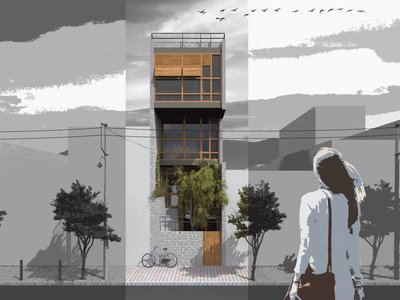
Compact & Sustainable Living in Piraeus: A Four-Level Family Home Built Around Light and Air
A narrow townhouse in one of Greece's densest port cities uses a central atrium and passive strategies to house three generations under one roof.


Explore Hospitality Building Competitions
Discover active competitions in this discipline




The International Standard for Design Portfolios


The Global Benchmark for Architecture Dissertation Awards


The Global Benchmark for Graduation Excellence


Challenge to reimagine the Iron Throne
Comments (0)
Please login or sign up to add comments
No comments yet. Be the first to comment!