

Clover Condo: Three Generations on a 12x4m Plot in Coimbatore
A climate-responsive residence uses form subtraction, jali walls, and modular skylights to house six people across three floors in Ukkadam.


How do you fit a retired professor's library, an IT couple's home office, children's play zones, and a grandmother's social life into a plot measuring 12 meters by 4 meters? Clover Condo answers that question not with spatial compromise but with architectural intelligence: form subtraction that cuts heat gain, jali screens that breathe cool air into tight rooms, and a stacking strategy that gives each generation its own vertical territory while keeping the household connected through light wells and open circulation.
Designed by Dhiliban Bala, Senthil Baskar, Dhana Ram Kumar DRK, and Neelu Shiker of Hindusthan School of Architecture, the project is sited in Ukkadam, a dense mixed-use neighborhood at the core of Coimbatore, wedged between the railway station and the city's commercial hub. Surrounded by civic landmarks like the Municipal Corporation office, District Library, and Town Hall, the plot sits within a highly permeable street network that favors pedestrian access despite significant urban congestion. Coimbatore's hot-dry and hot-humid climate makes passive cooling not a luxury but a prerequisite, and the team treats that constraint as the generative force behind every design decision.
Subtracting Volume to Let Air and Light In

The axonometric diagrams lay bare the project's passive design logic. Rather than filling the buildable envelope and then punching openings, the designers started with cuboid volumes and systematically removed mass. The south-facing roof is angularly modified to block direct UV penetration while still admitting diffused daylight through modular skylight systems (MSS). A traditional jali wall on the south façade does double duty: it filters sunlight into dappled patterns and uses external wind pressure to channel cool air deep into the interior. These strategies work together as a tuned system, not a checklist of green features.
Stacking Generations: Ground, Library, Sky


The floor plans reveal how the team distributes a six-person, three-generation household across three compact levels. The ground floor holds parking, a foyer, and a convertible living-bedroom area, accommodating the grandparents' need for accessible, adaptable space. The first floor houses the library and service core, with vertical and visual circulation aligned to reinforce thermal efficiency. The second floor provides private bedrooms with direct access to a terrace garden. Each floor has a clear programmatic identity, yet the section drawing shows how they interconnect through open risers and voids that permit both airflow and visual contact.
The section arrows are instructive. Warm air rises through the stacked volumes and exits via the MSS skylights, creating a stack ventilation effect that pulls cooler air in at ground level through the jali wall. The terrace garden, planted with Devil's Ivy, acts as a natural air purifier at the exhaust end of this thermal loop. It is a passive system with zero energy input, and its success hinges on the precise vertical alignment of openings and voids visible in the section.
A Double-Height Library as the Heart of the House

The interior perspective of the first-floor library is arguably the project's most compelling image. A cantilevered timber stair rises through a double-height volume, flanked by a perforated red screen wall that transforms harsh southern light into warm, shifting patterns across the reading space. The library is designed primarily for the retired professor grandfather, but its openness and warmth make it a gathering point for the entire household. Refurbished wooden bricks and pre-engineered elements reinforce the eco-conscious material palette while lending texture and warmth to the narrow interior. In a house this compact, dedicating a double-height volume to books and thought is a bold statement about priorities.
Split Levels and Angled Partitions Under a Sculpted Roof

The top-down view of the upper floor reveals a split-level arrangement where the bedroom and living hall are separated by angled white partition walls beneath a sloped ceiling. The angular geometry is not decorative. It derives directly from the solar-responsive roof modification visible in the earlier diagrams, where the south-facing slope was tilted to reject UV while admitting daylight at a controlled angle. The resulting interior geometry creates distinct zones within a single room, offering the working parents and middle-school children differentiated space without the cost of full-height walls on an already constrained footprint.
Terrace Garden and the Vertical Section

The final section drawing pulls the full composition into focus. The rooftop terrace garden, with its hanging plants and open trellises, crowns a layered vertical sequence: parking and social space at ground, the intellectual core on the first floor, private retreat on the second. The hanging Devil's Ivy isn't just aesthetic greening; it purifies air at the top of the stack ventilation path before exhaust. Viewed as a whole, the section demonstrates that every cubic meter of this 12x4 plot carries both spatial and environmental purpose. Nothing is filler.
Why This Project Matters
Clover Condo is a counterargument to the idea that sustainability requires generous budgets and expansive sites. Working within the constraints of a narrow urban plot in one of South India's fastest-growing cities, the design team demonstrates that passive cooling, intergenerational programming, and material economy can operate simultaneously when driven by rigorous spatial logic rather than additive technology. The jali wall, the modular skylights, the stack ventilation loop: none of these are novel in isolation, but their integration within a three-story, 48-square-meter footprint produces a result that feels both inventive and inevitable.
More importantly, the project takes the human dimension seriously. A retired professor gets a double-height library. Working parents get flexible zones that shift between office and bedroom. Children get light wells and playful circulation. The architecture responds not only to Coimbatore's climate but to the psychological rhythms of the people who live in it, treating adaptability as the deepest form of sustainability. For a student project, that level of synthetic thinking is worth paying close attention to.
View the Full Project
About the Designers
Designers: Hindusthan School of Architecture, Dhiliban Bala, Senthil Baskar, Dhana Ram Kumar DRK, Neelu Shiker
Enter a Design Competition on uni.xyz
uni.xyz runs architecture and design competitions year-round that reward proposals with spatial conviction and real site intelligence.
Project credits: Clover Condo by Hindusthan School of Architecture, Dhiliban Bala, Senthil Baskar, Dhana Ram Kumar DRK, Neelu Shiker.


Popular Articles
Popular articles from the community

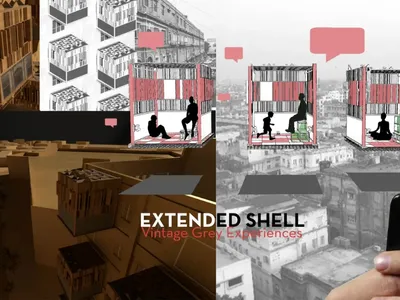
Extended Shell: Retrofitting Kolkata's Balconies as Living Urban Thresholds
A modular retrofit system recovers the social and environmental intelligence of Kolkata's historic verandas for contemporary Park Street residents.

Cloaked Colonization: A Mobile Underwater Habitat That Moves Like a Fish
Micah Abaya's shortlisted EHC Pacific entry reimagines ocean settlement as a dispersed network of self-sustaining architectural organisms.
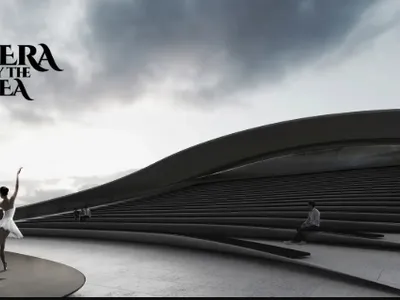
Opera by the Sea Estonia: Three Shells Dissolving Architecture into Tallinn's Coastline
A winning opera house proposal replaces monumental form with interconnected shells that blur the boundary between building, park and Baltic Sea.
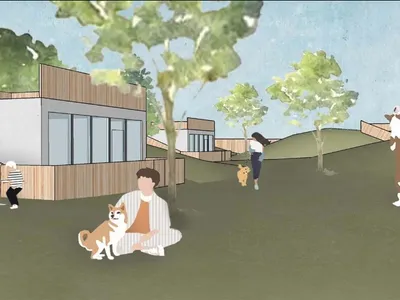
Temporary Home for Dogs: A Reversed Zoo Rethinks Animal Shelter Architecture
In Bucharest, a sinuous corridor and freed landscape flip the logic of containment, designing a shelter that works to make itself unnecessary.

Similar Reads
You might also enjoy these articles

Shakur's House: Exposed Brick as an Interior Organiser in a 168 m² Mashhad Residence
Brick moves indoors in this Mashhad residence, where masonry walls, glass partitions and teal planes sequence a compact home without closing it off.

Day and Night Park: A Time-Based Urban Newsstand in Beijing
A temporary urban newsstand in Beijing blending travel, light, and reading through poetic colors, compact form, and community-focused design.

Modernist Patio Renovation in El Masnou, Barcelona by Oliver Segura Arquitectura + Cebrià Arquitectura
Modernist patio renovation blending tradition and innovation with a movable pool, leveled floors, and Catalan materials in El Masnou.
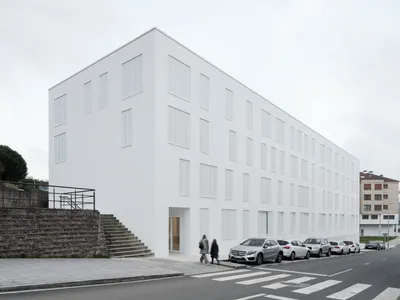
Alto Residencial Coop: Cooperative Housing Development in Santiago de Compostela by Carbajo Barrios Arquitectos
A linear cooperative housing complex blending white volumes and perforated metal façades, enhancing community living, natural light, privacy, and urban integration.

Explore Interior Design Competitions
Discover active competitions in this discipline

Challenge to design luxury tourism on rails

VR headsets Storefront design competition

Designing a staircase for a client
Comments (0)
Please login or sign up to add comments
No comments yet. Be the first to comment!