
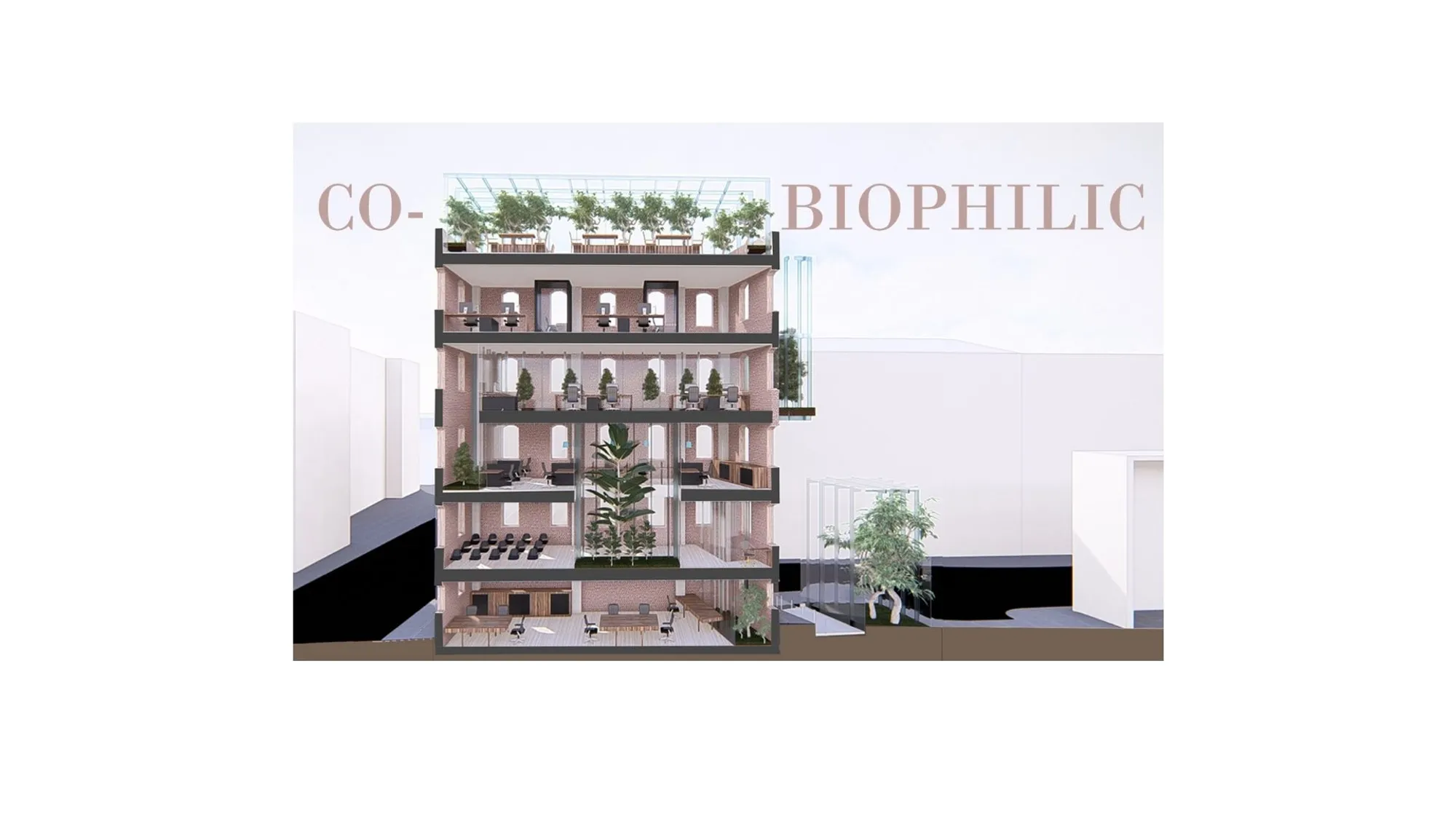
CO-BIOPHILIC
Co-Biophilic is the name of a co-working office where old and new combine through biophilic design.
The most important thing for the contestant to participate in the competition was to address the topic of adaptive reuse, which should be popularized today. In a world where resources are increasingly depleted and activity awareness is increasing, it offers a more sustainable and environmentally friendly approach by re-functioning existing structures instead of building them from scratch. Adaptive reuse ensures the preservation of both historical and cultural heritage and offers a more economically efficient solution. In this context, beyond competition, the idea of transforming this old Victorian paper warehouse into a modern co-working space by reviving its function attracted the attention of the participants. This project, which combines the past and the future by preserving a historical building and giving it a new life, also constitutes a good example of sustainable architecture. Such projects serve to preserve the fabric of the city, revitalize the local economy and perpetuate social memory.
With this awareness, research and analysis were first carried out on the existing building, because in order to add new things to the existing structure, the existing one had to be thoroughly understood. In this regard, features of the existing building such as its history, building structure and materials were investigated in depth. Analyzes were made regarding the area where it was located. In line with the information obtained and the requests of the competition, the design phase was started.
During the design phase, considering issues such as the lack of green space and light in the area where the building is located, as well as the limited number of changes that could be made since the building is on the 2nd grade listed building, it was decided to integrate a modern one with very delicate touches into the building. In this regard, a design was developed inspired by the direct experience of nature, branch of biophilic design.
The aim was to integrate green into the work spaces by placing glass greenhouses with glass structures in the design. These glass greenhouses move inside and outside the building, defining the spaces with green, ensuring continuity between floors and determining the positions of the furniture.
It was decided that the designed co-working space would be used by the architects. Thus, it was possible to carry out activities such as models, drawings and renderings of different architectural disciplines on different office floors. A model office and multi-media room were placed in the basement of the building, where employees can create their models by using 3D printers integrated with technology. A seminar room, where external employees can attend, was placed on the ground floor of the building, supported by a reception and common waiting area. A common office was arranged on the first floor, which can be used by people such as civil engineers and mechanical engineers who work together with architects. The rendering office and meeting room were located on the second floor. On the third floor, a drawing office and special work cabins where employees can make phone calls or video conferences were placed. A cafeteria was organized on the rooftop, which all employees and collaborators can use. The furniture in all offices was designed to be integrated into the glass greenhouses.


Popular Articles
Popular articles from the community


Co-Life: Senior Housing Design That Reconnects Older Adults With the City
Co-Life reimagines senior housing design through healing gardens, shared streets, workshops, and a sustainable community across generations.

Hill & Cross Opera: Sculptural Opera House Architecture Shaped by Tallinn’s Landscape and Identity
Hill & Cross Opera reimagines opera house architecture in Tallinn through its sculptural hill, civic plaza, glass wave and a luminous cross.

AL-JANNAH: Sustainable Architecture and Permaculture for Afghan Widows
AL-JANNAH uses sustainable architecture and permaculture to create resilient oasis of housing, learning, work and renewal for Afghan widows.

Riyadh For All: Intergenerational Urban Design for Active Aging in Rabat
Riyadh For All reimagines urban design in Rabat with intergenerational co-living, adaptive courtyards, and Moroccan cultural exchange today.


Similar Reads
You might also enjoy these articles

Bao Huynh Watercolor Atelier: A Serene Art Retreat in Hội An
Bao Huynh Watercolor Atelier in Hội An blends multifunctional art spaces, sustainable design, local materials, and family-friendly living in a serene environment.

Atelier Macri Concept Store Interior Design by CASE-REAL
Atelier Macri store features a "ko" counter, walnut wood details, cork displays, blending retail, gallery, and seamless customer experiences.

Manuel Vargas Izquierdo Stadium and High-Performance Sports Center: Architectural Excellence in Jalpa de Méndez
The Manuel Vargas Izquierdo Stadium blends sustainable design, inclusive sports facilities, and cultural-inspired architecture, revitalizing Jalpa de Méndez’s public spaces.

KAKR Buluh Awar Hall: Revitalizing Community and Ecology Through Bamboo Architecture
Community built bamboo hall revitalizes Buluh Awar village, empowering youth, restoring ecology, celebrating vernacular craftsmanship through sustainable architecture and culture.


Explore Biophilic Competitions
Discover active competitions in this discipline


Challenge to design luxury tourism on rails


VR headsets Storefront design competition

Designing a staircase for a client


Design challenge to reuse E-waste
Comments (0)
Please login or sign up to add comments
No comments yet. Be the first to comment!