
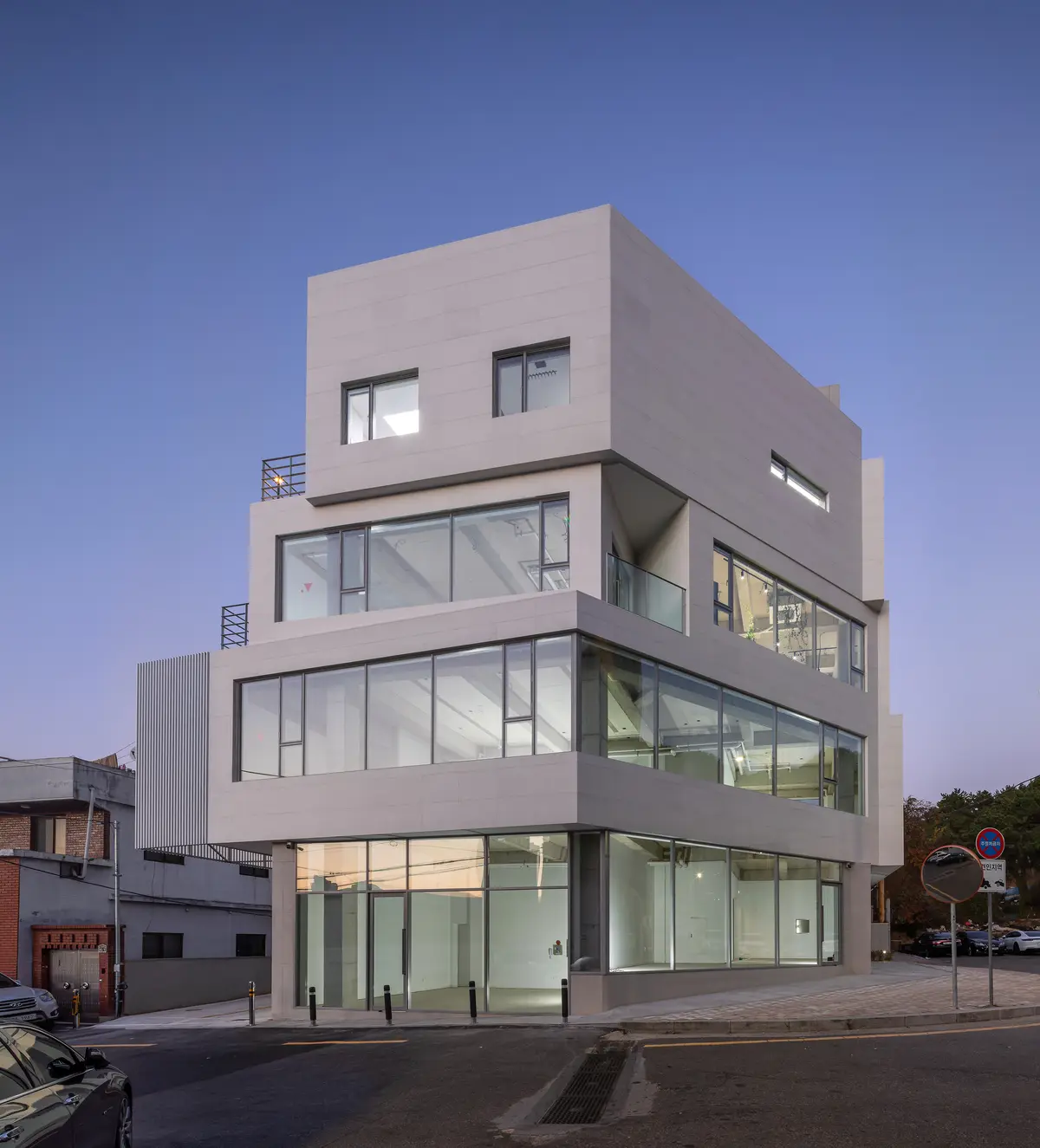
Architects Group RAUM Stacks Offset White Volumes into a Compact Office Tower in Busan
A 524-square-meter building on a tight corner lot in Haeundae plays with sunlight rights and shifting floor plates to create generous terraces.


Haeundae was not always Busan's engine of aspiration. The site of AWESOME185 once sat in a remote, undervalued patch of the city, the kind of leftover parcel that planners politely ignore. But as Centum City expanded and the mythology of waterfront Busan intensified, this corner lot at the junction of two roads became a gateway, and Architects Group RAUM seized the opportunity to build something that reads less like a small office block and more like a compact manifesto on how to occupy a constrained urban lot with clarity.
What makes AWESOME185 worth studying is the way it resolves a classic Korean urban problem: the right-to-sunlight regulation that governs residential-adjacent construction. Rather than treat the setback rules as a burden, RAUM turned them into architecture. Each floor plate shifts, steps back, or cantilevers beyond the one below it, producing a stacked composition of offset white volumes. The result is a building whose profile changes from every angle, and whose terraces and double-height voids are direct products of regulatory negotiation rather than stylistic whim.
Reading the Corner
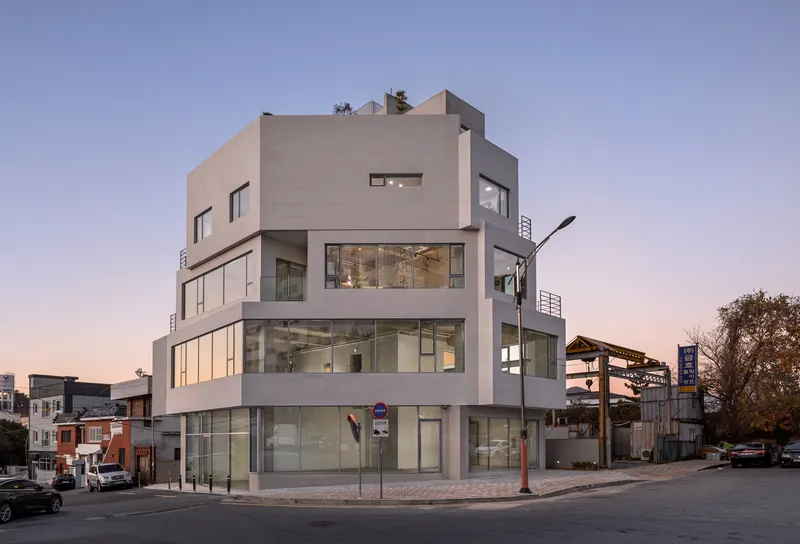
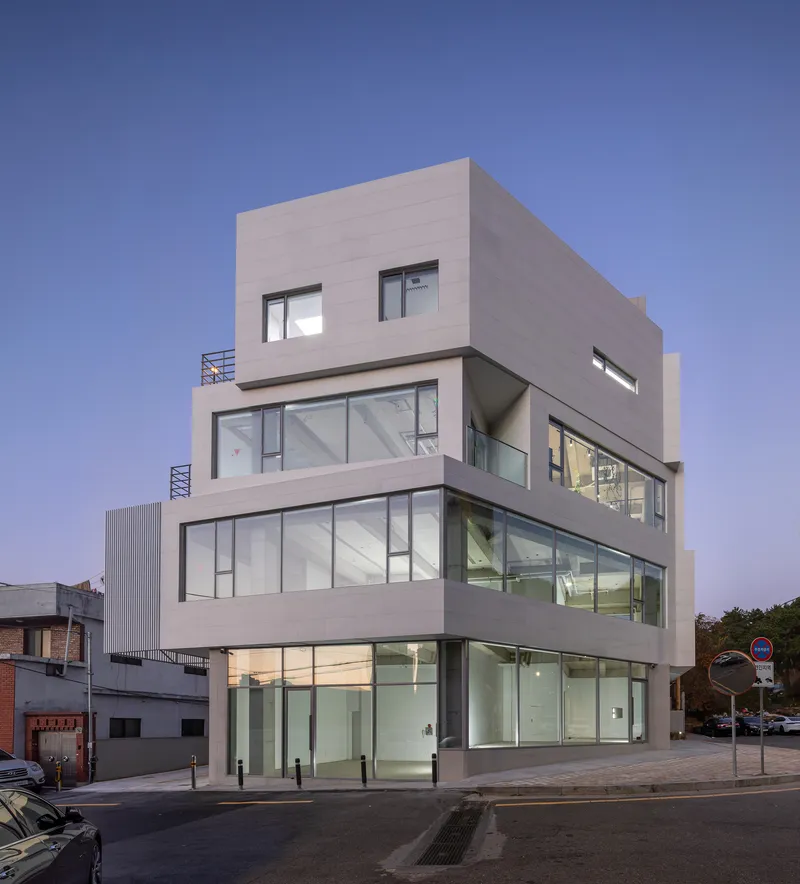

The building sits on an angled footprint where two roads converge, and RAUM exploits this geometry to give AWESOME185 a distinctive triangulated presence on the street. At dusk the offset floor plates become legible as individual glowing boxes, their full-height glazing revealing illuminated interiors. The corner condition is never resolved into a single facade plane; instead, each level presents a slightly different face, producing a slow rotation of mass as the eye moves upward.
From the street, horizontal railings on projecting balconies break up the white stucco surfaces and offer a human scale reference. Two figures standing on the upper railings in one image give the game away: this is a building designed to be inhabited at its edges, not just behind its glass.
Sunlight as Design Driver
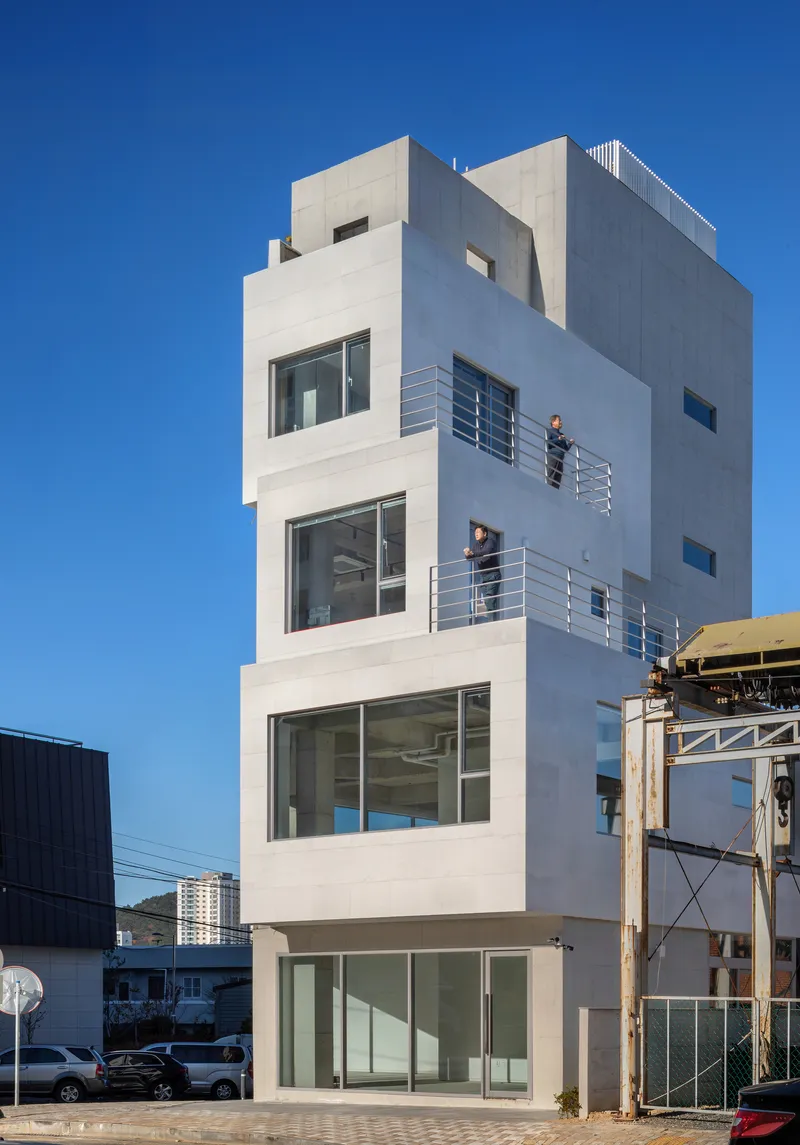

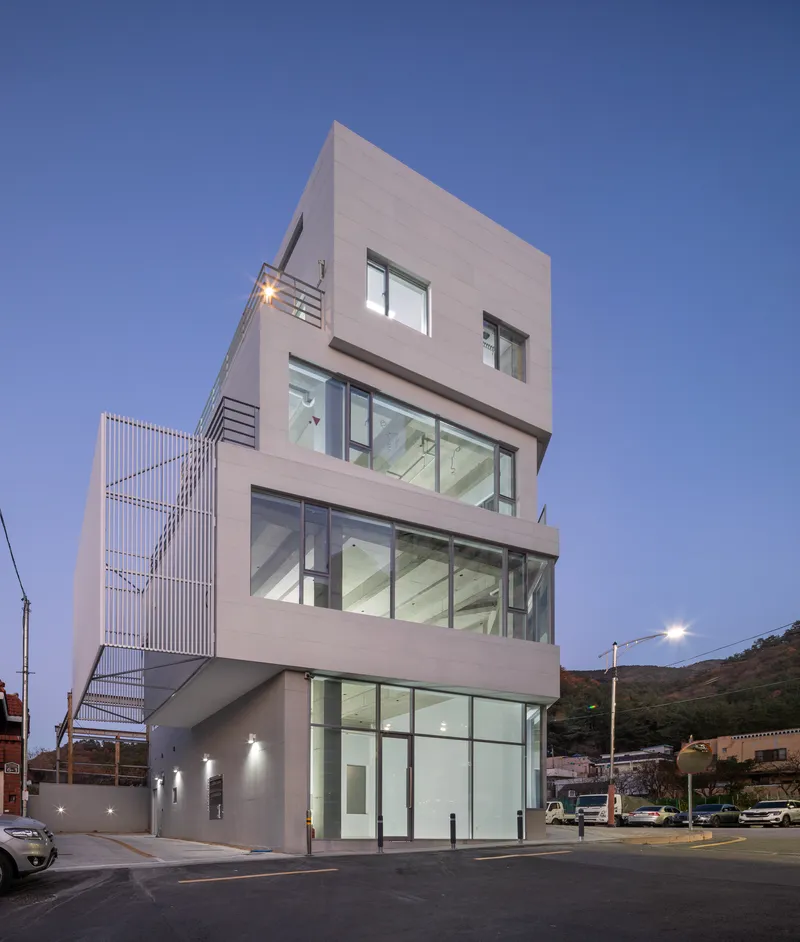
South Korean building codes enforce sunlight access for neighboring residential properties with a specificity that most Western architects would find astonishing. RAUM used these constraints to sculpt the massing, stepping the upper floors back to allow light to reach adjacent buildings. The side elevation reveals the logic clearly: a metal-screened stairwell tower anchors one end while cantilevered volumes reach out from the other, creating a dynamic composition that is fundamentally the shape of a regulation drawn in three dimensions.
The white stucco finish unifies the shifting volumes, but recessed balconies carve shadows into the surface that change throughout the day. The building is, in effect, a sundial of its own constraints.
The Interior Courtyard
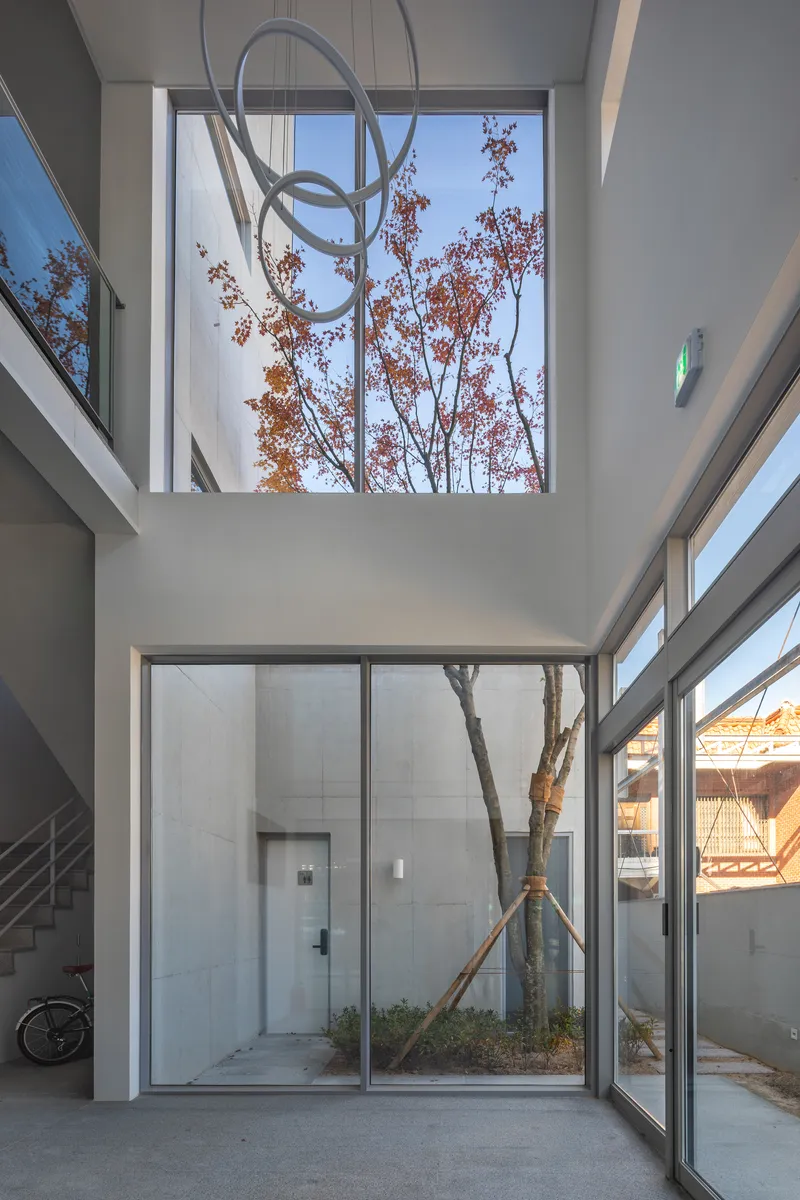
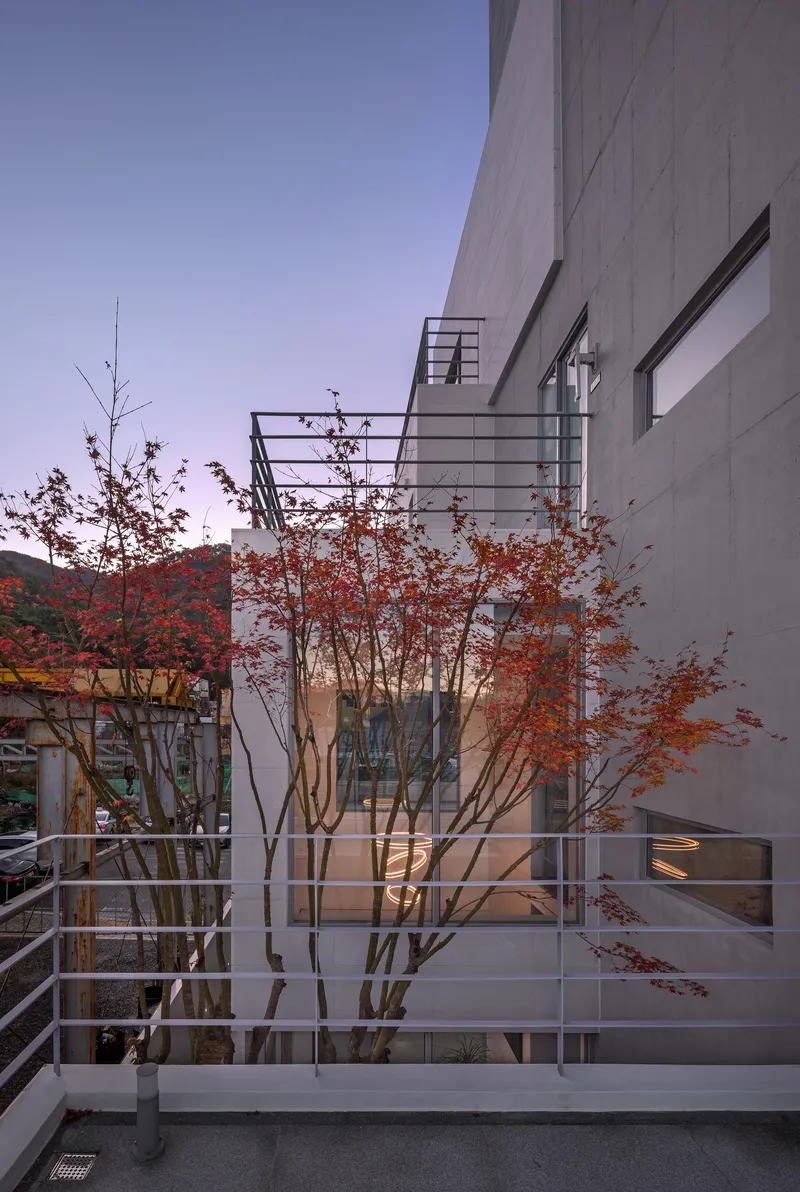
At the heart of the building, a double-height courtyard opens up to frame a single tree with autumn foliage. Floor-to-ceiling glazing wraps the void, pulling light deep into the plan and offering workers a visual anchor that changes with the seasons. It is a small gesture in terms of square meters, but it transforms the interior experience from a series of stacked floors into an interconnected vertical space.
The exterior terraces extend this logic outward, placing planted trees at the building's edges. The metal railings and white stucco backdrop turn these terraces into miniature gardens suspended above the street, blurring the line between workspace and open air. In a 524-square-meter building, finding room for both a courtyard and generous terraces is not obvious. It suggests a priority structure that values spatial quality over maximized leasable area.
Urban Context and Scale
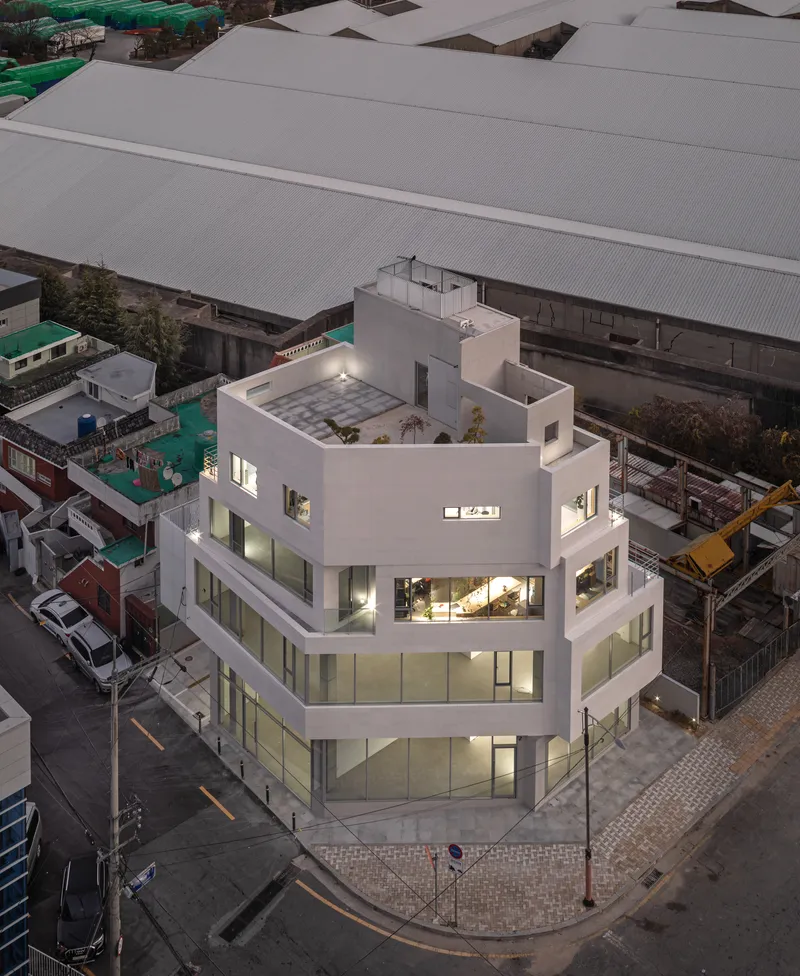
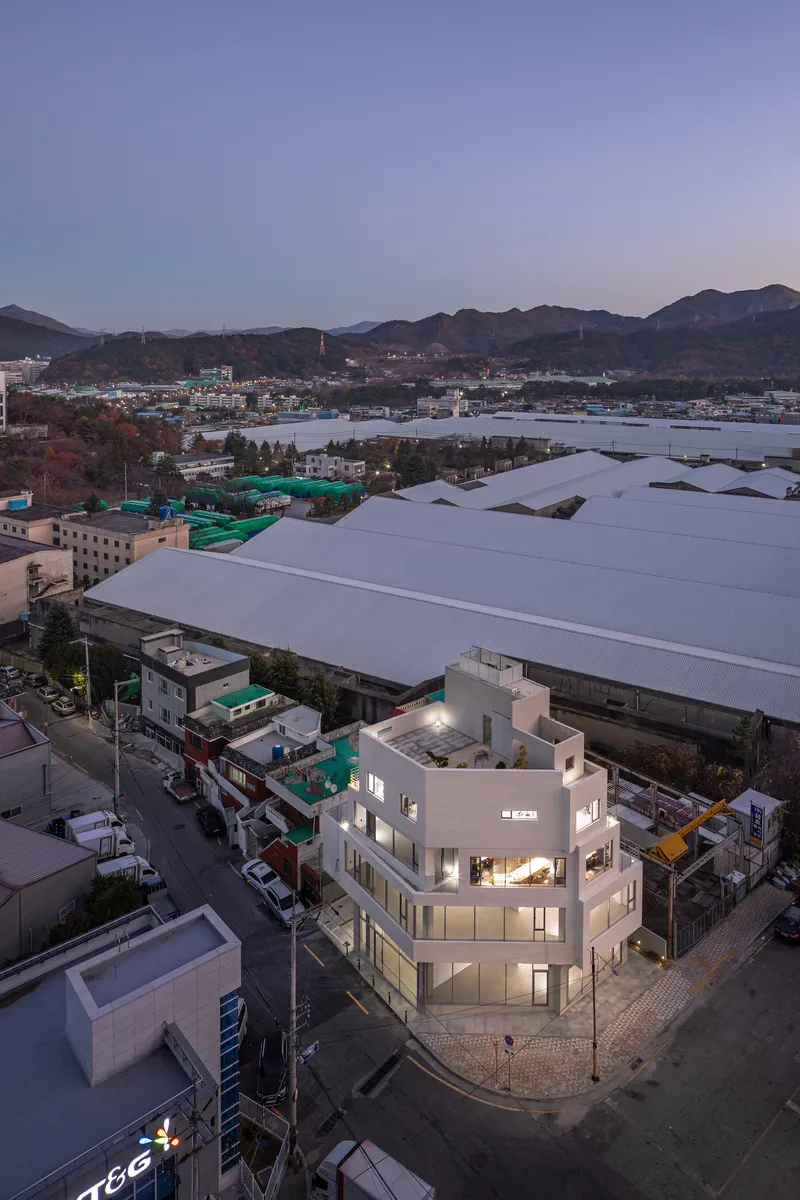
The aerial views are revealing. AWESOME185 sits among low industrial sheds and surface parking, a white vertical punctuation mark in a horizontal landscape. Mountains rise in the distance behind Centum City's towers, placing the building in a middle ground between Busan's natural topography and its commercial ambitions. The rooftop terrace, visible from above, reads as a fifth facade, with garden plantings that soften the building's geometry when seen from the residential towers nearby.
This is a building that understands its transitional role. It is neither a tower nor a shed, but something calibrated to a moment in a neighborhood's evolution, when a formerly peripheral site finds itself suddenly at a gateway.
Plans and Drawings


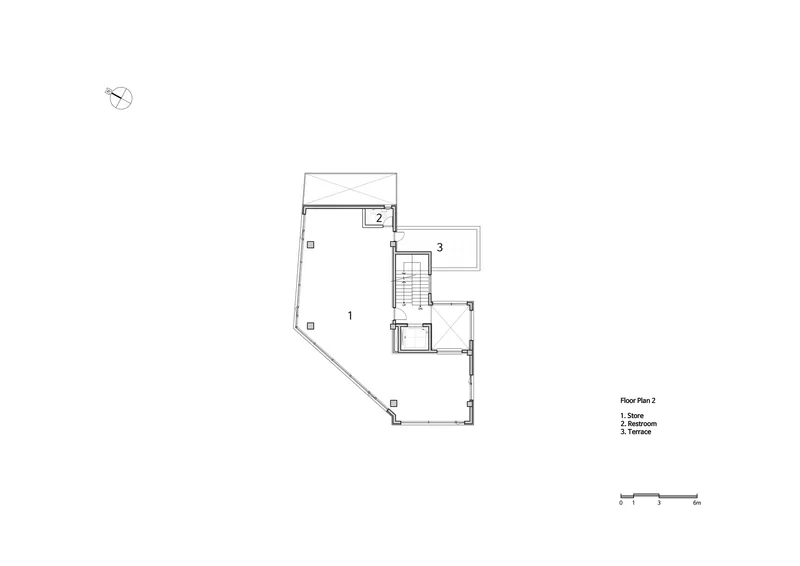
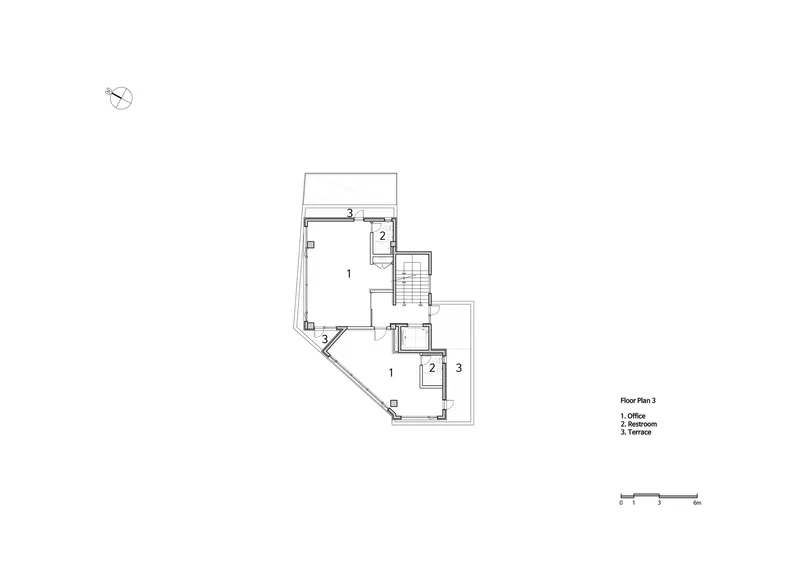
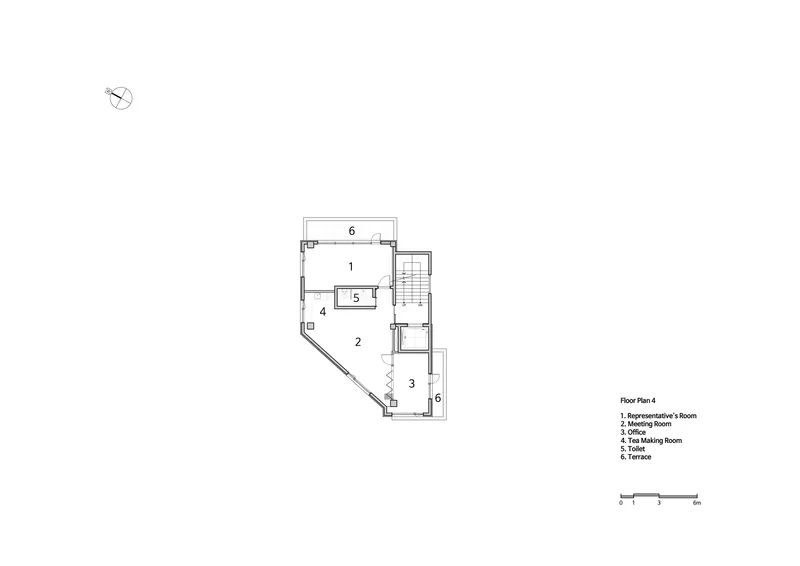

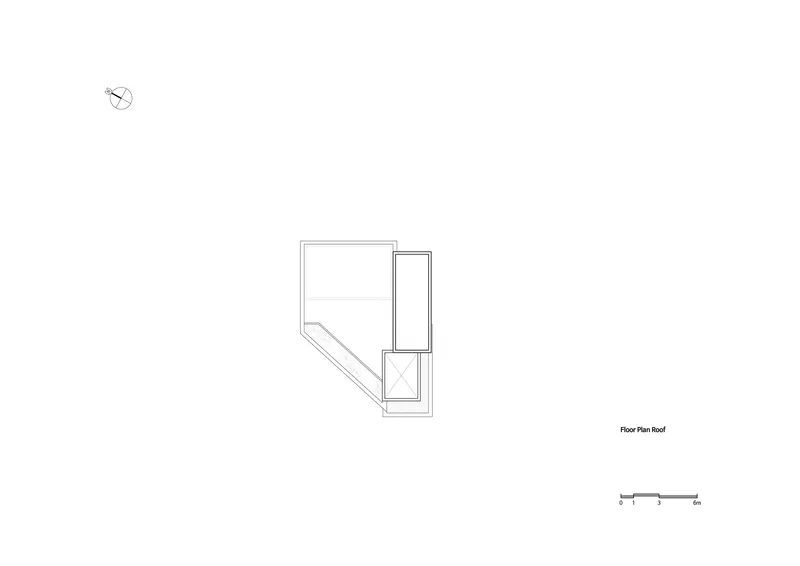
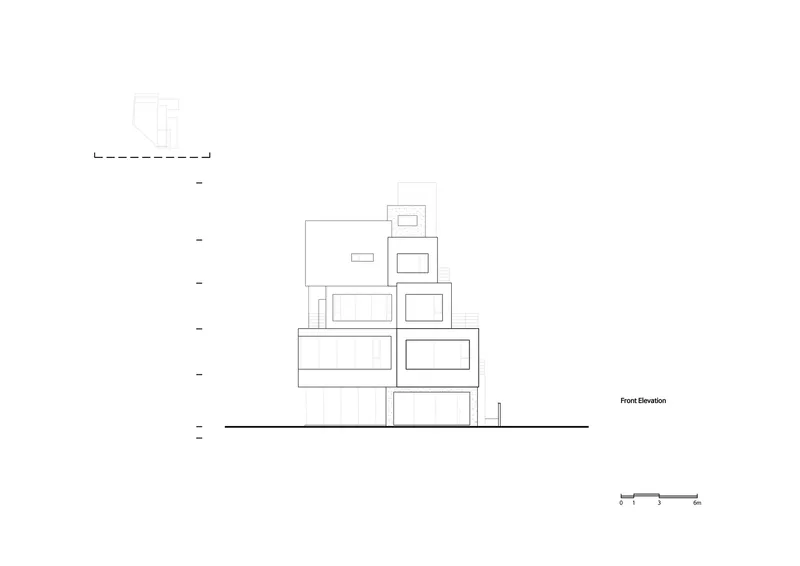
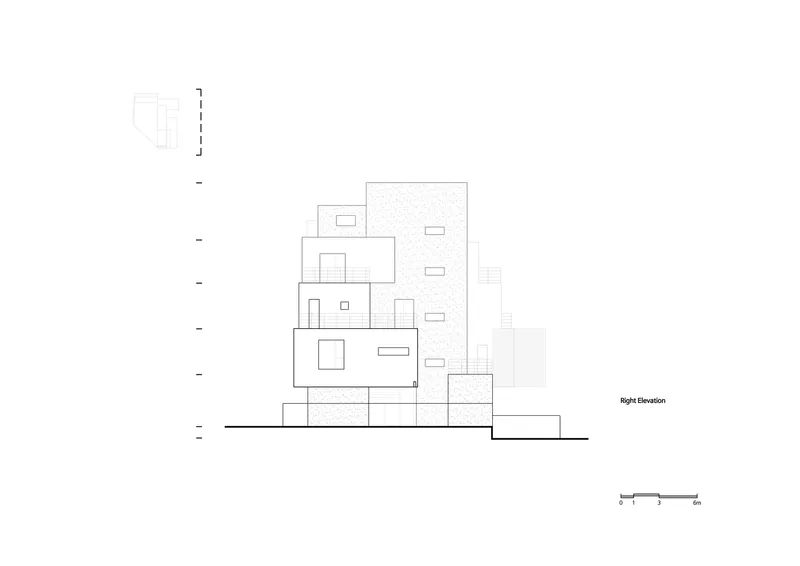


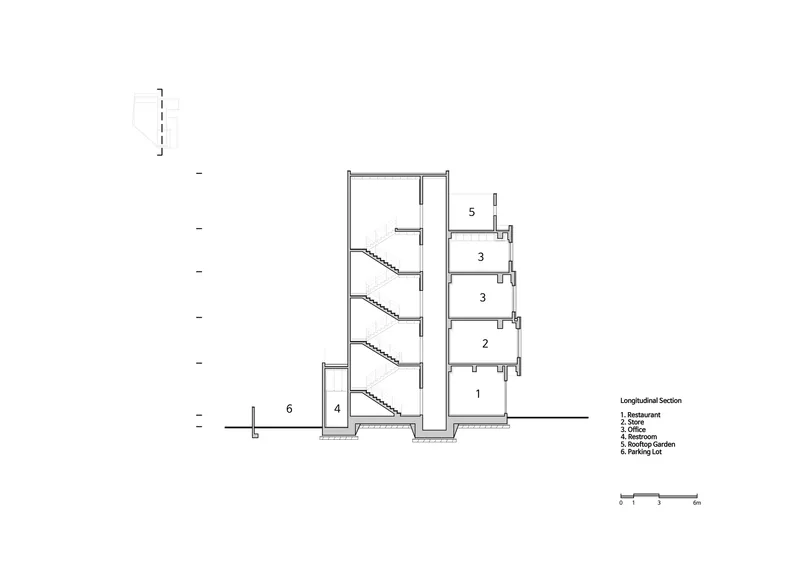
The site plan confirms the angled footprint wedged between two converging roads, a geometry that propagates upward through every floor. The ground level accommodates a hall, restaurant, and restrooms around a central stair, while upper floors progress from open workspaces with cantilevered side rooms to meeting rooms arranged along the angled spine. The roof plan shows the garden terrace and stair access, completing the vertical sequence.
The four elevations tell four different stories. The front shows the stacked-box logic most clearly, stepping upward from ground level. The right elevation reveals the terraced composition with its mix of textured and solid surfaces. The back elevation exposes the vertical circulation tower as an autonomous element, and the left elevation presents the most horizontal reading, with recessed and projecting forms playing against each other. The cross section is the most informative drawing of the set, revealing split levels, numbered zones, and the way the central stair stitches together floors that are never quite aligned.
Why This Project Matters
AWESOME185 is a case study in turning regulatory constraints into architectural language. The right-to-sunlight laws that shape so much Korean urban construction are often treated as obstacles to be minimized. RAUM instead internalized them as the project's primary compositional tool, producing a building whose silhouette, terraces, and interior voids are all direct expressions of the code. The result is architecture that is legible as both an act of compliance and an act of design, without the two being in conflict.
At 524 square meters, the project also demonstrates that a small commercial building can carry civic weight. Its white volumes catch light, its terraces green the streetscape, and its courtyard tree brings seasonal change into the workplace. In a neighborhood still defining itself between industrial past and commercial future, AWESOME185 proposes that even a modest office block can set the tone for what comes next.
AWESOME185 Office Building by Architects Group RAUM, Haeundae, Busan, South Korea. 524 m², completed 2021. Structural engineering by IN Structure. Construction by Dodam Construction. Photography by Yoon Joon-hwan.
About the Studio
Share Your Own Work on uni.xyz
If projects like this are the kind of work you want to make, uni.xyz is a place to publish your own, find collaborators, and enter design competitions.


Popular Articles
Popular articles from the community


Manzana Morphosis: Stretching Barcelona's Grid into a Living Landscape for 2050
A radical reworking of the Eixample manzana turns density into a tool for generous public space, vertical ecology, and environmental performance.


FCC Arquitectura Expands a Portuguese Granite House with a Board-Marked Concrete Wing
In Portugal, JV House pairs a cleaned-up whitewashed and granite dwelling with a timber-shuttered concrete extension, courtyards and a garden pool.

David Ortega Stacks a Two-Story Mexico City Penthouse Around a Steel Stair and a Pergola-Shaded Roof Terrace
In Colonia Roma, a 300 m² penthouse uses oak joinery, a planted steel stair and a slatted roof pergola to make a new-build apartment feel like a house.

Aquadapt: An Underwater Habitat That Rewrites Its Rooms by the Hour
Curved modules ring the seabed while one shell shifts from breakfast room to cinema, farm and football pitch as residents' needs change.

Similar Reads
You might also enjoy these articles

LAVA Architecten Gives Vocational Education a Sawtooth-Roofed Face on a Mechelen School Campus
In Mechelen, Belgium, a 2,053 m² STEM school on a 6×6 m grid turns workshops and classrooms into rooms that can be rearranged as teaching changes.

KEMA Studio Turns a Derelict Marvila Attic into a 60 m² Lighthouse Apartment Above Lisbon
In Lisbon's Marvila district, a rebuilt roof, four skylights and two plywood volumes turn an unlivable attic into a bright home facing the Tagus.

Pixel Gardens: One Repeated Module Stacked Into a Terraced Social Housing Tower for Famagusta
Salem Bader's shortlisted housing tower builds a vertical neighbourhood from one repeated module, offsetting units to carve terraces, light and air.

Bao Huynh Watercolor Atelier: A Serene Art Retreat in Hội An
Bao Huynh Watercolor Atelier in Hội An blends multifunctional art spaces, sustainable design, local materials, and family-friendly living in a serene environment.

Comments (0)
Please login or sign up to add comments
No comments yet. Be the first to comment!