
BICA Arquitectos Buries a Coastal Home in a Man-Made Dune on Portugal's Tróia Peninsula
A 300-square-meter house of timber, sand mortar, and travertine dissolves into the dune landscape it helped regenerate on the Alentejo coast.


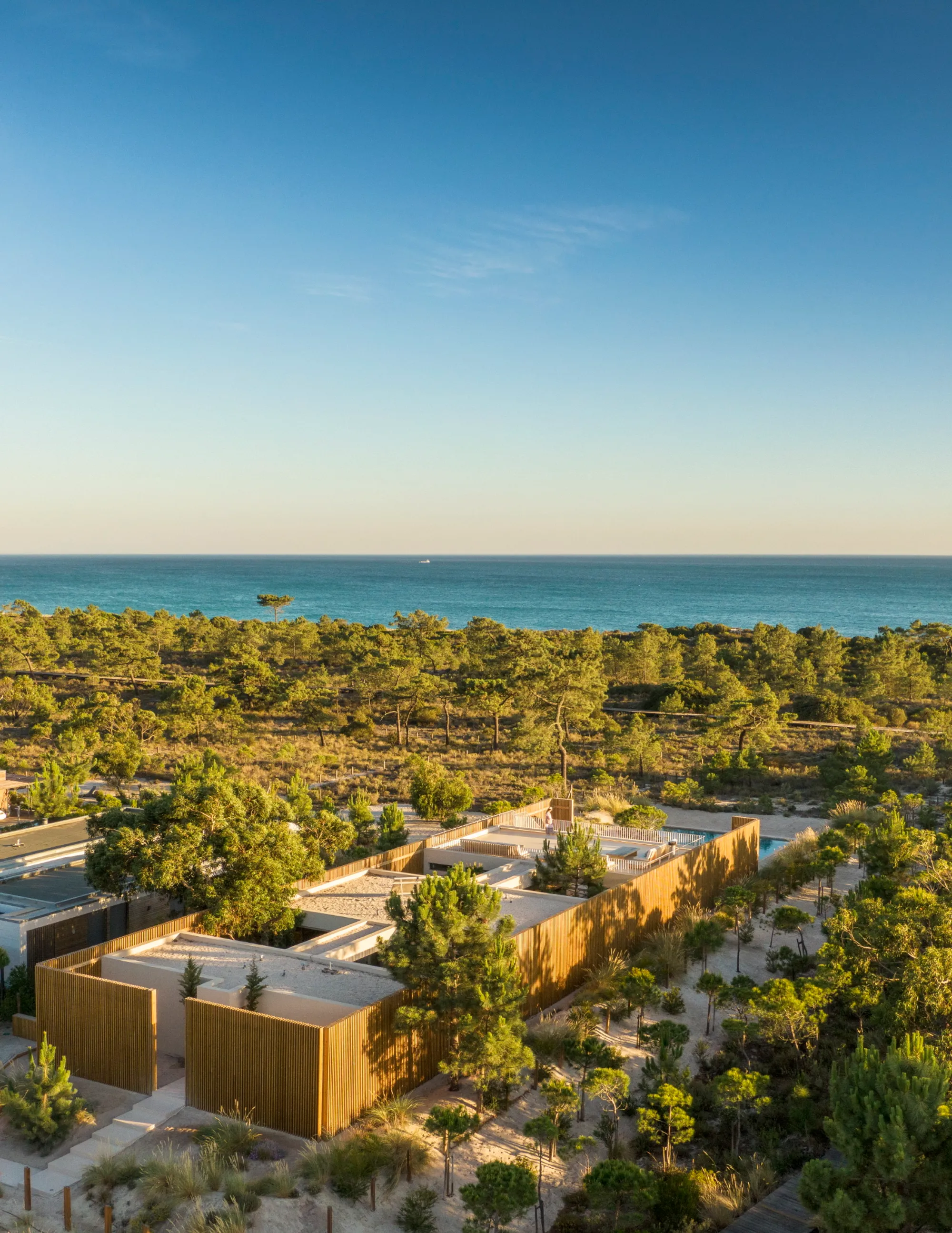
On the Tróia Peninsula in Grândola, Portugal, a long, low house sits meters from the Atlantic. Designed by BICA Arquitectos and led by architect Inês Cortesão, the 300-square-meter residence is organized as a sequence of solid volumes and planted courtyards threaded along a central corridor. The house faces the sea in a row of neighboring buildings, but from the social areas at its far end, the surrounding resort development vanishes entirely. What remains is pine, sand, sky, and water.
The most compelling decision here is not the plan or the palette but the landscape strategy. A large dune was carefully shaped around the house using sand excavated from nearby construction sites, then planted with native coastal species. The dune is not scenery; it is architecture. It absorbs the house into its terrain, protects the structure from wind, establishes privacy, and regenerates the ecology of a site that had been disturbed by development. The building does not merely sit gently on its landscape. It generates new landscape.
Reading the Site from Above
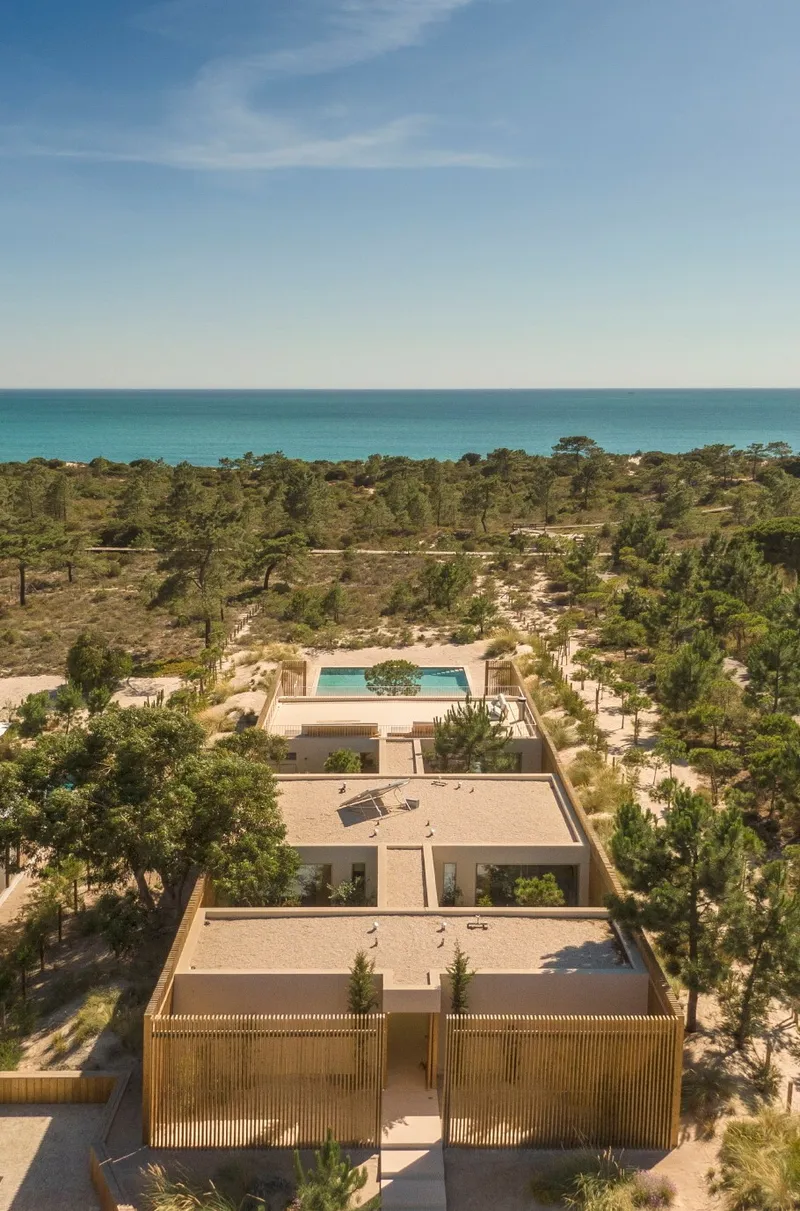
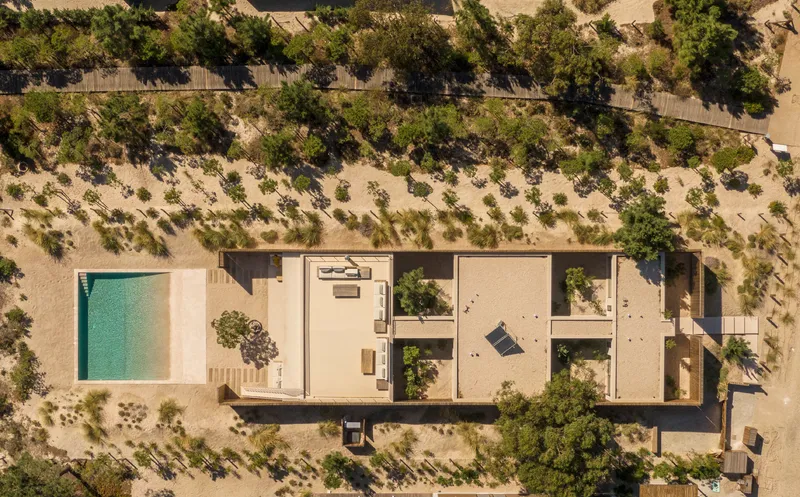
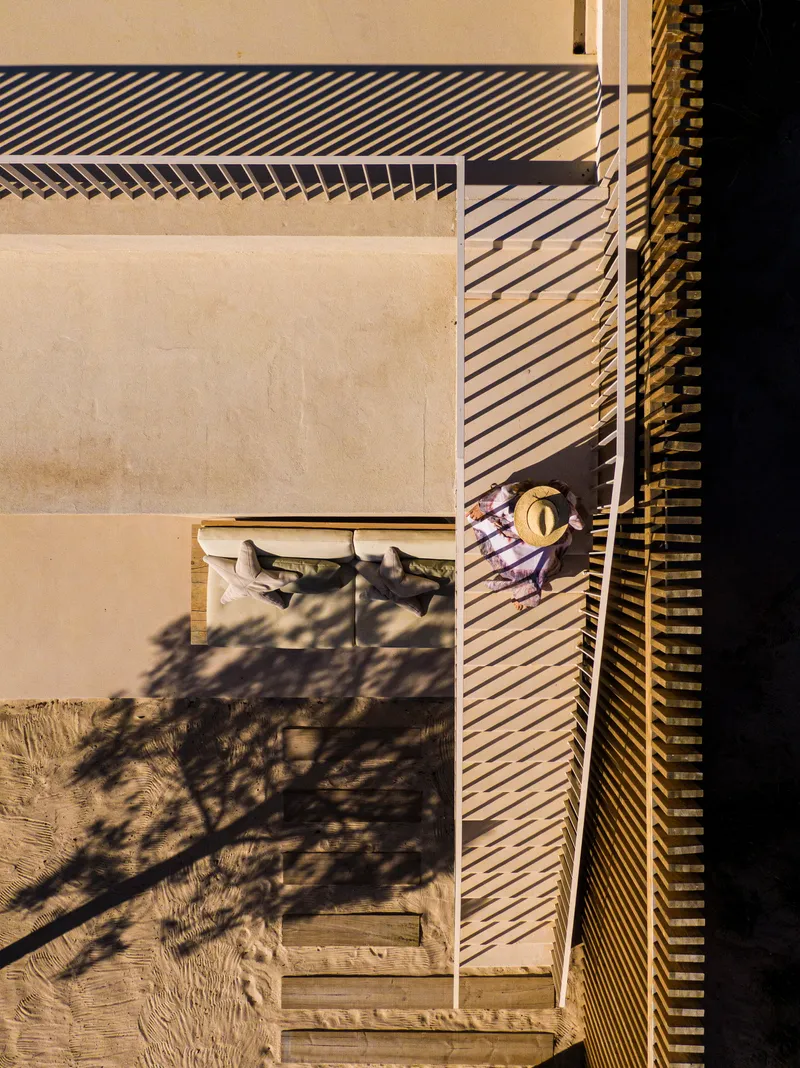
Aerial views reveal the house's logic most clearly. The plan is essentially linear: a sequence of flat-roofed, timber-clad volumes separated by open-air courtyards, all stitched together by a glass-walled corridor. The pool occupies a generous terrace at one end, barely distinguishable from the pale sandy terrain around it. The rooftops are minimal and utilitarian, with a terrace offering unobstructed views over the pine canopy to the ocean.
From overhead, the fir wood palisade fence that marks the construction perimeter reads as a deliberate boundary between the domestic realm and the regenerated dune. The scattered pines, some preserved from the original site and others newly planted, blur that boundary further. The house does not command its site. It negotiates with it.
Timber Screens and the Problem of Privacy
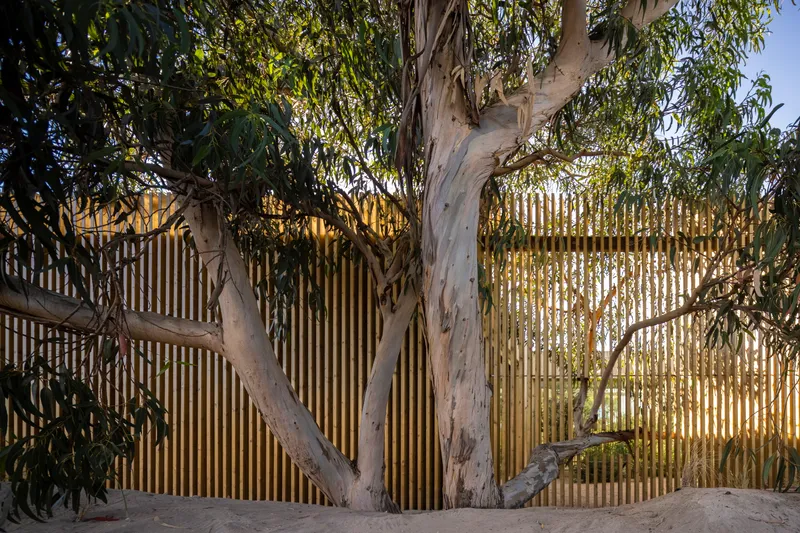
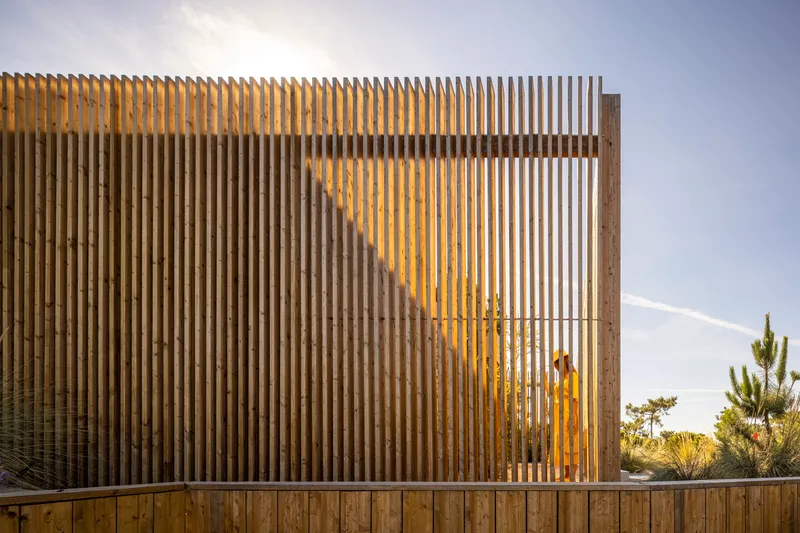
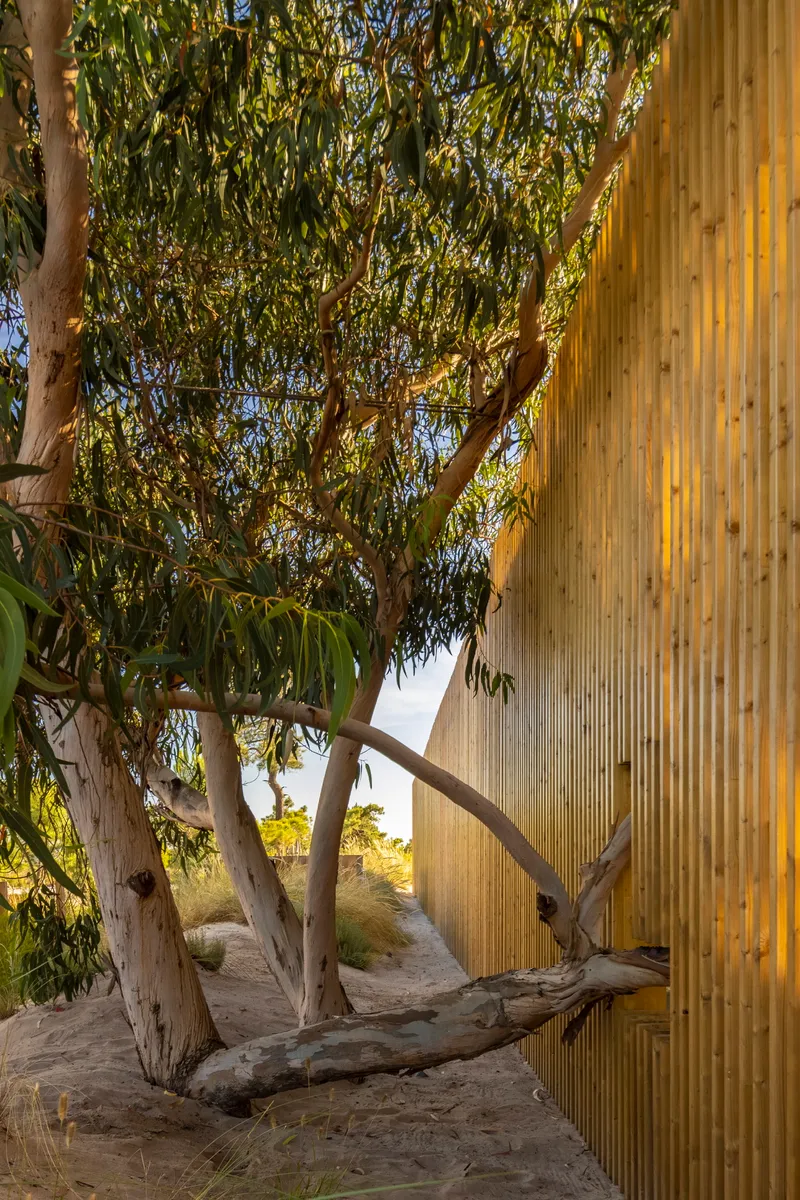
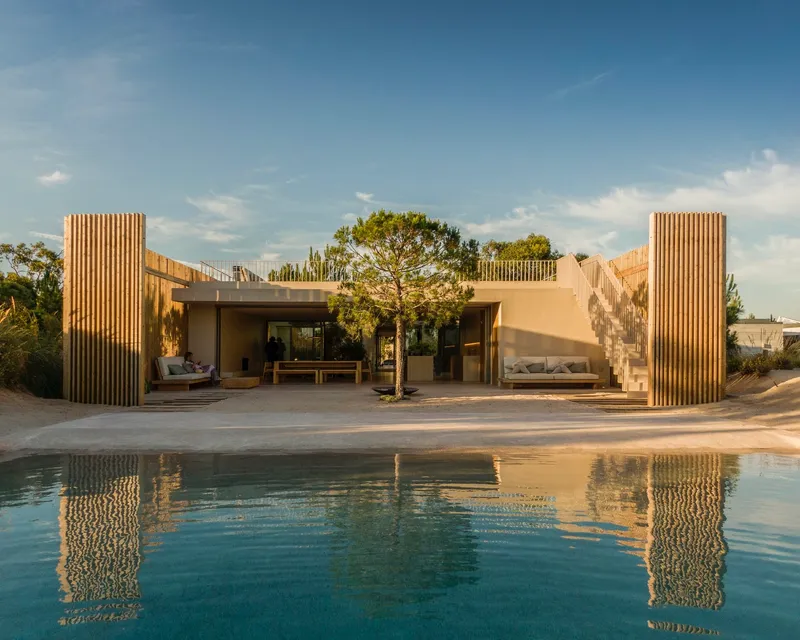
The vertical timber battens that clad most of the house's exterior serve a triple function: they filter light, establish visual privacy from neighbors, and give the facade a rhythmic depth that changes throughout the day. In afternoon light, the slats glow warm against the sandy ground. Behind them, existing eucalyptus trunks and pine trees stand as counterpoints, their organic forms set against the strict verticality of the screen.
Privacy was a stated priority for the design, and the timber screens solve it without resorting to solid walls or fortress-like massing. The house breathes. Light passes through the slats at oblique angles, dappling corridors and courtyards. From outside, the interior remains obscured. It is a simple move, executed with enough consistency to define the entire architectural character of the project.
The Corridor as Spine
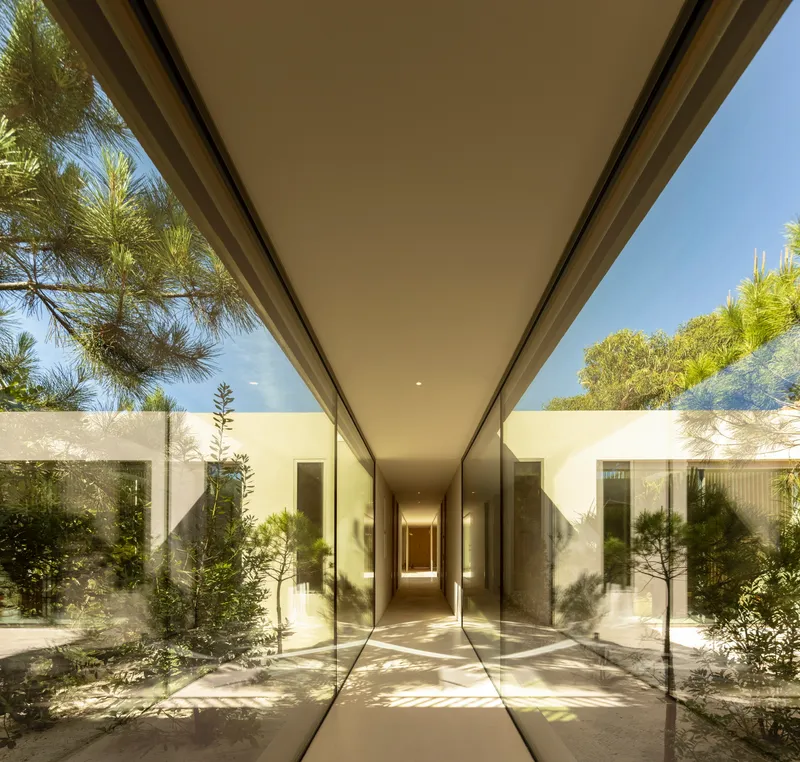
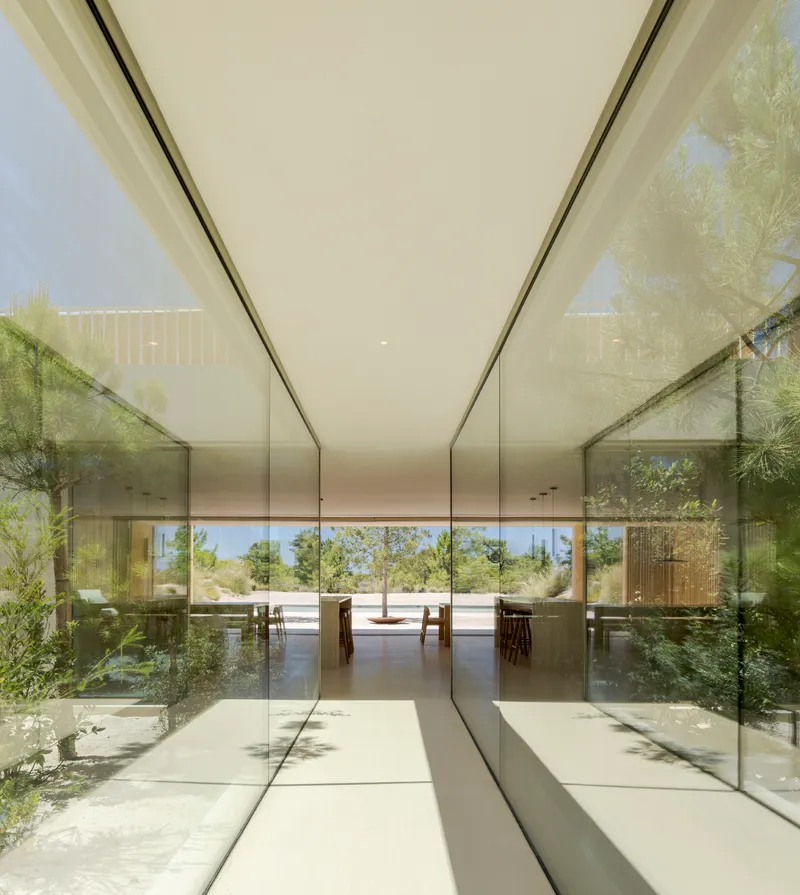
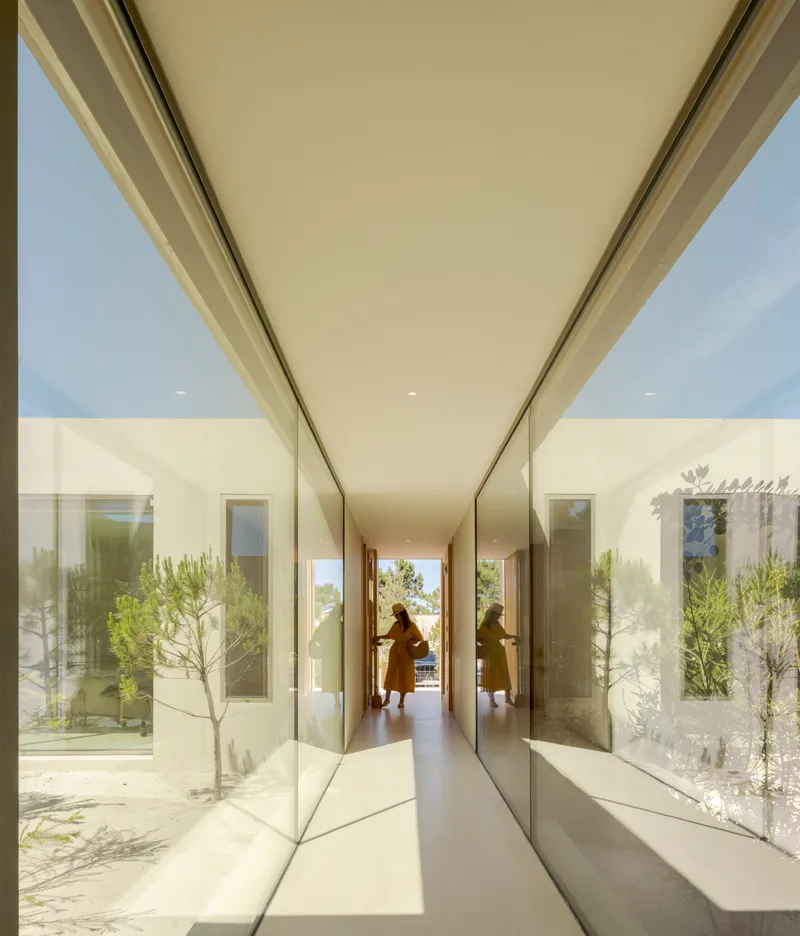
The lengthy central corridor is the organizational spine of the house. Private rooms are arranged symmetrically along its length, with planted courtyards inserted between volumes. Glass walls on both sides of the corridor transform it from a utilitarian passage into a luminous gallery, reflecting courtyard plantings in the polished sand-mortar floor. Walking through the house becomes a sequence of framed views: pine trunks, dune grasses, filtered sky.
This is an arrangement familiar in Mediterranean courtyard housing, updated with steel framing and full-height glazing. The courtyards are not afterthoughts. They are the mechanism by which the house gets natural ventilation, daylight, and visual depth while remaining low and linear. Each courtyard preserves existing vegetation, including pines, eucalyptus, and native shrubs that were on the site before construction began.
Courtyards as Rooms Without Roofs
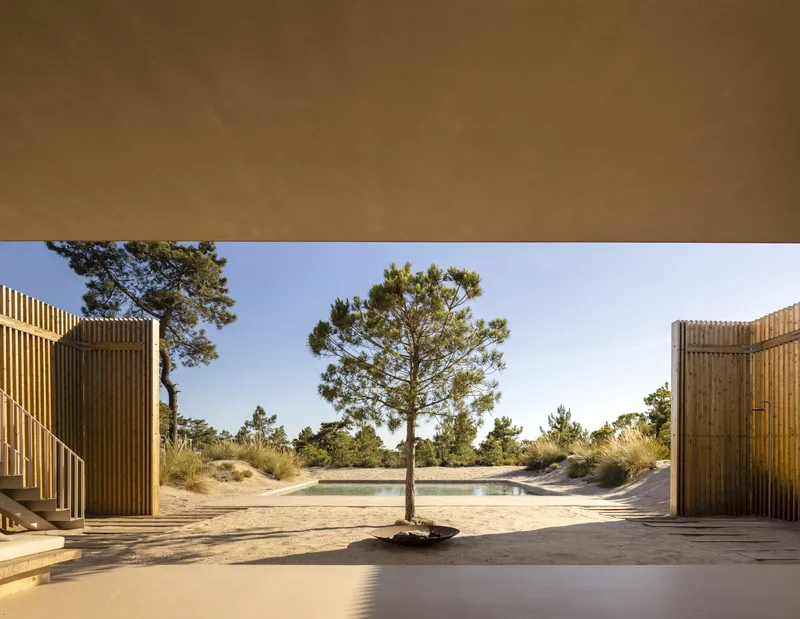
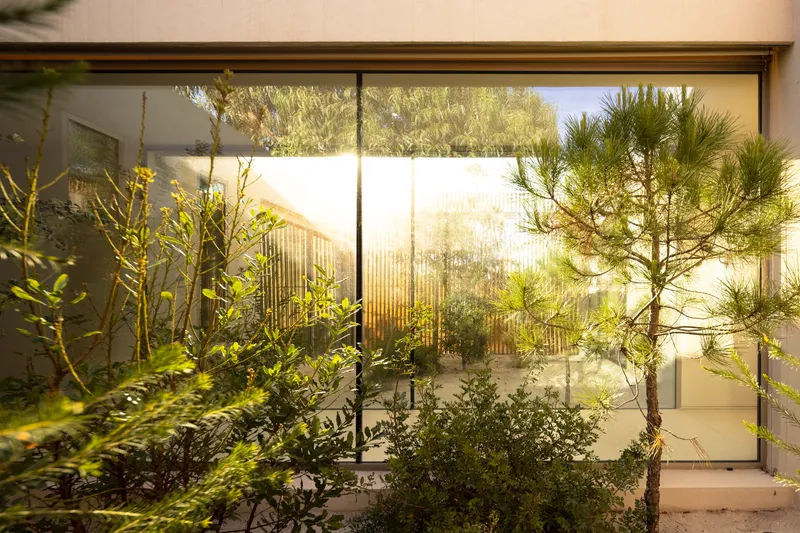
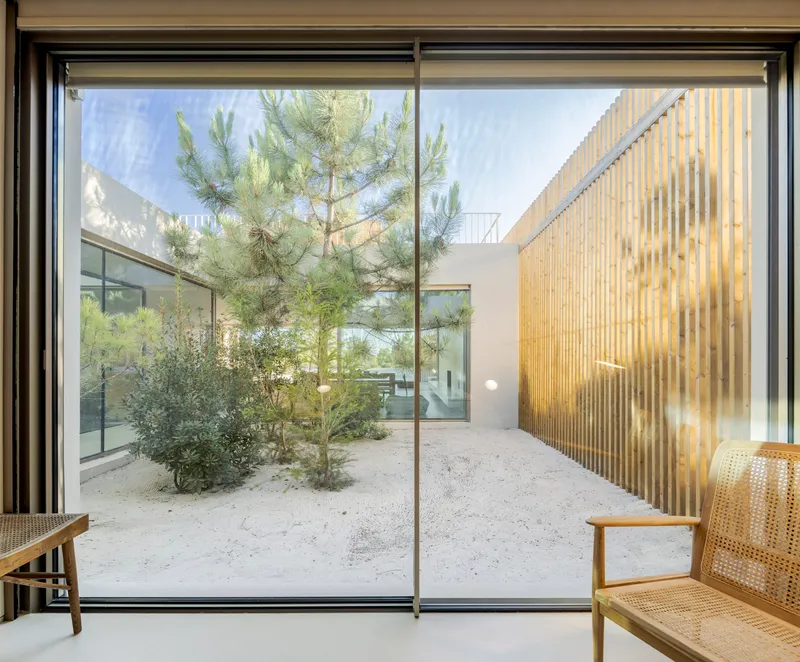
The courtyards do more than provide light and air. They operate as outdoor rooms, each with its own character. One contains a solitary pine centered in a field of sand. Another holds young trees and shrubs visible through floor-to-ceiling glass. A third opens through sliding doors to a timber-screened enclosure, blurring the distinction between inside and outside. The sand-based mortar used on both interior floors and exterior walls reinforces this continuity: the same surface underfoot, whether you are inside the glass or beyond it.
The interplay of solid volumes and void courtyards gives the plan a porosity that a single continuous volume could never achieve. It also means the house never feels like 300 square meters. The visual extensions into planted courts and through to the sky make each room feel larger than its footprint.
Material Continuity: Sand, Stone, Wood
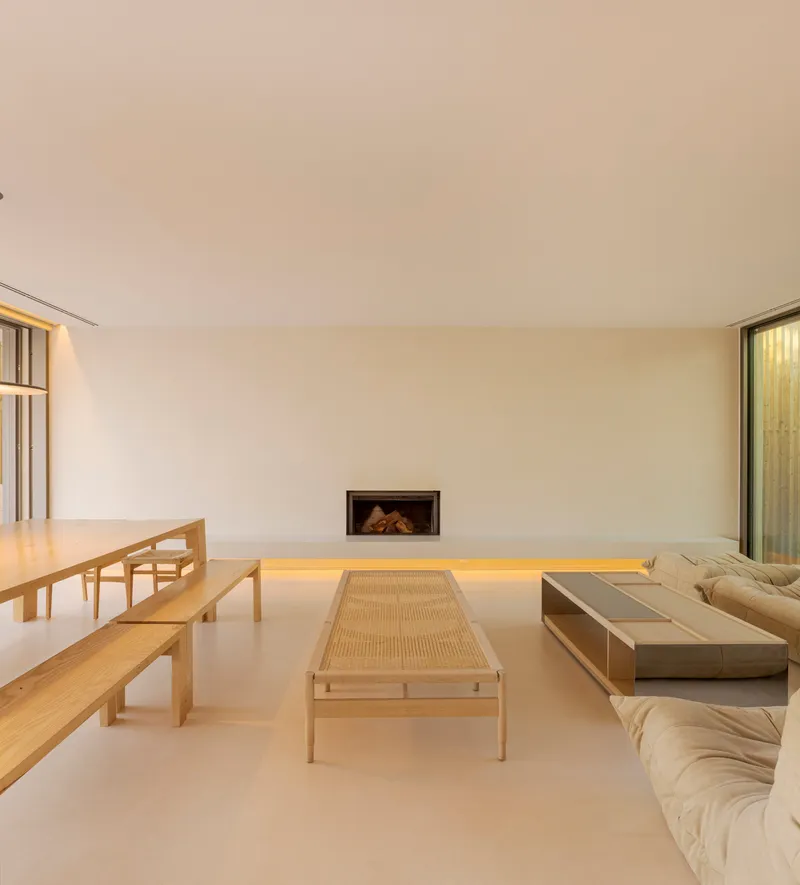
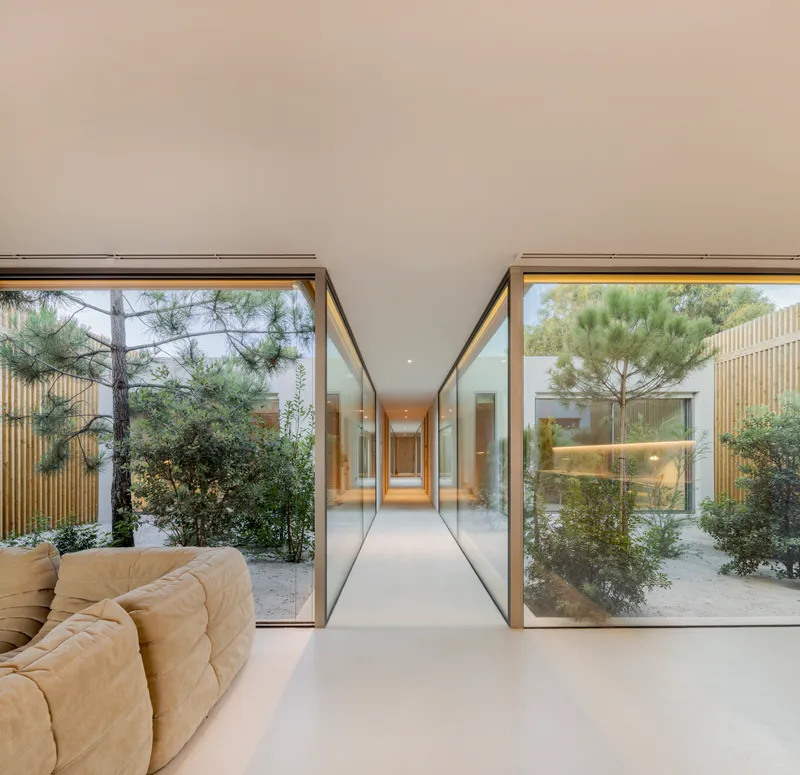
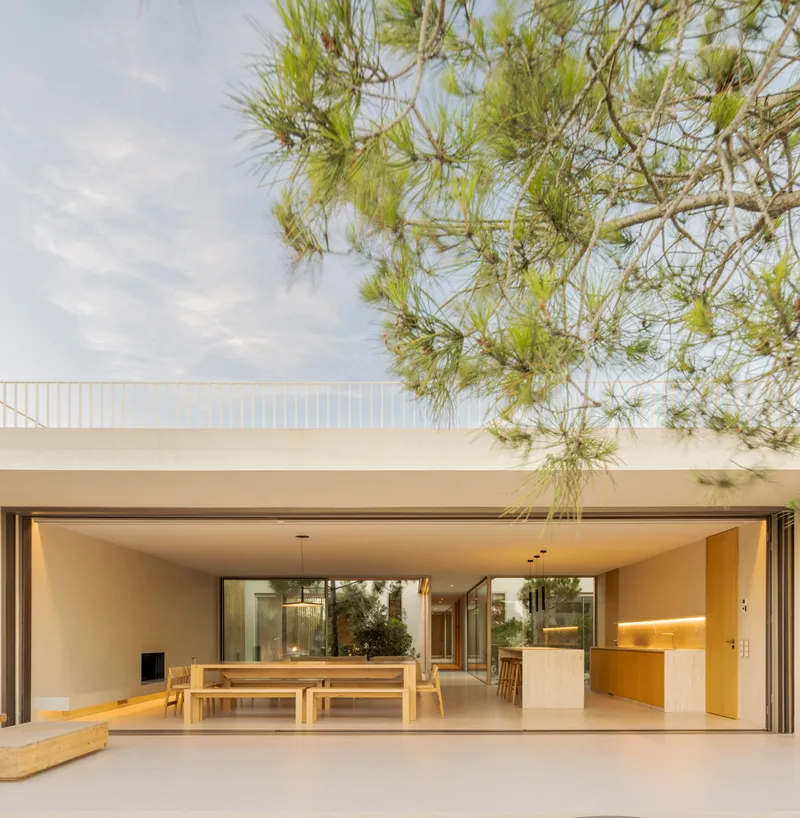
Inside, the palette is deliberately restrained. Sand-based mortar covers the floors, matching the exterior finish and establishing a material continuity with the dune landscape outside. Travertine, chosen for its resemblance to the layered sand strata of the coast, appears alongside ash wood furniture and pale timber built-ins. A recessed fireplace in the living room sits within a clean stucco wall, its simplicity consistent with the overall tone: warm, mineral, quiet.
The living and dining spaces open through folding glass doors onto the pool terrace, collapsing the boundary between interior social life and the outdoor landscape. Fir wood is used for exterior furniture, aging in concert with the timber cladding. There is no moment where the material logic breaks. Every surface, interior and exterior, belongs to the same sandy, sun-bleached family.
The Pool and the Dune Edge
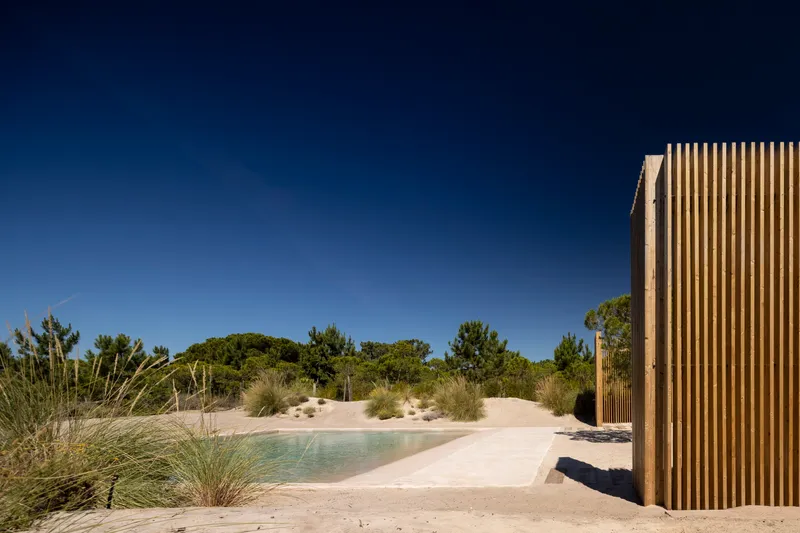
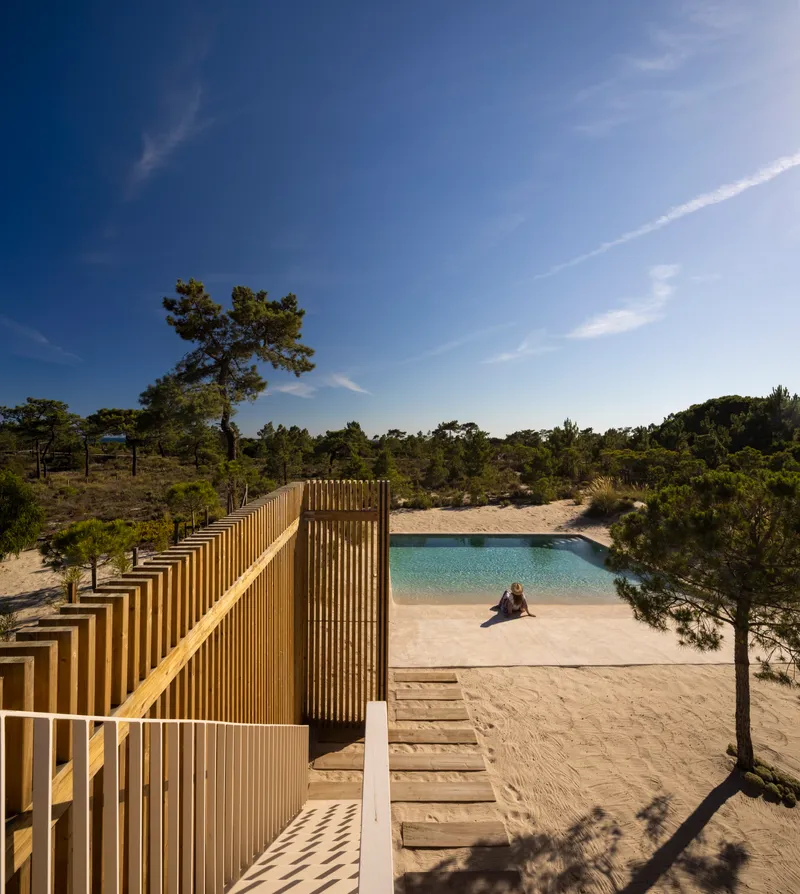
The swimming pool occupies a terrace at the seaward end of the site, just meters from the beach. Its access ramp is finished in sand-based mortar, creating a visual and tactile continuity with the surrounding dunes. This is a smart detail: the pool does not announce itself as a luxury amenity distinct from the landscape. Its edge dissolves into planted grasses and sandy ground, as if the dune simply dipped to reveal water.
A timber-slatted walkway descends from the upper terrace toward the pool and beach, reinforcing the idea of gradual transition rather than hard thresholds. The vertical timber screens frame the pool terrace on both sides, providing shelter from wind and enclosure from neighboring properties without ever blocking the view toward the Atlantic.
Rooftop and Threshold
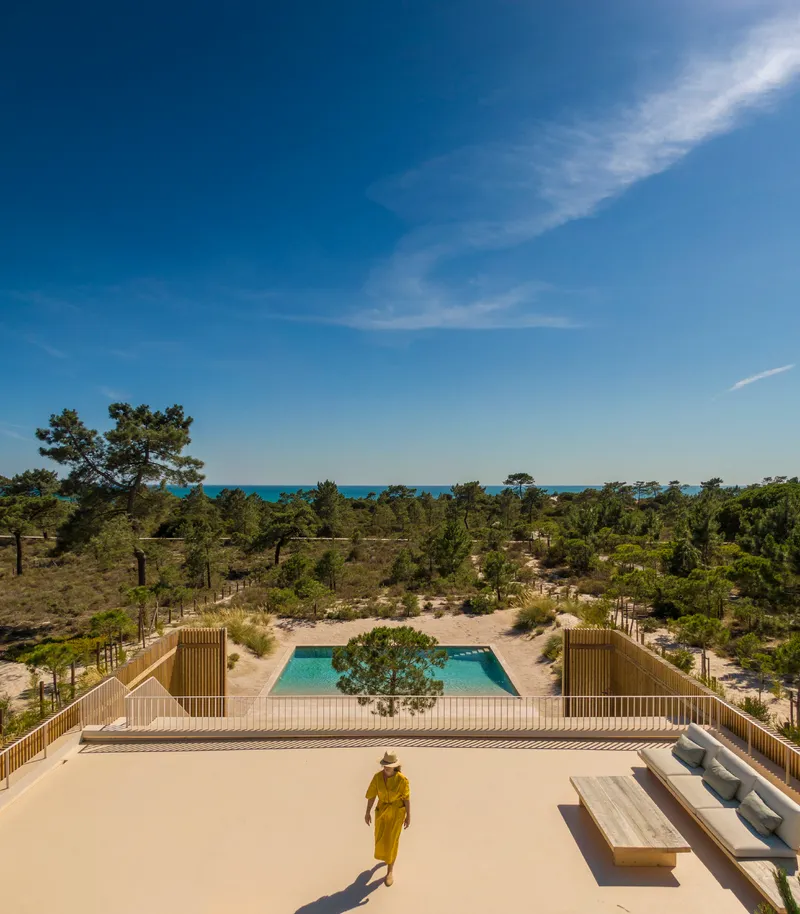
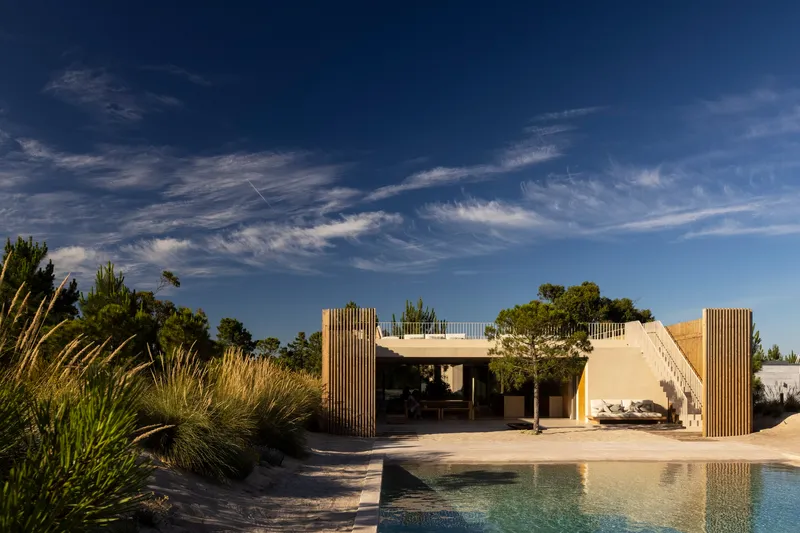
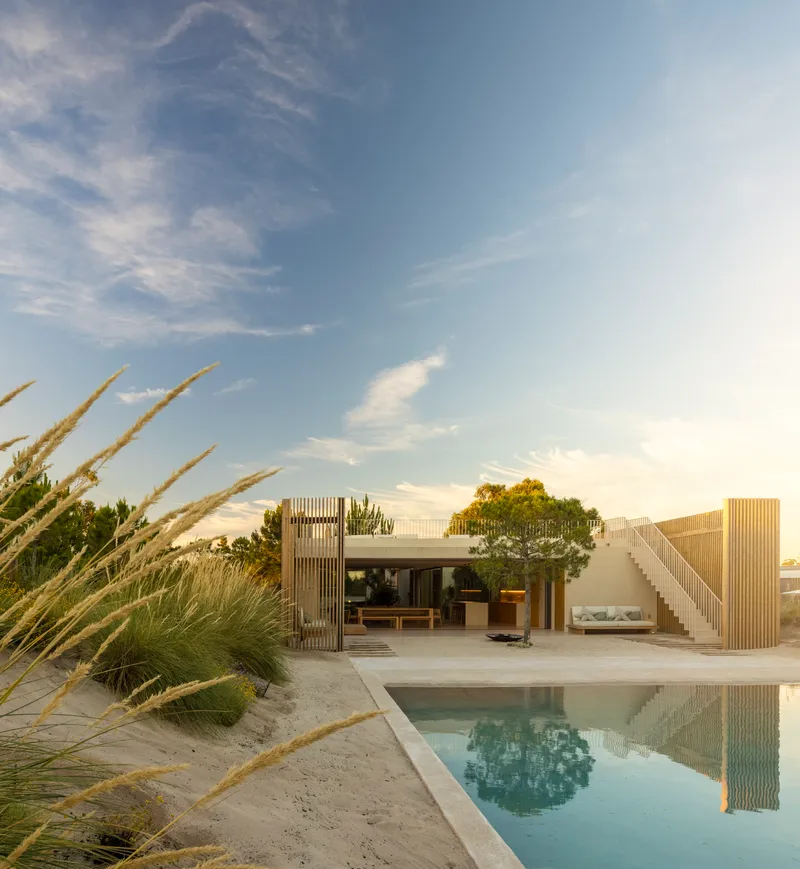
The roof terrace offers the only elevated vantage point, looking over the pine canopy and out to the ocean. It is a deliberate reward at the end of a house that otherwise stays low, private, and ground-hugging. From here, the full extent of the landscape strategy becomes visible: the shaped dune wrapping the perimeter, the palisade fence, the native plantings reclaiming disturbed ground.
At dusk, the pool terrace takes on a different quality. The timber screens become dark silhouettes against the sky, and the stucco pavilion at the social end of the house glows softly. The ornamental grasses along the pool edge catch the last light. The house, already quiet by design, settles further into its terrain.
Landscape as Architecture
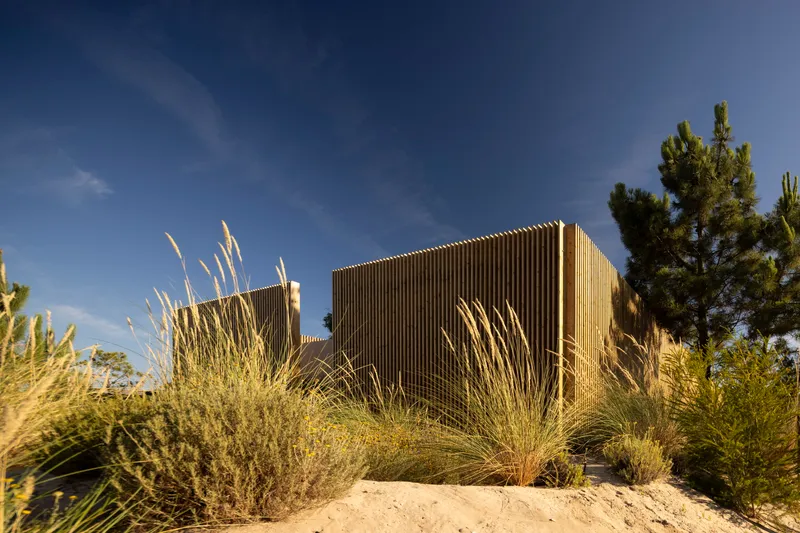
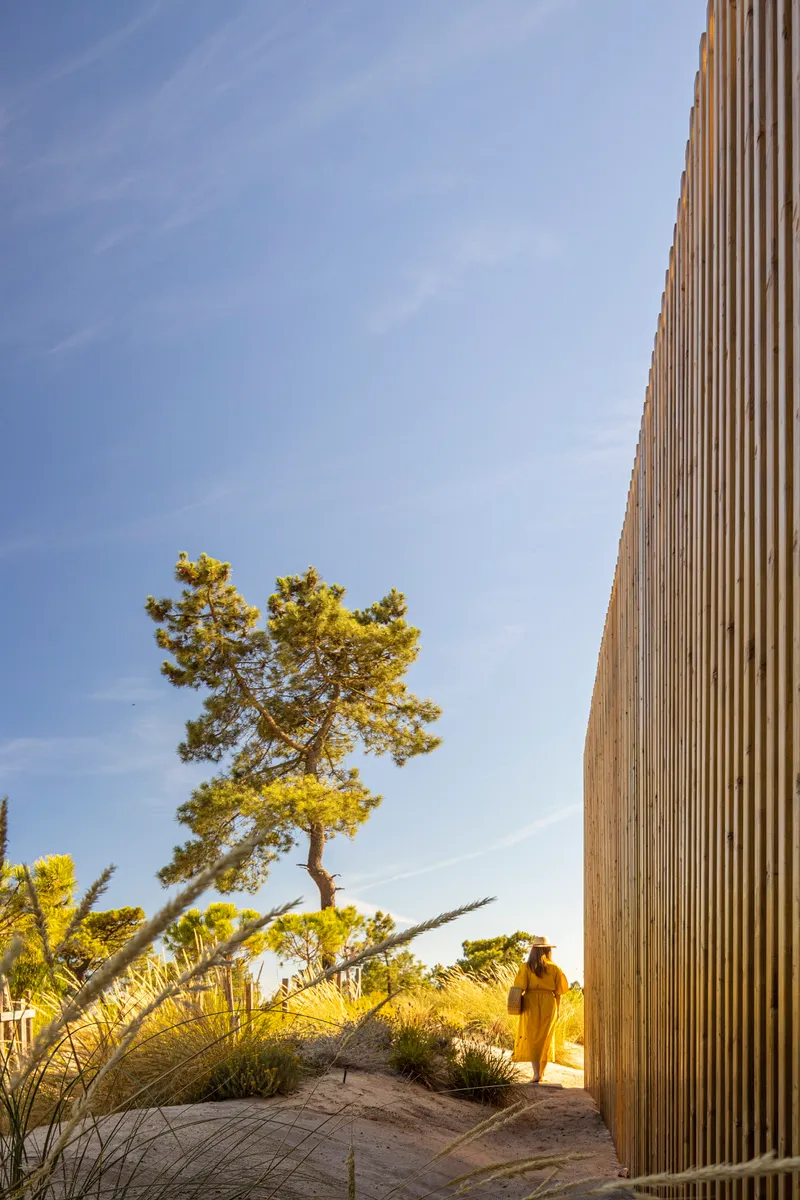
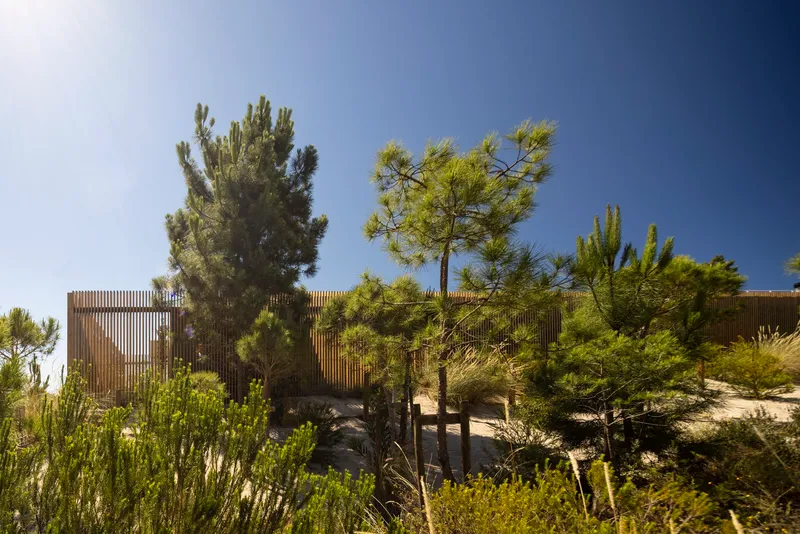
The most radical gesture in this project is the man-made dune. Sand excavated from nearby resort construction was shaped around the house and planted with native coastal species. This is not cosmetic landscaping. It is a structural landscape intervention that protects both the house and the existing dune ecosystem. A long fir wood palisade was erected to stabilize the new dune and define the construction perimeter, functioning simultaneously as fence, wind break, and ecological barrier.
The result, visible in photographs where native grasses rise against timber-clad volumes in golden light, is a house that appears to have emerged from the ground rather than been placed upon it. The sand-mortar walls, the travertine surfaces, and the weathered wood all belong to the same tonal register as the dune itself. BICA Arquitectos understood that on this site, the most important architectural act was not building the house. It was building the ground.
Entry Sequence
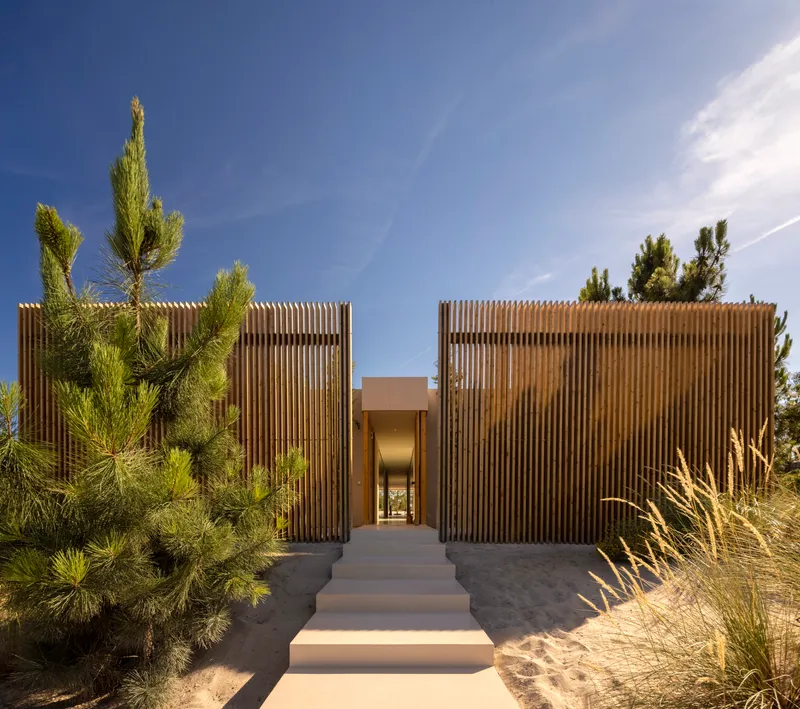
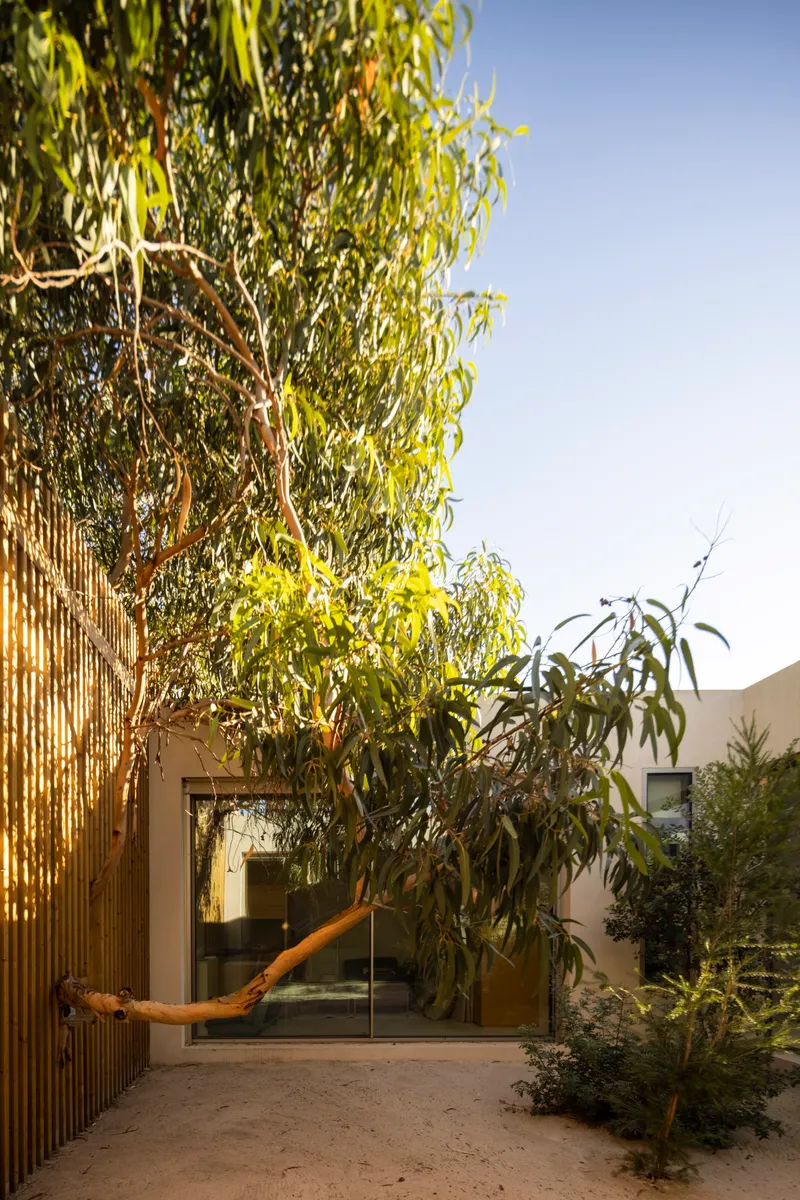
Arriving at the house, you pass through the timber palisade and walk along a sandy path framed by vertical slats and existing pine trees. The entry is deliberately understated. There is no grand portico, no change in material register. The same fir wood, the same sandy ground, the same filtered light. The threshold between landscape and house is almost imperceptible, which is precisely the point.
Plans and Drawings
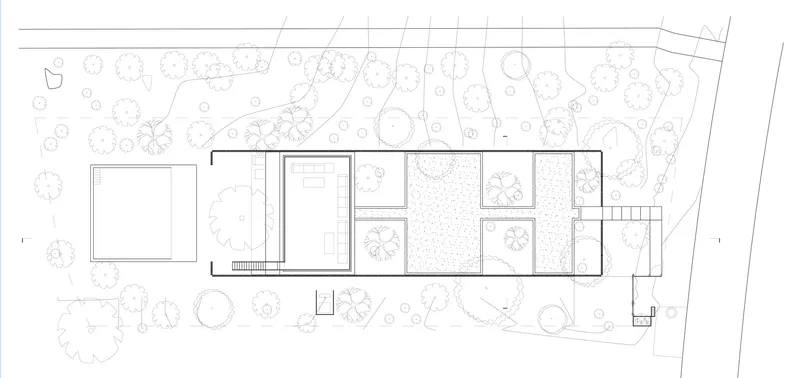
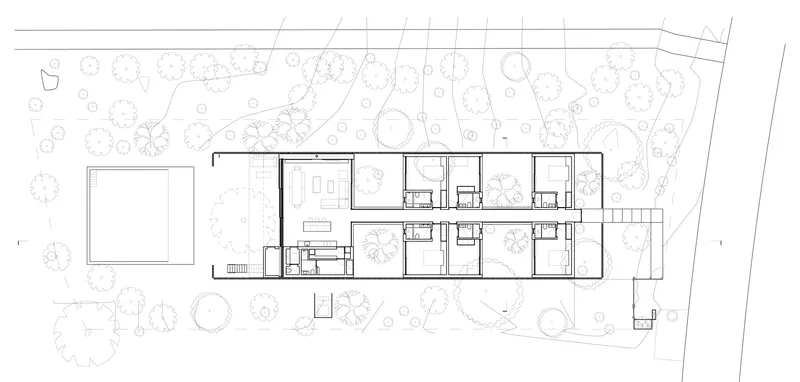
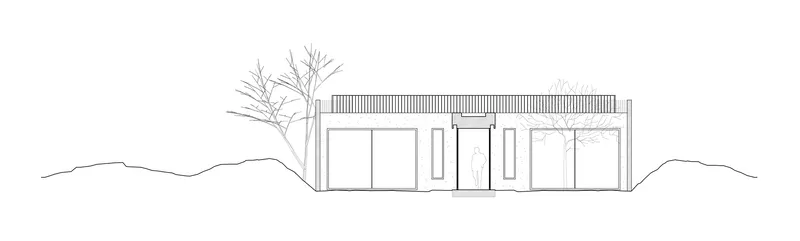
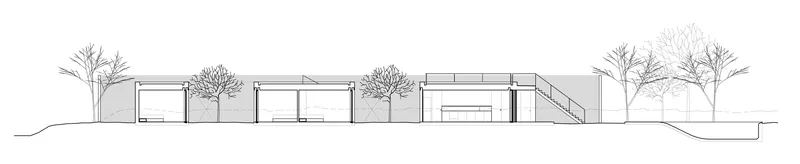
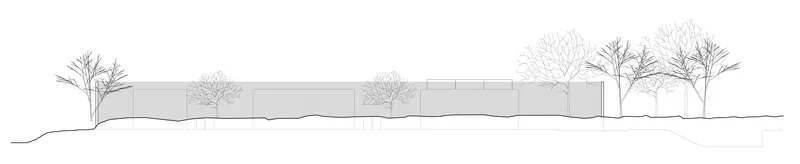
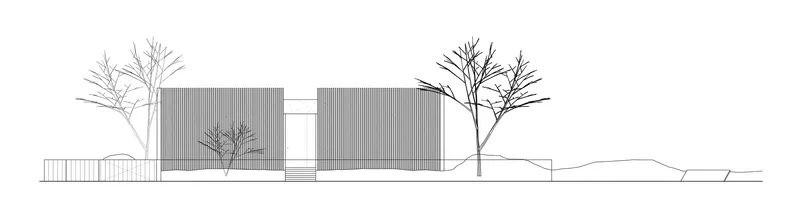
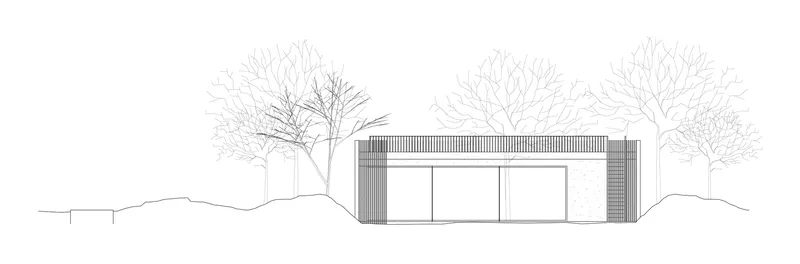
The site plans confirm what the aerial photographs suggest: a strictly linear organization, with the building volumes oriented along a single axis, offset by courtyards. The surrounding landscape is dense with tree symbols, making it clear that the planting strategy is as carefully planned as the floor plan. The elevation drawings are revealing. They show the house as a long, low horizon line punctuated by vertical timber screens and connected pavilions of varying height. The undulating ground line in several sections illustrates the shaped dune, which rises and falls around the structure as if the earth were gently swallowing it.
The steel structure, rendered as a lightweight frame in the sections, is legible as a pragmatic choice for a coastal site: fast to erect, resistant to salt air, and compatible with the OSB panel and insulation wall assembly that keeps the building envelope thin. The glazed connectors between volumes appear as transparent gaps in the elevations, reinforcing the reading of the house as a series of discrete objects rather than a single monolithic block.
Why This Project Matters
Coastal resort architecture has an almost gravitational pull toward the generic: white boxes, infinity pools, maximum glass. BICA Arquitectos resists this pull not through formal gymnastics but through material and landscape intelligence. The decision to use sand from neighboring excavations to build a protective dune, plant it with native species, and then clad the house in materials that match the terrain represents a kind of architectural thinking that is simultaneously ecological and aesthetic. The house does not merely minimize its footprint. It actively improves its site.
The project also demonstrates that privacy and openness are not opposites. Through the calibrated use of timber screens, planted courtyards, and a linear plan that places the social spaces at the point of maximum landscape exposure, the house achieves both intimacy and connection to the Atlantic coast. In a resort context where neighboring buildings crowd in from all sides, that is no small achievement. House in Tróia is quiet architecture, but it has something to say about how we might build responsibly on vulnerable coastlines.
House in Tróia by BICA Arquitectos, lead architect Inês Cortesão. Located on the Tróia Peninsula, Grândola, Portugal. 300 m², completed 2022. Photography by Fernando Guerra | FG + SG.
About the Studio
Share Your Own Work on uni.xyz
If projects like this are the kind of work you want to make, uni.xyz is a place to publish your own, find collaborators, and enter design competitions.




Popular Articles
Popular articles from the community


Conexión: Biophilic Design Reimagines High-Rise Living in Hong Kong
Conexión reimagines high-rise living in Hong Kong through biophilic design, green facades, shared spaces, daylight, water and nature within.

Hill & Cross Opera: Sculptural Opera House Architecture Shaped by Tallinn’s Landscape and Identity
Hill & Cross Opera reimagines opera house architecture in Tallinn through its sculptural hill, civic plaza, glass wave and a luminous cross.

Co-life: Sustainable Architecture for Age-Friendly Community Living
Co-life reimagines sustainable architecture for seniors through courtyards, rammed earth, shared gardens, and spaces designed for belonging.

Play: Fragments of Their World
Familiar architecture becomes modular playground design, creating safe spaces where displaced children can learn, connect, imagine and play.

Similar Reads
You might also enjoy these articles

Bao Huynh Watercolor Atelier: A Serene Art Retreat in Hội An
Bao Huynh Watercolor Atelier in Hội An blends multifunctional art spaces, sustainable design, local materials, and family-friendly living in a serene environment.

Atelier Macri Concept Store Interior Design by CASE-REAL
Atelier Macri store features a "ko" counter, walnut wood details, cork displays, blending retail, gallery, and seamless customer experiences.

Manuel Vargas Izquierdo Stadium and High-Performance Sports Center: Architectural Excellence in Jalpa de Méndez
The Manuel Vargas Izquierdo Stadium blends sustainable design, inclusive sports facilities, and cultural-inspired architecture, revitalizing Jalpa de Méndez’s public spaces.

KAKR Buluh Awar Hall: Revitalizing Community and Ecology Through Bamboo Architecture
Community built bamboo hall revitalizes Buluh Awar village, empowering youth, restoring ecology, celebrating vernacular craftsmanship through sustainable architecture and culture.




Comments (0)
Please login or sign up to add comments
No comments yet. Be the first to comment!