

Coast Protest (Rise)
ENVIRONMENTAL DEGRADATION OVER THE COASTLINE OF KARACHI.

Coastline:
Coast also called the shore, is known as the area where the ocean meets the land. The uneven margins among land and ocean, naturally change in shoreline can take so many years of the founding of shoreline rest on the factual of the land either sandy or rocky. For ecology, shorelines are very important. There is an extensive kind of biodiversity homes habitually. There are diverse kinds of coasts
Types of coastlines:
Salt Marsh
Mudflats
Mangroves
Dunes
Coral reef
Importance of coastlines:
Seaports
Tourism
Fishery
Breakwater
Mangroves Forest
Home for marine lives
In these few years over half of the world's population lives along the coastline to take the advantage of amenities the coast offers food supply, source of income, transport, and a healthy location. Half of the realm's prime capitals are built along the coastlines.

Karachi’s Coastline:
In Karachi, the population and pollution growth are rising day by day. And for the increasing capacity of shipping trade business through its port. It enormously pollutes the forestry of mangroves along the coastline and its marine lives. Because so many people live nearby the sea it influences the shore and the ocean, also many people die because of expected calamities. The total length of the coastal area of Pakistan is 1100 Km. Seaside of Pakistan is on the shore of the Arabian Sea and it connects Pakistan with other countries of the world via marine routes.

The realm is confined by India to the east and southeast, Iran to the west, Afghanistan to the northwest and north, and China to the northeast (3). Karachi developed as a trading centre in the 18th era. Karachi is constructed on shoreline steppes with scattered rocky extensions, mounts, and shoreline swamps. Sea mangrove forestry breeds in the saline waters around the Karachi Harbour. Karachi has 27 km of coast in the count to numerous creeks and mangroves forestry. Utmost of this shore is spread with prehistoric fishing villages.
Stakeholders of Karachi’s coastline
Defense Housing Authorities
High profile commercial & residential projects
Crescent Bay (Emaar)
Phase VIII
Cantonment Board Clifton
Karachi Port Trust
WWF
Port Grand
Hawks-bay
Mangopir
Pakistan Navy
Fishermen and their communities
General Public
Environmental degradation:
Environmental degradation is one of the threats officially cautioned by the United Nations. “The reduction of the capacity of the environment to meet social and ecological objectives and needs”, United Nations. It can occur in numerous ways.
Overpopulation: Hasty people's evolution sets pressures on natural resources, which results in the degradation of our environment.
Landfills: Normally the cheapest and simplest way of placing left-over. It distresses the environment and leaves affect biodiversity in numerous ways. The local environment such as soil and water gets polluted by landfills.
Coastline: Changes to the coastline are affected by human activities. The sea level is rising about 1 millimetre each year. Which habitat can adapt to, but the loss of coral reefs and coastal mangroves is caused by the sea level rise.
Mangrove forests: Despite of the fact that people have started to realise the significance of mangroves, they are disappearing at an alarming rate. The biggest threat to the mangrove forests is the rapid expansion of the shrimp farming industry. Hundreds of acres of wetlands have been cleared to make rooms for artificial ponds to stock shrimps. Demand for timber is also a big threat to the mangrove forest.
How environmental degradation is happening over Karachi’s coast?
Due to the privatisation of the coastline by stakeholders, they start reclaiming the area which outcome on the environment and results in degradation, mangroves deforesting, and social impact on the fishermen and their community, and mainly affect the access of the public.
Karachi is home to the 90 km long coastline that provides protection to the city and its citizens. Its coastline was used to be home to the 6th largest mangrove forest in the world but dwindled down to 35th over the years.
Concept:
The concept idea is to design a cycling protest across the coastline to aware the public how they should own their place without environmental degradation and reclamation that will remain accessible for every class of the society, aware authorities how they should treat public places (coastline) fill public.
Program:
The designed protest is for a rising route protest march in which people start the protest by gathering at a point where they get a briefing about the cycling route and the cause of protest including the activity programs along. It will hold on Karachi’s coastline which will be 8 hours long. The start point is already a park existing on the beach named Captain Farhan Ali Park and in the middle, there will be 3 pausing spaces (for first aid, washing, resting, eating, parking, and beach cleaning activities) because the total route is 7 km long and on each 1.5 km there will be a pausing space. In the last, the end point which will be the Beach View Park is also a disperse point for people who wants to leave and the ones who stay can visit the breakwater in front of it and take part in mangroves plantation activities and can have an experience of the observatory.


Popular Articles
Popular articles from the community


Singing Woman: An Opera House That Performs Before the Curtain Rises
Ovidiu Cristian Pavel's conceptual opera house translates Estonia's choral identity into a sculpted waterfront landmark facing the Baltic Sea.
Faces of the Soviet Avant-Garde: Turning Moscow's Street Names into an Open-Air Museum
A network of sculptural installations across a Moscow residential district transforms forgotten architect names into spatial encounters with cultural memor

Manzana Morphosis: Stretching Barcelona's Grid into a Living Landscape for 2050
A radical reworking of the Eixample manzana turns density into a tool for generous public space, vertical ecology, and environmental performance.

Opera by the Sea Estonia: Three Shells Dissolving Architecture into Tallinn's Coastline
A winning opera house proposal replaces monumental form with interconnected shells that blur the boundary between building, park and Baltic Sea.

Similar Reads
You might also enjoy these articles
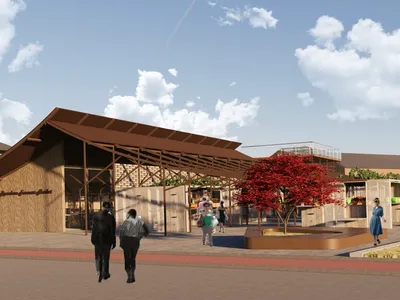
The Rhythm of Seasons
A Farmers' Market Connecting Nature and the City

More Than a Building-Designing a Living System
More Than a Building-Designing a Living System
Base Beyond
DESERT COMPOUND ARID: TOURISM OF ABSENCE AND ABUNDANCE

Explore Mangrove Forest Competitions
Discover active competitions in this discipline


Challenge to reimagine the Iron Throne

Photograph architecture without architects

Illustrate the lost glory of Angkor Wat - Render Challenge

Design challenge to reuse E-waste
Comments (0)
Please login or sign up to add comments
No comments yet. Be the first to comment!