

Comas-Pont arquitectes Carve a Steel Staircase into a Cliff to Restore a Lost Pilgrimage Path
In Manresa, Spain, a corten steel structure reconnects a historic route walked by Ignatius of Loyola in 1522 to the Cardener River valley.


Some infrastructure projects announce themselves. Others slip into a landscape so quietly that the real achievement is only legible once you understand what was missing. The Landscape Staircase in the Vall del Pardís, completed in 2025 by Comas-Pont arquitectes (led by Jordi Comas and Anna Pont), belongs to the second category. Bolted to a stratified sandstone cliff in Manresa, Spain, this 643 square meter intervention recovers a section of the Camino de Ignacio de Loyola, the pilgrimage route Ignatius walked in 1522 while composing the Spiritual Exercises. The path once linked the medieval Pont Vell and Creu del Tort with the Pou de Llum, and served residents of the Les Escodines neighbourhood, particularly women, who used it to reach the Cardener River below.
What makes the project worth close attention is not the fact that it reconnects two points on a map. It is the material and structural logic through which it does so. Comas-Pont treat the cliff face not as an obstacle to overcome but as a geological surface to inhabit. The staircase zigzags against exposed sedimentary rock, held in place by a metal structure and concrete anchors, while its weathering steel skin slowly converges in tone with the amber and rust hues of the stone itself. The result is a piece of public infrastructure that reads simultaneously as landscape, archaeology, and engineering.
Against the Rock


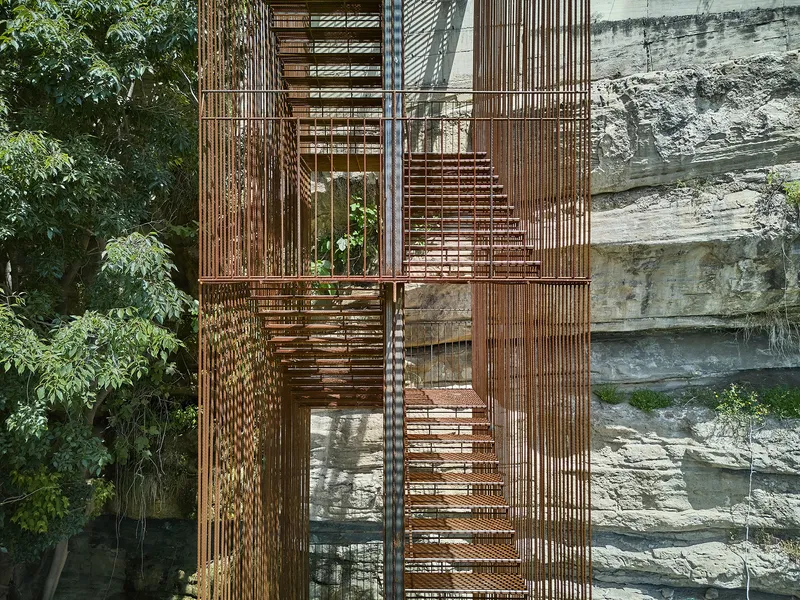
The cliff face is the true protagonist here. Layers of sandstone, deposited over millennia, provide a geological canvas against which the staircase reads as a precise, almost surgical, incision. Comas-Pont do not try to mask the rawness of the rock; instead they expose it, allowing the staircase structure to rest against strata of orange and grey stone that look as if they might peel away at any moment. A concrete retaining wall appears where the terrain needs stabilization, but it is kept deliberately modest, yielding visual authority to the geology.
The slatted corten steel enclosure acts as a filter rather than a barrier. From inside, the stone wall is always present at arm's length, textured and warm in afternoon light. From the outside, the tower reads as a vertical element that echoes the verticality of the cliff itself, its perforated skin dissolving into shadow and foliage depending on the hour.
The Descent and the View

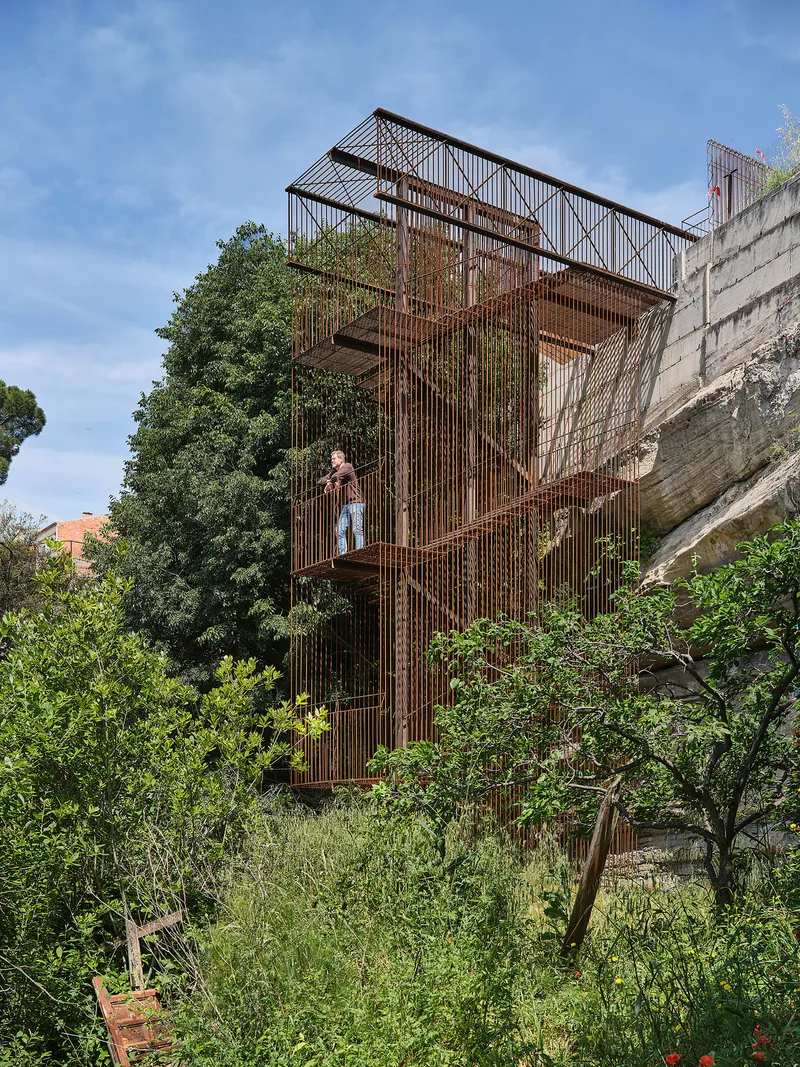

Arriving from the neighbourhood above, the staircase appears beneath the colorful residential buildings of Les Escodines, threading between summer foliage and weathered stone. It is a genuinely urban condition: the structure mediates between the domestic scale of the houses and the wild topography of the ravine. A person standing on one of the intermediate platforms is simultaneously in the city and outside it, occupying a threshold that the lost path once defined and that decades of neglect erased.
At the upper level, a concrete platform with metal deck and railings opens onto a panoramic frame. The distant jagged mountains of the Catalan pre-Pyrenees appear across a canopy of trees, calibrated by the horizontal line of the railing. It is a deliberately composed moment of stillness within an otherwise kinetic sequence of switchbacks and landings.
Structure as Ornament


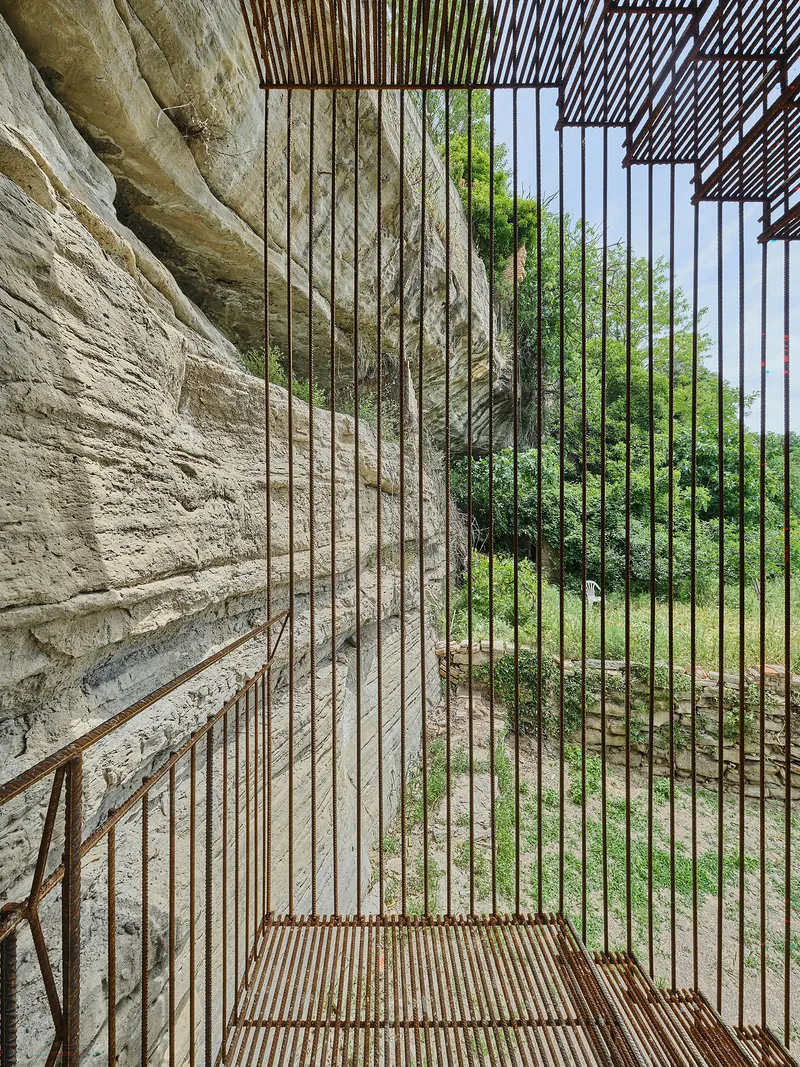
Looking up through the staircase core, the logic of the structure is exposed without apology. Weathered steel slats, rod balusters, and mesh balustrades layer against each other, casting compound shadows on the rock. There is no applied finish, no decorative gesture. The ornament, such as it is, emerges from the repetition of structural members and the interplay of light passing through open treads. This is a project that trusts its construction to do the expressive work.
From inside the narrow stair enclosure, the vertical rods frame alternating views: stone on one side, green landscape on the other. The effect is cinematic, each step shifting the proportion of rock to sky. Comas-Pont clearly studied these sequences; the staircase is not merely a means of getting from top to bottom but a calibrated walk through shifting visual registers.
Rebar Detailing and Fabrication

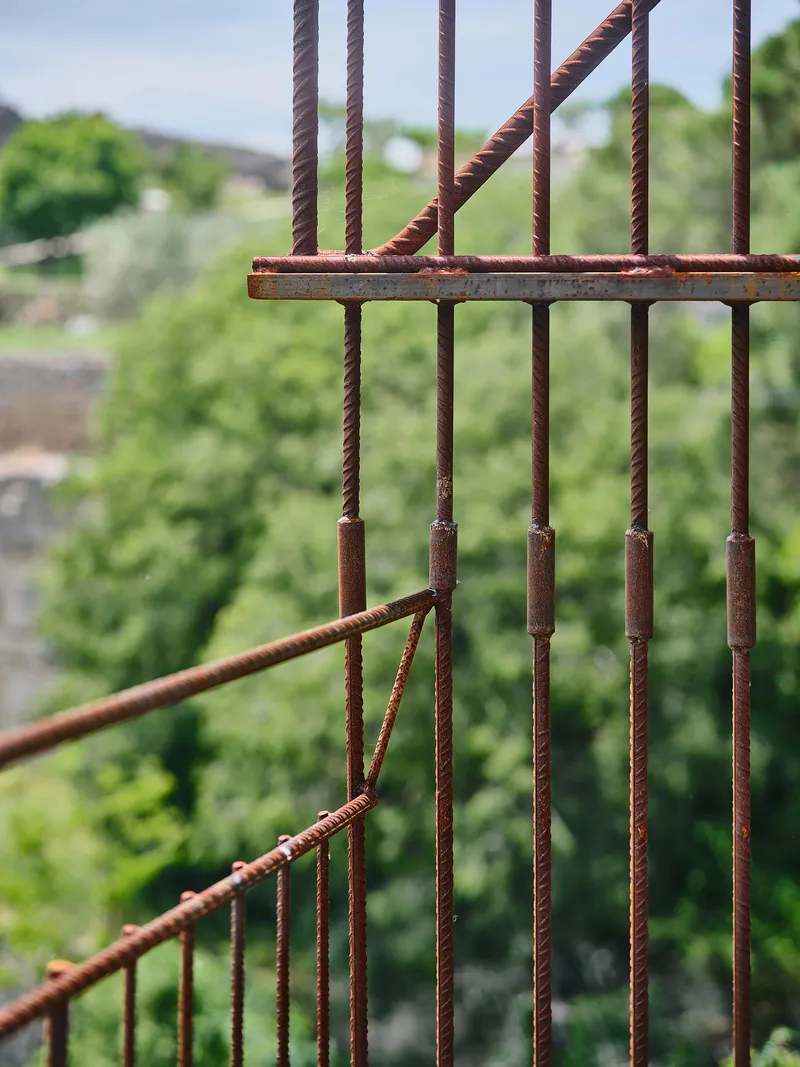

The detail photographs reveal something unexpected: the balusters and many of the visible structural members are fabricated from standard reinforcing bar, the kind normally buried inside concrete. Rebar becomes the primary visual material of the staircase, its ribbed surface left exposed and threaded couplers visible at junctions. This is a deliberate inversion of construction hierarchy, bringing a typically hidden element into the foreground and letting it oxidize and weather alongside the corten panels.
Workshop images show the assemblies being prepared under steel trusses, workers bending and connecting bar with the same precision that might go into a bespoke steel sculpture. It is an economical strategy that avoids the cost of custom steel profiles while producing a visual texture that is rough, honest, and entirely appropriate to the geological setting. The diagonal cross-bracing visible in several frames gives the railing a tensile, almost woven quality.
Canopy and Ground

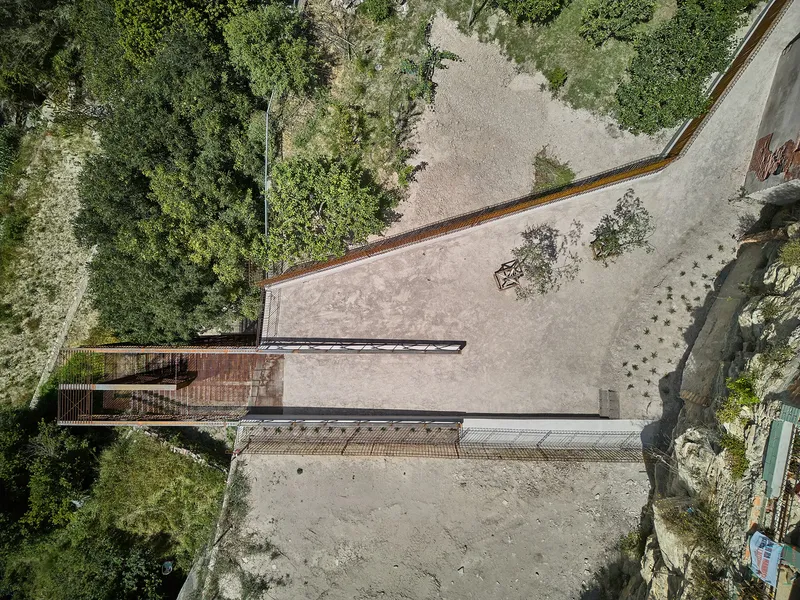

Where the staircase meets the valley floor, the character shifts. Mature trees form a dense canopy overhead, and the metal structure passes through their branches like a scaffold among trunks. Dry-stacked stone retaining walls, likely remnants of earlier agricultural terracing, appear alongside the new construction, establishing a material dialogue between centuries. At the top, an aerial view shows the concrete plaza acting as a threshold: hard surface on one side, tree canopy on the other, the metal deck mediating between built ground and living landscape.
The rebar railing with its diagonal bracing recurs at the upper levels, framed against green foliage and creeping ivy. There is a deliberate roughness to this edge condition, as if the architects wanted the boundary between infrastructure and nature to remain unresolved, subject to slow botanical negotiation over the coming decades.
Plans and Drawings
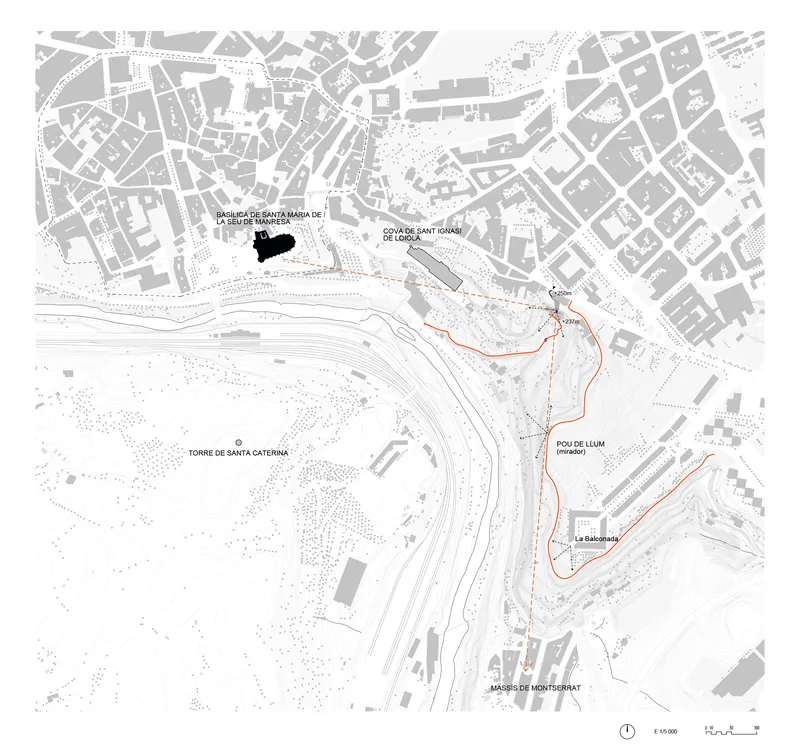

The site plans trace the recovered path in orange, connecting labeled landmarks (Pont Vell, Creu del Tort, Pou de Llum) across topographic contours. What is immediately striking is the linearity of the intervention within a landscape of curved contours and scattered vegetation. The staircase is not a single straight line but a sequence of angular moves, each responding to a specific condition in the rock or the tree canopy above. Building volumes nest within the contours with a precision that suggests extensive surveying of both the geology and the existing root systems.
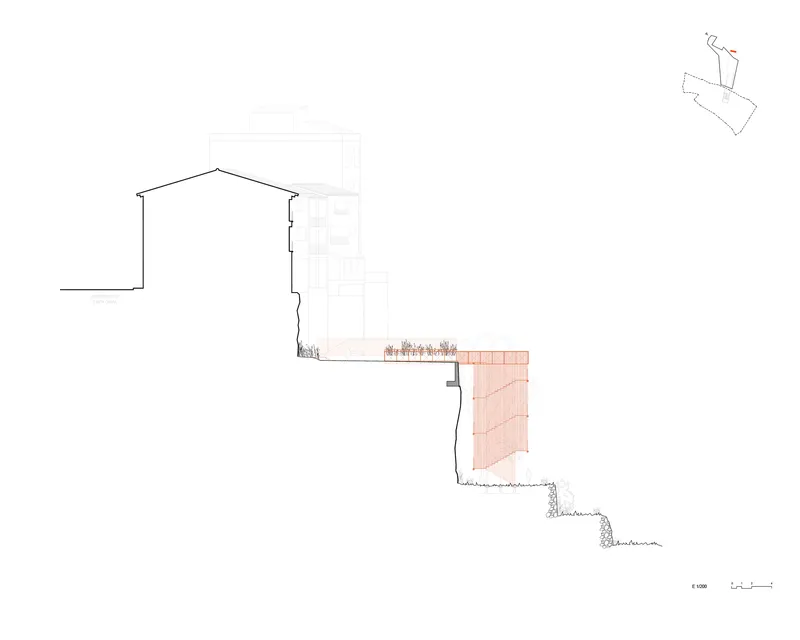
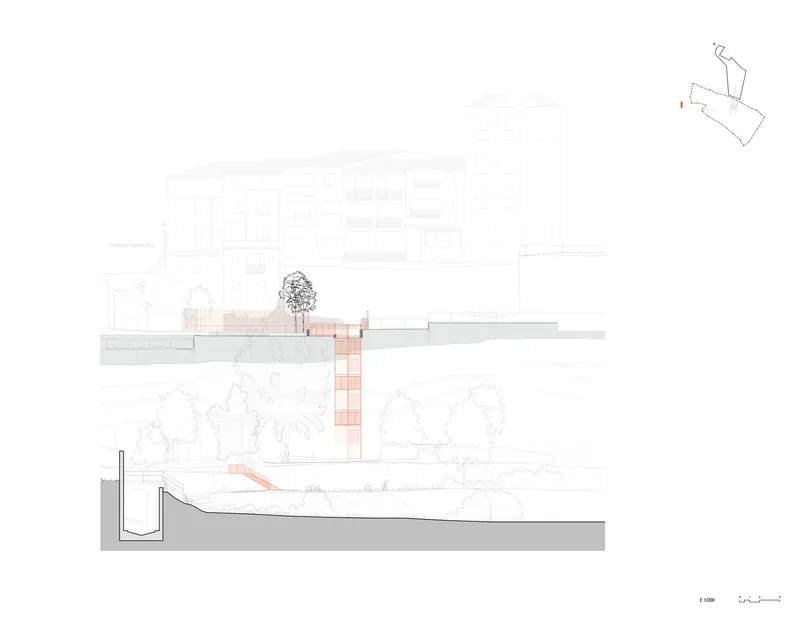

The section drawings are revelatory. They show the structure stepping down the slope in a cascade of levels, each platform integrating landscaping and planting to blur the edge between built and unbuilt ground. A longitudinal section exposes the full drama of the descent, multiple levels dropping through tree canopy and rock, while construction detail drawings depict the truss connections and structural assembly with labeled transversal and longitudinal sections. The precision of these drawings confirms what the photographs suggest: every joint, every angle of descent, was calculated to work with the specific geology of the site.
Why This Project Matters
Public infrastructure in historic landscapes is notoriously difficult to get right. Too timid, and the intervention disappears into irrelevance. Too bold, and it overwhelms the context it claims to serve. The Landscape Staircase finds a productive middle register: it is unmistakably contemporary in its materials and detailing, yet it defers constantly to the cliff face, the trees, and the memory of a 500-year-old path. The use of rebar as an exposed finish material is particularly compelling, offering a roughness and economy that more polished approaches would have undermined.
Comas-Pont have produced something that functions simultaneously as pilgrimage infrastructure, neighbourhood connector, and geological observation platform. In an era when many cities are rediscovering their topographies after decades of car-centric planning, this project in Manresa offers a concise lesson: the steepest, most difficult terrain often holds the richest architectural opportunities, if you are willing to climb.
Landscape Staircase in the Vall del Pardís, designed by Comas-Pont arquitectes (Jordi Comas and Anna Pont), Manresa, Spain. 643 m², completed 2025. Photography by Adrià Goula.
About the Studio
Share Your Own Work on uni.xyz
If projects like this are the kind of work you want to make, uni.xyz is a place to publish your own, find collaborators, and enter design competitions.


Popular Articles
Popular articles from the community


Temporary Home for Dogs: A Reversed Zoo Rethinks Animal Shelter Architecture
In Bucharest, a sinuous corridor and freed landscape flip the logic of containment, designing a shelter that works to make itself unnecessary.

The Amber Palace Opera: A Geological Fiction Surfaces on Tallinn's Baltic Waterfront
Pierre Brillard reimagines a Baltic legend as a public landscape, opera house, and waterfront promenade rooted in Tallinn's coastal identity.

Tsunami Convergenics: Turning Catastrophic Ocean Forces into Underwater Housing Infrastructure
A speculative underwater settlement off the coast of Onagawa, Japan, treats tsunamis and typhoons as energy sources rather than threats.

Opera on the Sea: Driftwood Logic Shapes a Timber Opera House on Estonia's Coast
Trevor Orgill's opera house translates the entangled drift of floating timber into a civic building where wood, water, and music converge.

Similar Reads
You might also enjoy these articles

Pixel Gardens: One Repeated Module Stacked Into a Terraced Social Housing Tower for Famagusta
Salem Bader's shortlisted housing tower builds a vertical neighbourhood from one repeated module, offsetting units to carve terraces, light and air.

Bao Huynh Watercolor Atelier: A Serene Art Retreat in Hội An
Bao Huynh Watercolor Atelier in Hội An blends multifunctional art spaces, sustainable design, local materials, and family-friendly living in a serene environment.

Atelier Macri Concept Store Interior Design by CASE-REAL
Atelier Macri store features a "ko" counter, walnut wood details, cork displays, blending retail, gallery, and seamless customer experiences.

Manuel Vargas Izquierdo Stadium and High-Performance Sports Center: Architectural Excellence in Jalpa de Méndez
The Manuel Vargas Izquierdo Stadium blends sustainable design, inclusive sports facilities, and cultural-inspired architecture, revitalizing Jalpa de Méndez’s public spaces.

Explore Staircases Competitions
Discover active competitions in this discipline

Challenge to reimagine the Iron Throne

Photograph architecture without architects

Illustrate the lost glory of Angkor Wat - Render Challenge

Design challenge to reuse E-waste
Comments (0)
Please login or sign up to add comments
No comments yet. Be the first to comment!