
Common Practice and Studio AAAN Carve a Hidden Courtyard World into Amsterdam's Narrowest Plot
Sixty-four mid-rent apartments on Oostenburgereiland turn a sliver beside a parking garage into a layered urban interior.


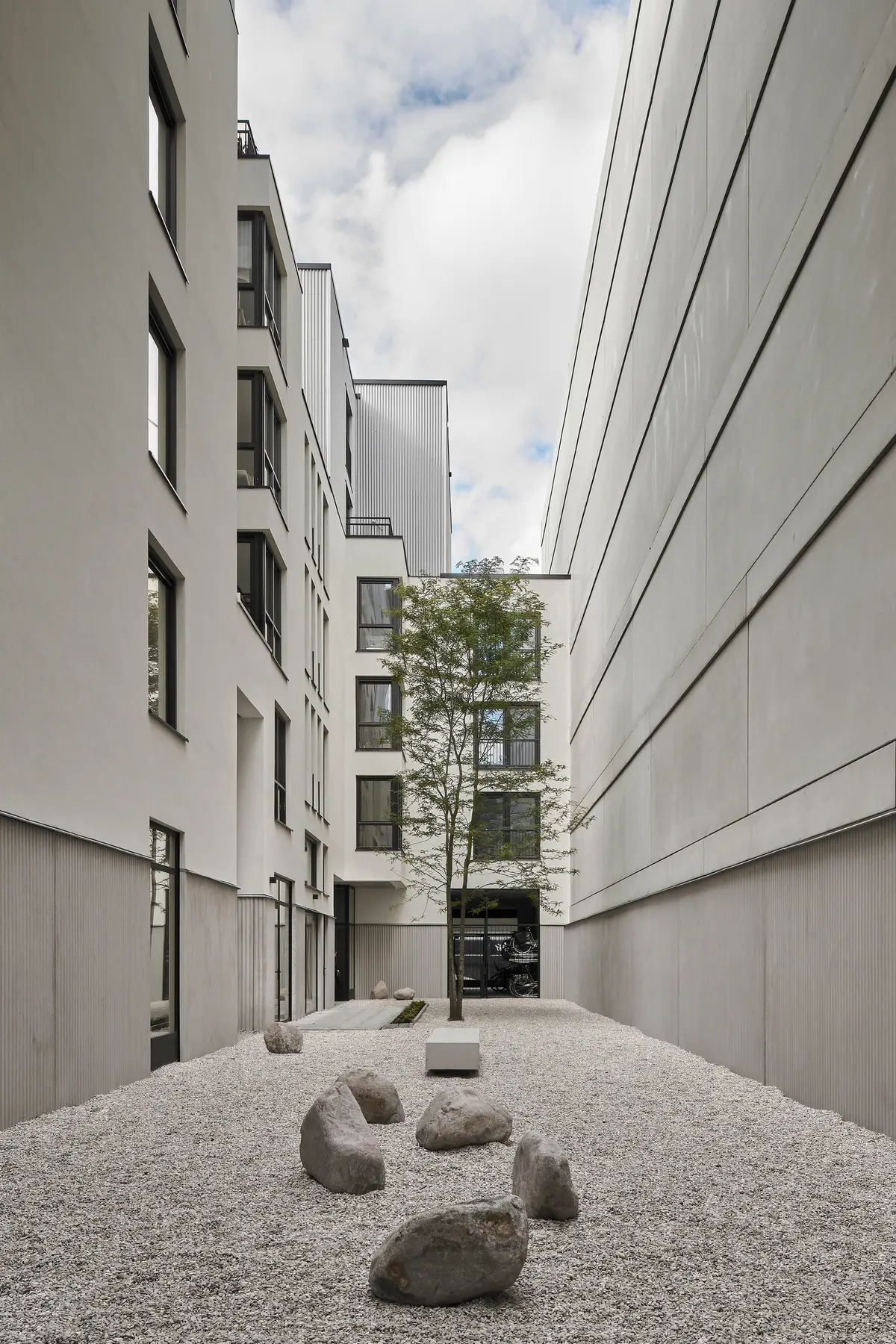
Building next to the blank wall of a parking garage is nobody's dream brief. But on Amsterdam's Oostenburgereiland, a former shipyard island being stitched back into the city, Common Practice and Studio AAAN won a competition for young architects and turned that disadvantage into the project's central idea. By splitting the mass of 64 mid-rent apartments into four distinct buildings and pulling them apart to create what they call an Urban Canyon, the architects delivered something rare in contemporary Dutch housing: a collective interior landscape that residents pass through every day, visible from the street only in tantalizing slices through gated openings.
What makes the project genuinely interesting is not the courtyard per se, which is a well-worn Amsterdam typology, but the degree to which the architects exploited it as a tool for both daylight access and social identity. Each of the four buildings has its own entrance hall, its own character, and its own facade expression, yet the courtyard binds them into a single address. The result is a complex that feels far more generous than its 5,800 square meters suggest, an effect reinforced inside individual apartments by flexible half-rooms and sliding partitions that allow a one-bedroom to perform like two.
Four Characters on One Narrow Stage
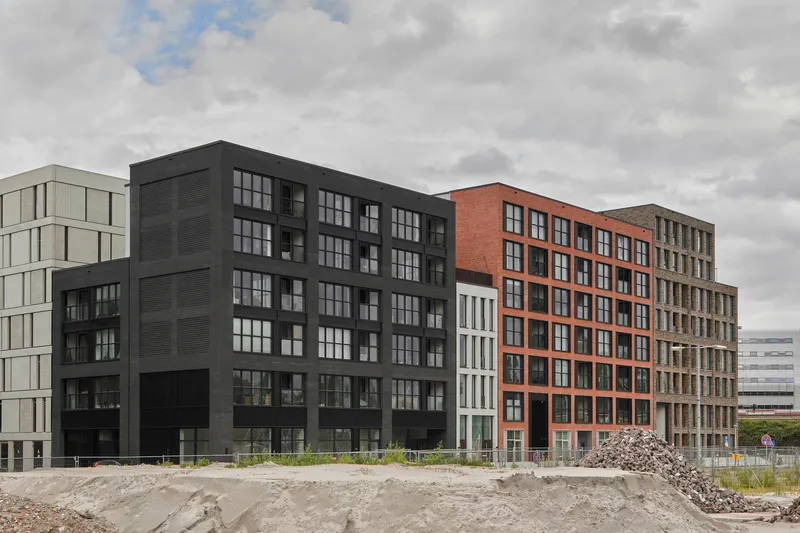
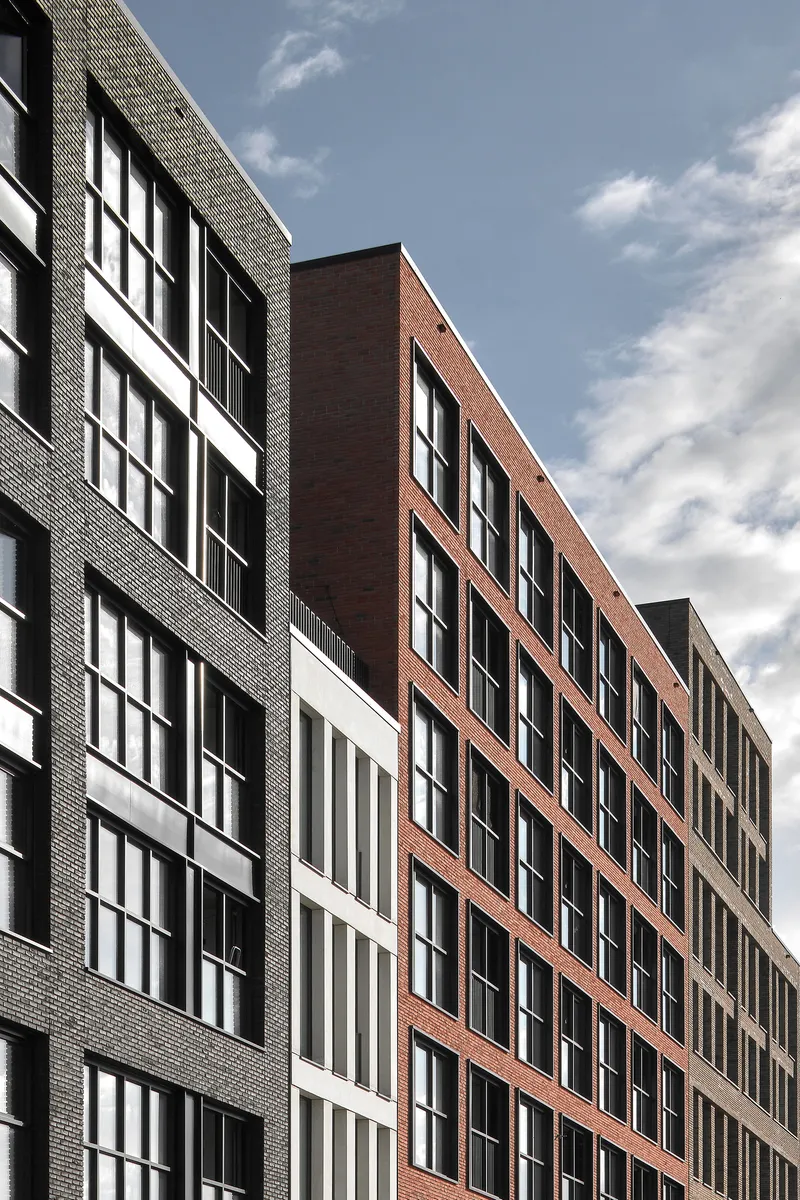
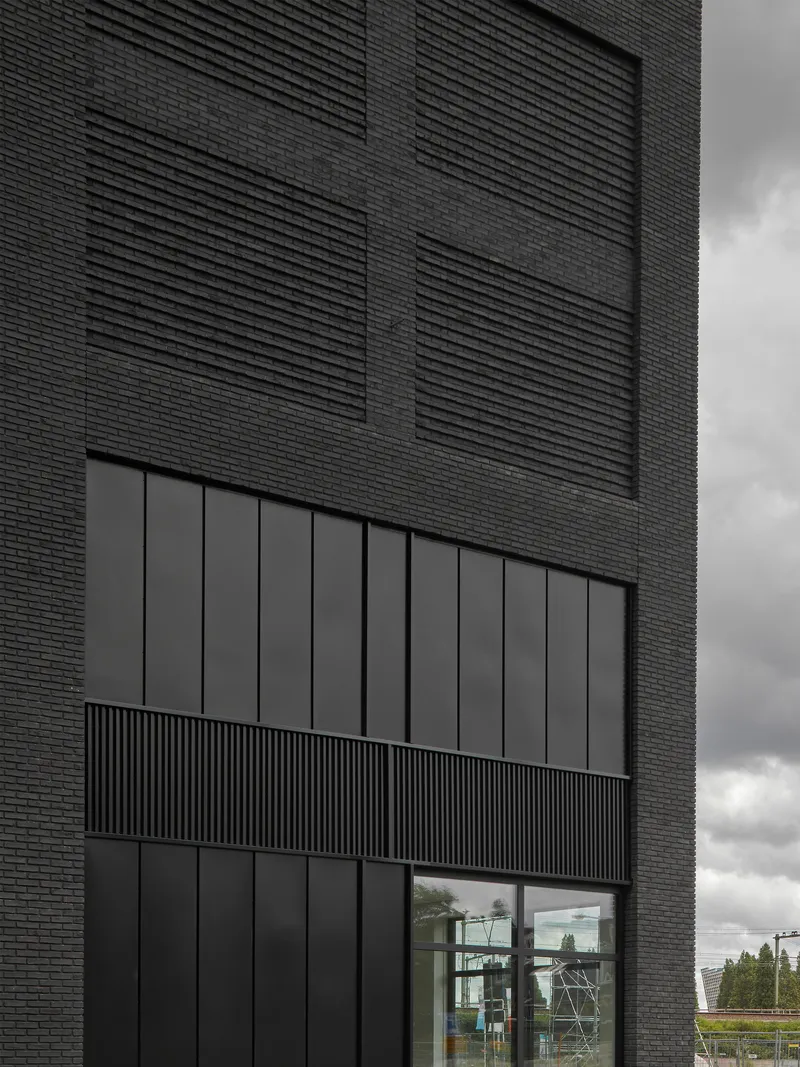
The street elevation reads as three separate buildings because the architects deliberately varied materials and proportions. One block wears deep orange brick arranged in a strict grid that references the island's industrial past. Its neighbor is clad in dark corrugated metal with horizontal bands. A third shifts to alternating stripes of grey, white, and terracotta brick. This is not decorative whimsy: each facade corresponds to a different apartment typology behind it, so the street communicates the internal variety without a word.
A small townhouse inserted into the row further disrupts the scale. It breaks the long block into a composition that feels more like a piece of city that evolved over time than a single development dropped onto a site. At eye level, the effect is amplified by alternating heights, private front doors, facade gardens, and large gates that frame glimpses of the hidden courtyard.
The Industrial Grid as Domestic Frame
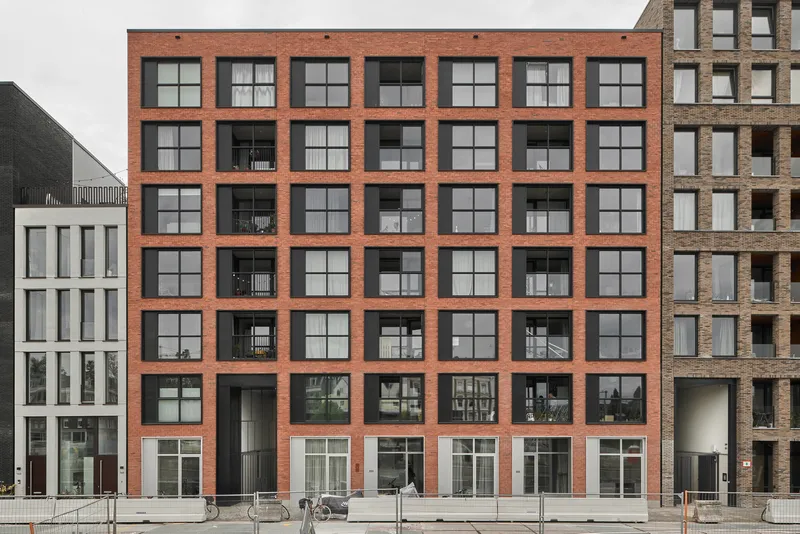
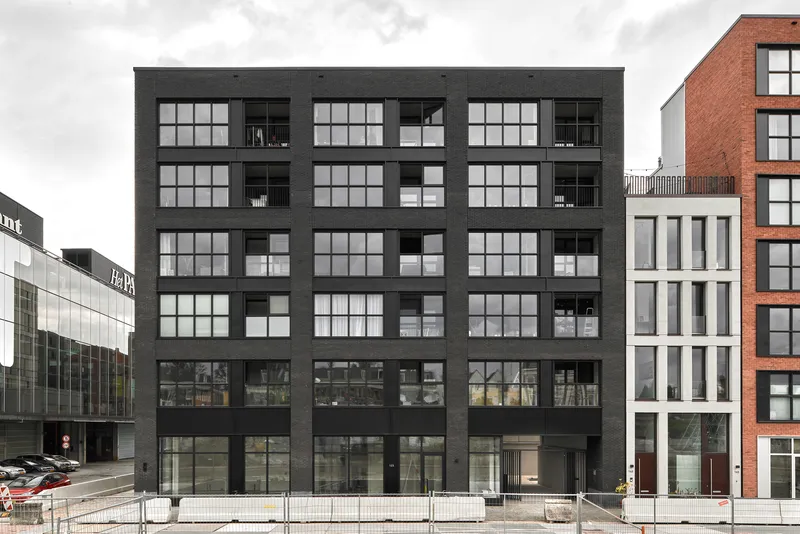
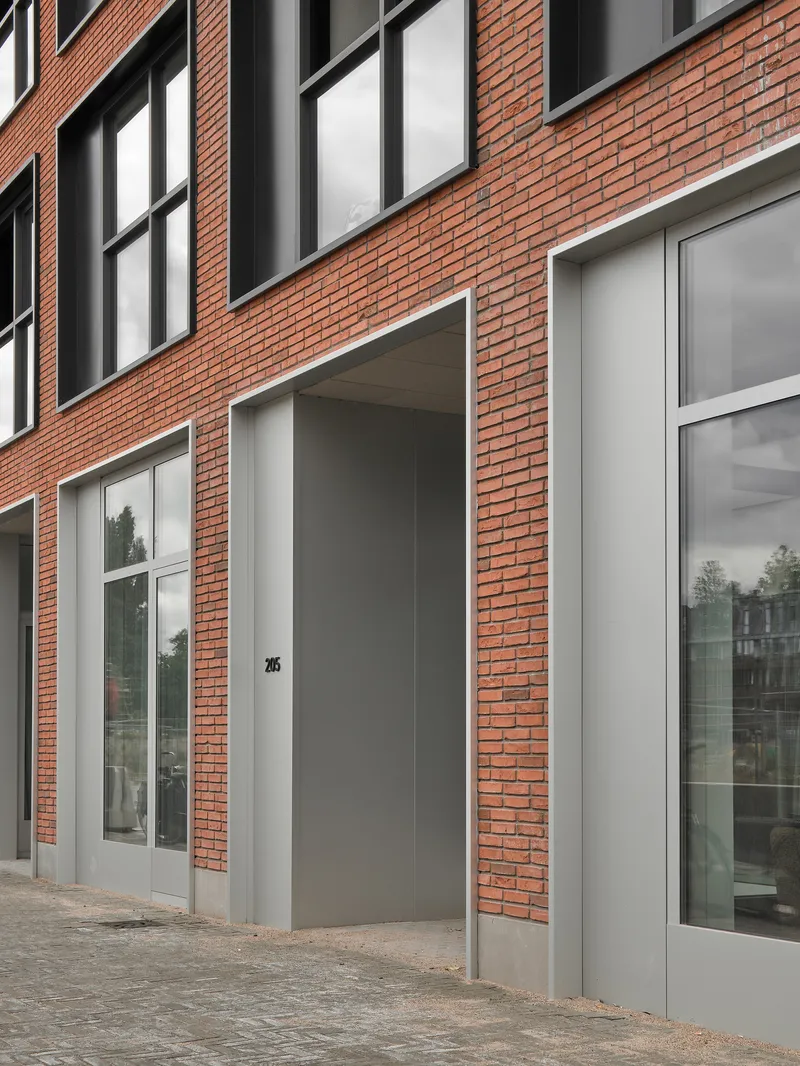
Oostenburgereiland carries a heavy industrial memory. Shipyards, slipways, and later heavy manufacturing defined the island for centuries. Common Practice and Studio AAAN translated that history into a facade discipline: the orange brick block, for instance, uses a rigid grid of deep reveals and recessed balconies that reads almost like a warehouse elevation adapted for habitation. The repetition is deliberate, and its power comes from the fact that every cell in the grid is occupied, windows, loggias, and solid panels all held in tension.
Corner windows and transparent loggias introduce diagonal views along both front and rear facades, softening the grid's strictness from inside. You see the canal or the courtyard tree not straight on but obliquely, which makes the modest apartments feel connected to a larger world. It is a small move with outsized spatial consequences.
Thresholds That Do More Than Open
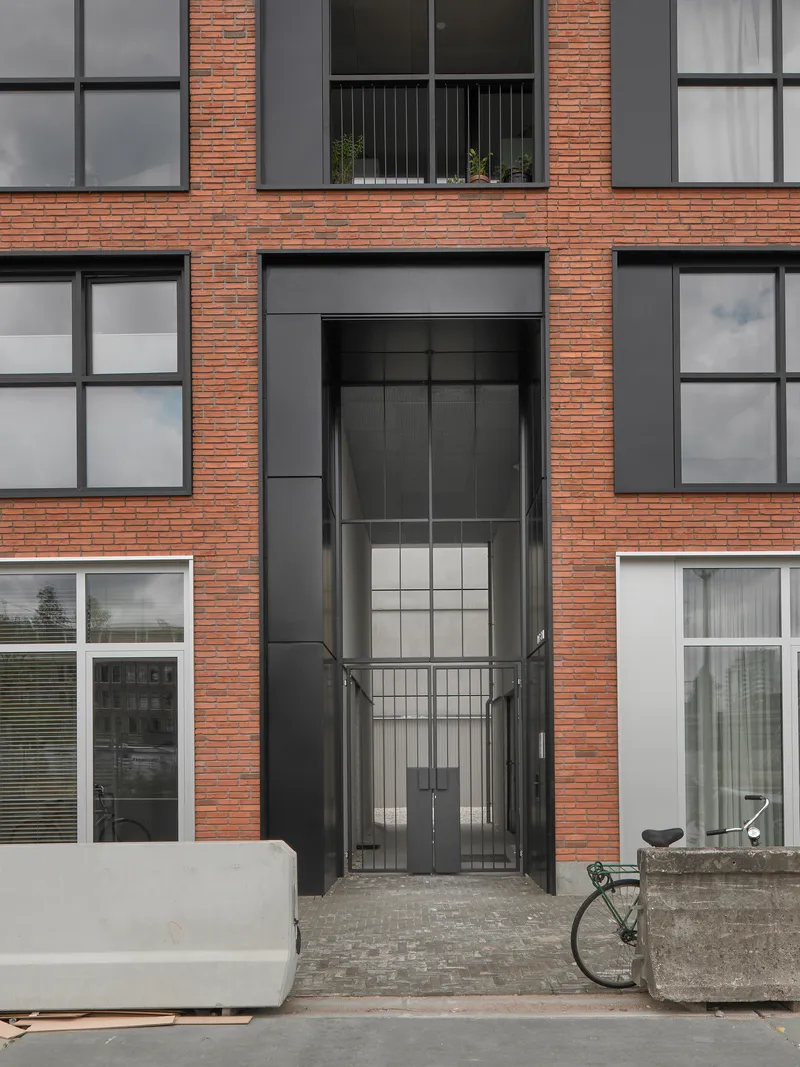
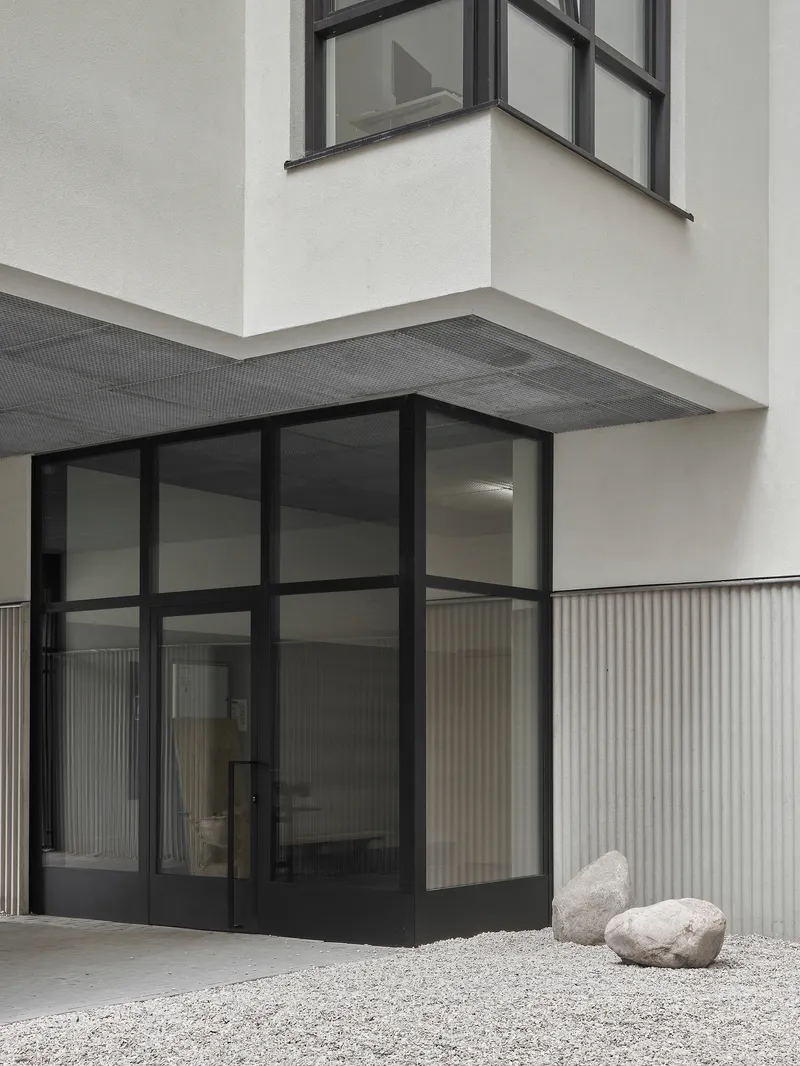
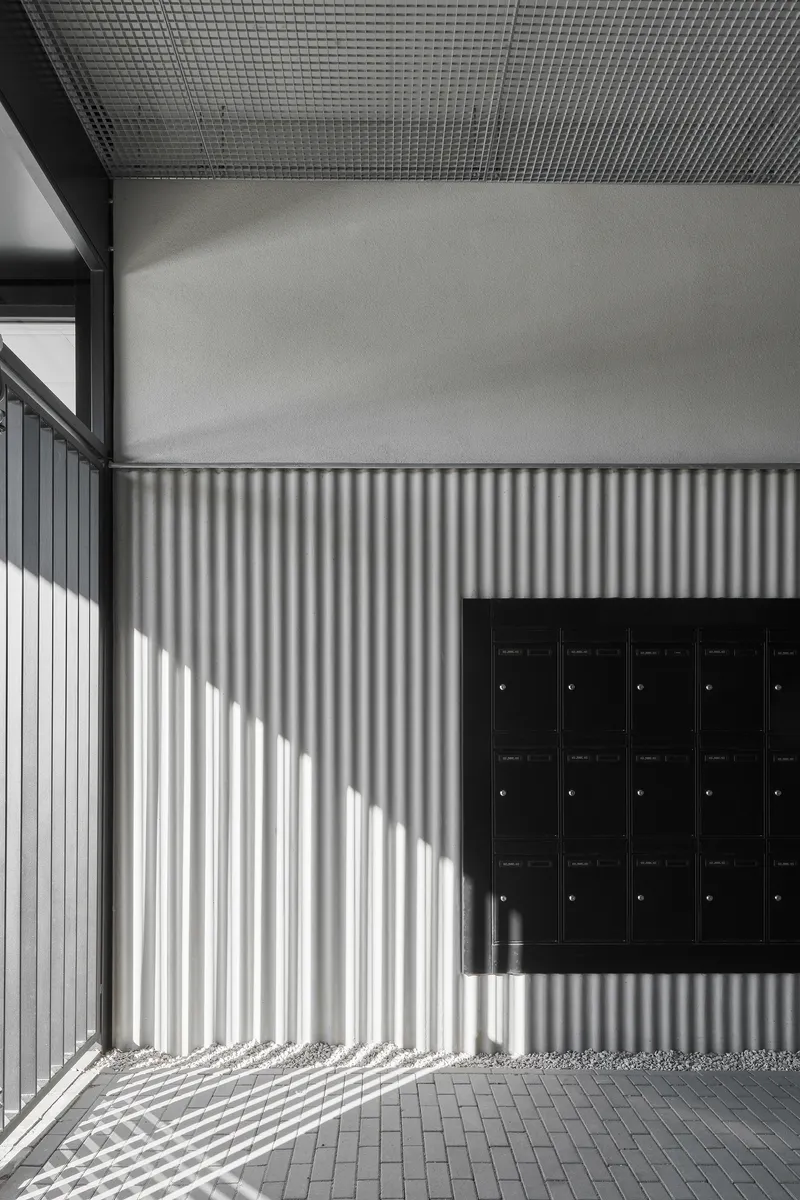
The gateways deserve close attention. Entrance halls and collective bicycle storage are folded into these passages, turning what could have been dead service zones into active thresholds between the street and the courtyard. A black metal gate set into orange brick, a corrugated metal alcove casting striped shadows beside a bank of mailboxes: the architects understood that transitions shape how residents feel about coming home, and they invested real design energy here.
The ribbed metal ceilings that run through these gateways and into the covered bicycle storage are a consistent material thread. They unify passage and parking under a single language while letting dappled light filter through, a detail visible in the way sunlight hits the grey-tiled walls of interior entryways. The gates occasionally reveal the courtyard to passersby, so the canyon plays a part in the daily rhythm of the neighborhood, not just the building.
The Canyon as Collective Living Room
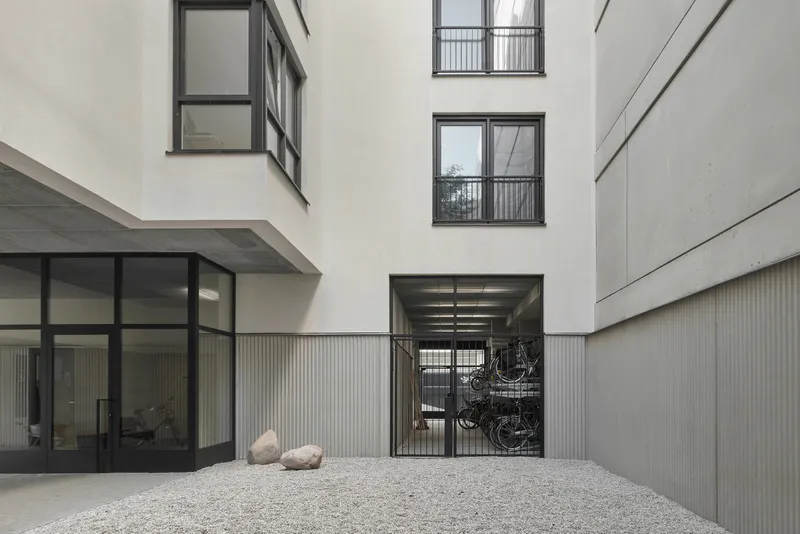
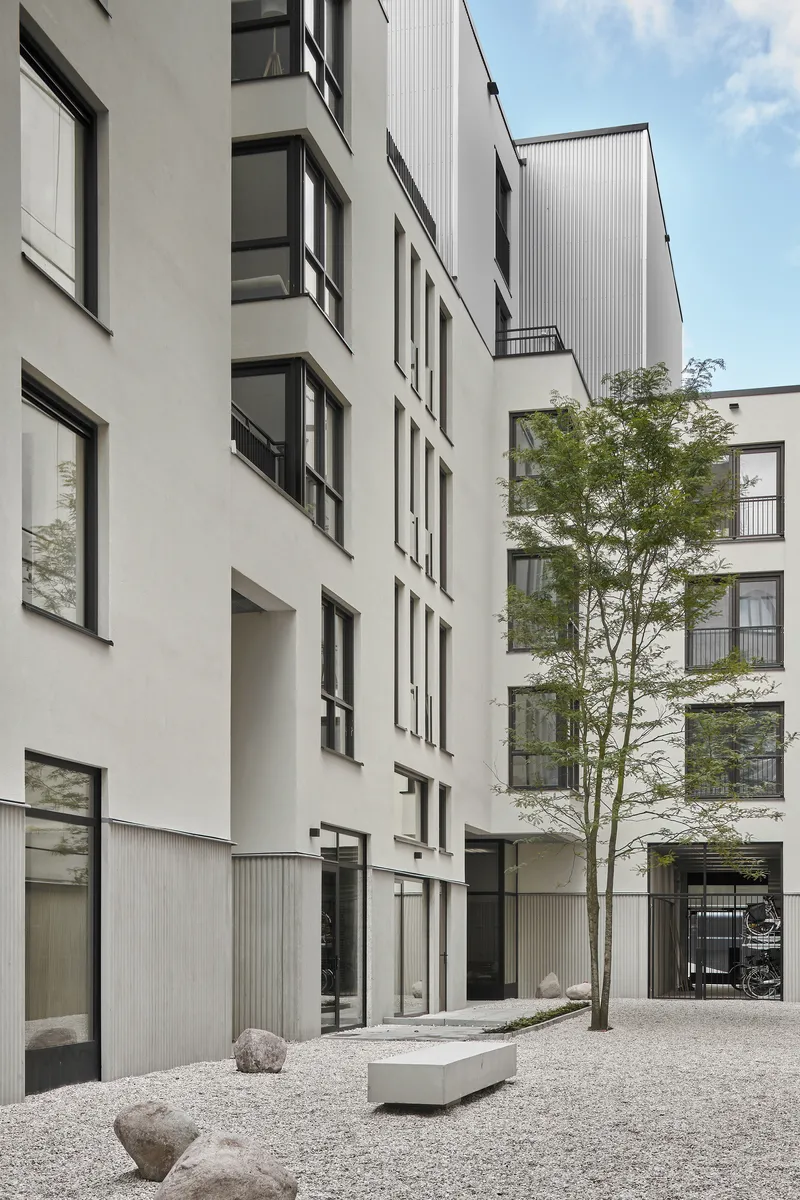
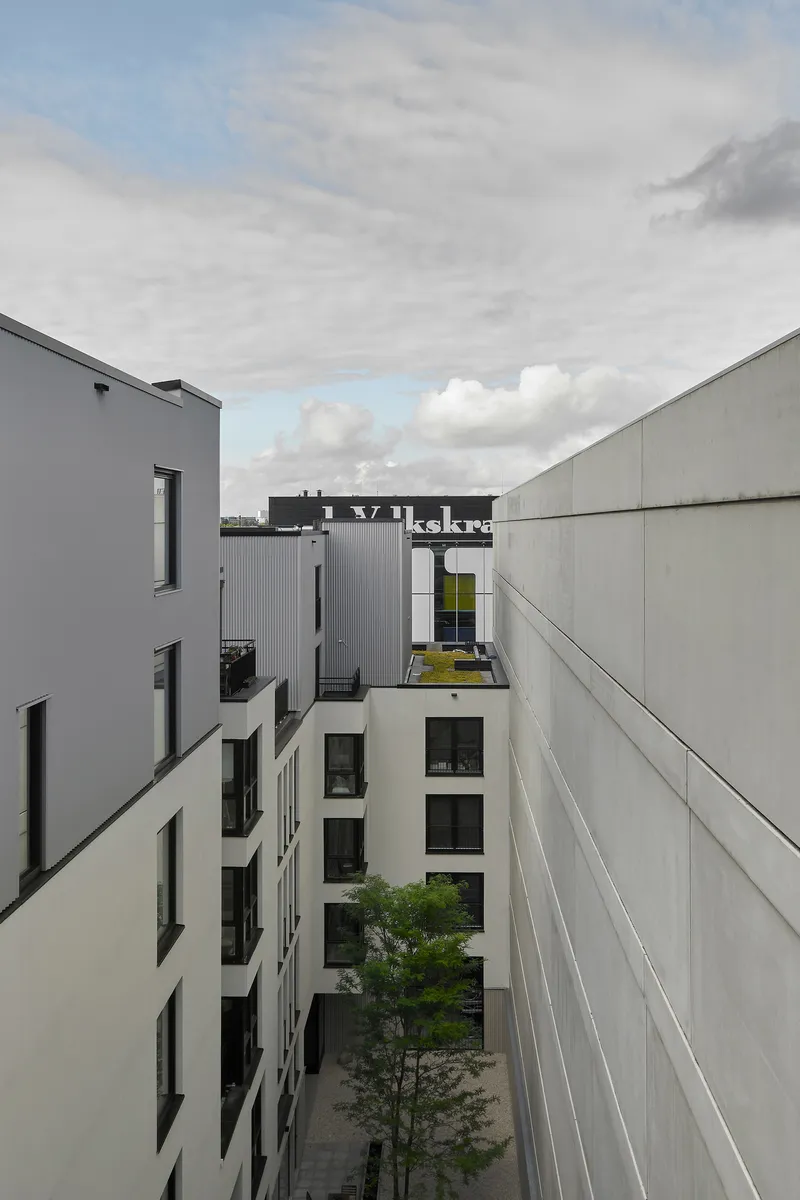
The courtyard itself is restrained to the point of severity: gravel ground plane, scattered boulders, a single young tree, concrete benches, white-rendered walls rising to the sky. There is no playground equipment, no planting scheme trying too hard. The architects trusted the proportions of the canyon to do the work, and they were right. The narrow slot of sky between white and grey facades creates a quality of light that shifts dramatically through the day, turning the space into something closer to a Roman cortile than a Dutch binnentuin.
A soft, undulating plinth runs along the base of the courtyard walls and continues to the monumental side facade of the adjacent parking garage, absorbing that awkward neighbor into the composition. It is a generous gesture that acknowledges context rather than fighting it.
Passages, Bikes, and the Continuous Interior
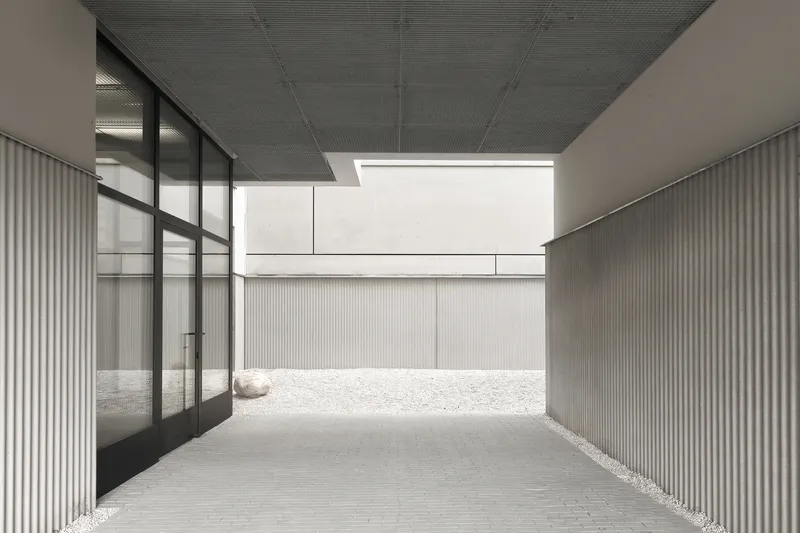
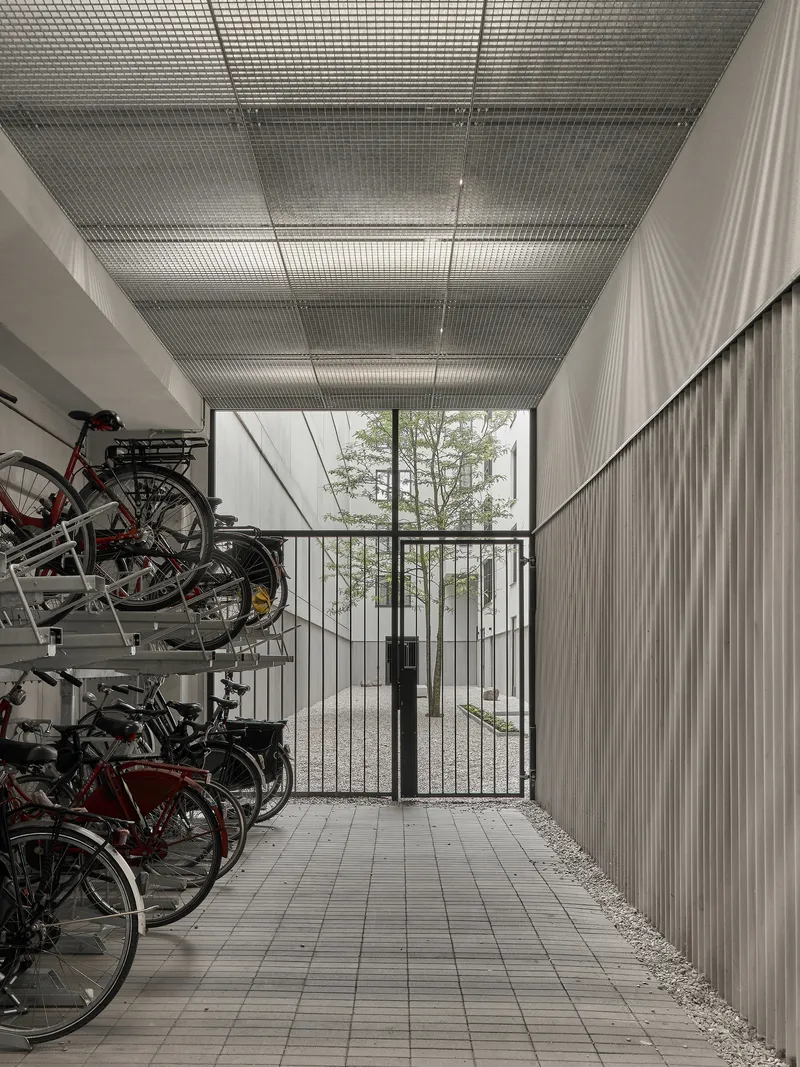
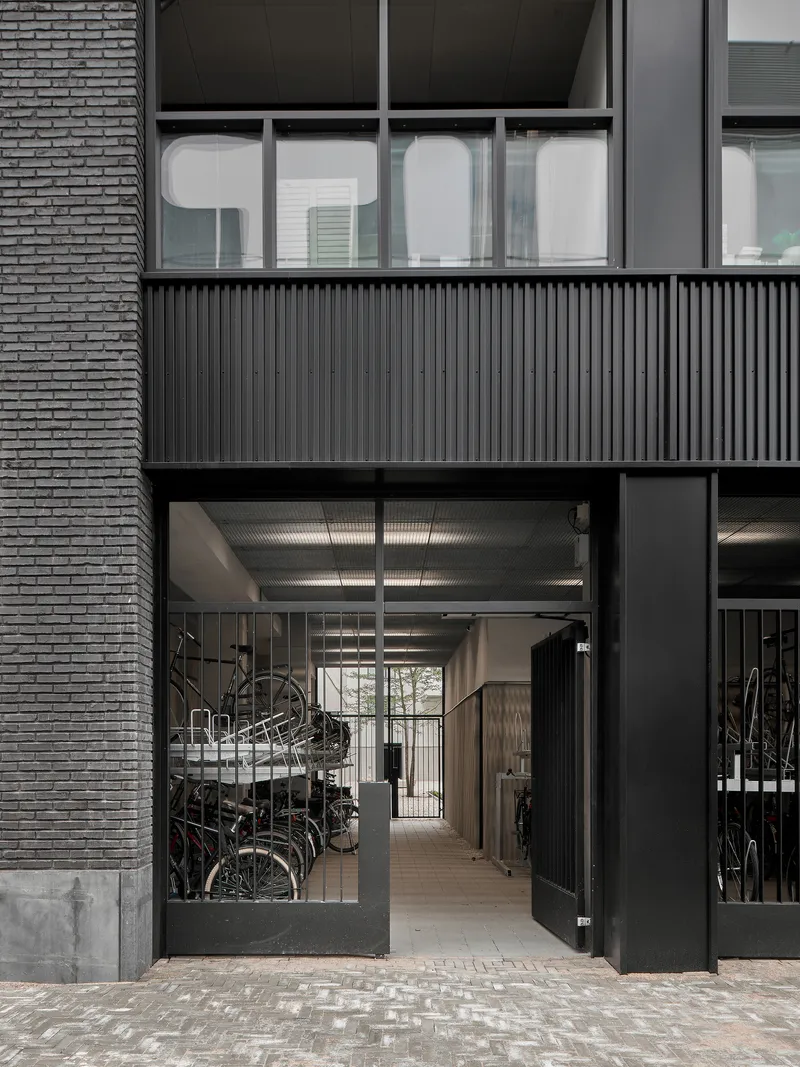
In Amsterdam, bicycle storage is not a footnote; it is infrastructure. Here, glazed gates open from covered passages directly into the courtyard, so wheeling a bike inside becomes a moment of spatial release rather than a chore. The mesh ceilings of the storage areas maintain visual continuity with the sky, and large glass walls keep the passages light and surveilled. These are the kinds of decisions that separate competent housing from housing people actually want to live in.
The entrance halls and courtyard form what the architects describe as a continuous urban interior, and the description holds. You move from street to gate to passage to courtyard without ever feeling you have passed through a security barrier. The transparency is both social and literal: glass doors, open frames, sightlines that run deep.
Materiality Up Close
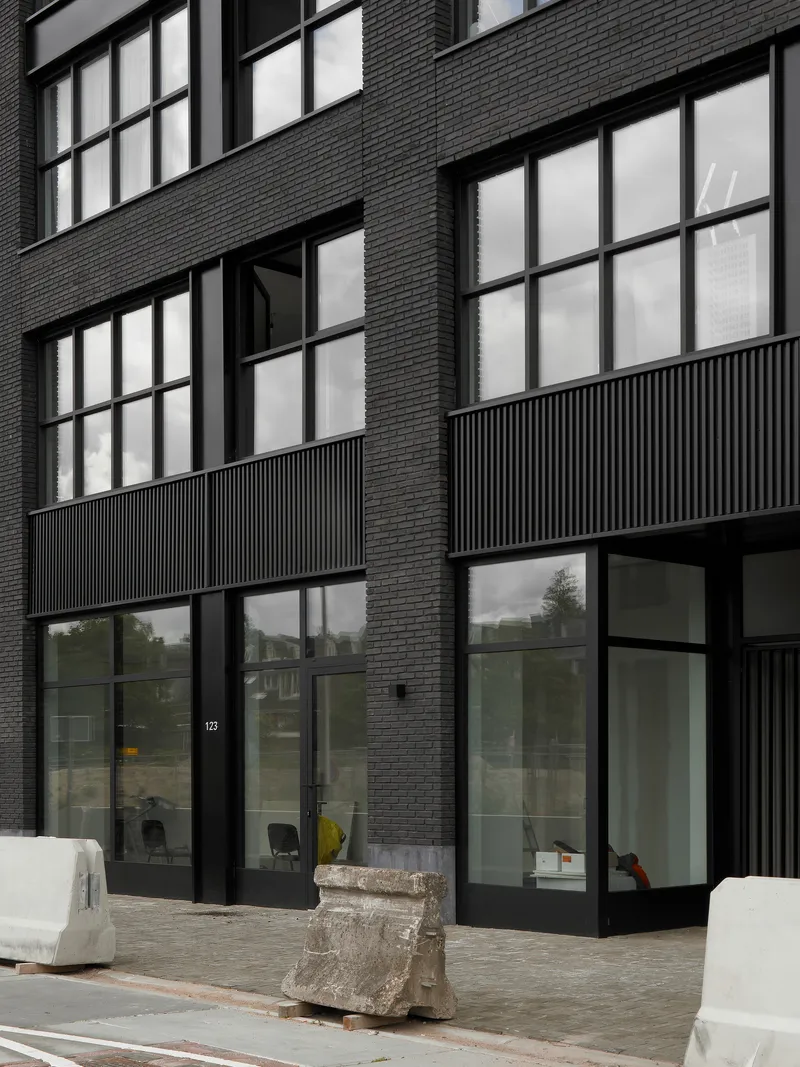
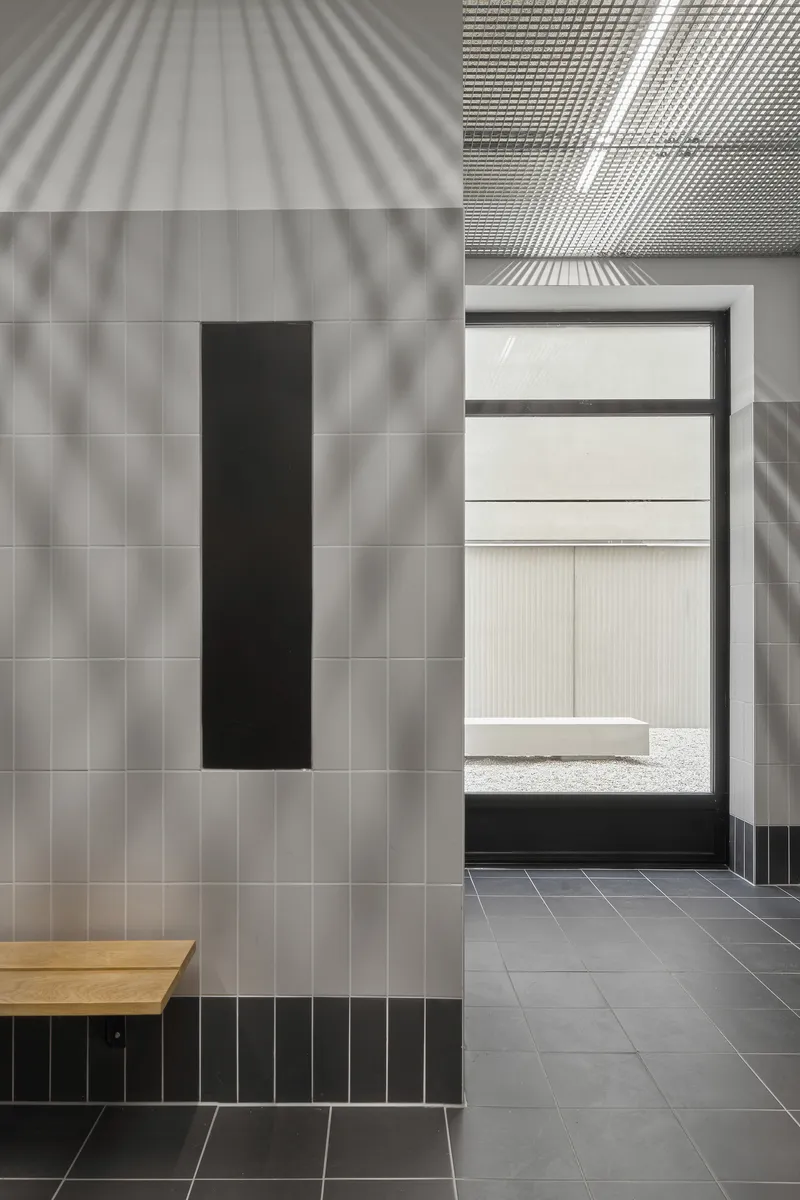
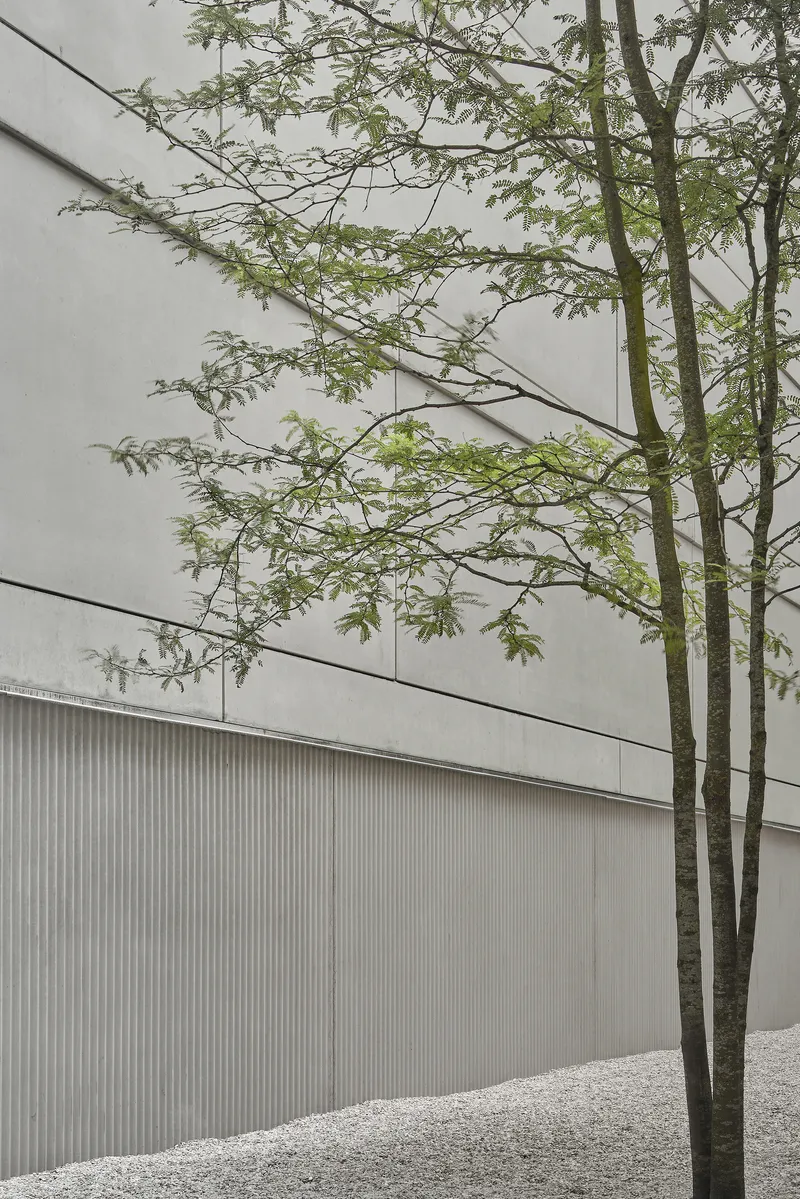
The palette is deliberately limited: brick (in orange, dark, and terracotta), corrugated metal, black steel frames, glass, and white render. Each material does a specific job. Brick anchors the project to its Amsterdam context and its industrial past. Corrugated metal signals the newer interventions, the gates, the canopies, the courtyard cladding. Black steel frames unify windows and doors across all four buildings. White render inside the canyon maximizes reflected light on the narrowest site.
The fluted metal panels at ground level are particularly effective. They catch light in fine vertical lines and give the plinth a texture that reads differently at walking speed versus from across the street. Combined with the ribbed ceilings inside the entrance passages, they create a haptic consistency that ties exterior to interior.
Inside the Stairwell
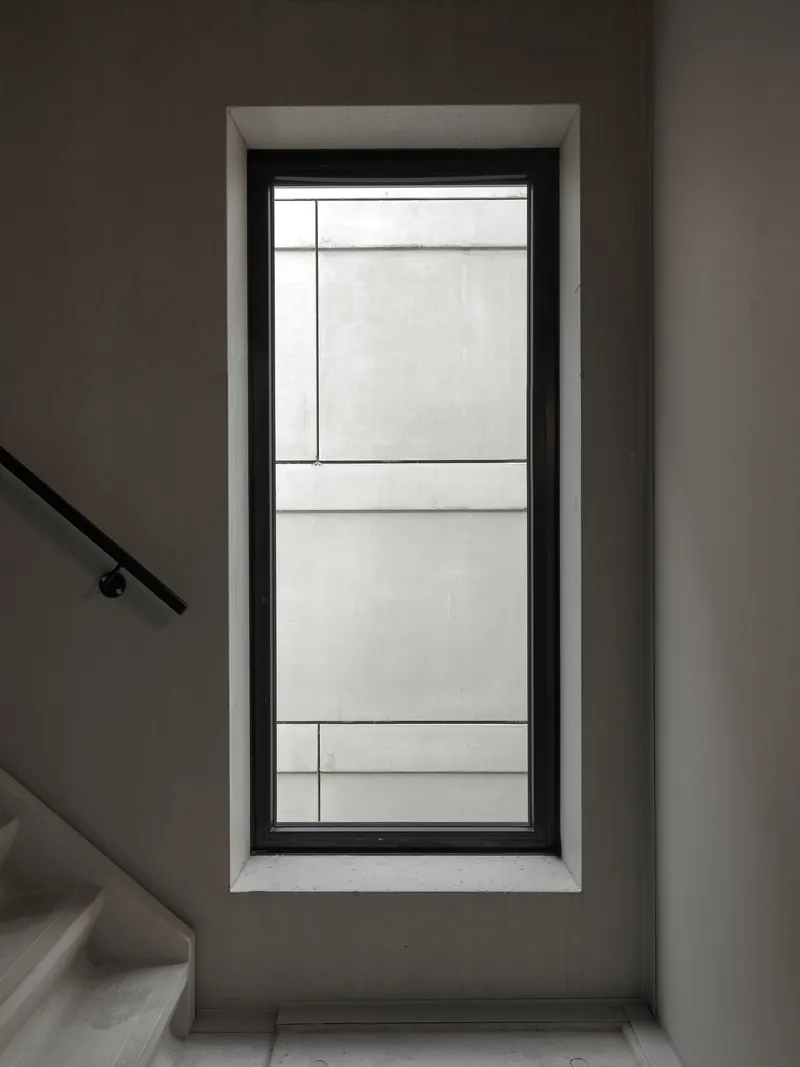
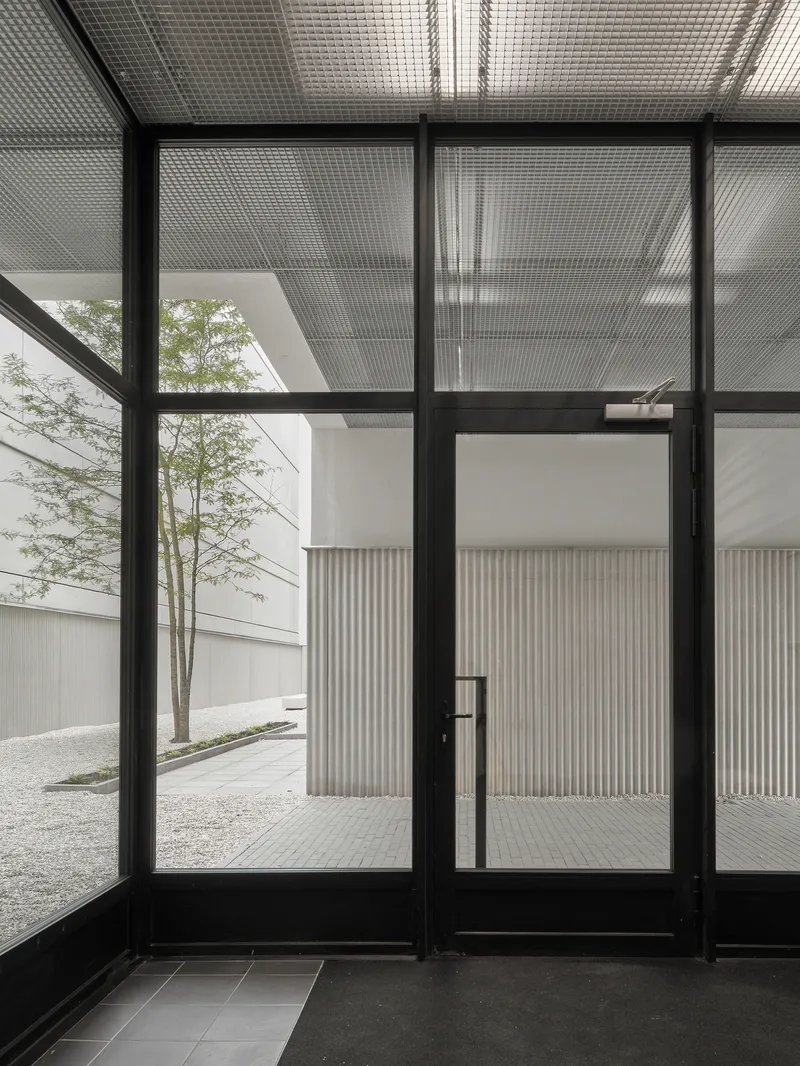
The circulation cores are handled with quiet competence. Tall windows with minimal mullions bring daylight deep into stairwells, and the handrail detailing is clean without being fussy. Three elevators serve the complex, which is generous for 64 units and reflects the mid-rent ethos: this is not luxury housing, but it is not cheapened housing either. The glass entry doors with translucent corrugated overhead canopies maintain the material language established on the facades and carry it into the most utilitarian moments of the building.
Plans and Drawings
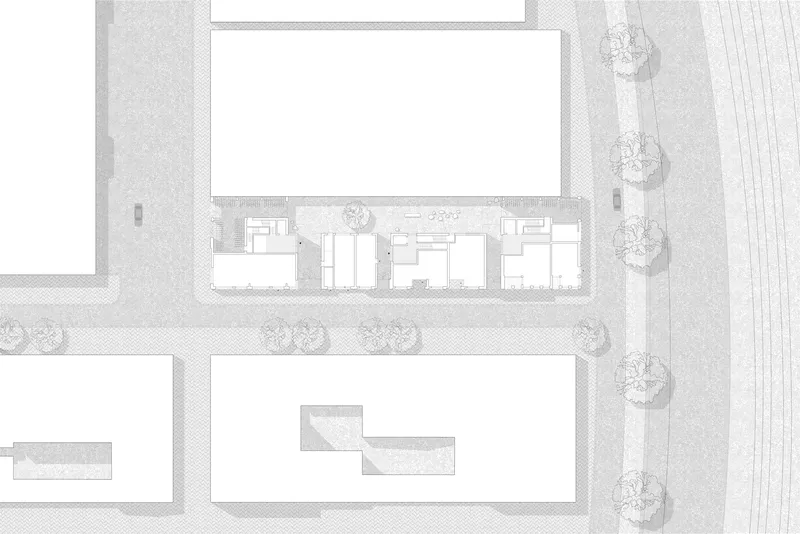
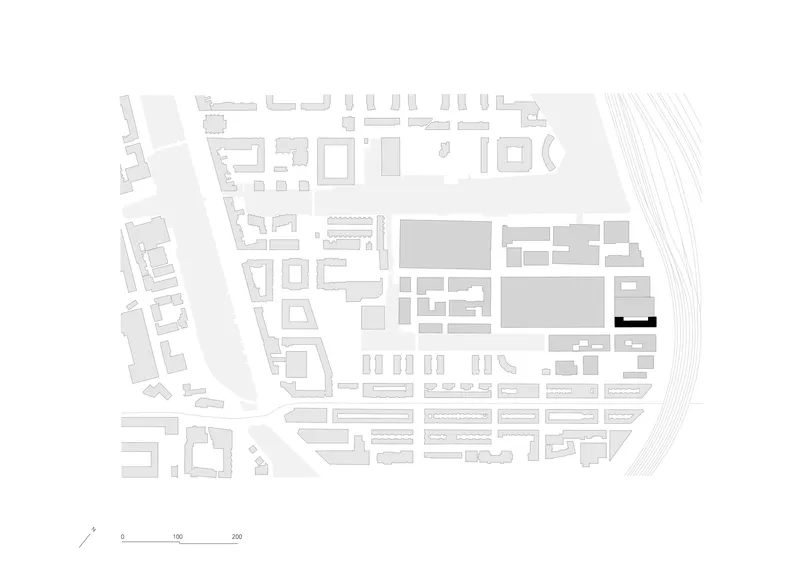
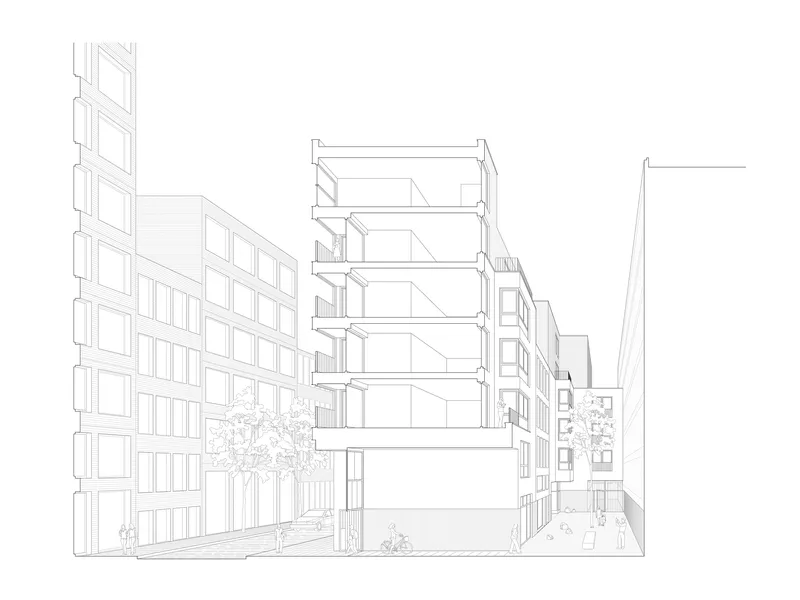
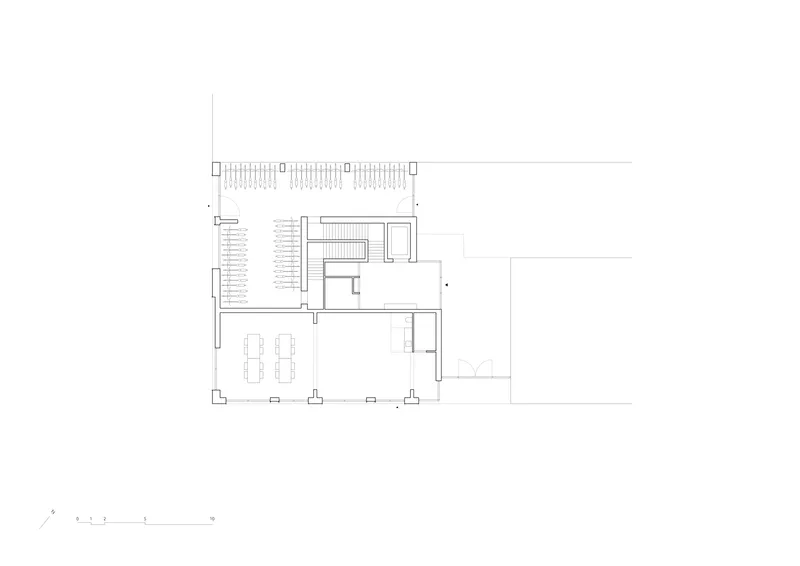
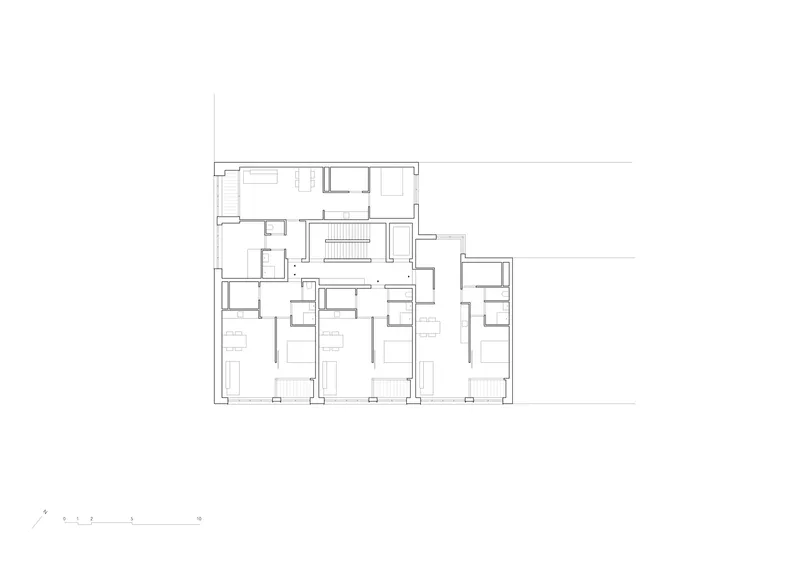
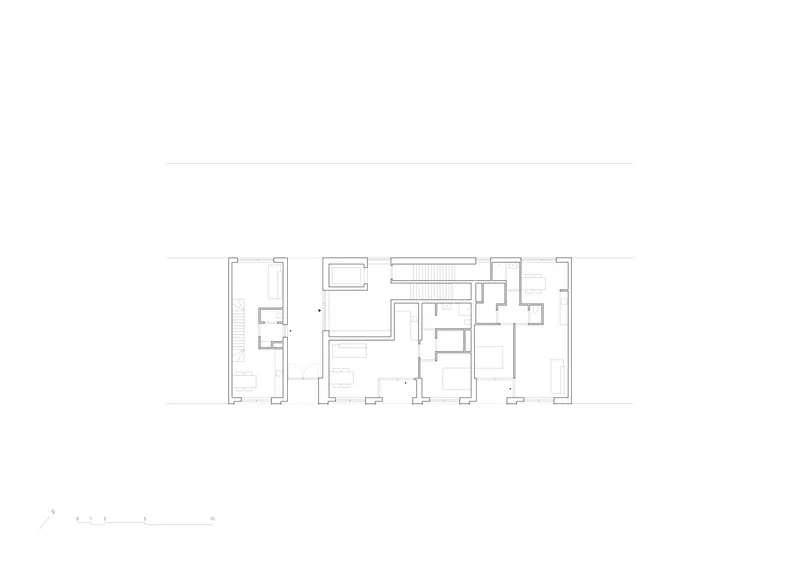
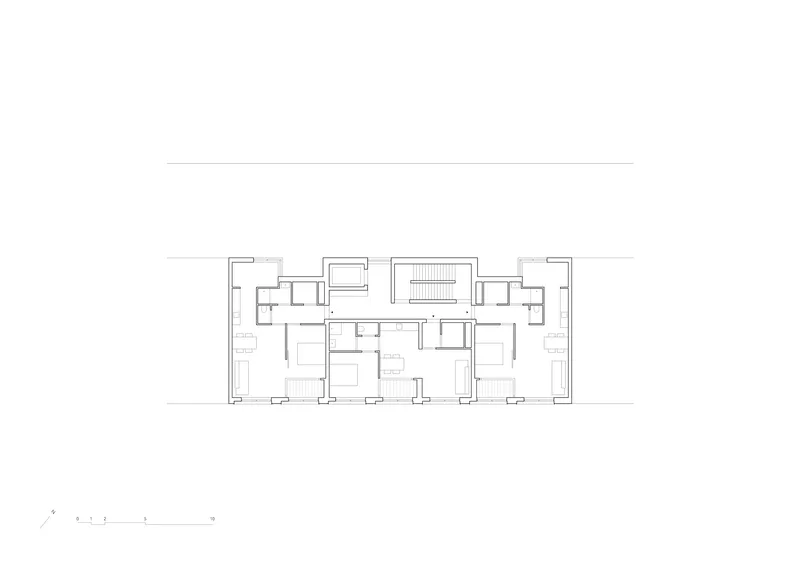
The site plan makes the constraint vivid: the building footprint is essentially a long bar pressed against the parking garage, with the courtyard carved out as a negative space between the bar and its neighbor. The floor plans show how the architects varied unit layouts across the four buildings while maintaining a central circulation spine. Half-rooms appear at the rear of several units, small spaces that can function as home offices, guest rooms, or nurseries depending on the household. Sliding doors between sleeping and living areas allow further reconfiguration during the day, so a compact apartment performs well beyond its square footage.
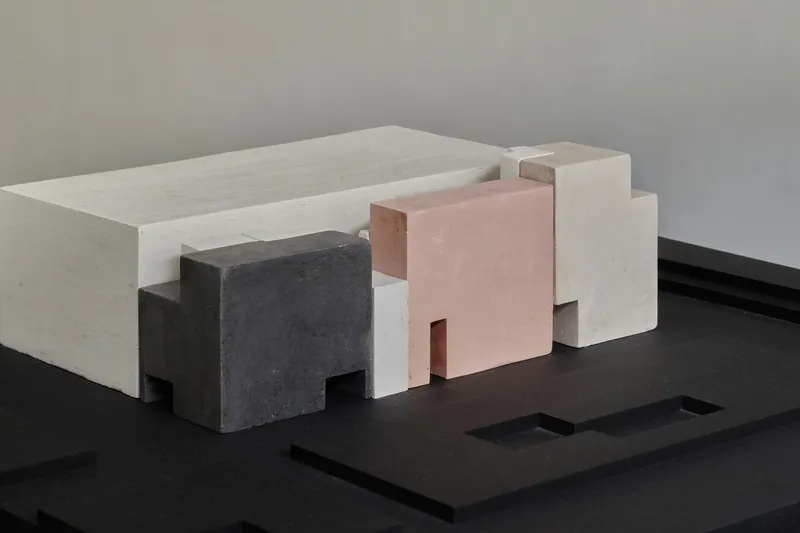
The massing model is revealing. The volumes step in height and depth, and the courtyard reads clearly as a deliberate void rather than leftover space. The staggered residential units visible in the upper floor plans show how the architects avoided a uniform slab by offsetting apartments to create the varied facade rhythm visible from the street. It is a plan-driven project, and the plans reward close reading.
Why This Project Matters
Mid-rent housing in Amsterdam is under enormous pressure to deliver density without sacrificing livability. Urban Canyon Apartments demonstrates that these goals are not in conflict if architects are willing to think hard about section, threshold, and collective space. Common Practice and Studio AAAN did not rely on a single big gesture; they accumulated dozens of smaller ones, half-rooms, diagonal views, material shifts between buildings, gateways that double as social infrastructure, and let them compound into something that feels whole.
The project also matters because of what it says about site adversity. A narrow plot pressed against a parking garage wall is, on paper, a miserable brief. But the architects used that constraint to invent the canyon, and the canyon became the project's identity. The lesson is not new, constraints breed invention, but it is rarely demonstrated this convincingly in affordable housing. If Oostenburgereiland's transformation into a livable district succeeds, this building will be one of the reasons.
Urban Canyon Apartments by Common Practice and Studio AAAN. Amsterdam, The Netherlands. 5,800 m². Completed 2022. Photography by Max Hart Nibbrig.
About the Studio
Share Your Own Work on uni.xyz
If projects like this are the kind of work you want to make, uni.xyz is a place to publish your own, find collaborators, and enter design competitions.


Popular Articles
Popular articles from the community


FCC Arquitectura Expands a Portuguese Granite House with a Board-Marked Concrete Wing
In Portugal, JV House pairs a cleaned-up whitewashed and granite dwelling with a timber-shuttered concrete extension, courtyards and a garden pool.

ETEH Reworks the Shared Spaces of São Domingos School in Brazil Around Timber, Color and Hanging Plants
At São Domingos School in Brazil, 436 m² of hall, refectory and library are recast with timber joinery, a yellow and blue code and trailing greenery.


Aquadapt: An Underwater Habitat That Rewrites Its Rooms by the Hour
Curved modules ring the seabed while one shell shifts from breakfast room to cinema, farm and football pitch as residents' needs change.

graciastudio Turns a Viewless Tijuana Lot Inward Around a Courtyard of Concrete, Timber and Trees
In Tijuana, Jorge Gracia's GA2 House stacks a timber-clad private floor over exposed concrete and replaces a missing view with a planted interior patio.

Similar Reads
You might also enjoy these articles

LAVA Architecten Gives Vocational Education a Sawtooth-Roofed Face on a Mechelen School Campus
In Mechelen, Belgium, a 2,053 m² STEM school on a 6×6 m grid turns workshops and classrooms into rooms that can be rearranged as teaching changes.

KEMA Studio Turns a Derelict Marvila Attic into a 60 m² Lighthouse Apartment Above Lisbon
In Lisbon's Marvila district, a rebuilt roof, four skylights and two plywood volumes turn an unlivable attic into a bright home facing the Tagus.

Pixel Gardens: One Repeated Module Stacked Into a Terraced Social Housing Tower for Famagusta
Salem Bader's shortlisted housing tower builds a vertical neighbourhood from one repeated module, offsetting units to carve terraces, light and air.

Bao Huynh Watercolor Atelier: A Serene Art Retreat in Hội An
Bao Huynh Watercolor Atelier in Hội An blends multifunctional art spaces, sustainable design, local materials, and family-friendly living in a serene environment.
Comments (0)
Please login or sign up to add comments
No comments yet. Be the first to comment!