

PRISM Architecture and KD Architecture Wrap Rabat's Competition Council in Layered Stone and Symbolism
A 2,800 square meter headquarters in Morocco's capital channels the Mechwar, the traditional Moroccan pathway, into institutional form.


Institutional buildings rarely get to be both legible and layered. In Rabat, the new headquarters for Morocco's Competition Council manages exactly that: a 2,800 square meter office building that reads as unmistakably contemporary yet draws its spatial logic and surface language from deep within Moroccan architectural tradition. Designed by PRISM Architecture and KD Architecture, the project won the Young Moroccan Architect Award 2024 for Best Office Building, a recognition that feels well placed once you understand how carefully the architects have calibrated every move.
What makes the building genuinely interesting is the refusal to treat heritage as decoration. The organizing idea is the Mechwar, a traditional Moroccan processional pathway, reinterpreted here as a central transparent axis that cuts through the plan and ties public, ceremonial, and administrative spaces into a single legible sequence. Around this spine, three interlocking volumes, a multipurpose hall and two office wings, negotiate scale and hierarchy without resorting to monumental gestures. The result is a building that communicates authority through material craft and spatial clarity rather than sheer size.
A Facade That Performs Double Duty
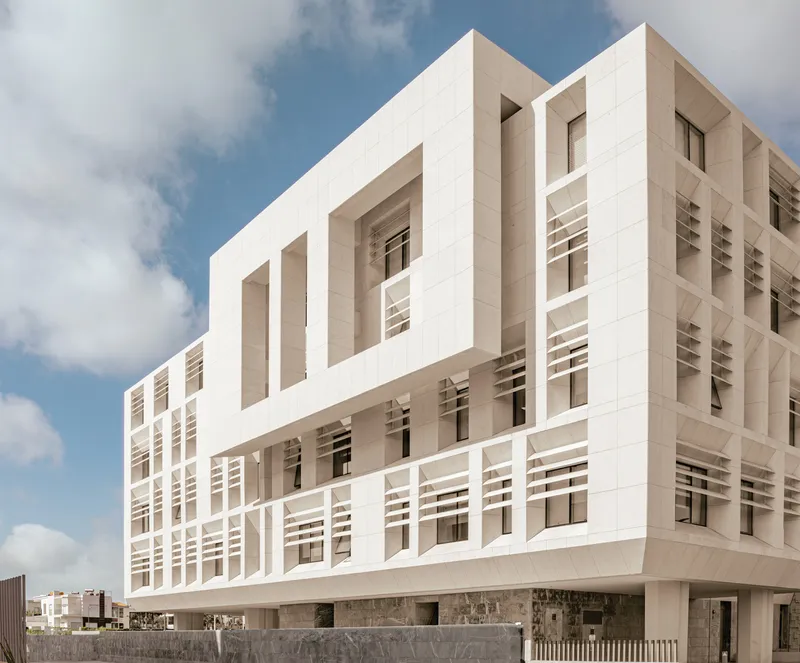
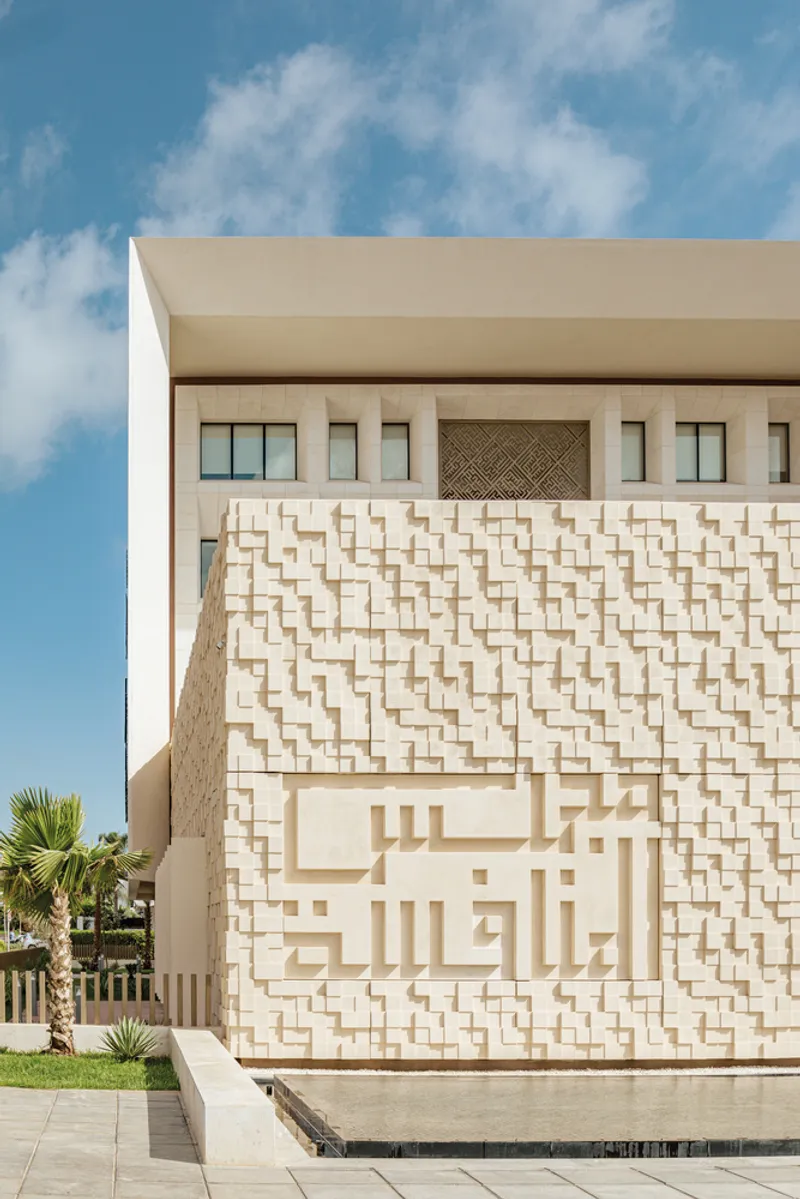
The street-facing elevation is the project's strongest statement. Deep horizontal bands of stone create a rhythm of shadow and mass that changes throughout the day, with recessed windows sitting well back from the outer plane. The effect is simultaneously protective and expressive: the layering shields interiors from Rabat's direct sun while giving the building a weight and texture that photographs only partially capture. Up close, a basketweave stone pattern and Arabic calligraphy inscriptions appear along a wall flanking a reflecting pool, turning what could have been a blank perimeter into something closer to a public artifact.
The reflecting pool itself deserves mention. Placed at the main entrance along Avenue Azaytoune, it introduces water as both a threshold marker and a cooling device. Backed by palm trees and the textured stone wall, the pool creates a micro-landscape that slows you down before you enter, a simple move that shifts the experience from bureaucratic approach to something more deliberate.
Entry as Threshold, Not Lobby
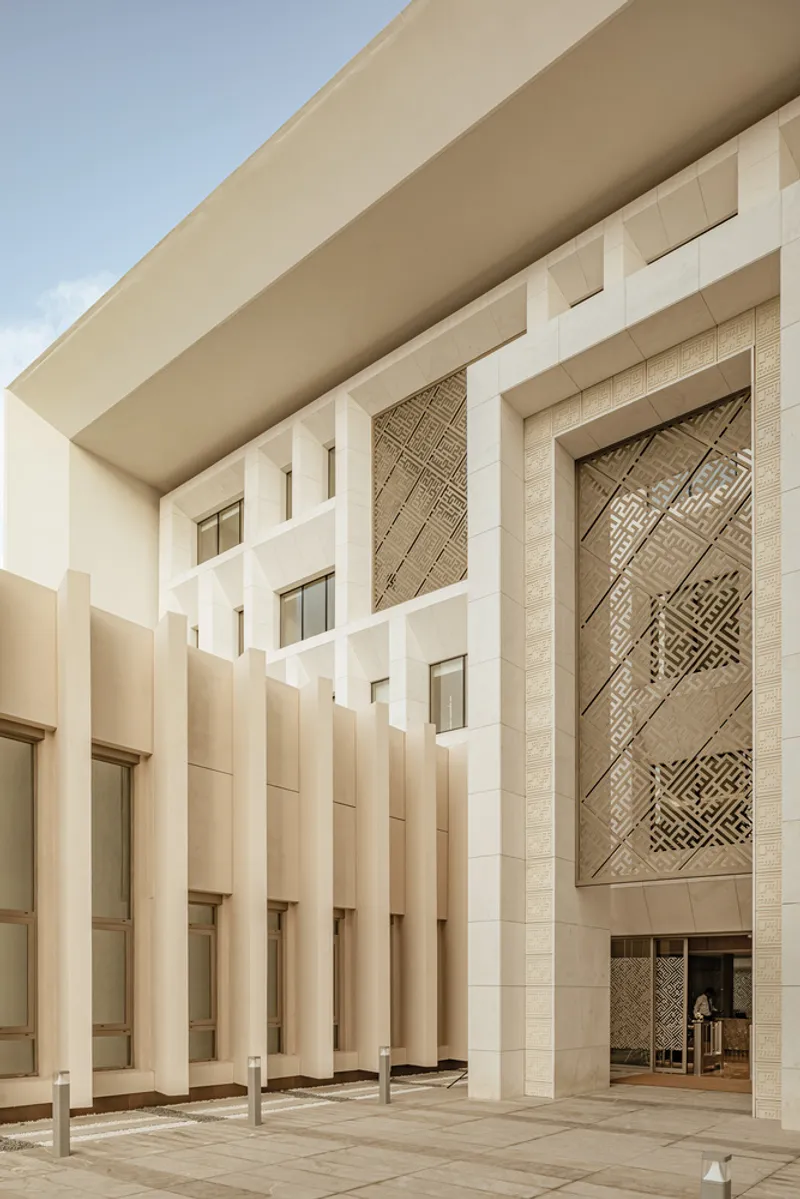
The covered entrance courtyard operates more like a mediated outdoor room than a conventional foyer. Vertical stone fins frame the approach while a large geometric screen panel, its pattern clearly drawn from Islamic geometry, filters light into the arrival zone. The screen is not merely ornamental. It controls glare, provides privacy for the interior spaces beyond, and signals the transition from the public realm of the street to the institutional realm of the Council. The composition is restrained: stone, shadow, geometry, and a clean overhead plane. No excess.
What the architects get right here is scale. An institutional entrance in a capital city could easily tip into grandiosity, but the proportions stay grounded. The vertical fins echo the rhythm of the facade banding turned ninety degrees, maintaining a material and formal continuity that makes the whole complex feel resolved rather than assembled.
The Council Chamber as Interior Set Piece
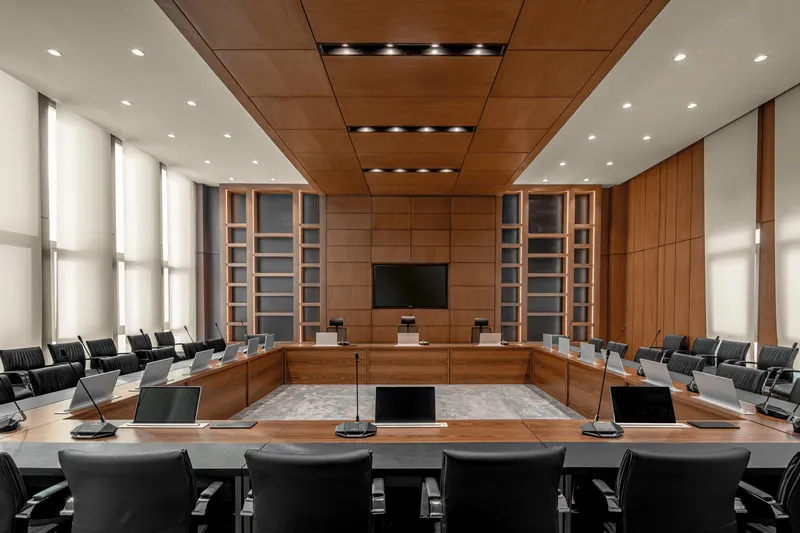
Inside, the council chamber is where the program's ceremonial demands concentrate. A U-shaped seating arrangement in warm timber paneling creates a focused, almost intimate room for deliberation. Integrated ceiling downlights wash the surfaces evenly, and the timber treatment wraps walls and furniture into a continuous field. The palette here, warm wood against neutral tones, stands in deliberate contrast to the cool stone exterior. It signals that the building's interior life is softer and more collaborative than its public face suggests.
The room also speaks to the building's structural logic. A post-and-beam (poteaux-poutres) system underlies the whole project, giving each floor plate modularity and the potential for future reconfiguration. In the chamber, this structural discipline translates into a clean, column-free volume that lets the seating geometry and ceiling plane do all the spatial work. It is a good example of how an economical structural choice can produce architectural generosity.
Material Restraint as Strategy
The material palette across the project is deliberately limited: concrete structure, stone cladding, glass, timber interiors, and water. That discipline pays off. With only a few materials in play, every joint, every texture shift, and every surface transition becomes legible. The basketweave pattern on the perimeter wall, for instance, gains its impact precisely because it appears against expanses of plain stone. In a lesser project, that kind of detail would get lost in a busier composition.
Glass plays a supporting role rather than a dominant one. Windows are recessed and carefully proportioned, giving the stone mass primacy. The central axis provides transparency where it matters, for wayfinding and visual connection, but the building overall favors opacity. In a climate like Rabat's, and for a building that handles sensitive governmental proceedings, that opacity is both environmentally and programmatically appropriate.
Why This Project Matters
The Competition Council headquarters is a compact case study in how to do institutional architecture in North Africa without defaulting to either glass-curtain-wall internationalism or superficial heritage pastiche. PRISM Architecture and KD Architecture found a middle register: a building that is modern in its spatial efficiency and structural pragmatism, yet deeply rooted in Moroccan spatial traditions like the Mechwar, the courtyard, and the screened threshold. The Young Moroccan Architect Award recognition confirms that this kind of work resonates locally, not just in the pages of international publications.
At 2,800 square meters, this is not a large building. Its significance lies less in scale than in the precision of its choices. Every element, from the reflecting pool to the geometric screen to the timber-clad chamber, is doing specific architectural work. Nothing is there for effect alone. For a young practice, that discipline is remarkable, and it sets a benchmark for how Morocco's next generation of public buildings might look and feel.
Competition Council Rabat (Siège du Conseil de la Concurrence) by PRISM Architecture and KD Architecture. Rabat, Morocco. 2,800 m². Completed 2024. Photography by Alessio Mei.
About the Studio
KD ARCHITECTURE
Share Your Own Work on uni.xyz
If projects like this are the kind of work you want to make, uni.xyz is a place to publish your own, find collaborators, and enter design competitions.


Popular Articles
Popular articles from the community


Cloaked Colonization: A Mobile Underwater Habitat That Moves Like a Fish
Micah Abaya's shortlisted EHC Pacific entry reimagines ocean settlement as a dispersed network of self-sustaining architectural organisms.

Opera on the Sea: Driftwood Logic Shapes a Timber Opera House on Estonia's Coast
Trevor Orgill's opera house translates the entangled drift of floating timber into a civic building where wood, water, and music converge.

Opera by the Sea Estonia: Three Shells Dissolving Architecture into Tallinn's Coastline
A winning opera house proposal replaces monumental form with interconnected shells that blur the boundary between building, park and Baltic Sea.
Faces of the Soviet Avant-Garde: Turning Moscow's Street Names into an Open-Air Museum
A network of sculptural installations across a Moscow residential district transforms forgotten architect names into spatial encounters with cultural memor

Similar Reads
You might also enjoy these articles


Hodi-Mandai Geram
Project Function: Preservation and revitalization of the Intangible heritage and socio-spatial identity of the Hodi by Housing, Cultural Memory Center, Sacred Grove, landscape, local tourism economy


Olio Towers: A Mid-Rise for Performers That Fuses Housing, Rehearsal, and Stage
Located blocks from Houston's Theater District, this modular tower stacks living units around a central performance atrium.

Oasis: Modular Green Housing Carved into Dhaka's Urban Fabric
A shortlisted Plugin Housing entry reclaims unauthorized settlements in Dhaka with stepped concrete volumes, green roofs, and ventilation-driven design.

Black Hole: A Floating Megastructure for the Post-Physical Era
Emiliano Mazzarotto envisions a spherical, self-scaling arena where e-sports, digital hotels, and holographic stadiums replace traditional public space.

Explore Office Building Competitions
Discover active competitions in this discipline

Challenge to reimagine the Iron Throne

Photograph architecture without architects

Illustrate the lost glory of Angkor Wat - Render Challenge

Design challenge to reuse E-waste
Comments (1)
Please login or sign up to add comments
the link for PRISM ARCHITECTURE FIRME IS :