
Corolla & Stamen: Floral Anatomy Recast as Bent-Steel Seating and Light
A lounge chair and floor lamp that borrow structure, not ornament, from a flower: slender bent steel, a suspended seat, and light split by twin shades.


Most furniture that claims floral inspiration stops at the silhouette: a petal-shaped backrest, a leafy print, a curve borrowed for its charm. Corolla & Stamen takes the harder route. It treats the flower as a structural diagram, asking how a ring of petals holds its core and how a slender filament stands upright. Then it rebuilds those answers in thin bent steel. The result is a pair of objects that behave less like products and more like small pieces of architecture.
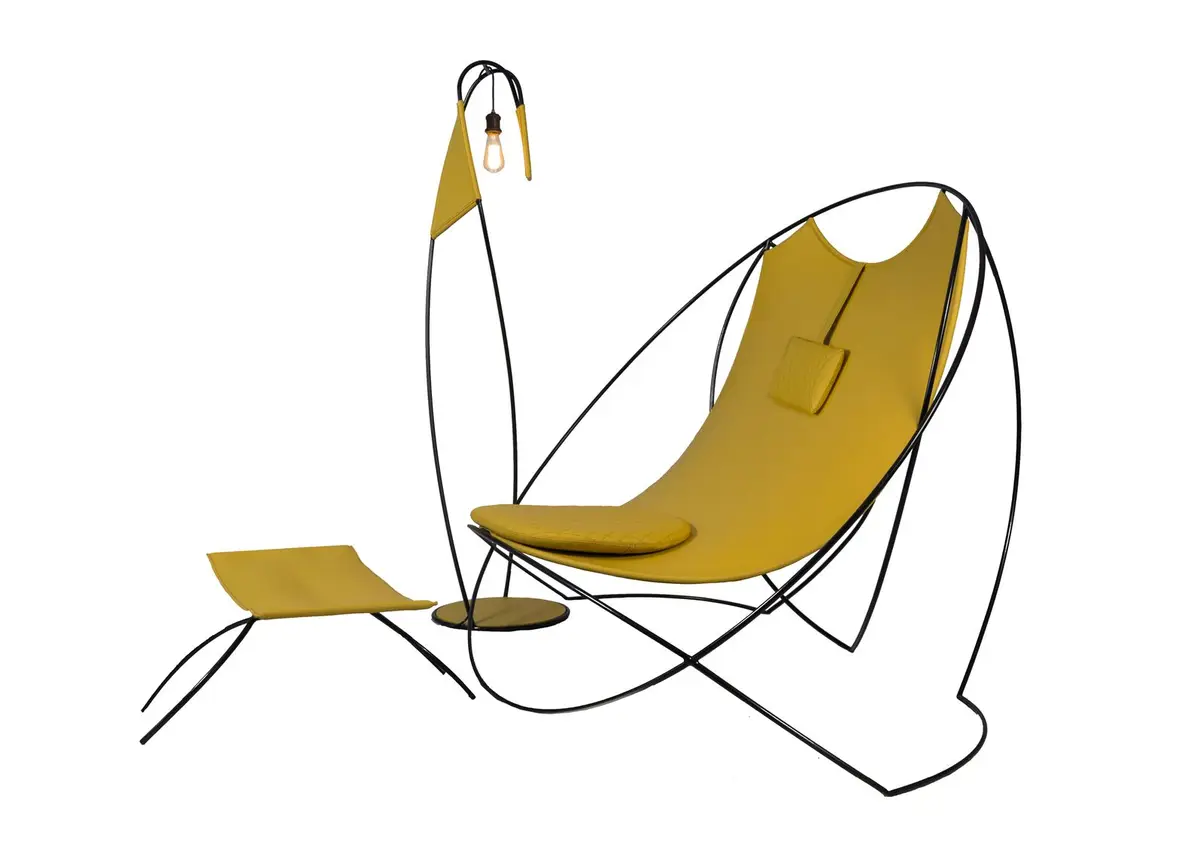
Designed by Badrinath Kaleru and published as a project on uni.xyz, the set centres on two interconnected pieces: the Corolla Lounge Chair and the Stamen Lamp, joined on the presentation boards by a matching footrest. Kaleru frames the work through biomimetic architectural furniture design. Seating and lighting are conceived as one spatial composition, and each object is named after the part of the flower whose logic it borrows.
A Petal Ring Built From 12 mm Steel Rod
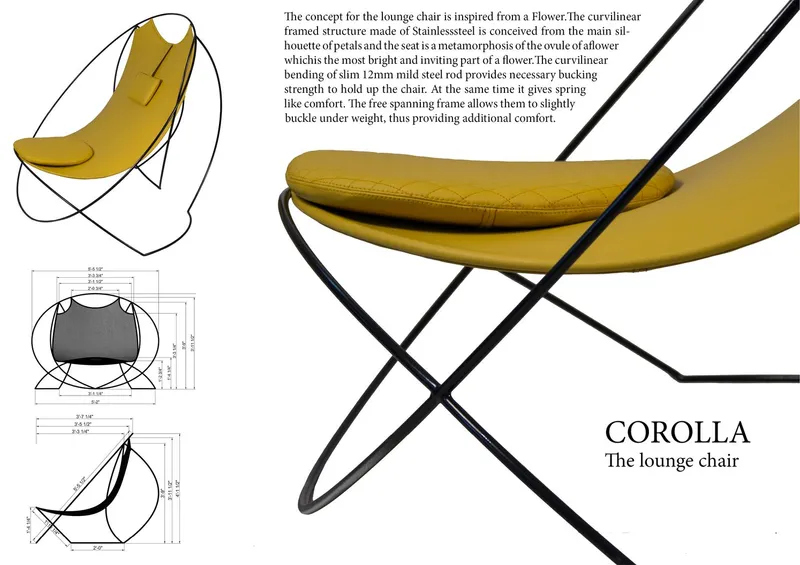
The Corolla Lounge Chair takes its name from the corolla, the ring of petals that encloses a flower's reproductive core. The chair plays the same role for the body. Its frame is a set of continuous curves in slim 12 mm mild steel rod, bent to trace the primary outline of petals. The board's front and side drawings show how little material the structure uses. The rod is the whole frame, with no secondary bracing and no rigid joints that break the line. Kaleru relies on the bending itself to supply buckling strength, so the geometry does the work a heavier section would normally do.
The more interesting claim is about behaviour. The frame free-spans and is meant to yield slightly under load, giving the sitter a spring-like give rather than the dead stiffness of a welded chair. The upholstered seat hangs within this skeleton and stands in for the ovule: soft, protected, central. Elasticity becomes the chair's comfort strategy, and that is where the biomimicry earns its keep. A petal flexes in wind without failing, and the Corolla asks steel to do something similar under a reclining body.
Two Crossing Stems and a Split Shade
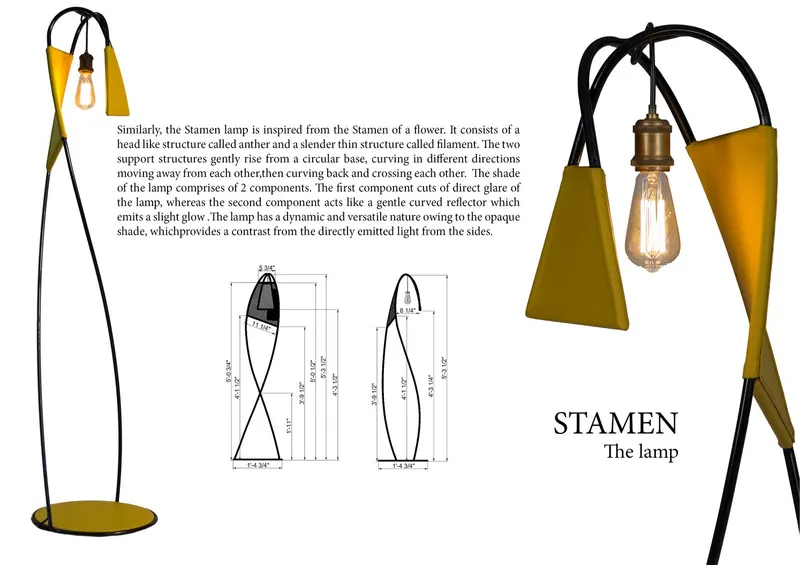
The Stamen Lamp turns to the flower's most vertical element, the slender filament that carries pollen. Two supporting members rise from a circular base, curve away from each other, then loop back and intersect. The crossing braces the lamp, but it also reads as growth: two stems leaning apart and finding each other again, holding a quiet tension that a single straight pole could never suggest. The elevations on the board make the move legible, showing how the cross stabilises a form that would otherwise feel precariously top-heavy.
The lighting assembly is just as deliberate. Two separate shade components share the work. One cuts direct glare from the bulb, while the second, a softly curved reflector, bounces light into a warm ambient wash. The close-up of the bulb shows this layering, with direct and indirect light produced by a single fixture. The opaque yellow shades tie the lamp back to the floral reference and to the chair's upholstery, so colour does as much to bind the set together as form does.
A Footrest That Completes the Reclining Room
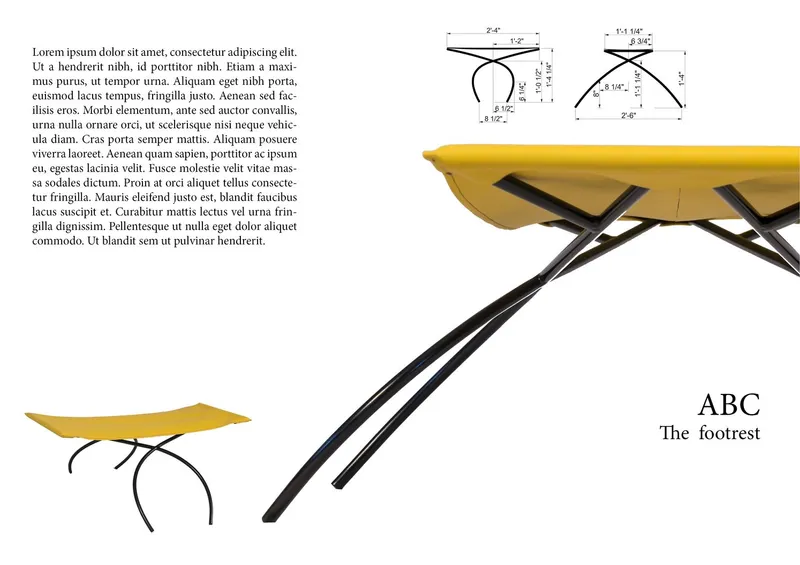
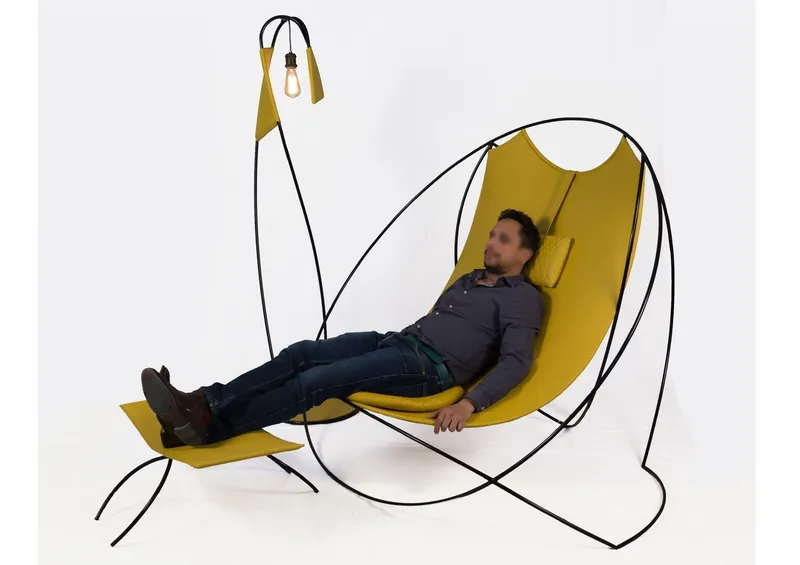
The footrest board extends the vocabulary without diluting it: a yellow pad carried on curved black steel legs, documented in two dimensioned elevations and a low-angle detail. It uses the same thin-member logic as the chair, so it reads as part of the family rather than an accessory added later. Its real contribution shows in the final staged image, where a man reclines in the sling chair with his feet raised and the lamp arching overhead.
That photograph makes the project's spatial argument better than any diagram. Against a plain white backdrop, the three pieces enclose the body. The chair holds it from below, the footrest extends it forward, and the lamp's curved stems draw a canopy above. Kaleru describes the chair as something close to a pavilion for the body, and the ensemble bears that out. Together the objects outline a small room made only of lines and a pool of light.
Why This Project Matters
Biomimicry is often reduced to a styling exercise. Corolla & Stamen is a useful counterexample because it pulls structure, movement and hierarchy out of the flower rather than its outline. The petal becomes a load-bearing curve, the ovule becomes a suspended seat, and the stamen becomes a self-bracing vertical. Each borrowing has a job to do, and the design is stronger for that discipline.
The project also makes a quiet case for minimal material used intelligently. Slender bent members, controlled flexibility and layered light let modest means produce a full spatial atmosphere. For young designers working between furniture and architecture, it is a reminder that the scale of an object does not limit its ambition. A chair and a lamp, carefully related, can define a place.
View the Full Project
About the Designers
Designer: Badrinath Kaleru
Enter a Design Competition on uni.xyz
uni.xyz runs architecture and design competitions year-round that reward proposals with spatial conviction and real site intelligence.
Project credits: Corolla & Stamen by Badrinath Kaleru.


Popular Articles
Popular articles from the community

The Amber Palace Opera: A Geological Fiction Surfaces on Tallinn's Baltic Waterfront
Pierre Brillard reimagines a Baltic legend as a public landscape, opera house, and waterfront promenade rooted in Tallinn's coastal identity.
Cloaked Colonization: A Mobile Underwater Habitat That Moves Like a Fish
Micah Abaya's shortlisted EHC Pacific entry reimagines ocean settlement as a dispersed network of self-sustaining architectural organisms.
Manzana Morphosis: Stretching Barcelona's Grid into a Living Landscape for 2050
A radical reworking of the Eixample manzana turns density into a tool for generous public space, vertical ecology, and environmental performance.
Faces of the Soviet Avant-Garde: Turning Moscow's Street Names into an Open-Air Museum
A network of sculptural installations across a Moscow residential district transforms forgotten architect names into spatial encounters with cultural memor

Similar Reads
You might also enjoy these articles


Maya Harvest: A Cacao Resort Village Rooted in Mayan Tradition and Local Craft
Situated within a Tabasco cacao plantation, this shortlisted resort proposal merges vernacular materials with hands-on cultural immersion.
Harmonia: A River-Shaped Community That Grows Over Decades in Boa Vista
Curved pathways and modular grid structures along the Branco River create a phased settlement designed to evolve from 2030 to 2050.

The Architecture of Bathing: A Mughal Hammam Reimagined Across the Yamuna
Charlotte May's honorable mention entry for The Black Taj reinterprets Agra's bathing rituals through red sandstone, water, and framed views of the Taj Mah
Om-1: A Wall-Hung System That Moves Your Workspace Off the Desk
Modular plywood boards, magnetic pegs, and utility elements migrate clutter from the horizontal surface to the vertical plane.

Explore Furniture Design Competitions
Discover active competitions in this discipline

Design challenge to equip cities with modern furniture

Competition to design a workstation for architects

Packaging challenge - Design meets sustainability
Comments (0)
Please login or sign up to add comments
No comments yet. Be the first to comment!