
COTA760 Wraps a São Paulo Apartment in a Continuous Red Steel Bookshelf
In the Perdizes neighborhood, a 100 square meter renovation turns exposed concrete and metallic shelving into a single domestic landscape.


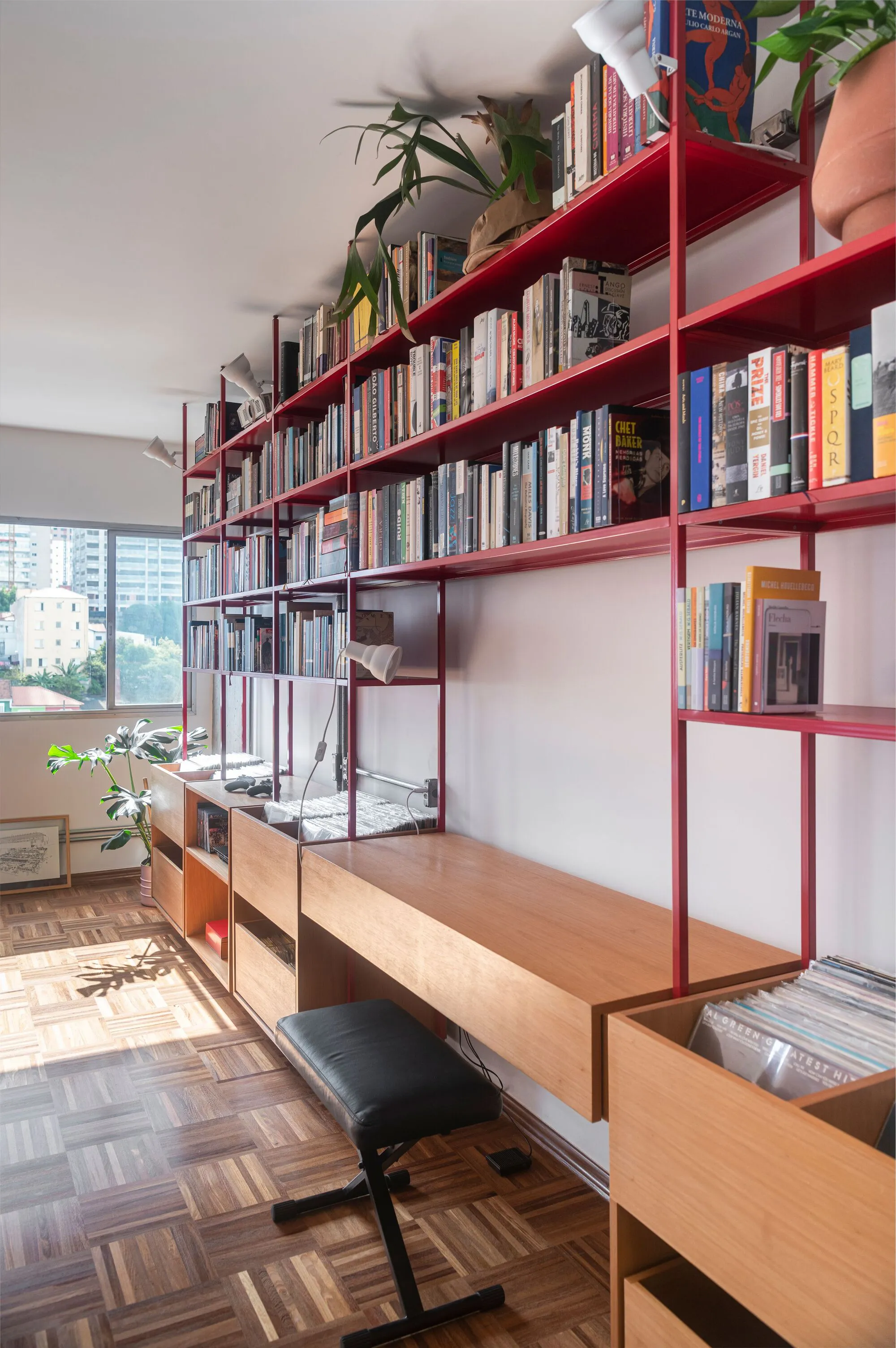
Most apartment renovations in São Paulo start with a wish list of finishes and end with a predictable palette of white walls and engineered wood. The Bookshelf Apartment by COTA760, led by architects Luis Rossi, Nicolas Le Roux, and Paula Lemos, starts instead with a single obsession: the client wanted a living room large enough to hold his books, his vinyl collection, his music equipment, and a projector for hosting friends. The result is a 100 square meter flat in Perdizes where one continuous red steel shelving system does nearly everything, from storing possessions to defining spatial boundaries to delivering indirect light.
What makes the project genuinely interesting is how the architects treated the apartment's existing bones. Rather than concealing the concrete pillars and beams left over from a previous renovation, they stripped the plaster away and made the raw structure visible. The exposed concrete becomes a compositional partner to the vivid red metalwork, each material honest about its role. One holds the building up; the other holds a life together.
Demolition as Space Making


The apartment originally had three bedrooms, a standard configuration for older São Paulo flats that prioritizes private cell after private cell at the expense of communal space. COTA760 removed the third bedroom entirely, transforming what had been an L-shaped living room into a single rectangular volume that connects seamlessly to the dining area and kitchen. The second bedroom was repurposed as an office and guest room, a move that kept the apartment functional for overnight visitors without sacrificing the new openness.
The kitchen was also expanded to accommodate serious cooking equipment and a generous island cooktop. Existing countertops and flooring were preserved, but joinery was entirely replaced, a pragmatic decision that kept costs and waste in check while still updating the room's character. The exposed concrete ceiling beam running between kitchen and living room now reads as a threshold rather than a wall, marking the transition between zones without interrupting the sightline.
The Shelving System as Architecture


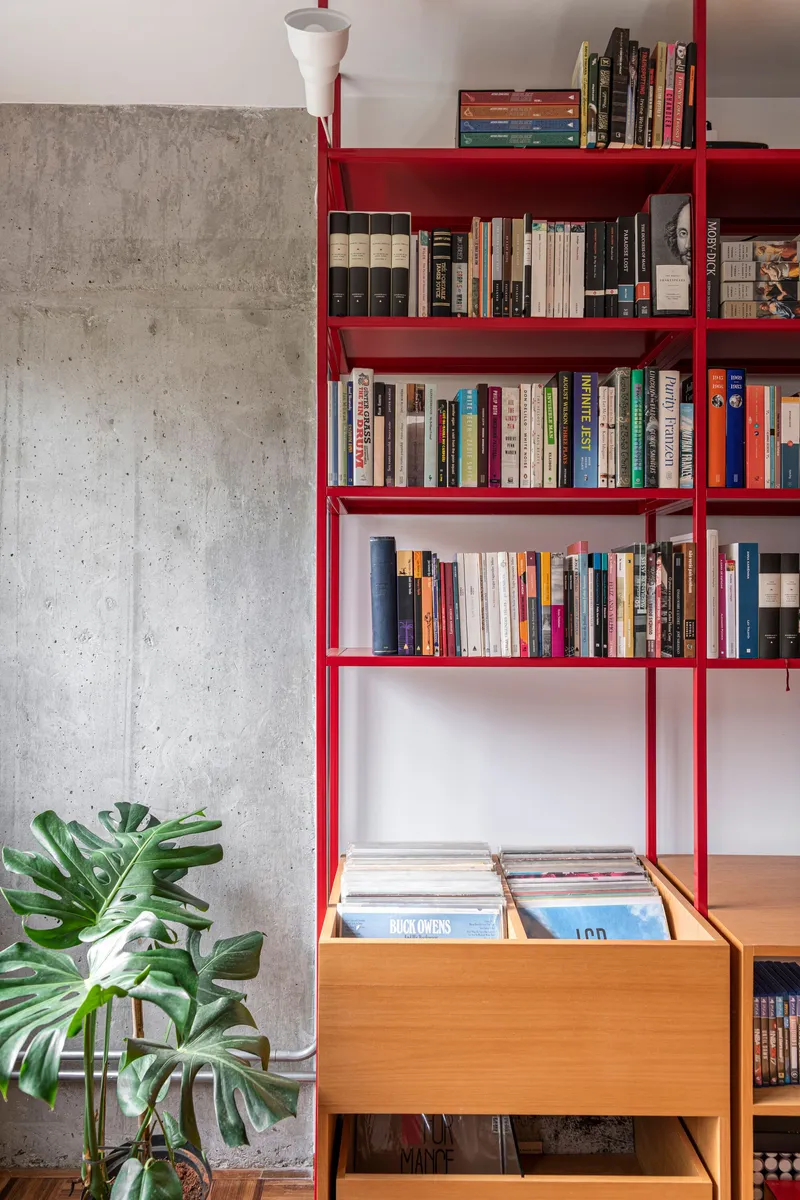
The red steel shelving is the project's signature, but calling it a bookshelf undersells its ambition. Fabricated by Atelier Edição Limitada, the metallic framework wraps corners, spans walls, and integrates timber desk units and drawer modules along its length. It holds books, vinyl, potted plants, audio gear, and kitchen implements with equal composure. The framework is dimensionally consistent throughout the apartment, so it reads as a single continuous element even as it adapts to different programmatic demands from room to room.
Crucially, the shelving doubles as lighting infrastructure. Directional spotlights are mounted within the metal frame and aimed at the ceiling, bouncing indirect light back into the room. There are no conventional ceiling fixtures fighting with the exposed concrete and conduit. The shelf does the work of a lighting plan, which is an elegant collapse of systems into a single piece of furniture-architecture.
Red and White: Two Characters


Not all the shelving is red. In the office and guest room, the same steel framework appears in white, a quieter register suited to a space that needs to function as both a workspace and a place to sleep. The white shelving sits against the window wall and incorporates a desk surface, sliding wooden cabinet bases, and trailing vines that soften the geometry. It is clearly the same system, but the color shift signals a different mood: concentration rather than gathering.
The dialogue between red and white shelving reflects a broader strategy of using color to organize the plan. The social spine of the apartment, living room, dining area, kitchen, is coded in red. The private retreat is coded in white. You do not need a floor plan to understand the hierarchy; the color tells you where you are.
Exposed Concrete and Herringbone Parquet
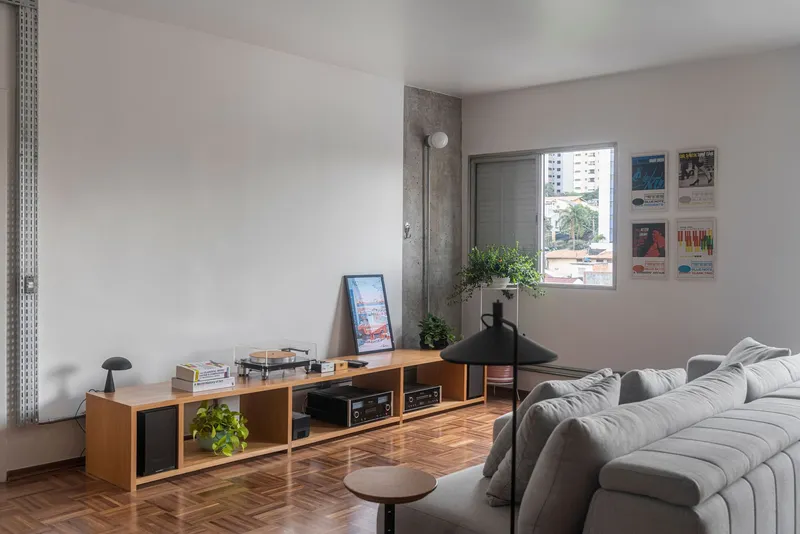

The material palette beyond the shelving is deliberately restrained: exposed concrete columns and beams, restored herringbone parquet flooring, and timber joinery by Rutra. The wooden floor was pre-existing and had to be complemented where the demolished bedroom wall once stood. The patching is visible if you look closely, a record of the apartment's spatial history written into the grain of the floor.
Stripping the plaster from the concrete structure was an archaeological gesture as much as an aesthetic one. Circular conduit mounts and rough formwork marks are left exposed, giving the apartment a texture that no amount of new finishing could replicate. Against this industrial backdrop, the precision of the red steel reads as interventional rather than decorative. The old and the new each sharpen the other.
Living with Music, Books, and Light
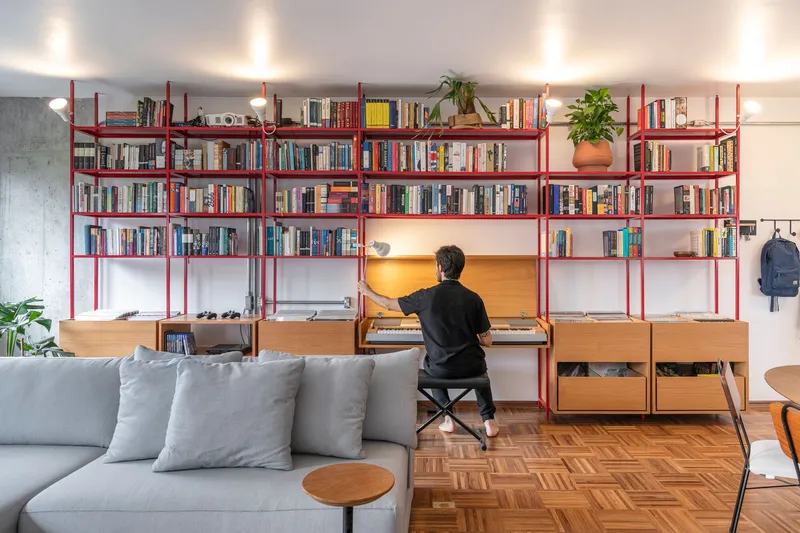


The apartment is organized around the rituals of a specific person: someone who reads, listens to vinyl, cooks for guests, and occasionally works from a desk nestled among potted plants. The shelving accommodates all of it. A pull-out keyboard drawer slots into the metal grid next to stacked books. A hammock hangs beside a window, just a few steps from the low credenza loaded with audio equipment. These are not staged vignettes; they are the evidence of a plan that was drawn around habits rather than imposed on them.
The projector the client requested is implied rather than spotlit: the long, uninterrupted living room wall opposite the shelving provides the throw distance, and the indirect ceiling lighting means the room can be dimmed without losing all spatial legibility. It is a domestic cinema that looks like a living room, not the other way around.
Kitchen and Dining as Social Extension
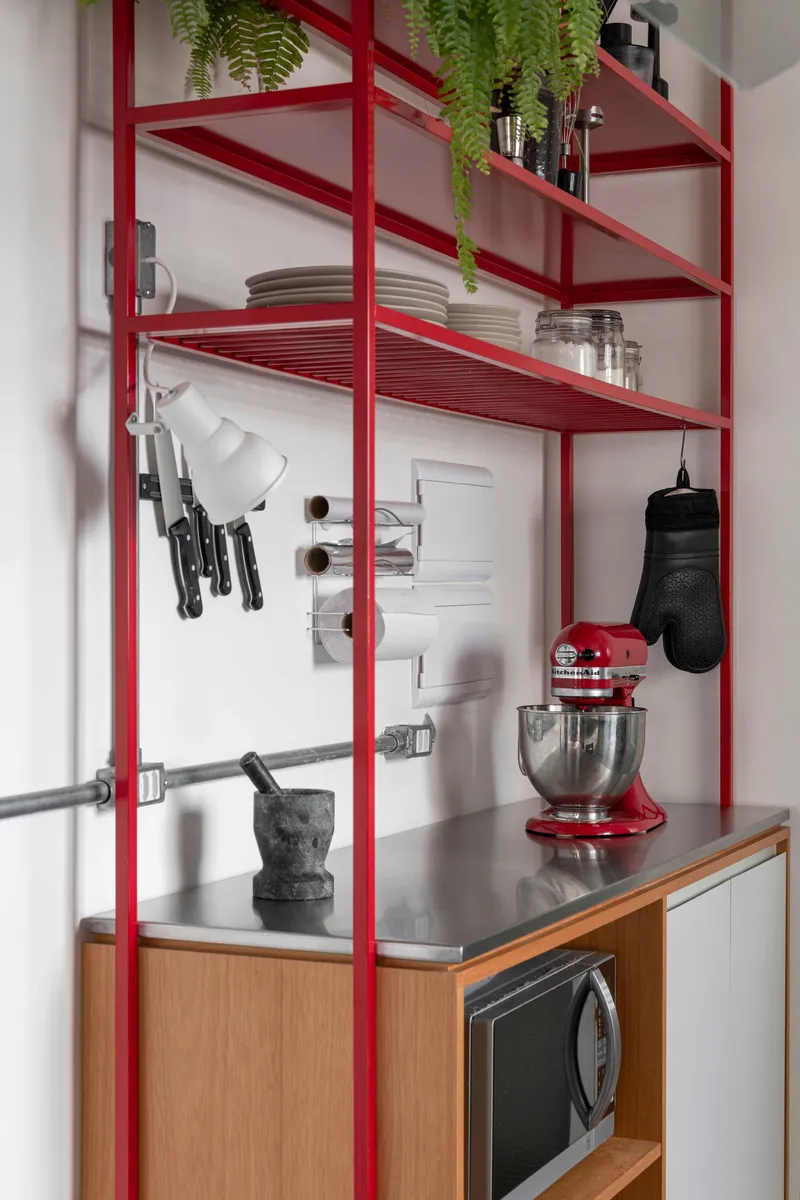


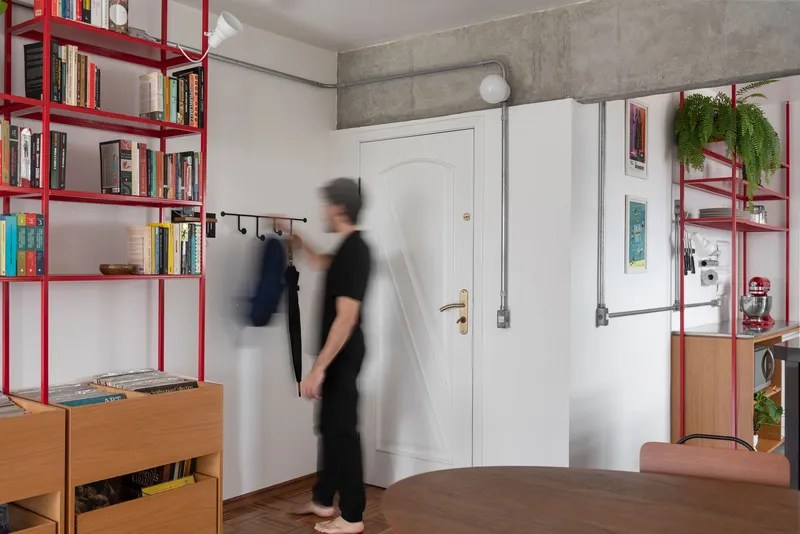
The red shelving does not stop at the living room boundary. It extends into the kitchen zone, where a section of the frame holds hanging knives and keeps a countertop mixer within arm's reach. The transition from bookshelf to kitchen rack is seamless, and it reinforces the idea that the entire social spine of the apartment operates as one room with many functions rather than a sequence of separate enclosures.
The dining area sits between kitchen and living room, anchored by a round wooden table on the herringbone parquet. A piece of graphic artwork marks the wall, and a strip of mosaic tile trim along the ceiling nods to the apartment's earlier life. Construction was handled by Papel Concreto, and the detailing at these junctions, where old tile meets new concrete meets restored wood, is handled with a care that keeps the collage legible without making it precious.
Plans and Drawings

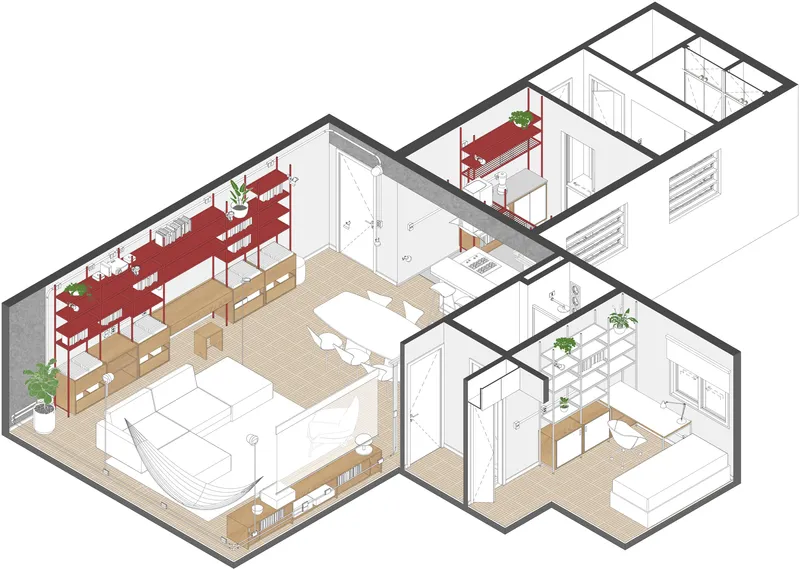
The floor plan confirms what the photographs suggest: the living and dining area forms a single rectangular volume that runs the full width of the apartment, with the kitchen extending off one side and two bedrooms (one now the office/guest room) occupying the opposite wing. The axonometric cutaway reveals how the shelving partitions subdivide the open plan without reaching the ceiling, preserving the continuity of the exposed concrete overhead. It also shows the density of furnishing: every surface is doing something, and the plan has no leftover space.
Why This Project Matters


The Bookshelf Apartment is a compact argument for renovation as authorship. COTA760 did not erase the existing apartment; they exposed its structure, preserved its flooring, and threaded a single new system through the entire plan. The red steel shelving is simultaneously furniture, lighting, storage, and spatial divider, a genuine piece of multi-performance design rather than a decorative gesture painted a bold color. That it was fabricated by a specialist metalwork atelier, not a furniture catalog, matters: the dimensions are tuned to this apartment, this collection, this set of habits.
In a city where apartment renovations often default to neutral minimalism in pursuit of resale value, this project takes a stand for personality. It is loud, specific, and completely tailored to its occupant. That kind of commitment is rare in residential work at this scale, and it produces an interior that is impossible to confuse with any other. The shelving will likely outlast multiple paint jobs and furniture swaps. It is the apartment now.
Bookshelf Apartment by COTA760 (Luis Rossi, Nicolas Le Roux, Paula Lemos). Located in Perdizes, Brazil. 100 m². Completed in 2022. Photography by Cris Farhat.
About the Studio
Share Your Own Work on uni.xyz
If projects like this are the kind of work you want to make, uni.xyz is a place to publish your own, find collaborators, and enter design competitions.




Popular Articles
Popular articles from the community


Co-life: Sustainable Architecture for Age-Friendly Community Living
Co-life reimagines sustainable architecture for seniors through courtyards, rammed earth, shared gardens, and spaces designed for belonging.

Hill & Cross Opera: Sculptural Opera House Architecture Shaped by Tallinn’s Landscape and Identity
Hill & Cross Opera reimagines opera house architecture in Tallinn through its sculptural hill, civic plaza, glass wave and a luminous cross.

Conexión: Biophilic Design Reimagines High-Rise Living in Hong Kong
Conexión reimagines high-rise living in Hong Kong through biophilic design, green facades, shared spaces, daylight, water and nature within.

The Ocean Hive: Sustainable Architecture for a Self-Sufficient Civilization at Sea
The Ocean Hive imagines sustainable architecture at sea, where modular habitats, algae, wave power and ocean waste sustain a growing colony.


Similar Reads
You might also enjoy these articles

Bao Huynh Watercolor Atelier: A Serene Art Retreat in Hội An
Bao Huynh Watercolor Atelier in Hội An blends multifunctional art spaces, sustainable design, local materials, and family-friendly living in a serene environment.

Atelier Macri Concept Store Interior Design by CASE-REAL
Atelier Macri store features a "ko" counter, walnut wood details, cork displays, blending retail, gallery, and seamless customer experiences.

Manuel Vargas Izquierdo Stadium and High-Performance Sports Center: Architectural Excellence in Jalpa de Méndez
The Manuel Vargas Izquierdo Stadium blends sustainable design, inclusive sports facilities, and cultural-inspired architecture, revitalizing Jalpa de Méndez’s public spaces.

KAKR Buluh Awar Hall: Revitalizing Community and Ecology Through Bamboo Architecture
Community built bamboo hall revitalizes Buluh Awar village, empowering youth, restoring ecology, celebrating vernacular craftsmanship through sustainable architecture and culture.


Comments (0)
Please login or sign up to add comments
No comments yet. Be the first to comment!